

|
시장보고서
상품코드
2101605
그리드용 배터리 관리 시스템 시장 기회, 성장요인, 업계 동향 분석 및 예측(2026-2035년)Grid Battery Management System (BMS) Market Opportunity, Growth Drivers, Industry Trend Analysis, and Forecast 2026 - 2035 |
||||||

세계의 그리드용 배터리 관리 시스템(BMS) 시장은 2025년에 22억 달러로 평가되고 CAGR 14.5%로 성장하며, 2035년까지 91억 달러에 달할 것으로 추정되고 있습니다.
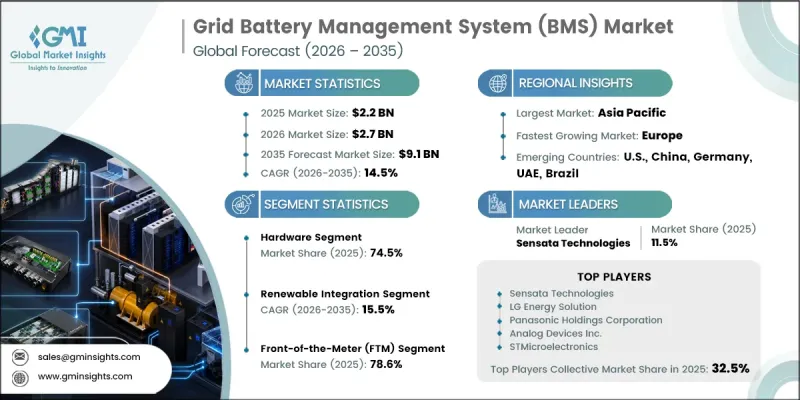
시장 성장은 유틸리티 규모의 배터리 에너지 저장 시스템의 급속한 도입과, 셀의 건전성을 모니터링하고 충전 상태를 정확하게 추정하며, 그리드 연동 운영을 지원할 수 있는 첨단 배터리 관리 솔루션에 대한 수요 증가에 힘입어 견인되고 있습니다. 그리드용 배터리 관리 시스템 시장은 기존의 안전 모니터링 기능에서 에너지 저장 성능과 운영 효율을 향상시키는 지능형 소프트웨어 주도 제어 플랫폼으로 진화하고 있습니다. 고급 분석, 디지털 모델링 기술, 클라우드 연결 및 예측 모니터링 기능의 통합이 진행됨에 따라 배터리 수명 주기 관리가 개선되는 동시에, 운영 사업자는 유지보수 요구 사항을 줄이고 시스템 성능을 최적화할 수 있게 되었습니다. 전 세계 배터리 용량의 지속적인 확대에 따라 고전압 시스템 관리, 대규모 배터리 설비의 조정, 그리고 전력계통 관리 인프라와의 원활한 통신을 지원할 수 있는 BMS 플랫폼에 대한 수요가 증가하고 있습니다. 동시에 업계에서는 설치를 간소화하고 시스템 유연성을 향상시키며, 대규모 에너지 저장 프로젝트 전반에 걸쳐 보다 상세한 실시간 모니터링을 제공하는 무선 배터리 관리 아키텍처로의 전환이 진행되고 있습니다. 이러한 기술적 진보로 인해 전 세계 전력계통용 배터리 관리 시스템 시장의 장기적인 전망은 계속해서 견고해지고 있습니다.
| 시장 범위 | |
|---|---|
| 시작연도 | 2025년 |
| 예측 기간 | 2026-2035년 |
| 개시 금액 | 22억 달러 |
| 예측액 | 91억 달러 |
| CAGR | 14.5% |
하드웨어 부문은 2025년에 74.5%의 점유율을 차지하며, 2035년까지 연평균 성장률(CAGR) 12.4%로 성장할 것으로 전망됩니다. 하드웨어는 배터리 모니터링, 보호, 통신, 제어에 필요한 필수 인프라를 제공하므로 계속해서 시장의 가장 큰 구성 요소로 자리매김하고 있습니다. 이 부문에는 전압 및 온도 모니터링, 배터리 작동 관리, 전기적 성능 측정, 시스템 절연 확보, 그리고 다층적인 배터리 관리 아키텍처 전반에 걸친 신뢰성 높은 통신 지원을 담당하는 구성 요소가 포함됩니다. 대규모 배터리 에너지 저장 시스템의 도입이 지속됨에 따라 첨단 BMS 하드웨어 솔루션에 대한 수요가 유지될 것으로 예상됩니다.
재생 가능 에너지 통합 부문은 2025년에 35.5%의 점유율을 차지하며, 2026-2035년 연평균 성장률(CAGR) 15.5%를 기록할 것으로 전망됩니다. 시장 성장은 재생 가능 에너지 발전의 지속적인 확대와 간헐적인 발전량을 조절할 수 있는 배터리 에너지 저장 시스템에 대한 수요 증가에 힘입고 있습니다. 전력망용 배터리 관리 시스템은 충방전 사이클 최적화, 정확한 충전 상태(SOC) 산출, 그리고 변동하는 운전 조건 하에서의 운영 신뢰성 향상에서 중요한 역할을 하고 있습니다. 재생에너지 인프라에 대한 투자 확대는 이 응용 분야 전반에 걸쳐 첨단 BMS 플랫폼에 대한 수요를 지속적으로 견인하고 있습니다.
북미의 그리드용 배터리 관리 시스템(BMS) 시장은 2025년에 40.2%의 점유율을 차지하며, 2026-2035년 연평균 성장률(CAGR) 13.3%로 성장할 것으로 전망됩니다. 미국은 배터리 에너지 저장 시스템 도입에 대한 막대한 투자와 유틸리티 규모의 에너지 저장 인프라의 지속적인 확장에 힘입어 여전히 최대 지역 시장으로 자리 잡고 있습니다. 첨단인 전력망 기술의 채택 확대, 지원적인 규제 체계, 그리고 전력망의 지속적인 현대화에 힘입어, 신뢰성 높고 효율적인 전력망 운영을 지원할 수 있는 첨단 배터리 관리 시스템에 대한 지역적 수요는 계속해서 증가하고 있습니다.
자주 묻는 질문
목차
제1장 조사 방법과 범위
제2장 개요
제3장 업계 인사이트
제4장 경쟁 구도
제5장 시장 규모·예측 : 컴포넌트별, 2022-2035년
제6장 시장 규모·예측 : 배터리 유형별, 2022-2035년
제7장 시장 규모·예측 : 토폴로지별, 2022-2035년
제8장 시장 규모·예측 : 용도별, 2022-2035년
제9장 시장 규모·예측 : 배포별, 2022-2035년
제10장 시장 규모·예측 : 최종사용자별, 2022-2035년
제11장 시장 규모·예측 : 통신 프로토콜별, 2022-2035년
제12장 시장 규모·예측 : 지역별, 2022-2035년
제13장 기업 개요
KSA 26.07.31The Global Grid Battery Management System (BMS) Market was valued at USD 2.2 billion in 2025 and is estimated to grow at a CAGR of 14.5% to reach USD 9.1 billion by 2035.
Market growth is driven by the rapid deployment of utility-scale battery energy storage systems and the increasing need for advanced battery management solutions capable of monitoring cell health, accurately estimating state of charge, and supporting grid-responsive operations. The grid battery management system market is evolving from a conventional safety monitoring function into an intelligent, software-driven control platform that enhances energy storage performance and operational efficiency. Growing integration of advanced analytics, digital modeling technologies, cloud connectivity, and predictive monitoring capabilities is improving battery lifecycle management while helping operators reduce maintenance requirements and optimize system performance. The continued expansion of battery energy storage capacity worldwide is increasing demand for BMS platforms capable of managing high-voltage systems, coordinating large battery installations, and supporting seamless communication with grid management infrastructure. At the same time, industry adoption is shifting toward wireless battery management architectures that simplify installation, improve system flexibility, and provide more detailed real-time monitoring across large-scale energy storage projects. These technological advancements continue to strengthen the long-term outlook for the global grid battery management system market.
| Market Scope | |
|---|---|
| Start Year | 2025 |
| Forecast Year | 2026-2035 |
| Start Value | $2.2 Billion |
| Forecast Value | $9.1 Billion |
| CAGR | 14.5% |
The hardware segment accounted for 74.5% share in 2025 and is projected to grow at a CAGR of 12.4% throughout 2035. Hardware remains the largest market component because it provides the essential infrastructure required for battery monitoring, protection, communication, and control. The segment includes components responsible for monitoring voltage and temperature, managing battery operation, measuring electrical performance, ensuring system isolation, and supporting reliable communication throughout multi-layer battery management architectures. Continued deployment of large-scale battery energy storage systems is expected to sustain demand for advanced BMS hardware solutions.
The renewable integration segment represented 35.5% share in 2025 and is anticipated to register a CAGR of 15.5% during 2026-2035. Market growth is supported by the continued expansion of renewable energy generation and the increasing need for battery energy storage systems capable of balancing intermittent power production. Grid battery management systems play an important role in optimizing charging and discharging cycles, maintaining accurate state-of-charge calculations, and improving operational reliability under varying operating conditions. Growing investments in renewable energy infrastructure continue to reinforce demand for advanced BMS platforms across this application segment.
North America Grid Battery Management System (BMS) Market accounted for 40.2% share in 2025 and is forecast to grow at a CAGR of 13.3% during 2026-2035. The United States remains the largest regional market, supported by significant investments in battery energy storage deployment and continued expansion of utility-scale energy storage infrastructure. Increasing adoption of advanced grid technologies, supportive regulatory frameworks, and ongoing modernization of electricity networks continue to strengthen regional demand for sophisticated battery management systems capable of supporting reliable and efficient grid operations.
Major companies operating in the global grid battery management system (BMS) market include Analog Devices Inc., AVL List GmbH, Batrium, CATL, Dukosi Ltd., EaglePicher Technologies, Eberspacher Group, Elithion Inc., Ewert Energy Systems, Infineon Technologies AG, LG Energy Solution, Microchip Technology Inc., MoviCom Electric, Nuvation Energy, onsemi, Panasonic Holdings Corporation, Renesas Electronics Corporation, ROHM Semiconductor, Sensata Technologies, and STMicroelectronics. Companies operating in the grid battery management system (BMS) market are strengthening their competitive position by investing in advanced battery monitoring technologies, intelligent software platforms, and next-generation energy management solutions. Manufacturers continue to enhance predictive analytics, wireless communication capabilities, and real-time monitoring functions to improve battery performance, reliability, and operational efficiency. Strategic investments in research and development, technology partnerships, and product innovation remain central to expanding market presence and addressing evolving utility-scale energy storage requirements.
Table of Contents
Chapter 1 Methodology & Scope
- 1.1 Research approach
- 1.2 Quality commitments
- 1.2.1 GMI AI policy & data integrity commitment
- 1.2.1.1 Source consistency protocol
- 1.2.1 GMI AI policy & data integrity commitment
- 1.3 Research trail & confidence scoring
- 1.3.1 Research trail components
- 1.3.2 Scoring components
- 1.4 Data collection
- 1.4.1 Partial list of primary sources
- 1.5 Data mining sources
- 1.5.1 Paid sources
- 1.5.1.1 Sources, by region
- 1.5.1 Paid sources
- 1.6 Base estimates and calculations
- 1.6.1 Base year calculation for any one approach
- 1.7 Market estimates & forecasts parameters
- 1.8 Forecast model
- 1.8.1 Quantified market impact analysis
- 1.8.1.1 Mathematical impact of growth parameters on forecast
- 1.8.1 Quantified market impact analysis
- 1.9 Research transparency addendum
- 1.9.1 Source attribution framework
- 1.9.2 Quality assurance metrics
- 1.9.3 Our commitment to trust
- 1.10 Market definitions
Chapter 2 Executive Summary
- 2.1 Industry synopsis, 2022 - 2035
- 2.1.1 Business trends
- 2.1.2 Component trends
- 2.1.3 Battery type trends
- 2.1.4 Topology trends
- 2.1.5 Application trends
- 2.1.6 Deployment trends
- 2.1.7 End user trends
- 2.1.8 Communication protocol trends
- 2.1.9 Regional trends
Chapter 3 Industry Insights
- 3.1 Industry ecosystem analysis
- 3.1.1 Raw material availability & sourcing analysis
- 3.1.2 Manufacturing capacity assessment
- 3.1.3 Supply chain resilience & risk factors
- 3.1.4 Distribution network analysis
- 3.2 Regulatory landscape
- 3.3 Industry impact forces
- 3.3.1 Growth drivers
- 3.3.2 Industry pitfalls & challenges
- 3.4 Growth potential analysis
- 3.5 Porter's analysis
- 3.5.1 Bargaining power of suppliers
- 3.5.2 Bargaining power of buyers
- 3.5.3 Threat of new entrants
- 3.5.4 Threat of substitutes
- 3.6 PESTEL analysis
- 3.6.1 Political factors
- 3.6.2 Economic factors
- 3.6.3 Social factors
- 3.6.4 Technological factors
- 3.6.5 Legal factors
- 3.6.6 Environmental factors
- 3.7 Impact of AI & Generative AI on the market (Driven by Primary Research)
- 3.7.1 AI-Driven production optimization (Core Solution)
- 3.7.2 Predictive maintenance & fault detection (Core Solution)
- 3.7.3 Risks, limitations & regulatory considerations
- 3.8 Investment & funding analysis (Driven by Primary Research)
- 3.8.1 Private investment & project finance trends
- 3.8.2 Government grants, subsidies & incentive mechanisms by region
- 3.8.3 Carbon credit markets & methane offset valuation
- 3.9 Technology & innovation landscape
- 3.9.1 Established utilization technologies overview
- 3.9.2 Emerging technologies (VAM catalytic oxidation, PSA enrichment, SOFCs, CFRR)
- 3.9.3 Technology Readiness Level (TRL) assessment
Chapter 4 Competitive Landscape, 2026
- 4.1 Introduction
- 4.2 Company market share analysis, by region, 2025
- 4.2.1 North America
- 4.2.2 Europe
- 4.2.3 Asia Pacific
- 4.2.4 Middle East & Africa
- 4.2.5 Latin America
- 4.3 Key developments
- 4.3.1 Key partnerships & collaborations
- 4.3.2 Major M&A activities
- 4.3.3 Product innovations & launches
- 4.3.4 Market expansion strategies
- 4.4 Competitive positioning matrix
- 4.5 Company tier benchmarking
- 4.5.1 Tier classification criteria & qualifying thresholds
- 4.5.2 Tier positioning matrix by revenue, geography & innovation
Chapter 5 Market Size and Forecast, By Component, 2022 - 2035 (USD Million)
- 5.1 Key trends
- 5.2 Hardware
- 5.3 Software
- 5.4 Services
Chapter 6 Market Size and Forecast, By Battery Type, 2022 - 2035 (USD Million)
- 6.1 Key trends
- 6.2 Lithium ion
- 6.3 Sodium Ion
- 6.4 Lead acid
- 6.5 Flow battery
- 6.6 Others
Chapter 7 Market Size and Forecast, By Topology, 2022 - 2035 (USD Million)
- 7.1 Key trends
- 7.2 Centralized
- 7.3 Modular
- 7.4 Distributed
Chapter 8 Market Size and Forecast, By Application, 2022 - 2035 (USD Million)
- 8.1 Key trends
- 8.2 Renewable integration
- 8.3 Frequency regulation
- 8.4 Peak shaving & load shifting
- 8.5 Grid stabilization
- 8.6 Others
Chapter 9 Market Size and Forecast, By Deployment, 2022 - 2035 (USD Million)
- 9.1 Key trends
- 9.2 Front of the meter
- 9.3 Behind the meter
Chapter 10 Market Size and Forecast, By End User, 2022 - 2035 (USD Million)
- 10.1 Key trends
- 10.2 Utilities & grid operators
- 10.3 IPPs & renewable developers
- 10.4 Commercial & industrial (C&I)
- 10.5 Microgrid/off grid operators
Chapter 11 Market Size and Forecast, By Communication Protocol, 2022 - 2035 (USD Million)
- 11.1 Key trends
- 11.2 Wired
- 11.3 Wireless
- 11.4 Hybrid
Chapter 12 Market Size and Forecast, By Region, 2022 - 2035 (MW & USD Million)
- 12.1 Key trends
- 12.2 North America
- 12.2.1 U.S.
- 12.2.2 Canada
- 12.2.3 Mexico
- 12.3 Europe
- 12.3.1 UK
- 12.3.2 France
- 12.3.3 Germany
- 12.3.4 Italy
- 12.3.5 Russia
- 12.3.6 Spain
- 12.4 Asia Pacific
- 12.4.1 China
- 12.4.2 Japan
- 12.4.3 South Korea
- 12.4.4 India
- 12.4.5 Australia
- 12.5 Middle East & Africa
- 12.5.1 Saudi Arabia
- 12.5.2 UAE
- 12.5.3 South Africa
- 12.6 Latin America
- 12.6.1 Brazil
- 12.6.2 Argentina
Chapter 13 Company Profiles
- 13.1 Analog Devices Inc.
- 13.2 AVL List GmbH
- 13.3 Batrium
- 13.4 CATL
- 13.5 Dukosi Ltd.
- 13.6 EaglePicher Technologies
- 13.7 Eberspacher Group
- 13.8 Elithion Inc.
- 13.9 Ewert Energy Systems
- 13.10 Infineon Technologies AG
- 13.11 LG Energy Solution
- 13.12 Microchip Technology Inc.
- 13.13 MoviCom Electric
- 13.14 Nuvation Energy
- 13.15 Onsemi
- 13.16 Panasonic Holdings Corporation
- 13.17 Renesas Electronics Corporation
- 13.18 ROHM Semiconductor
- 13.19 Sensata Technologies
- 13.20 STMicroelectronics


