

|
시장보고서
상품코드
2101619
광자 계수 CT 시장 기회, 성장요인, 업계 동향 분석 및 예측(2026-2035년)Photon-Counting CT Market Opportunity, Growth Drivers, Industry Trend Analysis, and Forecast 2026 - 2035 |
||||||

세계의 광자 계수 CT 시장은 2025년에 3억 2,270만 달러 규모에 달하며, CAGR이 24.7%로 확대하며, 2035년에는 29억 달러에 달할 것으로 예측됩니다.
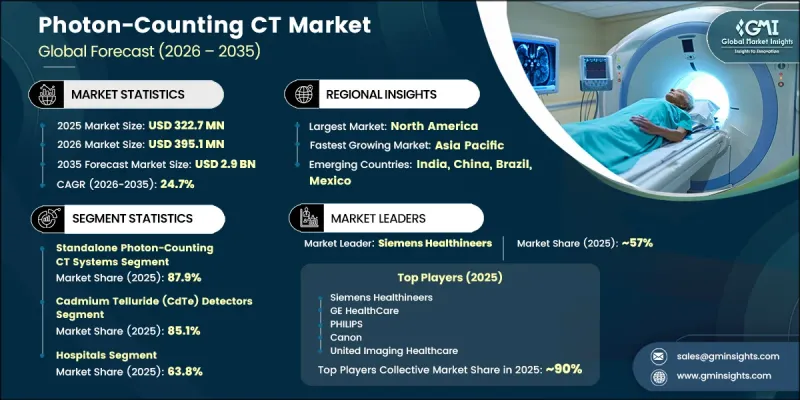
의료 종사자들이 더 높은 진단 정확도와 환자 치료 성과 향상을 가져다주는 첨단 영상 진단 기술을 점점 더 요구함에 따라 광자 계수 CT 시장은 급속한 성장을 달성하고 있습니다. 만성질환 및 암 발병률의 증가와 더불어 고품질 진단 영상에 대한 수요가 높아짐에 따라 차세대 컴퓨터 단층촬영(CT) 솔루션의 도입이 가속화되고 있습니다. 광자 계수형 CT 시스템은 첨단 검출기 기술을 사용하여 개별 X선 광자를 포착하고 그 에너지 수준을 측정함으로써, 기존 CT 시스템에 비해 보다 상세한 영상 분석을 가능하게 합니다. 이러한 시스템은 반도체 기반 검출기, 첨단 컴퓨팅 플랫폼 및 정교한 재구성 소프트웨어를 통합하여, 영상 선명도 향상, 조직 식별성 향상, 노이즈 감소 및 방사선 피폭량 감소를 실현하고 있습니다. 보다 정확한 질환 탐지에 대한 임상적 관심이 높아짐에 따라 종양학, 심혈관 영상 진단, 신경학적 평가, 근골격계 평가, 폐 질환 진단 등 다양한 의료 분야에서 이 기술의 도입이 가속화되고 있습니다. 병원과 영상 진단센터가 진단 인프라를 지속적으로 업그레이드함에 따라 광자 계수형 CT 기술에 대한 수요는 증가할 것으로 예상됩니다. 조기 진단, 맞춤형 치료 계획, 그리고 영상 진단 효율성 향상에 대한 관심이 높아지고 있는 것이 광자 계수형 CT 시장에 강력한 성장 기회를 창출하고 있습니다.
| 시장 범위 | |
|---|---|
| 시작연도 | 2025년 |
| 예측 기간 | 2026-2035년 |
| 개시 금액 | 3억 2,270만 달러 |
| 예측액 | 29억 달러 |
| CAGR | 24.7% |
2025년에는 독립형 광자 계수 CT 시스템 부문이 87.9%라는 가장 큰 시장 점유율을 차지했습니다. 이 부문의 주도적 지위는 첨단 검출기 기술의 이점을 극대화하도록 설계된 전용 광자 계수형 CT 스캐너의 채택 확대에 힘입은 것입니다. 이러한 시스템은 기존 CT 플랫폼에 비해 화질 향상, 스펙트럼 이미징 성능 향상, 공간 분해능 향상 및 방사선 피폭량 감소를 실현하고 있습니다. 통합 설계 덕분에 시스템 기능 최적화와 임상 역량 향상이 가능해져, 첨단 영상 진단 솔루션에 투자하는 의료 제공자들 사이에서 선호되는 선택지가 되고 있습니다.
2025년에는 카드뮴 텔루르(CdTe) 검출기 부문이 85.1%의 점유율을 차지했습니다. CdTe 검출기가 확고한 입지를 다진 것은 시판되는 광자 계수형 CT 시스템에 널리 채택되고 있다는 점과, X선 광자를 전기 신호로 직접 변환할 수 있는 능력 덕분입니다. 이 기술을 통해 기존 검출기 기술에 비해 영상 해상도 향상, 스펙트럼 이미징 능력 강화, 전자 노이즈 저감 및 선량 효율 향상이 실현되고 있습니다. CdTe 검출기의 입증된 성능과 첨단 CT 플랫폼과의 통합이 의료 기관에서의 도입을 지속적으로 촉진하고 있습니다.
2025년, 북미의 광자 계수 CT 시장은 38%의 점유율을 차지했습니다. 지역적 성장은 첨단 진단용 영상 솔루션에 대한 수요 증가, 만성질환 유병률 상승, 그리고 의료 시설 전반에 걸친 혁신적인 CT 기술 도입 확대에 힘입고 있습니다. 첨단 의료 인프라, 의료 영상 기술에 대한 투자 확대, 그리고 정확한 질환 탐지에 대한 관심 증대가 북미의 광자 계수 CT 시장의 지속적인 발전에 기여하고 있습니다.
자주 묻는 질문
목차
제1장 조사 방법
제2장 개요
제3장 업계 인사이트
제4장 경쟁 구도
제5장 시장 추산·예측 : 제품 유형별, 2022-2035년
제6장 시장 추산·예측 : 검출기 유형별, 2022-2035년
제7장 시장 추산·예측 : 용도별, 2022-2035년
제8장 시장 추산·예측 : 유통 채널별, 2022-2035년
제9장 시장 추산·예측 : 최종사용자별, 2022-2035년
제10장 시장 추산·예측 : 지역별, 2022-2035년
제11장 기업 개요
KSA 26.07.31The Global Photon-Counting CT Market was valued at USD 322.7 million in 2025 and is estimated to grow at a CAGR of 24.7% to reach USD 2.9 billion by 2035.
The photon-counting CT market is experiencing rapid expansion as healthcare providers increasingly seek advanced imaging technologies that deliver greater diagnostic precision and improved patient outcomes. The rising incidence of chronic diseases and cancer, combined with growing demand for high-quality diagnostic imaging, is accelerating the adoption of next-generation computed tomography solutions. Photon-counting CT systems use advanced detector technology to capture individual X-ray photons and measure their energy levels, enabling more detailed image analysis compared with traditional CT systems. These systems integrate semiconductor-based detectors, advanced computing platforms, and sophisticated reconstruction software to provide enhanced image clarity, improved tissue differentiation, reduced noise, and lower radiation exposure. Increasing clinical interest in more accurate disease detection is supporting adoption across multiple medical applications, including oncology, cardiovascular imaging, neurological assessment, musculoskeletal evaluation, and pulmonary diagnostics. As hospitals and imaging centers continue upgrading their diagnostic infrastructure, demand for photon-counting CT technology is expected to rise. The growing focus on early diagnosis, personalized treatment planning, and improved imaging efficiency is creating strong growth opportunities for the photon-counting CT market.
| Market Scope | |
|---|---|
| Start Year | 2025 |
| Forecast Year | 2026-2035 |
| Start Value | $322.7 Million |
| Forecast Value | $2.9 Billion |
| CAGR | 24.7% |
The standalone photon-counting CT systems segment held the largest market share of 87.9% in 2025. The segment's leadership is supported by increasing adoption of dedicated photon-counting CT scanners designed to maximize the advantages of advanced detector technology. These systems provide improved image quality, enhanced spectral imaging performance, higher spatial resolution, and reduced radiation exposure compared with conventional CT platforms. Their integrated design enables optimized system functionality and improved clinical capabilities, making them a preferred choice among healthcare providers investing in advanced diagnostic imaging solutions.
The cadmium telluride (CdTe) detectors segment accounted for 85.1% share in 2025. The strong position of CdTe detectors is attributed to their extensive use in commercially available photon-counting CT systems and their ability to directly transform X-ray photons into electrical signals. This technology supports improved image resolution, stronger spectral imaging capabilities, lower electronic noise, and enhanced dose efficiency compared with conventional detector technologies. The established performance of CdTe detectors and their integration into advanced CT platforms continue to drive adoption across healthcare institutions.
North America Photon-Counting CT Market accounted for 38% share in 2025. Regional expansion is supported by increasing demand for advanced diagnostic imaging solutions, rising prevalence of chronic conditions, and growing adoption of innovative CT technologies across healthcare facilities. The presence of advanced healthcare infrastructure, higher investment in medical imaging technologies, and increasing focus on accurate disease detection are contributing to the continued development of the photon-counting CT market in North America.
Prominent companies operating in the Global Photon-Counting CT Market include Siemens Healthineers, Canon, GE HealthCare, Kromek, Neusoft Medical Systems, PHILIPS, Samsung, and United Imaging Healthcare. Companies operating in the photon-counting CT market are strengthening their competitive position through continuous innovation, strategic partnerships, and investments in advanced imaging technologies. Industry participants are focusing on improving detector performance, enhancing image reconstruction capabilities, and expanding clinical applications to increase adoption. Companies are also investing in research and development activities to improve system efficiency, reduce operational limitations, and support broader healthcare implementation. Strategic collaborations with hospitals, research organizations, and healthcare providers are helping manufacturers strengthen their market presence and accelerate technology adoption. In addition, businesses are expanding product portfolios, improving customer support services, and developing advanced solutions to address the growing demand for precise, low-dose, and high-resolution diagnostic imaging systems.
Table of Contents
Chapter 1 Research Methodology
- 1.1 Research approach
- 1.2 Quality commitments
- 1.2.1 GMI AI policy & data integrity commitment
- 1.2.1.1 Source consistency protocol
- 1.2.1 GMI AI policy & data integrity commitment
- 1.3 Research trail & confidence scoring
- 1.3.1 Research trail components
- 1.3.2 Scoring components
- 1.4 Data collection
- 1.4.1 Partial list of primary sources
- 1.5 Data mining sources
- 1.5.1 Paid sources
- 1.5.1.1 Sources, by region
- 1.5.1 Paid sources
- 1.6 Base estimates and calculations
- 1.6.1 Base year calculation
- 1.7 Forecast model
- 1.7.1 Quantified market impact analysis
- 1.7.1.1 Mathematical impact of growth parameters on forecast
- 1.7.1 Quantified market impact analysis
- 1.8 Research transparency addendum
- 1.8.1 Source attribution framework
- 1.8.2 Quality assurance metrics
- 1.8.3 Our commitment to trust
Chapter 2 Executive Summary
- 2.1 Industry 360° synopsis
- 2.2 Key market trends
- 2.2.1 Regional trends
- 2.2.2 Product type trends
- 2.2.3 Detector type trends
- 2.2.4 Application trends
- 2.2.5 End use trends
- 2.3 CXO perspectives: Strategic imperatives
Chapter 3 Industry Insights
- 3.1 Industry ecosystem analysis
- 3.2 Industry impact forces
- 3.2.1 Growth drivers
- 3.2.1.1 Growing demand for high-resolution diagnostic imaging
- 3.2.1.2 Increasing prevalence of chronic diseases and cancer
- 3.2.1.3 Rising adoption of advanced CT technologies in healthcare facilities
- 3.2.1.4 Technological advancements in detector materials and system design
- 3.2.2 Industry pitfalls and challenges
- 3.2.2.1 High installation and equipment costs
- 3.2.2.2 Limited availability of photon-counting CT systems
- 3.2.2.3 Shortage of trained professionals for operation and interpretation
- 3.2.3 Opportunities
- 3.2.3.1 Expansion in emerging healthcare markets
- 3.2.3.2 Increasing research and development investments
- 3.2.3.3 Growing adoption in precision medicine and personalized healthcare
- 3.2.1 Growth drivers
- 3.3 Growth potential analysis
- 3.4 Regulatory landscape
- 3.4.1 North America
- 3.4.2 Europe
- 3.4.3 Asia Pacific
- 3.4.4 Latin America
- 3.4.5 Middle East and Africa
- 3.5 Pricing trend analysis
- 3.6 Patent analysis
- 3.7 Technology and innovation landscape (Driven by Primary Research)
- 3.7.1 Current technological trends
- 3.7.2 Emerging technologies
- 3.8 Future market trends (Driven by Primary Research)
- 3.9 Impact of AI & Generative AI on the Market (Driven by Primary Research)
- 3.10 Porter's analysis
- 3.11 PESTEL analysis
Chapter 4 Competitive Landscape, 2025
- 4.1 Introduction
- 4.2 Company matrix analysis
- 4.3 Company market share analysis (Driven by Primary Research)
- 4.3.1 Global
- 4.3.2 North America
- 4.3.3 Europe
- 4.3.4 Asia Pacific
- 4.4 Competitive analysis of major market players
- 4.5 Competitive positioning matrix
- 4.6 Key developments
- 4.6.1 Mergers & acquisitions
- 4.6.2 Partnerships & collaborations
- 4.6.3 New product launches
- 4.6.4 Expansion plans
Chapter 5 Market Estimates and Forecast, By Product Type, 2022 - 2035 ($ Mn)
- 5.1 Key trends
- 5.2 Standalone photon-counting CT systems
- 5.3 Retrofit photon-counting CT solutions
Chapter 6 Market Estimates and Forecast, By Detector Type, 2022 - 2035 ($ Mn)
- 6.1 Key trends
- 6.2 Silicon detectors
- 6.3 Cadmium telluride detectors
- 6.4 Cadmium zinc telluride (CZT) detectors
- 6.5 Others detector types
Chapter 7 Market Estimates and Forecast, By Application, 2022 - 2035 ($ Mn)
- 7.1 Key trends
- 7.2 Oncology
- 7.3 Cardiology
- 7.4 Neurology
- 7.5 Orthopedics
- 7.6 Pulmonology
- 7.7 Other application
Chapter 8 Market Estimates and Forecast, By Distribution Channel, 2022 - 2035 ($ Mn)
- 8.1 Key trends
- 8.2 Brick and mortar stores
- 8.3 E-commerce
Chapter 9 Market Estimates and Forecast, By End User, 2022 - 2035 ($ Mn)
- 9.1 Key trends
- 9.2 Hospital
- 9.3 Diagnostic Imaging Centers
- 9.4 Research Institutes
- 9.5 Other end users
Chapter 10 Market Estimates and Forecast, By Region, 2022 - 2035 ($ Mn)
- 10.1 Key trends
- 10.2 North America
- 10.2.1 U.S.
- 10.2.2 Canada
- 10.3 Europe
- 10.3.1 Germany
- 10.3.2 UK
- 10.3.3 France
- 10.3.4 Spain
- 10.3.5 Italy
- 10.3.6 Netherlands
- 10.4 Asia Pacific
- 10.4.1 China
- 10.4.2 Japan
- 10.4.3 India
- 10.4.4 Australia
- 10.4.5 South Korea
- 10.5 Latin America
- 10.5.1 Brazil
- 10.5.2 Mexico
- 10.5.3 Argentina
- 10.6 MEA
- 10.6.1 South Africa
- 10.6.2 Saudi Arabia
- 10.6.3 UAE
Chapter 11 Company Profiles
- 11.1 Canon
- 11.2 GE HealthCare
- 11.3 Kromek
- 11.4 Neusoft Medical Systems
- 11.5 PHILIPS
- 11.6 Samsung
- 11.7 Siemens Healthineers
- 11.8 United Imaging Healthcare


