

|
시장보고서
상품코드
2099539
AI 탑재 종양 진단용 바이브 CT 스캐너 시장 : 점유율 분석, 업계 동향 및 통계, 성장 예측(2026-2031년)AI Oncology Vibe CT Scanners - Market Share Analysis, Industry Trends & Statistics, Growth Forecasts (2026 - 2031) |
||||||
 Mordor Intelligence
Mordor Intelligence에 의하면, AI 탑재 종양 진단용 바이브 CT스캐너 시장 규모는 2025년 8억 6,000만 달러, 2026년 10억 5,000만 달러에서 2031년까지 29억 2,000만 달러로 확대한다고 예측되고 있어 2026년부터 2031년까지 연평균 복합 성장률(CAGR)은 22.70%를 나타낼 전망입니다.
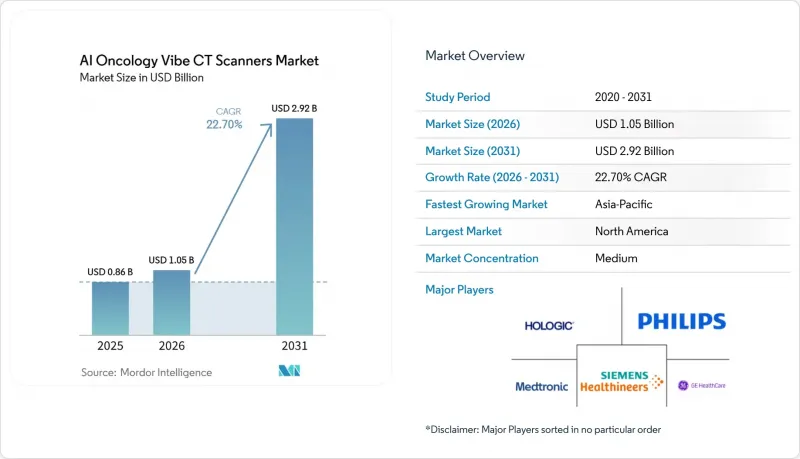
본 보고서는 구성 요소(하드웨어, 소프트웨어, 서비스), 배포 방식(기존 AI 강화 CT, 스펙트럼 CT, 광자 계수 CT, 중재적 CT), 용도(종양 진단, 종양 모니터링, 방사선 치료 계획, 임상시험), 최종 사용자(병원, 영상진단센터, 암센터, 연구기관), 지역(북미, 유럽, 아시아태평양, 중동 및 아프리카, 남미)별로 분류되어 있습니다.
전 세계 AI 탑재 종양 진단용 바이브 CT 스캐너 시장 동향과 인사이트
증가하는 종양학 영상 진단 수요: 전 세계 암 발병률이 기반을 형성
AI 탑재 종양 진단용 바이브 CT 스캐너 시장은 전 세계 암 환자 수의 방대한 규모에 의해 견인되고 있습니다. GLOBOCAN 2024 보고서에 따르면, 전 세계적으로 2,060만 건의 신규 암 진단과 980만 건의 암 사망이 기록되었으며, 해당 보고서는 2050년까지 환자 수가 3,440만 건에 달할 것으로 예측했습니다. 폐암은 신규 환자 수 260만 건으로 여전히 발생률이 가장 높은 암이며, 사망자 수 190만 명으로 암 사망의 주요 원인이 되고 있습니다. 이에 따라 초기 진단, 병기 분류 및 경과 관찰에서 CT의 활용이 더욱 중요시되고 있습니다. 『랜싯 종양』지 또한 암 진단 건수가 2025년의 1,358만 건에서 2050년까지 1,932만 건으로 증가할 것으로 예측하고 있으며, 특히 자원이 부족한 지역에서 그 부담이 가장 크게 늘어날 것으로 전망됩니다. 미국만 보더라도, 국립암연구소(NCI)는 2025년 신규 암 환자 수를 204만 건으로 추산하고 있으며, 이는 병원 설비 투자 예산이 어려운 상황에서도 영상 진단에 대한 지속적인 투자를 정당화할 수 있는 근거가 됩니다. 이러한 추세는 AI 탑재 종양 진단용 바이브 CT 스캐너 시장이 고급 병원뿐만 아니라, 보다 현실적인 조달 수준에서 종양학 등급의 화질을 필요로 하는 국가들에서도 고성능 중급 시스템에 대한 수요를 높이고 있음을 의미합니다.
AI를 활용한 프로토콜 최적화: 방사선과 의사의 생산성 격차 해소
AI 탑재 종양 진단용 바이브 CT 스캐너 시장은 방사선과 의사 및 영상 진단 팀의 업무 부담을 줄여주는 도구로부터도 혜택을 받고 있습니다. 세계보건기구(WHO) 보고서에 따르면, 저·중소득 국가의 70%에서 심각한 인력 부족이 발생하고 있으며, 이로 인해 스캔 선택, 재구성, 보고서 작성의 자동화가 일상적인 종양학 영상 진단에서 더욱 중요한 가치를 갖게 되었습니다. 2025년 11월, Mosaic Clinical Technologies사는 자사가 인수한 Cognita Imaging사와 관련된 초기 판독 연구에서 AI와 방사선과 의사의 협력을 통해 암 검출률이 최대 52% 향상되고, 중대한 진단 오류가 최대 4분의 1로 감소하며, 방사선과 의사의 판독 시간이 최대 76% 단축되었음을 밝혔습니다. United Imaging Intelligence사는 ECR 2026에서 ‘uAI Insight Image-to-Report’ 에이전트를 발표하며, 단일 흉부 CT 스캔에서 최대 73건의 흉부 소견을 감지하는 동시에 구조화된 예비 보고서를 자동으로 생성할 수 있다고 밝혔습니다. 그 결과, AI 탑재 종양 진단용 바이브 CT 스캐너 시장에서는 화질뿐만 아니라 인력 부족이 심화되는 환경 속에서 해당 플랫폼이 의료기관의 방사선과 전문의 채용, 유지, 지원에 기여할 수 있는지 여부도 점점 더 평가의 대상이 되고 있습니다. 이러한 변화로 인해 워크플로우 통합 도구를 갖춘 벤더는 단순히 영상 진단 성능 향상만을 제공하는 벤더에 비해 조달 협상에서 더 유리한 입장에 서 있습니다.
프리미엄 CT 플랫폼의 높은 자본 비용: 설비 투자의 장벽이 중견 시장으로의 확산을 제한
AI 탑재 종양 진단용 바이브 CT 스캐너 시장은 프리미엄 부문에서 여전히 뚜렷한 자본적 장벽에 직면해 있습니다. 초안에 따르면, 프리미엄 광자 계수형 CT의 도입 비용은 300만 달러를 초과하는 경우가 많으며, 이는 많은 지방 병원이나 독립 영상진단센터의 일반적인 조달 범위를 넘어섭니다. 이러한 부담은 첨단 플랫폼 기능보다 영상진단 건수나 폭넓은 접근성을 우선시하는 공공 의료기관에서 더욱 크게 작용하고 있습니다. 또한, 자금력이 풍부한 대규모 의료 기관이 플랫폼의 전면적인 교체를 신속하게 진행하는 반면, 많은 중규모 시설에서는 기존 스캐너를 소프트웨어를 통해 지속적으로 업그레이드하는 양상을 보이며 양극화 추세가 나타나고 있습니다. 실제로 이는 AI 탑재 종양 진단용 바이브 CT 스캐너 시장에서 기술에 대한 관심이 모두 즉각적인 하드웨어 매출로 이어지는 것은 아니라는 것을 의미합니다. 또한 일부 국가에서 스캐너의 완전한 교체보다 소프트웨어 도입이 더 빠르게 확대되고 있는 이유도 설명해 줍니다.
부문 분석
2025년, AI 탑재 종양 진단용 바이브 CT 스캐너 시장에서 하드웨어가 68.2%를 차지했습니다. 이는 하이엔드 종양 영상 진단 시스템에서 검출기 어셈블리, X선관 시스템, 간트리, 워크스테이션이 자본 집약적이라는 특성을 반영한 것입니다. 이러한 높은 점유율은 3차 의료기관 및 학술 기관에서 광자 계수 시스템이 기존의 에너지 적분형 장치를 대체하기 시작함에 따라 물리적 교체가 필요해지고 있음을 보여줍니다. AI 탑재 종양 진단용 바이브 CT 스캐너 업계에서는 하이엔드 병원들이 병변에 대한 보다 상세한 특성 분석과 더 강력한 정량적 출력을 지원하는 시스템에 대한 투자를 지속하고 있기 때문에 하드웨어는 여전히 공급업체 수익의 기반을 이루고 있습니다. 장기 유지보수, 관리형 영상 진단 계약 및 원격 지원이 도입된 장비와 연계되어 지속적인 수익을 창출하기 때문에 서비스 부문도 중요한 위치를 차지하고 있습니다. 또한, 본 보고서에서는 지멘스 헬스인어즈가 ‘밸류 파트너십’ 모델을 활용하여 라이프사이클 관리를 영업 제안의 일부로 자리매김하고 있다는 점에도 언급하고 있으며, 서비스의 충실도가 주요 고객 유지에 영향을 미칩니다는 점을 보여주고 있습니다.
소프트웨어는 2031년까지 연평균 성장률(CAGR)이 23.2%로 가장 빠르게 성장하는 분야이며, AI 탑재 종양 진단용 바이브 CT 스캐너 시장에서 가장 역동적인 수익원으로 자리 잡고 있습니다. 이러한 성장은 신규 및 기존 CT 사용자 모두에게 판매 가능한 AI 재구성 도구, 정량적 영상 분석, 그리고 클라우드 지원 워크플로우 플랫폼에 의해 뒷받침되고 있습니다. 벤더 중립적인 소프트웨어는 시스템 전체를 교체할 필요 없이 서로 다른 기종이 혼재된 스캐너 군 전체에 배포할 수 있으므로, 그 전략적 가치는 분명합니다. United Imaging Intelligence에 따르면, 이 회사의 ‘uAI Clinical Portal’에는 현재 종양학, 신경방사선학, 심혈관 영상 진단에 걸친 60개 이상의 AI 애플리케이션이 포함되어 있으며, 이는 각 벤더들이 영상 진단 하드웨어를 둘러싼 소프트웨어 계층을 얼마나 확대하고 있는지를 보여줍니다. Subtle Medical사도 전 세계 1,300대 이상의 스캐너를 지원하는 FDA 승인 CT 영상 보정 소프트웨어를 발표하며, 벤더 중립형 도입을 위한 상업적 로드맵을 제시했습니다. AI 탑재 종양 진단용 바이브 CT 스캐너 업계에서 이러한 추세는 프리미엄 하드웨어로 교체할 준비가 아직 되지 않은 기존 시스템에서도 수익 창출이 가능하기 때문에 대상 수요를 확대되고 있습니다.
2025년 시점에서 기존의 AI 강화형 CT는 AI 탑재 종양 진단용 바이브 CT 스캐너 시장의 58.2% 점유율을 차지하고 있으며, 업그레이드된 에너지 적분형 검출기 시스템의 도입 대수가 여전히 현재의 도입 규모를 결정짓고 있음을 알 수 있습니다. 이 점유율이 새로운 시스템에 대한 관심이 낮다는 것을 의미하는 것은 아닙니다. 이는 병원이나 영상진단센터에서 CT 구매를 좌우하는 긴 교체 주기를 반영한 것입니다. 스펙트럼 CT 및 중재적 CT는 조직 특성 평가, 치료 모니터링, 생검, 기타 표적 지향형 종양학 워크플로우에서 중요하지만, 여전히 보다 제한적인 역할을 수행하고 있습니다. AI 탑재 종양 진단용 바이브 CT 스캐너 시장에서 기존의 AI 강화형 CT는 현재 도입된 자산과 다음 검출기 주기 사이를 연결하는 실용적인 가교 역할을 계속하고 있습니다.
광자 계수형 CT는 2031년까지 연평균 성장률(CAGR)이 23.8%에 달하고, 가장 빠르게 성장하는 도입 형태이며, AI 탑재 종양 진단용 바이브 CT 스캐너 시장에서 이 분야가 확대되고 있는 것은 임상적 근거와 규제 당국의 지원이 현재 같은 방향으로 나아가고 있기 때문입니다. 2025년 『Insights into Imaging』지에 게재된 연구에 따르면, 병변 가시성 향상 및 조영제 사용량 감소 등 흉부, 복부 및 근골격계 종양학 전반에 걸친 강력한 이점이 보고되었습니다. GE 헬스케어는 2026년 3월 ‘Photonova Spectra’의 FDA 승인을 획득했으며, 이 시스템은 ‘Deep Silicon’ 검출기와 8빈 에너지 분해능 설계를 통해 기존 CT에 비해 최대 50배의 데이터를 처리할 수 있다고 발표했습니다. Philips는 2026년 4월 ‘Verida’의 FDA 승인을 획득했으며, 이를 ‘최초의 AI 탑재 검출기 기반 스펙트럼 CT’로 포지셔닝하여 프리미엄화 흐름에 더욱 탄력을 불어넣었습니다. 이러한 제품 출시가 중요한 이유는 AI 탑재 종양 진단용 바이브 CT 스캐너 시장을 더 우수한 종양 영상 진단과 장기적으로는 소프트웨어를 통한 수익 창출을 모두 지원할 수 있는 시스템으로 발전시키기 때문입니다.
지역별 분석
2025년, 북미는 AI 탑재 종양 진단용 바이브 CT 스캐너 시장에서 39.4%의 점유율을 차지하며 최대 지역 시장이 되었습니다. 미국에서는 확립된 보험 환급 제도와 자본 계획의 틀 안에서 활동하는 대학 병원, 지역 병원, 종합 암 센터를 통해 수요의 대부분이 주도되고 있습니다. 미국 국립암연구소(NCI)의 추산에 따르면, 2025년 미국의 신규 암 환자 수는 204만 명이며, 이 환자 수는 계속해서 견조한 영상 진단 건수를 뒷받침하고 있습니다. 또한, 이 지역에서는 2025년 하반기부터 2026년 중반에 걸쳐 Philips의 ‘Verida’, GE 헬스케어의 ‘Photonova Spectra’, 캐논 메디컬의 ‘Alphenix 4D CT’, 서블 메디컬의 ‘SubtleHD(CT)’ 와 관련된 주요 CT 장비의 승인을 포함해 활발한 규제 활동이 관찰되었습니다. 캐나다는 주 정부의 현대화 프로그램을 통해 안정적인 조달 시장을 유지하고 있는 반면, 멕시코에서는 민간 병원의 영상 진단 분야에서 여전히 성장 여지가 있습니다.
유럽은 AI 탑재 종양 진단용 바이브 CT 스캐너 시장에서 전략적으로 중요한 지역으로 자리매김하고 있습니다. 이는 집중 조달, 학계 내 영상 진단 분야의 리더십, 그리고 서비스 중심의 입찰 방식이 해당 지역 내 공급업체의 실적을 좌우하고 있기 때문입니다. 독일, 영국, 프랑스, 이탈리아, 스페인은 여전히 주요 구매 거점이며, 입찰 구조는 광범위한 서비스 네트워크와 오랜 지원 실적을 보유한 공급업체를 우대하는 경향이 있습니다. 유나이티드 이미징 헬스케어는 2025년 유럽 매출이 50% 가까이 증가했으며, 2026년 초 EU의 MDR(의료기기 규정) 체계에 따라 자사의 RT 시스템에 대한 CE 인증을 획득했다고 발표했는데, 아시아의 경쟁사들이 단순한 가격 경쟁에 그치지 않고 기세를 더해가고 있음을 보여줍니다. 또한 GE 헬스케어는 23억 달러 규모의 인텔라라드(Intelerad) 인수를 발표함으로써 영상 진단 소프트웨어 분야에서의 입지를 강화했습니다. 한편, GDPR(EU 개인정보보호규정)과 관련된 데이터 거버넌스에 대한 기대는 여러 거점을 보유한 의료 시스템 전반에 걸친 AI 기능 도입에 계속해서 복잡성을 더하고 있습니다.
아시아태평양은 2031년까지 연평균 성장률(CAGR) 24.2%를 나타낼 것으로 예측되며, AI 탑재 종양 진단용 바이브 CT 스캐너 시장에서 가장 두드러진 성장을 보이는 지역입니다. 이 지역 전체의 성장은 병원 확장, 종양학 분야 수요 증가, 그리고 주요 국내 시장에서 AI 탑재 CT 플랫폼의 상용화 가속화가 맞물려 발생하고 있습니다. 중국은 여전히 중요한 시장으로, 현급 병원 확장이 수요를 뒷받침하고 있을 뿐만 아니라, 현지 규제 동향이 국내 AI 역량과 더욱 긴밀하게 연계된 제품 전략을 뒷받침하고 있습니다. 유나이티드 이미징 헬스케어(United Imaging Healthcare)에 따르면, 2025년 아시아태평양의 매출은 40% 이상 증가했으며, 이는 지역 공급업체들이 자국 시장 및 인근 수출 시장에서 얼마나 강력하게 사업을 확장하고 있는지를 보여줍니다. 중동 및 아프리카 및 남미 시장 규모는 여전히 작지만, 본 보고서에서는 진단 인프라에 대한 공공 투자의 확대와 특정 신흥 시장에서 신규 수주 증가로 인해 견조한 성장세를 보이고 있습니다.
기타 혜택:
- 엑셀 형식 시장 예측(ME) 시트
- 3개월간의 애널리스트 지원
자주 묻는 질문
목차
제1장 서론
제2장 조사 방법
제3장 주요 요약
제4장 시장 구도
제5장 시장 규모와 성장 예측
제6장 경쟁 구도
제7장 시장 기회와 향후 전망
JHS 26.08.11According to Mordor Intelligence, the AI oncology vibe CT scanners market size is projected to expand from USD 0.86 billion in 2025 and USD 1.05 billion in 2026 to USD 2.92 billion by 2031, registering a CAGR of 22.70% between 2026 to 2031.
This report is Segmented by Component (Hardware, Software, Services), Deployment (Conventional AI-Enhanced CT, Spectral CT, Photon-Counting CT, Interventional CT), Application (Oncology Diagnosis, Tumor Monitoring, RT Planning, Trials), End User (Hospitals, Imaging Centers, Cancer Centers, Research Institutes), and Geography (North America, Europe, Asia-Pacific, MEA, South America).
Global AI Oncology Vibe CT Scanners Market Trends and Insights
Rising Oncology Imaging Demand: Global Cancer Incidence Sets the Baseline
The AI oncology vibe CT scanners market is being lifted by the sheer scale of global cancer incidence. GLOBOCAN 2024 reported 20.6 million new cancer diagnoses and 9.8 million cancer deaths worldwide, and the same release projected incidence to reach 34.4 million cases by 2050. Lung cancer remained the highest-incidence cancer with 2.6 million new cases and the leading cause of cancer mortality with 1.9 million deaths, which reinforces CT use across initial diagnosis, staging, and follow-up care. The Lancet Oncology also projected diagnosed cancer incidence to rise from 13.58 million cases in 2025 to 19.32 million cases by 2050, with the largest burden growth expected in lower-resource settings. In the United States alone, the National Cancer Institute estimated 2.04 million new cancer cases in 2025, which supports continued imaging investment even when hospital capital budgets remain tight. This pattern means the AI oncology vibe CT scanners market is not only expanding in premium hospitals, but is also drawing more demand for capable mid-tier systems in countries that need oncology-grade image quality at more practical procurement levels.
AI Assisted Protocol Optimization: Closing the Radiologist Productivity Gap
The AI oncology vibe CT scanners market is also gaining from tools that reduce the workload on radiologists and imaging teams. The World Health Organization reported acute workforce shortages in 70% of low- and middle-income countries, which makes automation in scan selection, reconstruction, and reporting more valuable in day-to-day oncology imaging. In November 2025, Mosaic Clinical Technologies said early reader studies tied to its Cognita Imaging acquisition showed up to 52% higher cancer detection, up to 4 times fewer significant diagnostic errors, and up to 76% lower radiologist read time with AI-radiologist collaboration. United Imaging Intelligence presented its uAI Insight Image-to-Report agent at ECR 2026 and said it could detect up to 73 thoracic findings from a single chest CT scan while generating a structured preliminary report automatically. As a result, the AI oncology vibe CT scanners market is increasingly being evaluated not only on image quality, but also on whether a platform can help facilities recruit, retain, and support radiologists in a tight labor environment. That shift gives vendors with integrated workflow tools a stronger position in procurement discussions than vendors offering imaging gains alone.
High Capital Cost of Premium CT Platforms: Capex Thresholds Limit Mid-Market Penetration
The AI oncology vibe CT scanners market still faces a clear capital barrier at the premium end. The draft indicates that premium photon-counting CT installations often exceed USD 3 million, which places them beyond the normal procurement range of many district hospitals and independent imaging centers. This burden is heavier in public systems that prioritize imaging volume and broad access over advanced platform capability. It also creates a two-tier pattern where large, well-funded institutions move faster into full platform replacement while many mid-tier sites continue upgrading existing scanners with software. In practice, this means the AI oncology vibe CT scanners market does not convert all technology interest into immediate hardware revenue. It also explains why software deployment can expand more quickly than complete scanner replacement in several countries.
Other drivers and restraints analyzed in the detailed report include:
- Photon Counting and Spectral Precision Gains: Detector Physics Rewrites Oncology Staging
- Radiation Dose Reduction Pressure: ALARA Standards Drive AI Reconstruction Adoption
- Oncology Workflow Automation and Triage: Faster Throughput Becomes a Buying Criterion
- Reimbursement Support for Quantitative Imaging: Documentation Value Moves Closer to Revenue Value
- Integration Burden Across PACS, RIS, and EHR Environments: Where AI Features Stall in Practice
For complete list of drivers and restraints, kindly check the Table Of Contents.
Segment Analysis
Hardware held 68.2% of the AI oncology vibe CT scanners market in 2025, which reflects the capital-intensive nature of detector assemblies, X-ray tube systems, gantries, and workstations in premium oncology imaging setups. This large base also reflects the need for physical replacement as photon-counting systems start to displace older energy-integrating installations in tertiary and academic settings. In the AI oncology vibe CT scanners industry, hardware still anchors vendor revenue because high-end hospitals continue to invest in systems that support better lesion characterization and stronger quantitative output. Services remain important because long-term maintenance, managed imaging agreements, and remote support create recurring income tied to the installed base. The draft also notes that Siemens Healthineers has used Value Partnership models to position lifecycle management as part of the sales offer, which shows that service depth can influence large account retention.
Software is the fastest-growing component at a 23.2% CAGR through 2031, which makes it the most dynamic profit pool within the AI oncology vibe CT scanners market. This growth is being supported by AI reconstruction tools, quantitative imaging analytics, and cloud-enabled workflow platforms that can be sold to both new and existing CT users. The strategic value is clear because vendor-neutral software can extend across mixed scanner fleets without waiting for full system replacement. United Imaging Intelligence said its uAI Clinical Portal now includes more than 60 AI applications across oncology, neuroradiology, and cardiovascular imaging, which illustrates how vendors are broadening the software layer around imaging hardware. Subtle Medicalalso showed the commercial path for vendor-neutral deployment when it announced FDA-cleared CT image enhancement software across more than 1,300 scanners worldwide. In the AI oncology vibe CT scanners industry, that pattern widens addressable demand because software can monetize installed systems that are not ready for premium hardware replacement yet.
Conventional AI-enhanced CT held 58.2% of the AI oncology vibe CT scanners market share in 2025, showing that the installed base of upgraded energy-integrating detector systems still defines current deployment volume. That share does not indicate weak interest in newer systems. It reflects the long replacement cycle that shapes CT purchasing across hospitals and imaging centers. Spectral CT and interventional CT continue to serve important but narrower roles in tissue characterization, treatment monitoring, biopsies, and other targeted oncology workflows. In the AI oncology vibe CT scanners market, conventional AI-enhanced CT remains the practical bridge between current installed assets and the next detector cycle.
Photon-counting CT is the fastest-growing deployment mode at a 23.8% CAGR through 2031, and this part of the AI oncology vibe CT scanners market is advancing because clinical evidence and regulatory support are now moving in the same direction. Research published in Insights into Imaging in 2025 described strong advantages across thoracic, abdominal, and musculoskeletal oncology, including better lesion visibility and lower contrast needs. GE HealthCare received FDA clearance for Photonova Spectra in March 2026 and said the system processes up to 50 times more data than conventional CT through its Deep Silicon detector and 8-bin energy resolution design. Philips received FDA clearance for Verida in April 2026 and positioned it as the first AI-powered detector-based spectral CT, adding further weight to the premium shift. These launches matter because they push the AI oncology vibe CT scanners market toward systems that can support both better oncology imaging and stronger software monetization over time.
Complete Report Scope:
- By Component
- Hardware
- Software
- Services
- By Deployment Mode
- Conventional AI-Enhanced CT
- Spectral CT
- Photon-Counting CT
- Interventional CT
- By Application
- Oncology Diagnosis and Staging
- Tumor Monitoring and Treatment Response
- Radiation Therapy Planning Support
- Research and Clinical Trials
- By End User
- Hospitals
- Diagnostic Imaging Centers
- Cancer Treatment Centers
- Academic and Research Institutes
- By Geography
- North America
- United States
- Canada
- Mexico
- Europe
- Germany
- United Kingdom
- France
- Italy
- Spain
- North America
- United States
- Canada
- Mexico
- Europe
- Germany
- United Kingdom
- France
- Italy
- Spain
- Rest of Europe
- Asia-Pacific
- China
- India
- Japan
- South Korea
- Australia
- Rest of Asia-Pacific
- Middle East & Africa
- GCC
- South Africa
- Rest of Middle East and Africa
- South America
- Brazil
- Argentina
- Rest of South America
- North America
Geography Analysis
North America held 39.4% share of the AI oncology vibe CT scanners market in 2025, which made it the largest regional base. The United States drives most of that demand through academic medical centers, community hospitals, and comprehensive cancer centers working within established reimbursement and capital planning structures. The National Cancer Institute estimated 2.04 million new cancer cases in the United States in 2025, and that case load continues to support strong imaging volumes. The region also saw dense regulatory activity between late 2025 and mid-2026, including major CT clearances tied to Philips Verida, GE HealthCare Photonova Spectra, Canon Medical Alphenix 4D CT, and Subtle Medical SubtleHD(CT) . Canada remains a steady procurement market through provincial modernization programs, while Mexico continues to offer room for growth in private hospital imaging.
Europe remains a strategically important part of the AI oncology vibe CT scanners market because centralized procurement, academic imaging leadership, and service-driven tenders shape vendor performance there. Germany, the United Kingdom, France, Italy, and Spain remain the main buying centers, and tender structures often favor suppliers with broad service networks and long support histories. United Imaging Healthcare said its Europe revenue rose nearly 50% in 2025 and that it secured CE certification for its RT systems under the EU MDR framework in early 2026, showing that Asian challengers are gaining traction beyond price competition alone. GE HealthCare also strengthened its imaging software position through the announced USD 2.3 billion Intelerad acquisition, while GDPR-related data governance expectations continue to add complexity to AI feature activation across multi-site health systems.
Asia Pacific is projected to grow at a 24.2% CAGR through 2031, which makes it the fastest-growing region in the AI oncology vibe CT scanners market. Growth across the region comes from a mix of hospital expansion, rising oncology demand, and faster commercialization of AI-enabled CT platforms in large national markets. China remains important because county-level hospital expansion supports volume demand, while local regulatory momentum encourages product strategies that align more closely with domestic AI capabilities. United Imaging Healthcare said Asia Pacific revenue grew more than 40% in 2025, which shows how strongly regional suppliers are scaling in their home markets and nearby export markets. Middle East and Africa and South America remain smaller in total size, but the draft still points to solid momentum from expanding public investment in diagnostic infrastructure and rising new orders in selected emerging markets.
- Alphabet Inc. (Google Health / DeepMind)
- Microsoft
- NVIDIA
- Siemens Healthineers
- GE HealthCare Technologies Inc.
- Koninklijke Philips
- Roche
- Tempus AI, Inc.
- Aidoc Medical Ltd.
- Qure.AI Technologies Private Limited
- Heartflow
- PathAI, Inc.
- Paige.AI, Inc.
- Ada Health GmbH
- AliveCor
- Butterfly Network, Inc.
- Digital Diagnostics
- Lunit
- Ibex Medical Analytics Ltd.
Additional Benefits:
- The market estimate (ME) sheet in Excel format
- 3 months of analyst support
TABLE OF CONTENTS
1 Introduction
- 1.1 Study Assumptions & Market Definition
- 1.2 Scope of the Study
2 Research Methodology
3 Executive Summary
4 Market Landscape
- 4.1 Market Overview
- 4.2 Market Drivers
- 4.2.1 Rising Oncology Imaging Demand
- 4.2.2 AI Assisted Protocol Optimization
- 4.2.3 Photon Counting and Spectral Precision Gains
- 4.2.4 Radiation Dose Reduction Pressure
- 4.2.5 Oncology Workflow Automation and Triage
- 4.2.6 Reimbursement Support for Quantitative Imaging
- 4.3 Market Restraints
- 4.3.1 High Capital Cost of Premium CT Platforms
- 4.3.2 Integration Burden Across PACS, RIS, and EHR Environments
- 4.3.3 Clinical Validation and Regulatory Friction for AI Features
- 4.3.4 Cybersecurity and Data Governance Concerns
- 4.4 Value / Supply-Chain Analysis
- 4.5 Regulatory Landscape
- 4.6 Technological Outlook
- 4.7 Porters Five Forces
5 Market Size & Growth Forecasts
- 5.1 By Component
- 5.1.1 Hardware
- 5.1.2 Software
- 5.1.3 Services
- 5.2 By Deployment Mode
- 5.2.1 Conventional AI-Enhanced CT
- 5.2.2 Spectral CT
- 5.2.3 Photon-Counting CT
- 5.2.4 Interventional CT
- 5.3 By Application
- 5.3.1 Oncology Diagnosis and Staging
- 5.3.2 Tumor Monitoring and Treatment Response
- 5.3.3 Radiation Therapy Planning Support
- 5.3.4 Research and Clinical Trials
- 5.4 By End User
- 5.4.1 Hospitals
- 5.4.2 Diagnostic Imaging Centers
- 5.4.3 Cancer Treatment Centers
- 5.4.4 Academic and Research Institutes
- 5.5 By Geography
- 5.5.1 North America
- 5.5.1.1 United States
- 5.5.1.2 Canada
- 5.5.1.3 Mexico
- 5.5.2 Europe
- 5.5.2.1 Germany
- 5.5.2.2 United Kingdom
- 5.5.2.3 France
- 5.5.2.4 Italy
- 5.5.2.5 Spain
- 5.5.4.6 Rest of Europe
- 5.5.5 Asia-Pacific
- 5.5.5.1 China
- 5.5.5.2 India
- 5.5.5.3 Japan
- 5.5.5.4 South Korea
- 5.5.5.5 Australia
- 5.5.5.6 Rest of Asia-Pacific
- 5.5.6 Middle East & Africa
- 5.5.6.1 GCC
- 5.5.6.2 South Africa
- 5.5.6.3 Rest of Middle East and Africa
- 5.5.7 South America
- 5.5.7.1 Brazil
- 5.5.7.2 Argentina
- 5.5.7.3 Rest of South America
- 5.5.1 North America
6 Competitive Landscape
- 6.1 Market Concentration
- 6.2 Market Share Analysis
- 6.3 Company Profiles
- 6.3.1 Alphabet Inc. (Google Health / DeepMind)
- 6.3.2 Microsoft Corporation
- 6.3.3 NVIDIA Corporation
- 6.3.4 Siemens Healthineers AG
- 6.3.5 GE HealthCare Technologies Inc.
- 6.3.6 Koninklijke Philips N.V.
- 6.3.7 F. Hoffmann-La Roche Ltd
- 6.3.8 Tempus AI, Inc.
- 6.3.9 Aidoc Medical Ltd.
- 6.3.10 Qure.ai Technologies Private Limited
- 6.3.11 Heartflow, Inc.
- 6.3.12 PathAI, Inc.
- 6.3.13 Paige.AI, Inc.
- 6.3.14 Ada Health GmbH
- 6.3.15 AliveCor, Inc.
- 6.3.16 Butterfly Network, Inc.
- 6.3.17 Digital Diagnostics, Inc.
- 6.3.18 Lunit Inc.
- 6.3.19 Ibex Medical Analytics Ltd.
7 Market Opportunities & Future Outlook
- 7.1 White Space and Unmet Need Assessment


