

|
시장보고서
상품코드
2101635
흡입약 전달 시장 기회, 성장요인, 업계 동향 분석 및 예측(2026-2035년)Inhalation Drug Delivery Market Opportunity, Growth Drivers, Industry Trend Analysis, and Forecast 2026 - 2035 |
||||||

세계의 흡입약 전달 시장은 2025년에 465억 달러 규모에 달하며, CAGR 6.4%로 성장하며, 2035년까지 849억 달러에 달할 것으로 추정되고 있습니다.
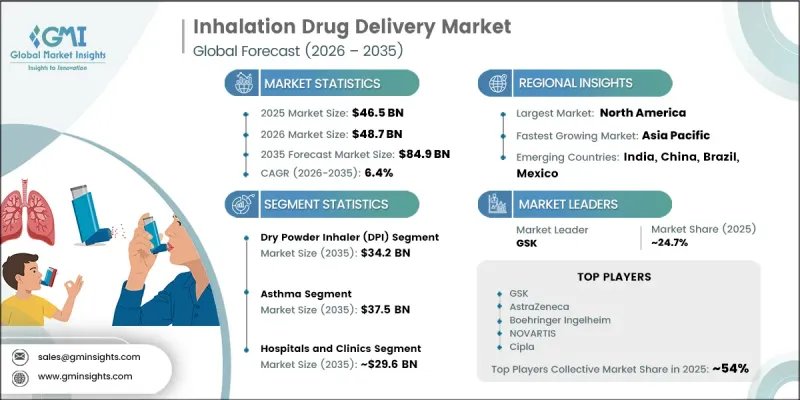
시장의 성장은 전 세계 호흡기 질환 부담의 증가, 재택 호흡기 치료의 보급 확대, 그리고 폐를 대상으로 한 약물전달 기술의 지속적인 발전에 힘입고 있습니다. 흡입 약물전달 시장은 약물을 폐로 직접 전달하여 전신에 대한 약물 노출을 최소화하면서 치료 효율을 향상시킴으로써, 현대 호흡기 질환 관리에서 매우 중요한 역할을 하고 있습니다. 이러한 표적화된 접근 방식은 기존의 투약 방식에 비해 작용 발현을 가속화하고, 투약량을 줄이며, 치료 성과를 향상시키고, 환자의 편의성을 높일 수 있게 합니다. 장기적인 호흡기 치료 솔루션에 대한 수요 증가와 더불어, 제네릭 의약품 및 병용 요법에 대한 수용이 확대되고 있는 점이 시장 확장을 지속적으로 지원하고 있습니다. 만성 호흡기 질환의 유병률 증가에 따라 질환 조절과 증상 관리 모두를 지원하는 효과적인 흡입 요법에 대한 지속적인 수요가 발생하고 있습니다. 지속적인 제품 혁신, 환자 인식 제고, 잘 갖춰진 의료 인프라, 그리고 호흡기 치료에 대한 접근성 확대가 전 세계 흡입제 전달 시장의 장기적인 성장에 더욱 기여하고 있습니다.
| 시장 범위 | |
|---|---|
| 시작연도 | 2025년 |
| 예측 기간 | 2026-2035년 |
| 개시 금액 | 465억 달러 |
| 예측액 | 849억 달러 |
| CAGR | 6.4% |
2025년, 건식 분말 흡입기(DPI) 부문은 38.2%의 점유율을 차지했습니다. 이 부문의 시장내 주도적 지위는 추진제를 사용하지 않는 설계, 폐로의 효율적인 약물전달, 투여의 편의성, 그리고 만성 호흡기 질환 관리에 대한 폭넓은 수용성에 의해 지원되고 있습니다. 의료진과 환자들이 신뢰할 수 있는 투여량 안정성, 효과적인 약물 침착, 간편한 취급, 그리고 치료 순응도 향상을 실현하는 흡입 시스템을 점점 더 선호함에 따라 이 부문은 계속해서 성장세를 보이고 있습니다. 이러한 성능상 이점은 전 세계 흡입 약물전달 산업에서 건식 분말 흡입기의 입지를 더욱 공고히 하고 있습니다.
천식 부문은 천식 유병률의 증가와 질병 관리의 표준적 접근 방식으로서 흡입 요법에 대한 지속적인 의존을 배경으로 연평균 성장률(CAGR) 6.2%를 기록하며, 2035년까지 375억 달러에 달할 것으로 예상됩니다. 흡입 요법에 대한 강력한 수요는 신속한 증상 조절, 효과적인 장기적 질환 관리, 그리고 환자 예후 개선에 대한 필요성에 의해 주도되고 있습니다. 소아 및 성인 모두에서 진단율이 증가함에 따라 전 세계에서 천식 치료를 위한 흡입 약물전달 기기의 사용 확대가 계속해서 촉진되고 있습니다.
2025년 기준, 북미의 흡입 약물전달 시장은 38%의 점유율을 차지했습니다. 지역 시장의 성장은 만성 호흡기 질환 유병률 증가, 잘 갖춰진 의료 인프라, 첨단 호흡기 치료법의 도입 확대, 그리고 장기적인 폐 질환 관리에 대한 수요 증가에 힘입고 있습니다. 호흡기 치료 기술에 대한 지속적인 투자와 혁신적인 치료 옵션에 대한 환자의 접근성 확대가 이 지역 전체의 시장 성장을 더욱 촉진할 것으로 예상됩니다.
자주 묻는 질문
목차
제1장 조사 방법
제2장 개요
제3장 업계 인사이트
제4장 경쟁 구도
제5장 시장 추산·예측 : 제품 유형별, 2022-2035년
제6장 시장 추산·예측 : 용도별, 2022-2035년
제7장 시장 추산·예측 : 유통 채널별, 2022-2035년
제8장 시장 추산·예측 : 최종 사용별, 2022-2035년
제9장 시장 추산·예측 : 지역별, 2022-2035년
제10장 기업 개요
KSA 26.07.31The Global Inhalation Drug Delivery Market was valued at USD 46.5 billion in 2025 and is estimated to grow at a CAGR of 6.4% to reach USD 84.9 billion by 2035.
Market growth is supported by the increasing burden of respiratory diseases worldwide, the growing adoption of home-based respiratory care, and continuous advancements in pulmonary drug delivery technologies. The inhalation drug delivery market plays a critical role in modern respiratory disease management by enabling medications to be delivered directly to the lungs, improving therapeutic efficiency while minimizing systemic drug exposure. This targeted approach allows for faster onset of action, lower medication requirements, improved treatment outcomes, and enhanced patient convenience compared with conventional drug administration methods. Rising demand for long-term respiratory care solutions, coupled with increasing acceptance of generic and combination therapies, continues to strengthen market expansion. The growing incidence of chronic respiratory disorders is creating sustained demand for effective inhalation-based treatment options that support both disease control and symptom management. Continuous product innovation, expanding patient awareness, favorable healthcare infrastructure, and increasing access to respiratory therapies are further contributing to the long-term growth of the global inhalation drug delivery market.
| Market Scope | |
|---|---|
| Start Year | 2025 |
| Forecast Year | 2026-2035 |
| Start Value | $46.5 Billion |
| Forecast Value | $84.9 Billion |
| CAGR | 6.4% |
The dry powder inhaler (DPI) segment held 38.2% share in 2025. Market leadership is supported by its propellant-free design, efficient pulmonary drug delivery, convenient administration, and broad acceptance for chronic respiratory disease management. The segment continues to gain momentum as healthcare providers and patients increasingly prefer inhalation systems that offer reliable dose consistency, effective drug deposition, simplified handling, and improved treatment compliance. These performance advantages continue to strengthen the position of dry powder inhalers within the global inhalation drug delivery industry.
The asthma segment is expected to grow at a CAGR of 6.2%, reaching USD 37.5 billion by 2035, supported by the growing prevalence of asthma and the continued reliance on inhalation therapies as the standard approach for disease management. Strong demand for inhalation-based treatment is driven by the need for rapid symptom control, effective long-term disease management, and improved patient outcomes. Increasing diagnosis rates across both pediatric and adult populations continue to support rising utilization of inhalation drug delivery devices for asthma treatment worldwide.
North America Inhalation Drug Delivery Market accounted for 38% share in 2025. Regional market expansion is supported by the increasing prevalence of chronic respiratory diseases, strong healthcare infrastructure, growing adoption of advanced respiratory therapies, and rising demand for long-term pulmonary disease management. Continued investment in respiratory care technologies and expanding patient access to innovative treatment options are expected to further reinforce market growth across the region.
Key companies operating in the global inhalation drug delivery market include 3M, AstraZeneca, Boehringer Ingelheim, Chiesi, Cipla, GSK, Monaghan, Novartis, OMRON Healthcare, OPKO, PARI, Philips, and Teva. Companies active in the inhalation drug delivery market are strengthening their competitive position by investing in advanced inhalation technologies, expanding product portfolios, and improving drug-device integration to enhance treatment effectiveness and patient adherence. Manufacturers are focusing on research and development to introduce innovative delivery platforms that improve dosing accuracy, ease of use, and therapeutic performance. Strategic collaborations, licensing agreements, and manufacturing partnerships are helping companies expand their global footprint while accelerating product commercialization. Businesses are also increasing investments in digital health integration, production capacity, and regulatory compliance to support evolving healthcare requirements.
Table of Contents
Chapter 1 Research Methodology
- 1.1 Research approach
- 1.2 Quality commitments
- 1.2.1 GMI AI policy & data integrity commitment
- 1.2.1.1 Source consistency protocol
- 1.2.1 GMI AI policy & data integrity commitment
- 1.3 Research trail & confidence scoring
- 1.3.1 Research trail components
- 1.3.2 Scoring components
- 1.4 Data collection
- 1.4.1 Partial list of primary sources
- 1.5 Data mining sources
- 1.5.1 Paid sources
- 1.5.1.1 Sources, by region
- 1.5.1 Paid sources
- 1.6 Base estimates and calculations
- 1.6.1 Base year calculation
- 1.7 Forecast model
- 1.7.1 Quantified market impact analysis
- 1.7.1.1 Mathematical impact of growth parameters on forecast
- 1.7.1 Quantified market impact analysis
- 1.8 Research transparency addendum
- 1.8.1 Source attribution framework
- 1.8.2 Quality assurance metrics
- 1.8.3 Our commitment to trust
Chapter 2 Executive Summary
- 2.1 Industry 360° synopsis
- 2.2 Key market trends
- 2.2.1 Regional trends
- 2.2.2 Product type trends
- 2.2.3 Application trends
- 2.2.4 Distribution channel trends
- 2.2.5 End use trends
- 2.3 CXO perspectives: Strategic imperatives
Chapter 3 Industry Insights
- 3.1 Industry ecosystem analysis
- 3.2 Industry impact forces
- 3.2.1 Growth drivers
- 3.2.1.1 Rising global prevalence of respiratory diseases
- 3.2.1.2 Expansion of home-based respiratory care
- 3.2.1.3 Technological advancements in inhaler devices
- 3.2.1.4 Growing adoption of generic and combination therapies
- 3.2.2 Industry pitfalls and challenges
- 3.2.2.1 Stringent regulatory requirements
- 3.2.2.2 High development and manufacturing costs
- 3.2.3 Opportunities
- 3.2.3.1 Growth of smart inhalers and connected healthcare solutions
- 3.2.3.2 Untapped potential in emerging markets
- 3.2.1 Growth drivers
- 3.3 Growth potential analysis
- 3.4 Regulatory landscape
- 3.5 Pricing trend analysis
- 3.6 Technology and innovation landscape (Driven by Primary Research)
- 3.6.1 Current technological trends
- 3.6.2 Emerging technologies
- 3.7 Future market trends (Driven by Primary Research)
- 3.8 Impact of AI & Generative AI on the Market (Driven by Primary Research)
- 3.9 Porter's analysis
- 3.10 PESTEL analysis
Chapter 4 Competitive Landscape, 2025
- 4.1 Introduction
- 4.2 Company matrix analysis
- 4.3 Company market share analysis (Driven by Primary Research)
- 4.3.1 Global
- 4.3.2 North America
- 4.3.3 Europe
- 4.3.4 Asia Pacific
- 4.3.5 LAMEA
- 4.4 Competitive analysis of major market players
- 4.5 Competitive positioning matrix
- 4.6 Key developments
- 4.6.1 Mergers & acquisitions
- 4.6.2 Partnerships & collaborations
- 4.6.3 New product launches
- 4.6.4 Expansion plans
Chapter 5 Market Estimates and Forecast, By Product Type, 2022 - 2035 ($ Mn)
- 5.1 Key trends
- 5.2 Pressurized metered dose inhaler (pMDI)
- 5.3 Dry powder inhaler (DPI)
- 5.3.1 Single-dose
- 5.3.2 Multi-dose
- 5.4 Soft mist inhaler (SMI)
- 5.5 Nebulizer
- 5.5.1 Jet nebulizer
- 5.5.2 Ultrasonic nebulizer
- 5.5.3 Vibrating mesh nebulizer
Chapter 6 Market Estimates and Forecast, By Application, 2022 - 2035 ($ Mn)
- 6.1 Key trends
- 6.2 Asthma
- 6.3 Chronic obstructive pulmonary disease
- 6.4 Cystic fibrosis (CF)
- 6.5 Allergic rhinitis
- 6.6 Other applications
Chapter 7 Market Estimates and Forecast, By Distribution Channel, 2022 - 2035 ($ Mn)
- 7.1 Key trends
- 7.2 Brick and mortar
- 7.3 E-commerce
Chapter 8 Market Estimates and Forecast, By End Use, 2022 - 2035 ($ Mn)
- 8.1 Key trends
- 8.2 Hospitals and clinics
- 8.3 Homecare settings
- 8.4 Other end users
Chapter 9 Market Estimates and Forecast, By Region, 2022 - 2035 ($ Mn)
- 9.1 Key trends
- 9.2 North America
- 9.2.1 U.S.
- 9.2.2 Canada
- 9.3 Europe
- 9.3.1 Germany
- 9.3.2 UK
- 9.3.3 France
- 9.3.4 Spain
- 9.3.5 Italy
- 9.3.6 Netherlands
- 9.4 Asia Pacific
- 9.4.1 China
- 9.4.2 Japan
- 9.4.3 India
- 9.4.4 Australia
- 9.4.5 South Korea
- 9.5 Latin America
- 9.5.1 Brazil
- 9.5.2 Mexico
- 9.5.3 Argentina
- 9.6 MEA
- 9.6.1 South Africa
- 9.6.2 Saudi Arabia
- 9.6.3 UAE
Chapter 10 Company Profiles
- 10.1 3M
- 10.2 AstraZeneca
- 10.3 Boehringer Ingelheim
- 10.4 Chiesi
- 10.5 Cipla
- 10.6 GSK
- 10.7 Monaghan
- 10.8 Novartis
- 10.9 OMRON Healthcare
- 10.10 OPKO
- 10.11 PARI
- 10.12 Philips
- 10.13 Teva


