

|
시장보고서
상품코드
2115049
폐용 약물전달 시스템 시장 : 점유율 분석, 업계 동향과 통계, 성장 예측(2026-2031년)Pulmonary Drug Delivery Systems - Market Share Analysis, Industry Trends & Statistics, Growth Forecasts (2026 - 2031) |
||||||
 Mordor Intelligence
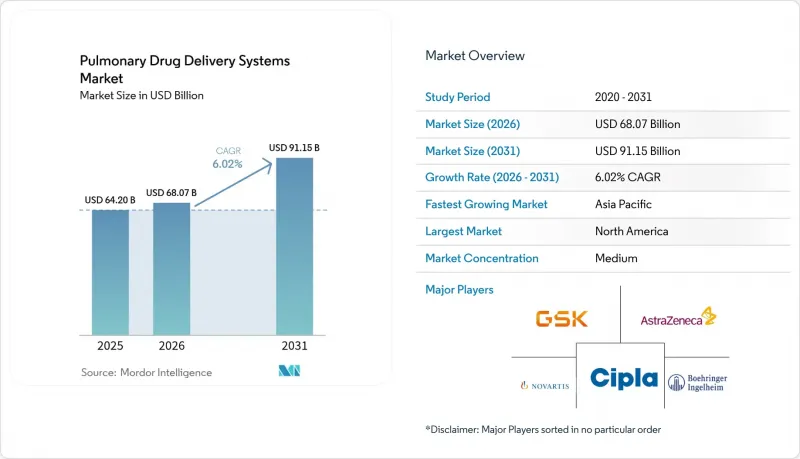
Mordor Intelligence에 의하면, 폐용 약물전달 시스템 시장 규모는 2025년에 642억 달러로 평가되었고 2026년 680억 7,000만 달러에서 2031년까지 911억 5,000만 달러에 이를 것으로 예측되며, 예측 기간(2026-2031년) CAGR은 6.02%를 나타낼 전망입니다.
본 보고서는 제품별(건조 분말 흡입기, 정량 흡입기, 네뷸라이저(제트식 네뷸라이저 등)), 용도별(천식, COPD 등),최종 사용자별(병원, 진단센터 등), 기술별(수동식 기기 및 디지털식/스마트 기기), 지역별(북미, 유럽 등)로 분류되어 있습니다. 시장 예측은 금액(달러) 기준으로 제시되어 있습니다.
전 세계 폐용 약물전달 시스템 시장 동향 및 인사이트
기기 공학 분야의 기술적 진보
스마트 액추에이터, 호흡 감지식 트리거 및 진동 메쉬 네뷸라이저는 기존의 제트식 모델보다 더 많은 약물을 세기관지로 전달하여, 5µm 미만의 입자 비율을 54.6%에서 59.25%로 향상시켰습니다. Adherium사의 ‘Smartinhaler’가 FDA 승인을 받음에 따라 ‘Airsupra’ 및 ‘Breztri’에 실시간 복약 순응도 데이터가 추가되어, 임상의는 객관적인 투여량 데이터를 얻을 수 있게 되었습니다. 메타 분석에 따르면, 진동 메쉬 시스템은 COPD 치료에서 제트식 네뷸라이저보다 우수한 효과를 보이며, 악화 빈도와 치료 기간을 단축시키는 것으로 확인되었습니다. 각 제조업체는 환자의 흡입 프로파일에 따라 유량을 조절하는 AI 모듈을 시험하고 있으며, 이 기능은 소아 및 노인의 치료 성과를 개선합니다. 이러한 기술적 진보로 인해 흡입기 사용 지도가 용이해졌으며, 조작 오류와 재입원이 감소하고 있습니다.
호흡기 질환 부담 증가와 흡입 요법으로의 전환
2021년에는 2억 1,339만 명이 COPD를 앓았으며, 400만 명의 사망이 보고되어, 증상 완화 및 예방 관리 모두에서 흡입이 바람직한 투여 경로라는 사실이 확고해졌습니다. 중국에서만 4,570만 명의 천식 환자와 9,990만 명의 COPD 환자가 보고되었으며, 이처럼 많은 환자 수는 임상 체계에 부담을 주고, 약물을 폐에 직접 전달하는 기기에 대한 수요를 높이고 있습니다. 젊은 성인의 COPD 부담 중 41.79%는 대기 오염이 원인이며, 각국 정부는 흡입 요법에 대한 지원을 추진하고 있습니다. 50년 만에 이루어진 천식·COPD 치료의 큰 진전인 벤라리주맙은 스테로이드 요법과 비교하여 치료 실패율이 30% 감소한 것으로 입증되어, 표적을 정확히 겨냥한 폐로의 약물전달의 중요성이 뒷받침되었습니다. 보험사 측은 흡입 제제가 전신성 부작용 감소 및 입원 기간 단축으로 이어진다고 판단하고 있으며, 이것이 에어로졸 제품에 대한 보험 적용 품목 변경을 뒷받침하고 있습니다.
엄격한 다관할구역에 걸친 의료기기·약제 병용 제품의 승인
복합 흡입제는 약물의 유효성과 기기의 성능 시험을 모두 충족해야 하므로, 이로 인해 개발 주기가 수년 연장되고 임상시험 예산이 증가하고 있습니다. 액추에이터의 형상을 둘러싼 지적 재산권의 중복은 제네릭 의약품 시장 진입을 복잡하게 만들고, 많은 지역에서 가격 억제를 방해하고 있습니다. 디지털 기능의 추가는 소프트웨어 검증이라는 추가 단계를 필요로 하며, 많은 경우 의료기기 지침에 따른 별도의 신청이 필요합니다. 중소기업은 이러한 이중 승인 절차를 감당할 자금이 부족하여, 혁신의 정체나 환자 선택권의 축소라는 위험이 발생하고 있습니다.
부문 분석
정량 분무식 흡입기(MDI)는 2025년 폐용 약물전달 시스템 시장 점유율의 43.10%를 차지했으나, GWP(지구 온난화 지수)가 높은 추진제를 지속 가능한 대체품으로 교체하라는 환경적 압력이 높아지고 있습니다. 건식 분말 흡입기는 2031년까지 연평균 성장률(CAGR) 9.12%로 점유율을 확대하고 있으며, MDI 사용에 어려움을 겪는 고령 환자나 추진제가 포함되지 않은 대안을 찾는 환경 의식이 높은 소비자들에게 지지를 받고 있습니다. 네뷸라이저는 급성기 치료나 손의 움직임이 불편한 환자에게 여전히 필수적이지만, 이 부문에서는 기존의 제트식 모델에서 약물을 보다 효율적으로 전달하는 첨단 진동 메쉬 기술 및 소프트 미스트 기술로 전환되고 있습니다.
아스트라제네카가 FDA 승인을 받은 최초의 항염증용 구급 흡입기 ‘AIRSUPRA’를 출시한 것은 제품 혁신이 치료 프로토콜을 재구성하고 새로운 시장 부문을 창출할 수 있음을 보여줍니다. 소프트 미스트식 네뷸라이저는 재사용 가능한 설계와 환경 부담 감소로 인해 지지를 넓히고 있으며, 기존 pMDI에 비해 탄소 발자국을 57-71% 줄일 수 있다는 사실이 연구를 통해 확인되었습니다. 초음파식 네뷸라이저는 기술 발전으로 인해 액적 형성이 개선되고 치료 시간이 단축되면서 다시 주목받고 있으며, 환자의 치료 순응도 확보가 과제가 되는 소아용 분야에서 특히 유용합니다. 건식 분말 흡입기(DPI)를 이용한 폐용 약물전달 시스템 시장 규모는 2026년부터 2031년까지 연평균 성장률(CAGR) 9.12%로 확대될 것으로 예측되며, 이는 조작이 간편한 기기에 대한 수요 증가를 반영합니다.
2025년에는 천식 적응증이 폐용 약물전달 시스템 시장의 39.05%를 차지하고, 이는 전 세계 의료 시스템에서 높은 유병률과 확립된 치료 프로토콜을 반영합니다. 낭포성 섬유증은 2031년까지 연평균 성장률(CAGR) 8.31%로 성장할 가장 빠르게 성장하는 적응증 부문으로 부상하고 있으며, 유럽 여러 국가에서 BI 3720931 흡입형 유전자 치료제를 시험하는 LENTICLAIR 1 임상시험을 포함하여,획기적인 유전자 치료제의 개발이 원동력이 되고 있습니다. 만성폐쇄성폐질환(COPD) 응용 분야에서는 기관지 확장 작용과 항염증 작용을 결합한, 20년 만에 등장한 COPD용 새로운 작용기전을 가진 엔시펜트린(Ohtuvayre) 등의 혁신적인 치료법이 기여하고 있습니다. 알레르기성 비염 분야에서는 중증 알레르기 반응에 대한 네피(Neffy) 비강 스프레이와 같은 바늘 없는 투여 시스템이 보급되면서, 기존의 흡입기 사용자를 넘어선 환자층으로 적용 범위가 확대되고 있습니다.
mRNA 및 유전자 치료의 혁신으로 인해 응용 분야는 변혁의 한가운데에 있습니다. 여러 임상시험을 통해 치료 패러다임을 근본적으로 바꿀 가능성을 지닌, 폐를 표적으로 한 유전자 중재의 잠재력이 입증되고 있습니다. 7개국에서 진행 중인 BioNTech사의 폐암 백신 ‘BNT116’ 임상시험은 호흡기 질환을 넘어 종양학 응용 분야로, 폐로의 약물전달을 대폭 확대하는 것입니다. 그 밖의 응용 분야에서는 특수한 제형 개발이 진행되고 있습니다. 예를 들어, 낭포성 섬유증 환자의 폐 감염증에 대한 새로운 히알루론산·반코마이신 복합체 분말은 24시간을 초과하는 서방형 방출 프로파일을 보여주고 있습니다. 낭포성 섬유증 치료 분야의 폐용 약물전달 시스템 시장 규모는 이러한 치료 혁신의 영향을 반영하여, 2031년까지 연평균 성장률(CAGR) 8.31%로 확대될 것으로 예측됩니다.
지역별 분석
북미는 2025년 폐용 약물전달 시스템 시장의 45.10%를 차지했습니다. 이는 종합적인 보험 적용 범위, 스마트 흡입기의 조기 도입, 그리고 획기적인 의료기기에 대한 FDA의 신속한 승인이 뒷받침한 결과입니다. AIRSUPRA 및 Yutrepia와 같은 최근 제품 출시가 수요를 뒷받침하는 한편, 민관 공동 연구개발 프로그램이 차세대 추진제로의 전환을 가속화하고 있습니다. 캐나다와 멕시코는 고령화 진행 및 유지 요법에 대한 접근성 확대를 배경으로 꾸준히 시장을 확대하고 있지만, 고급 기기의 이용률은 미국에 뒤처지고 있습니다.
아시아태평양은 천식 및 COPD 환자 수가 많으며, 보험 적용 범위 확대와 기기 비용을 절감하는 현지 생산에 힘입어 2031년까지 연평균 성장률(CAGR) 9.29%로 성장하고 있습니다. 중국만 해도 천식 환자가 4,570만 명, COPD 환자가 9,990만 명에 달하며, 이는 건식 분말 및 메쉬 네뷸라이저 시스템에 대한 대규모 입찰을 주도하고 있습니다. 인도는 흡입형 인슐린 ‘아프레차’ 도입 준비를 진행 중이며, 혁신적인 에어로졸 제품에 대한 수용성을 보이고 있습니다. 일본, 호주, 한국은 정부가 원격 의료를 추진하는 가운데, 해당 지역 내 커넥티드 흡입기의 보급을 주도하고 있습니다.
유럽에서는 지속가능성이 중시되고 있으며, 영국에서 HFO-1234ze(E) 추진제를 사용한 흡입기의 승인이 저탄소화의 기준이 되고 있습니다. 독일과 프랑스는 중요한 밸브 및 액추에이터 기술을 공급하고 있지만, EU 전역에서 살부타몰이 부족하는 상황은 추진제 전환 시 발생하는 공급망 위험을 여실히 드러내고 있습니다. 동유럽, 중동 및 아프리카, 남미에서는 대기질 개선 노력과 현지 조립 공장에 대한 자금 유입에 따라 판매량이 증가하고 있습니다.
기타 혜택:
- 엑셀 형식 시장 예측(ME) 시트
- 3개월간의 애널리스트 지원
자주 묻는 질문
목차
제1장 서론
제2장 조사 방법
제3장 주요 요약
제4장 시장 구도
제5장 시장 규모와 성장 예측
제6장 경쟁 구도
제7장 시장 기회와 향후 전망
JHS 26.08.26According to Mordor Intelligence, the pulmonary drug delivery system market size was valued at USD 64.20 billion in 2025 and estimated to grow from USD 68.07 billion in 2026 to reach USD 91.15 billion by 2031, at a CAGR of 6.02% during the forecast period (2026-2031).
This report is Segmented by Product (Dry Powder Inhalers, Metered Dose Inhalers, and Nebulizers[Jet Nebulizer and More]), Application (Asthma, COPD, and More), End User (Hospitals, Diagnostic Centers, and More), Technology (Manually-Operated Devices and Digitally-Operated / Smart Devices) and Geography (North America, Europe, and More). The Market Forecasts are Provided in Terms of Value (USD).
Global Pulmonary Drug Delivery Systems Market Trends and Insights
Technological Advancements in Device Engineering
Smart actuators, breath-actuated triggers, and vibrating mesh nebulizers now deliver more drug into the small airways than earlier jet models, improving the sub-5 µm particle fraction from 54.6% to 59.25%. The FDA clearance of Adherium's Smartinhaler adds real-time adherence feeds for Airsupra and Breztri, giving clinicians objective dose data. Meta-analysis confirms that vibrating mesh systems outperform jet nebulizers in COPD care, lowering exacerbations and treatment time. Manufacturers are testing AI modules that adjust flow rates in response to a patient's inspiratory profile, a feature that improves pediatric and geriatric outcomes. These engineering gains make inhalers easier to train on, reducing technique errors and hospital readmissions.
Rising Respiratory-Disease Burden & Shift to Inhalation Route
COPD affected 213.39 million people in 2021 and accounted for 4.0 million deaths, solidifying inhalation as the preferred route for both symptom relief and preventive care. China alone reports 45.7 million asthma and 99.9 million COPD patients, a volume that strains clinical capacity and lifts demand for devices that deliver drug directly to the lungs. Air pollution contributes 41.79% of COPD burden among young adults, pushing governments to subsidize inhaled therapies. Benralizumab, the first major asthma-COPD advance in five decades, demonstrated a 30% drop in treatment failures versus steroid regimens, reinforcing the relevance of targeted pulmonary delivery. Payers see inhaled formulations as a path to fewer systemic side effects and shorter hospital stays, underpinning formulary shifts toward aerosol products.
Stringent Multi-Jurisdiction Device & Drug-Combo Approvals
Combination inhalers must satisfy both drug efficacy and device-performance tests, prolonging development cycles by years and inflating trial budgets. Intellectual-property overlaps around actuator geometries complicate generic entry, limiting price relief in many regions. Digital add-ons invite an additional layer of software validation, often triggering separate submissions under medical-device directives. Smaller firms lack capital to navigate dual pathways, risking innovation attrition and narrowing patient choice.
Other drivers and restraints analyzed in the detailed report include:
- Ageing Population & Chronic-Care Medication Adherence Push
- Environmental Regulations Spurring Propellant-Free Inhalers
- Propellant Phase-Out Costs & Supply Bottlenecks
For complete list of drivers and restraints, kindly check the Table Of Contents.
Segment Analysis
Metered-dose inhalers claimed 43.10% of the pulmonary drug delivery system market share in 2025 but face mounting environmental pressure to replace high-GWP propellants with sustainable alternatives. Dry-powder inhalers are gaining ground at 9.12% CAGR through 2031, appealing to elderly patients who struggle with MDI coordination and environmentally conscious consumers seeking propellant-free options. Nebulizers remain essential for acute care and patients with limited dexterity, though the segment is shifting from traditional jet models toward advanced vibrating mesh and soft-mist technologies that deliver medication more efficiently.
AstraZeneca's AIRSUPRA launch as the first FDA-approved anti-inflammatory rescue inhaler demonstrates how product innovation can reshape treatment protocols and create new market segments. Soft-mist nebulizers are gaining traction due to their reusable design and reduced environmental impact, with studies confirming 57-71% carbon footprint reduction compared to traditional pMDIs. Ultrasonic nebulizers are experiencing renewed interest as technological advances improve droplet formation control and reduce treatment times, making them particularly valuable for pediatric applications where patient compliance presents challenges. The pulmonary drug delivery system market size for dry-powder inhalers is projected to expand at 9.12% CAGR between 2026-2031, reflecting growing preference for coordination-free devices.
Asthma applications dominated with 39.05% of the pulmonary drug delivery system market in 2025, reflecting high disease prevalence and established treatment protocols across global healthcare systems. Cystic fibrosis emerges as the fastest-growing application segment with 8.31% CAGR through 2031, driven by breakthrough gene therapy developments including the LENTICLAIR 1 trial testing BI 3720931 inhalable gene therapy across multiple European countries. COPD applications are benefiting from innovative treatments like ensifentrine (Ohtuvayre), which represents the first novel mechanism of action for COPD in over two decades by combining bronchodilator and anti-inflammatory effects. Allergic rhinitis applications are expanding with needle-free delivery systems like Neffy nasal spray for severe allergic reactions, broadening the addressable patient population beyond traditional inhaler users.
The application landscape is undergoing transformation through mRNA and gene therapy innovations, with multiple clinical trials demonstrating the potential for lung-targeted genetic interventions that could fundamentally change treatment paradigms. BioNTech's BNT116 lung cancer vaccine trials across seven countries represent a significant expansion of pulmonary delivery beyond respiratory diseases into oncology applications. Other applications are advancing through specialized formulations, such as novel hyaluronic acid-vancomycin complex powders for pulmonary infections in cystic fibrosis patients, which demonstrate extended release profiles exceeding 24 hours. The pulmonary drug delivery system market size for cystic fibrosis applications is forecast to grow at 8.31% CAGR through 2031, reflecting the impact of these therapeutic innovations.
Complete Report Scope:
- By Product
- Dry Powder Inhalers
- Metered Dose Inhalers
- Nebulizers
- Jet Nebulizers
- Soft-Mist Nebulizers
- Ultrasonic Nebulizers
- By Application
- Asthma
- COPD
- Cystic Fibrosis
- Allergic Rhinitis
- Other Applications
- By End User
- Hospitals
- Diagnostic Centres
- Home-Care Settings
- Other End Users
- By Technology
- Manually-Operated Devices
- Digitally-Operated / Smart Devices
- By Geography
- North America
- United States
- Canada
- Mexico
- Europe
- Germany
- United Kingdom
- France
- Italy
- Spain
- Rest of Europe
- Asia-Pacific
- China
- Japan
- India
- Australia
- South Korea
- Rest of Asia-Pacific
- Middle East and Africa
- GCC
- South Africa
- Rest of Middle East and Africa
- South America
- Brazil
- Argentina
- Rest of South America
- North America
Geography Analysis
North America commanded45.10% of the pulmonary drug delivery system market in2025, benefiting from robust insurance coverage, early uptake of smart inhalers, and swift FDA approvals for breakthrough devices. Recent launches such as AIRSUPRA and Yutrepia sustain demand while public-private R&D programs speed next-generation propellant transitions. Canada and Mexico expand steadily on the back of aging populations and broader access to maintenance therapies, though premium-device use trails the United States.
Asia Pacific is advancing at a9.29% CAGR through2031, propelled by large asthma and COPD pools, widening reimbursement, and local manufacturing that trims device costs. China alone counts45.7million asthma and99.9million COPD patients, driving bulk tenders for dry-powder and mesh-nebulizer systems. India is preparing for Afrezza inhaled insulin, signalling openness to innovative aerosols. Japan, Australia, and South Korea lead regional adoption of connected inhalers as governments push telehealth.
Europe focuses on sustainability, with the UK's approval of HFO-1234ze(E) propellant inhalers setting a low-carbon benchmark. Germany and France supply critical valve and actuator technology, while EU-wide shortages of salbutamol expose supply-chain risk during propellant changeovers. Eastern Europe, the Middle East & Africa, and South America register rising volumes as funding flows toward air-quality initiatives and local assembly plants.
- AstraZeneca
- Boehringer Ingelheim
- Chiesi Farmaceutici
- Cipla
- ElevateBio / Aerogen
- GF Health Products
- GlaxoSmithKline
- Gilbert Technologies
- H&T Presspart
- Koninklijke Philips
- Merck
- Novartis
- OMRON
- PARI Pharma
- Propeller Health
- Resmed
- Sunovion Pharma
- Teva Pharmaceutical Industries
- Vectura Group
- Aptar Pharma
Additional Benefits:
- The market estimate (ME) sheet in Excel format
- 3 months of analyst support
TABLE OF CONTENTS
1 Introduction
- 1.1 Study Assumptions and Market Definition
- 1.2 Scope of the Study
2 Research Methodology
3 Executive Summary
4 Market Landscape
- 4.1 Market Overview
- 4.2 Market Drivers
- 4.2.1 Technological Advancements In Device Engineering
- 4.2.2 Rising Respiratory-Disease Burden & Shift To Inhalation Route
- 4.2.3 Ageing Population & Chronic-Care Medication Adherence Push
- 4.2.4 Environmental Regulations Spurring Propellant-Free Inhalers
- 4.2.5 mRna / Gene-Therapy Pipelines Targeting Lung Delivery
- 4.2.6 Home-Based Smart, Prefillable Inhalers For Connected Care
- 4.3 Market Restraints
- 4.3.1 Stringent Multi-Jurisdiction Device & Drug-Combo Approvals
- 4.3.2 Propellant Phase-Out Costs & Supply Bottlenecks
- 4.3.3 Reimbursement Uncertainty For Digital Add-On Sensors
- 4.3.4 Micro-Plastic & Lithium-Ion Waste Scrutiny On Disposable Pens
- 4.4 Value / Supply-Chain Analysis
- 4.5 Regulatory Landscape
- 4.6 Technology Outlook
- 4.7 Porter's Five Forces Analysis
- 4.7.1 Bargaining Power of Suppliers
- 4.7.2 Bargaining Power of Buyers
- 4.7.3 Threat of New Entrants
- 4.7.4 Threat of Substitutes
- 4.7.5 Intensity of Competitive Rivalry
5 Market Size and Growth Forecasts (Value-USD)
- 5.1 By Product
- 5.1.1 Dry Powder Inhalers
- 5.1.2 Metered Dose Inhalers
- 5.1.3 Nebulizers
- 5.1.3.1 Jet Nebulizers
- 5.1.3.2 Soft-Mist Nebulizers
- 5.1.3.3 Ultrasonic Nebulizers
- 5.2 By Application
- 5.2.1 Asthma
- 5.2.2 COPD
- 5.2.3 Cystic Fibrosis
- 5.2.4 Allergic Rhinitis
- 5.2.5 Other Applications
- 5.3 By End User
- 5.3.1 Hospitals
- 5.3.2 Diagnostic Centres
- 5.3.3 Home-Care Settings
- 5.3.4 Other End Users
- 5.4 By Technology
- 5.4.1 Manually-Operated Devices
- 5.4.2 Digitally-Operated / Smart Devices
- 5.5 By Geography
- 5.5.1 North America
- 5.5.1.1 United States
- 5.5.1.2 Canada
- 5.5.1.3 Mexico
- 5.5.2 Europe
- 5.5.2.1 Germany
- 5.5.2.2 United Kingdom
- 5.5.2.3 France
- 5.5.2.4 Italy
- 5.5.2.5 Spain
- 5.5.2.6 Rest of Europe
- 5.5.3 Asia-Pacific
- 5.5.3.1 China
- 5.5.3.2 Japan
- 5.5.3.3 India
- 5.5.3.4 Australia
- 5.5.3.5 South Korea
- 5.5.3.6 Rest of Asia-Pacific
- 5.5.4 Middle East and Africa
- 5.5.4.1 GCC
- 5.5.4.2 South Africa
- 5.5.4.3 Rest of Middle East and Africa
- 5.5.5 South America
- 5.5.5.1 Brazil
- 5.5.5.2 Argentina
- 5.5.5.3 Rest of South America
- 5.5.1 North America
6 Competitive Landscape
- 6.1 Market Concentration
- 6.2 Market Share Analysis
- 6.3 Company profiles (includes Global level Overview, Market level overview, Core Segments, Financials as available, Strategic Information, Market Rank/Share for key companies, Products and Services, and Recent Developments)
- 6.3.1 AstraZeneca
- 6.3.2 Boehringer Ingelheim
- 6.3.3 Chiesi Farmaceutici
- 6.3.4 Cipla
- 6.3.5 ElevateBio / Aerogen
- 6.3.6 GF Health Products
- 6.3.7 GlaxoSmithKline
- 6.3.8 Gilbert Technologies
- 6.3.9 H&T Presspart
- 6.3.10 Koninklijke Philips
- 6.3.11 Merck & Co.
- 6.3.12 Novartis
- 6.3.13 Omron Healthcare
- 6.3.14 PARI GmbH
- 6.3.15 Propeller Health
- 6.3.16 ResMed
- 6.3.17 Sunovion Pharma
- 6.3.18 Teva Pharmaceuticals
- 6.3.19 Vectura Group
- 6.3.20 Aptar Pharma
7 Market Opportunities and Future Outlook
- 7.1 White-Space and Unmet-Need Assessment


