|
시장보고서
상품코드
2101658
혈관내 쇄석 시장 기회, 성장요인, 업계 동향 분석 및 예측(2026-2035년)Intravascular Lithotripsy (IVL) Market Opportunity, Growth Drivers, Industry Trend Analysis, and Forecast 2026 - 2035 |
||||||

세계의 혈관내 쇄석술(IVL) 시장은 2025년에 9억 5,430만 달러 규모에 달하며, 2035년까지 CAGR 15.8%로 성장하며, 40억 달러에 달할 것으로 추정되고 있습니다.
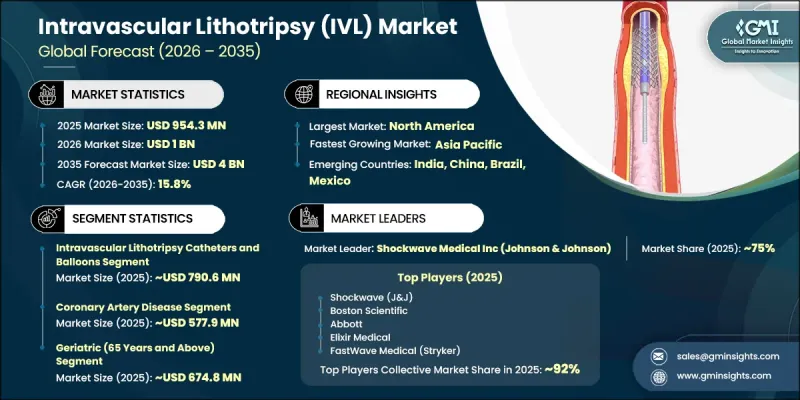
혈관내 쇄석술(IVL) 시장은 석회화 혈관 질환의 치료를 개선하는 저침습 기술에 대한 수요가 증가함에 따라 급속히 확대되고 있습니다. 고령화와 심대사성 질환 발생률 증가에 힘입어 동맥 석회화의 유병률이 증가하고 있는 것이 시장 성장에 계속해서 유리한 환경을 조성하고 있습니다. 의료진은 심혈관 중재 시술의 성공률을 높이고 환자의 예후를 최적화하기 위해 첨단 혈관 준비 기술을 점점 더 많이 채택하고 있습니다. 지속적인 임상 검증, 주요 의료 시장에서의 보험 적용 범위 확대, 그리고 끊임없는 기술 발전으로 인해 IVL은 신흥 치료 옵션에서 널리 수용되는 임상 솔루션으로 전환되는 움직임이 가속화되고 있습니다. 전 세계 고령 인구가 계속 증가함에 따라 복잡한 석회화 혈관 병변의 치료가 필요한 환자 수도 확대되고 있습니다. 혈관 석회화는 노화에 따라 발생 빈도가 높아지기 때문에 혈관내 쇄석 기술에 대한 장기적인 수요는 일시적인 도입 추세가 아닌 지속적인 임상적 필요성에 의해 지원되어 구조적으로 견고한 상태를 유지할 것으로 예상됩니다. 이러한 요인들은 전 세계 혈관내 쇄석(IVL) 시장의 긍정적인 성장 전망을 더욱 공고히 하고 있습니다.
| 시장 범위 | |
|---|---|
| 시작연도 | 2025년 |
| 예측 기간 | 2026-2035년 |
| 개시 금액 | 9억 5,430만 달러 |
| 예측액 | 40억 달러 |
| CAGR | 15.8% |
2025년에는 혈관내 쇄석용 카테터 및 풍선이 시장 점유율의 82.84%를 차지했으며, 그 규모는 7억 9,060만 달러에 달했습니다. 이 제품 카테고리가 주도적인 위치를 유지하고 있는 이유는 모든 IVL 시술에 새로운 카테터의 사용이 필요하므로 소모품에 대한 지속적인 수요가 발생하고 있기 때문입니다. 반면, 자본 장비는 장기간에 걸쳐 여러 시술에 사용됩니다. 일회용 기기에 대한 지속적인 수요는 견실한 수익 창출을 지원하며, 예측 기간 중 카테터 및 풍선 부문의 우위를 공고히 하고 있습니다.
병원 부문은 2025년에 72.2%의 점유율을 차지하며 6억 8,850만 달러의 매출을 창출했습니다. IVL 시술에는 전문적인 심혈관 치료 시설, 전용 시술 장비, 그리고 고도로 훈련된 다학제 임상 팀이 필요하므로 병원이 여전히 주요 최종사용자로 남아 있습니다. 첨단 심장 카테터 검사실 및 혈관 중재술 센터에서는 포괄적인 환자 치료 인프라와 IVL 기술의 지속적인 도입을 촉진하는 확립된 보험 급여 체계에 힘입어 많은 시술이 계속해서 이루어지고 있습니다.
2025년, 북미의 혈관내 쇄석술(IVL) 시장은 41.6%의 점유율을 차지하며 3억 9,700만 달러에 달했습니다. 미국은 유리한 보험 지급 정책, 첨단인 의료 인프라, 의료진의 채택 확대, 그리고 최소 침습 심혈관 시술의 이용 증가에 힘입어 계속해서 지역 수요의 대부분을 차지하고 있습니다. 임상 적응증 범위의 지속적인 확대와 지원적인 의료 정책에 힘입어, 예측 기간 중 해당 지역 전체에서 강력한 시장 성장이 지속될 것으로 예상됩니다.
자주 묻는 질문
목차
제1장 조사 방법
제2장 개요
제3장 업계 인사이트
제4장 경쟁 구도
제5장 시장 추산·예측 : 제품 유형별, 2022-2035년
제6장 시장 추산·예측 : 용도별, 2022-2035년
제7장 시장 추산·예측 : 연령층별, 2022-2035년
제8장 시장 추산·예측 : 최종 사용별, 2022-2035년
제9장 시장 추산·예측 : 지역별, 2022-2035년
제10장 기업 개요
KSA 26.07.31The Global Intravascular Lithotripsy (IVL) Market was valued at USD 954.3 million in 2025 and is estimated to grow at a CAGR of 15.8% to reach USD 4 billion by 2035.
The intravascular lithotripsy (IVL) market is witnessing rapid expansion as demand rises for minimally invasive technologies that improve the treatment of calcified vascular disease. The increasing prevalence of arterial calcification, driven by aging populations and the growing incidence of cardiometabolic disorders, continues to create favorable conditions for market growth. Healthcare providers are increasingly adopting advanced vessel preparation technologies to improve procedural success and optimize patient outcomes during interventional cardiovascular procedures. Continued clinical validation, expanding reimbursement support across major healthcare markets, and ongoing technological advancements are accelerating the transition of IVL from an emerging treatment option to a widely accepted clinical solution. As the global elderly population continues to increase, the number of patients requiring treatment for complex calcified vascular lesions is also expanding. Since vascular calcification becomes more common with advancing age, long-term demand for intravascular lithotripsy technologies is expected to remain structurally strong, supported by sustained clinical need rather than temporary adoption trends. These factors continue to reinforce favorable growth prospects for the global intravascular lithotripsy (IVL) market.
| Market Scope | |
|---|---|
| Start Year | 2025 |
| Forecast Year | 2026-2035 |
| Start Value | $954.3 Million |
| Forecast Value | $4 Billion |
| CAGR | 15.8% |
Intravascular lithotripsy catheters and balloons accounted for 82.84% share in 2025, representing USD 790.6 million. This product category maintains its leading position because every IVL procedure requires the use of a new catheter, creating recurring demand for consumable products. In contrast, capital equipment is utilized across multiple procedures over an extended period. The consistent need for single-use devices continues to support strong revenue generation and reinforces the dominance of the catheter and balloon segment throughout the forecast period.
The hospitals segment held 72.2% share in 2025, generating USD 688.5 million. Hospitals remain the primary end users because IVL procedures require specialized cardiovascular treatment facilities, dedicated procedural equipment, and highly trained multidisciplinary clinical teams. Advanced cardiac catheterization laboratories and vascular intervention centers continue to perform many procedures, supported by a comprehensive patient care infrastructure and established reimbursement pathways that encourage continued adoption of IVL technology.
North America Intravascular Lithotripsy (IVL) Market accounted for 41.6% share in 2025, representing USD 397 million. The United States continues to contribute most of the regional demand, supported by favorable reimbursement policies, advanced healthcare infrastructure, growing physician adoption, and increasing utilization of minimally invasive cardiovascular procedures. Continued expansion of clinical applications and supportive healthcare policies is expected to sustain strong market growth across the region throughout the forecast period.
Major companies operating in the global intravascular lithotripsy (IVL) market include Boston Scientific, Abbott, Philips, Shockwave Medical Inc. (Johnson & Johnson), Stryker (Amplitude Vascular Systems, Inc.), Elixir Medical, FastWave Medical, Cagent Vascular, LEPU Medical, and MicroPort. Companies operating in the intravascular lithotripsy (IVL) market are strengthening their competitive position by investing in research and development to enhance device performance, improve procedural efficiency, and expand clinical applications. Manufacturers continue to focus on product innovation, technological advancement, and the development of next-generation treatment solutions that address increasingly complex vascular conditions. Strategic collaborations with healthcare institutions, clinical research organizations, and distribution partners are supporting broader commercial adoption and market expansion. Companies are also increasing investments in regulatory approvals, manufacturing capacity, physician training, and global geographic expansion to improve market access.
Table of Contents
Chapter 1 Research Methodology
- 1.1 Market definitions and scope
- 1.2 Research approach
- 1.3 Quality commitments
- 1.3.1 GMI AI policy & data integrity commitment
- 1.3.1.1 Source consistency protocol
- 1.3.1 GMI AI policy & data integrity commitment
- 1.4 Research trail & confidence scoring
- 1.4.1 Research trail components
- 1.4.2 Scoring components
- 1.5 Data collection
- 1.5.1 Partial list of primary sources
- 1.6 Data mining sources
- 1.6.1 Paid sources
- 1.6.1.1 Sources, by region
- 1.6.1 Paid sources
- 1.7 Base estimates and calculations
- 1.7.1 Base year calculation
- 1.8 Forecast model
- 1.8.1 Quantified market impact analysis
- 1.8.1.1 Mathematical impact of growth parameters on forecast
- 1.8.1 Quantified market impact analysis
- 1.9 Research transparency addendum
- 1.9.1 Source attribution framework
- 1.9.2 Quality assurance metrics
- 1.9.3 Our commitment to trust
Chapter 2 Executive Summary
- 2.1 Industry 360° synopsis
- 2.2 Key market trends
- 2.2.1 Regional trends
- 2.2.2 Product type trends
- 2.2.3 Application trends
- 2.2.4 Age group trends
- 2.2.5 End use trends
- 2.3 CXO perspectives: Strategic imperatives
Chapter 3 Industry Insights
- 3.1 Industry ecosystem analysis
- 3.2 Industry impact forces
- 3.2.1 Growth drivers
- 3.2.1.1 Rising prevalence of cardiovascular diseases
- 3.2.1.2 Advancements in minimally invasive technologies
- 3.2.1.3 Growing awareness and adoption of IVL
- 3.2.1.4 Increasing aging global population
- 3.2.2 Industry pitfalls and challenges
- 3.2.2.1 High cost of procedures
- 3.2.2.2 Risk of complications
- 3.2.2.3 Reimbursement challenges
- 3.2.3 Opportunities
- 3.2.3.1 Integration of AI-driven precision technologies
- 3.2.3.2 Growing access in emerging markets
- 3.2.1 Growth drivers
- 3.3 Growth potential analysis
- 3.4 Regulatory landscape
- 3.5 Pricing trend analysis
- 3.6 Technology and innovation landscape (Driven by Primary Research)
- 3.6.1 Current technological trends
- 3.6.2 Emerging technologies
- 3.7 Future market trends (Driven by Primary Research)
- 3.8 Patent analysis
- 3.9 Pricing analysis
- 3.10 IVL procedure volume trends & calcified lesion treatment pipeline (Driven by Primary Research)
- 3.11 Impact of AI & Generative AI on the Market (Driven by Primary Research)
- 3.12 Porter's analysis
- 3.13 PESTEL analysis
Chapter 4 Competitive Landscape, 2025
- 4.1 Introduction
- 4.2 Company matrix analysis
- 4.3 Company market share analysis (Driven by Primary Research)
- 4.3.1 Global
- 4.3.2 North America
- 4.3.3 Europe
- 4.3.4 Asia Pacific
- 4.3.5 LAMEA
- 4.4 Competitive analysis of major market players
- 4.5 Competitive positioning matrix
- 4.6 Key developments
- 4.6.1 Mergers & acquisitions
- 4.6.2 Partnerships & collaborations
- 4.6.3 New product launches
- 4.6.4 Expansion plans
Chapter 5 Market Estimates and Forecast, By Product Type, 2022 - 2035 ($ Mn)
- 5.1 Key trends
- 5.2 Intravascular lithotripsy catheters and balloons
- 5.2.1 Coronary IVL balloons
- 5.2.2 Peripheral IVL balloons
- 5.3 IVL generators / consoles
- 5.4 Accessories & connector cables
Chapter 6 Market Estimates and Forecast, By Application, 2022 - 2035 ($ Mn)
- 6.1 Key trends
- 6.2 Coronary artery disease (cad)
- 6.2.1 Calcified coronary lesions
- 6.2.2 Left main coronary artery disease
- 6.2.3 In-stent restenosis
- 6.3 Peripheral artery disease (PAD)
- 6.3.1 Iliac artery lesions
- 6.3.2 Femoral-popliteal lesions
- 6.3.3 Infrapopliteal lesions
- 6.4 Other vascular applications
Chapter 7 Market Estimates and Forecast, By Age Group, 2022 - 2035 ($ Mn)
- 7.1 Key trends
- 7.2 Adult (18–64 Years)
- 7.3 Geriatric (65+ Years)
Chapter 8 Market Estimates and Forecast, By End Use, 2022 - 2035 ($ Mn)
- 8.1 Key trends
- 8.2 Hospitals
- 8.3 Ambulatory surgical centers
- 8.4 Others
Chapter 9 Market Estimates and Forecast, By Region, 2022 - 2035 ($ Mn)
- 9.1 Key trends
- 9.2 North America
- 9.2.1 U.S.
- 9.2.2 Canada
- 9.3 Europe
- 9.3.1 Germany
- 9.3.2 UK
- 9.3.3 France
- 9.3.4 Spain
- 9.3.5 Italy
- 9.3.6 Netherlands
- 9.4 Asia Pacific
- 9.4.1 China
- 9.4.2 Japan
- 9.4.3 India
- 9.4.4 Australia
- 9.4.5 South Korea
- 9.5 Latin America
- 9.5.1 Brazil
- 9.5.2 Mexico
- 9.5.3 Argentina
- 9.6 MEA
- 9.6.1 South Africa
- 9.6.2 Saudi Arabia
- 9.6.3 UAE
Chapter 10 Company Profiles
- 10.1 Shockwave Medical Inc (Johnson & Johnson)
- 10.2 Boston Scientific
- 10.3 ABBOTT
- 10.4 ELIXIR
- 10.5 FASTWAVE MEDICAL
- 10.6 Stryker (Amplitude Vascular Systems, Inc)
- 10.7 PHILIPS
- 10.8 MicroPort
- 10.9 LEPU MEDICAL
- 10.10 CAGENT VASCULAR