|
시장보고서
상품코드
2122774
체외충격파쇄석기 시장 : 시장 점유율 분석, 업계 동향 및 통계, 성장 예측(2026-2031년)Lithotripsy Device - Market Share Analysis, Industry Trends & Statistics, Growth Forecasts (2026 - 2031) |
||||||
 Mordor Intelligence
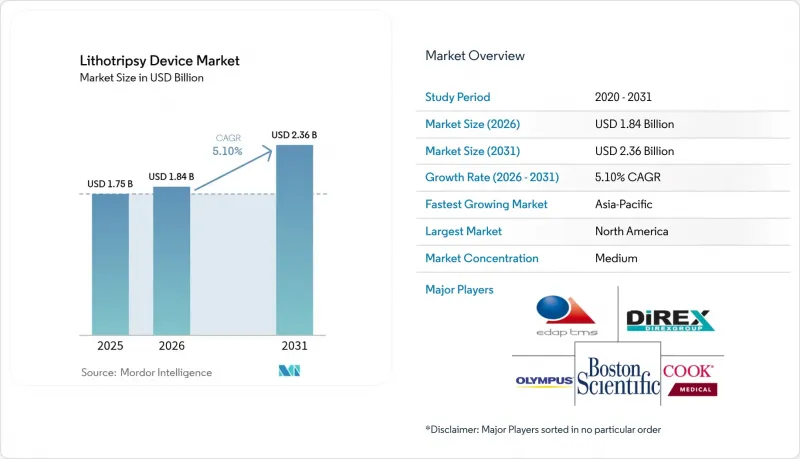
Mordor Intelligence에 의하면, 체외충격파쇄석기 시장 규모는 2025년 17억 5,000만 달러로 평가되었고, 2026년에는 18억 4,000만 달러로 추정되고, 2026-2031년 CAGR 5.10%로 성장을 지속할 전망이며, 2031년에는 23억 6,000만 달러에 이를 것으로 예측됩니다.
본 보고서는 장치 유형별(체외 충격파 쇄석 장치 및 체내 쇄석 장치), 모달리티별(독립형 시스템 및 휴대용/탁상형 시스템), 적응증별(신장 결석, 요관 결석 등), 최종 사용자별(병원, 외래수술센터(ASC) 등), 지역별(북미, 유럽 등)로 분류되어 있습니다. 시장 예측은 금액(달러)으로 표시되어 있습니다.
세계의 체외충격파쇄석기 시장 동향 및 인사이트
전 세계적으로 증가하는 신장 결석 및 요로 결석 발생률
식습관의 변화, 앉아 있는 생활 습관, 그리고 요로 내 미네랄 결정화를 촉진하는 탈수 증상 패턴으로 인해 모든 주요 지역에서 결석증 유병률이 상승하고 있습니다. 충격파 쇄석술은 적격 환자에게서 여전히 50-75%의 성공률을 보이고 있지만, 그 한계로 인해 더 단단한 결석이나 더 폭넓은 환자층을 치료할 수 있는 최신 기기에 대한 수요가 증가하고 있습니다. 임상시험에 따르면, 버스트 웨이브 초음파는 88%의 파쇄율과 약 49%의 결석 제거율을 보인 것으로 보고되어, 기존 시스템에 비해 유효성이 향상되었음을 보여줍니다. 그 결과, 시장에서는 더 적은 시술 횟수로 높은 제거율을 확보할 수 있는 솔루션에 대한 수요가 증가하고 있으며, 이는 결석 분쇄 장치 시장의 꾸준한 판매량 증가를 뒷받침하고 있습니다.
비침습적이고 고정밀도를 갖춘 플랫폼을 향한 지속적인 기술 진화
툴륨 파이버 레이저, 볼텍스 빔 초음파 및 최적화된 에너지 공급 알고리즘이 장비 사양과 임상 프로토콜을 혁신하고 있습니다. 올림푸스의 SOLTIVE 플랫폼은 홀뮴 YAG 레이저에 비해 시술 시간을 20% 단축하고 파쇄 효율을 33% 향상시켰습니다. 보스턴 사이언티피크(Boston Scientific)의 ‘MOSES 2.0’은 후방 이동을 50% 줄여 90%의 환자가 당일 퇴원이 가능하도록 함으로써 외래 진료 워크플로우에서 매력적인 선택지가 되고 있습니다. ‘Lithovortex’와 같은 학술적 프로토타입은 저비용 초음파 설계를 채택하고 있어, 더 폭넓은 환자층을 대상으로 비침습적 분쇄를 가능하게 할 것으로 기대됩니다. 이러한 발전으로 의료진은 마취 사용을 줄이면서도 치료 성과를 향상시킬 수 있게 되었으며, 이는 체외충격파쇄석기 시장 전체에서 고가 시스템에 대한 수요를 부추기고 있습니다.
ESWL 후의 유해한 합병증
체외충격파쇄석술(ESWL)에 따른 결석 재형성 및 기타 부작용은 여전히 임상적 우려 사항입니다. 특히 하극 신장 결석의 경우, 유연한 요관경 검사에서는 90.2%의 결석 제거율을 달성한 반면, ESWL에서는 61.5%에 그치고 있습니다. ESWL 분야에서 제조업체들의 철수와 임상의들의 내시경 치료로의 전환은 선택의 폭이 넓어지고 있음을 보여줍니다. 충격파 기술의 개선으로 체외 결석 분쇄 요법 시장이 활성화될 가능성은 있으나, 안전성에 대한 우려로 인해 결석 분쇄 기기 시장에서 ESWL 관련 지출은 계속해서 억제되고 있습니다.
부문 분석
2025년에는 체외충격파쇄석기가 결석 분쇄 장치 시장 점유율의 52.70%를 차지했으나, 2031년까지는 체강 내 플랫폼이 연평균 성장률(CAGR) 5.74%로 확대될 것으로 예측됩니다. 레이저식 시스템, 특히 툴륨 파이버 모델은 기존 레이저의 절반 출력으로 2배 더 빠르게 결석을 분쇄할 수 있으며, 이러한 성능상의 우위 덕분에 병원의 투자 우선순위가 변화하고 있습니다. 전자기식 ESWL 장치는 시술에 익숙한 기법이기 때문에 사례 수가 많은 의료 기관에서 계속해서 지지를 받고 있습니다. 한편, 압전식 장치는 에너지의 정밀한 조사가 필수적인 전문적인 틈새 시장을 개척하고 있습니다.
체내 치료 기술의 발전은 정밀도 향상과 조직에 대한 부담을 최소화하려는 외과 분야 전반의 동향과 부합합니다. 실험실 검증 결과, 최적화된 설정 하에서 92%의 파쇄율이 확인되어 이러한 기기에 대한 임상적 수용이 확대되고 있습니다. 흡입 기능을 갖춘 초음파 결석 분쇄 장치는 경피적 워크플로우를 개선하며, 공압식 장치는 기계적 충격이 필요한 어려운 사례에서 여전히 활용되고 있습니다. 이러한 동향이 맞물려 체외 체외충격파쇄석기 시장에서 체강 내용 제품의 비중을 높이는 동시에, 각 공급업체로 하여금 기존의 체외식 기기에 그치지 않는 제품 포트폴리오의 다양화를 촉진하고 있습니다.
2025년 시점에서 체외충격파쇄석기 시장 규모의 65.05%를 독립형 시스템이 차지했으며, 이는 통합형 영상 진단 시스템을 갖추고 복잡한 증례에 대응할 수 있는 시설을 갖춘 병원의 진료 유닛이 주도하고 있습니다. 한편, 휴대용 및 탁상형은 연평균 성장률(CAGR) 6.08%로 시장 확대를 주도하고 있습니다. Break Wave사의 초음파 기술은 기동성과 마취가 필요 없다는 특징 덕분에 응급실이나 지방 진료소로의 접근성 확대가 가능함을 보여주고 있습니다. ‘Lithovortex’ 프로토타입은 예산 제약이 있는 환경에 적합한 적당한 크기에 와류 빔 기능을 탑재함으로써 이러한 변화를 더욱 가속화하고 있습니다.
운영상의 유연성은 매우 중요합니다. 휴대용 시스템은 진료실 회전율을 향상시키고 여러 진료과에서 사용하기에 적합하며, 시설 운영 비용을 절감할 수 있어 높은 처리 능력을 추구하는 외래수술센터(ASC) 관리자들 사이에서 인기를 얻고 있습니다. 이에 따라 각 공급업체들은 운반에 적합한 콤팩트함과 투시 장치와의 통합을 견딜 수 있는 견고성을 겸비한 하이브리드 구성을 개발하고 있으며, 체외충격파쇄석기 시장에서 다양한 의료 환경에서의 지속적인 유용성을 확보하고 있습니다.
지역별 분석
북미는 투명성이 높은 환급 절차와 긴밀한 ASC 네트워크에 힘입어 2025년 체외충격파쇄석기 시장 점유율의 32.21%를 차지했습니다. 병원들은 메디케어 코딩의 안정성을 활용하여 장비 교체 주기를 정당화하고 있는 반면, 공급업체들은 새로운 기술을 적극적으로 도입하는 의사층을 고객으로 확보하고 있습니다. 이 지역의 탄탄한 사후 서비스 네트워크는 가동 시간을 더욱 확보하고, 장비 교체 수요를 지속시키고 있습니다.
이어 유럽에서는 성숙해 가면서도 꾸준히 현대화가 진행되고 있는 의료 제도를 볼 수 있습니다. 각국의 건강보험 기금은 저침습 치료를 장려하고 있으며, 이로 인해 신형 레이저 및 휴대용 초음파 장치의 도입이 가속화되고 있습니다. 국경을 초월한 조달 체계는 여러 국가에 걸친 입찰을 지원하고 있으며, 이러한 입찰에서는 종합적인 교육 및 유지보수를 제공하는 공급업체가 종종 우대받습니다. 이러한 요인이 지역 전체에 걸친 제품의 보급을 뒷받침하고 있습니다.
아시아태평양은 인프라 확충, 규제 개혁, 1인당 소득 증가에 힘입어 연평균 성장률(CAGR) 7.18%로 성장할 것으로 전망됩니다. 400억 달러 규모의 일본 의료기기 부문에서는 수술실 생산성을 극대화하는 IoT 지원 기기에 대한 투자가 활발해지고 있습니다. 중국의 부채 경감 전략으로 인해 병원의 설비 투자 예산 제약이 완화되고 있으며, 인도의 행동 강령은 시장의 투명성을 높이고 있습니다. 중동 및 아프리카 및 남미는 절대 규모 면에서는 뒤처져 있지만, 신규 민간 병원 및 공공 부문 프로젝트를 통한 수술실 설비 확충이 진행됨에 따라 성장이 가속화되고 있으며, 이는 체외충격파쇄석기 시장의 세계 확장을 이끌고 있습니다.
기타 혜택 :
- 엑셀 형식 시장 예측(ME) 시트
- 3개월간의 애널리스트 지원
자주 묻는 질문
목차
제1장 서론
제2장 조사 방법
제3장 주요 요약
제4장 시장 구도
제5장 시장 규모 및 성장 예측
제6장 경쟁 구도
제7장 시장 기회 및 향후 전망
AJY 26.09.07According to Mordor Intelligence, the lithotripsy device market size is expected to grow from USD 1.75 billion in 2025 to USD 1.84 billion in 2026 and is forecast to reach USD 2.36 billion by 2031 at 5.10% CAGR over 2026-2031.

This report is Segmented by Device Type (Extracorporeal Shock-Wave Lithotripters and Intracorporeal Lithotripters), Modality (Stand-Alone Systems and Portable / Table-Top Systems), Application (Kidney Stones, Ureteral Stones, and More), End User (Hospitals, Ambulatory Surgical Centers, and More), and Geography (North America, Europe, and More). The Market Forecasts are Provided in Terms of Value (USD).
Global Lithotripsy Device Market Trends and Insights
Growing Global Incidence of Kidney and Urinary Tract Stones
Stone disease prevalence is climbing across every major region due to diet shifts, sedentary habits, and dehydration patterns that potentiate mineral crystallization in urinary tracts. Shock-wave lithotripsy still posts 50-75% success among eligible patients, yet its limitations open room for modern devices that can address harder stones and wider patient profiles. Clinical trials report 88% fragmentation and nearly 49% stone-free status with burst-wave ultrasound, illustrating efficacy gains over legacy systems. Market demand consequently favors solutions that secure higher clearance in fewer sessions, reinforcing steady volume growth within the lithotripsy device market.
Continuous Technology Evolution Toward Non-Invasive, High-Precision Platforms
Thulium-fiber lasers, vortex-beam ultrasound, and optimized energy-delivery algorithms are rewriting device specifications and clinical protocols. Olympus's SOLTIVE platform lowers procedure time by 20% and boosts fragmentation efficiency by 33% compared with Holmium YAG lasers. Boston Scientific's MOSES 2.0 reduces retropulsion by 50% and enables 90% same-day discharge, making it attractive for outpatient workflows. Academic prototypes such as Lithovortex showcase low-cost ultrasound designs that promise non-invasive fragmentation for broader patient cohorts. These advances help providers elevate outcomes while trimming anesthesia use, fueling premium-priced system demand across the lithotripsy device market.
Adverse Post-ESWL Complications
Stone street formation and other side effects from shock-wave therapy remain clinical concerns, especially for lower-pole renal stones where flexible ureteroscopy achieves 90.2% stone-free rates versus ESWL's 61.5%. Manufacturer exits from the ESWL segment and clinician shifts toward endoscopic modalities illustrate growing selectivity. Although burst-wave refinements may revitalize extracorporeal offerings, safety perceptions continue to cap ESWL spend within the lithotripsy device market.
Other drivers and restraints analyzed in the detailed report include:
- Rising Adoption of Day-Care/Ambulatory Stone-Management Procedures
- Expansion of Healthcare Infrastructure and Surgical Capacity in Emerging Economies
- High Upfront and Lifecycle Costs of Lithotripsy Systems
For complete list of drivers and restraints, kindly check the Table Of Contents.
Segment Analysis
Extracorporeal shock-wave units captured 52.70% of lithotripsy device market share in 2025, yet intracorporeal platforms are forecast to rise at 5.74% CAGR through 2031. Laser-based systems, especially thulium-fiber models, fragment stones twice as quickly at half the power of earlier lasers, a performance win that has shifted hospital investment priorities. Electromagnetic ESWL devices keep traction in high-volume centers because of their procedural familiarity, while piezoelectric variants carve out specialized niches where precise energy targeting is essential.
Intracorporeal advances dovetail with the broader surgical trend toward precision and minimal tissue insult. Laboratory evidence shows 92% fragmentation under optimized settings, widening clinical acceptance of these tools. Ultrasonic lithotrites with aspiration enhance percutaneous workflows, and pneumatic devices persist in difficult cases needing mechanical impact. Collectively, these dynamics lift the intracorporeal portion of the lithotripsy device market while pushing vendors to diversify portfolios beyond legacy extracorporeal units.
Stand-alone suites held 65.05% of the lithotripsy device market size in 2025, anchored by well-equipped hospital units handling complex cases with integrated imaging. Yet portable and tabletop designs are pacing the modality race with a 6.08% CAGR. Break Wave ultrasound shows how mobility and anesthesia-free performance can broaden access to emergency departments and rural clinics. The Lithovortex prototype amplifies this shift by packaging vortex-beam capability into an affordable footprint suited for budget-restricted settings.
Operational flexibility is critical. Portable systems shorten room turnover, fit multi-department use, and lower facility overhead, making them popular with ASC administrators aiming for strong throughput. Vendors are thus engineering hybrid configurations-compact enough for transport yet robust enough to integrate with fluoroscopy-ensuring continued relevance across multiple care environments within the lithotripsy device market.
Complete Report Scope:
- By Device Type
- Extracorporeal Shock-Wave Lithotripters
- Electrohydraulic ESWL
- Electromagnetic ESWL
- Piezoelectric ESWL
- Intracorporeal Lithotripters
- Laser Lithotripters
- Ultrasonic Lithotripters
- Pneumatic/Ballistic Lithotripters
- Electrohydraulic Intracorporeal
- Extracorporeal Shock-Wave Lithotripters
- By Modality
- Stand-alone Systems
- Portable / Table-top Systems
- By Application
- Kidney Stones
- Ureteral Stones
- Bladder Stones
- Bile-duct Stones
- Pancreatic Stones
- Salivary-gland Stones
- By End User
- Hospitals
- Ambulatory Surgical Centers
- Specialty Clinics
- Others
- By Geography
- North America
- United States
- Canada
- Mexico
- Europe
- Germany
- United Kingdom
- France
- Italy
- Spain
- Russia
- Rest of Europe
- Asia Pacific
- China
- Japan
- India
- Australia
- South Korea
- Rest of Asia Pacific
- Middle East and Africa
- GCC
- South Africa
- Middle East and Africa
- South America
- Brazil
- Argentina
- Rest of South America
- North America
Geography Analysis
North America accounted for 32.21% of lithotripsy device market share in 2025, supported by transparent reimbursement pathways and a dense ASC network. Hospitals exploit Medicare coding stability to justify equipment refresh cycles, while vendors enjoy receptive early-adopter physician bases. The region's robust after-sales service networks further safeguard utilization uptime, sustaining replacement demand.
Europe follows with mature yet steadily modernizing health systems. National health funds encourage minimally invasive interventions, accelerating adoption of newer lasers and portable ultrasound. Cross-border purchasing frameworks support multicountry tenders that often favor vendors offering comprehensive training and maintenance, a factor strengthening pan-regional product footprints.
Asia Pacific is forecast to grow at 7.18% CAGR thanks to infrastructure expansion, regulatory reforms, and rising per-capita income. Japan's USD 40 billion medical-device sector is investing heavily in IoT-enabled equipment that maximizes operating-room productivity. China's debt-relief strategy is unblocking hospital CAPEX budgets, and India's conduct code is fostering market transparency. Middle East & Africa plus South America trail in absolute value but are accelerating as new private hospitals and public-sector projects equip operating theaters, broadening the global footprint of the lithotripsy device market.
- Advanced MedTech (Dornier MedTech)
- Boston Scientific
- Siemens Healthineers
- Olympus Corp.
- EDAP TMS
- Storz Medical
- Karl Storz
- Beckton Dickinson
- Cook Group
- DirexGroup
- EMS Electro Medical Systems
- Lumenis
- Richard Wolf
- WIKKON (Guangzhou)
- Allengers Medical Systems
- Teleflex
- Nidhi Meditech Systems
- SonoMotion
- Elmed Medical Systems
Additional Benefits:
- The market estimate (ME) sheet in Excel format
- 3 months of analyst support
TABLE OF CONTENTS
1 Introduction
- 1.1 Study Assumptions & Market Definition
- 1.2 Scope of the Study
2 Research Methodology
3 Executive Summary
4 Market Landscape
- 4.1 Market Overview
- 4.2 Market Drivers
- 4.2.1 Growing global incidence of kidney and urinary tract stones
- 4.2.2 Continuous technology evolution toward non-invasive, high-precision lithotripsy platforms
- 4.2.3 Rising adoption of day-care/ambulatory stone-management procedures
- 4.2.4 Expansion of healthcare infrastructure and surgical capacity in emerging economies
- 4.2.5 Broadening reimbursement coverage for stone-fragmentation treatments across major markets
- 4.2.6 Integration of advanced imaging and navigation systems enhancing procedural success
- 4.3 Market Restraints
- 4.3.1 Adverse post-ESWL complications
- 4.3.2 Availability of URS / PCNL alternatives
- 4.3.3 High upfront and lifecycle costs of lithotripsy systems limiting capital purchases
- 4.3.4 Reimbursement disparities and budget constraints in cost-sensitive regions
- 4.4 Regulatory Landscape
- 4.5 Technological Outlook
- 4.6 Porter's Five Forces Analysis
- 4.6.1 Threat of New Entrants
- 4.6.2 Bargaining Power - Buyers
- 4.6.3 Bargaining Power - Suppliers
- 4.6.4 Threat of Substitutes
- 4.6.5 Competitive Rivalry
5 Market Size & Growth Forecasts (Value)
- 5.1 By Device Type
- 5.1.1 Extracorporeal Shock-Wave Lithotripters
- 5.1.1.1 Electrohydraulic ESWL
- 5.1.1.2 Electromagnetic ESWL
- 5.1.1.3 Piezoelectric ESWL
- 5.1.2 Intracorporeal Lithotripters
- 5.1.2.1 Laser Lithotripters
- 5.1.2.2 Ultrasonic Lithotripters
- 5.1.2.3 Pneumatic/Ballistic Lithotripters
- 5.1.2.4 Electrohydraulic Intracorporeal
- 5.1.1 Extracorporeal Shock-Wave Lithotripters
- 5.2 By Modality
- 5.2.1 Stand-alone Systems
- 5.2.2 Portable / Table-top Systems
- 5.3 By Application
- 5.3.1 Kidney Stones
- 5.3.2 Ureteral Stones
- 5.3.3 Bladder Stones
- 5.3.4 Bile-duct Stones
- 5.3.5 Pancreatic Stones
- 5.3.6 Salivary-gland Stones
- 5.4 By End User
- 5.4.1 Hospitals
- 5.4.2 Ambulatory Surgical Centers
- 5.4.3 Specialty Clinics
- 5.4.4 Others
- 5.5 By Geography
- 5.5.1 North America
- 5.5.1.1 United States
- 5.5.1.2 Canada
- 5.5.1.3 Mexico
- 5.5.2 Europe
- 5.5.2.1 Germany
- 5.5.2.2 United Kingdom
- 5.5.2.3 France
- 5.5.2.4 Italy
- 5.5.2.5 Spain
- 5.5.2.6 Russia
- 5.5.2.7 Rest of Europe
- 5.5.3 Asia Pacific
- 5.5.3.1 China
- 5.5.3.2 Japan
- 5.5.3.3 India
- 5.5.3.4 Australia
- 5.5.3.5 South Korea
- 5.5.3.6 Rest of Asia Pacific
- 5.5.4 Middle East and Africa
- 5.5.4.1 GCC
- 5.5.4.2 South Africa
- 5.5.4.3 Middle East and Africa
- 5.5.5 South America
- 5.5.5.1 Brazil
- 5.5.5.2 Argentina
- 5.5.5.3 Rest of South America
- 5.5.1 North America
6 Competitive Landscape
- 6.1 Market Concentration
- 6.2 Market Share Analysis
- 6.3 Company Profiles (includes Global level Overview, Market level overview, Core Segments, Financials as available, Strategic Information, Market Rank/Share for key companies, Products & Services, and Recent Developments)
- 6.3.1 Advanced MedTech (Dornier MedTech)
- 6.3.2 Boston Scientific Corp.
- 6.3.3 Siemens Healthineers AG
- 6.3.4 Olympus Corp.
- 6.3.5 EDAP TMS
- 6.3.6 Storz Medical AG
- 6.3.7 Karl Storz SE & Co. KG
- 6.3.8 Becton, Dickinson and Co.
- 6.3.9 Cook Medical LLC
- 6.3.10 DirexGroup
- 6.3.11 EMS Electro Medical Systems
- 6.3.12 Lumenis Be Ltd.
- 6.3.13 Richard Wolf GmbH
- 6.3.14 WIKKON (Guangzhou)
- 6.3.15 Allengers Medical Systems
- 6.3.16 Teleflex Incorporated
- 6.3.17 Nidhi Meditech Systems
- 6.3.18 SonoMotion
- 6.3.19 Elmed Medical Systems
7 Market Opportunities & Future Outlook
- 7.1 White-space & Unmet-Need Assessment