|
시장보고서
상품코드
2101682
자동화 및 로보틱스용 산업용 액추에이터 시장 기회, 성장 촉진요인, 업계 동향 분석 및 예측(2026-2035년)Industrial Actuators for Automation and Robotics Market Opportunity, Growth Drivers, Industry Trend Analysis, and Forecast 2026 - 2035 |
||||||

세계의 자동화 및 로보틱스용 산업용 액추에이터 시장은 2025년에 304억 달러로 평가되었으며, CAGR 8.5%로 성장하여 2035년까지 677억 달러에 달할 것으로 추정됩니다.
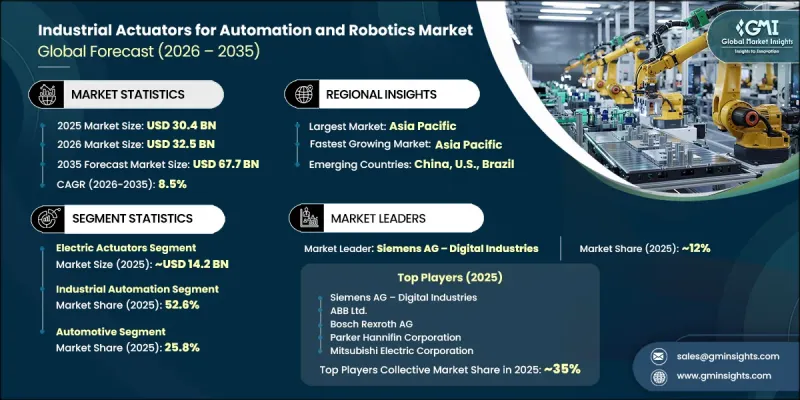
전 세계 자동화 및 로보틱스용 산업용 액추에이터 시장은 고정밀도이자 디지털로 연결된 모션 제어 솔루션을 필요로 하는 첨단 제조 기술의 급속한 보급에 따라 변혁을 겪고 있습니다. 생산 시설이 스마트 제조 환경으로 계속 전환됨에 따라, 정밀도, 신뢰성, 에너지 효율이 뛰어나고 자동 제어 시스템과 원활하게 통합될 수 있는 액추에이터에 대한 수요가 증가하고 있습니다. 산업 전반에 걸친 로봇 공학의 도입 확대는 장기적인 시장 성장을 더욱 뒷받침하고 있습니다. 이는 현대의 자동화가 생산 효율과 운영의 일관성을 향상시키기 위해 지능형 액추에이터 기술에 대한 의존도를 높이고 있기 때문입니다. 또한, 각 제조사는 첨단 로봇 시스템 및 자동화 설비를 지원하는 소형 고성능의 디지털 호환 액추에이터를 우선적으로 채택하고 있습니다. 제조업의 현대화, 산업의 디지털화, 그리고 생산성 향상을 위한 지속적인 투자는 주요 경제권 전반에 걸쳐 여전히 중요한 성장 촉진요인으로 작용하고 있습니다. 더욱이 업무 효율, 공정 최적화 및 고정밀 제조에 대한 중요성이 높아짐에 따라, 예측 기간 동안 광범위한 산업 분야에서 자동화 및 로보틱스용 산업용 액추에이터에 대한 지속적인 수요가 계속해서 강세를 보이고 있습니다.
| 시장 범위 | |
|---|---|
| 시작 연도 | 2025년 |
| 예측 기간 | 2026-2035년 |
| 개시 금액 | 304억 달러 |
| 예측 금액 | 677억 달러 |
| CAGR | 8.5% |
전동 액추에이터 부문은 2025년에 142억 달러의 시장 규모를 기록했으며, 2026년부터 2035년까지 연평균 성장률(CAGR) 8.2%로 성장할 것으로 전망됩니다. 전동 액추에이터는 기존 기술에 비해 뛰어난 정밀도, 신뢰성 높은 동작 제어 및 에너지 효율 향상을 실현함으로써 전 세계 자동화 및 로보틱스용 산업용 액추에이터 시장에서 계속해서 주도적인 위치를 차지하고 있습니다. 디지털 자동화 시스템과 손쉽게 통합될 수 있을 뿐만 아니라, 정확하고 재현성이 높은 성능을 발휘하는 능력 덕분에 현대 제조 시설에서 최적의 선택지로 자리 잡고 있습니다. 제조업체들이 생산성 향상, 운영 정밀도 개선, 유지보수 요구 사항 감소를 우선시하는 가운데, 산업 자동화의 지속적인 발전으로 인해 전동 액추에이터에 대한 수요는 계속해서 증가하고 있습니다.
2025년에는 산업 자동화 용도 부문이 시장 점유율의 52.6%를 차지했습니다. 자동화 제조 시스템, 생산 라인 현대화, 자재 취급 장비, 포장 공정 및 공정 제어 기술에 대한 지속적인 투자가 이 부문의 성장을 계속 견인하고 있습니다. 산업 사용자들 사이에서는 신뢰성 높은 성능, 정밀한 모션 제어, 그리고 첨단 자동화 플랫폼과의 호환성을 갖춘 액추에이터에 대한 수요가 증가하고 있습니다. 제조 효율 향상, 일관된 제품 품질 유지, 운영 비용 절감이 점점 더 중요시되는 가운데, 자동화 기술에 대한 투자가 지속적으로 촉진되고 있으며, 이는 전 세계 다양한 산업 분야에서 산업용 액추에이터에 대한 지속적인 수요를 뒷받침하고 있습니다.
미국의 자동화 및 로보틱스용 산업용 액추에이터 시장은 2025년에 52억 달러 규모에 도달했으며, 2026년부터 2035년까지 연평균 성장률(CAGR) 7.8%로 성장할 것으로 전망됩니다. 이러한 시장 성장은 첨단 제조 기술의 광범위한 도입, 공장 자동화에 대한 지속적인 투자, 그리고 잘 구축된 산업용 로봇 생태계에 의해 뒷받침되고 있습니다. 제조업 전반에 걸친 전동 액추에이터 및 서보 액추에이터에 대한 수요 증가는 계속해서 큰 성장 기회를 창출하고 있습니다. 생산 시설의 지속적인 현대화, 창고 자동화의 확대, 그리고 스마트 제조 시스템 도입 증가는 미국 시장 전반에 걸쳐 첨단 액추에이터 기술에 대한 수요를 더욱 강화하고 있습니다.
자주 묻는 질문
목차
제1장 조사 방법과 범위
제2장 주요 요약
제3장 업계 인사이트
제4장 경쟁 구도
제5장 시장 추정 및 예측 : 작동 유형별, 2022-2035년
제6장 시장 추정 및 예측 : 동작 유형별, 2022-2035년
제7장 시장 추정 및 예측 : 용도별, 2022-2035년
제8장 시장 추정 및 예측 : 최종 이용 산업별, 2022-2035년
제9장 시장 추정 및 예측 : 지역별, 2022-2035년
제10장 기업 개요
KSM 26.08.06The Global Industrial Actuators for Automation and Robotics Market was valued at USD 30.4 billion in 2025 and is estimated to grow at a CAGR of 8.5% to reach USD 67.7 billion by 2035.
The global industrial actuators for automation and robotics market is transformed by the rapid adoption of advanced manufacturing technologies that require highly accurate and digitally connected motion control solutions. As production facilities continue transitioning toward smart manufacturing environments, demand is rising for actuators capable of delivering precision, reliability, energy efficiency, and seamless integration with automated control systems. The growing adoption of robotics across industrial operations further supports long-term market expansion, as modern automation increasingly depends on intelligent actuator technologies to improve production efficiency and operational consistency. Manufacturers are also prioritizing compact, high-performance, and digitally enabled actuators that support advanced robotic systems and automated equipment. Continuous investment in manufacturing modernization, industrial digitization, and productivity enhancement remains a key growth driver across major economies. In addition, increasing emphasis on operational efficiency, process optimization, and high-precision manufacturing continues to reinforce sustained demand for industrial actuators for automation and robotics across a broad range of industrial applications throughout the forecast period.
| Market Scope | |
|---|---|
| Start Year | 2025 |
| Forecast Year | 2026-2035 |
| Start Value | $30.4 Billion |
| Forecast Value | $67.7 Billion |
| CAGR | 8.5% |
The electric actuators segment generated USD 14.2 billion in 2025 and is projected to grow at a CAGR of 8.2% from 2026 to 2035. Electric actuators continue to dominate the global industrial actuators for automation and robotics market because they offer exceptional precision, reliable motion control, and improved energy efficiency compared to conventional technologies. Their ability to integrate easily with digital automation systems while delivering accurate and repeatable performance makes them the preferred choice across modern manufacturing facilities. Ongoing advancements in industrial automation continue to strengthen demand for electric actuators as manufacturers prioritize higher productivity, greater operational accuracy, and lower maintenance requirements.
The industrial automation application segment accounted for 52.6% share in 2025. Continued investments in automated manufacturing systems, production line modernization, material handling equipment, packaging operations, and process control technologies continue to drive segment growth. Industrial users increasingly require actuators that provide dependable performance, precise motion control, and compatibility with advanced automation platforms. Rising emphasis on improving manufacturing efficiency, maintaining consistent product quality, and reducing operating costs continues to encourage greater investment in automation technologies, supporting sustained demand for industrial actuators across multiple industries worldwide.
U.S. Industrial Actuators for Automation and Robotics Market captured USD 5.2 billion in 2025 and is forecast to grow at a CAGR of 7.8% between 2026 and 2035. Market growth is supported by widespread adoption of advanced manufacturing technologies, continued investment in factory automation, and a well-developed industrial robotics ecosystem. Increasing demand for electric and servo actuators across manufacturing industries continues to create significant growth opportunities. Ongoing modernization of production facilities, expanding warehouse automation, and increasing implementation of intelligent manufacturing systems further strengthen demand for advanced actuator technologies throughout the U.S. market.
Major companies operating in the global industrial actuators for automation and robotics market include SMC Corporation, FANUC Corporation, Bosch Rexroth AG, Siemens AG - Digital Industries, Festo SE & Co. KG, ABB Ltd. - Motion BA, Parker Hannifin Corporation, Yaskawa Electric Corporation, Rockwell Automation, Inc., Emerson Electric Co., Mitsubishi Electric Corporation, IAI - Intelligent Actuator Inc., Ewellix AB (Schaeffler Group), IMI Norgren (IMI plc), Moog Inc., LINAK Group, Thomson Industries, Inc., Tolomatic, Inc., Harmonic Drive AG / LLC, Nidec Corporation, and Omron Corporation. Companies competing in the global industrial actuators for automation and robotics market focus on product innovation, digital integration, and portfolio expansion to strengthen their competitive position. Manufacturers continue investing in research and development to improve actuator precision, energy efficiency, reliability, and compatibility with advanced automation systems. Many companies broaden their offerings by introducing intelligent electric and servo actuator solutions designed to meet evolving industrial automation requirements. Strategic partnerships, technology collaborations, and expansion of distribution networks help companies increase market reach and strengthen customer relationships across key industries.
Table of Contents
Chapter 1 Methodology and Scope
- 1.1 Market scope and definition
- 1.2 Research design
- 1.2.1 Research approach
- 1.2.2 Data collection methods
- 1.3 Data mining sources
- 1.3.1 Global
- 1.3.2 Regional/Country
- 1.4 Base estimates and calculations
- 1.4.1 Base year calculation
- 1.4.2 Key trends for market estimation
- 1.5 Primary research and validation
- 1.5.1 Primary sources
- 1.6 Forecast model
- 1.7 Research assumptions and limitations
Chapter 2 Executive Summary
- 2.1 Industry 360° synopsis
- 2.2 Key market trends
- 2.2.1 Regional
- 2.2.2 Actuation type
- 2.2.3 Motion type
- 2.2.4 Application
- 2.2.5 End user industry
Chapter 3 Industry Insights
- 3.1 Industry ecosystem analysis
- 3.1.1 Raw material & component suppliers
- 3.1.2 Actuator manufacturers & OEMs
- 3.1.3 System integrators & distributors
- 3.1.4 End-user industries
- 3.1.5 Profit margin
- 3.1.6 Value addition at each stage
- 3.1.7 Factor affecting the value chain
- 3.2 Industry impact forces
- 3.2.1 Growth drivers
- 3.2.1.1 Accelerating adoption of factory automation & smart manufacturing
- 3.2.1.2 Rising deployment of collaborative robots (cobots) across SME sector
- 3.2.1.3 Expansion of humanoid robot programs creating new actuator demand vectors
- 3.2.2 Pitfalls & challenges
- 3.2.2.1 High upfront cost of advanced electric & servo actuators limiting adoption in cost-sensitive markets
- 3.2.2.2 Dependency on rare earth materials & permanent magnets creating supply vulnerability
- 3.2.3 Opportunities
- 3.2.3.1 Humanoid & service robotics segment opening premium actuator design demand
- 3.2.3.2 AI-integrated predictive maintenance creating new aftermarket service revenue streams
- 3.2.1 Growth drivers
- 3.3 Growth potential analysis
- 3.4 Technology and innovation landscape
- 3.4.1 Emerging actuator technologies
- 3.4.2 Smart actuator integration
- 3.4.3 Miniaturization & high-torque-density design trends
- 3.5 Regulatory framework
- 3.5.1 Industrial safety & functional safety standards (IEC 62061, ISO 13849)
- 3.5.2 Energy efficiency & emissions regulations (EU Ecodesign, ENERGY STAR)
- 3.5.3 Collaborative robot safety regulations (ISO/TS 15066, ISO 10218)
- 3.5.4 Regional regulatory landscape (North America, Europe, Asia Pacific)
- 3.6 Pricing analysis (driven by primary research)
- 3.6.1 Historical price trend analysis by product category
- 3.6.2 Pricing strategy by player type (premium / value / cost-plus)
- 3.7 Supply chain analysis
- 3.7.1 Critical input materials
- 3.7.2 Supply chain vulnerabilities & geopolitical risks
- 3.7.3 Near-shoring & supplier diversification strategies
- 3.8 Trade data analysis (driven by paid database) (HS code- 8412)
- 3.8.1 Import/export volume & value trends
- 3.8.2 Key trade corridors & tariff impact
- 3.9 Impact of AI & generative AI on the market
- 3.9.1 AI-Driven disruption of existing actuator design & manufacturing models
- 3.9.2 GenAI use cases & adoption roadmap by segment
- 3.9.3 Risks, limitations & regulatory considerations for AI in motion control
- 3.10 Capacity & production landscape (driven by primary research)
- 3.10.1 Installed manufacturing capacity by region & key producer
- 3.10.2 Capacity utilization rates & expansion pipelines (driven by primary research)
Chapter 4 Competitive Landscape, 2025
- 4.1 Introduction
- 4.2 Company market share analysis
- 4.2.1 By region
- 4.2.1.1 North America
- 4.2.1.2 Europe
- 4.2.1.3 Asia Pacific
- 4.2.1.4 Latin America
- 4.2.1.5 Middle East and Africa
- 4.2.1 By region
- 4.3 Company matrix analysis
- 4.4 Competitive analysis of major market players
- 4.5 Competitive positioning matrix
- 4.6 Key developments
- 4.6.1 Mergers & acquisitions
- 4.6.2 Partnerships & collaborations
- 4.6.3 New product launches
- 4.6.4 Expansion plans
Chapter 5 Market Estimates and Forecast, By Actuation Type, 2022 - 2035 (USD Billion) (Thousand Units)
- 5.1 Key trends
- 5.2 Electric actuators
- 5.2.1 Servo actuators
- 5.2.2 Stepper motor actuators
- 5.2.3 Linear motor actuators
- 5.2.4 Direct-drive actuators
- 5.3 Hydraulic actuators
- 5.3.1 Single-acting hydraulic actuators
- 5.3.2 Double-acting hydraulic actuators
- 5.4 Pneumatic actuators
- 5.4.1 Single-acting pneumatic actuators
- 5.4.2 Double-acting pneumatic actuators
- 5.5 Rotary pneumatic actuators
- 5.5.1 Piezoelectric actuators
- 5.5.2 Stack piezoelectric actuators
- 5.5.3 Bending piezoelectric actuators
- 5.6 Others (soft actuators, shape memory alloy actuators, electroactive polymer actuators)
Chapter 6 Market Estimates and Forecast, By Motion Type, 2022 - 2035 (USD Billion) (Thousand Units)
- 6.1 Key trends
- 6.2 Linear actuators
- 6.2.1 Rod-style linear actuators
- 6.2.2 Rodless linear actuators
- 6.2.3 Telescopic linear actuators
- 6.3 Rotary actuators
- 6.3.1 Vane-type rotary actuators
- 6.3.2 Rack & pinion rotary actuators
- 6.3.3 Scotch yoke rotary actuators
Chapter 7 Market Estimates and Forecast, By Application, 2022 - 2035 (USD Billion) (Thousand Units)
- 7.1 Key trends
- 7.2 Industrial robots
- 7.2.1 Articulated robots
- 7.2.2 Scara robots
- 7.2.3 Delta/parallel robots
- 7.2.4 Cartesian/gantry robots
- 7.3 Collaborative robots (cobots)
- 7.3.1 Tabletop & lightweight cobots
- 7.3.2 Heavy-payload cobots
- 7.4 Process automation
- 7.4.1 Valve & flow control actuation
- 7.4.2 CNC & machine tool actuation
- 7.4.3 Conveyor & material handling actuation
- 7.5 Service robots
- 7.5.1 Autonomous guided vehicles (AGVS) & AMRS
- 7.5.2 Surgical & medical robots
- 7.5.3 Field robots & exoskeletons
- 7.6 Humanoid robots
- 7.6.1 Full-body anthropomorphic platforms
- 7.6.2 Partial humanoid / upper-body systems
Chapter 8 Market Estimates and Forecast, By End User Industry, 2022 - 2035 (USD Billion) (Thousand Units)
- 8.1 Key trends
- 8.2 Automotive
- 8.2.1 Body assembly & welding
- 8.2.2 Painting & coating automation
- 8.2.3 EV battery assembly
- 8.3 Electronics & semiconductor
- 8.3.1 PCB assembly & smt
- 8.3.2 Chip handling & wafer processing
- 8.4 Aerospace & defense
- 8.4.1 Precision machining & assembly
- 8.4.2 MRO automation
- 8.5 Food & beverages
- 8.5.1 Packaging & filling lines
- 8.5.2 Sorting & inspection automation
- 8.6 Healthcare & medical
- 8.6.1 Surgical robotic systems
- 8.6.2 Rehabilitation & exoskeleton devices
- 8.7 Chemicals & materials
- 8.8 Logistics & warehousing
- 8.8.1 Sortation & pick-and-place systems
- 8.8.2 Autonomous mobile robots (AMRS) in fulfillment centers
- 8.9 Others (metal & machinery, mining, oil & gas, water & wastewater)
Chapter 9 Market Estimates and Forecast, By Region, 2022 - 2035 (USD Billion) (Thousand Units)
- 9.1 Key trends
- 9.2 North America
- 9.2.1 U.S.
- 9.2.2 Canada
- 9.3 Europe
- 9.3.1 Germany
- 9.3.2 UK
- 9.3.3 France
- 9.3.4 Italy
- 9.3.5 Spain
- 9.4 Asia Pacific
- 9.4.1 China
- 9.4.2 Japan
- 9.4.3 India
- 9.4.4 Australia
- 9.4.5 South Korea
- 9.5 Latin America
- 9.5.1 Brazil
- 9.5.2 Mexico
- 9.5.3 Argentina
- 9.6 Middle East and Africa
- 9.6.1 South Africa
- 9.6.2 Saudi Arabia
- 9.6.3 UAE
Chapter 10 Company Profiles
- 10.1 Global players
- 10.1.1 SMC Corporation
- 10.1.2 Festo SE & Co. KG
- 10.1.3 Bosch Rexroth AG
- 10.1.4 Parker Hannifin Corporation
- 10.1.5 ABB Ltd.
- 10.1.6 Yaskawa Electric Corporation
- 10.1.7 FANUC Corporation
- 10.2 Regional Players
- 10.2.1 Siemens AG - Digital Industries
- 10.2.2 Rockwell Automation, Inc.
- 10.2.3 Emerson Electric Co.
- 10.2.4 Mitsubishi Electric Corporation
- 10.2.5 IAI - Intelligent Actuator Inc.
- 10.2.6 Ewellix AB
- 10.2.7 IMI Norgren
- 10.3 Emerging Players
- 10.3.1 Moog Inc.
- 10.3.2 LINAK Group
- 10.3.3 Thomson Industries, Inc.
- 10.3.4 Tolomatic, Inc.
- 10.3.5 Harmonic Drive AG / LLC
- 10.3.6 Nidec Corporation
- 10.3.7 Omron Corporation