
|
시장보고서
상품코드
2096353
휴머노이드 로봇 시장 : 유형별(이족 보행형, 차륜 구동형), 구성요소별(선형 및 회전 액추에이터, 모터, 카메라 및 비전 센서, 하모닉 및 유성 감속기, 인코더, 가속도계, 토크 센서, 모션 및 조인트 컨트롤러) - 세계 예측(-2035년)Humanoid Robot Market by Type (Biped, Wheel Drive), Component (Linear & Rotary Actuators, Motors, Cameras & Vision Sensors, Harmonic & Planetary Reducers, Encoders, Accelerometers, Torque Sensors, Motion & Joint Controllers) - Global Forecast to 2035 |
||||||

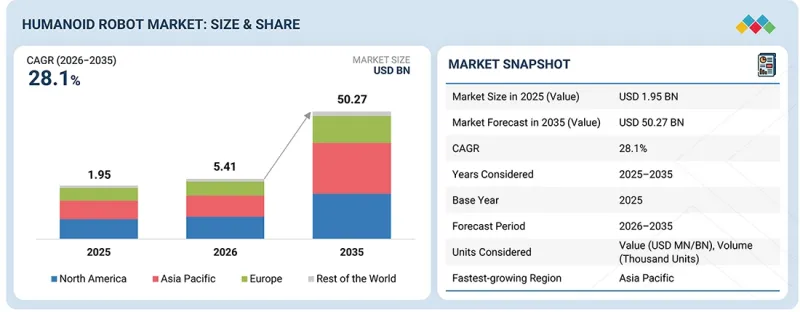
휴머노이드 로봇 시장 규모는 2026년에 54억 1,000만 달러로 추정되며, 2035년에는 502억 7,000만 달러에 달할 것으로 예측됩니다.
2026년부터 2035년까지 연평균 성장률(CAGR) 28.1%로 성장할 것으로 전망됩니다. 시장의 성장은 제조, 창고·물류 센터, 의료, 교육, 호텔·엔터테인먼트, 소매, 개인 비서 분야에서의 유연한 자동화에 대한 수요 증가에 힘입고 있습니다. 최종사용자들이 반복적이고 노동 집약적인 작업이나 대면 응대가 필요한 업무의 자동화를 요구하는 가운데, 이족 보행형, 바퀴 구동형, 몸통형·고정형 휴머노이드 로봇에 대한 투자가 크게 증가하고 있습니다.
| 조사 범위 | |
|---|---|
| 조사 대상 기간 | 2021-2032년 |
| 기준 연도 | 2025년 |
| 예측 기간 | 2026-2032년 |
| 단위 | 금액(달러) |
| 부문 | 유형, 구성요소, 지역별 |
| 대상 지역 | 북미, 유럽, 아시아태평양, 기타 지역 |
휴머노이드 로봇은 생산성 향상, 보다 안전한 운영 지원, 인간과 로봇 간의 상호작용 실현, 그리고 인간을 위해 설계된 환경으로의 자동화 확대에 있어 매우 중요한 역할을 하고 있습니다. 피지컬 AI, 로봇 기반 모델, 시뮬레이션 도구, 지각 시스템, 구동 시스템, 연산·제어 시스템, 함대 관리 플랫폼 분야의 발전이 가속화됨에 따라 전 세계 휴머노이드 로봇 생태계 전반에 걸친 수요가 더욱 증가하고 있습니다.
"하드웨어가 예측 기간 동안 상당한 시장 점유율을 차지할 것으로 전망됩니다."
하드웨어는 로봇의 이동, 조작, 지각, 제어, 전력 관리를 가능하게 하는 데 중요한 역할을 하고 있기 때문에 2026년부터 2035년까지 큰 비중을 차지할 것으로 예측됩니다. 휴머노이드 로봇에는 구동 시스템, 지각 시스템, 연산·제어 시스템, 로봇 제어 시스템, 통신 시스템, 전원 시스템, 그리퍼, 구조 프레임, 열 관리 부품 등 다방면에 걸친 고부가가치 하드웨어 부품이 필요합니다. 이러한 시스템은 휴머노이드 로봇의 물리적 핵심 아키텍처를 구성하며, 균형, 민첩성, 동작 정밀도, 신뢰성, 동작 성능에 직접적인 영향을 미칩니다. 액추에이터, 센서, 배터리, 컨트롤러, 프로세서, 모션 구성요소의 지속적인 개선을 통해, 이족 보행형, 바퀴 구동형, 몸통형 및 고정형 휴머노이드 로봇에의 적용이 더욱 가속화되고 있습니다. 제조, 창고·물류 센터, 의료, 교육, 호텔·관광, 소매, 개인 비서 등의 분야에서 도입이 확대됨에 따라, 예측 기간 동안 하드웨어는 시장 매출의 주요 구성요소가 될 것으로 예상됩니다.
"창고·물류 센터가 예측 기간 동안 상당한 연평균 성장률(CAGR)을 기록할 것으로 전망됩니다."
창고·물류 센터 부문은 물류, 3PL, E-Commerce, 소매 주문 처리 업무 분야에서 유연한 자동화에 대한 수요가 증가함에 따라, 예측 기간 동안 상당한 연평균 성장률(CAGR)을 기록할 것으로 예상됩니다. 기업들은 피킹, 분류, 상품 이동, 재고 관리, 주문 처리 지원 등 반복적이고 육체적으로 힘든 작업을 지원하기 위해 휴머노이드 로봇 도입을 점점 더 적극적으로 모색하고 있습니다. 휴머노이드 로봇은 사람을 위해 설계된 창고 환경에서 작동할 수 있으므로, 대규모 설비 개조가 어려운 시설에도 적합합니다. 주문 정확도 향상, 인력 의존도 감소, 생산성 향상, 대량 주문 처리 업무 관리에 대한 압박이 커짐에 따라, 현대적인 물류 센터에서의 도입이 가속화되고 있습니다. 또한, AI를 활용한 지각, 동작 계획, 조작, 내비게이션, 센서, 액추에이터, 차량 관리 플랫폼의 발전으로 인해 창고 및 물류 생태계 전반에 걸친 휴머노이드 로봇의 도입이 더욱 확대될 것으로 예상됩니다.
"북미는 예측 기간 동안 상당한 연평균 성장률(CAGR)을 기록할 것으로 전망됩니다."
북미에서는 체화형 AI, 로봇 공학 소프트웨어, 산업 자동화, 차세대 인간-기계 상호작용 기술에 대한 활발한 투자를 바탕으로, 예측 기간 동안 크게 성장할 것으로 전망됩니다. 미국은 Tesla, Figure AI, Agility Robotics, Apptronik, Boston Dynamics, 1X Technologies 등 주요 휴머노이드 로봇 개발 기업들이 포진해 있어 지역 시장의 성장을 주도하고 있습니다. 또한 제조, 창고·물류 센터, 물류, 연구, 의료 지원, 상업 서비스 분야에서의 휴머노이드 로봇 도입 확대도 지역 수요를 견인하고 있습니다. 또한, AI를 활용한 지각, 운동 계획, 로봇의 자율성, 조작, 배터리 시스템, 플릿 수준의 제어 플랫폼 분야에서 이루어진 발전이 지역 전체의 상용화를 가속화하고 있습니다. 심화되는 인력 부족, 제조 업무의 국내 복귀, 반복적이고 육체적으로 고된 작업의 자동화에 대한 관심이 높아지는 것도 북미의 휴머노이드 로봇 솔루션 도입을 더욱 촉진하고 있습니다.
휴머노이드 로봇 시장에서 사업을 전개하는 주요 기업 : Unitree Robotics(중국), AgiBot(중국), UBTECH Robotics(중국), Leju Robotics(중국), EngineAI Robotics(중국), Tesla, Inc.(미국), Agility Robotics(미국), Figure AI, Inc.(미국), Fourier Intelligence/Fourier Robotics(중국), Kawada Robotics Corporation(일본), ROBOTIS(한국), PAL Robotics(스페인) 그 밖의 주목할 만한 기업으로는 Boston Dynamics(미국), Apptronik, Inc.(미국), 1X Technologies(노르웨이), LimX Dynamics(중국), Engineered Arts Ltd.(영국)
본 보고서에서는 전 세계 휴머노이드 로봇 시장을 조사하여, 시장 개요, 시장 성장에 영향을 미치는 다양한 요인에 대한 분석, 기술 및 특허 동향, 법규제 환경, 사례 연구, 시장 규모 추정 및 전망, 각종 분류·지역/주요 국가별 상세 분석, 경쟁 현황, 주요 기업 개요 등을 정리하고 있습니다.
KSM 26.07.29자주 묻는 질문
The humanoid robot market is estimated to be USD 5.41 billion in 2026 and is projected to reach USD 50.27 billion by 2035, growing at a CAGR of 28.1% from 2026 to 2035. Market growth is supported by the increasing demand for flexible automation across manufacturing, warehousing & distribution centers, healthcare, education, hospitality & entertainment, retail, and personal assistance applications. As end users seek solutions to automate repetitive, labor-intensive, and human-facing tasks, investments in biped, wheel drive, and torso & stationary humanoid robots are increasing significantly.
| Scope of the Report | |
|---|---|
| Years Considered for the Study | 2021-2032 |
| Base Year | 2025 |
| Forecast Period | 2026-2032 |
| Units Considered | Value (USD Billion) |
| Segments | By Type, Component and Region |
| Regions covered | North America, Europe, APAC, RoW |
Humanoid robots play a critical role in improving productivity, supporting safer operations, enabling human-robot interaction, and expanding automation into environments designed for humans. Growing advancements in physical AI, robot foundation models, simulation tools, perception systems, actuation systems, compute & control systems, and fleet-management platforms are further reinforcing demand across the global humanoid robot ecosystem.
"Hardware to hold significant market share during forecast period"
Hardware is projected to account for a significant share of the humanoid robot market from 2026 to 2035, supported by its critical role in enabling robot mobility, manipulation, perception, control, and power management. Humanoid robots require a wide range of high-value hardware components, including actuation systems, perception systems, compute & control systems, robot control systems, communication systems, power systems, grippers, structural frames, and thermal management components. These systems form the core physical architecture of humanoid robots and directly influence balance, dexterity, movement accuracy, reliability, and operating performance. Continuous improvements in actuators, sensors, batteries, controllers, processors, and motion components are further supporting adoption across biped, wheel drive, and torso & stationary humanoid robots. As deployment expands across manufacturing, warehousing & distribution centers, healthcare, education, hospitality, retail, and personal assistance applications, hardware is expected to remain a major contributor to market revenues throughout the forecast period.
"Warehousing & distribution centers to register significant CAGR during forecast period."
The warehousing & distribution centers segment is expected to register a significant CAGR during the forecast period, driven by increasing demand for flexible automation across logistics, 3PL, e-commerce, and retail fulfillment operations. Companies are increasingly exploring humanoid robots to support repetitive and physically demanding tasks such as picking, sorting, goods movement, inventory handling, and fulfillment assistance. Humanoid robots can operate in human-designed warehouse environments, making them suitable for facilities where major infrastructure redesign may not be feasible. Rising pressure to improve order accuracy, reduce labor dependency, enhance productivity, and manage high-volume fulfillment operations is supporting adoption across modern distribution centers. In addition, advancements in AI-enabled perception, motion planning, manipulation, navigation, sensors, actuators, and fleet-management platforms are expected to strengthen humanoid robot deployment across warehousing and logistics ecosystems.
"North America to register significant CAGR during forecast period"
North America is expected to witness significant growth in the humanoid robot market throughout the forecast period, supported by strong investments in embodied AI, robotics software, industrial automation, and next-generation human-machine interaction technologies. The US remains the primary contributor to regional growth due to the presence of leading humanoid robot developers such as Tesla, Figure AI, Agility Robotics, Apptronik, Boston Dynamics, and 1X Technologies. Rising adoption of humanoid robots across manufacturing, warehousing & distribution centers, logistics, research, healthcare assistance, and commercial service environments is driving regional demand. In addition, advancements in AI-enabled perception, motion planning, robot autonomy, manipulation, battery systems, and fleet-level control platforms are accelerating commercialization across the region. Growing labor shortages, the reshoring of manufacturing operations, and increasing focus on automation in repetitive and physically demanding tasks are further encouraging companies to adopt humanoid robot solutions in North America.
Breakdown of primaries
A variety of executives from key organizations operating in the humanoid robot market were interviewed in-depth, including CEOs, marketing directors, and innovation and technology directors.
- By Company Type: Tier 1 - 52%, Tier 2 - 31%, and Tier 3 - 17%
- By Designation: C-level Executives - 47%, Directors - 31%, and Others - 22%
- By Region: North America - 37%, Europe - 28%, Asia Pacific - 31%, and Rest of the World - 4%
Note: Three tiers of companies have been defined based on their total revenue as of 2025: tier 3: revenue less than USD 500 million; tier 2: revenue between USD 500 million and USD 5 billion; and tier 1: revenue more than USD 5 billion. Other designations include product, sales, and marketing managers. Rest of the World mainly includes South America, Africa, and the Middle East.
Major players operating in the humanoid robot market include Unitree Robotics (China), AgiBot (China), UBTECH Robotics (China), Leju Robotics (China), EngineAI Robotics (China), Tesla, Inc. (US), Agility Robotics (US), Figure AI, Inc. (US), Fourier Intelligence / Fourier Robotics (China), Kawada Robotics Corporation (Japan), ROBOTIS Co., Ltd. (South Korea), and PAL Robotics (Spain). Other notable players include Boston Dynamics (US), Apptronik, Inc. (US), 1X Technologies (Norway), LimX Dynamics (China), and Engineered Arts Ltd. (UK). These companies offer humanoid robot platforms, mobility systems, perception systems, actuation technologies, AI-enabled control software, robot learning platforms, and deployment services supporting manufacturing, warehousing & distribution centers, healthcare, education, hospitality, retail, and personal assistance applications. Market participants compete through product innovation, mobility and manipulation performance, AI integration, safety validation, cost optimization, manufacturing scale-up and strategic partnerships with industrial and service-sector end users. The study provides a detailed competitive analysis of these key players, presenting company profiles, recent developments, product portfolios, and key market strategies.
The study provides a detailed competitive analysis of these key players in the humanoid robot market, presenting their company profiles, recent developments, and key market strategies.
Research Coverage
The humanoid robot market is segmented by type, offering, application, and region. The type segment includes biped, wheel drive, and torso & stationary humanoid robots, while the offering segment comprises hardware, software, and services. The hardware segment covers actuation systems, perception systems, compute & control systems, robot control systems, communication systems, power systems, and other hardware components. By application, the market covers manufacturing, warehousing & distribution centers, healthcare, education, hospitality & entertainment, personal assistance & caregiving, and others. Regionally, the market is segmented into North America, Europe, Asia Pacific, and the Rest of the World.
Reasons to buy the report
The report will help market leaders and new entrants by providing information on the closest approximations of revenue for the overall humanoid robot market and its subsegments. This report will help stakeholders understand the competitive landscape and gain additional insights to position their businesses better and plan suitable go-to-market strategies. The report also helps stakeholders gauge the pulse of the market and provides insights into key drivers, restraints, challenges, and opportunities influencing the humanoid robot market.
Key Benefits of Buying the Report
- Analysis of key drivers (Rapid progress in physical AI, robot foundation models, and simulation tools, Advancements in artificial intelligence and machine learning, Constant focus on developing humanoid robots with advanced features, Increasing use of humanoids in education sector, Surging deployment of humanoid robots in retail stores, Rising demand for humanoid robots from healthcare sector), restraints (Requirement for significant capital investment and extensive R&D expenditure in humanoid robots, Performance limitations of humanoid robots in untested environments), opportunities (Increasing adoption of Robots-as-a-Service and fleet-management models, Government-led robotics programs and standardization initiatives to support commercialization, Rapidly growing elderly population worldwide, Rising demand for humanoid robots from logistics sector, Increasing adoption of humanoid robots in search and rescue operations), and challenges (Safety concerns limiting adoption of humanoid robots, Limited awareness about advantages of humanoid robots) influencing the growth of the humanoid robot market.
- Product Development/Innovation: Detailed insights on upcoming technologies, research and development activities, and product launches in the humanoid robot market
- Market Development: Comprehensive information about lucrative markets - the report analyzes the humanoid robot market across varied regions
- Market Diversification: Exhaustive information about new products/services, untapped geographies, recent developments, and investments in the humanoid robot market
- Competitive Assessment: In-depth assessment of market shares, growth strategies, product portfolios, and service offerings of leading players such as Unitree Robotics (China), AgiBot (China), UBTECH Robotics (China), Leju Robotics (China), and EngineAI Robotics (China). The report provides detailed insights into their competitive positioning, strategic developments, product innovations, and growth initiatives across the global humanoid robot market.
TABLE OF CONTENTS
1 INTRODUCTION
- 1.1 STUDY OBJECTIVES
- 1.2 MARKET DEFINITION
- 1.3 STUDY SCOPE
- 1.3.1 MARKET SEGMENTATION AND REGIONAL SCOPE
- 1.3.2 INCLUSIONS AND EXCLUSIONS
- 1.3.3 YEARS CONSIDERED
- 1.4 CURRENCY CONSIDERED
- 1.5 UNIT CONSIDERED
- 1.6 STAKEHOLDERS
- 1.7 SUMMARY OF CHANGES
2 EXECUTIVE SUMMARY
- 2.1 MARKET HIGHLIGHTS AND KEY INSIGHTS
- 2.2 KEY MARKET PARTICIPANTS: MAPPING OF STRATEGIC DEVELOPMENTS
- 2.3 DISRUPTIVE TRENDS IN HUMANOID ROBOT MARKET
- 2.4 HIGH GROWTH SEGMENTS
- 2.5 REGIONAL SNAPSHOT: MARKET SIZE, GROWTH RATE, AND FORECAST
3 PREMIUM INSIGHTS
- 3.1 ATTRACTIVE OPPORTUNITIES FOR PLAYERS IN HUMANOID ROBOT MARKET
- 3.2 HUMANOID ROBOT MARKET, BY TYPE
- 3.3 HUMANOID ROBOT MARKET, BY OFFERING
- 3.4 HUMANOID ROBOT MARKET, BY APPLICATION
- 3.5 HUMANOID ROBOT MARKET, BY GEOGRAPHY
4 MARKET OVERVIEW
- 4.1 INTRODUCTION
- 4.2 MARKET DYNAMICS
- 4.2.1 DRIVERS
- 4.2.1.1 Rapid progress in physical AI, robot foundation models, and simulation tools
- 4.2.1.2 Rising integration of artificial intelligence (AI) and machine learning (ML)
- 4.2.1.3 Growing emphasis on developing robots with advanced features
- 4.2.1.4 Increasing implementation of educational robotics programs
- 4.2.1.5 Strong focus on enhancing customer engagement in retail stores
- 4.2.1.6 Rising automation of healthcare operations
- 4.2.1 DRIVERS
4.2.2 RESTRAINTS
- 4.2.2.1 Requirement for significant capital investment and extensive R&D expenditure
- 4.2.2.2 Limited scope in unstructured, human-centered environments
- 4.2.3 OPPORTUNITIES
- 4.2.3.1 Increasing adoption of Robots-as-a-Service and fleet-management models
- 4.2.3.2 Rising implementation of government-led robotics programs and standardization initiatives
- 4.2.3.3 Growing elderly population worldwide
- 4.2.3.4 Strong focus on reducing operational costs and addressing labor shortages in logistics sector
- 4.2.4 CHALLENGES
- 4.2.4.1 Safety concerns arising from robot malfunction
- 4.2.4.2 Limited awareness about advantages of humanoid robots
- 4.3 INTERCONNECTED MARKETS AND CROSS-SECTOR OPPORTUNITIES
- 4.4 STRATEGIC MOVES BY TIER-1/2/3 PLAYERS
5 INDUSTRY TRENDS
- 5.1 INTRODUCTION
- 5.2 PORTER'S FIVE FORCES ANALYSIS
- 5.2.1 BARGAINING POWER OF SUPPLIERS
- 5.2.2 BARGAINING POWER OF BUYERS
- 5.2.3 THREAT OF NEW ENTRANTS
- 5.2.4 THREAT OF SUBSTITUTES
- 5.2.5 INTENSITY OF COMPETITIVE RIVALRY
- 5.3 MACROECONOMIC OUTLOOK
- 5.3.1 INTRODUCTION
- 5.3.2 GDP TRENDS AND FORECAST
- 5.3.3 TRENDS IN GLOBAL WAREHOUSING & DISTRIBUTION INDUSTRY
- 5.3.4 TRENDS IN GLOBAL MANUFACTURING INDUSTRY
- 5.4 VALUE CHAIN ANALYSIS
- 5.5 ECOSYSTEM ANALYSIS
- 5.6 PRICING ANALYSIS
- 5.6.1 AVERAGE SELLING PRICE OF HUMANOID ROBOTS OFFERED BY KEY PLAYERS, BY TYPE, 2025
- 5.6.2 AVERAGE SELLING PRICE TREND OF HUMANOID ROBOTS, 2025-2035
- 5.6.3 AVERAGE SELLING PRICE TREND OF HUMANOID ROBOTS, BY REGION, 2025-2035
- 5.7 TRADE ANALYSIS
- 5.7.1 IMPORT SCENARIO (HS CODE 847950)
- 5.7.2 EXPORT SCENARIO (HS CODE 847950)
- 5.8 KEY CONFERENCES AND EVENTS, 2026-2027
- 5.9 TRENDS/DISRUPTIONS IMPACTING CUSTOMER BUSINESS
- 5.10 INVESTMENT AND FUNDING SCENARIO
- 5.11 CASE STUDY ANALYSIS
- 5.11.1 BMW GROUP USES FIGURE 02 HUMANOID ROBOT TO IMPROVE PRODUCTIVITY, SAFETY, AND CONSISTENCY IN AUTOMOTIVE OPERATIONS
- 5.11.2 MERCEDES-BENZ TESTS APTRONIK'S APOLLO HUMANOID ROBOT TO SUPPORT MANUFACTURING OPERATIONS
- 5.11.3 GXO USES AGILITY ROBOTICS' DIGIT HUMANOID ROBOT TO AUTOMATE LOGISTICS OPERATIONS
- 5.12 IMPACT OF US TARIFFS - HUMANOID ROBOT MARKET
- 5.12.1 INTRODUCTION
- 5.12.2 KEY TARIFF RATES
- 5.12.3 PRICE IMPACT ANALYSIS
- 5.12.4 IMPACT ON COUNTRIES/REGIONS
- 5.12.4.1 US
- 5.12.4.2 Europe
- 5.12.4.3 Asia Pacific
- 5.12.5 IMPACT ON APPLICATIONS
6 TECHNOLOGICAL ADVANCEMENTS, AI-DRIVEN IMPACT, PATENTS, AND INNOVATIONS
- 6.1 KEY TECHNOLOGIES
- 6.1.1 ARTIFICIAL INTELLIGENCE (AI) AND MACHINE LEARNING (ML)
- 6.1.2 NATURAL LANGUAGE PROCESSING (NLP)
- 6.2 COMPLEMENTARY TECHNOLOGIES
- 6.2.1 CLOUD COMPUTING
- 6.2.2 EDGE COMPUTING
- 6.2.3 SIMULATION, DIGITAL TWIN, AND SYNTHETIC DATA GENERATION
- 6.3 ADJACENT TECHNOLOGIES
- 6.3.1 5G AND INDUSTRIAL AUTOMATION
- 6.3.2 INTERNET OF THINGS (IOT)
- 6.4 TECHNOLOGY/PRODUCT ROADMAP
- 6.5 PATENT ANALYSIS
- 6.6 IMPACT OF AI ON HUMANOID ROBOT MARKET
- 6.6.1 TOP USE CASES AND MARKET POTENTIAL
- 6.6.2 BEST PRACTICES FOLLOWED BY OEMS IN HUMANOID ROBOT MARKET
- 6.6.3 CASE STUDIES RELATED TO AI IMPLEMENTATION IN HUMANOID ROBOT MARKET
- 6.6.4 INTERCONNECTED ECOSYSTEM AND IMPACT ON MARKET PLAYERS
- 6.6.5 CLIENTS' READINESS TO ADOPT AI-INTEGRATED HUMANOID ROBOTS
7 REGULATORY LANDSCAPE
- 7.1 REGIONAL REGULATIONS AND COMPLIANCE
- 7.1.1 REGULATORY BODIES, GOVERNMENT AGENCIES, AND OTHER ORGANIZATIONS
- 7.2 INDUSTRY STANDARDS
- 7.3 REGULATIONS
- 7.3.1 NORTH AMERICA
- 7.3.1.1 US
- 7.3.1.1.1 OSHA 29 CFR 1910 - Occupational Safety and Health Standards for General Industry
- 7.3.1.1.2 ANSI/A3 R15.06-2025 - Industrial Robots and Robot Systems Safety Requirements
- 7.3.1.1.3 UL 3300 - Service, Communication, Information, Education, and Entertainment Robots
- 7.3.1.2 Canada
- 7.3.1.2.1 CAN/CSA-Z434 - Industrial Robots and Robot Systems Safety Requirements
- 7.3.1.2.2 Canada Occupational Health and Safety Regulations/Provincial OHS Requirements
- 7.3.1.2.3 CSA C22.2 No. 301 - Industrial Electrical Machinery
- 7.3.1.2.4 PIPEDA - Personal Information Protection and Electronic Documents Act
- 7.3.1.1 US
- 7.3.2 EUROPE
- 7.3.2.1 EU
- 7.3.2.1.1 EU AI Act (Regulation (EU) 2024/1689)
- 7.3.2.1.2 Machinery Regulation (EU) 2023/1230
- 7.3.2.1.3 Robot Safety Standards - EN ISO 13482 and EN ISO 10218
- 7.3.2.1.4 Cyber Resilience Act and GDPR
- 7.3.2.2 Germany
- 7.3.2.2.1 DGUV/IFA Guidance on Collaborative Robot Systems
- 7.3.2.2.2 DIN EN ISO Robot Safety Standards - DIN EN ISO 10218, ISO/TS 15066, and ISO 13482
- 7.3.2.3 UK
- 7.3.2.3.1 Supply of Machinery (Safety) Regulations 2008
- 7.3.2.3.2 UK Designated Machinery Standards, including BS EN ISO 10218 and Service-robot Safety Standards
- 7.3.2.3.3 UK AI and Data Protection Framework
- 7.3.2.1 EU
- 7.3.3 ASIA PACIFIC
- 7.3.3.1 China
- 7.3.3.1.1 Humanoid Robot Standard System/National Standardization Framework
- 7.3.3.1.2 China Robot Certification and Safety Requirements
- 7.3.3.1 China
- 7.3.1 NORTH AMERICA
7.3.3.2 Japan
- 7.3.3.2.1 JJIS/ISO Robot Safety Standards
- 7.3.3.2.2 Service Robot Safety Operation Standards
8 CUSTOMER LANDSCAPE AND BUYER BEHAVIOR
- 8.1 DECISION-MAKING PROCESS
- 8.2 KEY STAKEHOLDERS INVOLVED IN BUYING PROCESS AND THEIR EVALUATION CRITERIA
- 8.2.1 KEY STAKEHOLDERS IN BUYING PROCESS
- 8.2.2 BUYING CRITERIA
- 8.3 ADOPTION BARRIERS AND INTERNAL CHALLENGES
- 8.4 UNMET NEEDS OF VARIOUS APPLICATIONS
9 HUMANOID ROBOT MARKET, BY TYPE
- 9.1 INTRODUCTION
- 9.2 BIPED
- 9.2.1 RISING INTEGRATION OF ADVANCED TECHNOLOGIES AND SENSORS TO BOOST SEGMENTAL GROWTH
- 9.3 WHEEL DRIVE
- 9.3.1 INCREASING USE IN ENVIRONMENTS REQUIRING EFFICIENT MOVEMENT OVER FLAT SURFACES TO FUEL SEGMENTAL GROWTH
- 9.4 TORSO & STATIONARY
- 9.4.1 GROWING FOCUS ON SUPPORTING CUSTOMER ENGAGEMENT AND REMOTE OPERATION AT LOW COST TO SPUR DEMAND
10 HUMANOID ROBOT MARKET, BY OFFERING
- 10.1 INTRODUCTION
- 10.2 HARDWARE
- 10.2.1 HUMANOID ROBOTS: KEY COMPONENTS & TECHNICAL SPECIFICATIONS
- 10.2.2 ACTUATION SYSTEMS
- 10.2.2.1 By actuator type
- 10.2.2.1.1 Linear actuators
- 10.2.2.1.1.1 Ability to improve gripping precision, load handling, and repeatable movement accuracy to augment segmental growth
- 10.2.2.1.2 Rotary actuators
- 10.2.2.1.2.1 Support for smooth and precise joint control to contribute to segmental growth
- 10.2.2.1.1 Linear actuators
- 10.2.2.2 By component
- 10.2.2.2.1 Motors
- 10.2.2.2.1.1 High precision, torque control, efficiency, and reliability to expedite segmental growth
- 10.2.2.2.1.2 Frameless torque motors
- 10.2.2.2.1.3 Servo motors
- 10.2.2.2.1.4 Brushless DC (BLDC) motors
- 10.2.2.2.2 Motion components
- 10.2.2.2.2.1 Use to improve torque output, stability, and repeatable robot movement to facilitate segmental growth
- 10.2.2.2.2.2 Harmonic reducers/gearboxes
- 10.2.2.2.2.3 Planetary reducers/gearboxes
- 10.2.2.2.2.4 Ball screws
- 10.2.2.2.2.5 Roller screws
- 10.2.2.2.2.6 Linear guides
- 10.2.2.2.3 Actuator electronics
- 10.2.2.2.3.1 Focus on enabling accurate motor control and coordinated motion execution to augment segmental growth
- 10.2.2.2.3.2 Motor drives
- 10.2.2.2.3.3 Servo drives
- 10.2.2.2.1 Motors
- 10.2.2.1 By actuator type
- 10.2.3 PERCEPTION SYSTEMS
- 10.2.3.1 External sensors
- 10.2.3.1.1 Cameras & spatial awareness sensors
- 10.2.3.1.1.1 Ability to support object recognition, depth estimation, mapping, obstacle detection, and navigation to foster segmental growth
- 10.2.3.1.1.2 Cameras & vision sensors
- 10.2.3.1.1.3 LiDAR sensors
- 10.2.3.1.1.4 Ultrasonic sensors
- 10.2.3.1.1.5 Radar sensors
- 10.2.3.1.2 Thermal & proximity sensors
- 10.2.3.1.2.1 Need to maintain safe operating distance, reduce collision risk, and improve human-aware movement to expedite segmental growth
- 10.2.3.1.3 Infrared sensors
- 10.2.3.1.3.1 Ability to support non-contact detection to accelerate segmental growth
- 10.2.3.1.4 Audio sensors
- 10.2.3.1.4.1 Use to improve accessibility and ease of use of robots to bolster segmental growth
- 10.2.3.1.1 Cameras & spatial awareness sensors
- 10.2.3.2 Internal sensors
- 10.2.3.2.1 Motion & position sensors
- 10.2.3.2.1.1 Requirement for precise joint control, real-time feedback, autonomous operation, and safety to drive market
- 10.2.3.2.1.2 Encoders
- 10.2.3.2.1.3 Accelerometers
- 10.2.3.2.1.4 Gyroscopes
- 10.2.3.2.2 Force & contact sensors
- 10.2.3.2.2.1 Ability to support joint force control, safe object handling, and collision detection to boost segmental growth
- 10.2.3.2.2.2 Torque sensors
- 10.2.3.2.2.3 Force sensors
- 10.2.3.2.2.4 Tactile sensors
- 10.2.3.2.2.5 Pressure sensors
- 10.2.3.2.3 Health monitoring sensors
- 10.2.3.2.3.1 Use to detect overheating, overload, battery issues, electrical faults, and abnormal operating conditions to spur demand
- 10.2.3.2.3.2 Temperature sensors
- 10.2.3.2.3.3 Current & voltage sensors
- 10.2.3.2.1 Motion & position sensors
- 10.2.3.3 Compute & control systems
- 10.2.3.3.1 CPUs
- 10.2.3.3.1.1 Growing complexity of robots and multitasking requirements to augment segmental growth
- 10.2.3.3.2 GPUs
- 10.2.3.3.2.1 Rising need for advanced perception, navigation, and environmental awareness of robots to facilitate segmental growth
- 10.2.3.3.3 NPUs
- 10.2.3.3.3.1 Increasing use to process complex neural networks locally to contribute to segmental growth
- 10.2.3.3.1 CPUs
- 10.2.3.4 Robot control systems
- 10.2.3.4.1 Motion controllers
- 10.2.3.4.1.1 Growing need for precise trajectory planning and smooth execution of complex robotic tasks to drive market
- 10.2.3.4.2 Joint controllers
- 10.2.3.4.2.1 Strong focus on accurate position, torque, and velocity control at individual robot joints to fuel segmental growth
- 10.2.3.4.1 Motion controllers
- 10.2.3.5 Communication systems
- 10.2.3.5.1 Wired systems
- 10.2.3.5.1.1 Ethernet
- 10.2.3.5.1.1.1 Mounting adoption to allow high-speed processing and sensor communication to boost segmental growth
- 10.2.3.5.1.2 Controller area network (CAN)
- 10.2.3.5.1.2.1 Rising support for reliable communication between sensors, actuators, and control electronics to spur demand
- 10.2.3.5.1.3 EtherCAT
- 10.2.3.5.1.3.1 Increasing use to support fast and synchronized control communication to contribute to segmental growth
- 10.2.3.5.1.1 Ethernet
- 10.2.3.5.2 Wireless systems
- 10.2.3.5.2.1 Wi-Fi
- 10.2.3.5.2.1.1 Need for remote monitoring, diagnostics, software updates, and local network communication to foster segmental growth
- 10.2.3.5.2.2 5G/Cellular
- 10.2.3.5.2.2.1 Use to support robot operation across large facilities, campuses, public spaces, and distributed environments to expedite segmental growth
- 10.2.3.5.2.1 Wi-Fi
- 10.2.3.5.1 Wired systems
- 10.2.3.6 Power systems
- 10.2.3.6.1 Battery packs
- 10.2.3.6.1.1 Rechargeable nature and high energy density to contribute to segmental growth
- 10.2.3.6.2 Battery management systems
- 10.2.3.6.2.1 Use to enable safe operation, longer battery life, and predictable runtime to bolster segmental growth
- 10.2.3.6.3 Power & charging management components
- 10.2.3.6.3.1 Ability to protect sensitive electronics and improve energy efficiency to augment segmental growth
- 10.2.3.6.1 Battery packs
- 10.2.3.7 Other hardware components
- 10.2.3.1 External sensors
- 10.3 SOFTWARE
- 10.3.1 FOCUS ON IMPROVING AUTONOMY, FLEXIBILITY, ACCURACY, AND HUMAN-LIKE INTERACTION TO FUEL SEGMENTAL GROWTH
- 10.3.2 MANIPULATION
- 10.3.3 NAVIGATION
- 10.3.4 INTERACTION
- 10.4 SERVICES
- 10.4.1 EMPHASIS ON IMPROVING ROBOT UPTIME, EXTENDING LIFESPAN, AND ADAPTING TO SPECIFIC OPERATIONAL NEEDS TO DRIVE MARKET
11 HUMANOID ROBOT MARKET, BY APPLICATION
- 11.1 INTRODUCTION
- 11.2 MANUFACTURING
- 11.2.1 RISING NEED TO PERFORM REPETITIVE, PHYSICALLY DEMANDING, OR ERGONOMICALLY CHALLENGING TASKS TO BOOST SEGMENTAL GROWTH
- 11.2.2 AUTOMOTIVE
- 11.2.3 ELECTRONICS
- 11.2.4 PHARMACEUTICALS
- 11.2.5 GENERAL INDUSTRIAL MANUFACTURING
- 11.3 WAREHOUSING & DISTRIBUTION
- 11.3.1 GROWING DEMAND FOR FLEXIBLE AUTOMATION TOOLS TO HANDLE REPETITIVE TASKS TO ACCELERATE SEGMENTAL GROWTH
- 11.3.2 LOGISTICS & 3PL
- 11.3.3 E-COMMERCE & RETAIL
- 11.4 HEALTHCARE
- 11.4.1 STRONG FOCUS ON PATIENT ASSISTANCE, CAREGIVING SUPPORT, AND HOSPITAL AUTOMATION TO FOSTER SEGMENTAL GROWTH
- 11.4.2 HOSPITAL OPERATIONS
- 11.4.3 PATIENT CARE, REHABILITATION & THERAPY
- 11.5 EDUCATION
- 11.5.1 MOUNTING DEMAND FOR INTERACTIVE LEARNING ASSISTANTS TO EXPEDITE SEGMENTAL GROWTH
- 11.5.2 TRAINING & INTERACTIVE LEARNING
- 11.5.3 RESEARCH & DEVELOPMENT
- 11.6 HOSPITALITY & ENTERTAINMENT
- 11.6.1 RISING EMPHASIS ON IMPROVING GUEST ENGAGEMENT AND CONCIERGE SERVICES TO ACCELERATE SEGMENTAL GROWTH
- 11.6.2 HOTELS
- 11.6.3 AIRPORTS
- 11.6.4 THEME PARKS & VISITOR ATTRACTIONS/MUSEUMS
- 11.7 PERSONAL ASSISTANCE & CAREGIVING
- 11.7.1 INCREASING NEED FOR ELDERLY SUPPORT, COMPANIONSHIP, AND DAILY-LIVING ASSISTANCE TO FUEL SEGMENTAL GROWTH
- 11.7.2 WELLNESS & COMPANIONSHIP
- 11.7.3 HOME ASSISTANCE
- 11.8 OTHER APPLICATIONS
12 HUMANOID ROBOT MARKET, BY REGION
- 12.1 INTRODUCTION
- 12.2 NORTH AMERICA
- 12.2.1 US
- 12.2.1.1 Growing aging population and technological advances to boost market growth
- 12.2.2 CANADA
- 12.2.2.1 Increasing investment in service robotics and automation to support market growth
- 12.2.3 MEXICO
- 12.2.3.1 Rising interest in AI-enabled automation and manufacturing robotics adoption to fuel market growth
- 12.2.1 US
- 12.3 EUROPE
- 12.3.1 UK
- 12.3.1.1 Mounting adoption of robots in healthcare and personal assistance applications to accelerate market growth
- 12.3.2 GERMANY
- 12.3.2.1 Strong industrial base and government-backed robotics research to drive market
- 12.3.3 FRANCE
- 12.3.3.1 Growing emphasis on advancing robotics through research and practical applications to create market growth opportunities
- 12.3.4 ITALY
- 12.3.4.1 Increasing incentives and funding for robotics and automation to foster market growth
- 12.3.5 SPAIN
- 12.3.5.1 Rising adoption of robots to enhance learning experiences in education sector and research institutions to propel market
- 12.3.6 REST OF EUROPE
- 12.3.1 UK
12.4 ASIA PACIFIC
- 12.4.1 CHINA
- 12.4.1.1 Growing focus on mass development of robots and embodied AI to augment market growth
- 12.4.2 JAPAN
- 12.4.2.1 Rising government initiatives related to robot developments to cater to aging population to drive market
- 12.4.3 INDIA
- 12.4.3.1 Increasing research and development in robotics to create lucrative market growth opportunities
- 12.4.4 SOUTH KOREA
- 12.4.4.1 Rising smart factory development and manufacturing automation to support market growth
- 12.4.5 AUSTRALIA
- 12.4.5.1 Growing emphasis on automation and technological advancements to accelerate segmental growth
- 12.4.6 SINGAPORE
- 12.4.6.1 Rising need for automation in care delivery, patient support, rehabilitation, and elderly assistance to fuel market growth
- 12.4.7 REST OF ASIA PACIFIC
- 12.5 ROW
- 12.5.1 SOUTH AMERICA
- 12.5.1.1 Increasing installation of industrial robots for automation to expedite market growth
- 12.5.2 MIDDLE EAST
- 12.5.2.1 Mounting deployment of professional service robots to contribute to market growth
- 12.5.2.2 GCC countries
- 12.5.2.3 Rest of Middle East
- 12.5.3 AFRICA
- 12.5.3.1 Increasing investment in industrial automation and digital transformation initiatives to bolster market growth
- 12.5.1 SOUTH AMERICA
13 COMPETITIVE LANDSCAPE
- 13.1 OVERVIEW
- 13.2 KEY PLAYER COMPETITIVE STRATEGIES/RIGHT TO WIN, 2023-2026
- 13.3 REVENUE ANALYSIS, 2021-2025
- 13.4 MARKET SHARE ANALYSIS, 2025
- 13.5 COMPANY VALUATION AND FINANCIAL METRICS
- 13.6 PRODUCT COMPARISON
- 13.7 COMPANY EVALUATION MATRIX: KEY PLAYERS, 2025
- 13.7.1 STARS
- 13.7.2 EMERGING LEADERS
- 13.7.3 PERVASIVE PLAYERS
- 13.7.4 PARTICIPANTS
- 13.7.5 COMPANY FOOTPRINT: KEY PLAYERS, 2025
- 13.7.5.1 Company footprint
- 13.7.5.2 Region footprint
- 13.7.5.3 Type footprint
- 13.7.5.4 Offering footprint
- 13.7.5.5 Application footprint
- 13.8 COMPANY EVALUATION MATRIX: STARTUPS/SMES, 2025
- 13.8.1 PROGRESSIVE COMPANIES
- 13.8.2 RESPONSIVE COMPANIES
- 13.8.3 DYNAMIC COMPANIES
- 13.8.4 STARTING BLOCKS
- 13.8.5 COMPETITIVE BENCHMARKING: STARTUPS/SMES, 2025
- 13.8.5.1 Detailed list of key startups/SMES
- 13.8.5.2 Competitive benchmarking of key startups/SMEs
- 13.9 COMPETITIVE SCENARIO
- 13.9.1 PRODUCT LAUNCHES
- 13.9.2 DEALS
- 13.9.3 EXPANSIONS
14 COMPANY PROFILES
- 14.1 KEY PLAYERS
- 14.1.1 UNITREE ROBOTICS (YUSHU TECHNOLOGY CO., LTD.)
- 14.1.1.1 Business overview
- 14.1.1.2 Products/Solutions/Services offered
- 14.1.1.3 Recent developments
- 14.1.1.3.1 Deals
- 14.1.1.4 MnM view
- 14.1.1.4.1 Key strengths/Right to win
- 14.1.1.4.2 Strategic choices
- 14.1.1.4.3 Weaknesses/Competitive threats
- 14.1.2 AGIBOT INNOVATION (SHANGHAI) TECHNOLOGY CO., LTD.
- 14.1.2.1 Business overview
- 14.1.2.2 Products/Solutions/Services offered
- 14.1.2.3 Recent developments
- 14.1.2.3.1 Product launches
- 14.1.2.3.2 Deals
- 14.1.2.3.3 Expansions
- 14.1.2.4 MnM view
- 14.1.2.4.1 Key strengths/Right to win
- 14.1.2.4.2 Strategic choices
- 14.1.2.4.3 Weaknesses/Competitive threats
- 14.1.1 UNITREE ROBOTICS (YUSHU TECHNOLOGY CO., LTD.)
14.1.3 UBTECH ROBOTICS CORP LTD.
- 14.1.3.1 Business overview
- 14.1.3.2 Products/Solutions/Services offered
- 14.1.3.3 Recent developments
- 14.1.3.3.1 Deals
- 14.1.3.3.2 Other developments
- 14.1.3.4 MnM view
- 14.1.3.4.1 Key strengths/Right to win
- 14.1.3.4.2 Strategic choices
- 14.1.3.4.3 Weaknesses/Competitive threats
- 14.1.4 LEJU (SHENZHEN) ROBOTICS CO. LTD.
- 14.1.4.1 Business overview
- 14.1.4.2 Products/Solutions/Services offered
- 14.1.4.3 Recent developments
- 14.1.4.3.1 Deals
- 14.1.4.4 MnM view
- 14.1.4.4.1 Key strengths/Right to win
- 14.1.4.4.2 Strategic choices
- 14.1.4.4.3 Weaknesses/Competitive threats
- 14.1.5 ENGINEAI
- 14.1.5.1 Business overview
- 14.1.5.2 Products/Solutions/Services offered
- 14.1.5.3 Recent developments
- 14.1.5.3.1 Deals
- 14.1.5.4 MnM view
- 14.1.5.4.1 Key strengths/Right to win
- 14.1.5.4.2 Strategic choices
- 14.1.5.4.3 Weaknesses/Competitive threats
- 14.1.6 TESLA
- 14.1.6.1 Business overview
- 14.1.6.2 Products/Solutions/Services offered
- 14.1.7 AGILITY ROBOTICS
- 14.1.7.1 Business overview
- 14.1.7.2 Products/Solutions/Services offered
- 14.1.7.3 Recent developments
- 14.1.7.3.1 Product launches
- 14.1.7.3.2 Deals
- 14.1.7.3.3 Expansions
14.1.8 FIGURE 281 14.1.8.1 Business overview
- 14.1.8.2 Products/Solutions/Services offered
- 14.1.8.3 Recent developments
- 14.1.8.3.1 Deals
- 14.1.8.3.2 Expansions
- 14.1.9 FOURIER
- 14.1.9.1 Business overview
- 14.1.9.2 Products/Solutions/Services offered
- 14.1.9.3 Recent developments
- 14.1.9.3.1 Deals
- 14.1.10 ROBOTIS
- 14.1.10.1 Business overview
- 14.1.10.2 Products/Solutions/Services offered
- 14.1.10.3 Recent developments
- 14.1.10.3.1 Product launches
- 14.1.10.3.2 Deals
- 14.1.11 PAL ROBOTICS
- 14.1.11.1 Business overview
- 14.1.11.2 Products/Solutions/Services offered
- 14.1.11.3 Recent developments
- 14.1.11.3.1 Deals
- 14.1.12 KAWADA ROBOTICS CORPORATION
- 14.1.12.1 Business overview
- 14.1.12.2 Products/Solutions/Services offered
- 14.1.12.3 Recent developments
- 14.1.12.3.1 Deals
- 14.2 OTHER KEY PLAYERS
- 14.2.1 BOSTON DYNAMICS
- 14.2.2 APPTRONIK
- 14.2.3 1X
- 14.2.4 NEURA ROBOTICS GMBH
- 14.2.5 RAINBOW ROBOTICS
- 14.2.6 ENGINEERED ARTS LTD
- 14.2.7 SANBOT INNOVATION TECHNOLOGY., LTD
- 14.2.8 LIMX DYNAMICS TECHNOLOGY CO., LTD.
- 14.2.9 HANSON ROBOTICS LTD.
- 14.2.10 ROBOTERA
- 14.2.11 BOOSTER ROBOTICS
- 14.2.12 DOBOT
- 14.2.13 MENTEE ROBOTICS.
15 RESEARCH METHODOLOGY
- 15.1 RESEARCH APPROACH
- 15.1.1 SECONDARY AND PRIMARY RESEARCH
- 15.1.2 SECONDARY DATA
- 15.1.2.1 List of key secondary sources
- 15.1.2.2 Key data from secondary sources
- 15.1.3 PRIMARY DATA
- 15.1.3.1 List of primary interview participants
- 15.1.3.2 Breakdown of primary interviews
- 15.1.3.3 Key data from primary sources
- 15.1.3.4 Key industry insights
- 15.2 MARKET SIZE ESTIMATION
- 15.2.1 BOTTOM-UP APPROACH
- 15.2.2 TOP-DOWN APPROACH
- 15.2.3 MARKET SIZE CALCULATION FOR BASE YEAR
- 15.3 MARKET FORECAST APPROACH
- 15.3.1 SUPPLY SIDE
- 15.3.2 DEMAND SIDE
- 15.4 DATA TRIANGULATION
- 15.5 RESEARCH ASSUMPTIONS
- 15.6 RESEARCH LIMITATIONS
- 15.7 RISK ANALYSIS
16 APPENDIX
- 16.1 DISCUSSION GUIDE
- 16.2 KNOWLEDGESTORE: MARKETSANDMARKETS' SUBSCRIPTION PORTAL
- 16.3 CUSTOMIZATION OPTIONS
- 16.4 RELATED REPORTS
- 16.5 AUTHOR DETAILS