

|
시장보고서
상품코드
2101683
위성 추진 시스템 시장 기회, 성장 촉진요인, 업계 동향 분석 및 예측(2026-2035년)Satellite Propulsion Systems Market Opportunity, Growth Drivers, Industry Trend Analysis, and Forecast 2026 - 2035 |
||||||

세계의 위성 추진 시스템 시장은 2025년에 55억 달러 규모에 달하고, CAGR 9%로 확대되어 2035년에는 131억 달러에 달할 것으로 예측됩니다.
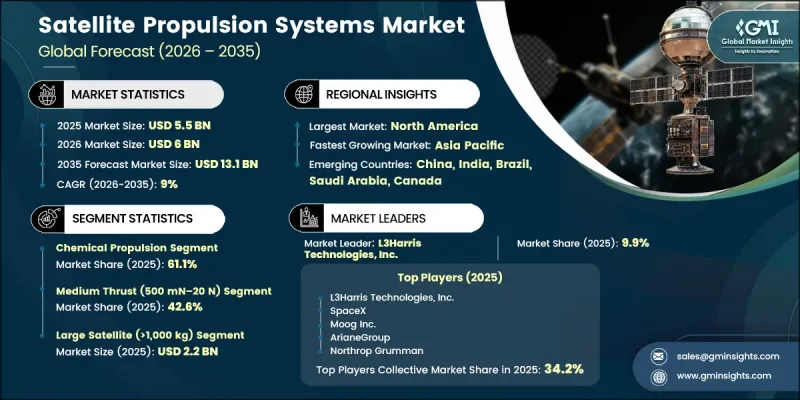
상업, 정부, 국방 각 분야에서 위성 배치 속도가 계속해서 가속화됨에 따라 위성 추진 시스템 시장은 확대되고 있습니다. 저궤도 위성 네트워크의 급속한 확대, 소형 위성의 채택 증가, 그리고 각국의 우주 프로그램에 대한 투자 확대로 인해 첨단 추진 기술에 대한 수요가 높아지고 있습니다. 추진 시스템은 궤도 진입, 궤도 유지, 기동, 충돌 회피 및 수명 종료 시 궤도 이탈에 필수적이며, 현대 위성 임무에서 매우 중요한 구성요소로 자리 잡고 있습니다. 전기식 및 친환경 추진 기술에 대한 지속적인 혁신을 통해 임무 효율이 향상되고, 추진제 소비량이 감소하며, 운영 수명주기의 연장이 뒷받침되고 있습니다. 동시에, 지속가능한 우주 운용 및 위성 유지보수에 대한 관심이 높아짐에 따라 첨단 추진 솔루션에 대한 추가적인 기회가 창출되고 있습니다. 상업 및 정부 용도 모두에서 임무 성능을 향상시키는 것을 목표로 하는 차세대 추진 기술에 대한 투자 증가는 전 세계 우주 산업의 진화하는 요구 사항을 뒷받침하는 동시에 장기적인 시장 성장을 강화할 것으로 예상됩니다.
| 시장 범위 | |
|---|---|
| 시작 연도 | 2025년 |
| 예측 기간 | 2026-2035년 |
| 개시 금액 | 55억 달러 |
| 예측 금액 | 131억 달러 |
| CAGR | 9% |
2025년에는 미션 크리티컬한 운영에서 높은 추력과 신뢰성 높은 성능을 발휘할 수 있다는 점으로 인해, 화학 추진 부문이 시장 점유율의 61.1%를 차지했습니다. 화학 추진 시스템은 궤도 진입, 우주선 기동, 자세 제어 및 심우주 임무에서 계속해서 널리 채택되고 있습니다. 입증된 운영 신뢰성과 까다로운 정부, 국방 및 상업용 위성 프로그램에 대한 적합성은 예측 기간 동안 꾸준한 시장 수요를 뒷받침하고 있습니다.
중추력(500 mN-20 N) 부문은 2025년에 42.6%의 점유율을 차지했습니다. 이 추력 범위는 광범위한 위성 플랫폼에서 궤도 진입, 궤도 기동, 궤도 유지 및 자세 제어를 위한 최적의 선택지로 자리 잡고 있습니다. 이 부문은 추진 효율과 기동성 사이에서 효과적인 균형을 제공하며, 중형 위성, 정지 궤도 임무 및 확대되는 위성 군집에 적합합니다. 화학적 추진 기술과 전기 추진 기술 모두와의 호환성은 해당 시장에서 이 부문의 선도적 지위를 더욱 공고히 하고 있습니다.
2025년, 북미 위성 추진 시스템 시장은 45.1%의 점유율을 차지했습니다. 이 지역의 성장은 우주 탐사에 대한 정부 투자 증가, 상업용 위성 배치 확대, 그리고 국방 관련 우주 이니셔티브의 증가에 힘입고 있습니다. 확립된 항공우주 제조 생태계에 더해, 첨단 추진 기술 및 위성 개발 프로그램에 대한 지속적인 투자가 결합되어 북미 세계 시장 내 리더십은 계속해서 강화되고 있습니다.
자주 묻는 질문
목차
제1장 조사 방법과 범위
제2장 주요 요약
제3장 업계 인사이트
제4장 경쟁 구도
제5장 시장 추정 및 예측 : 추진 기술별, 2022-2035년
제6장 시장 추정 및 예측 : 구성요소별, 2022-2035년
제7장 시장 추정 및 예측 : 위성 질량별, 2022-2035년
제8장 시장 추정 및 예측 : 스러스트 클래스별, 2022-2035년
제9장 시장 추정 및 예측 : 최종사용자별, 2022-2035년
제10장 시장 추정 및 예측 : 지역별, 2022-2035년
제11장 기업 개요
KSM 26.08.06The Global Satellite Propulsion Systems Market was valued at USD 5.5 billion in 2025 and is estimated to grow at a CAGR of 9% to reach USD 13.1 billion by 2035.
The satellite propulsion systems market is expanding as satellite deployments continue to accelerate across commercial, government, and defense sectors. Growing demand for advanced propulsion technologies is being driven by the rapid expansion of low Earth orbit satellite networks, increasing adoption of small satellites, and rising investments in national space programs. Propulsion systems have become essential for orbital insertion, station-keeping, maneuvering, collision avoidance, and end-of-life deorbiting, making them a critical component of modern satellite missions. Continuous innovation in electric and environmentally friendly propulsion technologies is improving mission efficiency, lowering propellant consumption, and supporting longer operational lifecycles. At the same time, increasing emphasis on sustainable space operations and satellite servicing is creating additional opportunities for advanced propulsion solutions. Rising investments in next-generation propulsion technologies designed to improve mission performance across both commercial and government applications are expected to strengthen long-term market growth while supporting the evolving requirements of the global space industry.
| Market Scope | |
|---|---|
| Start Year | 2025 |
| Forecast Year | 2026-2035 |
| Start Value | $5.5 Billion |
| Forecast Value | $13.1 Billion |
| CAGR | 9% |
The chemical propulsion segment accounted for 61.1% share in 2025, owing to its ability to deliver high thrust and dependable performance for mission-critical operations. Chemical propulsion systems continue to be widely adopted for orbit insertion, spacecraft maneuvering, attitude control, and deep-space missions. Their proven operational reliability and suitability for demanding government, defense, and commercial satellite programs continue to support strong market demand throughout the forecast period.
The medium thrust (500 mN-20 N) segment held a share of 42.6% in 2025. This thrust range has become the preferred choice for orbit raising, orbital maneuvering, station-keeping, and attitude control across a broad range of satellite platforms. The segment offers an effective balance between propulsion efficiency and maneuverability, making it suitable for medium-sized satellites, geostationary missions, and expanding satellite constellations. Its compatibility with both chemical and electric propulsion technologies further strengthens its market leadership.
North America Satellite Propulsion Systems Market accounted for 45.1% share in 2025. Regional growth is supported by increasing government investment in space exploration, expanding commercial satellite deployment, and rising defense-related space initiatives. A well-established aerospace manufacturing ecosystem, combined with ongoing investments in advanced propulsion technologies and satellite development programs, continues to reinforce North America's leadership in the global market.
Major companies operating in the global satellite propulsion systems market include SpaceX, Northrop Grumman, Rocket Lab USA, Moog Inc., L3Harris Technologies, Inc., Safran, Airbus DS (Electric Prop.), Airbus CRISA, ArianeGroup / OPC Lampoldshausen, Bellatrix Aerospace, Bradford Space, Busek Co. Inc., Dawn Aerospace, Exotrail SA, Aurora Propulsion Technologies, Orbion Space Technology, Benchmark Space Systems, Morpheus Space, VACCO Industries, Tethers Unlimited, SITAEL S.p.A., T4i S.r.l., ThrustMe, Enpulsion GmbH, ECAPS AB, GomSpace, Pale Blue Co., Neumann Space, Agile Space Industries, Aliena Pte Ltd, CU Aerospace, ExoTerra Resource, IHI Corporation, Rafael Advanced Defense, Marotta Controls, Revolution Space, Xingchen Space, and Yidong Yuhang. Companies operating in the satellite propulsion systems market are strengthening their competitive position through continuous investment in advanced propulsion technologies, product innovation, and research and development. Market participants are focusing on improving propulsion efficiency, reducing system weight, extending mission life, and developing environmentally sustainable propulsion solutions to meet evolving customer requirements. Strategic collaborations with satellite manufacturers, launch service providers, government agencies, and defense organizations are expanding commercial opportunities and accelerating technology adoption.
Table of Contents
Chapter 1 Methodology and Scope
- 1.1 Market scope and definition
- 1.2 Research design
- 1.2.1 Research approach
- 1.2.2 Data collection methods
- 1.3 Data mining sources
- 1.3.1 Global
- 1.3.2 Regional/Country
- 1.4 Base estimates and calculations
- 1.4.1 Base year calculation
- 1.4.2 Key trends for market estimation
- 1.5 Primary research and validation
- 1.5.1 Primary sources
- 1.6 Forecast model
- 1.7 Research assumptions and limitations
Chapter 2 Executive Summary
- 2.1 Industry 360° synopsis, 2022 - 2035
- 2.2 Key market trends
- 2.2.1 Propulsion technology trends
- 2.2.2 Component trends
- 2.2.3 Satellite mass trends
- 2.2.4 Thrust class trends
- 2.2.5 End-user trends
- 2.2.6 Regional trends
- 2.3 TAM Analysis, 2026-2035
- 2.4 CXO perspectives: Strategic imperatives
Chapter 3 Industry Insights
- 3.1 Industry ecosystem analysis
- 3.1.1 Supplier Landscape
- 3.1.2 Profit Margin
- 3.1.3 Cost structure
- 3.1.4 Value addition at each stage
- 3.1.5 Factor affecting the value chain
- 3.1.6 Disruptions
- 3.2 Industry impact forces
- 3.2.1 Growth drivers
- 3.2.1.1 Increasing deployment of small satellites and LEO constellations
- 3.2.1.2 Government investments in space exploration and national satellite programs
- 3.2.1.3 Advancements in electric and green propulsion technologies
- 3.2.1.4 Growing emphasis on space sustainability and orbital debris mitigation
- 3.2.1.5 Rising demand for in-orbit servicing and satellite life extension
- 3.2.2 Industry pitfalls and challenges
- 3.2.2.1 High development and qualification costs of advanced propulsion systems
- 3.2.2.2 Power, size, and propulsion performance trade-offs in small satellites
- 3.2.3 Market opportunities
- 3.2.3.1 Growing adoption of electric and green propulsion technologies
- 3.2.3.2 Expansion of in-orbit servicing, satellite life extension, and space logistics
- 3.2.1 Growth drivers
- 3.3 Growth potential analysis
- 3.4 Pricing Analysis (Driven by Primary Research)
- 3.4.1 Historical Price Trend Analysis
- 3.4.2 Pricing Strategy by Player Type (Premium / Value / Cost-plus)
- 3.5 Regulatory landscape
- 3.5.1 North America
- 3.5.2 Europe
- 3.5.3 Asia Pacific
- 3.5.4 Latin America
- 3.5.5 Middle East & Africa
- 3.6 Porter's analysis
- 3.7 PESTEL analysis
- 3.8 Trade Data Analysis (Based on Paid Database)
- 3.8.1 Import/Export Volume & Value Trends
- 3.8.2 Key Trade Corridors & Tariff Impact
- 3.9 Impact of AI & Generative AI on the Market (Driven by Primary Research)
- 3.9.1 AI-Driven Disruption of Existing Business Models
- 3.9.2 GenAI Use Cases & Adoption Roadmap by Segment
- 3.10 Capacity & Production Landscape (Driven by Primary Research)
- 3.10.1 Production Capacity by Key Producer
- 3.10.2 Capacity Utilization Rates & Expansion Pipelines
Chapter 4 Competitive Landscape, 2025
- 4.1 Introduction
- 4.1.1 By Region
- 4.1.1.1 North America
- 4.1.1.2 Europe
- 4.1.1.3 Asia-Pacific
- 4.1.1.4 Latin America
- 4.1.1.5 Middle East and Africa
- 4.1.2 Market Concentration Analysis
- 4.1.1 By Region
- 4.2 Competitive analysis of major market players
- 4.3 Competitive positioning matrix
- 4.4 Key developments
- 4.4.1 Mergers & acquisitions
- 4.4.2 Partnerships & collaborations
- 4.4.3 New product launches
- 4.4.4 Expansion plans and funding
- 4.5 Company tier benchmarking
- 4.5.1 Tier classification criteria & qualifying thresholds
- 4.5.2 Tier positioning matrix by revenue, geography & innovation
Chapter 5 Market Estimates and Forecast, By Propulsion Technology, 2022 - 2035 (USD Million)
- 5.1 Key trends
- 5.2 Chemical propulsion
- 5.3 Electric propulsion
- 5.3.1 Hall-effect thrusters
- 5.3.2 Ion thrusters (gridded ion engines)
- 5.3.3 Electrospray & FEEP systems
- 5.3.4 Pulsed Plasma Thrusters (PPT)
- 5.3.5 Others
- 5.4 Green / low-toxicity propulsion
- 5.5 Cold gas propulsion
- 5.6 Hybrid propulsion
Chapter 6 Market Estimates and Forecast, By Component, 2022 - 2035 (USD Million)
- 6.1 Key trends
- 6.2 Thrusters
- 6.3 Propellant tanks & storage systems
- 6.4 Feed systems
- 6.5 Power processing units (PPUs)
- 6.6 Propulsion control electronics
- 6.7 Others
Chapter 7 Market Estimates and Forecast, By Satellite Mass, 2022 - 2035 (USD Million)
- 7.1 Key trends
- 7.2 Nanosatellite (<10 kg)
- 7.3 Microsatellite (11-100 kg)
- 7.4 Minisatellite (101-500 kg)
- 7.5 Medium satellite (501-1,000 kg)
- 7.6 Large satellite (>1,000 kg)
Chapter 8 Market Estimates and Forecast, By Thrust Class, 2022 - 2035 (USD Million)
- 8.1 Key trends
- 8.2 Low thrust (<500 mN)
- 8.3 Medium thrust (500 mN-20 N)
- 8.4 High thrust (>20 N)
Chapter 9 Market Estimates and Forecast, By End User, 2022 - 2035 (USD Million)
- 9.1 Key trends
- 9.2 Government & civil
- 9.3 Commercial
- 9.4 Military & defense
Chapter 10 Market Estimates and Forecast, By Region, 2022 - 2035 (USD Million)
- 10.1 Key trends
- 10.2 North America
- 10.2.1 U.S.
- 10.2.2 Canada
- 10.3 Europe
- 10.3.1 Germany
- 10.3.2 UK
- 10.3.3 France
- 10.3.4 Spain
- 10.3.5 Italy
- 10.4 Asia Pacific
- 10.4.1 China
- 10.4.2 India
- 10.4.3 Japan
- 10.4.4 Australia
- 10.4.5 South Korea
- 10.5 Latin America
- 10.5.1 Brazil
- 10.5.2 Mexico
- 10.5.3 Argentina
- 10.6 Middle East and Africa
- 10.6.1 South Africa
- 10.6.2 Saudi Arabia
- 10.6.3 UAE
Chapter 11 Company Profiles
- 11.1 Global Key Players
- 11.1.1 L3Harris Technologies, Inc.
- 11.1.2 SpaceX
- 11.1.3 Moog Inc.
- 11.1.4 ArianeGroup
- 11.1.5 Northrop Grumman
- 11.2 Regional key players
- 11.2.1 North America
- 11.2.1.1 Agile Space Industries
- 11.2.1.2 Benchmark Space Systems
- 11.2.1.3 Busek Co. Inc.
- 11.2.1.4 ExoTerra Resource
- 11.2.1.5 Marotta Controls
- 11.2.1.6 Rocket Lab USA
- 11.2.2 Asia Pacific
- 11.2.2.1 Aliena Pte Ltd
- 11.2.2.2 Bellatrix Aerospace
- 11.2.2.3 IHI Corporation
- 11.2.2.4 Neumann Space
- 11.2.2.5 Pale Blue Co.
- 11.2.2.6 Xingchen Space
- 11.2.2.7 Yidong Yuhang
- 11.2.3 Europe
- 11.2.3.1 Airbus CRISA
- 11.2.3.2 Airbus DS (Electric Prop.)
- 11.2.3.3 Dawn Aerospace
- 11.2.3.4 Enpulsion GmbH
- 11.2.3.5 GomSpace
- 11.2.3.6 Safran
- 11.2.3.7 SITAEL S.p.A.
- 11.2.3.8 T4i S.r.l.
- 11.2.1 North America
- 11.3 Niche Players/Disruptors
- 11.3.1 Aurora Propulsion Technologies
- 11.3.2 Bradford Space
- 11.3.3 CU Aerospace
- 11.3.4 ECAPS AB
- 11.3.5 Exotrail SA
- 11.3.6 Morpheus Space
- 11.3.7 Orbion Space Technology
- 11.3.8 Rafael Advanced Defense Systems
- 11.3.9 Revolution Space
- 11.3.10 Tethers Unlimited
- 11.3.11 ThrustMe
- 11.3.12 VACCO Industries


