|
시장보고서
상품코드
2101872
항공우주 및 방위용 추진 시스템 시장 기회, 성장 촉진요인, 업계 동향 분석 및 예측(2026-2035년)Aerospace and Defense Propulsion System Market Opportunity, Growth Drivers, Industry Trend Analysis, and Forecast 2026 - 2035 |
||||||

세계의 항공우주 및 방위용 추진 시스템 시장은 2025년에 1,929억 달러 규모에 달하고, CAGR 7.1%로 성장하여 2035년까지 3,810억 달러에 달할 것으로 추정됩니다.
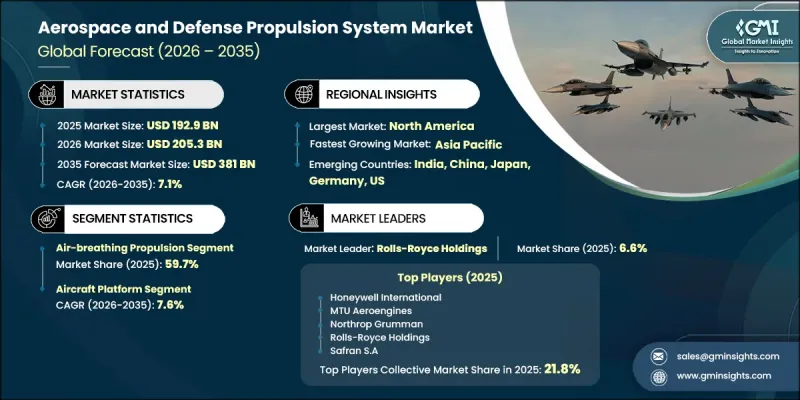
이러한 성장은 항공기의 장기적인 교체 주기, 국방 현대화 프로그램의 확대, 그리고 차세대 추진 기술에 대한 투자 증가에 의해 주도되고 있습니다. 이러한 요인들은 밸류체인 전반에 걸친 혁신을 가속화하는 동시에 기존 기술 개발 주기를 단축시키고 있습니다. 지속가능한 항공 및 고효율 추진 시스템으로의 전환은 업계 전반의 연구 개발(R&D) 우선순위를 더욱 재편하고 있습니다. 특히 NATO 및 인도-태평양 지역의 지정학적 긴장 고조와 국방비 증가는 꾸준한 조달 수요를 뒷받침하고 있습니다. 방위 예산이 지속적으로 증가하고 민간 항공 수요도 높은 이용률 수준에서 안정되는 가운데, 추진 시스템은 성능 최적화와 연료 효율 향상을 위한 중요한 중점 분야로 부상하고 있습니다. 전기 항공기 및 무인 시스템을 위한 새로운 추진 기술도 주목을 받으며, 항공우주 및 방위 분야의 다양한 용도에서 성장을 이끌고 있습니다.
| 시장 범위 | |
|---|---|
| 시작 연도 | 2025년 |
| 예측 기간 | 2026-2035년 |
| 초기 시장 규모 | 1,929억 달러 |
| 예측액 | 3,810억 달러 |
| CAGR | 7.1% |
공기 호흡식 추진 시스템 부문은 59.7%의 점유율을 차지하며, 2025년에는 1,151억 달러의 시장 규모를 기록하고, 2035년까지 연평균 성장률(CAGR) 7.4%로 성장할 것으로 예측됩니다. 이 부문에는 터보팬, 터보제트, 터보프로프, 터보샤프트 엔진이 포함되며, 이들은 민간 항공기, 군용기, 회전익기 플랫폼에서 널리 사용되고 있습니다. 이 부문의 우위는 폭넓은 용도와 민간 및 방위 항공 부문 전반에 걸친 안정적인 수요에 힘입어, 개별 최종 용도 시장의 주기적인 변동에도 불구하고 장기적인 안정성이 확보되어 있습니다.
항공기 플랫폼 부문은 2025년에 38.5%의 점유율을 차지하며 742억 달러 규모의 시장을 기록했으며, 2035년까지 연평균 성장률(CAGR) 7.6%로 성장할 것으로 전망됩니다. 이 부문은 주로 민간 및 군용 수송기 프로그램에서 발생하는 대규모 수요에 의해 주도되고 있습니다. 진행 중인 기체 현대화 및 교체 계획이 전 세계 항공기 제조사들의 저연비 차세대 항공기 추진 시스템에 대한 수요 증가에 힘입어 견조한 생산 활동을 유지하고 있습니다.
북미의 항공우주 및 방위용 추진 시스템 시장은 2025년에 40.5%의 점유율을 차지하며 781억 달러의 시장 규모를 기록했으며, 2035년까지 연평균 성장률(CAGR) 7.5%로 성장할 것으로 전망됩니다. 이 지역 내에서는 미국이 압도적인 점유율을 차지하고 있으며, 그 배경에는 견조한 국방 조달 예산, 대규모 민간 항공기 기단, 그리고 확립된 항공우주 제조 생태계가 있습니다. 이 지역은 민간 및 국방 용도 모두에서 집중된 생산능력과 추진 시스템 혁신에 대한 지속적인 투자의 혜택을 계속해서 누리고 있습니다.
자주 묻는 질문
목차
제1장 조사 방법과 범위
제2장 주요 요약
제3장 업계 인사이트
제4장 경쟁 구도
제5장 시장 규모 및 예측 : 추진 유형별, 2022-2035년
제6장 시장 규모 및 예측 : 플랫폼별, 2022-2035년
제7장 시장 규모 및 예측 : 최종사용별, 2022-2035년
제8장 시장 규모 및 예측 : 지역별, 2022-2035년
제9장 기업 개요
KSM 26.08.05The Global Aerospace and Defense Propulsion System Market was valued at USD 192.9 billion in 2025 and is estimated to grow at a CAGR of 7.1% to reach USD 381 billion by 2035.
Growth is driven by long-term aircraft replacement cycles, rising defense modernization programs, and increased investment in next-generation propulsion technologies. These factors are accelerating innovation across the value chain while shortening traditional technology development cycles. The shift toward sustainable aviation and high-efficiency propulsion systems is further reshaping R&D priorities across the industry. Expanding geopolitical tensions and rising defense expenditures, particularly across NATO and Indo-Pacific regions, are reinforcing steady procurement demand. As defense budgets continue to increase and commercial aviation demand stabilizes at higher utilization levels, propulsion systems are becoming a critical focus area for performance optimization and fuel efficiency improvements. Emerging propulsion technologies for electric aircraft and unmanned systems are also gaining traction, contributing to diversified growth across multiple aerospace and defense applications.
| Market Scope | |
|---|---|
| Start Year | 2025 |
| Forecast Year | 2026-2035 |
| Start Value | $192.9 Billion |
| Forecast Value | $381 Billion |
| CAGR | 7.1% |
The air-breathing propulsion segment held a 59.7% share, generating USD 115.1 billion in 2025, and is projected to grow at a CAGR of 7.4% through 2035. This segment includes turbofan, turbojet, turboprop, and turboshaft engines, which are widely used across commercial aviation, military aircraft, and rotorcraft platforms. Its dominance is supported by broad application coverage and consistent demand across both civil and defense aviation sectors, ensuring long-term stability despite cyclical fluctuations in individual end-use markets.
The aircraft platform segment held 38.5% share in 2025, generating USD 74.2 billion, and is expected to grow at a CAGR of 7.6% through 2035. This segment is primarily driven by high-volume demand from commercial and military transport aircraft programs. Ongoing fleet modernization and replacement initiatives are sustaining strong production activity, supported by increased demand for fuel-efficient and next-generation aircraft propulsion systems across global aviation manufacturers.
North America Aerospace and Defense Propulsion System Market held 40.5% share, generating USD 78.1 billion in 2025 and is projected to grow at a CAGR of 7.5% through 2035. The United States represents the dominant share within the region, driven by strong defense procurement budgets, a large commercial aviation fleet base, and a well-established aerospace manufacturing ecosystem. The region continues to benefit from concentrated production capabilities and sustained investment in propulsion system innovation across both commercial and defense applications.
Key companies operating in the global aerospace and defense propulsion system market include Safran S.A., Rolls-Royce Holdings, General Electric Company, Pratt & Whitney, Honeywell International, MTU Aero Engines, Mitsubishi Heavy Industries, Airbus SE, Northrop Grumman, L3Harris Technologies Inc., IHI Corporation, GKN Aerospace, Aero Engine Corporation of China, CFM International, Avio S.p.A., and Bellatrix Aerospace. Companies operating in the aerospace and defense propulsion system market are strengthening their market position by investing heavily in next-generation propulsion technologies, including fuel-efficient turbine systems, hybrid-electric propulsion, and advanced thermal management solutions. Manufacturers are focusing on improving engine performance, reducing emissions, and enhancing lifecycle efficiency to meet evolving regulatory and operational requirements. Strategic collaborations between OEMs, defense contractors, and research institutions are accelerating innovation and shortening development timelines for advanced propulsion platforms. Companies are also expanding production capacity and modernizing manufacturing facilities to support rising aircraft and defense procurement demand.
Table of Contents
Chapter 1 Methodology & Scope
- 1.1 Research approach
- 1.2 Quality commitments
- 1.2.1 GMI AI policy & data integrity commitment
- 1.2.1.1 Source consistency protocol
- 1.2.1 GMI AI policy & data integrity commitment
- 1.3 Research trail & confidence scoring
- 1.3.1 Research trail components
- 1.3.2 Scoring components
- 1.4 Data collection
- 1.4.1 Partial list of primary sources
- 1.5 Data mining sources
- 1.5.1 Paid sources
- 1.5.1.1 Sources, by region
- 1.5.1 Paid sources
- 1.6 Base estimates and calculations
- 1.6.1 Base year calculation for any one approach
- 1.7 Market estimates & forecasts parameters
- 1.8 Forecast model
- 1.8.1 Quantified market impact analysis
- 1.8.1.1 Mathematical impact of growth parameters on forecast
- 1.8.1 Quantified market impact analysis
- 1.9 Research transparency addendum
- 1.9.1 Source attribution framework
- 1.9.2 Quality assurance metrics
- 1.9.3 Our commitment to trust
- 1.10 Market definitions
Chapter 2 Executive Summary
- 2.1 Industry synopsis, 2022 - 2035
- 2.1.1 Propulsion Type trends
- 2.1.2 Platform trends
- 2.1.3 End Use trends
- 2.1.4 Regional trends
Chapter 3 Industry Insights
- 3.1 Industry ecosystem analysis
- 3.2 Industry impact forces
- 3.2.1 Growth drivers
- 3.2.1.1 Rising Global Defense Expenditure and Military Aircraft Modernization
- 3.2.1.2 Expansion of Commercial Aviation and Fleet Renewal Programs
- 3.2.1.3 Increasing Demand for Unmanned Aerial Vehicles (UAVs) and Autonomous Defense Platforms
- 3.2.1.4 Continuous Technological Advancements in Engine Efficiency and Materials
- 3.2.2 Industry pitfalls and challenges
- 3.2.2.1 High Development, Certification, and Manufacturing Costs
- 3.2.2.2 Complex Supply Chain and Critical Material Availability
- 3.2.3 Market opportunities
- 3.2.3.1 Expansion of Space Launch Programs and Reusable Rocket Propulsion
- 3.2.3.2 Rising Investments in Next-Generation Military Aviation and Hypersonic Platforms
- 3.2.1 Growth drivers
- 3.3 Growth potential analysis
- 3.4 Regulatory landscape (Driven by primary research)
- 3.4.1 North America
- 3.4.2 Europe
- 3.4.3 Asia Pacific
- 3.4.4 Latin America
- 3.4.5 MEA
- 3.5 Technology landscape
- 3.5.1 Current technological trends
- 3.5.2 Emerging technologies
- 3.6 Pricing trend analysis (Driven by primary research)
- 3.7 Future market trends
- 3.8 Patent analysis
- 3.9 Porter's analysis
- 3.10 PESTEL analysis
- 3.11 Impact of AI and Generative AI on the market (Driven by primary research)
- 3.12 Value chain analysis (Driven by primary research)
- 3.13 Investment & funding analysis (Driven by primary research)
- 3.14 Consumer insights (Driven by primary research)
Chapter 4 Competitive Landscape, 2025
- 4.1 Introduction
- 4.2 Company market share analysis, by region, 2025
- 4.2.1 North America
- 4.2.2 Europe
- 4.2.3 Asia Pacific
- 4.2.4 Middle East & Africa
- 4.2.5 Latin America
- 4.3 Key developments
- 4.3.1 Key partnerships & collaborations
- 4.3.2 Major M&A activities
- 4.3.3 Product innovations & launches
- 4.3.4 Market expansion strategies
- 4.4 Competitive positioning matrix
Chapter 5 Market Size and Forecast, By Propulsion Type, 2022 - 2035 (USD Million)
- 5.1 Key trends
- 5.2 Air-breathing
- 5.2.1 Turbojet
- 5.2.2 Turbofan
- 5.2.3 Turboshaft
- 5.2.4 Turboprop
- 5.2.5 Ramjets & scramjets
- 5.3 Non-air-breathing
- 5.3.1 Solid propulsion
- 5.3.2 Liquid propulsion
- 5.3.3 Hybrid propulsion
- 5.4 Electric propulsion
Chapter 6 Market Size and Forecast, By Platform, 2022 - 2035 (USD Million)
- 6.1 Key trends
- 6.2 Aircraft
- 6.2.1 Narrow-body aircraft
- 6.2.2 Wide-body aircraft
- 6.2.3 Regional jets
- 6.2.4 Business jets
- 6.3 Missiles
- 6.4 Spacecraft
- 6.5 Unmanned Aerial Vehicles (UAVs)
- 6.6 Others
Chapter 7 Market Size and Forecast, By End Use, 2022 - 2035 (USD Million)
- 7.1 Key trends
- 7.2 Commercial
- 7.3 Government & military
Chapter 8 Market Size and Forecast, By Region, 2022 - 2035 (USD Million)
- 8.1 Key trends
- 8.2 North America
- 8.2.1 U.S.
- 8.2.2 Canada
- 8.3 Europe
- 8.3.1 Germany
- 8.3.2 France
- 8.3.3 UK
- 8.3.4 Netherlands
- 8.3.5 Spain
- 8.3.6 Italy
- 8.4 Asia Pacific
- 8.4.1 China
- 8.4.2 Japan
- 8.4.3 South Korea
- 8.4.4 India
- 8.4.5 Australia
- 8.5 Middle East & Africa
- 8.5.1 Saudi Arabia
- 8.5.2 UAE
- 8.5.3 South Africa
- 8.6 Latin America
- 8.6.1 Brazil
- 8.6.2 Argentina
- 8.6.3 Mexico
Chapter 9 Company Profiles
- 9.1 Aero Engine Corporation of China
- 9.2 Airbus SE
- 9.3 Avio S.p.A.
- 9.4 Bellatrix Aerospace
- 9.5 CFM International
- 9.6 Firehawk Aerospace
- 9.7 General Electric Company
- 9.8 GKN Aerospace
- 9.9 Honeywell International
- 9.10 IHI Corporation
- 9.11 L3Harris Technologies, Inc.
- 9.12 Mitsubishi Heavy Industries
- 9.13 MTU Aeroengines
- 9.14 Northrop Grumman
- 9.15 Pratt & Whitney
- 9.16 Rolls-Royce Holdings
- 9.17 Safran S.A.