

|
시장보고서
상품코드
2101874
종이컵 시장 기회, 성장 촉진요인, 업계 동향 분석 및 예측(2026-2035년)Paper Cups Market Opportunity, Growth Drivers, Industry Trend Analysis, and Forecast 2026 - 2035 |
||||||

세계의 종이컵 시장은 2025년에 146억 달러 규모에 달하고, CAGR 4.3%로 성장하여 2035년까지 221억 달러에 달할 것으로 추정됩니다.
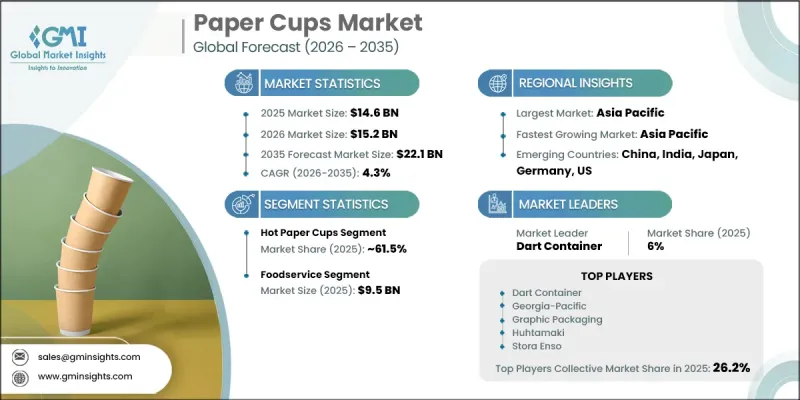
전 세계적인 지속가능성 관련 규제로 인해 일회용 플라스틱 포장에 대한 제한이 강화되고, 상업 및 공공 기관에서의 사용에 있어 섬유 기반 대체재로 전환이 가속화됨에 따라 종이컵 시장은 꾸준한 성장을 이루고 있습니다. 북미, 유럽, 아시아태평양의 주요 경제권에서 시행된 규제 조치로 인해 조달 관행이 재편되면서, 외식 업체와 소매업체들은 재활용이 가능하고 환경 기준을 준수하는 포장 솔루션을 채택할 수밖에 없게 되었습니다. 동시에, 조직화된 외식 네트워크의 급속한 성장으로 인해, 특히 급성장하는 도시 지역의 소비 환경에서 일회용 음료 용기에 대한 수요가 크게 증가하고 있습니다. 퀵 서비스 레스토랑, 카페 체인, 편의성을 중시하는 소매 업태의 보급이 진행됨에 따라 종이컵의 구조적 소비는 계속해서 강화되고 있습니다. 신흥 경제국의 도시화가 진행됨에 따라 가정 밖에서의 음식·음료 소비가 확대되고 있으며, 이는 제품 수요를 더욱 뒷받침하고 있습니다. 또한 시장은 단순한 기초 상품 카테고리의 범위를 넘어 진화하고 있으며, 각 제조사는 배리어 코팅, 재활용 가능성 기준, 그리고 맞춤형 브랜딩 솔루션의 혁신에 주력하고 있습니다. 지속가능한 포장 성능과 공급망 확장성에 대한 중요성이 커지는 가운데, 종이컵은 현대 세계 외식 산업을 위한 포장 시스템에서 필수적인 요소로서의 입지를 확고히 하고 있습니다.
| 시장 범위 | |
|---|---|
| 시작 연도 | 2025년 |
| 예측 기간 | 2026-2035년 |
| 시작 시점 시장 규모 | 146억 달러 |
| 예측액 | 221억 달러 |
| CAGR | 4.3% |
2025년에는 뜨거운 음료용 종이컵이 90억 달러를 차지하며 61.5%의 점유율을 유지했습니다. 이 부문은 특히 뜨거운 음료 소비가 여전히 일상적인 습관으로 자리 잡은 성숙 시장에서 기존의 외식 소비 습관에 깊이 뿌리내리고 있어, 계속해서 주도적인 위치를 유지하고 있습니다. 또한, 따뜻한 음료 소비 패턴이 빠르게 정착되고 있는 개발도상 지역에서의 퀵 서비스 레스토랑 네트워크 확대도 수요를 더욱 부추기고 있습니다. 제품 설계는 비용 효율성과 단열 성능 향상을 동시에 달성하는 단층 및 이중 구조로 계속 진화하고 있으며, 대량 처리가 요구되는 외식 산업 환경의 운영 요구를 충족시키고 있습니다.
외식 산업 부문은 2025년에 95억 달러의 매출을 기록하고, 시장 점유율 65.1%를 차지하며, 연평균 성장률(CAGR) 4.6%로 성장할 것으로 예측됩니다. 외식 사업자들이 음료 서비스에서 표준화된 일회용 용기에 대한 의존도를 높이고 있는 만큼, 이 부문은 계속해서 주요 수요의 견인차 역할을 하고 있습니다. 대량 소비는 퀵 서비스 레스토랑 및 카페 사업에 집중되어 있으며, 안정적인 공급 요건과 세계 운영 기준에 따라 여러 지역에 걸쳐 균일한 품질과 유통 효율을 제공할 수 있는 대규모 제조업체가 우위를 점하고 있습니다.
2025년 북미의 종이컵 시장 규모는 41억 달러였습니다. 미국은 고도로 발달된 외식 산업 인프라와 상업 채널 전반에 걸친 일회용 음료 용기의 광범위한 보급으로 인해, 이 지역에서 계속해서 가장 큰 기여를 하는 국가로 자리매김하고 있습니다. 조직화된 외식 점포의 강력한 입지가 안정적인 수요를 지속적으로 뒷받침하는 한편, 일회용 플라스틱 감축을 촉진하는 규제 움직임이 종이 대체품으로의 전환을 더욱 가속화하고 있습니다. 캐나다에서도 지속가능성에 관한 규제 발전과 환경 기준을 준수하는 포장 솔루션의 채택 확대에 힘입어 꾸준한 성장이 나타나고 있습니다.
자주 묻는 질문
목차
제1장 조사 방법과 범위
제2장 주요 요약
제3장 업계 인사이트
제4장 경쟁 구도
제5장 시장 규모 및 예측 : 유형별, 2022-2035년
제6장 시장 규모 및 예측 : 벽 구조별, 2022-2035년
제7장 시장 규모 및 예측 : 용량별, 2022-2035년
제8장 시장 규모 및 예측 : 코팅 유형별, 2022-2035년
제9장 시장 규모 및 예측 : 인쇄 기술별, 2022-2035년
제10장 시장 규모 및 예측 : 최종 용도별, 2022-2035년
제11장 시장 규모 및 예측 : 지역별, 2022-2035년
제12장 기업 개요
KSM 26.08.05The Global Paper Cups Market was valued at USD 14.6 billion in 2025 and is estimated to grow at a CAGR of 4.3% to reach USD 22.1 billion by 2035.
The paper cups market is witnessing steady expansion as global sustainability regulations increasingly restrict single-use plastic packaging and accelerate the shift toward fiber-based alternatives across commercial and institutional applications. Regulatory initiatives across major economies in North America, Europe, and Asia Pacific are reshaping procurement practices, compelling foodservice operators and retailers to adopt recyclable and environmentally compliant packaging solutions. At the same time, rapid growth in organized foodservice networks is significantly strengthening demand for disposable beverage packaging, particularly within fast-growing urban consumption environments. The increasing penetration of quick-service restaurants, cafe chains, and convenience-oriented retail formats continues to reinforce structural consumption of paper cups. As urbanization progresses in emerging economies, out-of-home food and beverage consumption is expanding, further supporting product demand. The market is also evolving beyond a basic commodity category, with manufacturers focusing on innovation in barrier coatings, recyclability standards, and customized branding solutions. Growing emphasis on sustainable packaging performance and supply chain scalability is positioning paper cups as a critical component within modern global foodservice packaging systems.
| Market Scope | |
|---|---|
| Start Year | 2025 |
| Forecast Year | 2026-2035 |
| Start Value | $14.6 Billion |
| Forecast Value | $22.1 Billion |
| CAGR | 4.3% |
Hot paper cups accounted for USD 9 billion, held 61.5% share in 2025. The segment continues to lead due to its strong integration into established foodservice consumption habits, particularly in mature markets where hot beverage consumption remains a daily routine. Demand is further reinforced by the expansion of quick-service restaurant networks in developing regions, where hot beverage consumption patterns are rapidly formalizing. Product design continues to evolve with single-wall and double-wall configurations that support both cost efficiency and improved insulation performance, meeting the operational needs of high-volume foodservice environments.
The foodservice segment generated USD 9.5 billion, accounting for 65.1% share in 2025, and is projected to grow at a CAGR of 4.6%. This segment remains the primary demand driver as foodservice operators increasingly rely on standardized disposable packaging for beverage service. High-volume consumption is concentrated within quick-service restaurants and cafe operations, where consistent supply requirements and global operational standards favor large-scale manufacturers capable of delivering uniform quality and distribution efficiency across multiple regions.
North America Paper Cups Market was valued at USD 4.1 billion in 2025. The United States remains the leading contributor within the region due to its highly developed foodservice infrastructure and widespread adoption of disposable beverage packaging across commercial channels. Strong presence of organized foodservice outlets continues to sustain consistent demand, while regulatory momentum supporting the reduction of single-use plastics is further encouraging the shift toward paper-based alternatives. Canada is also witnessing steady growth, supported by evolving sustainability regulations and increasing adoption of environmentally compliant packaging solutions.
Key companies operating in the global paper cups market include Huhtamaki, Stora Enso, WestRock Company, Graphic Packaging International, LLC, Dart Container Corporation, Pactiv Evergreen Inc., Georgia-Pacific Consumer Products LP, Tekni-Plex, Inc., ConverPack, Genpak LLC, Bender Limited, Detmold Group, Grupo Phoenix, Golden Paper Cups, Dispo International, Nippon Paper Foodpac, Printed Cup Company, Seda International Packaging Group, ISHWARA, and Stanpac Inc. Companies operating in the paper cups market are strengthening their market position by focusing on sustainable packaging innovation, expanding production capacity, and improving material efficiency. Manufacturers are investing in advanced coating technologies and recyclable fiber-based solutions to meet evolving environmental regulations and consumer expectations. Strategic emphasis is being placed on product customization and branding capabilities to support foodservice operators seeking differentiated packaging solutions. Businesses are also enhancing supply chain integration and global distribution networks to ensure consistent product availability across key regions.
Table of Contents
Chapter 1 Methodology & Scope
- 1.1 Research approach
- 1.2 Quality commitments
- 1.2.1 GMI AI policy & data integrity commitment
- 1.2.1.1 Source consistency protocol
- 1.2.1 GMI AI policy & data integrity commitment
- 1.3 Research trail & confidence scoring
- 1.3.1 Research trail components
- 1.3.2 Scoring components
- 1.4 Data collection
- 1.4.1 Partial list of primary sources
- 1.5 Data mining sources
- 1.5.1 Paid sources
- 1.5.1.1 Sources, by region
- 1.5.1 Paid sources
- 1.6 Base estimates and calculations
- 1.6.1 Base year calculation for any one approach
- 1.7 Market estimates & forecasts parameters
- 1.8 Forecast model
- 1.8.1 Quantified market impact analysis
- 1.8.1.1 Mathematical impact of growth parameters on forecast
- 1.8.1 Quantified market impact analysis
- 1.9 Research transparency addendum
- 1.9.1 Source attribution framework
- 1.9.2 Quality assurance metrics
- 1.9.3 Our commitment to trust
- 1.10 Market definitions
Chapter 2 Executive Summary
- 2.1 Industry synopsis, 2022 - 2035
- 2.1.1 Type trends
- 2.1.2 Wall Type trends
- 2.1.3 Capacity trends
- 2.1.4 Coating Type trends
- 2.1.5 Printing Technology trends
- 2.1.6 End-use trends
- 2.1.7 Regional trends
Chapter 3 Industry Insights
- 3.1 Industry ecosystem analysis
- 3.2 Industry impact forces
- 3.2.1 Growth drivers
- 3.2.1.1 Expansion of Foodservice and Quick-Service Restaurant Chains
- 3.2.1.2 Stringent Regulations on Single-Use Plastic Products
- 3.2.1.3 Rising Consumer Preference for Eco-Friendly Packaging
- 3.2.1.4 Increasing Urbanization and Busy Lifestyles
- 3.2.2 Industry pitfalls and challenges
- 3.2.2.1 Fluctuating Prices of Paper Pulp and Raw Materials
- 3.2.2.2 Recycling Challenges Due to Plastic Linings
- 3.2.3 Market opportunities
- 3.2.3.1 Development of Fully Recyclable and Compostable Paper Cups
- 3.2.3.2 Growing Demand in Emerging Markets and Food Delivery Services
- 3.2.1 Growth drivers
- 3.3 Growth potential analysis
- 3.4 Regulatory landscape (Driven by primary research)
- 3.4.1 North America
- 3.4.2 Europe
- 3.4.3 Asia Pacific
- 3.4.4 Latin America
- 3.4.5 MEA
- 3.5 Technology landscape
- 3.5.1 Current technological trends
- 3.5.2 Emerging technologies
- 3.6 Pricing trend analysis (Driven by primary research)
- 3.7 Future market trends
- 3.8 Patent analysis
- 3.9 Porter's analysis
- 3.10 PESTEL analysis
- 3.11 Impact of AI and Generative AI on the market (Driven by primary research)
- 3.12 Value chain analysis (Driven by primary research)
- 3.13 Investment & funding analysis (Driven by primary research)
- 3.14 Consumer insights (Driven by primary research)
Chapter 4 Competitive Landscape, 2025
- 4.1 Introduction
- 4.2 Company market share analysis, by region, 2025
- 4.2.1 North America
- 4.2.2 Europe
- 4.2.3 Asia Pacific
- 4.2.4 Middle East & Africa
- 4.2.5 Latin America
- 4.3 Key developments
- 4.3.1 Key partnerships & collaborations
- 4.3.2 Major M&A activities
- 4.3.3 Product innovations & launches
- 4.3.4 Market expansion strategies
- 4.4 Competitive positioning matrix
Chapter 5 Market Size and Forecast, By Type, 2022 - 2035 (USD Million & Kilo Tons)
- 5.1 Key trends
- 5.2 Hot Paper Cups
- 5.3 Cold Paper Cups
Chapter 6 Market Size and Forecast, By Wall Type, 2022 - 2035 (USD Million & Kilo Tons)
- 6.1 Key trends
- 6.2 Single Wall
- 6.3 Double Wall
- 6.4 Triple Wall
Chapter 7 Market Size and Forecast, By Capacity, 2022 - 2035 (USD Million & Kilo Tons)
- 7.1 Key trends
- 7.2 Up to 150 ml
- 7.3 151 to 350 ml
- 7.4 351 to 500 ml
- 7.5 Above 500 ml
Chapter 8 Market Size and Forecast, By Coating Type, 2022 - 2035 (USD Million & Kilo Tons)
- 8.1 PE (Polyethylene) Coated
- 8.2 PLA (Polylactic Acid) Coated
- 8.3 Water-Based / Dispersion Coated
- 8.4 Other Barrier Coatings (Wax, Hybrid, Mineral-Based)
Chapter 9 Market Size and Forecast, By Printing Technology 2022 - 2035 (USD Million & Kilo Tons)
- 9.1 Flexographic Printing
- 9.2 Offset Printing
- 9.3 Digital Printing
- 9.4 Gravure Printing
Chapter 10 Market Size and Forecast, By End-use 2022 - 2035 (USD Million & Kilo Tons)
- 10.1 Foodservice
- 10.1.1 Quick Service Restaurants (QSRs)
- 10.1.2 Cafes and Coffee Shops
- 10.1.3 Others
- 10.2 Institutional
- 10.3 Household
Chapter 11 Market Size and Forecast, By Region, 2022 - 2035 (USD Million)
- 11.1 Key trends
- 11.2 North America
- 11.2.1 U.S.
- 11.2.2 Canada
- 11.3 Europe
- 11.3.1 Germany
- 11.3.2 France
- 11.3.3 UK
- 11.3.4 Netherlands
- 11.3.5 Spain
- 11.3.6 Italy
- 11.4 Asia Pacific
- 11.4.1 China
- 11.4.2 Japan
- 11.4.3 South Korea
- 11.4.4 India
- 11.4.5 Australia
- 11.5 Middle East & Africa
- 11.5.1 Saudi Arabia
- 11.5.2 UAE
- 11.5.3 South Africa
- 11.6 Latin America
- 11.6.1 Brazil
- 11.6.2 Argentina
- 11.6.3 Mexico
Chapter 12 Company Profiles
- 12.1 Bender Limited
- 12.2 ConverPack
- 12.3 Dart Container Corporation
- 12.4 Detmold Group
- 12.5 Dispo International
- 12.6 Genpak LLC
- 12.7 Georgia-Pacific Consumer Products LP.
- 12.8 Golden Paper Cups
- 12.9 Graphic Packaging International, LLC
- 12.10 Grupo Phoenix
- 12.11 Huhtamaki
- 12.12 ISHWARA
- 12.13 Nippon Paper Foodpac
- 12.14 Pactiv Evergreen Inc.
- 12.15 Printed Cup Company
- 12.16 Seda International Packaging Group
- 12.17 Stanpac Inc
- 12.18 Stora Enso
- 12.19 Tekni-Plex, Inc.
- 12.20 WestRock Company


