

|
시장보고서
상품코드
2101875
폼 포장 시장 기회, 성장 촉진요인, 업계 동향 분석 및 예측(2026-2035년)Foam Packaging Market Opportunity, Growth Drivers, Industry Trend Analysis, and Forecast 2026 - 2035 |
||||||

세계의 폼 포장 시장은 2025년에 201억 달러 규모에 달하고, CAGR 6%로 확대되어 2035년에는 356억 달러에 달할 것으로 예측됩니다.
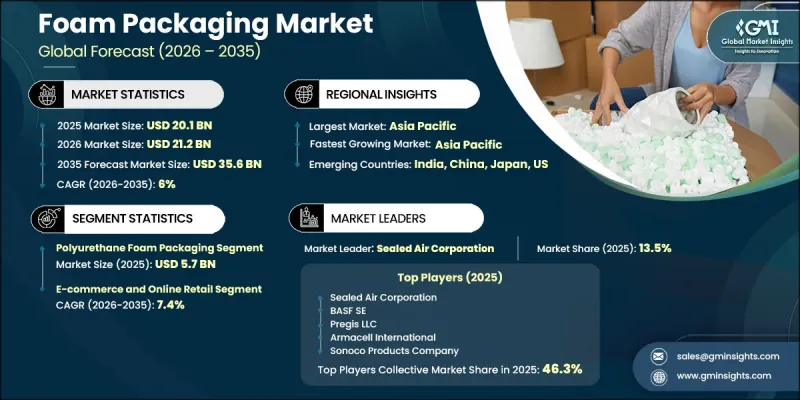
이러한 성장의 원동력은 온라인 소매의 급속한 확대로, 이로 인해 소포 배송에 사용되는 보호용 및 단열 포장재에 대한 수요가 크게 증가하고 있습니다. 동시에, 의료 및 식품 배송 채널에서 온도에 민감한 상품의 소비가 전 세계적으로 증가함에 따라 고성능 단열 솔루션에 대한 수요가 높아지고 있습니다. 발포 폴리스티렌 계열 소재에 대한 규제적 제한으로 인해 생산 전략이 재검토되고 있으며, 재활용 가능, 바이오 유래 및 엔지니어링 발포재와 같은 대체 소재로의 전환이 가속화되고 있습니다. 폼 포장은 물류 네트워크 전반에 걸쳐 완충·충격 흡수·열 안정성을 제공하며, 깨지기 쉬운 제품이나 신선 식품의 보호에 있어 계속해서 중요한 역할을 하고 있습니다. 도시화의 진전과 소비자 직배송형 공급망으로의 전환에 따라 다양한 산업 분야에서 그 채택이 더욱 확대되고 있습니다. 그러나 일회용 플라스틱 발포 제품을 대상으로 한 환경 규제로 인해, 밸류체인 전반에 걸쳐 소재 혁신과 지속가능성에 초점을 맞춘 제품 재설계가 촉진되고 있습니다.
| 시장 범위 | |
|---|---|
| 시작 연도 | 2025년 |
| 예측 기간 | 2026-2035년 |
| 초기 시장 규모 | 201억 달러 |
| 예측액 | 356억 달러 |
| CAGR | 6% |
폴리우레탄 폼 포장 부문은 완충재, 단열 포장 및 맞춤형 성형 포장 용도에서의 폭넓은 적용 가능성에 힘입어 57억 달러의 매출을 기록하며 시장 점유율 28.3%를 차지했습니다. 광범위한 밀도 범위에서 설계 가능한 특성 덕분에 경량 보호 포장부터 고정밀 산업 용도에 이르기까지 폭넓게 활용되고 있으며, 특정 발포 소재에 대한 규제 압력이 높아지고 있음에도 불구하고 수요는 계속해서 견조한 추세를 보이고 있습니다.
E-Commerce 및 온라인 소매 부문은 2025년에 68억 달러에 달했습니다. 이러한 성장은 소포 처리량의 증가와 특히 전자기기, 퍼스널케어 제품, 신선 식품 등 고가 화물에 대한 보호 포장 수요의 증가를 반영합니다. 발포재 기반 보호 시스템은 그 완충 효율과 운송 중 파손을 줄여주는 신뢰성 덕분에 물류 처리 업무에서 계속해서 널리 채택되고 있습니다.
북미 폼 포장 시장은 2025년에 53억 달러를 기록했으며, 2035년까지 91억 달러에 달할 것으로 예상되어 연평균 성장률(CAGR) 5.7%로 확대될 전망입니다. 미국은 고도로 발달한 E-Commerce 물류 네트워크와 대규모 의약품·소매 유통 시스템에 힘입어 지역 수요의 대부분을 차지하고 있습니다.
자주 묻는 질문
목차
제1장 조사 방법과 범위
제2장 주요 요약
제3장 업계 인사이트
제4장 경쟁 구도
제5장 시장 규모 및 예측 : 소재 유형별, 2022-2035년
제6장 시장 규모 및 예측 : 포장 형태별, 2022-2035년
제7장 시장 규모 및 예측 : 최종 이용 산업별, 2022-2035년
제8장 시장 규모 및 예측 : 지역별, 2022-2035년
제9장 기업 개요
KSM 26.08.05The Global Foam Packaging Market was valued at USD 20.1 billion in 2025 and is estimated to grow at a CAGR of 6% to reach USD 35.6 billion by 2035.
Growth is driven by the rapid expansion of online retail, which has significantly increased demand for protective and insulated packaging formats used in parcel delivery. At the same time, rising global consumption of temperature-sensitive goods in healthcare and food delivery channels is reinforcing the need for high-performance insulation solutions. Regulatory restrictions on expanded polystyrene-based materials are reshaping production strategies and accelerating the transition toward recyclable, bio-based, and engineered foam alternatives. Foam packaging continues to play a critical role in safeguarding fragile and perishable products, offering cushioning, shock absorption, and thermal stability across logistics networks. Increasing urbanization and the shift toward direct-to-consumer supply chains are further strengthening adoption across multiple industries. However, environmental regulations targeting single-use plastic foam products are encouraging material innovation and sustainability-focused product redesigns across the value chain.
| Market Scope | |
|---|---|
| Start Year | 2025 |
| Forecast Year | 2026-2035 |
| Start Value | $20.1 Billion |
| Forecast Value | $35.6 Billion |
| CAGR | 6% |
The polyurethane foam packaging segment generated USD 5.7 billion, accounting for 28.3% share, supported by its adaptability across cushioning, insulation, and custom-molded packaging applications. Its ability to be engineered across a wide density range enables use in both lightweight protective packaging and high-precision industrial applications, ensuring continued demand despite increasing regulatory pressure on certain foam-based materials.
The e-commerce and online retail segment reached USD 6.8 billion in 2025. This growth reflects rising parcel volumes and increasing demand for protective packaging in high-value shipments, particularly across electronics, personal care products, and perishable goods. Foam-based protective systems remain widely adopted in fulfillment operations due to their cushioning efficiency and reliability in reducing transit damage.
North America Foam Packaging Market captured USD 5.3 billion in 2025 and is projected to reach USD 9.1 billion by 2035, expanding at a CAGR of 5.7%. The United States accounts for the majority of regional demand, supported by highly developed e-commerce logistics networks and large-scale pharmaceutical and retail distribution systems.
Major players operating in the global foam packaging industry include Sealed Air Corporation, BASF SE, Pregis LLC, Armacell International, Sonoco Products Company, Zotefoams PLC, Rogers Corporation, Storopack Hans Reichenecker GmbH, UFP Technologies, Recticel NV/SA, JSP Corporation, and Kaneka Corporation, along with Kaneka Belgium NV. Companies in the foam packaging market are prioritizing material innovation to develop recyclable and bio-based alternatives that comply with tightening environmental regulations. Many players are expanding production capabilities for advanced polyurethane and engineered foam solutions to meet rising demand from e-commerce and cold chain logistics. Strategic partnerships with logistics providers and retailers are helping improve integration into supply chains. Firms are also investing in lightweight and high-performance packaging designs that reduce material usage while maintaining protection standards. Geographic expansion into fast-growing emerging markets is supporting revenue diversification.
Table of Contents
Chapter 1 Methodology & Scope
- 1.1 Research approach
- 1.2 Quality commitments
- 1.2.1 GMI AI policy & data integrity commitment
- 1.2.1.1 Source consistency protocol
- 1.2.1 GMI AI policy & data integrity commitment
- 1.3 Research trail & confidence scoring
- 1.3.1 Research trail components
- 1.3.2 Scoring components
- 1.4 Data collection
- 1.4.1 Partial list of primary sources
- 1.5 Data mining sources
- 1.5.1 Paid sources
- 1.5.1.1 Sources, by region
- 1.5.1 Paid sources
- 1.6 Base estimates and calculations
- 1.6.1 Base year calculation for any one approach
- 1.7 Market estimates & forecasts parameters
- 1.8 Forecast model
- 1.8.1 Quantified market impact analysis
- 1.8.1.1 Mathematical impact of growth parameters on forecast
- 1.8.1 Quantified market impact analysis
- 1.9 Research transparency addendum
- 1.9.1 Source attribution framework
- 1.9.2 Quality assurance metrics
- 1.9.3 Our commitment to trust
- 1.10 Market definitions
Chapter 2 Executive Summary
- 2.1 Industry synopsis, 2022 - 2035
- 2.1.1 Material Type trends
- 2.1.2 Packaging Format trends
- 2.1.3 End-User Industry trends
- 2.1.4 Regional trends
Chapter 3 Industry Insights
- 3.1 Industry ecosystem analysis
- 3.2 Industry impact forces
- 3.2.1 Growth drivers
- 3.2.1.1 Expansion of E-commerce and Parcel Delivery Services
- 3.2.1.2 Rising Demand from Food & Beverage Industry
- 3.2.1.3 Growing Pharmaceutical and Healthcare Logistics
- 3.2.1.4 Increasing Industrial and Electronics Manufacturing
- 3.2.2 Industry pitfalls and challenges
- 3.2.2.1 Stringent Environmental Regulations on Plastic Foam
- 3.2.2.2 Volatility in Petrochemical Raw Material Prices
- 3.2.3 Market opportunities
- 3.2.3.1 Development of Bio-based and Recyclable Foam Packaging Solutions
- 3.2.3.2 Growing Demand from Cold Chain and Pharmaceutical Logistics
- 3.2.1 Growth drivers
- 3.3 Growth potential analysis
- 3.4 Regulatory landscape (Driven by primary research)
- 3.4.1 North America
- 3.4.2 Europe
- 3.4.3 Asia Pacific
- 3.4.4 Latin America
- 3.4.5 MEA
- 3.5 Technology landscape
- 3.5.1 Current technological trends
- 3.5.2 Emerging technologies
- 3.6 Pricing trend analysis (Driven by primary research)
- 3.7 Future market trends
- 3.8 Patent analysis
- 3.9 Porter's analysis
- 3.10 PESTEL analysis
- 3.11 Impact of AI and Generative AI on the market (Driven by primary research)
- 3.12 Value chain analysis (Driven by primary research)
- 3.13 Investment & funding analysis (Driven by primary research)
- 3.14 Consumer insights (Driven by primary research)
Chapter 4 Competitive Landscape, 2025
- 4.1 Introduction
- 4.2 Company market share analysis, by region, 2025
- 4.2.1 North America
- 4.2.2 Europe
- 4.2.3 Asia Pacific
- 4.2.4 Middle East & Africa
- 4.2.5 Latin America
- 4.3 Key developments
- 4.3.1 Key partnerships & collaborations
- 4.3.2 Major M&A activities
- 4.3.3 Product innovations & launches
- 4.3.4 Market expansion strategies
- 4.4 Competitive positioning matrix
Chapter 5 Market Size and Forecast, By Material Type, 2022 - 2035 (USD Million & Kilo Tons)
- 5.1 Key trends
- 5.2 Polyurethane (PU) Foam Packaging
- 5.3 Polystyrene Foam Packaging
- 5.3.1 Expanded Polystyrene (EPS)
- 5.3.2 Extruded Polystyrene (XPS)
- 5.4 Polyethylene (PE) Foam Packaging
- 5.5 Polypropylene (PP) Foam Packaging
- 5.6 Bio-based and Sustainable Foam Packaging
- 5.6.1 PLA-based foams
- 5.6.2 Starch-based foams
- 5.6.3 Mycelium and novel bio-materials
- 5.6.4 Recycled content foams
- 5.7 Other Specialty Foams
Chapter 6 Market Size and Forecast, By Packaging format, 2022 - 2035 (USD Million & Kilo Tons)
- 6.1 Key trends
- 6.2 Cushioning and Void Fill
- 6.3 Molded Foam Inserts
- 6.4 Insulated Containers and Boxes
- 6.5 Trays and Clamshells
- 6.6 Cups, Plates, and Foodservice Items
- 6.7 Pouches and Sleeves
Chapter 7 Market Size and Forecast, By End-user industry, 2022 - 2035 (USD Million & Kilo Tons)
- 7.1 Key trends
- 7.2 E-commerce and Online Retail
- 7.3 Food and Beverage Industry
- 7.4 Electronics and Electrical Equipment
- 7.5 Pharmaceutical and Healthcare
- 7.6 Automotive
- 7.7 Industrial and Manufacturing
- 7.8 Consumer Goods and Retail
- 7.9 Others
Chapter 8 Market Size and Forecast, By Region, 2022 - 2035 (USD Million & Kilo Tons)
- 8.1 Key trends
- 8.2 North America
- 8.2.1 U.S.
- 8.2.2 Canada
- 8.3 Europe
- 8.3.1 Germany
- 8.3.2 France
- 8.3.3 UK
- 8.3.4 Netherlands
- 8.3.5 Spain
- 8.3.6 Italy
- 8.4 Asia Pacific
- 8.4.1 China
- 8.4.2 Japan
- 8.4.3 South Korea
- 8.4.4 India
- 8.4.5 Australia
- 8.5 Middle East & Africa
- 8.5.1 Saudi Arabia
- 8.5.2 UAE
- 8.5.3 South Africa
- 8.6 Latin America
- 8.6.1 Brazil
- 8.6.2 Argentina
- 8.6.3 Mexico
Chapter 9 Company Profiles
- 9.1 Sealed Air Corporation
- 9.2 BASF SE
- 9.3 Pregis LLC
- 9.4 Armacell International
- 9.5 Sonoco Products Company
- 9.6 Storopack Hans Reichenecker GmbH
- 9.7 Zotefoams PLC
- 9.8 Rogers Corporation
- 9.9 UFP Technologies
- 9.10 Recticel NV/SA
- 9.11 Foam Fabricators Inc.
- 9.12 Wisconsin Foam Products
- 9.13 Polyfoam Corporation
- 9.14 Nomaco
- 9.15 FoamPartner Group
- 9.16 Sekisui Alveo
- 9.17 Kaneka Belgium NV
- 9.18 Furukawa Electric
- 9.19 Plastazote
- 9.20 Cellpack Packaging
- 9.21 JSP Corporation
- 9.22 Toray Plastics
- 9.23 Jiangsu Zhongda New Material Group
- 9.24 Dongguan City Lvheng Foam Plastic
- 9.25 Supreme Industries


