

|
시장보고서
상품코드
2101878
자동차용 음성 인식 시스템 시장 기회, 성장 촉진요인, 업계 동향 분석 및 예측(2026-2035년)Automotive Voice Recognition System Market Opportunity, Growth Drivers, Industry Trend Analysis, and Forecast 2026 - 2035 |
||||||

세계의 자동차용 음성 인식 시스템 시장은 2025년에 44억 달러로 평가되었으며, CAGR 8.4%로 성장하여 2035년까지 101억 달러에 달할 것으로 예측됩니다.
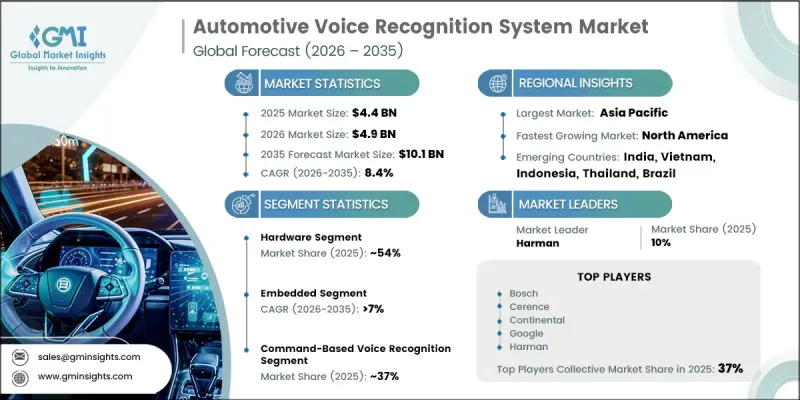
자동차 업계가 커넥티드 인포테인먼트 플랫폼, 중앙 집중형 컴퓨팅, 클라우드 지원 차량 생태계를 특징으로 하는 소프트웨어 정의 차량 아키텍처로의 전환을 지속함에 따라, 자동차용 음성 인식 시스템 시장은 꾸준히 확대되고 있습니다. 음성 인식 기술은 현대적인 인간-기계 인터페이스에서 필수적인 요소가 되어, 운전자가 핸즈프리 조작을 통해 차량의 주요 기능을 제어하면서 도로에 대한 집중력을 높일 수 있게 해줍니다. 운전 중 주의 산만에 대한 우려가 커지고 도로 교통 안전 규제가 강화됨에 따라, 자동차 제조사들은 신차에 첨단 음성 지원 시스템을 탑재하고 있습니다. 동시에 인공지능, 기계 학습, 자연어 이해, 생성형 AI 분야의 지속적인 발전으로 인해 음성 인식 정확도, 문맥 해석, 다국어 지원 능력, 응답 속도가 크게 향상되고 있습니다. 이러한 기술적 진보는 보다 안전한 차량 운전과 사용자 편의성 향상을 뒷받침하는 동시에 전반적인 운전 경험을 개선하고 있습니다. 연결되고 지능적이며 개인화된 차량 내 경험에 대한 소비자의 수요 증가와 차세대 자동차 기술에 대한 투자 확대가 맞물리면서, 전 세계 자동차용 음성 인식 시스템 시장 전체에서 장기적인 성장이 지속될 것으로 예상됩니다.
| 시장 범위 | |
|---|---|
| 시작 연도 | 2025년 |
| 예측 기간 | 2026-2035년 |
| 초기 시장 규모 | 44억 달러 |
| 예측액 | 101억 달러 |
| CAGR | 8.4% |
하드웨어 부문은 2025년에 54%의 점유율을 차지했으며, 2026년부터 2035년까지 연평균 성장률(CAGR) 7%로 성장할 것으로 전망됩니다. 자동차 제조사들이 음성 처리 속도 향상, 인식 정확도 제고, 시스템 지연 시간 단축을 우선시함에 따라, 첨단 하드웨어 부품에 대한 수요는 지속적으로 증가하고 있습니다. 고성능 처리 장치, 첨단 마이크 기술, 전용 음성 처리 하드웨어 및 엣지 컴퓨팅 기능의 통합을 통해 클라우드 연결에 대한 의존도를 낮추면서도 더욱 신뢰할 수 있는 음성 인식이 가능해집니다. 차량 아키텍처가 점점 더 고도화됨에 따라, 각 제조사는 성능 향상과 원활한 사용자 상호작용을 실현하는 첨단 하드웨어 솔루션에 대한 투자를 지속하고 있습니다.
명령형 음성 인식 부문은 2025년에 37%의 점유율을 차지했으며, 2035년까지 연평균 성장률(CAGR) 7%로 성장할 것으로 전망됩니다. 소비자들이 차량 기능에 대한 직관적인 핸즈프리 조작을 점점 더 요구함에 따라, 이 부문은 계속해서 시장을 주도하고 있습니다. 명령형 음성 인식을 통해 운전자는 음성 지시를 통해 차량의 주요 기능에 접근할 수 있게 되어 편의성이 향상될 뿐만 아니라, 차량 조작 장치에 대한 수동 조작이 줄어듭니다. 이 기술은 운전 중 주의 산만을 최소화하고, 보다 효율적이며 사용자 친화적인 운전 경험을 제공함으로써 안전한 운전을 지원하며, 다양한 차종에서의 보급을 촉진하고 있습니다.
아시아태평양의 자동차용 음성 인식 시스템 시장은 45%의 점유율을 차지하며, 2025년에는 20억 달러 규모의 시장에 달할 것으로 전망됩니다. 이 지역이 시장을 주도하고 있는 배경으로는 자동차 생산의 지속적인 확대, 커넥티드카에 대한 소비자 수요 증가, 그리고 자동차 제조사들의 차량용 지능형 기술 통합이 진행되고 있다는 점을 들 수 있습니다. 생산 대수의 증가는 음성 인식 소프트웨어, 임베디드 자동차 기술 및 지능형 차량용 인터페이스 솔루션 개발 기업들에게 큰 비즈니스 기회를 창출하고 있습니다. 첨단 자동차 전자기기 및 디지털 모빌리티 기술에 대한 지속적인 투자로 인해, 예측 기간 동안 해당 지역의 시장 성장이 더욱 가속화될 것으로 전망됩니다.
자주 묻는 질문
목차
제1장 조사 방법
제2장 주요 요약
제3장 업계 인사이트
제4장 경쟁 구도
제5장 시장 추정 및 예측 : 구성요소별, 2022-2035년
제6장 시장 추정 및 예측 : 전개 모델별, 2022-2035년
제7장 시장 추정 및 예측 : 음성 인식별, 2022-2035년
제8장 시장 추정 및 예측 : 차량별, 2022-2035년
제9장 시장 추정 및 예측 : 연료별, 2022-2035년
제10장 시장 추정 및 예측 : 용도별, 2022-2035년
제11장 시장 추정 및 예측 : 판매 채널별, 2022-2035년
제12장 시장 추정 및 예측 : 지역별, 2022-2035년
제13장 기업 개요
KSM 26.08.05The Global Automotive Voice Recognition System Market was valued at USD 4.4 billion in 2025 and is estimated to grow at a CAGR of 8.4% to reach USD 10.1 billion by 2035.
The automotive voice recognition system market is expanding steadily as the automotive industry continues its transition toward software-defined vehicle architectures featuring connected infotainment platforms, centralized computing, and cloud-enabled vehicle ecosystems. Voice recognition technology has become a critical component of modern human-machine interfaces, enabling drivers to operate key vehicle functions through hands-free interaction while maintaining greater focus on the road. Increasing concerns surrounding distracted driving, combined with stricter road safety regulations, are encouraging automakers to integrate advanced voice-enabled systems into new vehicle models. At the same time, continuous advancements in artificial intelligence, machine learning, natural language understanding, and generative AI are significantly improving speech recognition accuracy, contextual interpretation, multilingual capabilities, and response speed. These technological improvements are enhancing the overall driving experience while supporting safer vehicle operation and greater user convenience. Growing consumer demand for connected, intelligent, and personalized in-vehicle experiences, together with rising investments in next-generation automotive technologies, is expected to sustain long-term growth across the global automotive voice recognition system market.
| Market Scope | |
|---|---|
| Start Year | 2025 |
| Forecast Year | 2026-2035 |
| Start Value | $4.4 Billion |
| Forecast Value | $10.1 Billion |
| CAGR | 8.4% |
The hardware segment accounted for 54% share in 2025 and is anticipated to grow at a CAGR of 7% from 2026 to 2035. Demand for advanced hardware components continues to increase as automakers prioritize faster speech processing, improved recognition accuracy, and lower system latency. The integration of high-performance processing units, advanced microphone technologies, dedicated speech-processing hardware, and edge computing capabilities enables more reliable voice recognition while reducing dependence on cloud connectivity. As vehicle architectures become increasingly sophisticated, manufacturers continue investing in advanced hardware solutions that deliver enhanced performance and seamless user interaction.
The command-based voice recognition segment represented 37% share in 2025 and is expected to grow at a CAGR of 7% through 2035. This segment continues to lead the market as consumers increasingly demand intuitive hands-free control of vehicle functions. Command-based voice recognition enables drivers to access essential vehicle features through spoken instructions, improving convenience while reducing manual interaction with vehicle controls. The technology supports safer driving by minimizing distractions and delivering a more efficient and user-friendly driving experience, encouraging broader adoption across multiple vehicle categories.
Asia Pacific Automotive Voice Recognition System Market held 45% share, generating USD 2 billion in 2025. The region's leadership is driven by continued expansion in vehicle manufacturing, rising consumer demand for connected vehicles, and increasing integration of intelligent in-vehicle technologies by automotive manufacturers. Growing production volumes are creating significant opportunities for developers of voice recognition software, embedded automotive technologies, and intelligent vehicle interface solutions. Continued investment in advanced automotive electronics and digital mobility technologies is expected to further strengthen regional market growth throughout the forecast period.
Major companies operating in the global automotive voice recognition system market include Harman, Bosch, Cerence, Continental, Google, Apple, Amazon, Microsoft, Denso, and SoundHound AI. Companies operating in the automotive voice recognition system market are strengthening their competitive position through continuous investment in artificial intelligence, natural language processing, and advanced speech recognition technologies. Manufacturers are expanding partnerships with automotive OEMs to integrate intelligent voice solutions into next-generation connected vehicles while improving compatibility with broader digital vehicle ecosystems. Businesses are also focusing on developing multilingual capabilities, faster processing speeds, enhanced contextual understanding, and improved personalization features to deliver a more intuitive user experience. Strategic investments in cloud connectivity, edge computing, software updates, and cybersecurity are further enhancing system performance and reliability.
Table of Contents
Chapter 1 Methodology
- 1.1 Research approach
- 1.2 Quality Commitments
- 1.2.1 GMI AI policy & data integrity commitment
- 1.2.1.1 Source consistency protocol
- 1.2.1 GMI AI policy & data integrity commitment
- 1.3 Research Trail & Confidence Scoring
- 1.3.1 Research Trail Components
- 1.3.2 Scoring Components
- 1.4 Data Collection
- 1.4.1 Partial list of primary sources
- 1.5 Data mining sources
- 1.5.1 Paid sources
- 1.5.2 Sources, by region
- 1.6 Base estimates and calculations
- 1.6.1 Base year calculation
- 1.7 Forecast model
- 1.7.1 Quantified market impact analysis
- 1.7.1.1 Mathematical impact of growth parameters on forecast
- 1.7.1 Quantified market impact analysis
- 1.8 Research transparency addendum
- 1.8.1 Source attribution framework
- 1.8.2 Quality assurance metrics
- 1.8.3 Our commitment to trust
Chapter 2 Executive Summary
- 2.1 Industry 360° synopsis, 2022 - 2035
- 2.2 Key market trends
- 2.2.1 Regional
- 2.2.2 Component
- 2.2.3 Deployment Model
- 2.2.4 Voice Recognition
- 2.2.5 Vehicle
- 2.2.6 Fuel
- 2.2.7 Application
- 2.2.8 Sales Channel
- 2.3 TAM Analysis, 2026-2035
- 2.4 CXO perspectives: Strategic imperatives
Chapter 3 Industry Insights
- 3.1 Industry ecosystem analysis
- 3.1.1 Supplier landscape
- 3.1.2 Profit margin analysis
- 3.1.3 Cost structure
- 3.1.4 Value addition at each stage
- 3.1.5 Factor affecting the value chain
- 3.1.6 Disruptions
- 3.2 Industry impact forces
- 3.2.1 Growth drivers
- 3.2.1.1 Rising adoption of connected-car ecosystems and smart cockpit technologies
- 3.2.1.2 Stringent hands-free driving regulations
- 3.2.1.3 Accelerated EV adoption
- 3.2.1.4 Declining edge AI chip costs
- 3.2.2 Industry pitfalls and challenges
- 3.2.2.1 High installation and integration costs
- 3.2.2.2 Accent, dialect, and multilingual accuracy gaps
- 3.2.2.3 Data privacy compliance burden
- 3.2.2.4 RF interference in multi-sensor cockpit environments
- 3.2.3 Market opportunities
- 3.2.3.1 Expansion of multilingual and regional language capabilities
- 3.2.3.2 Voice-activated in-car commerce and payments
- 3.2.3.3 Integration of generative AI and LLMs
- 3.2.3.4 OTA software update monetization
- 3.2.1 Growth drivers
- 3.3 Growth potential analysis
- 3.4 Technology and innovation landscape
- 3.4.1 Current technological trends
- 3.4.2 Emerging technologies
- 3.5 Price analysis (Driven by Primary Research)
- 3.5.1 Historical Price Trend Analysis
- 3.5.2 Pricing Strategy by Player Type (Premium / Value / Cost-plus)
- 3.6 Regulatory landscape
- 3.6.1 North America
- 3.6.1.1 Environmental Protection Agency (EPA)
- 3.6.1.2 National Highway Traffic Safety Administration (NHTSA)
- 3.6.1.3 Federal Motor Vehicle Safety Standards (FMVSS)
- 3.6.1.4 U.S. Department of Transportation (DOT)
- 3.6.1.5 Canadian Motor Vehicle Safety Standards (CMVSS)
- 3.6.2 Europe
- 3.6.2.1 UNECE Regulation No. 155 (Cybersecurity)
- 3.6.2.2 UNECE Regulation No. 156 (Software Updates)
- 3.6.2.3 General Data Protection Regulation (GDPR)
- 3.6.2.4 Radio Equipment Directive (RED)
- 3.6.2.5 EU General Safety Regulation (GSR)
- 3.6.3 Asia Pacific
- 3.6.3.1 China Compulsory Certification (CCC)
- 3.6.3.2 China Automotive Data Security Regulations
- 3.6.3.3 Indian Central Motor Vehicle Rules (CMVR)
- 3.6.3.4 Japanese Road Transport Vehicle Act
- 3.6.3.5 Australian Design Rules (ADR)
- 3.6.4 Latin America
- 3.6.4.1 Brazilian General Data Protection Law (LGPD)
- 3.6.4.2 Brazilian National Traffic Council (CONTRAN)
- 3.6.4.3 Brazilian National Institute of Metrology (INMETRO)
- 3.6.4.4 Mexican Official Standards (NOM)
- 3.6.4.5 Regional Vehicle Type Approval & Certification Requirements
- 3.6.5 Middle East & Africa
- 3.6.5.1 GCC Standardization Organization (GSO) Vehicle Regulations
- 3.6.5.2 Saudi Standards, Metrology and Quality Organization (SASO)
- 3.6.5.3 South African National Regulator for Compulsory Specifications (NRCS)
- 3.6.5.4 National Road Traffic Act (NRTA)
- 3.6.5.5 UAE Emirates Authority for Standardization and Metrology (ESMA) Vehicle Regulations
- 3.6.1 North America
- 3.7 Trade data analysis (Driven by Paid Research)
- 3.7.1 Import/export volume & value trends
- 3.7.2 Key trade corridors & tariff impact
- 3.8 Impact of AI & generative AI on the market
- 3.8.1 AI-driven disruption of existing business models
- 3.8.2 GenAI use cases & adoption roadmap by segment
- 3.8.3 Risks, limitations & regulatory considerations
- 3.9 Capacity & production landscape (Driven by Primary Research)
- 3.9.1 Installed capacity by region & key producer
- 3.9.2 Capacity utilization rates & expansion pipelines
- 3.10 Cost breakdown analysis
- 3.11 Patent analysis (Driven by Primary Research)
- 3.12 Porter's analysis
- 3.13 PESTEL analysis
- 3.14 Sustainability and environmental aspects
- 3.14.1 Sustainable practices
- 3.14.2 Waste reduction strategies
- 3.14.3 Energy efficiency in production
- 3.14.4 Eco-friendly Initiatives
- 3.14.5 Carbon footprint considerations
- 3.15 Forecast assumptions & scenario analysis (Driven by Primary Research)
- 3.15.1 Base Case - key macro & industry variables driving CAGR
- 3.15.2 Optimistic Scenarios - Favorable macro and industry tailwinds
- 3.15.3 Pessimistic Scenario - Macroeconomic slowdown or industry headwinds
Chapter 4 Competitive Landscape, 2025
- 4.1 Introduction
- 4.2 Company market share analysis
- 4.2.1 North America
- 4.2.2 Europe
- 4.2.3 Asia Pacific
- 4.2.4 LATAM
- 4.2.5 MEA
- 4.3 Competitive analysis of major market players
- 4.4 Competitive positioning matrix
- 4.5 Key developments
- 4.5.1 Mergers & acquisitions
- 4.5.2 Partnerships & collaborations
- 4.5.3 New Product Launches
- 4.5.4 Expansion Plans and funding
- 4.6 Company tier benchmarking
- 4.6.1 Tier classification criteria & qualifying thresholds
- 4.6.2 Tier positioning matrix by revenue, geography & innovation
Chapter 5 Market Estimates & Forecast, By Component, 2022 - 2035 ($Mn, Units)
- 5.1 Key trends
- 5.2 Hardware
- 5.2.1 Microphones
- 5.2.2 Electronic control units (ECUs)
- 5.2.3 Infotainment head unit / (HMI)
- 5.2.4 Connectivity hardware
- 5.2.5 Others
- 5.3 Software
- 5.3.1 Automatic speech recognition (ASR)
- 5.3.2 Natural language understanding (NLU)
- 5.3.3 Text-to-speech (TTS)
- 5.3.4 Voice assistant platforms (custom or third-party)
- 5.3.5 Others
- 5.4 Services
- 5.4.1 OTA updates (Over-the-Air)
- 5.4.2 Third-party app integrations
- 5.4.3 Multilingual support services
- 5.4.4 Others
Chapter 6 Market Estimates & Forecast, By Deployment Model, 2022 - 2035 ($Mn, Units)
- 6.1 Key trends
- 6.2 Embedded
- 6.3 Cloud-based
- 6.4 Hybrid
Chapter 7 Market Estimates & Forecast, By Voice Recognition, 2022 - 2035 ($Mn, Units)
- 7.1 Key trends
- 7.2 Command-based Voice Recognition
- 7.3 Natural Language Understanding (NLU)-based
- 7.4 Conversational AI
Chapter 8 Market Estimates & Forecast, By Vehicle, 2022 - 2035 ($Mn, Units)
- 8.1 Key trends
- 8.2 Passenger car
- 8.2.1 Hatchback
- 8.2.2 Sedan
- 8.2.3 SUV
- 8.3 Commercial Vehicle
- 8.3.1 Light duty
- 8.3.2 Medium duty
- 8.3.3 Heavy duty
Chapter 9 Market Estimates & Forecast, By Fuel, 2022 - 2035 ($Mn, Units)
- 9.1 Key trends
- 9.2 Gasoline
- 9.3 Diesel
- 9.4 BEV
- 9.5 HEV
- 9.6 PHEV
- 9.7 FCEV
Chapter 10 Market Estimates & Forecast, By Application, 2022 - 2035 ($Mn)
- 10.1 Key trends
- 10.2 Navigation & Location-Based Services
- 10.3 Infotainment & Media Control
- 10.4 Communication & Call Handling
- 10.5 Cabin Comfort & Climate Control
- 10.6 Vehicle Control & Connected Services
- 10.7 Driver Safety & Assistance
Chapter 11 Market Estimates & Forecast, By Sales Channel, 2022 - 2035 ($Mn, Units)
- 11.1 Key trends
- 11.2 OEM
- 11.3 Aftermarket
Chapter 12 Market Estimates & Forecast, By Region, 2022 - 2035 ($Mn, Units)
- 12.1 Key trends
- 12.2 North America
- 12.2.1 U.S.
- 12.2.2 Canada
- 12.3 Europe
- 12.3.1 UK
- 12.3.2 Germany
- 12.3.3 France
- 12.3.4 Italy
- 12.3.5 Spain
- 12.3.6 Russia
- 12.3.7 Nordics
- 12.4 Asia Pacific
- 12.4.1 China
- 12.4.2 India
- 12.4.3 Japan
- 12.4.4 South Korea
- 12.4.5 Southeast Asia
- 12.4.5.1 Indonesia
- 12.4.5.2 Malaysia
- 12.4.5.3 Singapore
- 12.4.5.4 Thailand
- 12.4.5.5 Vietnam
- 12.4.6 ANZ
- 12.5 Latin America
- 12.5.1 Brazil
- 12.5.2 Argentina
- 12.5.3 Mexico
- 12.6 MEA
- 12.6.1 UAE
- 12.6.2 Saudi Arabia
- 12.6.3 South Africa
Chapter 13 Company Profiles
- 13.1 Global Players
- 13.1.1 Amazon
- 13.1.2 Apple
- 13.1.3 Bosch
- 13.1.4 Cerence
- 13.1.5 Continental
- 13.1.6 Denso
- 13.1.7 Google
- 13.1.8 Harman
- 13.1.9 Microsoft
- 13.1.10 Qualcomm Technologies
- 13.1.11 Valeo
- 13.1.12 Visteon
- 13.2 Regional Players
- 13.2.1 Alpine Electronics
- 13.2.2 Infineon Technologies
- 13.2.3 LG Electronics
- 13.2.4 NXP Semiconductors
- 13.2.5 Panasonic Automotive Systems
- 13.2.6 Sensory
- 13.2.7 SoundHound AI
- 13.2.8 STMicroelectronics


