

|
시장보고서
상품코드
2101883
유제품 가공용 한외여과 및 정밀여과 시장 기회, 성장 촉진요인, 업계 동향 분석 및 예측(2026-2035년)Ultra-Filtration and Microfiltration in Dairy Processing Market Opportunity, Growth Drivers, Industry Trend Analysis, and Forecast 2026 - 2035 |
||||||

세계의 유제품 가공용 한외여과 및 정밀여과 시장은 2025년에 19억 달러 규모에 달하고, CAGR 9.4%로 성장하여 2035년까지 47억 달러에 달할 것으로 예측됩니다.
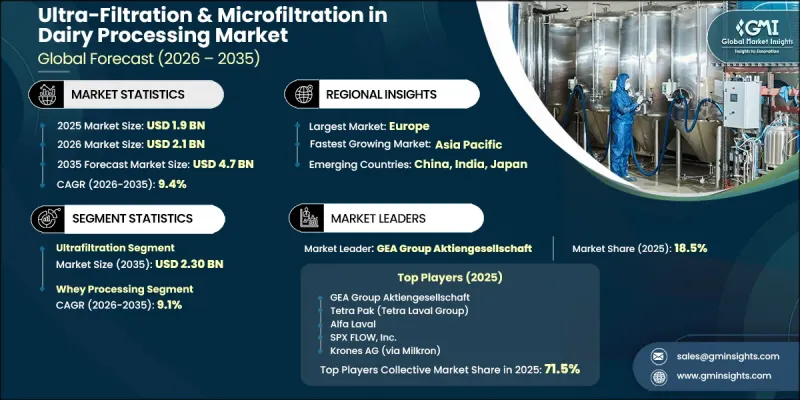
이러한 성장은 고단백 유성분에 대한 수요 증가, 식품 가공 환경에서의 미생물 안전 기준 강화, 그리고 막 기술을 활용한 유제품 제조 시스템의 지속적인 확대가 맞물려 추진되고 있습니다. 한외여과 및 미세여과 기술은 단백질 회수율 향상, 열증발법에 비해 에너지 소비량 절감, 그리고 공정 전반의 효율 향상을 실현하는 능력에 힘입어, 2차 가공 도구에서 현대 유제품 생산의 핵심 인프라로 그 위상을 전환하고 있습니다. 고단백 유성분의 프리미엄 가격 책정은 주요 유제품 생산 지역 전반에 걸쳐 막 시스템에 대한 재투자를 지속적으로 촉진하고 있습니다. 동시에, 세계 인구의 상당 부분이 정도 차이는 있겠지만 유당 불내증을 앓고 있기 때문에 무유당 유제품에 대한 수요 확대가 첨단 여과 공정의 도입을 뒷받침하고 있습니다. 막 분리 시스템은 영양 성분을 보존한 채 유제품 스트림을 효율적으로 분획할 수 있게 하여, 전 세계 유제품 공급망 전반에 걸쳐 제품 혁신과 규제 준수를 모두 뒷받침하고 있습니다.
| 시장 범위 | |
|---|---|
| 시작 연도 | 2025년 |
| 예측 기간 | 2026-2035년 |
| 초기 시장 규모 | 19억 달러 |
| 예측액 | 47억 달러 |
| CAGR | 9.4% |
한외여과 부문은 2025년에 9억 900만 달러의 매출을 기록하며 시장 점유율의 47.5%를 차지했으며, 2035년까지 연평균 성장률(CAGR) 9.8%로 23억 달러에 달할 것으로 전망됩니다. 이 부문은 유제품 가공 사업에서 여전히 핵심적인 역할을 수행하고 있으며, 주요 생산 지역의 대규모 유제품 시설에서는 유청 단백질 농축, 유단백 농축물 제조 및 예비 농축 공정에 막 시스템이 널리 활용되고 있습니다.
유청 가공 부문은 6억 800만 달러에 달해 31.7%의 점유율을 차지하고 있으며, 연평균 성장률(CAGR) 9.1%로 성장하여 2035년까지 14억 5,000만 달러에 달할 것으로 예상됩니다. 이러한 우위는 유청 단백질 생산 시스템에서 막 여과의 필수적인 역할에 기인합니다. 이 시스템에서는 한외여과를 통해 고부가가치 단백질 농축물 및 분리물을 산업 규모로 경제적으로 생산할 수 있게 되어, 단백질이 풍부한 유제품 원료에 대한 전 세계적 수요를 뒷받침하고 있습니다.
북미 유제품 가공 분야의 한외여과 및 정밀여과 시장은 2025년에 5억 6,600만 달러를 차지했습니다. 미국은 고도로 발달한 유청 가공 산업과 주요 유제품 생산 지역에 집중된 광범위한 막 여과 인프라에 힘입어 여전히 주요 수요 거점으로 자리 잡고 있습니다. 대규모 유제품 가공 시설에서의 첨단 분리 기술에 대한 강력한 통합이 이 지역 시장의 주도적 지위를 계속해서 공고히 하고 있습니다.
자주 묻는 질문
목차
제1장 조사 방법과 범위
제2장 주요 요약
제3장 업계 인사이트
제4장 경쟁 구도
제5장 시장 추정 및 예측 : 기술 유형별, 2022-2035년
제6장 시장 추정 및 예측 : 모듈 설계별, 2022-2035년
제7장 시장 추정 및 예측 : 용도별, 2022-2035년
제8장 시장 추정 및 예측 : 최종사용자별, 2022-2035년
제9장 시장 추정 및 예측 : 지역별, 2022-2035년
제10장 기업 개요
KSM 26.08.05The Global Ultra-Filtration and Microfiltration in Dairy Processing Market was valued at USD 1.9 billion in 2025 and is estimated to grow at a CAGR of 9.4% to reach USD 4.7 billion by 2035.
Growth is driven by the convergence of rising demand for high-protein dairy ingredients, stricter microbial safety requirements in food processing environments, and the continued scaling of membrane-based dairy manufacturing systems. Ultrafiltration and microfiltration technologies have shifted from secondary processing tools to core infrastructure in modern dairy production, supported by their ability to improve protein recovery, reduce energy consumption compared to thermal evaporation, and enhance overall process efficiency. Premium pricing for high-protein dairy ingredients continues to support reinvestment in membrane systems across major dairy-producing regions. At the same time, expanding demand for lactose-free dairy products is reinforcing the adoption of advanced filtration processes, as a significant share of the global population experiences varying degrees of lactose intolerance. Membrane-based separation systems enable efficient fractionation of dairy streams while preserving nutritional composition, supporting both product innovation and regulatory compliance across global dairy supply chains.
| Market Scope | |
|---|---|
| Start Year | 2025 |
| Forecast Year | 2026-2035 |
| Start Value | $1.9 Billion |
| Forecast Value | $4.7 Billion |
| CAGR | 9.4% |
The ultrafiltration segment generated USD 909 million in 2025, accounting for 47.5% share, and is projected to reach USD 2.30 billion by 2035 at a CAGR of 9.8%. This segment remains central to dairy processing operations, with membrane systems widely used for whey protein concentration, milk protein concentrate production, and pre-concentration processes in large-scale dairy facilities across key producing regions.
The whey processing segment reached USD 608 million, holding 31.7% share, and is expected to grow at a CAGR of 9.1% to reach USD 1.45 billion by 2035. This dominance is driven by the essential role of membrane filtration in whey protein production systems, where ultrafiltration enables the economic production of high-value protein concentrates and isolates at an industrial scale, supporting global demand for protein-rich dairy ingredients.
North America Ultra-Filtration and Microfiltration in Dairy Processing Market accounted for USD 566 million in 2025. The United States remains the primary demand hub, supported by a highly developed whey processing industry and extensive membrane filtration infrastructure concentrated in major dairy-producing regions. Strong integration of advanced separation technologies within large-scale dairy processing facilities continues to reinforce regional market leadership.
Major players operating in the global ultra-filtration & microfiltration in dairy processing industry are Dexcom, Inc., Medtronic Plc, Abbott Laboratories, Novo Nordisk A/S, F. Hoffmann-La Roche Ltd, Tandem Diabetes Care, Inc., Insulet Corporation, Ypsomed Holding, Ascensia Diabetes Care Holdings AG, DarioHealth Corporation, Senseonics, Glooko Inc., Emperra GmbH E-Health Technologies, Pendiq. Companies operating in the ultra-filtration and microfiltration in dairy processing market are focusing on expanding membrane efficiency and improving separation performance through advanced material engineering and optimized pore structure designs. Many players are investing in automation and digital monitoring systems to enhance process control, reduce downtime, and improve yield consistency across dairy production lines. Strategic collaborations with dairy processors are strengthening long-term supply contracts and enabling customized system integration for whey and milk processing applications. Firms are also prioritizing energy-efficient membrane technologies to reduce operational costs and improve sustainability performance in large-scale plants.
Table of Contents
Chapter 1 Methodology & Scope
- 1.1 Research approach
- 1.2 Quality Commitments
- 1.2.1 GMI AI policy & data integrity commitment
- 1.2.1.1 Source consistency protocol
- 1.2.1 GMI AI policy & data integrity commitment
- 1.3 Research Trail & Confidence Scoring
- 1.3.1 Research Trail Components
- 1.3.2 Scoring Components
- 1.4 Data Collection
- 1.4.1 Partial list of primary sources
- 1.5 Data mining sources
- 1.5.1 Paid sources
- 1.5.1.1 Sources, by region
- 1.5.1 Paid sources
- 1.6 Base estimates and calculations
- 1.6.1 Base year calculation for any one approach
- 1.7 Forecast model
- 1.7.1 Quantified market impact analysis
- 1.7.1.1 Mathematical impact of growth parameters on forecast
- 1.7.1 Quantified market impact analysis
- 1.8 Research transparency addendum
- 1.8.1 Source attribution framework
- 1.8.2 Quality assurance metrics
- 1.8.3 Our commitment to trust
Chapter 2 Executive Summary
- 2.1 Industry 360° synopsis
- 2.2 Key market trends
- 2.2.1 Regional
- 2.2.2 Technology Type
- 2.2.3 Module Design
- 2.2.4 Application
- 2.2.5 End-User
- 2.3 TAM Analysis, 2026-2035
- 2.4 CXO perspectives: Strategic imperatives
Chapter 3 Industry Insights
- 3.1 Industry ecosystem analysis
- 3.1.1 Supplier landscape
- 3.1.2 Profit margin
- 3.1.3 Value addition at each stage
- 3.1.4 Factor affecting the value chain
- 3.1.5 Disruptions
- 3.2 Industry impact forces
- 3.2.1 Growth drivers
- 3.2.2 Industry pitfalls and challenges
- 3.2.3 Market opportunities
- 3.3 Growth potential analysis
- 3.4 Regulatory landscape
- 3.4.1 North America
- 3.4.2 Europe
- 3.4.3 Asia Pacific
- 3.4.4 Latin America
- 3.4.5 Middle East & Africa
- 3.5 Porter's analysis
- 3.6 PESTEL analysis
- 3.7 Price trends
- 3.7.1 By region
- 3.7.2 By product type
- 3.8 Future market trends
- 3.9 Technology and Innovation landscape
- 3.9.1 Current technological trends
- 3.9.2 Emerging technologies
- 3.10 Patent Landscape
- 3.11 Trade statistics (HS code)
- 3.11.1 Major importing countries
- 3.11.2 Major exporting countries
- 3.12 Sustainability and environmental aspects
- 3.12.1 Sustainable practices
- 3.12.2 Waste reduction strategies
- 3.12.3 Energy efficiency in production
- 3.12.4 Eco-friendly initiatives
- 3.13 Carbon footprint consideration
Chapter 4 Competitive Landscape, 2025
- 4.1 Introduction
- 4.2 Company market share analysis
- 4.2.1 By region
- 4.2.1.1 North America
- 4.2.1.2 Europe
- 4.2.1.3 Asia Pacific
- 4.2.1.4 LATAM
- 4.2.1.5 MEA
- 4.2.1 By region
- 4.3 Company matrix analysis
- 4.4 Competitive analysis of major market players
- 4.5 Competitive positioning matrix
- 4.6 Key developments
- 4.6.1 Mergers & acquisitions
- 4.6.2 Partnerships & collaborations
- 4.6.3 New Product Launches
- 4.6.4 Expansion Plans
Chapter 5 Market Estimates and Forecast, By Technology Type, 2022-2035 (USD Million)
- 5.1 Key trends
- 5.2 Ultrafiltration (UF)
- 5.2.1 Spiral Wound UF
- 5.2.2 Plate & Frame UF
- 5.2.3 Tubular UF
- 5.2.4 Hollow Fiber UF
- 5.3 Microfiltration (MF)
- 5.3.1 Ceramic MF
- 5.3.2 Polymeric MF
- 5.3.3 Cold MF
- 5.4 Nanofiltration (NF)
- 5.4.1 Spiral Wound NF
- 5.4.2 Tubular NF
- 5.5 Reverse Osmosis (RO)
- 5.5.1 Spiral Wound RO
- 5.5.2 Plate & Frame RO
- 5.6 Others
- 5.6.1 Diafiltration
- 5.6.2 Electrodialysis
- 5.6.3 Membrane Contactors
Chapter 6 Market Estimates and Forecast, By Module Design, 2022-2035 (USD Million)
- 6.1 Key trends
- 6.2 Spiral Wound
- 6.3 Tubular Systems
- 6.4 Plate & Frame
- 6.5 Hollow Fiber
Chapter 7 Market Estimates and Forecast, By Application, 2022-2035 (USD Million)
- 7.1 Key trends
- 7.2 Milk Processing
- 7.2.1 Milk Standardization & Protein Concentration
- 7.2.2 Bacterial & Spore Removal
- 7.2.3 Lactose Reduction
- 7.2.4 Fat Fractionation
- 7.3 Whey Processing
- 7.3.1 Whey Protein Concentrate (WPC) Production
- 7.3.2 Whey Protein Isolate (WPI) Production
- 7.3.3 Lactose Recovery
- 7.3.4 Whey Demineralization
- 7.4 Cheese Production
- 7.4.1 Cheese Milk Preparation
- 7.4.2 Bacterial Removal for Extended Shelf Life
- 7.4.3 Brine Treatment
- 7.4.4 MCC Production
- 7.5 Yogurt Production
- 7.5.1 Greek Yogurt & High-Protein Yogurt
- 7.5.2 Skyr & Quark Production
- 7.5.3 Protein Standardization for Fermented Products
- 7.6 Butter Production
- 7.6.1 Fat Fractionation & Clarification
- 7.6.2 Buttermilk Concentration
- 7.7 Others
- 7.7.1 Cream Processing
- 7.7.2 Infant Formula Ingredients
- 7.7.3 Sports & Senior Nutrition Protein Products
Chapter 8 Market Estimates and Forecast, By End-User, 2022-2035 (USD Million)
- 8.1 Key trends
- 8.2 Dairy Processing Plants
- 8.2.1 Large-Scale Integrated Facilities
- 8.2.2 Medium-Scale Regional Plants
- 8.2.3 Small-Scale Artisanal Processors
- 8.3 Cheese Manufacturers
- 8.3.1 Natural Cheese Producers
- 8.3.2 Processed Cheese Facilities
- 8.4 Yogurt Producers
- 8.4.1 Conventional Yogurt Plants
- 8.4.2 High-Protein & Greek Yogurt Facilities
- 8.5 Butter Manufacturers
- 8.5.1 Creamery Butter Production
- 8.5.2 Specialty Butter Processing
- 8.6 Fluid Milk Producers
- 8.6.1 Fresh Milk Processing
- 8.6.2 Extended Shelf Life (ESL) Milk
- 8.6.3 UHT Milk Production
Chapter 9 Market Estimates and Forecast, By Region, 2022-2035 (USD Million)
- 9.1 Key trends
- 9.2 North America
- 9.2.1 U.S.
- 9.2.2 Canada
- 9.3 Europe
- 9.3.1 Germany
- 9.3.2 UK
- 9.3.3 France
- 9.3.4 Spain
- 9.3.5 Italy
- 9.3.6 Rest of Europe
- 9.4 Asia Pacific
- 9.4.1 China
- 9.4.2 India
- 9.4.3 Japan
- 9.4.4 Australia
- 9.4.5 South Korea
- 9.4.6 Rest of Asia Pacific
- 9.5 Latin America
- 9.5.1 Brazil
- 9.5.2 Mexico
- 9.5.3 Argentina
- 9.5.4 Rest of Latin America
- 9.6 Middle East and Africa
- 9.6.1 Saudi Arabia
- 9.6.2 South Africa
- 9.6.3 UAE
- 9.6.4 Rest of Middle East and Africa
Chapter 10 Company Profiles
- 10.1 GEA Group Aktiengesellschaft
- 10.2 Tetra Pak (Tetra Laval Group)
- 10.3 Alfa Laval
- 10.4 SPX FLOW, Inc.
- 10.5 Krones AG (via Milkron)
- 10.6 Koch Membrane Systems
- 10.7 IDMC Limited
- 10.8 Andritz AG
- 10.9 Pentair plc
- 10.10 Kovalus Separation Solutions
- 10.11 Neologic Engineers Private Limited
- 10.12 Gemak Ltd.
- 10.13 Permionics Membranes Private Limited
- 10.14 Caloris Engineering LLC
- 10.15 Synder Filtration


