|
시장보고서
상품코드
2101892
오토인젝터 시장 기회, 성장 촉진요인, 업계 동향 분석 및 예측(2026-2035년)Autoinjectors Market Opportunity, Growth Drivers, Industry Trend Analysis, and Forecast 2026 - 2035 |
||||||

세계의 오토인젝터 시장은 2025년에 1,150억 달러 규모에 달하고, 2035년까지 CAGR 14.4%로 성장하여 4,308억 달러에 달할 것으로 예측됩니다.
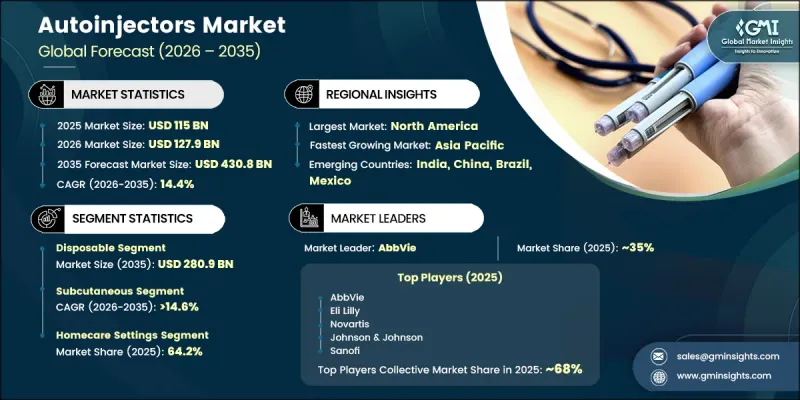
시장 성장은 표적 치료법의 채택 확대, 제네릭 오토인젝터의 접근성 향상, 그리고 편의성이 뛰어난 자가 투여 기기에 대한 수요 증가에 힘입어 견인되고 있습니다. 오토인젝터는 사용자의 부담을 최소화하면서 바늘을 통해 미리 설정된 용량의 약물을 자동으로 투여하도록 설계된 첨단 약물 투여 시스템입니다. 이러한 기기는 당뇨병, 류마티스 관절염, 알레르기 및 기타 장기적인 질환을 포함한 만성 질환 치료의 자가 투여에 널리 사용되고 있습니다. 일반적으로 스프링식 주입 기구로 뒷받침되는 사용하기 쉬운 설계 덕분에 정기적인 주사가 필요한 환자에게 특히 적합합니다. 중증 알레르기 반응 발생률의 증가는 응급 상황에서 신속한 자가 투여를 가능하게 하는 응급용 약물 투여 장치에 대한 수요를 더욱 가속화하고 있습니다. 또한, 비용 효율적인 제네릭 오토인젝터에 대한 접근성이 확대됨에 따라 치료비 부담이 줄어들고, 전 세계 의료 시장 전반에서 환자의 접근성이 확대되고 있습니다. 지속적인 제품 혁신, 환자 편의성 향상, 그리고 재택 치료에 대한 선호도 증가는 오토인젝터 시장의 장기적인 성장 전망을 더욱 공고히 하고 있습니다.
| 시장 범위 | |
|---|---|
| 시작 연도 | 2025년 |
| 예측 기간 | 2026-2035년 |
| 초기 시장 규모 | 1,150억 달러 |
| 예측액 | 4,308억 달러 |
| CAGR | 14.4% |
2025년에는 일회용 오토인젝터 부문이 66.5%의 점유율을 차지했습니다. 이는 광범위한 치료 용도에서 일회용 기기가 제공하는 편의성, 안전성 및 사용 편의성에 힘입은 결과입니다. 일회용 오토인젝터는 약물이 미리 충전된 상태로 공급되며, 1회 투여를 목적으로 하기 때문에 카트리지 교체가 필요 없을 뿐만 아니라 오염 위험과 투여량 오차도 최소화됩니다. 높은 신뢰성과 간편한 조작성 덕분에, 장기간에 걸쳐 일관되고 정확한 약물 투여가 필요한 만성 질환 치료 분야에서 널리 채택되고 있습니다.
재택의료 분야는 자가 투여 및 환자 중심 의료 모델로의 전환이 진행된 것을 배경으로, 2025년에는 64.2%의 점유율을 차지했습니다. 재택 치료는 편의성이 높고, 의료비를 절감하며, 만성 질환의 자립적인 관리를 지원하기 때문에 환자들로부터 지속적인 지지를 받고 있습니다. 오토인젝터는 의료진의 직접적인 감독 없이도 안전하고 정확하며 사용하기 쉬운 약물 투여를 가능하게 하므로, 장기적인 주사 요법에 이상적인 솔루션일 뿐만 아니라 치료 순응도와 환자 만족도를 향상시킵니다.
2025년, 북미의 오토인젝터 시장은 46.9%의 점유율을 차지했습니다. 이 지역의 시장 확대는 정기적인 주사 요법이 필요한 만성 질환의 유병률 증가, 자가 투여를 통한 치료 옵션에 대한 인식 제고, 그리고 첨단 약물전달 기술의 보급에 힘입어 이루어지고 있습니다. 편리하고 신뢰할 수 있으며 환자 친화적인 주사 기기에 대한 지속적인 수요와 확립된 의료 인프라가 결합되어, 해당 지역 전체의 시장 성장이 지속될 것으로 예상됩니다.
자주 묻는 질문
목차
제1장 조사 방법
제2장 주요 요약
제3장 업계 인사이트
제4장 경쟁 구도
제5장 시장 추정 및 예측 : 유형별, 2022-2035년
제6장 시장 추정 및 예측 : 투여 경로별, 2022-2035년
제7장 시장 추정 및 예측 : 치료법별, 2022-2035년
제8장 시장 추정 및 예측 : 최종사용별, 2022-2035년
제9장 시장 추정 및 예측 : 지역별, 2022-2035년
제10장 기업 개요
KSM 26.08.05The Global Autoinjectors Market was valued at USD 115 billion in 2025 and is estimated to grow at a CAGR of 14.4% to reach USD 430.8 billion by 2035.
Market growth is being fueled by the rising adoption of targeted therapies, expanding availability of generic autoinjectors, and increasing demand for convenient self-administration devices. Autoinjectors are advanced drug delivery systems designed to automatically administer a predetermined dose of medication through a needle with minimal user effort. These devices are widely used for the self-administration of therapies for chronic conditions, including diabetes, rheumatoid arthritis, allergies, and other long-term diseases. Their user-friendly design, typically supported by a spring-powered injection mechanism, makes them particularly suitable for patients requiring regular injections. The increasing prevalence of severe allergic reactions is further accelerating demand for emergency drug delivery devices that enable rapid self-administration during critical situations. In addition, broader access to cost-effective generic autoinjectors is improving treatment affordability and expanding patient access across global healthcare markets. Continuous product innovation, improved patient convenience, and growing preference for home-based treatment continue to reinforce the long-term growth outlook for the autoinjectors market.
| Market Scope | |
|---|---|
| Start Year | 2025 |
| Forecast Year | 2026-2035 |
| Start Value | $115 Billion |
| Forecast Value | $430.8 Billion |
| CAGR | 14.4% |
The disposable autoinjectors segment held 66.5% share in 2025, supported by the convenience, safety, and ease of use offered by single-use devices across a broad range of therapeutic applications. Disposable autoinjectors are supplied prefilled and intended for one-time administration, eliminating the need for cartridge replacement while minimizing contamination risks and dosing inaccuracies. Their high reliability and simplified operation have encouraged widespread adoption for the treatment of chronic diseases that require consistent and accurate medication delivery over extended periods.
The homecare settings segment captured a 64.2% share in 2025 driven by the increasing shift toward self-administration and patient-centered healthcare models. Patients continue to favor home-based treatment because it offers greater convenience, lowers healthcare expenses, and supports independent management of chronic conditions. Autoinjectors provide safe, precise, and user-friendly drug administration without requiring direct medical supervision, making them an ideal solution for long-term injectable therapies while improving treatment adherence and patient satisfaction.
North America Autoinjectors Market accounted for 46.9% share in 2025. Regional expansion is supported by the growing prevalence of chronic diseases that require routine injectable therapies, increasing awareness of self-administered treatment options, and the widespread adoption of advanced drug delivery technologies. Continued demand for convenient, reliable, and patient-friendly injection devices, along with a well-established healthcare infrastructure, is expected to sustain market growth across the region.
Key players operating in the global autoinjectors market include Novo Nordisk, AbbVie, Gerresheimer, Eli Lilly and Company, Becton, Dickinson and Company, Johnson & Johnson, SHL Medical, Halozyme, Owen Mumford, Teva Pharmaceuticals, GlaxoSmithKline, Mylan, Antares Pharma, West Pharmaceutical Services, Ypsomed, and Amgen. Companies operating in the autoinjectors market are strengthening their competitive position by investing in advanced drug delivery technologies, expanding product portfolios, and enhancing patient-centric device designs. Manufacturers are focusing on developing user-friendly, ergonomic, and highly reliable autoinjectors that improve treatment adherence and overall patient experience. Strategic partnerships with pharmaceutical companies, healthcare providers, and distribution networks are helping expand commercial reach and support combination product development. Businesses are also increasing investments in research and development to improve injection mechanisms, safety features, and device compatibility with biologics and specialty drugs. In addition, companies continue to pursue regulatory approvals, geographic expansion, manufacturing capacity enhancements, and the introduction of cost-effective generic autoinjectors to broaden market access and reinforce long-term market leadership.
Table of Contents
Chapter 1 Research Methodology
- 1.1 Research approach
- 1.2 Quality commitments
- 1.2.1 GMI AI policy & data integrity commitment
- 1.2.1.1 Source consistency protocol
- 1.2.1 GMI AI policy & data integrity commitment
- 1.3 Research trail & confidence scoring
- 1.3.1 Research trail components
- 1.3.2 Scoring components
- 1.4 Data collection
- 1.4.1 Partial list of primary sources
- 1.5 Data mining sources
- 1.5.1 Paid sources
- 1.5.1.1 Sources, by region
- 1.5.1 Paid sources
- 1.6 Base estimates and calculations
- 1.6.1 Base year calculation
- 1.7 Forecast model
- 1.7.1 Quantified market impact analysis
- 1.7.1.1 Mathematical impact of growth parameters on forecast
- 1.7.1 Quantified market impact analysis
- 1.8 Research transparency addendum
- 1.8.1 Source attribution framework
- 1.8.2 Quality assurance metrics
- 1.8.3 Our commitment to trust
Chapter 2 Executive Summary
- 2.1 Industry 360° synopsis
- 2.2 Key market trends
- 2.2.1 Regional trends
- 2.2.2 Type trends
- 2.2.3 Route of administration trends
- 2.2.4 Therapy trends
- 2.2.5 End use trends
- 2.3 CXO perspectives: Strategic imperatives
Chapter 3 Industry Insights
- 3.1 Industry ecosystem analysis
- 3.2 Industry impact forces
- 3.2.1 Growth drivers
- 3.2.1.1 Growing demand for targeted therapies
- 3.2.1.2 Availability of generic autoinjectors globally
- 3.2.1.3 Increasing incidence of diabetes and anaphylaxis
- 3.2.1.4 Rising patient preference towards self-administration of medication
- 3.2.2 Industry pitfalls and challenges
- 3.2.2.1 Availability of alternative treatment options
- 3.2.2.2 High pricing of the autoinjectors
- 3.2.2.3 Limited autoinjector manufacturing capacity
- 3.2.3 Opportunities
- 3.2.3.1 Adoption of smart and connected autoinjectors
- 3.2.3.2 Expansion of biosimilar and biologic drug launches
- 3.2.1 Growth drivers
- 3.3 Growth potential analysis
- 3.4 Regulatory landscape
- 3.4.1 North America
- 3.4.2 Europe
- 3.4.3 Asia Pacific
- 3.4.4 Latin America
- 3.4.5 Middle East and Africa
- 3.5 Pricing trend analysis (Driven by Primary Research)
- 3.6 Technology and innovation landscape (Driven by Primary Research)
- 3.6.1 Current technological trends
- 3.6.2 Emerging technologies
- 3.7 Future market trends (Driven by Primary Research)
- 3.8 Impact of AI & Generative AI on the Market (Driven by Primary Research)
- 3.9 Porter's analysis
- 3.10 PESTEL analysis
Chapter 4 Competitive Landscape, 2025
- 4.1 Introduction
- 4.2 Company matrix analysis
- 4.3 Company market share analysis (Driven by Primary Research)
- 4.3.1 Global
- 4.3.2 North America
- 4.3.3 Europe
- 4.3.4 Asia Pacific
- 4.3.5 LAMEA
- 4.4 Competitive analysis of major market players
- 4.5 Competitive positioning matrix
- 4.6 Key developments
- 4.6.1 Mergers & acquisitions
- 4.6.2 Partnerships & collaborations
- 4.6.3 New product launches
- 4.6.4 Expansion plans
Chapter 5 Market Estimates and Forecast, By Type, 2022 - 2035 ($ Mn)
- 5.1 Key trends
- 5.2 Disposable
- 5.3 Reusable
Chapter 6 Market Estimates and Forecast, By Route of Administration, 2022 - 2035 ($ Mn)
- 6.1 Key trends
- 6.2 Subcutaneous
- 6.3 Intramuscular
Chapter 7 Market Estimates and Forecast, By Therapy, 2022 - 2035 ($ Mn)
- 7.1 Key trends
- 7.2 Rheumatoid arthritis
- 7.3 Multiple sclerosis
- 7.4 Anaphylaxis
- 7.5 Diabetes
- 7.6 Other therapies
Chapter 8 Market Estimates and Forecast, By End Use, 2022 - 2035 ($ Mn)
- 8.1 Key trends
- 8.2 Hospital and clinics
- 8.3 Homecare settings
- 8.4 Other end users
Chapter 9 Market Estimates and Forecast, By Region, 2022 - 2035 ($ Mn)
- 9.1 Key trends
- 9.2 North America
- 9.2.1 U.S.
- 9.2.2 Canada
- 9.3 Europe
- 9.3.1 Germany
- 9.3.2 UK
- 9.3.3 France
- 9.3.4 Spain
- 9.3.5 Italy
- 9.3.6 Netherlands
- 9.4 Asia Pacific
- 9.4.1 China
- 9.4.2 Japan
- 9.4.3 India
- 9.4.4 Australia
- 9.4.5 South Korea
- 9.5 Latin America
- 9.5.1 Brazil
- 9.5.2 Mexico
- 9.5.3 Argentina
- 9.6 MEA
- 9.6.1 South Africa
- 9.6.2 Saudi Arabia
- 9.6.3 UAE
Chapter 10 Company Profiles
- 10.1 AbbVie
- 10.2 Amgen
- 10.3 Antares Pharma
- 10.4 Becton, Dickinson and Company
- 10.5 Eli Lilly
- 10.6 Gerresheimer
- 10.7 GlaxoSmithKline
- 10.8 Halozyme
- 10.9 Johnson & Johnson
- 10.10 Mylan
- 10.11 Novo Nordisk
- 10.12 Owen Mumford
- 10.13 SHL Medical
- 10.14 Teva Pharmaceuticals
- 10.15 West Pharmaceutical Services
- 10.16 Ypsomed