

|
시장보고서
상품코드
2101908
신생아 케어 시장 기회, 성장 촉진요인, 업계 동향 분석 및 예측(2026-2035년)Neonatal Infant Care Market Opportunity, Growth Drivers, Industry Trend Analysis, and Forecast 2026 - 2035 |
||||||

세계의 신생아 케어 시장은 2025년에 30억 달러로 평가되었으며, CAGR 6.5%로 성장하여 2035년까지 56억 달러에 달할 것으로 추정됩니다.
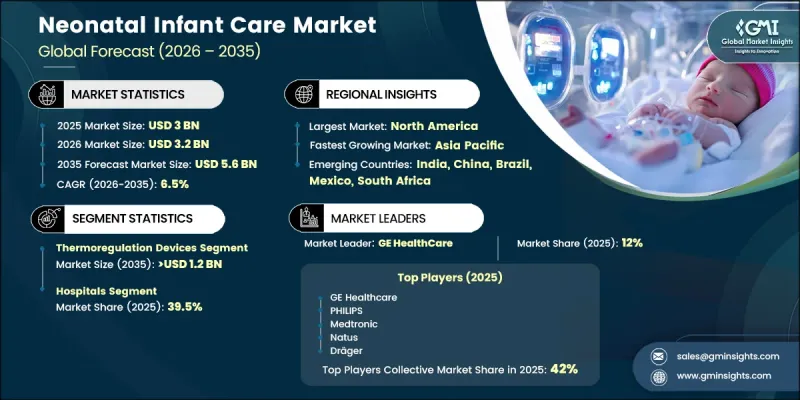
시장 확대는 신생아 중환자실(NICU)의 증가, 임산부 및 신생아 의료에 대한 정부 지출 확대, 그리고 신생아 치료 역량의 지속적인 향상에 힘입고 있습니다. 신생아 돌봄이란 신생아, 특히 조산이나 의학적 합병증으로 인해 추가적인 모니터링, 치료적 개입 또는 집중 치료 지원이 필요한 영아에게 제공되는 전문적인 의료 지원을 의미합니다. 신생아 사망률 감소를 위한 전 세계적인 노력의 확대에 따라, 첨단 신생아 돌봄 장비 및 기술의 도입이 더욱 촉진되고 있습니다. 전 세계 의료 시스템에서는 조산아 및 저체중아의 증가에 대응하기 위해 신생아 중환자실(NICU) 인프라에 대한 투자를 확대하고 있습니다. 신생아 생존율 향상, 의료 시설 강화, 임상 역량 향상에 초점을 맞춘 정부의 노력 또한 시장 발전에 더욱 기여하고 있습니다. 자금은 NICU 수용 능력 확대, 첨단 신생아용 의료기기 도입, 그리고 신생아 치료에 종사하는 의료진의 기술 향상을 위해 점점 더 많이 배정되고 있습니다. 이러한 요인들이 결합되어 병원 및 의료 시설 전반에 걸쳐 신생아 치료 솔루션에 대한 지속적인 수요를 창출하고 있습니다.
| 시장 범위 | |
|---|---|
| 시작 연도 | 2025년 |
| 예측 기간 | 2026-2035년 |
| 초기 시장 규모 | 30억 달러 |
| 예측액 | 56억 달러 |
| CAGR | 6.5% |
2025년, 체온 조절 기기 부문은 24.8%의 점유율을 차지했습니다. 모자 보건 프로그램에 대한 투자 확대가 해당 부문의 지속적인 성장을 뒷받침할 것으로 예상됩니다. 신생아용 인큐베이터 및 복사식 가온기 등의 체온 조절 솔루션은 특히 조산아나 저체중아와 같은 취약한 신생아의 적절한 체온을 유지하도록 설계되었습니다. 이러한 시스템은 저체온증 및 이에 따른 건강상의 합병증 위험을 최소화하는 통제된 환경을 조성하는 데 도움이 됩니다. 체온 조절 기술의 지속적인 발전으로 기기의 성능, 신뢰성 및 임상 결과가 향상되고 있습니다. 최신 신생아용 시스템에는 자동 온도 제어, 습도 관리, 실시간 모니터링 기능 등 첨단 기능이 탑재되어 있어 의료진이 정확한 체온 관리를 수행할 수 있도록 지원합니다.
2025년에는 전문적인 의료 관리가 필요한 신생아 환자 수의 증가와 의료 인프라에 대한 투자 확대에 힘입어 병원 부문이 39.5%의 점유율을 차지했습니다. 병원은 전문적인 NICU(신생아 집중 치료실) 시설과 첨단 치료 능력을 갖추고 있어 신생아 치료 기기의 주요 사용자로 자리매김하고 있습니다. 이러한 의료 기관들은 다수의 조산아와 중증 신생아를 관리하고 있어, 인큐베이터, 호흡 지원 시스템, 모니터링 기기 등을 포함한 통합형 신생아 솔루션에 대한 안정적인 수요를 창출하고 있습니다. 정부의 재정 지원과 환자 수요 증가에 힘입어 병원 인프라가 지속적으로 개선되면서 첨단 신생아 기술의 도입이 가속화되고 있습니다.
2025년, 북미 신생아 케어 시장은 33.8%의 점유율을 기록했습니다. 이 지역의 강력한 시장 입지는 조산율 증가, 신생아 합병증 사례 수 증가, 그리고 잘 갖춰진 의료 인프라 구축에 기인합니다. 첨단 의료 시설과 전문적인 신생아 치료 서비스에 대한 접근성 확대로 인해, 이 지역 전체에서 중요한 신생아 의료 개입에 대한 수요는 계속해서 증가하고 있습니다.
자주 묻는 질문
목차
제1장 조사 방법
제2장 주요 요약
제3장 업계 인사이트
제4장 경쟁 구도
제5장 시장 추정 및 예측 : 제품 유형별, 2022-2035년
제6장 시장 추정 및 예측 : 최종사용별, 2022-2035년
제7장 시장 추정 및 예측 : 지역별, 2022-2035년
제8장 기업 개요
KSM 26.08.05The Global Neonatal Infant Care Market was valued at USD 3 billion in 2025 and is estimated to grow at a CAGR of 6.5% to reach USD 5.6 billion by 2035.
Market expansion is supported by the rising establishment of neonatal intensive care units (NICUs), increased government spending on maternal and newborn healthcare, and continuous improvements in neonatal treatment capabilities. Neonatal infant care refers to specialized medical support provided to newborns, particularly infants requiring additional monitoring, therapeutic intervention, or critical care assistance due to early birth or medical complications. Growing global efforts to reduce neonatal mortality are encouraging greater adoption of advanced neonatal care equipment and technologies. Healthcare systems worldwide are increasing investments in NICU infrastructure to address the rising number of premature and low-birth-weight births. Government initiatives focused on improving newborn survival rates, strengthening healthcare facilities, and enhancing clinical capabilities are further contributing to market development. Funding is increasingly directed toward expanding NICU capacity, acquiring advanced neonatal devices, and improving the skills of healthcare professionals involved in newborn care. These factors are collectively creating sustained demand for neonatal infant care solutions across hospitals and healthcare facilities.
| Market Scope | |
|---|---|
| Start Year | 2025 |
| Forecast Year | 2026-2035 |
| Start Value | $3 Billion |
| Forecast Value | $5.6 Billion |
| CAGR | 6.5% |
The thermoregulation devices segment held 24.8% share in 2025. Increasing investments in maternal and child healthcare programs are expected to support continued segment growth. Thermoregulation solutions, including infant incubators and radiant warmers, are designed to maintain appropriate body temperatures for vulnerable newborns, especially premature and low-birth-weight infants. These systems help create controlled environments that minimize the risk of hypothermia and associated health complications. Continuous advancements in thermoregulation technologies have improved device performance, reliability, and clinical outcomes. Modern neonatal systems now include advanced capabilities such as automated temperature control, humidity management, and real-time monitoring features, allowing healthcare providers to deliver accurate thermal care.
The hospitals segment captured 39.5% share in 2025, supported by the increasing number of newborn patients requiring specialized medical attention and rising investments in healthcare infrastructure. Hospitals remain the primary users of neonatal care equipment because they provide specialized NICU facilities and advanced treatment capabilities. These healthcare institutions manage a substantial volume of premature and critically ill newborns, creating consistent demand for integrated neonatal solutions, including incubators, respiratory support systems, and monitoring devices. Ongoing upgrades in hospital infrastructure, supported by government funding and increasing patient requirements, are encouraging the adoption of advanced neonatal technologies.
North America Neonatal Infant Care Market held 33.8% share in 2025. The region's strong market presence is attributed to the increasing incidence of premature births, rising cases of neonatal complications, and the availability of well-developed healthcare infrastructure. Advanced medical facilities and broader access to specialized newborn care services continue to increase demand for critical neonatal interventions across the region.
Key companies operating in the global neonatal infant care industry include Natus Medical, GE Healthcare, ATOM MEDICAL, Medtronic, PHILIPS, Fanem Medical Devices, MASIMO, Drager, AVI Healthcare, Fisher & Paykel HEALTHCARE, Novos Medical Systems, INSPIRATION HEALTHCARE GROUP, COBAMS, PHOENIX, DAVID, and PLUSS. Companies operating in the neonatal infant care market are strengthening their market position through product innovation, strategic partnerships, geographic expansion, and investments in advanced neonatal technologies. Key players are focusing on developing next-generation care systems with improved monitoring capabilities, enhanced accuracy, and better integration with hospital infrastructure. Companies are also expanding their presence in emerging healthcare markets by introducing cost-effective solutions that address increasing newborn care requirements. Collaborations with hospitals, research organizations, and healthcare providers are helping manufacturers improve product development and clinical performance. In addition, businesses are prioritizing regulatory approvals, digital healthcare integration, and continuous research initiatives to enhance their competitive advantage and strengthen long-term market foothold.
Table of Contents
Chapter 1 Research Methodology
- 1.1 Research approach
- 1.2 Quality commitments
- 1.2.1 GMI AI policy & data integrity commitment
- 1.2.1.1 Source consistency protocol
- 1.2.1 GMI AI policy & data integrity commitment
- 1.3 Research trail & confidence scoring
- 1.3.1 Research trail components
- 1.3.2 Scoring components
- 1.4 Data collection
- 1.4.1 Partial list of primary sources
- 1.5 Data mining sources
- 1.5.1 Paid sources
- 1.5.1.1 Sources, by region
- 1.5.1 Paid sources
- 1.6 Base estimates and calculations
- 1.6.1 Base year calculation for any one approach
- 1.7 Forecast model
- 1.7.1 Quantified market impact analysis
- 1.7.1.1 Mathematical impact of growth parameters on forecast
- 1.7.1 Quantified market impact analysis
- 1.8 Research transparency addendum
- 1.8.1 Source attribution framework
- 1.8.2 Quality assurance metrics
- 1.8.3 Our commitment to trust
Chapter 2 Executive Summary
- 2.1 Industry 360° synopsis
- 2.2 Key market trends
- 2.2.1 Regional trends
- 2.2.2 Product type trends
- 2.2.3 End use trends
- 2.3 CXO perspectives: Strategic imperatives
Chapter 3 Industry Insights
- 3.1 Industry ecosystem analysis
- 3.2 Industry impact forces
- 3.2.1 Growth drivers
- 3.2.1.1 Rising incidence of premature birth rate
- 3.2.1.2 Increasing number of installations for NICU units
- 3.2.1.3 Growing government investments in maternal and child health programs
- 3.2.1.4 Technological advancements in neonatal infant care devices
- 3.2.2 Industry pitfalls and challenges
- 3.2.2.1 High cost of advanced neonatal care equipment
- 3.2.2.2 Limited accessibility to NICU facilities in low-income regions
- 3.2.3 Market opportunities
- 3.2.3.1 Expansion of home-based neonatal care solutions
- 3.2.1 Growth drivers
- 3.3 Growth potential analysis
- 3.4 Regulatory landscape (Driven by primary research)
- 3.4.1 North America
- 3.4.2 Europe
- 3.4.3 Asia Pacific
- 3.5 Technology landscape
- 3.5.1 Current technological trends
- 3.5.2 Emerging technologies
- 3.6 Pricing trend analysis (Driven by primary research)
- 3.7 Future market trends
- 3.8 Impact of AI and Generative AI on the market (Driven by primary research)
- 3.9 Epidemiology scenario
- 3.10 Patient safety and infection control measures in NICUs
- 3.11 Number of neonatal intensive care units, by region, 2025
- 3.11.1 Global
- 3.11.2 North America
- 3.11.3 Europe
- 3.11.4 Asia Pacific
- 3.11.5 Latin America
- 3.11.6 MEA
- 3.12 Porter's analysis
- 3.13 PESTEL analysis
- 3.14 Gap analysis
Chapter 4 Competitive Landscape, 2025
- 4.1 Introduction
- 4.2 Company matrix analysis
- 4.3 Company market share analysis (Driven by primary research)
- 4.3.1 Global
- 4.3.2 North America
- 4.3.3 Europe
- 4.3.4 Asia Pacific
- 4.4 Competitive positioning matrix
- 4.5 Competitive analysis of major market players
- 4.6 Key developments
- 4.6.1 Mergers & acquisitions
- 4.6.2 Partnerships & collaborations
- 4.6.3 New product launches
- 4.6.4 Expansion plans
Chapter 5 Market Estimates and Forecast, By Product Type, 2022 - 2035 ($ Mn)
- 5.1 Key trends
- 5.2 Thermoregulation devices
- 5.2.1 Neonatal incubators
- 5.2.2 Warmers
- 5.2.3 Neonatal cooling systems
- 5.3 Phototherapy devices
- 5.3.1 LED phototherapy system
- 5.3.2 CFL phototherapy system
- 5.4 Monitoring systems
- 5.4.1 Neonatal ventilation
- 5.4.2 Blood gas monitoring system
- 5.4.3 Brain monitoring
- 5.4.4 Other monitoring systems
- 5.5 Neonatal infant resuscitator devices
- 5.6 Neonatal hearing screening
- 5.7 Vision screening
- 5.8 Other product types
Chapter 6 Market Estimates and Forecast, By End Use, 2022 - 2035 ($ Mn)
- 6.1 Key trends
- 6.2 Hospitals
- 6.3 Pediatric and neonatal clinics
- 6.4 Nursing homes
Chapter 7 Market Estimates and Forecast, By Region, 2022 - 2035 ($ Mn)
- 7.1 Key trends
- 7.2 North America
- 7.2.1 U.S.
- 7.2.2 Canada
- 7.3 Europe
- 7.3.1 Germany
- 7.3.2 UK
- 7.3.3 France
- 7.3.4 Spain
- 7.3.5 Italy
- 7.3.6 Netherlands
- 7.4 Asia Pacific
- 7.4.1 China
- 7.4.2 Japan
- 7.4.3 India
- 7.4.4 Australia
- 7.4.5 South Korea
- 7.5 Latin America
- 7.5.1 Brazil
- 7.5.2 Mexico
- 7.5.3 Argentina
- 7.6 Middle East and Africa
- 7.6.1 South Africa
- 7.6.2 Saudi Arabia
- 7.6.3 UAE
Chapter 8 Company Profiles
- 8.1 ATOM MEDICAL
- 8.2 AVI Healthcare
- 8.3 COBAMS
- 8.4 DAVID
- 8.5 Drager
- 8.6 Fanem Medical Devices
- 8.7 Fisher & Paykel HEALTHCARE
- 8.8 GE Healthcare
- 8.9 INSPIRATION HEALTHCARE GROUP
- 8.10 MASIMO
- 8.11 Medtronic
- 8.12 Natus Medical
- 8.13 Novos Medical Systems
- 8.14 PHILIPS
- 8.15 PHOENIX
- 8.16 PLUSS


