

|
시장보고서
상품코드
2101919
염증성 장질환 치료 시장 기회, 성장 촉진요인, 업계 동향 분석 및 예측(2026-2035년)Inflammatory Bowel Disease Treatment Market Opportunity, Growth Drivers, Industry Trend Analysis, and Forecast 2026 - 2035 |
||||||

세계의 염증성 장질환 치료 시장은 2025년에 281억 달러 규모에 달하고, CAGR 6%로 확대되어 2035년에는 503억 달러에 달할 것으로 추정됩니다.
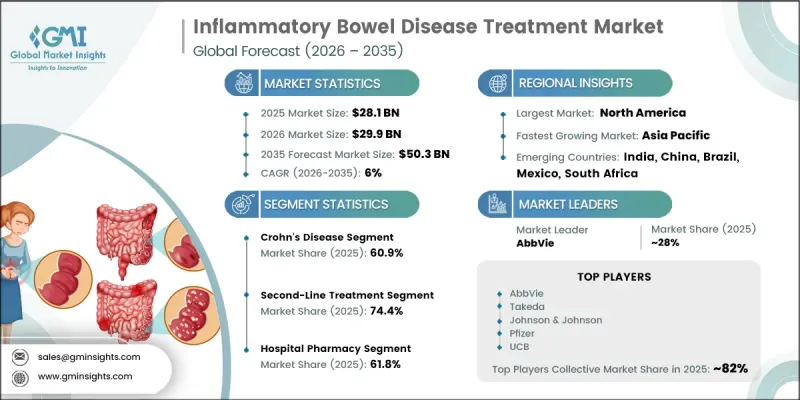
염증성 장질환 치료 시장은 만성 위장 질환의 유병률 증가, 보험 환급 정책의 개선, 그리고 조기 진단과 적절한 질환 관리를 촉진하는 인식 제고에 힘입어 꾸준히 성장하고 있습니다. 염증성 장질환의 치료는 약물 요법, 영양 관리, 생활 습관 개선, 그리고 임상적으로 필요한 경우의 외과적 개입을 결합하여 소화관의 만성 염증을 억제하고, 증상을 완화하며, 질환의 진행을 방지하고, 장기적인 관해를 달성하는 데 중점을 두고 있습니다. 제약사들은 임상 결과를 개선하고 치료 선택지를 확대하는 첨단 바이오의약품, 바이오시밀러, 표적 치료법 등 혁신적인 치료 옵션을 도입하기 위해 연구 개발에 대한 투자를 지속적으로 늘리고 있습니다. 전략적 제휴, 인수합병, 그리고 제품 개발 노력이 혁신을 가속화하는 동시에, 환자들이 차세대 치료법에 접근할 수 있는 기회를 확대하고 있습니다. 또한, 정부의 지원 정책, 규제 절차의 간소화, 그리고 견고한 보험 급여 체계 덕분에 의료 시스템 전반에 걸쳐 치료 접근성이 개선되고 있습니다. 의료 종사자와 환자의 인식 제고는 조기 진단, 보다 적절한 질환 모니터링, 그리고 더 효과적인 장기 관리를 더욱 촉진하고 있으며, 이는 염증성 장질환 치료 시장의 지속적인 성장을 위한 유리한 환경을 조성하고 있습니다.
| 시장 범위 | |
|---|---|
| 시작 연도 | 2025년 |
| 예측 기간 | 2026-2035년 |
| 시작 시점 시장 규모 | 281억 달러 |
| 예측액 | 503억 달러 |
| CAGR | 6% |
2025년, 크론병 부문은 시장 점유율의 60.9%를 차지하며, 해당 질환의 유병률 상승, 진단 능력 향상, 그리고 장기적인 질환 관리 및 환자 예후 개선을 뒷받침하는 첨단 치료법의 채택 확대에 힘입어 주도적인 위치를 유지했습니다. 이 질환은 만성적인 특성을 지니고 있어 지속적인 치료, 정기적인 모니터링, 장기적인 질환 관리가 필요하며, 그 결과 삶의 질을 향상시키고 질환의 진행을 억제하는 혁신적인 치료법에 대한 수요가 지속되고 있습니다.
2025년, 병원 약국 부문은 61.8%의 점유율을 차지했습니다. 이는 임상적 감독이나 고도의 의료 인프라가 필요한 경우가 많은 염증성 장질환 전문 치료제의 조제 과정에서 병원 약국이 필수적인 역할을 수행하고 있기 때문입니다. 병원 약국은 다학제 의료팀과 긴밀히 협력하여 치료의 원활한 이행을 보장하고, 복약 순응도를 향상시키며, 환자의 장기적인 예후를 최적화하고 있습니다. 복잡한 치료 프로토콜을 관리하고 전문적인 약제 지원을 제공하는 능력을 바탕으로, 이 부문의 시장 내 주도적 지위는 지속적으로 강화되고 있습니다.
2025년, 북미의 염증성 장질환 치료 시장은 65.5%의 점유율을 차지했습니다. 이 지역은 염증성 장질환의 높은 유병률, 확립된 의료 인프라, 그리고 첨단 치료 옵션에 대한 광범위한 접근성 덕분에 계속해서 시장을 주도하고 있습니다. 탄탄한 환급 제도와 종합적인 보험 적용으로 환자들이 혁신적인 치료를 받기 쉬워졌으며, 이는 첨단 치료법의 꾸준한 도입을 뒷받침하고 해당 지역의 지속적인 시장 성장에 기여하고 있습니다.
자주 묻는 질문
목차
제1장 조사 방법
제2장 주요 요약
제3장 업계 인사이트
제4장 경쟁 구도
제5장 시장 추정 및 예측 : 치료 유형별, 2022-2035년
제6장 시장 추정 및 예측 : 약물 계열별, 2022-2035년
제7장 시장 추정 및 예측 : 투여 경로별, 2022-2035년
제8장 시장 추정 및 예측 : 유통 채널별, 2022-2035년
제9장 시장 추정 및 예측 : 지역별, 2022-2035년
제10장 기업 개요
KSM 26.08.05The Global Inflammatory Bowel Disease Treatment Market was valued at USD 28.1 billion in 2025 and is estimated to grow at a CAGR of 6% to reach USD 50.3 billion by 2035.
The inflammatory bowel disease treatment market is experiencing steady expansion, supported by the increasing incidence of chronic gastrointestinal disorders, improving reimbursement policies, and growing awareness that encourages earlier diagnosis and timely disease management. Inflammatory bowel disease treatment focuses on controlling chronic inflammation of the gastrointestinal tract, relieving symptoms, preventing disease progression, and achieving long-term remission through a combination of pharmacological therapies, nutritional management, lifestyle modifications, and surgical intervention when clinically required. Pharmaceutical companies continue to increase research and development investments to introduce innovative treatment options, including advanced biologics, biosimilars, and targeted therapies that improve clinical outcomes and expand therapeutic choices. Strategic partnerships, acquisitions, and product development initiatives are accelerating innovation while broadening patient access to next-generation therapies. In addition, supportive government initiatives, streamlined regulatory processes, and strong reimbursement frameworks are improving treatment accessibility across healthcare systems. Increasing awareness among healthcare professionals and patients is further promoting earlier diagnosis, better disease monitoring, and more effective long-term management, creating favorable conditions for sustained growth in the inflammatory bowel disease treatment market.
| Market Scope | |
|---|---|
| Start Year | 2025 |
| Forecast Year | 2026-2035 |
| Start Value | $28.1 Billion |
| Forecast Value | $50.3 Billion |
| CAGR | 6% |
The Crohn's disease segment accounted for 60.9% share in 2025, maintaining its leading position due to the rising prevalence of the condition, improvements in diagnostic capabilities, and increasing adoption of advanced therapeutic options that support long-term disease control and improved patient outcomes. The chronic nature of the disease requires continuous treatment, ongoing monitoring, and long-term disease management, resulting in sustained demand for innovative therapies that enhance quality of life and reduce disease progression.
The hospital pharmacy segment held 61.8% share in 2025, driven by its essential role in dispensing specialized inflammatory bowel disease therapies that often require clinical oversight and advanced healthcare infrastructure. Hospital pharmacies work closely with multidisciplinary medical teams to ensure coordinated treatment delivery, improve medication adherence, and optimize long-term patient outcomes. Their ability to manage complex treatment protocols and provide specialized pharmaceutical support continues to strengthen the segment's leadership within the market.
North America Inflammatory Bowel Disease Treatment Market accounted for 65.5% share in 2025. The region continues to lead the market due to the high prevalence of inflammatory bowel disease, well-established healthcare infrastructure, and widespread access to advanced therapeutic options. Strong reimbursement systems and comprehensive insurance coverage further improve patient access to innovative treatments, supporting consistent adoption of advanced therapies and contributing to continued regional market growth.
Major companies operating in the global inflammatory bowel disease treatment market include AbbVie, Takeda Pharmaceuticals, Johnson & Johnson, Pfizer, Eli Lilly, UCB, Celltrion, Amgen, Biogen, Alvotech, Boehringer Ingelheim, Ferring, Dr. Falk Pharma, and Organon. Companies participating in the inflammatory bowel disease treatment market are strengthening their competitive position through continuous investment in research and development aimed at expanding biologic, biosimilar, and targeted therapy portfolios. Strategic collaborations, licensing agreements, acquisitions, and partnerships are enabling manufacturers to accelerate product development while expanding global commercial reach. Organizations are also focusing on improving treatment efficacy, enhancing patient convenience, and developing therapies with better long-term safety profiles to address evolving clinical needs. Increased investment in precision medicine, advanced drug delivery technologies, and patient support programs is further improving treatment adherence and outcomes.
Table of Contents
Chapter 1 Research Methodology
- 1.1 Research approach
- 1.2 Quality commitments
- 1.2.1 GMI AI policy & data integrity commitment
- 1.2.1.1 Source consistency protocol
- 1.2.1 GMI AI policy & data integrity commitment
- 1.3 Research trail & confidence scoring
- 1.3.1 Research trail components
- 1.3.2 Scoring components
- 1.4 Data collection
- 1.4.1 Partial list of primary sources
- 1.5 Data mining sources
- 1.5.1 Paid sources
- 1.5.1.1 Sources, by region
- 1.5.1 Paid sources
- 1.6 Base estimates and calculations
- 1.6.1 Base year calculation for any one approach
- 1.7 Forecast model
- 1.7.1 Quantified market impact analysis
- 1.7.1.1 Mathematical impact of growth parameters on forecast
- 1.7.1 Quantified market impact analysis
- 1.8 Research transparency addendum
- 1.8.1 Source attribution framework
- 1.8.2 Quality assurance metrics
- 1.8.3 Our commitment to trust
Chapter 2 Executive Summary
- 2.1 Industry 360° synopsis
- 2.2 Key market trends
- 2.2.1 Regional trends
- 2.2.2 Treatment type trends
- 2.2.3 Drug class trends
- 2.2.4 Route of Administration trends
- 2.2.5 Distribution channel trends
- 2.3 CXO perspectives: Strategic imperatives
Chapter 3 Industry Insights
- 3.1 Industry ecosystem analysis
- 3.2 Industry impact forces
- 3.2.1 Growth drivers
- 3.2.1.1 Increasing prevalence of IBD
- 3.2.1.2 Favorable reimbursement policies
- 3.2.1.3 Technological advancements
- 3.2.1.4 Growing awareness and early diagnosis of IBD symptoms
- 3.2.2 Industry pitfalls and challenges
- 3.2.2.1 Stringent regulatory scenario
- 3.2.2.2 High cost of treatment
- 3.2.3 Market opportunities
- 3.2.3.1 Rising adoption of biologics and targeted therapies
- 3.2.3.2 Expansion in emerging markets
- 3.2.1 Growth drivers
- 3.3 Growth potential analysis
- 3.4 Regulatory landscape (Driven by primary research)
- 3.4.1 North America
- 3.4.2 Europe
- 3.4.3 Asia Pacific
- 3.4.4 Latin America
- 3.4.5 Middle East and Africa
- 3.5 Technology landscape
- 3.5.1 Current technological trends
- 3.5.2 Emerging technologies
- 3.6 Pricing trend analysis (Driven by primary research)
- 3.7 Future market trends
- 3.8 Reimbursement scenario
- 3.9 Porter's analysis
- 3.10 PESTEL analysis
- 3.11 Impact of AI and Generative AI on the market (Driven by primary research)
- 3.12 Value chain analysis (Driven by primary research)
- 3.13 Investment & funding analysis (Driven by primary research)
- 3.14 Treatment switching patterns or sequencing trends
- 3.15 Treatment infrastructure & clinical adoption landscape
Chapter 4 Competitive Landscape, 2025
- 4.1 Introduction
- 4.2 Company matrix analysis
- 4.3 Company market share analysis (Driven by primary research)
- 4.3.1 Global
- 4.3.2 North America
- 4.3.3 Europe
- 4.3.4 Asia Pacific
- 4.4 Competitive positioning matrix
- 4.5 Competitive analysis of major market players
- 4.6 Key developments
- 4.6.1 Mergers & acquisitions
- 4.6.2 Partnerships & collaborations
- 4.6.3 New product launches
- 4.6.4 Expansion plans
Chapter 5 Market Estimates and Forecast, By Treatment Type, 2022 - 2035 ($ Mn)
- 5.1 Key trends
- 5.2 Crohn's disease
- 5.3 Ulcerative colitis
Chapter 6 Market Estimates and Forecast, By Drug Class, 2022 - 2035 ($ Mn)
- 6.1 Key trends
- 6.2 First-line treatment
- 6.2.1 Aminosalicylates
- 6.2.2 Corticosteroids
- 6.3 Second-line treatment
- 6.3.1 IL inhibitors
- 6.3.2 TNF inhibitors
- 6.3.3 JAK inhibitors
- 6.3.4 Anti-integrin
- 6.3.5 S1P receptor modulator
- 6.4 Combination therapy
- 6.4.1 TNF inhibitors + thiopurines
- 6.4.2 Other combination therapies
Chapter 7 Market Estimates and Forecast, By Route of Administration, 2022 - 2035 ($ Mn)
- 7.1 Key trends
- 7.2 Injectable
- 7.3 Oral
- 7.4 Rectal
Chapter 8 Market Estimates and Forecast, By Distribution Channel, 2022 - 2035 ($ Mn)
- 8.1 Key trends
- 8.2 Hospital pharmacy
- 8.3 Retail pharmacy
- 8.4 Online pharmacy
Chapter 9 Market Estimates and Forecast, By Region, 2022 - 2035 ($ Mn)
- 9.1 Key trends
- 9.2 North America
- 9.2.1 U.S.
- 9.2.2 Canada
- 9.3 Europe
- 9.3.1 Germany
- 9.3.2 UK
- 9.3.3 France
- 9.3.4 Spain
- 9.3.5 Italy
- 9.3.6 Netherlands
- 9.4 Asia Pacific
- 9.4.1 China
- 9.4.2 Japan
- 9.4.3 India
- 9.4.4 Australia
- 9.4.5 South Korea
- 9.5 Latin America
- 9.5.1 Brazil
- 9.5.2 Mexico
- 9.5.3 Argentina
- 9.6 Middle East and Africa
- 9.6.1 South Africa
- 9.6.2 Saudi Arabia
- 9.6.3 UAE
Chapter 10 Company Profiles
- 10.1 AbbVie
- 10.2 Alvotech
- 10.3 Amgen
- 10.4 Biogen
- 10.5 Boehringer Ingelheim
- 10.6 Celltrion
- 10.7 Dr Falk Pharma
- 10.8 Eli Lilly
- 10.9 Ferring
- 10.10 Johnson & Johnson
- 10.11 ORGANON
- 10.12 Pfizer
- 10.13 Takeda Pharmaceuticals
- 10.14 UCB


