

|
시장보고서
상품코드
2116426
염증성 장질환 치료제 시장 : 점유율 분석, 업계 동향과 통계, 성장 예측(2026-2031년)Inflammatory Bowel Therapeutics - Market Share Analysis, Industry Trends & Statistics, Growth Forecasts (2026 - 2031) |
||||||
 Mordor Intelligence
Mordor Intelligence에 의하면, 염증성 장질환 치료제 시장 규모는 2025년 274억 3,000만 달러에서 2026년에는 289억 5,000만 달러로 확대되어 2026년부터 2031년까지 CAGR 5.55%로 성장을 지속하여, 2031년에는 379억 2,000만 달러에 이를 것으로 예측됩니다.
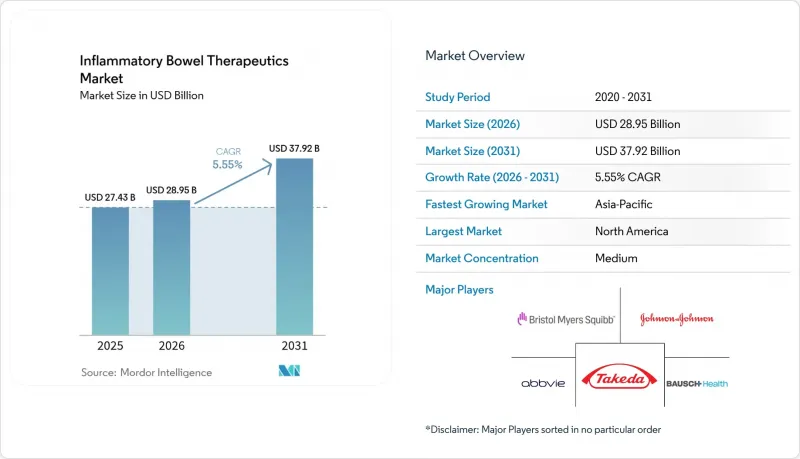
본 보고서는 질환별(크론병 및 궤양성 대장염), 약물 분류별(TNF 억제제, JAK 억제제 등), 분자 유형별(생물학적 제제, 바이오시밀러 등),투여 경로별(경구 및 비경구), 유통 채널별(병원 약국, 소매 약국 등), 그리고 지역별로 분류되어 있습니다. 시장 예측은 금액(달러) 기준으로 제시되어 있습니다.
전 세계 염증성 장질환 치료제 시장 동향 및 인사이트
항-IL-23 및 TL1A 약물의 후기 임상 개발 파이프라인 확대
항-IL-23 약물은 3상 임상시험 데이터를 통해 내시경적 관해율의 우월성이 확인됨에 따라 기존의 TNF 억제제를 대체해 가고 있습니다. 직접 비교 임상시험에서 리산키주맙은 48주 시점에서 31.8%의 관해율을 달성한 반면, 우스테키누맙은 16.2%에 그쳤습니다. 유럽 규제 당국은 궤양성 대장염 치료용 리산키주맙에 대해 긍정적인 견해를 표명하여, 유럽 전역에서의 시판 허가를 향한 길이 열렸습니다. 일라이 릴리(Eli Lilly)의 밀리키주맙은 비만 관련 동반 질환을 치료하기 위해 틸제파티드와 함께 후기 임상시험 단계에 있으며, 다중 질환 관리를 향한 시장 동향을 여실히 보여주고 있습니다. 제약사들이 전신성 면역 억제를 동반하지 않는 장 특이적 항염증 작용을 추구하는 가운데, TL1A 억제제는 개념 증명 시험 단계로 진입하고 있습니다. 이러한 종합적인 노력을 통해 염증성 장질환(IBD) 치료제 시장에서 치료 알고리즘의 재구축과 수익원의 재분배가 진행될 전망입니다.
중등도에서 중증의 궤양성 대장염(UC) 및 크론병(CD)에서 경구용 JAK 억제제의 급속한 보급
경구용 JAK 억제제는 일부 환자들이 생물학적 제제 치료 시작을 주저하게 만들었던 ‘주사라는 장벽’을 허물었습니다. 토파시티닙과 우파다시티닙은 정맥 주사형 생물학적 제제와 맞먹는 효능을 발휘하는 한편, 본인 부담금 경감 프로그램을 통해 대상 환자의 본인 부담 비용이 절감되고 있습니다. 미국 FDA는 감시 체계와 처방 의사의 편의성 간의 균형을 맞추기 위해 REMS 프로그램을 개선하고 있으며, 실제 임상 데이터를 통해 IBD 환자 집단에서 심혈관 위험 및 악성 종양 위험 프로파일이 점차 밝혀지고 있습니다. 사춘기 환자를 대상으로 한 에트라시모드의 소아 임상시험 결과에 따르면, 연령 제한이 완화됨에 따라 치료 대상이 되는 환자층이 확대될 것으로 시사되고 있습니다. 이러한 임상 데이터, 환자 수요, 그리고 보험사의 지원이 어우러져 염증성 장질환(IBD) 치료제 시장에서 경구 요법에 의한 성장 기여도가 크게 높아지고 있습니다.
JAK 억제제에 대한 엄격한 REMS 및 박스 경고
JAK 억제제의 보급은 규제상의 장벽에 직면해 있습니다. 이는 FDA의 REMS 프로그램에 따라 처방 의사가 환자에게 심혈관 질환, 악성 종양 및 혈전증의 위험에 대해 설명해야 하기 때문입니다. 특히 고령자나 동반 질환이 있는 환자군에 대한 박스 경고는 제한이 엄격하여, 이러한 환자층에서 1차 선택 약제로의 채택을 지연시키고 있습니다. 실세계 데이터가 축적됨에 따라 이러한 제약은 시간이 지남에 따라 완화될 가능성이 있지만, 단기적으로는 IL-23 억제제나 장 선택적 기전을 가진 약물이 유리해져, 염증성 장질환 치료제 시장의 잠재적 성장을 억제하는 요인이 되고 있습니다.
부문 분석
크론병 관련 매출은 2031년까지 연평균 성장률(CAGR) 8.32%로 증가할 것으로 예측되며, 2025년에는 궤양성 대장염이 매출의 51.68%를 차지하여 시장 전체의 성장 속도를 상회할 것으로 전망됩니다. 2세 아동을 대상으로 한 약동학 연구를 통해 리산키주맙의 안전한 투여량이 입증됨에 따라, 소아 환자를 위한 크론병 특이적 염증성 장질환 치료제 시장 규모가 확대되고 있습니다. 항인테그린 약물과 JAK 억제제를 병용하는 병용 요법은 난치성 사례에서 우수한 내시경적 치유율을 보여주고 있으며, 이로 인해 평균 치료비가 더욱 상승하고 있습니다.
지속적인 점막 손상과 높은 수술률로 인해 임상의들은 크론병에 대해 조기 생물학적 제제 개입을 채택해야 할 압박을 받고 있으며, 보험사들도 점차 하향식 프로토콜을 승인하고 있습니다. 이 질환의 이질성으로 인해 환자 1인당 모니터링 비용은 상승하지만, 한편으로는 고가의 정밀 치료제 수요 증가의 여지도 만들어내고 있습니다. 대조적으로, 궤양성 대장염은 병세 경과가 더 명확할 뿐만 아니라, 새로 승인된 밀리키주맙을 포함한 효과적인 경구용 약물 라인업이 확대되고 있다는 장점이 있습니다. 두 가지 생물학적 제제를 병용하는 접근법과 동반 질환 관리에 이르는 치료의 개인화로 인해, 염증성 장질환 치료제 시장에서 크론병 환자 1인당 평생 수익은 증가할 전망입니다.
2025년에는 바이오시밀러에 의한 시장 잠식이 심화되었음에도 불구하고, TNF 억제제는 염증성 장질환 치료제 시장에서 35.95%의 점유율을 유지했습니다. 2024년에는 ‘스카이라지’와 ‘린복’의 매출이 176억 8,900만 달러로 급증하며, 신중하게 계획된 포트폴리오 승계가 기존 제품의 매출 감소를 어떻게 완화할 수 있는지 보여주고 있습니다. 연평균 성장률(CAGR) 6.85%로 성장하고 있는 JAK 억제제는 경구 투여의 편의성과 점점 더 양호해지는 안전성 프로파일을 겸비하고 있으며, 젊은 층을 대상으로 한 임상시험이 점차 진행되고 있습니다.
인터루킨 억제제, 특히 IL-23 억제제는 유럽과 일본에서 광범위한 보험 적용이 시작되면 채택이 비약적으로 확대될 전망입니다. 항인테그린 약물은 장 선택적 표적 치료를 선호하는 환자들에게 치료 선택지로 계속해서 기여하고 있으며, TL1A 길항제에 대한 연구는 치료 선택지에 새로운 작용기전을 추가하고 있습니다. 한편, ISM5411 등의 PHD 억제제는 장 한정형 소분자 약제로서 미래의 틈새 시장을 개척하고 있으며, 염증성 장질환 치료제 시장에서 경쟁력을 확보하는 열쇠는 앞으로도 작용기전의 다양화에 있다는 점이 시사되고 있습니다.
지역별 분석
북미는 선진적인 의료 인프라, 폭넓은 보험 적용, 그리고 FDA의 ‘획기적 신약(Breakthrough Designation)’ 절차를 통한 신속한 제품 출시를 배경으로, 2025년에는 전 세계 매출의 35.84%를 차지했습니다. 총 매출 176억 8,900만 달러를 기록한 ‘Skyrizi’와 ‘Rinvoq’의 보급 상황은 확고한 실세계 데이터로 뒷받침된다면 처방 의사가 얼마나 신속하게 새로운 작용기전으로 전환할 수 있는지를 보여줍니다. 환자 본인 부담금 지원은 여전히 필수적이지만, 29개 주에서는 여전히 ‘어큐뮬레이터 프로그램’이 허용되고 있어, 이는 제약사의 쿠폰 혜택을 약화시킬 가능성이 있으므로 환자 지원 단체의 지속적인 노력이 요구됩니다.
유럽은 매출액 기준 2위이지만, 바이오시밀러 도입률에서는 세계를 선도하고 있어, 이익률을 압박하는 한편 환자에 대한 접근성을 확대하는 경쟁 환경을 조성하고 있습니다. 궤양성 대장염 치료제 리산키주맙에 대해 EMA의 CHMP가 긍정적인 견해를 표명함에 따라, IL-23 억제제 시장의 성장이 가속화될 것으로 예측됩니다. 한편, HTA 기관은 점진적 혁신에 대한 프리미엄에 계속해서 이의를 제기하며, 기업을 성과 기반 계약으로 이끌고 있습니다. 시판 후 안전성 레지스트리는 특히 잘 정비되어 있으며, 전 세계 규제 재검토에 정보를 제공하는 동시에 지불 주체와의 협상 기반이 되고 있습니다.
아시아태평양은 규제 조화와 전문 의료에 대한 공공 부문의 투자에 힘입어, 2031년까지 8.21%라는 지역별 최고 수준의 연평균 성장률(CAGR)을 나타낼 전망입니다. 일본의 생명공학 활성화 전략에는 국내 스타트업에 대한 자금 지원 및 심사 신속화 조치가 포함되어 있는 반면, 중국의 우스테키누맙 후향적 연구에서는 소아 크론병 코호트에서 75%의 관해율이 보고되었습니다. 인도는 미국의 ‘바이오시큐어법(BioSecure Act)’에 따라 CDMO의 대체 거점으로 부상하고 있으며, 중국공급망 집중을 우려하는 다국적 기업들에게 매력적인 선택지가 되고 있습니다. 이러한 동향들이 결합되어 아시아태평양 전체의 염증성 장질환 치료제 시장에 깊이와 탄력성을 더하고 있습니다.
중동 및 아프리카는 절대적인 규모는 작지만, 젊은 층이 많은 인구 구성과 전문 의료 서비스에 대한 접근성 개선으로 인해 장기적인 성장이 예상됩니다. GCC 국가 정부들은 IBD(염증성 장질환) 전문 의료 센터를 건설하고, 다국적 기업과 제휴하여 현지에서 충전 및 마무리 작업을 수행하고 있습니다. 남아프리카의 임상시험 역량은 초기 단계의 연구를 유치하고 있으며, 이 지역은 시판까지의 기간을 단축할 가능성이 있는 최첨단 치료법을 직접 접할 기회를 얻고 있습니다.
남미에서는 브라질과 아르헨티나가 규제 체계를 정비하고 해외 투자를 유치하고 있어 꾸준한 성장이 예상됩니다. 경제 변동은 여전히 생물학적 제제의 가격에 압박을 가하고 있지만, 단계적인 보험 환급 프로그램과 현지 생산 파트너십을 통해 제품의 접근성이 높아지고 있습니다. 임상시험 참여는 라틴아메리카를 목표로 하는 기업들에게 계속해서 시장 진출 전략으로서의 역할을 수행하고 있으며, 중증 환자를 위한 ‘컴패셔네이트 유스(특별 사용)’ 경로를 제공하는 동시에 처방 의사의 인지도 향상에도 기여하고 있습니다.
기타 혜택:
- 엑셀 형식 시장 예측(ME) 시트
- 3개월간의 애널리스트 지원
자주 묻는 질문
목차
제1장 서론
제2장 조사 방법
제3장 주요 요약
제4장 시장 구도
제5장 시장 규모와 성장 예측
제6장 경쟁 구도
제7장 시장 기회와 향후 전망
JHS 26.08.28According to Mordor Intelligence, the inflammatory bowel therapeutics market size is expected to grow from USD 27.43 billion in 2025 to USD 28.95 billion in 2026 and is forecast to reach USD 37.92 billion by 2031 at 5.55% CAGR over 2026-2031.
This report is Segmented by Disease (Crohn's Disease and Ulcerative Colitis), Drug Class (TNF Inhibitors, JAK Inhibitors and More), Moelcule Type (Biologics, Biosimiliar and More), Route of Administration (Oral and Parenteral), Distribution Channel (Hospital Pharmacies, Retail Pharmacies and More), and Geography. The Market Forecasts are Provided in Terms of Value (USD).
Global Inflammatory Bowel Therapeutics Market Trends and Insights
Intensifying Late-Stage Pipeline for Anti-IL-23 & TL1A
Anti-IL-23 drugs are displacing legacy TNF blockers as Phase 3 data confirm superior endoscopic remission rates; risankizumab achieved 31.8% at week 48 versus ustekinumab's 16.2% in a head-to-head trial. The European regulator issued a positive opinion for risankizumab in ulcerative colitis, setting the stage for a continent-wide launch. Eli Lilly's mirikizumab is in late-stage testing alongside tirzepatide to address obesity comorbidities, underscoring the market's move toward multi-disease management. TL1A inhibitors are moving through proof-of-concept studies as drug makers strive for intestine-specific anti-inflammatory action without systemic immune suppression. These combined efforts are set to reshape treatment algorithms and reallocate revenue streams within the inflammatory bowel disease (IBD) therapeutics market.
Rapid Uptake of Oral JAK Inhibitors in Moderate-to-Severe UC & CD
Oral JAK inhibitors have broken the injection barrier that discouraged some patients from initiating biologic therapy. Tofacitinib and upadacitinib deliver efficacy comparable to infusion-based biologics, while copay savings programs cut out-of-pocket costs for eligible patients. The United States FDA has refined the REMS program to balance vigilance with prescriber convenience, and real-world data are clarifying cardiovascular and malignancy risk profiles in IBD populations. Pediatric trials of etrasimod in adolescents signal that the addressable pool will grow as age restrictions fall. This convergence of clinical data, patient demand, and payer support is translating into a materially higher growth contribution from oral therapies to the inflammatory bowel disease (IBD) therapeutics market.
Stringent REMS & Boxed Warnings for JAK Class
Uptake of JAK inhibitors faces regulatory friction as prescribers must counsel patients on cardiovascular, malignancy, and thrombosis risks under the FDA's REMS program. The boxed warnings are particularly restrictive for elderly or comorbid populations, slowing first-line adoption in these cohorts. Although accumulating real-world data may soften these constraints over time, the near-term drag favors IL-23 agents and gut-selective mechanisms, trimming potential growth for the inflammatory bowel disease therapeutics market.
Other drivers and restraints analyzed in the detailed report include:
- Expansion of Treat-to-Target Guidelines Boosting Early Biologic Use
- Mainstream Biosimilar Penetration Driving Patient Access
- High Biologic Pricing Pressure From Payers & HTA Bodies
For complete list of drivers and restraints, kindly check the Table Of Contents.
Segment Analysis
Revenue from Crohn's disease is projected to climb at an 8.32% CAGR to 2031, overtaking overall market pace despite ulcerative colitis' 51.68% revenue dominance in 2025. The crohn's-specific inflammatory bowel disease therapeutics market size for pediatric patients is enlarging as pharmacokinetic studies in children as young as two demonstrate safe dosing of risankizumab. Combination regimens that pair an anti-integrin with a JAK inhibitor have yielded superior endoscopic healing in refractory cases, further lifting average treatment spend.
Persistent mucosal damage and higher surgical rates push clinicians to adopt early biologic intervention in Crohn's disease, and insurers are gradually approving top-down protocols. The disease's heterogeneity raises per-patient monitoring costs, but also creates headroom for premium-priced precision therapies. Ulcerative colitis, by contrast, benefits from a clearer disease course and an expanding lineup of effective oral agents, including newly approved mirikizumab. Treatment personalization, spanning dual biologic approaches as well as comorbidity management, is set to raise lifetime revenue per Crohn's patient within the inflammatory bowel disease therapeutics market.
TNF inhibitors held a 35.95% inflammatory bowel disease therapeutics market share in 2025 even as biosimilar erosion intensified. Skyrizi and Rinvoq revenues leapt to USD 17.689 billion in 2024, exemplifying how carefully sequenced portfolio hand-offs can cushion the erosion of legacy assets. JAK inhibitors, growing at a 6.85% CAGR, marry oral convenience with increasingly favorable safety packages and are progressively tested in younger cohorts.
Interleukin inhibitors, particularly IL-23 agents, are positioned for step-change adoption once broad reimbursement starts in Europe and Japan. Anti-integrins continue to serve patients who prefer gut-selective targeting, and research into TL1A antagonists is adding another mechanism to the therapeutic mix. Meanwhile, PHD inhibitors such as ISM5411 are carving out a future niche as gut-restricted small molecules, indicating that mechanistic diversification will remain central to competitiveness within the inflammatory bowel disease therapeutics market.
Complete Report Scope:
- By Disease
- Crohn's Disease
- Ulcerative Colitis
- By Drug Class
- TNF Inhibitors
- JAK Inhibitors
- IL Inhibitors
- Anti-integrins
- Aminosalicylates
- Corticosteroids
- Other Classes
- By Molecule Type
- Biologics
- Small-Molecule Therapies
- Biosimilars
- By Route of Administration
- Parenteral
- Oral
- By Distribution Channel
- Hospital Pharmacies
- Retail Pharmacies
- Online Pharmacies
- By Geography
- North America
- United States
- Canada
- Mexico
- Europe
- Germany
- United Kingdom
- France
- Italy
- Spain
- Rest of Europe
- Asia-Pacific
- China
- Japan
- India
- Australia
- South Korea
- Rest of Asia-Pacific
- Middle East and Africa
- GCC
- South Africa
- Rest of Middle East and Africa
- South America
- Brazil
- Argentina
- Rest of South America
- North America
Geography Analysis
North America controlled 35.84% of global revenue in 2025 on the back of advanced health-care infrastructure, strong insurance coverage, and rapid product launches through the FDA's breakthrough designation pathway. Uptake of Skyrizi and Rinvoq, which booked USD 17.689 billion in combined sales, demonstrates how quickly prescribers migrate to new mechanisms when supported by robust real-world evidence. Copay assistance remains essential, yet 29 states still allow accumulator programs that can blunt the benefit of manufacturer coupons, prompting ongoing patient-advocacy efforts.
Europe ranks second by value but leads the world in biosimilar adoption, creating a price-competitive environment that compresses margins yet expands patient reach. The EMA's positive CHMP opinion for risankizumab in ulcerative colitis is expected to accelerate IL-23 growth, whereas HTA bodies continue to challenge incremental innovation premiums, directing companies toward outcomes-based contracts. Post-marketing safety registries are especially developed, informing global regulatory revisions and underpinning payer negotiations.
Asia-Pacific is forecast for the highest regional CAGR at 8.21% through 2031, propelled by regulatory harmonization and public-sector investment in specialty care. Japan's biotechnology revitalization strategy includes funding for local startups and expedited review pathways, while China's retrospective study of ustekinumab reports 75% remission rates in pediatric Crohn's disease cohorts. India is emerging as a CDMO alternative under the US Biosecure Act, appealing to multinationals wary of supply-chain concentration in China. These developments collectively add depth and resilience to the inflammatory bowel disease therapeutics market across Asia-Pacific.
Middle East and Africa, though smaller in absolute terms, deliver long-run upside thanks to young demographics and improving specialty-care access. GCC governments are building IBD centers of excellence and partnering with multinational firms for local fill-and-finish operations. South Africa's clinical-trial capacity is drawing early-phase studies, giving the region first-hand exposure to cutting-edge therapies that could shorten launch timelines.
South America delivers steady gains as Brazil and Argentina refine their regulatory frameworks and court foreign investment. Economic volatility still pressures biologic pricing, but phased reimbursement programs and local production partnerships are increasing availability. Clinical-trial participation continues to serve as an entry strategy for companies targeting Latin America, offering compassionate-use channels for severe cases while building prescriber familiarity.
- Abbvie
- Johnson & Johnson
- Takeda Pharmaceuticals
- Pfizer
- Eli Lilly and Company
- Bristol-Myers Squibb
- UCB
- Amgen
- Samsung Bioepis
- Bausch Health (Salix)
- Gilead Sciences
- Arena Pharmaceuticals
- Celltrion Healthcare
- Galapagos NV
- Merck
- Abivax
- Aurobindo
- Fresenius
- Sun Pharmaceuticals Industries
- Zydus Lifesciences
Additional Benefits:
- The market estimate (ME) sheet in Excel format
- 3 months of analyst support
TABLE OF CONTENTS
1 Introduction
- 1.1 Study Assumptions and Market Definition
- 1.2 Scope of the Study
2 Research Methodology
3 Executive Summary
4 Market Landscape
- 4.1 Market Overview
- 4.2 Market Drivers
- 4.2.1 Intensifying Late-Stage Pipeline For Anti-IL-23 & TL1A Agents
- 4.2.2 Rapid Uptake Of Oral JAK Inhibitors In Moderate-To-Severe UC & CD
- 4.2.3 Expansion Of Treat-To-Target Guidelines Boosting Early Biologic Use
- 4.2.4 Mainstream Biosimilar Penetration Driving Patient Access
- 4.2.5 Rise Of Digital Adherence Solutions Improving Real-World Outcomes
- 4.2.6 Investment In Microbiome-Based Adjunct Therapies
- 4.3 Market Restraints
- 4.3.1 Stringent REMS & Boxed Warnings For JAK Class
- 4.3.2 High Biologic Pricing Pressure From Payers & HTA Bodies
- 4.3.3 Manufacturing Capacity Bottlenecks For Complex Biologics
- 4.3.4 Patient Reluctance Toward Long-Term Immunosuppression
- 4.4 Value / Supply-Chain Analysis
- 4.5 Regulatory Landscape
- 4.6 Technology Outlook
- 4.7 Porter's Five Forces Analysis
- 4.7.1 Bargaining Power of Suppliers
- 4.7.2 Bargaining Power of Buyers
- 4.7.3 Threat of New Entrants
- 4.7.4 Threat of Substitutes
- 4.7.5 Intensity of Competitive Rivalry
5 Market Size and Growth Forecasts (Value-USD)
- 5.1 By Disease
- 5.1.1 Crohn's Disease
- 5.1.2 Ulcerative Colitis
- 5.2 By Drug Class
- 5.2.1 TNF Inhibitors
- 5.2.2 JAK Inhibitors
- 5.2.3 IL Inhibitors
- 5.2.4 Anti-integrins
- 5.2.5 Aminosalicylates
- 5.2.6 Corticosteroids
- 5.2.7 Other Classes
- 5.3 By Molecule Type
- 5.3.1 Biologics
- 5.3.2 Small-Molecule Therapies
- 5.3.3 Biosimilars
- 5.4 By Route of Administration
- 5.4.1 Parenteral
- 5.4.2 Oral
- 5.5 By Distribution Channel
- 5.5.1 Hospital Pharmacies
- 5.5.2 Retail Pharmacies
- 5.5.3 Online Pharmacies
- 5.6 By Geography
- 5.6.1 North America
- 5.6.1.1 United States
- 5.6.1.2 Canada
- 5.6.1.3 Mexico
- 5.6.2 Europe
- 5.6.2.1 Germany
- 5.6.2.2 United Kingdom
- 5.6.2.3 France
- 5.6.2.4 Italy
- 5.6.2.5 Spain
- 5.6.2.6 Rest of Europe
- 5.6.3 Asia-Pacific
- 5.6.3.1 China
- 5.6.3.2 Japan
- 5.6.3.3 India
- 5.6.3.4 Australia
- 5.6.3.5 South Korea
- 5.6.3.6 Rest of Asia-Pacific
- 5.6.4 Middle East and Africa
- 5.6.4.1 GCC
- 5.6.4.2 South Africa
- 5.6.4.3 Rest of Middle East and Africa
- 5.6.5 South America
- 5.6.5.1 Brazil
- 5.6.5.2 Argentina
- 5.6.5.3 Rest of South America
- 5.6.1 North America
6 Competitive Landscape
- 6.1 Market Concentration
- 6.2 Market Share Analysis
- 6.3 Company profiles (includes Global level Overview, Market level overview, Core Segments, Financials as available, Strategic Information, Market Rank/Share for key companies, Products and Services, and Recent Developments)
- 6.3.1 AbbVie
- 6.3.2 Johnson & Johnson
- 6.3.3 Takeda Pharmaceutical
- 6.3.4 Pfizer
- 6.3.5 Eli Lilly
- 6.3.6 Bristol Myers Squibb
- 6.3.7 UCB S.A.
- 6.3.8 Amgen
- 6.3.9 Samsung Bioepis
- 6.3.10 Bausch Health (Salix)
- 6.3.11 Gilead Sciences
- 6.3.12 Arena Pharmaceuticals
- 6.3.13 Celltrion Healthcare
- 6.3.14 Galapagos NV
- 6.3.15 Merck & Co.
- 6.3.16 Abivax
- 6.3.17 Aurobindo
- 6.3.18 Fresenius Kabi
- 6.3.19 Sun Pharma
- 6.3.20 Zydus Lifesciences
7 Market Opportunities and Future Outlook
- 7.1 White-Space and Unmet-Need Assessment


