

|
시장보고서
상품코드
2101939
동반진단 시장 기회, 성장 촉진요인, 업계 동향 분석 및 예측(2026-2035년)Companion Diagnostics Market Opportunity, Growth Drivers, Industry Trend Analysis, and Forecast 2026 - 2035 |
||||||

세계의 동반진단 시장은 2025년에 79억 달러 규모에 달하고, 2035년까지 CAGR 11.2%로 성장하여 225억 달러에 달할 것으로 추정됩니다.
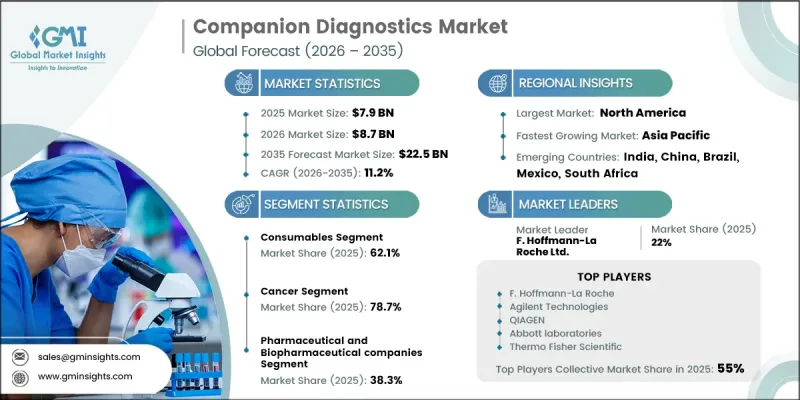
동반진단 시장의 성장은 암 유병률 증가, 약물 부작용 발생률 상승, 그리고 의료 시스템 전반에 걸친 정밀 의학의 도입 확대에 의해 주도되고 있습니다. 동반진단이란, 어떤 환자가 표적 치료에 가장 잘 반응할 가능성이 높거나 치료와 관련된 부작용 위험이 높은지 파악하기 위해 고안된 전문 의료 검사입니다. 이러한 진단 솔루션은 바이오마커, 유전자 변이 및 단백질 발현 패턴을 식별하여 맞춤형 치료법 선택을 지원하고, 임상적 의사결정을 개선합니다. 정밀 의학에서 그 역할이 확대됨에 따라, 특히 바이오마커에 기반한 환자 선별이 필요한 치료법에서 현대 의료 분야에서 동반진단의 중요성은 현저히 높아지고 있습니다. 전 세계적으로 암 환자 수가 계속 증가하는 가운데, 의료 서비스 제공자들은 치료 효과와 환자 예후를 개선하기 위해 정확한 분자 검사에 더욱 중점을 두고 있습니다. 표준화된 치료 접근 방식에서 맞춤형 의료 전략으로의 전환이 진행되고 있는 점도 시장 수요를 더욱 강화하고 있습니다. 이는 바이오마커 기반 진단이 보다 정밀한 치료 개입을 가능하게 하고 더 나은 임상 결과에 기여하는 동시에, 표적 치료의 지속적인 발전을 뒷받침하고 있기 때문입니다.
| 시장 범위 | |
|---|---|
| 시작 연도 | 2025년 |
| 예측 기간 | 2026-2035년 |
| 시작 시점 시장 규모 | 79억 달러 |
| 예측액 | 225억 달러 |
| CAGR | 11.2% |
2025년에는 소모품 부문이 62.1%의 점유율을 차지했습니다. 이 부문에는 동반진단 절차에 필요한 어세이 키트, 시약, 항체, 프로브, 카트리지 및 기타 검사용 자재가 포함됩니다. 이러한 제품들은 표적 치료 결정을 이끌어내기 위해 사용되는 바이오마커, 유전자 변이 및 기타 질환 특이적 특징을 식별할 수 있게 함으로써, 분자 검사 및 유전자 검사 워크플로우에서 필수적인 구성요소로 기능하고 있습니다. 바이오마커 기반 검사가 정밀 의학의 필수 요소가 되어 광범위한 임상 응용 분야에서 정확한 환자 선별과 맞춤형 치료 전략을 뒷받침함에 따라 그 중요성은 점점 더 커지고 있습니다.
2025년, 제약 및 바이오의약품 기업 부문은 38.3%의 점유율을 차지했습니다. 이 기업들은 적절한 환자 집단을 식별하고 표적 치료법 개발을 지원하기 위해 의약품 개발 과정의 여러 단계에 동반진단을 통합하고 있습니다. 임상 개발 프로그램에서 바이오마커 기반 접근법의 활용 확대는 치료 효과 향상, 임상시험 결과 최적화, 규제 당국의 승인 획득을 위한 노력을 뒷받침하며, 동반진단 기술에 대한 지속적인 수요에 기여하고 있습니다.
2025년, 북미의 동반진단 시장은 33.3%의 점유율을 차지했습니다. 약물 부작용에 대한 우려가 높아짐에 따라 해당 지역 전반에서 동반진단 솔루션의 채택이 더욱 확대되고 있습니다. 바이오마커 기반 검사를 통해 의료진은 치료와 관련된 합병증의 위험을 최소화하면서 특정 치료법으로부터 혜택을 받을 가능성이 높은 환자를 식별할 수 있게 됩니다. 맞춤형 의료 및 정밀 치료 접근법에 대한 관심이 높아짐에 따라 북미 시장 전반에서 동반진단에 대한 수요는 계속해서 증가하고 있습니다.
자주 묻는 질문
목차
제1장 조사 방법
제2장 주요 요약
제3장 업계 인사이트
제4장 경쟁 구도
제5장 시장 추정 및 예측 : 제품별, 2022-2035년
제6장 시장 추정 및 예측 : 치료 분야별, 2022-2035년
제7장 시장 추정 및 예측 : 기술별, 2022-2035년
제8장 시장 추정 및 예측 : 최종사용별, 2022-2035년
제9장 시장 추정 및 예측 : 지역별, 2022-2035년
제10장 기업 개요
KSM 26.08.05The Global Companion Diagnostics Market was valued at USD 7.9 billion in 2025 and is estimated to grow at a CAGR of 11.2% to reach USD 22.5 billion by 2035.
Growth in the Companion Diagnostics Market is fueled by the increasing prevalence of cancer, the rising occurrence of adverse drug reactions, and the expanding adoption of precision medicine across healthcare systems. Companion diagnostics are specialized medical tests designed to determine which patients are most likely to respond to a targeted therapy or may face a greater risk of treatment-related adverse effects. These diagnostic solutions identify biomarkers, genetic alterations, and protein expression patterns that support personalized treatment selection and improve clinical decision-making. Their growing role in precision medicine has significantly increased their importance in modern healthcare, particularly for therapies that require biomarker-guided patient selection. As cancer cases continue to increase worldwide, healthcare providers are placing greater emphasis on accurate molecular testing to improve treatment effectiveness and patient outcomes. The ongoing transition from standardized treatment approaches toward personalized healthcare strategies is further strengthening market demand, as biomarker-based diagnostics enable more precise therapeutic interventions and contribute to better clinical results while supporting the continued advancement of targeted medicine.
| Market Scope | |
|---|---|
| Start Year | 2025 |
| Forecast Year | 2026-2035 |
| Start Value | $7.9 Billion |
| Forecast Value | $22.5 Billion |
| CAGR | 11.2% |
The consumables segment accounted for a 62.1% share in 2025. This segment includes assay kits, reagents, antibodies, probes, cartridges, and other testing materials required during companion diagnostic procedures. These products serve as essential components of molecular and genetic testing workflows by enabling the identification of biomarkers, gene mutations, and other disease-specific characteristics used to guide targeted treatment decisions. Their importance continues to increase as biomarker-driven testing becomes an integral part of precision medicine, supporting accurate patient selection and personalized therapeutic strategies across a wide range of clinical applications.
The pharmaceutical and biopharmaceutical companies segment held 38.3% share in 2025. These organizations integrate companion diagnostics throughout multiple stages of the drug development process to identify appropriate patient populations and support the advancement of targeted therapies. The increasing use of biomarker-based approaches within clinical development programs is helping improve treatment effectiveness, optimize clinical trial performance, and support regulatory approval efforts, contributing to continued demand for companion diagnostic technologies.
North America Companion Diagnostics Market held a 33.3% share in 2025. Rising concerns regarding adverse drug reactions are encouraging broader adoption of companion diagnostic solutions throughout the region. Biomarker-based testing enables healthcare providers to identify patients who are more likely to benefit from specific therapies while minimizing the risk of treatment-related complications. The growing emphasis on personalized healthcare and precision treatment approaches continues to strengthen demand for companion diagnostics across the North American market.
Major companies operating in the Global Companion Diagnostics Market include F. Hoffmann-La Roche Ltd, Foundation Medicine, QIAGEN, Agilent Technologies, Abbott Laboratories, Illumina, Thermo Fisher Scientific, Guardant Health, Myriad Genetics, BioMerieux, Leica Biosystems, MolecularMD, ARUP Laboratories, Bio-Rad Laboratories, and Sysmex Corporation. Companies participating in the Companion Diagnostics Market are reinforcing their market position by investing in biomarker discovery, expanding molecular diagnostic capabilities, and strengthening research and development activities. Many organizations are focusing on developing advanced diagnostic assays that support precision medicine and improve targeted therapy selection. Strategic collaborations between diagnostic developers and pharmaceutical companies are accelerating the co-development of companion diagnostics alongside innovative therapies, helping expand commercial opportunities and improve regulatory success.
Table of Contents
Chapter 1 Research Methodology
- 1.1 Research approach
- 1.2 Quality commitments
- 1.2.1 GMI AI policy and data integrity commitment
- 1.2.1.1 Source consistency protocol
- 1.2.1 GMI AI policy and data integrity commitment
- 1.3 Research trail and confidence scoring
- 1.3.1 Research trail components
- 1.3.2 Scoring components
- 1.4 Data collection
- 1.4.1 Partial list of primary sources
- 1.5 Data mining sources
- 1.5.1 Paid sources
- 1.5.1.1 Sources, by region
- 1.5.1 Paid sources
- 1.6 Base estimates and calculations
- 1.6.1 Base year calculation for any one approach
- 1.7 Forecast model
- 1.7.1 Quantified market impact analysis
- 1.7.1.1 Mathematical impact of growth parameters on forecast
- 1.7.1 Quantified market impact analysis
- 1.8 Research transparency addendum
- 1.8.1 Source attribution framework
- 1.8.2 Quality assurance metrics
- 1.8.3 Our commitment to trust
Chapter 2 Executive Summary
- 2.1 Industry 3600 synopsis
- 2.2 Key market trends
- 2.2.1 Product trends
- 2.2.2 Therapy area trends
- 2.2.3 Technology trends
- 2.2.4 End use trends
- 2.2.5 Regional trends
- 2.3 CXO perspectives: Strategic imperatives
Chapter 3 Industry Insights
- 3.1 Industry ecosystem analysis
- 3.2 Industry impact forces
- 3.2.1 Growth drivers
- 3.2.1.1 Rising prevalence of cancer.
- 3.2.1.2 Growing incidence of adverse drug reaction.
- 3.2.1.3 Growth of precision medicine.
- 3.2.1.4 Pharmaceutical firms increasingly embed companion drugs in drug development.
- 3.2.1.5 Rising ADC and immuno-oncology drug approvals requiring companion diagnostics
- 3.2.2 Industry pitfalls and challenges
- 3.2.2.1 High development costs.
- 3.2.2.2 Limited reimbursement models.
- 3.2.3 Market opportunities
- 3.2.3.1 Growing adoption of liquid biopsy-based companion diagnostics
- 3.2.3.2 Expansion of companion diagnostics for emerging biomarker targets (HER2-ultralow, KRAS G12C, FGFR alterations, and NTRK gene fusions)
- 3.2.1 Growth drivers
- 3.3 Growth potential analysis
- 3.4 Regulatory landscape (Driven by primary research)
- 3.4.1 North America
- 3.4.2 Europe
- 3.4.3 Asia Pacific
- 3.4.4 Latin America
- 3.4.5 Middle East and Africa
- 3.5 Technology landscape (Driven by primary research)
- 3.5.1 Current technological trends
- 3.5.2 Emerging technologies
- 3.6 Future market trends (Driven by primary research)
- 3.7 Impact of AI and Generative AI on the market (Driven by primary research)
- 3.8 Patent analysis
- 3.9 Pricing trend analysis (Driven by primary research)
- 3.10 Porter's analysis
- 3.11 PESTEL analysis
Chapter 4 Competitive Landscape, 2025
- 4.1 Introduction
- 4.2 Company market share analysis
- 4.2.1 Global
- 4.2.2 North America
- 4.2.3 Europe
- 4.2.4 Asia Pacific
- 4.3 Company matrix analysis
- 4.4 Competitive analysis of major market players
- 4.5 Competitive positioning matrix
- 4.6 Key developments
- 4.6.1 Mergers and acquisitions
- 4.6.2 Partnerships and collaborations
- 4.6.3 New product launches
- 4.6.4 Expansion plans
Chapter 5 Market Estimates and Forecast, By Product, 2022 - 2035 ($ Mn)
- 5.1 Key trends
- 5.2 Instruments
- 5.3 Consumables
- 5.4 Software and services
Chapter 6 Market Estimates and Forecast, By Therapy Areas, 2022 - 2035 ($ Mn)
- 6.1 Key trends
- 6.2 Cancer
- 6.2.1 Breast cancer
- 6.2.2 Lung cancer
- 6.2.3 Colorectal cancer
- 6.2.4 Skin cancer
- 6.2.5 Other cancers
- 6.3 Cardiovascular disease
- 6.4 Neurological diseases
- 6.5 Other therapy areas
Chapter 7 Market Estimates and Forecast, By Technology, 2022 - 2035 ($ Mn)
- 7.1 Key trends
- 7.2 Immunohistochemistry
- 7.3 In situ hybridization
- 7.4 Polymerase chain reaction
- 7.5 Next-Generation Sequencing
- 7.6 Other technologies
Chapter 8 Market Estimates and Forecast, By End Use, 2022 - 2035 ($ Mn)
- 8.1 Key trends
- 8.2 Hospitals
- 8.3 Pharmaceutical and biopharmaceutical companies
- 8.4 Contract research organizations
- 8.5 Diagnostic laboratories
Chapter 9 Market Estimates and Forecast, By Region, 2022 - 2035 ($ Mn)
- 9.1 Key trends
- 9.2 North America
- 9.2.1 U.S.
- 9.2.2 Canada
- 9.3 Europe
- 9.3.1 Germany
- 9.3.2 UK
- 9.3.3 France
- 9.3.4 Spain
- 9.3.5 Italy
- 9.3.6 Netherlands
- 9.4 Asia Pacific
- 9.4.1 China
- 9.4.2 Japan
- 9.4.3 India
- 9.4.4 Australia
- 9.4.5 South Korea
- 9.5 Latin America
- 9.5.1 Brazil
- 9.5.2 Mexico
- 9.5.3 Argentina
- 9.6 Middle East and Africa
- 9.6.1 South Africa
- 9.6.2 Saudi Arabia
- 9.6.3 UAE
Chapter 10 Company Profiles
- 10.1 F. Hoffmann-La Roche Ltd
- 10.2 Foundation Medicine
- 10.3 QIAGEN
- 10.4 Agilent Technologies
- 10.5 Abbott Laboratories
- 10.6 Illumina
- 10.7 Thermo Fisher Scientific
- 10.8 Guardant Health
- 10.9 Myriad Genetics
- 10.10 BioMerieux
- 10.11 Leica Biosystems
- 10.12 MolecularMD
- 10.13 ARUP Laboratories
- 10.14 Bio-Rad Laboratories
- 10.15 Sysmex Corporation


