

|
시장보고서
상품코드
2101956
고정식 크레인 시장 기회, 성장 촉진요인, 업계 동향 분석 및 예측(2026-2035년)Fixed Crane Market Opportunity, Growth Drivers, Industry Trend Analysis, and Forecast 2026 - 2035 |
||||||

세계의 고정식 크레인 시장은 2025년에 104억 달러 규모에 달하고, CAGR 5.7%로 성장하여 2035년까지 181억 달러에 달할 것으로 추정됩니다.
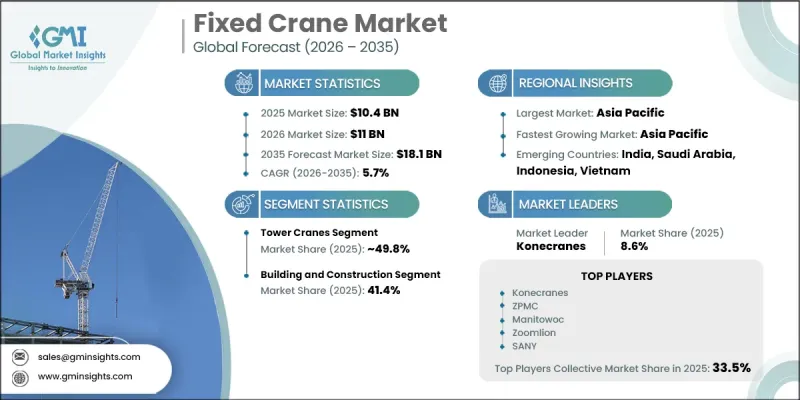
시장의 성장은 대규모 인프라 개발에 대한 투자 증가, 산업 건설 활동의 확대, 그리고 상업·주거·산업 프로젝트 전반에 걸친 대용량 리프팅 장비에 대한 수요 증가에 힘입고 있습니다. 급속한 도시화와 대도시권의 지속적인 확장으로 인해, 복잡한 건설 작업 및 자재 취급 요건을 충족할 수 있는 고정식 크레인에 대한 지속적인 수요가 발생하고 있습니다. 동시에, 교통망, 산업 시설, 에너지 인프라, 물류 허브에 대한 지속적인 투자로 인해 선진국 및 신흥국에서 장비 도입이 촉진되고 있습니다. 디지털 기술, 자동화 및 예측 유지보수 솔루션의 도입 확대 또한 장비의 신뢰성을 향상시키고, 가동 중지 시간을 최소화하며, 운영 효율을 높임으로써 크레인 운영을 혁신하고 있습니다. 또한, 각 제조사는 진화하는 고객 요구 사항에 부응하기 위해 모니터링 기능을 강화하고 적재 정밀도를 높인 기술적으로 진보된 크레인 시스템을 도입하고 있습니다. 제조 시설 및 건설 방식의 지속적인 현대화는 고정식 크레인 제조업체에 장기적인 기회를 제공할 뿐만 아니라, 예측 기간 동안 꾸준한 시장 확장을 뒷받침할 것으로 예상됩니다.
| 시장 범위 | |
|---|---|
| 시작 연도 | 2025년 |
| 예측 기간 | 2026-2035년 |
| 시작 시점 시장 규모 | 104억 달러 |
| 예측액 | 181억 달러 |
| CAGR | 5.7% |
타워 크레인 부문은 49.8%의 점유율을 차지하며, 2025년에는 51억 8,000만 달러의 시장 규모를 기록했습니다. 타워 크레인은 전 세계의 고층 주택, 상업 시설, 인프라 개발 분야에서 여전히 선호되는 적재 솔루션이기 때문에 해당 부문은 계속해서 주도적인 위치를 유지하고 있습니다. 고소에서 중량물을 효율적으로 취급할 수 있다는 점 때문에 대규모 건설 프로젝트에서 널리 채택되고 있습니다. 도시 개발 및 상업 건축에 대한 지속적인 투자로 인해, 예측 기간 동안 타워 크레인 설치에 대한 견조한 수요가 유지될 것으로 전망됩니다.
건축·건설 용도 부문은 2025년에 41.4%의 점유율을 차지하며 43억 달러에 달했으며, 2035년까지 연평균 성장률(CAGR) 5.5%로 성장할 것으로 전망됩니다. 이 부문이 주도적인 위치를 차지하고 있다는 사실은 대규모 개발 프로젝트에서 다층 건물 건축, 구조물 조립, 자재 취급을 뒷받침하는 데 고정식 크레인이 수행하는 매우 중요한 역할을 반영합니다. 주거, 상업, 산업, 인프라 각 부문에서의 건설 활동 증가로 인해, 프로젝트 효율 향상 및 공사 기간 단축이 가능한 고정식 크레인 솔루션에 대한 안정적인 수요가 지속적으로 창출되고 있습니다.
미국 고정식 크레인 시장은 2025년에 16억 6,000만 달러에 달했으며, 2035년까지 연평균 성장률(CAGR) 5.5%로 성장할 것으로 전망됩니다. 시장의 성장은 인프라 현대화, 산업 시설 확장, 교통망 정비 및 재생에너지 관련 건설에 대한 지속적인 투자에 힘입고 있습니다. 활발한 건설 활동과 더불어 여러 최종 이용 산업에서 첨단 리프팅 장비의 채택 확대가 맞물리면서, 미국은 세계 고정식 크레인 시장에서 주도적인 입지를 더욱 공고히 하고 있습니다.
자주 묻는 질문
목차
제1장 조사 방법과 범위
제2장 주요 요약
제3장 업계 인사이트
제4장 경쟁 구도
제5장 시장 추정 및 예측 : 유형별, 2022-2035년
제6장 시장 추정 및 예측 : 용도별, 2022-2035년
제7장 시장 추정 및 예측 : 최종사용자별, 2022-2035년
제8장 시장 추정 및 예측 : 지역별, 2022-2035년
제9장 기업 개요
KSM 26.08.05The Global Fixed Cranes Market was valued at USD 10.4 billion in 2025 and is estimated to grow at a CAGR of 5.7% to reach USD 18.1 billion by 2035.
Market growth is supported by rising investments in large-scale infrastructure development, expanding industrial construction activities, and increasing demand for high-capacity lifting equipment across commercial, residential, and industrial projects. Rapid urbanization and continuous expansion of metropolitan areas are creating sustained demand for fixed cranes capable of supporting complex construction operations and material handling requirements. At the same time, ongoing investments in transportation networks, industrial facilities, energy infrastructure, and logistics hubs are strengthening equipment deployment across developed and emerging economies. The growing adoption of digital technologies, automation, and predictive maintenance solutions is also transforming crane operations by improving equipment reliability, minimizing downtime, and enhancing operational efficiency. In addition, manufacturers are introducing technologically advanced crane systems with enhanced monitoring capabilities and greater lifting precision to meet evolving customer requirements. The continued modernization of manufacturing facilities and construction practices is expected to generate long-term opportunities for fixed cranes manufacturers while supporting steady market expansion throughout the forecast period.
| Market Scope | |
|---|---|
| Start Year | 2025 |
| Forecast Year | 2026-2035 |
| Start Value | $10.4 Billion |
| Forecast Value | $18.1 Billion |
| CAGR | 5.7% |
The tower crane segment held 49.8% share, generating USD 5.18 billion in 2025. The segment continues to lead because tower cranes remain the preferred lifting solution for high-rise residential, commercial, and infrastructure developments worldwide. Their ability to efficiently handle heavy materials at significant heights supports widespread adoption across large construction projects. Continued investments in urban development and commercial construction are expected to sustain strong demand for tower crane installations throughout the forecast period.
The building and construction application segment accounted for 41.4% share in 2025, representing USD 4.30 billion, and is anticipated to grow at a CAGR of 5.5% through 2035. The segment's leadership reflects the critical role of fixed cranes in supporting multi-story construction, structural assembly, and material handling across large-scale development projects. Increasing construction activity in residential, commercial, industrial, and infrastructure sectors continues to create stable demand for fixed crane solutions capable of improving project efficiency and reducing construction timelines.
United States Fixed Cranes Market reached USD 1.66 billion in 2025 and is projected to grow at a CAGR of 5.5% through 2035. Market growth is supported by ongoing investments in infrastructure modernization, industrial facility expansion, transportation development, and renewable energy construction. Strong construction activity, combined with increasing adoption of advanced lifting equipment across multiple end-use industries, continues to reinforce the country's leading position within the global fixed crane market.
Major companies operating in the global fixed cranes market include: Liebherr, Konecranes, SANY, Manitowoc (Potain), ZPMC (Shanghai Zhenhua Heavy Industries), Zoomlion, and Weihua Group. Companies operating in the fixed cranes market are strengthening their market position through continuous investments in product innovation, automation technologies, and digital equipment management solutions. Manufacturers are expanding their portfolios with high-capacity, energy-efficient, and intelligent crane systems equipped with remote monitoring, predictive maintenance, and advanced safety features. Strategic collaborations with construction companies, industrial contractors, and equipment rental providers are helping businesses expand their customer base and secure long-term projects. Companies are also increasing investments in manufacturing capacity, regional service networks, and aftermarket support to improve customer satisfaction and equipment lifecycle performance.
Table of Contents
Chapter 1 Methodology & Scope
- 1.1 Research approach
- 1.2 Quality Commitments
- 1.2.1 GMI AI policy & data integrity commitment
- 1.2.1.1 Source consistency protocol
- 1.2.1 GMI AI policy & data integrity commitment
- 1.3 Research Trail & Confidence Scoring
- 1.3.1 Research Trail Components
- 1.3.2 Scoring Components
- 1.4 Data Collection
- 1.4.1 Partial list of primary sources
- 1.5 Data mining sources
- 1.5.1 Paid sources
- 1.5.1.1 Sources, by region
- 1.5.1 Paid sources
- 1.6 Base estimates and calculations
- 1.6.1 Base year calculation
- 1.7 Forecast model
- 1.7.1 Quantified market impact analysis
- 1.7.1.1 Mathematical impact of growth parameters on forecast
- 1.7.1 Quantified market impact analysis
- 1.8 Research transparency addendum
- 1.8.1 Source attribution framework
- 1.8.2 Quality assurance metrics
- 1.8.3 Our commitment to trust
Chapter 2 Executive Summary
- 2.1 Industry 360° synopsis
- 2.2 Key market trends
- 2.2.1 Type
- 2.2.2 Application
- 2.2.3 End-User
- 2.2.4 Region
- 2.3 TAM Analysis, 2026-2035
- 2.4 CXO perspectives: Strategic imperatives
Chapter 3 Industry Insights
- 3.1 Industry ecosystem analysis
- 3.1.1 Supplier landscape
- 3.1.1.1 Raw material suppliers
- 3.1.1.2 Component suppliers
- 3.1.1.3 Manufacturers
- 3.1.1.4 Service providers
- 3.1.1.5 Distribution channel
- 3.1.1.6 End Use
- 3.1.2 Cost structure
- 3.1.3 Profit margin
- 3.1.4 Value addition at each stage
- 3.1.5 Vertical integration trends
- 3.1.6 Disruptors
- 3.1.1 Supplier landscape
- 3.2 Industry impact forces
- 3.2.1 Growth drivers
- 3.2.1.1 Global Infrastructure Investment and Urban Construction Activity
- 3.2.1.2 Port Infrastructure Modernization and Maritime Trade Expansion
- 3.2.1.3 Industrial Automation and Industry 4.0 Integration
- 3.2.1.4 Renewable Energy Sector Capital Investment
- 3.2.2 Industry pitfalls & challenges
- 3.2.2.1 High Capital Expenditure and Financing Constraints
- 3.2.2.2 Skilled Operator and Maintenance Workforce Shortage
- 3.2.2.3 Regulatory Complexity and Safety Compliance Costs
- 3.2.3 Market opportunities
- 3.2.3.1 Expansion of Smart Manufacturing Facilities
- 3.2.3.2 Growth of Offshore Energy and Marine Infrastructure
- 3.2.3.3 Modernization of Industrial Facilities
- 3.2.1 Growth drivers
- 3.3 Growth potential analysis
- 3.4 Technology and Innovation landscape
- 3.4.1 Current technologies
- 3.4.2 Emerging technologies
- 3.5 Pricing Analysis (Driven by Primary Research)
- 3.5.1 Historical Price Trend Analysis
- 3.5.2 Pricing Strategy by Player Type (Premium / Value / Cost-plus)
- 3.6 Regulatory landscape
- 3.6.1 North America
- 3.6.1.1 OSHA Crane & Derrick Standards
- 3.6.1.2 ASME B30.5 - Mobile & Locomotive Cranes
- 3.6.1.3 NCCCO Crane Operator Certification
- 3.6.1.4 CSA Z150 - Safety Code on Mobile Cranes
- 3.6.2 Europe
- 3.6.2.1 EU Machinery Regulation
- 3.6.2.2 EU Stage V Emission Standards
- 3.6.2.3 EN 13000 - Crane Safety Standard
- 3.6.2.4 LOLER - Lifting Equipment Regulations
- 3.6.3 Asia-Pacific
- 3.6.3.1 GB/T 14560 - Mobile Crane Safety Standard (China)
- 3.6.3.2 CCMA Crane Type Certification (China)
- 3.6.3.3 JCMA Safety Standards (Japan)
- 3.6.3.4 DGFASLI Crane Safety Regulations (India)
- 3.6.3.5 AS 2550.5 - Cranes Safety in Use (Australia)
- 3.6.4 Latin America
- 3.6.4.1 NR-11 & NR-12 Machinery Safety Regulations (Brazil)
- 3.6.4.2 NOM-009-STPS Lifting Equipment Regulations (Mexico)
- 3.6.5 Middle East & Africa
- 3.6.5.1 OSHAD Lifting Operations Code (UAE)
- 3.6.5.2 Saudi Aramco Lifting Equipment Standards
- 3.6.5.3 South Africa Lifting Machinery Regulations (SANS)
- 3.6.1 North America
- 3.7 Porter's analysis
- 3.8 PESTEL analysis
- 3.9 Patent analysis (Driven by Primary Research)
- 3.10 Trade Data Analysis (Driven by paid database)
- 3.10.1 Import/export volume & value trends
- 3.10.2 Key trade corridors & tariff impact
- 3.11 Cost breakdown analysis
- 3.12 Impact of AI & generative AI on the market
- 3.12.1 AI-Driven Disruption of Existing Business Models
- 3.12.2 Automated design optimization
- 3.12.3 Supply chain AI for demand forecasting
- 3.12.4 GenAI use cases & adoption roadmap by segment
- 3.12.5 Risks, Limitations & Regulatory Considerations
- 3.13 Capacity & Production Landscape (Driven by Primary Research)
- 3.13.1 Installed Capacity by Region & Key Producer
- 3.13.2 Capacity Utilization Rates & Expansion Pipelines
- 3.14 Forecast assumptions & scenario analysis (Driven by Primary Research)
- 3.14.1 Base Case - key macro & industry variables driving CAGR
- 3.14.2 Optimistic Scenarios - Favorable Macro and Industry Tailwinds
- 3.14.3 Pessimistic Scenario - Macroeconomic slowdown or industry headwinds
Chapter 4 Competitive Landscape, 2025
- 4.1 Introduction
- 4.2 Company market share analysis
- 4.2.1 North America
- 4.2.2 Europe
- 4.2.3 Asia-Pacific
- 4.2.4 Latin America
- 4.2.5 Middle East & Africa
- 4.3 Competitive positioning matrix
- 4.4 Key developments
- 4.4.1 Mergers & acquisitions
- 4.4.2 Partnerships & collaborations
- 4.4.3 New product launches
- 4.4.4 Expansion plans and funding
- 4.5 Company tier benchmarking
- 4.5.1 Tier classification criteria & qualifying thresholds
- 4.5.2 Tier positioning matrix by revenue, geography & innovation
Chapter 5 Market Estimates & Forecast, By Type, 2022 - 2035 ($Mn, Units)
- 5.1 Key trends
- 5.2 Tower Crane
- 5.2.1 Below 5 Tons
- 5.2.2 6 to 20 Tons
- 5.2.3 21 to 50 Tons
- 5.2.4 51 to 80 Tons
- 5.2.5 Above 80 Tons
- 5.3 Gantry Crane
- 5.3.1 Below 25 Tons
- 5.3.2 26 Tons to 50 Tons
- 5.3.3 51 Tons to 80 Tons
- 5.3.4 Above 80 Tons
- 5.4 Stiffleg Crane
- 5.4.1 Up to 25 Tons
- 5.4.2 26 Tons to 50 Tons
- 5.4.3 51 Tons to 80 Tons
- 5.4.4 Above 80 Tons
- 5.5 Monorail Crane
- 5.5.1 Up to 25 Tons
- 5.5.2 26 Tons to 50 Tons
- 5.5.3 51 Tons to 80 Tons
- 5.5.4 Above 80 Tons
Chapter 6 Market Estimates & Forecast, By Application, 2022 - 2035 ($Mn, Units)
- 6.1 Key trends
- 6.2 Building & Construction
- 6.3 Port, Logistics & Shipbuilding
- 6.4 Industrial Manufacturing & Warehousing
- 6.5 Energy & Mining
- 6.6 Others
Chapter 7 Market Estimates & Forecast, By End-User, 2022 - 2035 ($Mn, Units)
- 7.1 Key trends
- 7.2 Construction Companies & Real Estate Developers
- 7.3 Transportation, Logistics & Port Operators
- 7.4 Industrial Manufacturing Enterprises
- 7.5 Government, Municipal & Energy Utilities
- 7.6 Crane Rental Companies
- 7.7 Others
Chapter 8 Market Estimates & Forecast, By Region, 2022 - 2035 ($Mn, Units)
- 8.1 North America
- 8.1.1 US
- 8.1.2 Canada
- 8.2 Europe
- 8.2.1 UK
- 8.2.2 Germany
- 8.2.3 France
- 8.2.4 Italy
- 8.2.5 Spain
- 8.2.6 Belgium
- 8.2.7 Netherlands
- 8.2.8 Sweden
- 8.2.9 Russia
- 8.3 Asia Pacific
- 8.3.1 China
- 8.3.2 India
- 8.3.3 Japan
- 8.3.4 Australia
- 8.3.5 Singapore
- 8.3.6 South Korea
- 8.3.7 Vietnam
- 8.3.8 Indonesia
- 8.3.9 Thailand
- 8.4 Latin America
- 8.4.1 Brazil
- 8.4.2 Mexico
- 8.4.3 Argentina
- 8.5 MEA
- 8.5.1 South Africa
- 8.5.2 Saudi Arabia
- 8.5.3 UAE
- 8.5.4 Turkey
Chapter 9 Company Profiles
- 9.1 Global Players
- 9.1.1 Konecranes
- 9.1.2 Liebherr
- 9.1.3 Manitowoc
- 9.1.4 Palfinger
- 9.1.5 SANY
- 9.1.6 Tadano
- 9.1.7 Terex
- 9.1.8 XCMG
- 9.1.9 Zoomlion
- 9.1.10 ZPMC
- 9.2 Regional Players
- 9.2.1 ABUS Kransysteme
- 9.2.2 GH Cranes & Components
- 9.2.3 Henan Mine Crane
- 9.2.4 KITO Crosby
- 9.2.5 Nucleon Crane
- 9.2.6 Street Crane
- 9.2.7 Weihua
- 9.3 Emerging Players/Disruptors
- 9.3.1 Bocker Maschinenwerke
- 9.3.2 Maeda Seisakusho
- 9.3.3 Sennebogen


