

|
시장보고서
상품코드
2109137
UV 경화 시스템 시장 기회, 성장요인, 업계 동향 분석 및 예측(2026-2035년)UV Curing System Market Opportunity, Growth Drivers, Industry Trend Analysis, and Forecast 2026 - 2035 |
||||||

세계의 UV 경화 시스템 시장은 2025년에 28억 달러로 평가되었고. CAGR 7.4%로 성장하여 2035년에는 56억 달러에 이를 것으로 예측됩니다.
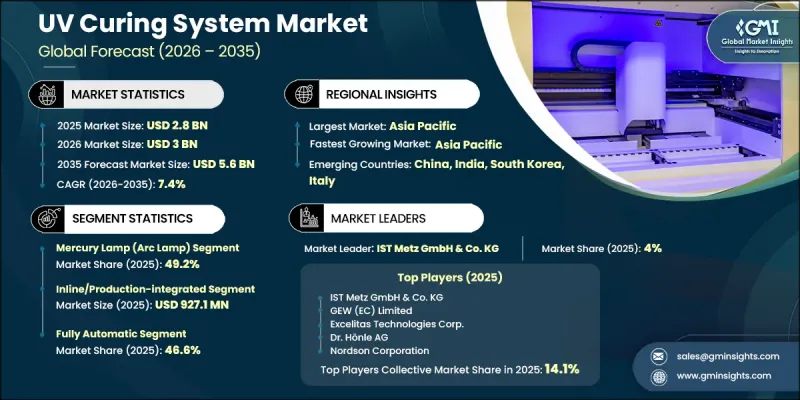
이 시장은 친환경 제조로의 전환이 진행되고 있으며, 에너지 절약형 UV-LED 경화 기술의 도입이 증가하고 있고, 정확하고 신속한 경화 성능이 필요한 업계 수요가 확대되고 있어 강력한 성장세를 보이고 있습니다. 전자 및 반도체 부품 생산 확대, 인쇄·포장 공정의 고속화에 대한 수요 증가, 그리고 첨단 산업 분야에서 UV 경화형 접착제, 코팅, 수지의 채택 확대가 시장 성장을 뒷받침하고 있습니다. 각 업계에서는 배출량 저감, 에너지 소비 감소, 처리 속도 향상, 업무 효율 개선 등의 이점으로 인해 기존의 열경화 및 용제 기반 공정을 대체하여 UV 경화 기술로의 전환이 진행되고 있습니다. 기존의 수은계 UV 램프에서 UV-LED 경화 시스템으로의 전환은 유지보수 요구 사항 감소, 전력 소비 절감, 수명 연장, 지속가능성 향상 등의 이점을 가져와 새로운 성장 기회를 창출하고 있습니다. 저VOC 생산 방식 및 보다 깨끗한 제조 관행에 대한 관심이 높아지고 있는 점도 다양한 분야에서 UV 경화 시스템의 도입을 더욱 가속화하고 있습니다.
| 시장 범위 | |
|---|---|
| 개시 연도 | 2025년 |
| 예측 기간 | 2026-2035년 |
| 초기 시장 규모 | 28억 달러 |
| 예측액 | 56억 달러 |
| CAGR | 7.4% |
2025년에는 수은 램프(아크 램프) 부문이 49.2%의 점유율을 차지했습니다. 이 부문은 높은 출력 성능과 신뢰성 높은 경화 능력이 요구되는 용도에서 고휘도 수은계 UV 램프가 널리 사용되고 있기 때문에 주도적인 위치를 유지하고 있습니다. 이러한 시스템은 고속 처리, 산업용 표면 처리, 접착 작업, 인쇄 용도 및 코팅 공정에서 강력한 UV 광원과 다양한 수은계 UV 경화성 소재와의 호환성이 요구되는 산업을 지속적으로 뒷받침하고 있습니다.
인라인/생산 통합형 부문은 2025년에 9억 2,710만 달러에 달했습니다. 이 부문 시장 내 강력한 입지는 높은 생산성, 자동화 및 일관된 제품 품질이 요구되는 연속 제조 환경에서의 도입 증가에 기인합니다. 인라인 UV 경화 시스템은 중단 없는 가공을 지원하고, 가동 지연을 최소화하며, 균일한 경화 결과를 제공할 수 있어 대규모 생산 공정에 널리 통합되고 있습니다. 자동화 제조 시스템과의 호환성 덕분에 생산 효율 향상과 가동 중단 시간 단축에 주력하는 업계 전반에서 도입이 확대되고 있습니다.
2025년, 북미의 UV 경화 시스템 시장은 33.6%의 점유율을 차지했습니다. 이 지역 시장은 환경 규제 강화, 에너지 효율이 높은 생산 기술의 도입 확대, 그리고 인쇄, 포장, 전자, 자동차, 의료기기 제조 등 산업 분야 수요 증가에 힘입어 성장하고 있습니다. 제조 공정에서 VOC(휘발성 유기 화합물) 배출 감축을 촉진하는 규제 조치가 기존의 용제형 경화 방식에서 UV 경화 솔루션으로의 전환을 뒷받침하고 있습니다. 해당 지역의 정부 기관 및 환경 단체는 보다 깨끗한 생산 방식을 지속적으로 추진하고 있으며, 이는 첨단 UV 경화 기술에 대한 수요를 높이고 있습니다.
자주 묻는 질문
목차
제1장 조사 방법과 범위
제2장 주요 요약
제3장 업계 인사이트
제4장 경쟁 구도
제5장 시장 추산 및 예측 : 기술별, 2022년-2035년
제6장 시장 추산 및 예측 : 시스템 구성별, 2022년-2035년
제7장 시장 추산 및 예측 : 용도별, 2022년-2035년
제8장 시장 추산 및 예측 : 자동화 레벨별, 2022년-2035년
제9장 시장 추산 및 예측 : 최종 사용 산업별, 2022년-2035년
제10장 시장 추산 및 예측 : 지역별, 2022년-2035년
제11장 기업 개요
LSH 26.08.14The Global UV Curing System Market was valued at USD 2.8 billion in 2025 and is estimated to grow at a CAGR of 7.4% to reach USD 5.6 billion in 2035.
The market is witnessing strong growth due to the increasing shift toward environmentally responsible manufacturing, rising implementation of energy-saving UV-LED curing technologies, and expanding demand from industries requiring accurate and rapid curing performance. The growing production of electronics and semiconductor components, rising need for faster printing and packaging operations, and wider adoption of UV-curable adhesives, coatings, and resins across advanced industrial applications are strengthening market expansion. Industries are increasingly replacing conventional thermal curing and solvent-based processes with UV curing technologies due to their lower emissions, reduced energy consumption, faster processing capabilities, and improved operational efficiency. The transition from traditional mercury-based UV lamps toward UV-LED curing systems is creating new growth opportunities by offering advantages such as lower maintenance requirements, reduced power consumption, extended service life, and improved sustainability. The increasing emphasis on low-VOC production methods and cleaner manufacturing practices is further accelerating the adoption of UV curing systems across multiple sectors.
| Market Scope | |
|---|---|
| Start Year | 2025 |
| Forecast Year | 2026-2035 |
| Start Value | $2.8 Billion |
| Forecast Value | $5.6 Billion |
| CAGR | 7.4% |
The mercury lamp (arc lamp) segment accounted for a 49.2% share in 2025. The segment maintains its leading position due to the widespread use of high-intensity mercury-based UV lamps in applications requiring strong output performance and reliable curing capabilities. These systems continue to support industries where high-speed processing, industrial surface treatment, bonding operations, printing applications, and coating processes require powerful UV energy sources and compatibility with various mercury-based UV-curable materials.
The inline/production-integrated segment reached USD 927.1 million in 2025. The segment's strong market presence is attributed to increasing installation across continuous manufacturing environments that require high productivity, automation, and consistent product quality. Inline UV curing systems are extensively integrated into large-scale production operations due to their ability to support uninterrupted processing, minimize operational delays, and provide uniform curing results. Their compatibility with automated manufacturing systems has increased their adoption across industries focused on improving production efficiency and reducing downtime.
North America UV Curing System Market held a 33.6% share in 2025. The regional market is expanding due to stronger environmental regulations, increasing adoption of energy-efficient production technologies, and rising demand from industries including printing, packaging, electronics, automotive, and medical device manufacturing. Regulatory initiatives encouraging reduced VOC emissions from manufacturing processes are supporting the transition from conventional solvent-based curing methods toward UV curing solutions. Government agencies and environmental organizations across the region continue to promote cleaner production approaches, which is increasing demand for advanced UV curing technologies.
Major players operating in the UV curing system industry are Nordson Corporation, Dr. Honle AG, Excelitas Technologies Corp., Baldwin Technology / AMS Spectral UV, Dymax Corporation, USHIO Inc., GEW (EC) Limited, IST Metz GmbH & Co. KG, DELO Industrial Adhesives GmbH, American Ultraviolet Company, Kyocera Corporation, Miltec UV, CurePro s.r.l., Uvitron International, Inc., APL Machinery Pvt. Ltd., ProPhotonix Limited, IUV (Guangdong Ruixin Electronics), and Shenzhen Yongchen Guang Electronics. Companies operating in the UV curing system market are adopting strategies focused on technological innovation, product development, strategic collaborations, and expansion of application capabilities to improve their market position. Manufacturers are investing heavily in UV-LED curing solutions to meet rising demand for energy-efficient and environmentally sustainable technologies. Companies are also enhancing system performance through improvements in curing speed, reliability, thermal management, and automation compatibility. Expanding product portfolios to serve diverse industries, strengthening global distribution networks, and developing customized solutions for specific manufacturing requirements are helping companies increase customer reach.
Table of Contents
Chapter 1 Methodology and Scope
- 1.1 Market scope and definition
- 1.2 Research design
- 1.2.1 Research approach
- 1.2.2 Data collection methods
- 1.3 Data mining sources
- 1.3.1 Global
- 1.3.2 Regional/Country
- 1.4 Base estimates and calculations
- 1.4.1 Base year calculation
- 1.4.2 Key trends for market estimation
- 1.5 Primary research and validation
- 1.5.1 Primary sources
- 1.6 Forecast model
- 1.7 Research assumptions and limitations
Chapter 2 Executive Summary
- 2.1 Industry 360° synopsis, 2022 - 2035
- 2.2 Key market trends
- 2.2.1 Technology trends
- 2.2.2 System configuration trends
- 2.2.3 Application trends
- 2.2.4 Automation level
- 2.2.5 End-use industry trends
- 2.2.6 Regional trends
- 2.3 TAM Analysis, 2026-2035
- 2.4 CXO perspectives: Strategic imperatives
Chapter 3 Industry Insights
- 3.1 Industry ecosystem analysis
- 3.1.1 Supplier Landscape
- 3.1.2 Profit Margin
- 3.1.3 Cost structure
- 3.1.4 Value addition at each stage
- 3.1.5 Factor affecting the value chain
- 3.1.6 Disruptions
- 3.2 Industry impact forces
- 3.2.1 Growth drivers
- 3.2.1.1 Stringent environmental regulations promoting low-VOC manufacturing
- 3.2.1.2 Expansion of electronics and semiconductor manufacturing
- 3.2.1.3 Growing demand for energy-efficient industrial processing
- 3.2.1.4 Increasing adoption in printing, packaging, and label manufacturing
- 3.2.1.5 Rising use of UV-curable materials in medical devices and advanced manufacturing
- 3.2.2 Industry pitfalls and challenges
- 3.2.2.1 High initial investment and equipment replacement costs
- 3.2.2.2 Limited compatibility with certain substrates and formulations
- 3.2.3 Market opportunities
- 3.2.3.1 Growing adoption of UV-LED curing technology
- 3.2.3.2 Expansion of advanced manufacturing, medical devices, and 3D printing
- 3.2.1 Growth drivers
- 3.3 Growth potential analysis
- 3.4 Regulatory landscape
- 3.4.1 North America
- 3.4.2 Europe
- 3.4.3 Asia Pacific
- 3.4.4 Latin America
- 3.4.5 Middle East & Africa
- 3.5 Porter's analysis
- 3.6 PESTEL analysis
- 3.7 Technology and Innovation landscape
- 3.7.1 Current technological trends
- 3.7.2 Emerging technologies
- 3.8 Price trends
- 3.8.1 By region
- 3.8.2 By product
- 3.9 Pricing Strategies
- 3.10 Emerging Business Models
- 3.11 Compliance Requirements
- 3.12 Patent and IP analysis
Chapter 4 Competitive Landscape, 2025
- 4.1 Introduction
- 4.2 Company market share analysis
- 4.2.1 By region
- 4.2.1.1 North America
- 4.2.1.2 Europe
- 4.2.1.3 Asia Pacific
- 4.2.1.4 Latin America
- 4.2.1.5 Middle East & Africa
- 4.2.2 Market concentration analysis
- 4.2.1 By region
- 4.3 Competitive benchmarking of key players
- 4.3.1 Financial performance comparison
- 4.3.1.1 Revenue
- 4.3.1.2 Profit margin
- 4.3.1.3 R&D
- 4.3.2 Product portfolio comparison
- 4.3.2.1 Product range breadth
- 4.3.2.2 Technology
- 4.3.2.3 Innovation
- 4.3.3 Geographic presence comparison
- 4.3.3.1 Global footprint analysis
- 4.3.3.2 Service network coverage
- 4.3.3.3 Market penetration by region
- 4.3.4 Competitive positioning matrix
- 4.3.4.1 Leaders
- 4.3.4.2 Challengers
- 4.3.4.3 Followers
- 4.3.4.4 Niche players
- 4.3.5 Strategic outlook matrix
- 4.3.1 Financial performance comparison
- 4.4 Key developments
- 4.4.1 Mergers and acquisitions
- 4.4.2 Partnerships and collaborations
- 4.4.3 Technological advancements
- 4.4.4 Expansion and investment strategies
- 4.4.5 Digital transformation initiatives
- 4.5 Emerging/ startup competitors landscape
Chapter 5 Market Estimates and Forecast, By Technology, 2022 - 2035 (USD Million)
- 5.1 Key trends
- 5.2 UV LED
- 5.3 Mercury lamp (arc lamp)
- 5.4 Microwave-powered UV systems
Chapter 6 Market Estimates and Forecast, By System Configuration, 2022 - 2035 (USD Million)
- 6.1 Key trends
- 6.2 Bench-top/tabletop
- 6.3 Conveyor
- 6.4 Inline/production-integrated
- 6.5 Handheld/portable
- 6.6 Customized/turnkey
Chapter 7 Market Estimates and Forecast, By Application, 2022 - 2035 (USD Million)
- 7.1 Key trends
- 7.2 Ink curing
- 7.3 Coating curing
- 7.4 Adhesive curing
- 7.5 Sealant & potting compound curing
- 7.6 Resin & composite curing
- 7.7 Others
Chapter 8 Market Estimates and Forecast, By Automation Level, 2022 - 2035 (USD Million)
- 8.1 Key trends
- 8.2 Manual
- 8.3 Semi-automatic
- 8.4 Fully automatic
Chapter 9 Market Estimates and Forecast, By End-Use Industry, 2022 - 2035 (USD Million)
- 9.1 Key trends
- 9.2 Automotive
- 9.3 Electronics & semiconductor
- 9.4 Printing
- 9.5 Packaging
- 9.6 Healthcare & medical devices
- 9.7 Aerospace
- 9.8 Others
Chapter 10 Market Estimates and Forecast, By Region, 2022 - 2035 (USD Million)
- 10.1 Key trends
- 10.2 North America
- 10.2.1 U.S.
- 10.2.2 Canada
- 10.3 Europe
- 10.3.1 Germany
- 10.3.2 UK
- 10.3.3 France
- 10.3.4 Spain
- 10.3.5 Italy
- 10.4 Asia Pacific
- 10.4.1 China
- 10.4.2 India
- 10.4.3 Japan
- 10.4.4 Australia
- 10.4.5 South Korea
- 10.5 Latin America
- 10.5.1 Brazil
- 10.5.2 Mexico
- 10.5.3 Argentina
- 10.6 Middle East and Africa
- 10.6.1 South Africa
- 10.6.2 Saudi Arabia
- 10.6.3 UAE
Chapter 11 Company Profiles
- 11.1 Global Key Players
- 11.1.1 IST Metz GmbH & Co. KG
- 11.1.2 GEW (EC) Limited
- 11.1.3 Excelitas Technologies Corp.
- 11.1.4 Dr. Honle AG
- 11.1.5 Nordson Corporation
- 11.2 Regional key players
- 11.2.1 North America
- 11.2.1.1 American Ultraviolet Company
- 11.2.1.2 Miltec UV
- 11.2.1.3 Dymax Corporation
- 11.2.1.4 Baldwin Technology / AMS Spectral UV
- 11.2.2 Asia Pacific
- 11.2.2.1 USHIO Inc.
- 11.2.2.2 Kyocera Corporation
- 11.2.2.3 IUV (Guangdong Ruixin Electronics)
- 11.2.2.4 Shenzhen Yongchen Guang Electronics
- 11.2.3 Europe
- 11.2.3.1 ProPhotonix Limited
- 11.2.3.2 DELO Industrial Adhesives GmbH
- 11.2.1 North America
- 11.3 Niche Players/Disruptors
- 11.3.1 CurePro s.r.l.
- 11.3.2 Uvitron International, Inc.
- 11.3.3 APL Machinery Pvt. Ltd.


