

|
시장보고서
상품코드
2109139
DTC 원격의료 약국 시장 비즈니스 기회, 성장요인, 업계 동향 분석 및 예측(2026-2035년)DTC Telehealth Pharmacy Market Opportunity, Growth Drivers, Industry Trend Analysis, and Forecast 2026 - 2035 |
||||||

세계의 DTC 원격의료 약국 시장은 2025년에 43억 달러로 평가되었고, CAGR 12.3%로 성장하여 2035년까지 144억 달러에 이를 것으로 추정되고 있습니다.
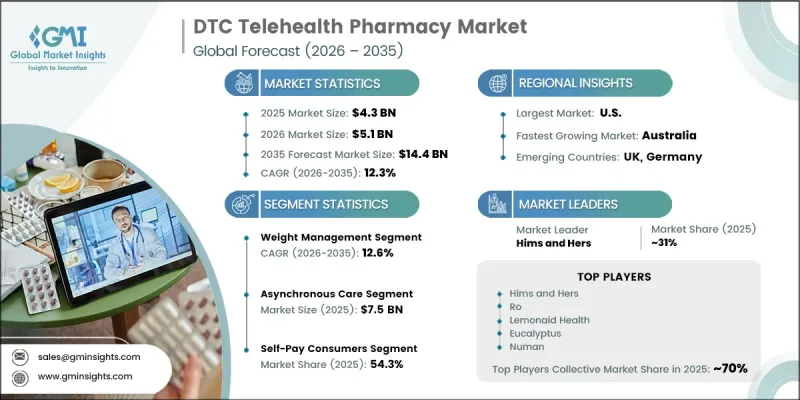
소비자 직접(DTC) 원격의료 약국 시장의 성장은 온라인 진료와 처방전 조제를 결합한 디지털 연결형 의료 서비스에 대한 수요 증가에 힘입어 견인되고 있습니다. 소비자들은 접근성이 뛰어나고 편리하며 개인 맞춤형 헬스케어 솔루션을 점점 더 많이 요구하고 있으며, 이는 디지털 약국 플랫폼의 보급을 촉진하고 있습니다. 만성 질환 유병률 증가와 원격 의료 서비스에 대한 수용 확대 또한 시장 성장을 더욱 뒷받침하고 있습니다. 또한, 온라인 진료, 통합형 온라인 약국 서비스, 처방약 택배 배송 및 구독형 케어 모델의 이용 증가가 업계 성장을 강화하고 있습니다. GLP-1 요법의 상용화가 진행되고 있는 점도 환자들의 디지털 헬스케어 플랫폼 이용을 더욱 가속화하고 있으며, 시장 진출기업들에게 큰 성장 기회를 창출하고 있습니다. DTC 원격의료 약국 시장은 온라인 진료와 약국 서비스를 통합한 디지털 의료 제공자로 구성되어 있으며, 환자는 기존의 대면 진료를 거치지 않고도 온라인 상담, 전자 처방전, 약제 조제, 자택 배송 및 지속적인 치료 관리를 받을 수 있습니다.
| 시장 범위 | |
|---|---|
| 개시 연도 | 2025년 |
| 예측 기간 | 2026-2035년 |
| 초기 시장 규모 | 43억 달러 |
| 예측액 | 144억 달러 |
| CAGR | 12.3% |
2025년, 체중 관리 부문은 35.4%의 점유율을 차지했습니다. 이 부문은 디지털 헬스케어 플랫폼을 통해 제공되는 의사의 감독 하에 진행되는 치료 프로그램에 대한 편리한 접근을 원하는 소비자 수요가 증가함에 따라 계속해서 혜택을 보고 있습니다. 온라인 진료 프로그램에서 온라인 상담, 임상 평가, 디지털 처방, 약국의 조제, 지속적인 치료 모니터링이 점점 더 결합됨에 따라 체중 관리는 주요 치료 범주로 자리 잡고 있습니다. 원격 의료 약국 제공업체들은 환자의 편의성을 높이고, 복약 순응도를 지원하며, 근거 기반 치료에 대한 장기적인 참여를 촉진하는 맞춤형 치료 경로를 확대되고 있습니다.
2025년에는 본인 부담 소비자 부문이 54.3%의 점유율을 차지했습니다. 개인정보 보호, 편의성, 투명한 가격 책정, 치료에 대한 신속한 접근, 그리고 온라인 의료 플랫폼을 통한 처방약 직접 구매에 대한 소비자의 선호도가 높아짐에 따라, 이 부문은 많은 디지털 의료 제공자에게 여전히 주요 고객 기반이 되고 있습니다. 자비 부담 방식의 디지털 헬스케어 서비스 수용이 증가함에 따라, 여러 치료 분야에 걸친 수요가 지속적으로 강화되고 있으며, 이는 시장의 지속적인 성장을 뒷받침하고 있습니다.
2025년 미국 DTC 원격의료 약국 시장 규모는 18억 달러로 평가되었습니다. 미국은 온라인 진료, 전자 처방, 조제, 가정 의약품 배송을 통합한 디지털 헬스케어 플랫폼의 광범위한 보급에 힘입어 계속해서 세계 최대 시장을 차지하고 있습니다. 편리성이 높은 헬스케어 서비스에 대한 소비자의 강력한 수요와 구독형 치료 프로그램의 도입 확대가 시장 성장을 지속적으로 견인하고 있습니다. 디지털 기반의 체중 관리 프로그램의 급속한 보급에 더해 GLP-1 요법의 이용 확대가 맞물리면서, 미국은 세계 시장에서 주도적인 입지를 더욱 공고히 하고 있습니다.
자주 묻는 질문
목차
제1장 조사 방법과 범위
제2장 주요 요약
제3장 업계 인사이트
제4장 경쟁 구도
제5장 시장 추산 및 예측 : 치료 영역별, 2022년-2035년
제6장 시장 추산 및 예측 : 케어 제공 모델별, 2022년-2035년
제7장 시장 추산 및 예측 : 플랫폼 유형별, 2022년-2035년
제8장 시장 추산 및 예측 : 비즈니스 모델별, 2022년-2035년
제9장 시장 추산 및 예측 : 최종 용도별, 2022년-2035년
제10장 시장 추산 및 예측 : 국가별, 2022년-2035년
제11장 기업 개요
LSH 26.08.14The Global DTC Telehealth Pharmacy Market was valued at USD 4.3 billion in 2025 and is estimated to grow at a CAGR of 12.3% to reach USD 14.4 billion by 2035.
Growth in the direct-to-consumer (DTC) telehealth pharmacy market is driven by the increasing demand for digitally connected healthcare services that combine virtual medical consultations with prescription fulfillment. Consumers are increasingly seeking accessible, convenient, and personalized healthcare solutions, encouraging wider adoption of digital pharmacy platforms. The rising incidence of chronic health conditions and growing acceptance of remote healthcare services are further supporting market expansion. In addition, the increasing use of virtual physician consultations, integrated online pharmacy services, home delivery of prescription medications, and subscription-based care models is strengthening industry growth. The expanding commercialization of GLP-1 therapies has further accelerated patient engagement with digital healthcare platforms, creating significant growth opportunities for market participants. The DTC telehealth pharmacy market consists of digital healthcare providers that integrate virtual clinical evaluations with pharmacy services, allowing patients to receive online consultations, electronic prescriptions, medication dispensing, home delivery, and ongoing treatment management without the need for traditional in-person healthcare appointments.
| Market Scope | |
|---|---|
| Start Year | 2025 |
| Forecast Year | 2026-2035 |
| Start Value | $4.3 Billion |
| Forecast Value | $14.4 Billion |
| CAGR | 12.3% |
The weight management segment held a 35.4% share in 2025. The segment continues to benefit from rising consumer demand for convenient access to medically supervised treatment programs delivered through digital healthcare platforms. Weight management has become the leading therapeutic category as virtual care programs increasingly combine online consultations, clinical evaluations, digital prescribing, pharmacy fulfillment, and continuous treatment monitoring. Telehealth pharmacy providers are expanding personalized treatment pathways that improve patient convenience, support medication adherence, and encourage long-term engagement with evidence-based therapies.
The self-pay consumers segment accounted for a 54.3% share in 2025. This segment remains the primary customer base for many digital healthcare providers due to growing consumer preference for privacy, convenience, transparent pricing, faster access to treatment, and direct availability of prescription medications through online healthcare platforms. Increasing acceptance of self-funded digital healthcare services continues to strengthen demand across multiple therapeutic categories while supporting sustained market growth.
U.S. DTC Telehealth Pharmacy Market was valued at USD 1.8 billion in 2025. The United States continues to represent the largest market globally, supported by widespread adoption of digital healthcare platforms that integrate virtual consultations, electronic prescribing, pharmacy fulfillment, and home medication delivery. Strong consumer demand for convenient healthcare services and increasing adoption of subscription-based treatment programs continue to support market expansion. The rapid uptake of digitally managed weight management programs, along with increasing utilization of GLP-1 therapies, has further strengthened the country's leadership in the global market.
Major companies operating in the global DTC telehealth pharmacy market include Hims & Hers Health, Ro, LifeMD, Thirty Madison, Lemonaid Health, PlushCare, Numan, Manual, ZAVA, Eucalyptus, Mochi Health, Form Health, and Calibrate. Companies participating in the DTC telehealth pharmacy market are strengthening their competitive position by expanding digital healthcare platforms, enhancing virtual care capabilities, and broadening integrated pharmacy services. Many organizations are investing in advanced technology to improve patient experience, streamline prescription fulfillment, and optimize treatment management. Strategic partnerships with healthcare providers, pharmacy networks, and technology companies are helping expand service offerings and improve operational efficiency. Businesses are also introducing subscription-based care models, personalized treatment programs, and enhanced digital engagement tools to improve customer retention and long-term loyalty.
Table of Contents
Chapter 1 Methodology and Scope
- 1.1 Research approach
- 1.2 Quality commitments
- 1.2.1 GMI AI policy & data integrity commitment
- 1.2.1.1 Source consistency protocol
- 1.2.1 GMI AI policy & data integrity commitment
- 1.3 Research trail & confidence scoring
- 1.3.1 Research trail components
- 1.3.2 Scoring components
- 1.4 Data collection
- 1.4.1 Partial list of primary sources
- 1.5 Data mining sources
- 1.5.1 Paid sources
- 1.5.1.1 Sources, by country
- 1.5.1 Paid sources
- 1.6 Base estimates and calculations
- 1.6.1 Base year calculation for any one approach
- 1.7 Forecast model
- 1.7.1 Quantified market impact analysis
- 1.7.1.1 Mathematical impact of growth parameters on forecast
- 1.7.1 Quantified market impact analysis
- 1.8 Research transparency addendum
- 1.8.1 Source attribution framework
- 1.8.2 Quality assurance metrics
- 1.8.3 Our commitment to trust
Chapter 2 Executive Summary
- 2.1 Industry 360° synopsis
- 2.2 Key market trends
- 2.2.1 Business trends
- 2.2.2 Therapeutic area trends
- 2.2.3 Care delivery model trends
- 2.2.4 Platform type trends
- 2.2.5 Business model trends
- 2.2.6 End use trends
- 2.2.7 Country trends
- 2.3 CXO perspectives: Strategic imperatives
Chapter 3 Industry Insights
- 3.1 Industry ecosystem analysis
- 3.1.1 Supplier landscape
- 3.1.2 Value addition at each stage
- 3.1.3 Factors affecting the value chain
- 3.2 Industry impact forces
- 3.2.1 Growth drivers
- 3.2.1.1 Growing demand for GLP-1 therapies
- 3.2.1.2 Rising adoption of digital healthcare
- 3.2.1.3 Increasing prevalence of mental health conditions
- 3.2.1.4 Growing obesity and chronic disease burden
- 3.2.2 Industry pitfalls and challenges
- 3.2.2.1 Regulatory scrutiny of online prescribing
- 3.2.2.2 Rising customer acquisition costs
- 3.2.3 Market opportunities
- 3.2.3.1 Growth of subscription-based care models
- 3.2.1 Growth drivers
- 3.3 Growth potential analysis
- 3.4 Technological and innovation landscape
- 3.4.1 Current technological trends
- 3.4.2 Emerging technologies (Driven by Primary Research)
- 3.5 Pricing analysis (Driven by Primary Research)
- 3.6 Regulatory landscape (Driven by Primary Research)
- 3.7 Porter's analysis
- 3.8 PESTEL analysis
- 3.9 Impact of AI and Generative AI on the market (Driven by Primary Research)
- 3.10 Investment and funding landscape (Driven by Primary Research)
- 3.11 Future market trends (Driven by Primary Research)
- 3.12 Reimbursement scenario
- 3.13 GLP-1 trends shaping DTC telehealth pharmacy
Chapter 4 Competitive Landscape, 2025
- 4.1 Introduction
- 4.2 Company market share analysis
- 4.3 Company matrix analysis
- 4.4 Competitive analysis of major market players
- 4.5 Competitive positioning matrix
- 4.6 Key developments
- 4.6.1 Merger and acquisition
- 4.6.2 Partnership and collaboration
- 4.6.3 New product launches
- 4.6.4 Expansion plans
Chapter 5 Market Estimates and Forecast, By Therapeutic Area, 2022 – 2035 ($ Mn)
- 5.1 Key trends
- 5.2 Weight management
- 5.2.1 GLP-1 weight management
- 5.2.2 Non GLP-1 weight management
- 5.3 Mental and behavioral health
- 5.4 Hair restoration
- 5.5 Reproductive & sexual health
- 5.6 Primary care & general wellness
- 5.7 Other therapeutic areas
Chapter 6 Market Estimates and Forecast, By Care Delivery Model, 2022 – 2035 ($ Mn)
- 6.1 Key trends
- 6.2 Asynchronous care
- 6.3 Synchronous virtual care
- 6.4 Hybrid care
Chapter 7 Market Estimates and Forecast, By Platform Type, 2022 – 2035 ($ Mn)
- 7.1 Key trends
- 7.2 Integrated platforms
- 7.3 Standalone platforms
Chapter 8 Market Estimates and Forecast, By Business Model, 2022 – 2035 ($ Mn)
- 8.1 Key trends
- 8.2 Pay per visit
- 8.3 Subscription
- 8.4 Hybrid
Chapter 9 Market Estimates and Forecast, By End Use, 2022 – 2035 ($ Mn)
- 9.1 Key trends
- 9.2 Self-pay consumers
- 9.3 Commercial insurance members
- 9.4 Employer-sponsored members
- 9.5 Other end users
Chapter 10 Market Estimates and Forecast, By Country, 2022 – 2035 ($ Mn)
- 10.1 Key trends
- 10.2 U.S.
- 10.3 Germany
- 10.4 UK
- 10.5 Australia
- 10.6 Rest of World
Chapter 11 Company Profiles
- 11.1 Hims & Hers Health
- 11.2 Ro
- 11.3 LifeMD
- 11.4 Thirty Madison
- 11.5 Lemonaid Health
- 11.6 PlushCare
- 11.7 Numan
- 11.8 Manual
- 11.9 ZAVA
- 11.10 Eucalyptus
- 11.11 Mochi Health
- 11.12 Form Health
- 11.13 Calibrate


