
|
시장보고서
상품코드
2109151
의료용 LLM 및 기반 모델 시장 기회, 성장 촉진요인, 업계 동향 분석 및 예측(2026-2035년)Healthcare LLM and Foundation Model Market Opportunity, Growth Drivers, Industry Trend Analysis, and Forecast 2026 - 2035 |
||||||

세계의 의료용 LLM 및 기반 모델 시장은 2025년에 24억 달러 규모로 평가되었고, 27.7%의 연평균 복합 성장률(CAGR)로 확대되어 277억 달러에 이를 것으로 추정되고 있습니다.
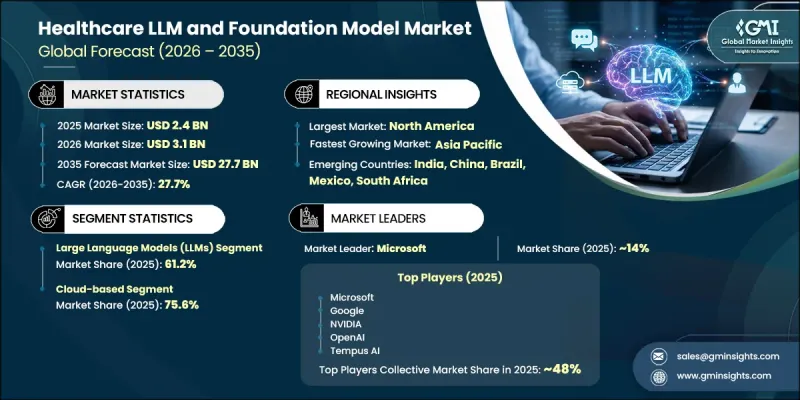
시장의 확대는 헬스케어 생태계 전반에 걸친 인공지능(AI)의 급속한 보급에 힘입고 있습니다. 각 기관은 업무 효율, 임상적 정확도 및 환자 치료 성과를 향상시키기 위해 고급 언어 모델과 파운데이션 모델에 대한 투자를 확대되고 있습니다. AI를 활용한 임상 기록, 가상 진료 플랫폼, 지능형 환자 참여 솔루션 및 고급 헬스케어 분석에 대한 수요 증가가 기술 제공업체에 큰 비즈니스 기회를 제공합니다. 생명과학 연구, 정밀의료, 유전체학 분야에서 파운데이션 모델의 활용 확대 또한 시장 발전을 더욱 가속화하고 있습니다. 게다가 의료 업무 전반에 걸친 멀티모달 AI 기술의 도입 확대는 의료 제공업체가 복잡한 임상 정보를 처리하고 해석하는 방식에 혁신을 가져오고 있습니다. 의료 기관이 구조화 및 비구조화 의료 데이터를 방대한 양으로 계속 생성하는 가운데, 정확한 인사이트 제공, 워크플로우 자동화, 데이터 기반 의사 결정을 가능하게 하는 확장 가능한 AI 플랫폼에 대한 수요가 높아지고 있는 점이 의료용 LLM 및 기반 모델 시장의 장기적인 전망을 더욱 견고하게 하고 있습니다.
| 시장 범위 | |
|---|---|
| 시작 연도 | 2025년 |
| 예측 기간 | 2026-2035년 |
| 시작 금액 | 24억 달러 |
| 예측 금액 | 277억 달러 |
| CAGR | 27.7% |
의료용 LLM 및 기반 모델 시장은 의료 관련 정보의 처리, 해석, 분석, 생성을 목적으로 개발된 대규모 언어 모델, 비전 기반 모델, 멀티모달 기반 모델, 그리고 생물학·유전체 기반 모델과 같은 첨단 인공지능 기술로 구성되어 있습니다. 이러한 기술은 임상 기록, 환자 참여, 의료 분석, 의료 영상, 임상 의사결정 지원, 의료 코딩, 유전체 연구, 신약 개발 등 폭넓은 용도를 뒷받침하고 있습니다. 진료 기록, 영상 진단 시스템, 유전체 데이터베이스 및 기타 의료 정보원에서 생성되는 의료 데이터의 지속적인 증가가 이러한 지능형 솔루션의 보급을 뒷받침하고 있습니다. 의료 기관에서는 AI를 활용한 플랫폼 도입이 점점 더 확대되고 있으며, 이를 통해 진료 기록 작성을 효율화하고, 관리 업무의 워크플로우를 최적화하며, 임상 의사결정을 강화하고, 코딩 정확도를 향상시켜 업무 성과를 높이는 동시에 의사의 업무 부담을 경감시키고 있습니다. 동시에 제약 및 생명공학 기업에서는 연구 효율 향상, 치료법 개발 가속화, 바이오마커 분석 강화, 그리고 임상 개발 활동 지원을 목적으로 기반 모델의 활용을 확대되고 있습니다.
대규모 언어 모델(LLM) 부문은 의료 기관 전반에 걸쳐 AI를 활용한 문서 작성 플랫폼 및 워크플로우 자동화 기술에 대한 수요가 증가함에 힘입어, 2025년에는 61.2%의 시장 점유율을 차지했습니다. 의료 전용 언어 모델의 도입 확대에 따라 의료 제공업체는 임상 문서 작성을 자동화하고, 환자 기록을 요약하며, 코딩 프로세스를 효율화하고, 행정 업무의 복잡성을 줄일 수 있게 됩니다. 이러한 기능을 통해 생산성이 향상되고 문서의 질이 높아지며, 의료 종사자는 수작업 문서 작성 과정에서 발생하는 업무 비효율성을 최소화하면서 환자 치료에 더 많은 시간을 할애할 수 있게 됩니다.
제약 및 생명공학 기업 부문은 연평균 성장률(CAGR) 28.5%를 나타낼 것으로 예측됩니다. 이 부문 시장 성장은 신약 개발 가속화, 표적 발견 개선, 바이오마커 연구 강화, 분자 설계 프로세스 최적화, 그리고 임상시험 효율 향상을 목적으로 한 생물학적 및 유전체 기반 모델의 도입 확대에 힘입고 있습니다. 연구 개발 활동 전반에 걸친 인공지능의 응용 확대는 제약·바이오기술 업계 전체의 생산성을 지속적으로 향상시키는 동시에 개발 기간 단축에도 기여하고 있습니다.
2025년, 북미 의료용 LLM 및 기반 모델 시장은 42.5%의 점유율을 차지했습니다. 지역별 성장은 선진적인 의료 인프라, 전자의무기록 시스템의 광범위한 도입, 그리고 인공지능 기술에 대한 지속적인 투자에 힘입고 있습니다. 강력한 디지털 헬스케어 혁신 노력과 병원, 의료 네트워크, 연구 기관에서의 AI 탑재 플랫폼 도입 확대가 시장 성장을 지속적으로 뒷받침하고 있습니다. 임상 기록, 환자 참여, 의료 분석, 의료 영상, 임상 의사결정 지원을 위한 지능형 솔루션의 채택 확대는 예측 기간 동안 해당 지역의 선도적 입지를 더욱 공고히 하고 있습니다.
자주 묻는 질문
목차
제1장 조사 방법
제2장 주요 요약
제3장 업계 인사이트
제4장 경쟁 구도
제5장 시장 규모 및 예측 : 모델 유형별(2022-2035년)
제6장 시장 규모 및 예측 : 도입 모드별(2022-2035년)
제7장 시장 규모 및 예측 : 용도별(2022-2035년)
제8장 시장 규모 및 예측 : 최종 용도별(2022-2035년)
제9장 시장 규모 및 예측 : 지역별(2022-2035년)
제10장 기업 개요
KTH 26.08.20The Global Healthcare LLM and Foundation Model Market was valued at USD 2.4 billion in 2025 and is estimated to grow at a CAGR of 27.7% to reach USD 27.7 billion by 2035.
Market expansion is being fueled by the rapid adoption of artificial intelligence across the healthcare ecosystem, where organizations are investing in advanced language and foundation models to improve operational efficiency, clinical accuracy, and patient outcomes. Rising demand for AI-enabled clinical documentation, virtual care platforms, intelligent patient engagement solutions, and advanced healthcare analytics is creating substantial opportunities for technology providers. The growing use of foundation models in life sciences research, precision medicine, and genomics is further accelerating market development. In addition, increasing implementation of multimodal AI technologies across healthcare operations is transforming the way providers process and interpret complex clinical information. As healthcare organizations continue generating massive volumes of structured and unstructured medical data, the need for scalable AI-powered platforms capable of delivering accurate insights, workflow automation, and data-driven decision-making continues to strengthen the long-term outlook for the healthcare LLM and foundation model market.
| Market Scope | |
|---|---|
| Start Year | 2025 |
| Forecast Year | 2026-2035 |
| Start Value | $2.4 Billion |
| Forecast Value | $27.7 Billion |
| CAGR | 27.7% |
The healthcare LLM and foundation model market comprises advanced artificial intelligence technologies, including large language models, vision foundation models, multimodal foundation models, and biological and genomic foundation models developed to process, interpret, analyze, and generate healthcare-related information. These technologies support a broad range of applications, including clinical documentation, patient engagement, healthcare analytics, medical imaging, clinical decision support, medical coding, genomics research, and drug discovery. Continuous growth in healthcare data generated from clinical records, imaging systems, genomic databases, and other healthcare sources is driving wider adoption of these intelligent solutions. Healthcare organizations are increasingly integrating AI-driven platforms to streamline documentation, optimize administrative workflows, strengthen clinical decision-making, improve coding accuracy, and enhance operational performance while reducing physician workload. At the same time, pharmaceutical and biotechnology organizations are expanding the use of foundation models to improve research efficiency, accelerate therapeutic development, enhance biomarker analysis, and support clinical development activities.
The large language models (LLMs) segment accounted for a 61.2% share in 2025, supported by increasing demand for AI-powered documentation platforms and workflow automation technologies across healthcare organizations. Growing implementation of healthcare-focused language models enables providers to automate clinical documentation, summarize patient records, streamline coding processes, and reduce administrative complexity. These capabilities improve productivity, enhance documentation quality, and allow healthcare professionals to dedicate more time to patient care while minimizing operational inefficiencies associated with manual documentation processes.
The pharmaceutical and biotechnology companies segment is projected to grow at a CAGR of 28.5% throughout 2035. Market growth within this segment is supported by increasing adoption of biological and genomic foundation models to accelerate drug development, improve target discovery, strengthen biomarker research, optimize molecular design processes, and enhance clinical trial efficiency. The expanding application of artificial intelligence throughout research and development activities continues to improve productivity while reducing development timelines across the pharmaceutical and biotechnology industries.
North America Healthcare LLM and Foundation Model Market held a 42.5% share in 2025. Regional growth is supported by advanced healthcare infrastructure, widespread adoption of electronic health record systems, and continued investments in artificial intelligence technologies. Strong digital healthcare transformation initiatives and increasing implementation of AI-powered platforms across hospitals, healthcare networks, and research organizations continue to support market expansion. Growing adoption of intelligent solutions for clinical documentation, patient engagement, healthcare analytics, medical imaging, and clinical decision support is further strengthening the region's leadership position throughout the forecast period.
Key Players in the Global Healthcare LLM and Foundation Model Market include Microsoft, Tempus AI, Orbita, BenevolentAI, OpenAI, Amazon Web Services, Hyro, Abridge, NVIDIA, Google, Paige AI, Anthropic, Suki AI, Elsevier, Isomorphic Labs, Nabla, Aidoc, Viz.ai, Ambience Healthcare, Hippocratic AI, Insilico Medicine, Recursion Pharmaceuticals. Companies operating in the healthcare LLM and foundation model market are strengthening their competitive position through continuous investments in artificial intelligence innovation, healthcare-specific model development, and strategic collaborations with healthcare providers, research organizations, and life sciences companies. Market participants are expanding their product portfolios by introducing specialized AI solutions that improve clinical workflows, automate documentation, and enhance decision support capabilities. Organizations are also investing heavily in cloud-based infrastructure, data security, regulatory compliance, and scalable deployment models to meet the evolving needs of healthcare institutions. In addition, companies are prioritizing research and development to improve model accuracy, multimodal capabilities, and interoperability with existing healthcare systems. Geographic expansion, strategic acquisitions, long-term technology partnerships, and continuous platform enhancements remain key initiatives for strengthening market presence and maintaining a competitive advantage.
Table of Contents
Chapter 1 Research Methodology
- 1.1 Research approach
- 1.2 Quality commitments
- 1.2.1 GMI AI policy & data integrity commitment
- 1.2.1.1 Source consistency protocol
- 1.2.1 GMI AI policy & data integrity commitment
- 1.3 Research trail & confidence scoring
- 1.3.1 Research trail components
- 1.3.2 Scoring components
- 1.4 Data collection
- 1.4.1 Partial list of primary sources
- 1.5 Data mining sources
- 1.5.1 Paid sources
- 1.5.1.1 Sources, by region
- 1.5.1 Paid sources
- 1.6 Base estimates and calculations
- 1.6.1 Base year calculation for any one approach
- 1.7 Forecast model
- 1.7.1 Quantified market impact analysis
- 1.7.1.1 Mathematical impact of growth parameters on forecast
- 1.7.1 Quantified market impact analysis
- 1.8 Research transparency addendum
- 1.8.1 Source attribution framework
- 1.8.2 Quality assurance metrics
- 1.8.3 Our commitment to trust
Chapter 2 Executive Summary
- 2.1 Industry 360° synopsis
- 2.2 Key market trends
- 2.2.1 Regional trends
- 2.2.2 Model type trends
- 2.2.3 Deployment mode trends
- 2.2.4 Application trends
- 2.2.5 End use trends
- 2.3 CXO perspectives: Strategic imperatives
Chapter 3 Industry Insights
- 3.1 Industry ecosystem analysis
- 3.2 Industry impact forces
- 3.2.1 Growth drivers
- 3.2.1.1 Rising demand for clinical documentation automation
- 3.2.1.2 Accelerating adoption of AI in drug discovery & genomics research
- 3.2.1.3 Expansion of value-based care models driving patient engagement AI
- 3.2.1.4 Growing healthcare data volumes enabling larger and more accurate foundation models
- 3.2.2 Industry pitfalls and challenges
- 3.2.2.1 Data privacy, HIPAA compliance challenges
- 3.2.2.2 High compute and operational costs for large-scale model deployment
- 3.2.3 Market opportunities
- 3.2.3.1 Multimodal AI integration across diagnostics, pathology & genomics
- 3.2.3.2 Expansion into underserved healthcare markets via low-cost cloud deployment
- 3.2.1 Growth drivers
- 3.3 Growth potential analysis
- 3.4 Regulatory landscape (Driven by primary research)
- 3.4.1 North America
- 3.4.2 Europe
- 3.4.3 Asia Pacific
- 3.4.4 Latin America
- 3.4.5 MEA
- 3.5 Technology landscape
- 3.5.1 Current technological trends
- 3.5.2 Emerging technologies
- 3.6 Pricing trend analysis (Driven by primary research)
- 3.7 Future market trends
- 3.8 Porter's analysis
- 3.9 PESTEL analysis
- 3.10 Impact of AI and Generative AI on the market (Driven by primary research)
- 3.11 Gap analysis
Chapter 4 Competitive Landscape, 2025
- 4.1 Introduction
- 4.2 Company matrix analysis
- 4.3 Company market share analysis (Driven by primary research)
- 4.3.1 Global
- 4.3.2 North America
- 4.3.3 Europe
- 4.3.4 Asia Pacific
- 4.4 Competitive positioning matrix
- 4.5 Competitive analysis of major market players
- 4.6 Key developments
- 4.6.1 Mergers & acquisitions
- 4.6.2 Partnerships & collaborations
- 4.6.3 New product launches
- 4.6.4 Expansion plans
Chapter 5 Market Estimates and Forecast, By Model Type, 2022 - 2035 ($ Mn)
- 5.1 Key trends
- 5.2 Large language models (LLMs)
- 5.2.1 Clinical and documentation LLMs
- 5.2.2 Patient engagement LLMs
- 5.2.3 Biomedical research LLMs
- 5.3 Vision foundation models
- 5.4 Multimodal foundation models
- 5.5 Biological and genomic foundation models
Chapter 6 Market Estimates and Forecast, By Deployment Mode, 2022 - 2035 ($ Mn)
- 6.1 Key trends
- 6.2 Cloud-based
- 6.3 On-premise
Chapter 7 Market Estimates and Forecast, By Application, 2022 - 2035 ($ Mn)
- 7.1 Key trends
- 7.2 Clinical documentation
- 7.3 Medical imaging
- 7.4 Drug discovery and development
- 7.5 Patient engagement
- 7.6 Other applications
Chapter 8 Market Estimates and Forecast, By End Use, 2022 - 2035 ($ Mn)
- 8.1 Key trends
- 8.2 Hospitals
- 8.3 Pharmaceutical and biotechnology companies
- 8.4 Payers
- 8.5 Research institutions
- 8.6 Other end users
Chapter 9 Market Estimates and Forecast, By Region, 2022 - 2035 ($ Mn)
- 9.1 Key trends
- 9.2 North America
- 9.2.1 U.S.
- 9.2.2 Canada
- 9.3 Europe
- 9.3.1 Germany
- 9.3.2 UK
- 9.3.3 France
- 9.3.4 Spain
- 9.3.5 Italy
- 9.3.6 Netherlands
- 9.4 Asia Pacific
- 9.4.1 China
- 9.4.2 Japan
- 9.4.3 India
- 9.4.4 Australia
- 9.4.5 South Korea
- 9.5 Latin America
- 9.5.1 Brazil
- 9.5.2 Mexico
- 9.5.3 Argentina
- 9.6 Middle East and Africa
- 9.6.1 South Africa
- 9.6.2 Saudi Arabia
- 9.6.3 UAE
Chapter 10 Company Profiles
- 10.1 Abridge
- 10.2 Aidoc
- 10.3 Amazon Web Services
- 10.4 Ambience Healthcare
- 10.5 Anthropic
- 10.6 BenevolentAI
- 10.7 Elsevier
- 10.8 Google
- 10.9 Hippocratic AI
- 10.10 Hyro
- 10.11 Insilico Medicine
- 10.12 Isomorphic Labs
- 10.13 Microsoft
- 10.14 Nabla
- 10.15 NVIDIA
- 10.16 OpenAI
- 10.17 Orbita
- 10.18 Paige AI
- 10.19 Recursion Pharmaceuticals
- 10.20 Suki AI
- 10.21 Tempus AI
- 10.22 Viz.ai