

|
시장보고서
상품코드
2099455
디지털 헬스케어·공급망 관리 : 시장 점유율 분석, 업계 동향 및 통계, 성장 예측(2026-2031년)Digital Healthcare Supply Chain Management - Market Share Analysis, Industry Trends & Statistics, Growth Forecasts (2026 - 2031) |
||||||
 Mordor Intelligence
Mordor Intelligence에 의하면, 디지털 헬스케어·공급망 관리 시장은 2025년에 26억 7,000만 달러로 평가되었습니다. 2026년 28억 8,000만 달러, 2031년 43억 2,000만 달러에 이를 것으로 예측되며, 2026년부터 2031년에 걸쳐 CAGR 8.44%로 성장할 전망입니다.
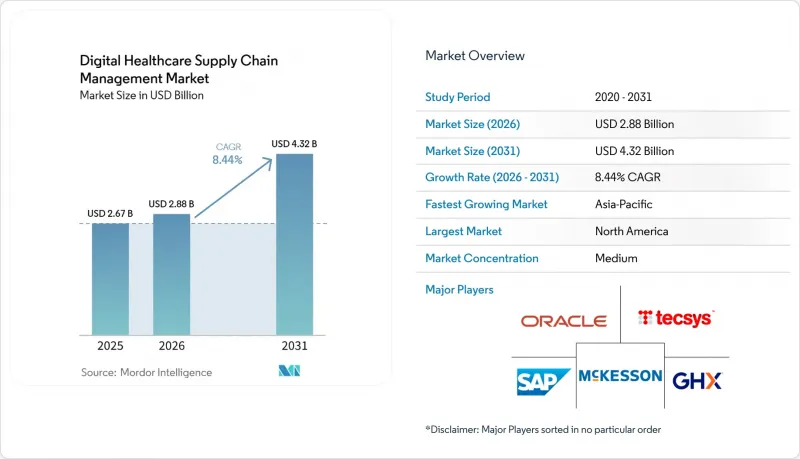
본 보고서는 구성 요소(소프트웨어, 서비스), 배포 방식(클라우드 기반, On-Premise형), 기능(조달 관리, 재고 관리, 기타), 최종 사용자(병원 및 의료 시스템, 제약·바이오기술 기업, 기타), 지역(북미, 유럽, 아시아태평양, 기타)별로 분류되어 있습니다. 시장 전망은 금액(달러) 기준으로 제시되어 있습니다.
세계의 디지털 헬스케어 공급망 관리 시장 동향 및 인사이트
의료 네트워크 전반에 걸친 실시간 재고 가시화에 대한 수요 증가
디지털 헬스케어 공급망 관리 시장에서 실시간 재고 가시화는 일상 업무의 필수 요건이 되었습니다. 이는 의료 현장에서의 품절이 진료 절차나 직원의 생산성을 저해하기 때문입니다. 의료 시스템은 단순한 자산 추적의 범위를 넘어, 실시간 위치 정보, 재고 현황, 사용 현황 신호를 보충 조치로 전환하는 플랫폼을 요구하고 있습니다. 이에 따라 디지털 헬스케어 공급망 관리 시장의 구매 논리가 변화하고 있습니다. 의료 제공업체들은 더 이상 단순한 데이터 수집뿐만 아니라 워크플로우 대응을 중시하게 되었기 때문입니다. Kontakt.io는 2026년 2월 ‘Supply Chain Agent’를 출시하며, 해당 시스템이 의료 수요 신호를 활용해 장비를 보다 능동적으로 배분함으로써 간호사의 검색 시간을 80% 단축했다고 발표했습니다. 이러한 움직임은 디지털 헬스케어 공급망 관리 시장이 재고를 파악하고, 중요한 사항을 판단하며, 수동 개입을 기다리지 않고 조치를 촉발할 수 있는 소프트웨어 계층으로 전환되고 있는 이유를 보여줍니다. 그 결과, 더 강력한 오케스트레이션 기능을 갖춘 벤더들이 의료 기관의 구매 결정에서 우위를 점하고 있습니다.
재고 부족 및 유통기한 만료 재고 감축에 대한 압박 고조
디지털 헬스케어 공급망 관리 시장은 병원 및 전체 유통 네트워크 전반에 걸친 재고 부족, 유통기한 만료 제품, 그리고 피할 수 있는 폐기물 감축에 대한 압박이 고조되면서 성장하고 있습니다. 의료 기관은 현재 단순한 보고 기능 개선에 그치는 기술 도입에는 소극적인 태도를 보이고 있으며, 재고 회전율 향상, 재고 보충 누락 감소, 긴급 조달 비용 절감 등 직접적인 비용 절감 효과를 점점 더 요구하고 있습니다. 이로 인해 디지털 헬스케어 공급망 관리 시장공급업체에 대한 요구 수준이 높아지고 있습니다. 구매자들은 더 짧은 투자 회수 기간 내에 측정 가능한 업무 성과를 기대하고 있기 때문입니다. 이와 같은 압박으로 인해 의료 제공업체 네트워크는 서로 연동되지 않는 개별 도구를 합리화하고, 조달, 재고 관리, 공급업체 조정을 단일 운영 계층으로 통합한 시스템을 우선시하고 있습니다. 이러한 추세는 클라우드 네이티브이자 분석 주도형 솔루션을 뒷받침하는 한편, 유지보수 부담이 큰 구식 시스템은 자본 지출 재검토 주기에서 더 큰 압박을 받고 있습니다. 또한, 소프트웨어 활용을 통해 낭비를 줄이고 보다 안정적인 공급 지속성을 실현할 수 있는 공급업체의 경우, 계약 갱신 전망도 밝아지고 있습니다.
분산된 레거시 ERP 및 조달 환경
분산된 ERP 환경은 디지털 헬스케어 공급망 관리 시장에 여전히 큰 걸림돌이 되고 있습니다. 그 이유는 많은 의료 기관과 제조 기업이 조달 및 재무 환경을 혼합한 상태로 계속 운영하고 있기 때문입니다. 새로운 공급망 용도는 대부분의 경우 구식 트랜잭션 시스템, 로컬 데이터베이스, 맞춤형 인터페이스, 그리고 서로 다른 거버넌스 규칙을 동시에 처리해야 합니다. 이로 인해 디지털 헬스케어 공급망 관리 시장의 도입 기간이 길어지고, 구매자가 클라우드 전환이나 워크플로우 자동화를 통해 기대하는 이점의 실현이 지연될 가능성이 있습니다. 또한 이로 인해 일부 고객은 핵심 트랜잭션 시스템을 교체하기 전에 개별 기능을 단계적으로 추가해 나가는 점진적인 현대화 경로를 따를 수밖에 없게 됩니다. 하이브리드 도입 모델을 지원할 수 있는 벤더는 기존 운영 시스템에 미치는 영향을 최소화하면서 새로운 분석 도구 및 오케스트레이션 도구를 연결할 수 있으므로 더 유리한 입장에 있습니다. 하지만 기술 도입이 아직 완료되지 않은 광범위한 ERP 전환에 의존하고 있는 경우, 디지털 헬스케어·공급망 관리 시장의 성장세는 여전히 둔화될 수밖에 없습니다.
부문 분석
2025년, 소프트웨어는 디지털 헬스케어 공급망 관리 시장 점유율의 65.18%를 차지했으며, 이는 분석, 규정 준수, 워크플로우 실행을 단일 환경 내에서 통합할 수 있는 플랫폼에 대한 구매자의 선호도를 반영한 것입니다. 디지털 헬스케어 공급망 관리 업계에서 소프트웨어는 조달, 재고 관리, 추적성 및 공급업체 조정을 위한 주요 제어 계층으로 자리 잡고 있습니다. 의료 기관은 지속적인 프로세스 개선과 여러 시설에 걸친 서비스 제공 가속화를 지원하기 위해 지속적인 소프트웨어 기능을 활용하는 것을 선호합니다.
서비스 부문은 2031년까지 연평균 성장률(CAGR) 9.58%를 기록하며 시장에서 가장 빠르게 성장하는 분야가 될 것으로 예상되는데, 이는 도입 기반이 확대됨에 따라 디지털 헬스케어 공급망 관리 시장에서 여전히 교육, 통합 및 관리형 지원에 대한 수요가 있음을 보여줍니다. 또한, 조직이 단계적으로 시스템을 현대화하고 신구 환경 모두에 걸친 지원이 필요한 경우에도 디지털 헬스케어·공급망 관리 시장은 서비스 수요를 창출합니다. 장기적으로는 서비스도 계속해서 중요할 것이지만, 고객이 매일 의존하는 정기적인 트랜잭션 로직과 데이터 모델을 소프트웨어가 담당하고 있기 때문에 시장 점유율 우위는 소프트웨어 측에 머물 가능성이 높다고 볼 수 있습니다.
2025년 시점에서 클라우드 기반 도입은 디지털 헬스케어·공급망 관리 시장 규모의 59.42%를 차지했으며, 2031년까지 연평균 성장률(CAGR) 10.26%로 가장 빠르게 성장하는 도입 형태가 될 것으로 예측됩니다. 이러한 조합은 디지털 헬스케어·공급망 관리 시장이 새로운 클라우드 사용자를 늘리고 있을 뿐만 아니라, 가치 창출의 중심을 호스팅형으로 지속적으로 업데이트되는 플랫폼으로 이동시키고 있음을 보여주며, 중요한 의미를 지닙니다. 병원에서는 유지보수 부담 경감, 기능의 신속한 도입, 그리고 분산된 거점 및 거래처와의 상호운용성 향상을 요구하는 목소리가 높아지고 있습니다. 또한 클라우드 아키텍처는 대규모 로컬 환경을 재구성하지 않고도 새로운 모델, 규칙, 워크플로우 변경을 도입할 수 있으므로 AI 도입을 보다 효과적으로 지원합니다.
구식 통합 구조, 내부 통제 요건 또는 단계적 전환 계획을 가진 일부 대규모 기관에서는 On-Premise 배포가 여전히 중요하게 여겨지고 있습니다. 그러한 경우에도 디지털 헬스케어·공급망 관리 업계는 On-Premise 환경을 무기한으로 유지하는 대신, 프라이빗 클라우드나 하이브리드 모델로 전환하고 있습니다. 조달, 추적성, 워크플로우 인텔리전스를 위한 공통 운영 계층을 요구하는 구매자가 늘어남에 따라, 클라우드 도입은 디지털 헬스케어·공급망 관리 시장 전체에서 가장 강력한 구조적 촉진요인으로 남아 있을 것입니다.
지역별 분석
2025년, 북미는 디지털 헬스케어 공급망 관리 시장 점유율의 43.68%를 차지하며 계속해서 최대 지역 부문으로서의 지위를 유지했습니다. 이 지역은 헬스케어 IT의 높은 성숙도, 광범위한 병원 네트워크, 그리고 의약품 추적성에 관한 가장 진보된 규제 추진이라는 이점을 누리고 있습니다. 클라우드 도입에 대한 준비 태세 또한 또 다른 강점이며, GHX에 따르면 미국 병원 및 의료 시스템의 70% 가까이가 2026년까지 클라우드 기반 접근 방식을 채택할 전망입니다. 이러한 요인들이 결합되어 북미의 디지털 헬스케어 공급망 관리 시장은 플랫폼 도입과 워크플로우 현대화 양면에서 다른 지역을 크게 앞서고 있습니다.
유럽은 의료 시스템의 디지털화와 상호운용성 개혁이 맞물려 디지털 헬스케어 공급망 관리 시장에서 여전히 2위 지역 블록을 유지하고 있습니다. 독일은 중요한 참고 사례가 됩니다. 연방 보건부가 2026년 2월 디지털화 전략을 추진한 데 이어, 의료 분야의 데이터 및 디지털 혁신을 지원하기 위해 2026년에 GeDIG 프레임워크를 발표했기 때문입니다. 또한, SAP와 프레제니우스는 2026년 1월, HL7 FHIR 표준을 활용한 상호 운용 가능한 AI 지원형 의료 시스템을 구축하기 위한 전략적 제휴를 발표했습니다. 이러한 움직임은 조달, 데이터 공유, 디지털 운영 기준의 일관성이 점점 더 높아지고 있는 해당 지역 시장을 뒷받침하고 있습니다.
아시아태평양은 디지털 헬스케어 공급망 관리 시장에서 가장 빠르게 성장하는 지역 부문이 될 것으로 예상되며, 2031년까지 연평균 성장률(CAGR)은 11.24%를 나타낼 것으로 전망됩니다. 이 지역의 성장은 도입 규모가 아직 작다는 점, 병원 현대화가 진행 중이라는 점, 그리고 자동화된 물류 및 디지털 조달 시스템의 활용 확대에 힘입고 있습니다. 중국과 일본은 여전히 주요 성장 축을 이루고 있는 반면, 인도, 한국, 호주에서는 디지털 헬스케어 인프라 확충에 힘입어 성장세가 가속화되고 있습니다. 중동 및 아프리카 및 남미를 포함한 기타 지역에서는 도입이 아직 초기 단계에 있지만, 병원 투자와 현지 의약품 개발 프로그램을 통해 디지털 헬스케어 공급망 관리 시장에 대한 1세대 수요가 지속적으로 창출되고 있습니다.
기타 혜택 :
- 엑셀 형식 시장 예측(ME) 시트
- 3개월간의 애널리스트 지원
자주 묻는 질문
목차
제1장 서론
제2장 조사 방법
제3장 주요 요약
제4장 시장 구도
제5장 시장 규모 및 성장 예측
제6장 경쟁 구도
제7장 시장 기회 및 향후 전망
KTH 26.08.10According to Mordor Intelligence, the digital healthcare supply chain management market is projected to be USD 2.67 billion in 2025, USD 2.88 billion in 2026, and reach USD 4.32 billion by 2031, growing at a CAGR of 8.44% from 2026 to 2031.
This report is Segmented by Component (Software, Services), Deployment Mode (Cloud-Based, On-Premises), Function (Procurement Management, Inventory Management, and Others), End-User (Hospitals and Health Systems, Pharmaceutical and Biotechnology Companies, and Others), and Geography (North America, Europe, Asia-Pacific, and Others). The Market Forecasts are Provided in Terms of Value (USD).
Global Digital Healthcare Supply Chain Management Market Trends and Insights
Rising Demand for Real-Time Inventory Visibility Across Healthcare Networks
Real-time inventory visibility has become a daily operating requirement in the digital healthcare supply chain management market because shortages at the point of care disrupt procedures and staff productivity. Health systems are moving beyond simple asset tracking and are asking platforms to convert live location, census, and usage signals into replenishment actions. This is changing the buying logic in the digital healthcare supply chain management market, because providers now value workflow response and not just data capture. Kontakt.io launched its Supply Chain Agent in February 2026 and said the system reduced nurse search time by 80% by using care demand signals to route equipment more proactively.That kind of move shows why the digital healthcare supply chain management market is shifting toward software layers that can see inventory, decide what matters, and trigger action without waiting for manual intervention. As a result, vendors with stronger orchestration features are gaining a better position in provider buying decisions.
Increasing Pressure to Reduce Stockouts and Expired Inventory
The digital healthcare supply chain management market is also being pulled forward by tighter pressure to reduce stockouts, expired products, and avoidable waste across hospitals and distribution networks. Healthcare organizations are now less willing to approve technology that only improves reporting, and they increasingly want direct savings from better stock rotation, fewer missed replenishment events, and lower emergency sourcing costs. This has raised the bar for vendors in the digital healthcare supply chain management market, because buyers expect measurable operational results within a shorter payback period. The same pressure is pushing provider networks to rationalize disconnected point tools and favor systems that combine procurement, inventory, and supplier coordination in one operating layer. That trend supports cloud-native and analytics-led offerings, while older high-maintenance deployments face more pressure during capital review cycles. It also strengthens renewal prospects for vendors that can tie software usage to reduced waste and more stable supply continuity.
Fragmented Legacy ERP and Procurement Environments
Fragmented ERP estates remain a major drag on the digital healthcare supply chain management market because many provider and manufacturer organizations still operate mixed procurement and finance environments. New supply chain applications often need to work with older transaction systems, local databases, custom interfaces, and different governance rules at the same time. This raises implementation time in the digital healthcare supply chain management market and can delay the benefits that buyers expect from cloud migration and workflow automation. It also keeps some customers on phased modernization paths where they add point capabilities before they can replace core transaction systems. Vendors that can support hybrid deployment models are better placed because they can connect new analytics and orchestration tools to older operational systems with less disruption. Even so, the digital healthcare supply chain management market still loses momentum when technology adoption depends on a broader ERP transition that has not yet been completed.
Other drivers and restraints analyzed in the detailed report include:
- Expansion of Interoperable Cloud-Based Supply Chain Platforms
- Regulatory Push for Traceability and Product Authentication
- High Integration Complexity with Clinical and Logistics Systems
For complete list of drivers and restraints, kindly check the Table Of Contents.
Segment Analysis
Software held 65.18% of the digital healthcare supply chain management market share in 2025, and this reflected buyer preference for platforms that can combine analytics, compliance, and workflow execution inside one environment. In the digital healthcare supply chain management industry, software has become the main control layer for procurement, inventory, traceability, and supplier coordination. Healthcare organizations prefer recurring software capability because it supports continuous process improvement and faster feature delivery across multiple facilities.
Services are expected to be the fastest-growing component at a 9.58% CAGR through 2031, which shows that the digital healthcare supply chain management market still needs training, integration, and managed support as the installed base grows. The digital healthcare supply chain management market also creates service demand when organizations modernize in phases and need support across both old and new environments. Over time, services should remain important, but the share premium is likely to stay with software because it owns the recurring transaction logic and the data model that customers depend on every day.
Cloud-based deployment accounted for 59.42% of the digital healthcare supply chain management market size in 2025, and it is also expected to be the fastest-growing mode at a 10.26% CAGR through 2031. That combination is important because it shows the digital healthcare supply chain management market is not only adding new cloud users, but also shifting the center of value creation toward hosted and continuously updated platforms. Hospitals increasingly want lower maintenance burden, quicker feature activation, and better interoperability with distributed sites and trading partners. Cloud architecture also supports AI rollout more effectively because new models, rules, and workflow changes can be delivered without major local reconfiguration.
On-premises deployment still remains relevant for some large institutions with older integration structures, internal control requirements, or staged migration plans. Even in those cases, the digital healthcare supply chain management industry is moving toward private cloud or hybrid models rather than defending full on-premises estates indefinitely. As more buyers seek a common operating layer for procurement, traceability, and workflow intelligence, cloud deployment is likely to remain the strongest structural driver across the digital healthcare supply chain management market.
Complete Report Scope:
- By Component
- Software
- Services
- By Deployment Mode
- Cloud-Based
- On-Premises
- By Function
- Procurement Management
- Inventory Management
- Order and Supplier Management
- Demand Planning and Forecasting
- Analytics and Reporting
- Traceability and Serialization
- By End-User
- Hospitals and Health Systems
- Pharmaceutical and Biotechnology Companies
- Medical Device Manufacturers
- Other End-Users
- By Geography
- North America
- United States
- Canada
- Mexico
- Europe
- Germany
- United Kingdom
- France
- Italy
- Spain
- Rest of Europe
- Asia-Pacific
- China
- Japan
- India
- Australia
- South Korea
- Rest of Asia-Pacific
- Middle East and Africa
- GCC
- South Africa
- Rest of Middle East and Africa
- South America
- Brazil
- Argentina
- Rest of South America
- North America
Geography Analysis
North America held 43.68% of the digital healthcare supply chain management market share in 2025, which kept it as the largest regional segment. The region benefits from strong healthcare IT maturity, a deep hospital network scale, and the most developed regulatory push around pharmaceutical traceability. Cloud readiness is another advantage, with GHX stating that nearly 70% of U.S. hospitals and health systems were on track to adopt a cloud-based approach by 2026. This combination keeps the digital healthcare supply chain management market in North America well ahead on both platform adoption and workflow modernization.
Europe remained the second-largest regional block in the digital healthcare supply chain management market, supported by a mix of health system digitization and interoperability reform. Germany is an important reference point because the Federal Ministry of Health advanced its digitalization strategy in February 2026 and also published the GeDIG framework in 2026 to support data and digital innovation in healthcare. SAP and Fresenius also announced a strategic partnership in January 2026 to build an interoperable AI-supported healthcare system using HL7 FHIR standards. These moves support a regional market where procurement, data sharing, and digital operating standards are becoming more aligned.
Asia-Pacific is projected to be the fastest-growing regional segment in the digital healthcare supply chain management market, with a projected 11.24% CAGR through 2031. Growth in the region is supported by a lower installed base, ongoing hospital modernization, and broader use of automated logistics and digital procurement systems. China and Japan remain the main scale anchors, while India, South Korea, and Australia add momentum from expanding digital healthcare infrastructure. Other regions, including the Middle East and Africa and South America, are still earlier in adoption, but hospital investment and local pharmaceutical development programs continue to open first-generation demand for the digital healthcare supply chain management market.
- Blue Yonder Group, Inc.
- Cardinal Health
- Coupa Software Incorporated
- Epicor Software Corporation
- GHX, Inc.
- Honeywell International
- IBM
- Infor
- JAGGAER
- Kinaxis Inc.
- Korber
- LogiTag Systems Ltd.
- Logiware
- Manhattan Associates, Inc.
- Mckesson
- Oracle
- Owens and Minor, Inc.
- SAP Ariba
- SAP
- Tecsys Inc.
- Zebra Technologies
Additional Benefits:
- The market estimate (ME) sheet in Excel format
- 3 months of analyst support
TABLE OF CONTENTS
1 Introduction
- 1.1 Study Assumptions and Market Definition
- 1.2 Scope of the Study
2 Research Methodology
3 Executive Summary
4 Market Landscape
- 4.1 Market Overview
- 4.2 Market Drivers
- 4.2.1 Rising Demand for Real-Time Inventory Visibility Across Healthcare Networks
- 4.2.2 Increasing Pressure to Reduce Stockouts and Expired Inventory
- 4.2.3 Expansion of Interoperable Cloud-Based Supply Chain Platforms
- 4.2.4 Regulatory Push for Traceability and Product Authentication
- 4.2.5 Growing Need for Automated Demand Forecasting and Replenishment
- 4.2.6 Rising Adoption of AI-Enabled Exception Management in Hospital Procurement
- 4.3 Market Restraints
- 4.3.1 Fragmented Legacy ERP and Procurement Environments
- 4.3.2 High Integration Complexity with Clinical and Logistics Systems
- 4.3.3 Data Standardization Gaps Across Suppliers, Distributors, and Providers
- 4.3.4 Budget Constraints in Smaller Healthcare Providers
- 4.4 Value Chain Analysis
- 4.5 Regulatory Landscape
- 4.6 Technological Outlook
- 4.7 Porter's Five Forces Analysis
- 4.7.1 Threat of New Entrants
- 4.7.2 Bargaining Power of Suppliers
- 4.7.3 Bargaining Power of Buyers
- 4.7.4 Threat of Substitutes
- 4.7.5 Competitive Rivalry
5 Market Size & Growth Forecasts (Value, USD)
- 5.1 By Component
- 5.1.1 Software
- 5.1.2 Services
- 5.2 By Deployment Mode
- 5.2.1 Cloud-Based
- 5.2.2 On-Premises
- 5.3 By Function
- 5.3.1 Procurement Management
- 5.3.2 Inventory Management
- 5.3.3 Order and Supplier Management
- 5.3.4 Demand Planning and Forecasting
- 5.3.5 Analytics and Reporting
- 5.3.6 Traceability and Serialization
- 5.4 By End-User
- 5.4.1 Hospitals and Health Systems
- 5.4.2 Pharmaceutical and Biotechnology Companies
- 5.4.3 Medical Device Manufacturers
- 5.4.4 Other End-Users
- 5.5 By Geography
- 5.5.1 North America
- 5.5.1.1 United States
- 5.5.1.2 Canada
- 5.5.1.3 Mexico
- 5.5.2 Europe
- 5.5.2.1 Germany
- 5.5.2.2 United Kingdom
- 5.5.2.3 France
- 5.5.2.4 Italy
- 5.5.2.5 Spain
- 5.5.2.6 Rest of Europe
- 5.5.3 Asia-Pacific
- 5.5.3.1 China
- 5.5.3.2 Japan
- 5.5.3.3 India
- 5.5.3.4 Australia
- 5.5.3.5 South Korea
- 5.5.3.6 Rest of Asia-Pacific
- 5.5.4 Middle East and Africa
- 5.5.4.1 GCC
- 5.5.4.2 South Africa
- 5.5.4.3 Rest of Middle East and Africa
- 5.5.5 South America
- 5.5.5.1 Brazil
- 5.5.5.2 Argentina
- 5.5.5.3 Rest of South America
- 5.5.1 North America
6 Competitive Landscape
- 6.1 Market Concentration
- 6.2 Market Share Analysis
- 6.3 Company Profiles (includes Global level Overview, Market level overview, Core Segments, Financials as available, Strategic Information, Market Rank/Share for key companies, Products & Services, Recent Developments)
- 6.3.1 Blue Yonder Group, Inc.
- 6.3.2 Cardinal Health, Inc.
- 6.3.3 Coupa Software Incorporated
- 6.3.4 Epicor Software Corporation
- 6.3.5 GHX, Inc.
- 6.3.6 Honeywell International Inc.
- 6.3.7 IBM
- 6.3.8 Infor
- 6.3.9 JAGGAER
- 6.3.10 Kinaxis Inc.
- 6.3.11 Korber AG
- 6.3.12 LogiTag Systems Ltd.
- 6.3.13 Logiware
- 6.3.14 Manhattan Associates, Inc.
- 6.3.15 McKesson Corporation
- 6.3.16 Oracle
- 6.3.17 Owens and Minor, Inc.
- 6.3.18 SAP Ariba
- 6.3.19 SAP SE
- 6.3.20 Tecsys Inc.
- 6.3.21 Zebra Technologies Corporation
7 Market Opportunities & Future Outlook
- 7.1 White-space & Unmet-need Assessment


