|
시장보고서
상품코드
2109176
뿌리채소 강판기 시장 기회, 성장 촉진요인, 산업 동향 분석 및 예측(2026-2035년)Root Crop Grating Machines Market Opportunity, Growth Drivers, Industry Trend Analysis, and Forecast 2026 - 2035 |
||||||

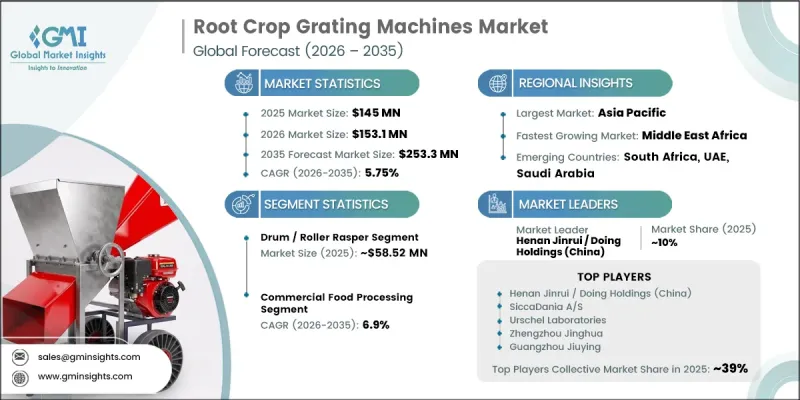
세계의 뿌리채소 강판기 시장은 2025년에 1억 4,500만 달러 규모로 평가되었고, CAGR 5.75%로 성장하여 2억 5,330만 달러에 이를 것으로 예측됩니다.
식품 가공 업계가 가공 효율, 제품의 균일성 및 운영 생산성을 향상시키는 자동화 설비에 대한 투자를 지속함에 따라, 해당 시장은 꾸준한 성장을 이루고 있습니다. 가공 뿌리채소 제품에 대한 수요 증가, 식품 제조 시설 전반에 걸친 기계화의 진전, 그리고 노동 집약적인 가공 방식의 축소가 점점 더 중요시되고 있는 점이 시장 확장을 뒷받침하고 있습니다. 각 제조업체는 처리 능력 향상, 원재료 손실 최소화, 그리고 일관된 제품 품질 유지를 위해 첨단 강판 시스템 도입을 점점 더 확대되고 있습니다. 기계의 내구성, 처리 속도, 에너지 효율, 그리고 위생적인 설계에 대한 지속적인 개선이 상업용 식품 가공 시설 전반에 걸친 설비 도입을 더욱 촉진하고 있습니다. 또한, 식품 가공 인프라에 대한 투자 확대, 제조 공장의 현대화, 그리고 고부가가치 농산물에 대한 수요 증가가 시장 진출기업들에게 계속해서 호기를 창출하고 있습니다.
| 시장 범위 | |
|---|---|
| 시작 연도 | 2025년 |
| 예측 기간 | 2026-2035년 |
| 초기 시장 규모 | 1억 4,500만 달러 |
| 예측 금액 | 2억 5,330만 달러 |
| CAGR | 5.75% |
드럼/롤러식 강판 부문은 2025년에 5,852만 미달러의 매출을 기록했으며, 2026년부터 연평균 성장률(CAGR) 5.1%로 성장할 것으로 전망됩니다. 이 부문은 효율적인 강판 성능, 높은 처리 능력, 그리고 상업용 식품 생산 환경에서 보여주는 높은 신뢰성을 바탕으로 뿌리채소 강판기 시장에서 계속해서 큰 점유율을 유지하고 있습니다. 균일한 입자 크기를 실현하고, 처리 효율을 향상시키며, 생산 가동 중단 시간을 줄일 수 있는 설비에 대한 수요가 증가함에 따라 드럼 및 롤러식 라스퍼 기술의 지속적인 채택이 촉진되고 있습니다. 또한, 각 제조업체는 기계의 내구성, 가동 신뢰성 및 유지보수 효율성 향상에도 주력하고 있으며, 이로 인해 해당 부문의 장기적인 성장 전망은 더욱 견고해지고 있습니다.
상업용 식품 가공 부문은 2025년에 49.5%의 점유을을 차지했으며, 연평균 성장률(CAGR) 6.9%로 성장할 것으로 전망됩니다. 식품 제조업체들이 생산 효율과 제품 품질 향상을 위해 자동 가공 설비에 대한 투자를 지속적으로 확대하고 있어, 이 용도는 계속해서 시장 수익의 최대 기여원이 되고 있습니다. 가공 식품에 대한 수요 증가, 산업용 식품 생산 확대, 그리고 표준화된 가공 공정에 대한 중요성 증대가 설비 도입을 지속적으로 뒷받침하고 있습니다. 최신 식품 가공 시설에서는 워크플로우 최적화, 운영 생산성 향상 및 제품 균일성 제고를 위해 첨단 강판 시스템 도입이 점점 더 확대되고 있어, 향후 몇 년간 장비 제조업체에게 유리한 성장 기회가 창출되고 있습니다.
북미의 뿌리채소 강판기 시장은 2025년에 8%의 점유율을 차지했습니다. 이 지역 시장은 뿌리채소 가공에 중점을 둔 산업용 식품 가공 사업 수요에 힘입어 계속해서 안정적인 입지를 유지하고 있습니다. 식품 제조 자동화에 대한 투자 확대, 가공 효율 향상, 생산 시설의 현대화가 해당 지역 전체 시장 발전을 지속적으로 뒷받침하고 있습니다. 장비의 신뢰성, 식품 안전 기준 및 업무 효율성에 대한 중요성이 높아짐에 따라 식품 가공업체들은 첨단 강판 기술을 도입하고 있습니다. 기술의 지속적인 발전과 자동 식품 가공 장비에 대한 투자가 예측 기간 동안 꾸준한 시장 성장에 기여할 것으로 예측됩니다.
자주 묻는 질문
목차
제1장 조사 방법과 범위
제2장 주요 요약
제3장 업계 인사이트
제4장 경쟁 구도
제5장 시장 규모 및 예측 : 기계 유형별(2022-2035년)
제6장 시장 규모 및 예측 : 스케일별(2022-2035년)
제7장 시장 규모 및 예측 : 가공 원료별(2022-2035년)
제8장 시장 규모 및 예측 : 전력별(2022-2035년)
제9장 시장 규모 및 예측 : 최종 사용자별(2022-2035년)
제10장 시장 규모 및 예측 : 지역별(2022-2035년)
제11장 기업 개요
KTH 26.08.20The Global Root Crop Grating Machines Market was valued at USD 145 million in 2025 and is estimated to grow at a CAGR of 5.75% to reach USD 253.3 million by 2035.
The market is experiencing steady growth as food processing industries continue to invest in automated equipment that improves processing efficiency, product consistency, and operational productivity. Rising demand for processed root crop products, increasing mechanization across food manufacturing facilities, and the growing emphasis on reducing labor-intensive processing methods are supporting market expansion. Manufacturers are increasingly adopting advanced grating systems to enhance throughput, minimize raw material losses, and maintain consistent product quality. Continuous improvements in machine durability, processing speed, energy efficiency, and hygienic design are further driving equipment adoption across commercial food processing facilities. In addition, increasing investments in food processing infrastructure, modernization of manufacturing plants, and growing demand for value-added agricultural products continue to create favorable opportunities for market participants.
| Market Scope | |
|---|---|
| Start Year | 2025 |
| Forecast Year | 2026-2035 |
| Start Value | $145 Million |
| Forecast Value | $253.3 Million |
| CAGR | 5.75% |
The drum/roller rasper segment generated USD 58.52 million in 2025 and is forecast to grow at a 5.1% CAGR during 2026 - 2035. The segment continues to maintain a significant share of the Root Crop Grating Machines Market due to its efficient grating performance, high processing capacity, and reliable operation in commercial food production environments. Growing demand for equipment capable of delivering consistent particle size, improved processing efficiency, and reduced production downtime is supporting continued adoption of drum and roller rasper technologies. Manufacturers are also focusing on improving machine durability, operational reliability, and maintenance efficiency, further strengthening the segment's long-term growth prospects.
The commercial food processing segment held a 49.5% share in 2025 and is forecast to grow at a 6.9% CAGR through 2035. This application remains the largest contributor to market revenue as food manufacturers continue to increase investments in automated processing equipment to improve production efficiency and product quality. Rising demand for processed food products, growing industrial food production, and increasing emphasis on standardized processing operations continue to support equipment adoption. Modern food processing facilities are increasingly integrating advanced grating systems to optimize workflow, improve operational productivity, and enhance product consistency, creating favorable growth opportunities for equipment manufacturers over the coming years.
North America Root Crop Grating Machines Market captured an 8% share in 2025. The regional market continues to maintain a stable presence, supported by demand from industrial food processing operations focused on root vegetable processing. Increasing investments in food manufacturing automation, improvements in processing efficiency, and modernization of production facilities continue to support market development across the region. Growing emphasis on equipment reliability, food safety standards, and operational efficiency is encouraging food processors to adopt advanced grating technologies. Continued technological advancements and investments in automated food processing equipment are expected to contribute to steady market growth throughout the forecast period.
Major companies operating in the global root crop grating machines market include TREIF Maschinenbau GmbH, Urschel Laboratories, SiccaDania A/S, holac Maschinenbau GmbH, Kronitek, Martin Maq, ProFruit Machinery, Henan Jinrui / Doing Holding, ZhengZhou JingHua Industry, Fengxiang Food Machinery, Guangzhou Jiuying, Genex Tech Industries LLP, Nanyang Goodway Machinery, GlobeCore, Thomas International, FINIC Nigeria Limited, NMC / Khorasan Packaging, Zhengzhou Sida Agriculture Equip., Henan Zhiyuan Starch Engineering, Henan Huafood Machinery Tech., and Chengyi (Linyi) Agricultural Mach. Companies operating in the global root crop grating machines market are strengthening their competitive position through continuous product innovation, manufacturing expansion, and technological advancements in food processing equipment. Manufacturers are investing in research and development to improve machine efficiency, processing capacity, energy performance, and operational reliability while meeting evolving customer requirements. Strategic collaborations with food processors, equipment distributors, and industrial partners are helping companies expand their market reach and strengthen customer relationships. Businesses are also enhancing product portfolios by introducing advanced automation features, improved hygienic designs, and user-friendly operating systems that increase productivity and reduce maintenance requirements. Expansion of regional distribution networks, stronger after-sales service capabilities, and customized equipment solutions further improve market competitiveness. Continuous focus on quality, innovation, operational excellence, and customer-centric product development enables companies to reinforce their market presence and sustain long-term growth within the global root crop grating machines market.
Table of Contents
Chapter 1 Methodology & Scope
- 1.1 Research approach
- 1.2 Quality Commitments
- 1.2.1 GMI AI policy & data integrity commitment
- 1.2.2 Source consistency protocol
- 1.3 Research Trail & Confidence Scoring
- 1.3.1 Research Trail Components
- 1.3.2 Scoring Components
- 1.4 Data Collection
- 1.4.1 Partial list of primary sources
- 1.5 Data mining sources
- 1.5.1 Paid sources
- 1.5.1.1 Sources, by region
- 1.5.1 Paid sources
- 1.6 Base estimates and calculations
- 1.6.1 Base year calculation
- 1.7 Forecast model
- 1.7.1 Quantified market impact analysis
- 1.7.1.1 Mathematical impact of growth parameters on forecast
- 1.7.1 Quantified market impact analysis
- 1.8 Research transparency addendum
- 1.8.1 Source attribution framework
- 1.8.2 Quality assurance metrics
- 1.8.3 Our commitment to trust
Chapter 2 Executive Summary
- 2.1 Industry 360° synopsis
- 2.2 Key market trends
- 2.2.1 Region
- 2.2.2 Machine Type
- 2.2.3 Scale
- 2.2.4 Raw Material Processed
- 2.2.5 Power Source
- 2.2.6 End-user
Chapter 3 Industry Insights
- 3.1 Industry ecosystem analysis
- 3.1.1 Supplier landscape
- 3.1.2 Profit margin
- 3.1.3 Value addition at each stage
- 3.1.4 Factor affecting the value chain
- 3.2 Industry impact forces
- 3.2.1 Growth drivers
- 3.2.1.1 Rising Global Demand for Cassava-Derived Products (Starch, Garri, Fufu, Flour) Driving Processing Equipment Uptake
- 3.2.1.2 Expanding Smallholder Mechanization Programs in Sub-Saharan Africa & Southeast Asia
- 3.2.1.3 Growth in Starch & Flour Processing Industry Creating Demand for High-Capacity Industrial Graters
- 3.2.1.4 Increasing Investments by Development Finance Institutions in Agri-Processing Infrastructure
- 3.2.2 Industry pitfalls & challenges
- 3.2.2.1 High Machine Cost Relative to Smallholder & SME Purchasing Power in Developing Markets
- 3.2.2.2 Rapid Wear of Grating Surfaces & High Maintenance Requirements Limiting Adoption
- 3.2.2.3 Limited Access to Electricity & Grid Infrastructure in Key Demand Markets (Rural Africa, Southeast Asia)
- 3.2.3 Opportunities
- 3.2.3.1 Solar & Renewable Energy-Powered Graters Unlocking Off-Grid Rural Markets
- 3.2.3.2 Multi-Crop Grating Machines Addressing Diverse Tuber Processing Needs Across Regions
- 3.2.3.3 Premiumization of Stainless-Steel, Food-Grade Hygienic Graters for Export-Oriented Plants
- 3.2.3.4 Digital & IoT-Enabled Predictive Maintenance Reducing Downtime in Industrial Applications
- 3.2.1 Growth drivers
- 3.3 Growth potential analysis
- 3.4 Supply Chain Analysis
- 3.4.1 Critical Component Sourcing (Rasper Drums, Grating Blades, Motors)
- 3.4.2 Manufacturing Hub Concentration (China, India, Nigeria, Brazil)
- 3.4.3 Supply Chain Disruption Risks & Mitigation Strategies
- 3.4.4 Spare Parts Availability & After-Sales Infrastructure Gaps
- 3.5 Future market trends
- 3.6 Technology and innovation landscape
- 3.6.1 Evolution of Grating Mechanism Technologies
- 3.6.2 Stainless Steel & Food-Grade Material Adoption
- 3.6.3 IoT & Smart Monitoring Integration in Industrial Graters
- 3.6.4 Renewable Energy-Powered Grating Systems (Solar, Biogas)
- 3.6.5 Emerging Hybrid & Multi-Crop Grating Platforms
- 3.7 Regulatory landscape
- 3.7.1 Food Safety & Hygiene Standards for Food Processing Equipment (Codex Alimentarius, ISO 14159)
- 3.7.2 CE Marking & Machinery Safety Directives (EU Market)
- 3.7.3 NAFDAC, SON & National Certification Requirements (Africa)
- 3.7.4 Import/Export Regulations on Agricultural Machinery
- 3.7.5 Environmental & Energy Efficiency Compliance
- 3.8 Trade data analysis
- 3.8.1 Import/Export Volume & Value Trends for Root Crop Processing Equipment (Driven by Primary Research)
- 3.8.2 Key Trade Corridors & Tariff Impact
- 3.9 Impact of AI & Generative AI on the market
- 3.9.1 AI-Driven Disruption of Existing Machine Design & Manufacturing Business Models
- 3.9.2 GenAI Use Cases & Adoption Roadmap by Segment (Predictive Maintenance, Design Optimization)
- 3.9.3 Risks, Limitations & Regulatory Considerations
- 3.10 Pricing Analysis
- 3.10.1 Historical Price Trend Analysis (Driven by Primary Research)
- 3.10.2 Pricing Strategy by Player Type (Premium / Value / Cost-plus) (Driven by Primary Research)
- 3.10.3 Price Benchmarking by Machine Type & Capacity Tier
- 3.10.4 DaaS Pricing Models
- 3.11 Porter’s analysis
- 3.12 PESTEL analysis
Chapter 4 Competitive Landscape, 2025
- 4.1 Introduction
- 4.2 Company market share analysis
- 4.3 Company matrix analysis
- 4.4 Competitive analysis of major market players
- 4.5 Competitive positioning matrix
- 4.6 Key developments
- 4.6.1 Mergers & acquisitions
- 4.6.2 Partnerships & collaborations
- 4.6.3 New product launches
- 4.6.4 Expansion plans
Chapter 5 Market Estimates & Forecast, By Machine Type, 2022 – 2035, (USD Million) (Thousand Units)
- 5.1 Key Trends
- 5.2 Drum/Roller Rasper
- 5.2.1 Single-Drum Rasper
- 5.2.2 Double/Multi-Drum Rasper
- 5.3 Hammer Mill Grater
- 5.3.1 Single-Stage Hammer Mill
- 5.3.2 Two-Stage/Combination Hammer Mill
- 5.4 Disc/Plate Grater
- 5.4.1 Fixed Abrasive Disc Grater
- 5.4.2 Rotating Disc Grater
- 5.5 Screw/Auger Grater
- 5.5.1 Continuous-Feed Screw Grater
- 5.5.2 Integrated Screw-Rasper Modules
- 5.6 Others
Chapter 6 Market Estimates & Forecast, By Scale, 2022 – 2035, (USD Million) (Thousand Units)
- 6.1 Key Trends
- 6.2 Small-Scale (< 500 kg/hr)
- 6.2.1 Manual/Pedal-Operated Units
- 6.2.2 Low-Power Electric Units (≤ 2 HP)
- 6.3 Medium-Scale (500–2,000 kg/hr)
- 6.3.1 Single-Phase Electric Units (2–10 HP)
- 6.3.2 Diesel/Petrol Engine-Driven Units
- 6.4 Large-Scale (> 2,000 kg/hr)
- 6.4.1 Three-Phase Industrial Raspers
- 6.4.2 Fully Integrated Continuous Processing Line Graters
Chapter 7 Market Estimates & Forecast, By Raw Material Processed, 2022 – 2035, (USD Million) (Thousand Units)
- 7.1 Key Trends
- 7.2 Cassava/Tapioca
- 7.2.1 Starch Production Applications
- 7.2.2 Garri/Fufu/Attieke Production Applications
- 7.2.3 Cassava Flour Production Applications
- 7.3 Potato
- 7.3.1 Starch & French Fries Processing
- 7.3.2 Mashed Potato & Dehydrated Potato Products
- 7.4 Sweet Potato
- 7.4.1 Starch & Flour Applications
- 7.4.2 Health Food & Confectionery Applications
- 7.5 Beetroot & Carrots
- 7.5.1 Juice Extraction Applications
- 7.5.2 Pickled & Processed Vegetable Applications
- 7.6 Others
Chapter 8 Market Estimates & Forecast, By Power Source, 2022 – 2035, (USD Million) (Thousand Units)
- 8.1 Key Trends
- 8.2 Electric-Powered
- 8.2.1 Single-Phase (Household & Small Commercial)
- 8.2.2 Three-Phase (Industrial & Semi-Industrial)
- 8.3 Diesel/Engine-Powered
- 8.3.1 Diesel Engine-Driven
- 8.3.2 Petrol/Gasoline Engine-Driven
- 8.4 Solar-Powered
- 8.4.1 Direct Solar PV-Driven
- 8.4.2 Solar-Battery Hybrid Systems
- 8.5 Manual/Pedal-Operated
Chapter 9 Market Estimates & Forecast, By End-user, 2022 – 2035, (USD Million) (Thousand Units)
- 9.1 Key Trends
- 9.2 Commercial Food Processing Plants
- 9.2.1 Starch Processing Plants
- 9.2.2 Flour & Dried Product Plants
- 9.2.3 Garri, Fufu & Fermented Food Plants
- 9.3 Agricultural Cooperatives & Smallholder Farmer Groups
- 9.3.1 Government-Supported Cooperative Processing Units
- 9.3.2 NGO & Development Organization-Funded Community Mills
- 9.4 Research & Academic Institutions
- 9.5 Household & Artisanal Processors
Chapter 10 Market Estimates & Forecast, By Region, 2022 – 2035, (USD Million) (Thousand Units)
- 10.1 Key Trends
- 10.2 North America
- 10.2.1 U.S.
- 10.2.2 Canada
- 10.3 Europe
- 10.3.1 Germany
- 10.3.2 France
- 10.3.3 UK
- 10.3.4 Italy
- 10.3.5 Spain
- 10.4 Asia Pacific
- 10.4.1 China
- 10.4.2 Japan
- 10.4.3 India
- 10.4.4 Australia
- 10.4.5 South Korea
- 10.5 Latin America
- 10.5.1 Brazil
- 10.5.2 Mexico
- 10.5.3 Argentina
- 10.6 MEA
- 10.6.1 Saudi Arabia
- 10.6.2 UAE
- 10.6.3 South Africa
Chapter 11 Company Profiles
- 11.1 Global Leaders
- 11.1.1 Urschel Laboratories
- 11.1.2 TREIF Maschinenbau GmbH
- 11.1.3 SiccaDania A/S
- 11.1.4 holac Maschinenbau GmbH
- 11.1.5 Henan Jinrui / Doing Holding
- 11.1.6 ZhengZhou JingHua Industry
- 11.1.7 Fengxiang Food Machinery
- 11.2 Regional Players
- 11.2.1 Kronitek
- 11.2.2 Martin Maq
- 11.2.3 Nanyang Goodway Machinery
- 11.2.4 NMC / Khorasan Packaging
- 11.2.5 ProFruit Machinery
- 11.2.6 Genex Tech Industries LLP
- 11.2.7 Guangzhou Jiuying
- 11.3 Emerging players
- 11.3.1 FINIC Nigeria Limited
- 11.3.2 Thomas International
- 11.3.3 GlobeCore
- 11.3.4 Zhengzhou Sida Agriculture Equip.
- 11.3.5 Henan Zhiyuan Starch Engineering
- 11.3.6 Henan Huafood Machinery Tech.
- 11.3.7 Chengyi (Linyi) Agricultural Mach