

|
시장보고서
상품코드
2109197
풍력 터빈 타워 시장 기회, 성장 촉진요인, 산업 동향 분석 및 예측(2026-2035년)Wind Turbine Tower Market Opportunity, Growth Drivers, Industry Trend Analysis, and Forecast 2026 - 2035 |
||||||

세계의 풍력 터빈 타워 시장은 2025년에 279억 달러 규모로 평가되었고, CAGR 8.5%로 성장하여 635억 달러에 이를 것으로 추정되고 있습니다.
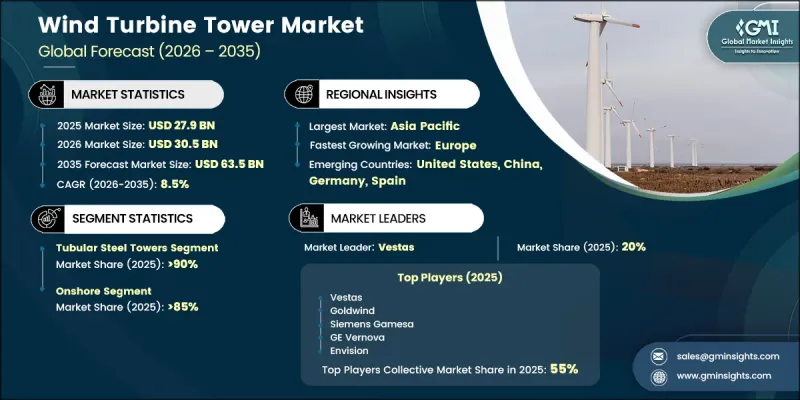
각국의 재생에너지 목표와 전 세계적인 탈탄소화 노력이 풍력 발전 설비의 대폭적인 증가를 뒷받침하고 있어, 업계 전망은 계속해서 밝습니다. 시장에서는 현재 두 가지 주요 수요 동향으로의 전환이 진행되고 있습니다. 하나는 기존 육상 프로젝트용의 비용 효율이 뛰어난 표준화된 타워 솔루션이며, 다른 하나는 해상 풍력 발전소나 허브 높이가 더 높은 용도를 위한 첨단 엔지니어링 설계입니다. 특히 120-160미터 이상의 설계를 포함한 타워 높이 증대가 주목받고 있습니다. 이는 특히 풍속이 낮은 지역에서 높이가 높아짐에 따라 풍속이 향상되어 발전량이 증가하기 때문입니다. IRENA의 데이터에 따르면, 풍속이 낮은 지역에서 허브 높이를 80미터에서 120미터로 높이면 설비 이용률이 5-12퍼센트 포인트 향상되어, 발전 효율 향상과 균등화 발전 원가 절감에 기여하는 것으로 나타났습니다.
| 시장 범위 | |
|---|---|
| 시작 연도 | 2025년 |
| 예측 기간 | 2026-2035년 |
| 초기 시장 규모 | 279억 달러 |
| 예측 금액 | 635억 달러 |
| CAGR | 8.5% |
강관 타워는 풍력 터빈 타워 시장에서 계속해서 지배적인 위치를 차지하고 있으며, 분류된 타워 부문 시장 규모의 90% 이상을 차지하고 있습니다. 이러한 견고한 시장 지위는 확립된 제조 공정, 신뢰할 수 있는 구조용 강재 공급망, 그리고 장기적인 가동 응력 조건 하에서 원통형 타워를 설계한 풍부한 경험에 의해 뒷받침되고 있습니다. 주요 풍력 터빈 제조업체들은 입증된 성능, 확장성 및 최신 터빈 시스템과의 호환성 덕분에 계속해서 강관 타워 솔루션을 널리 활용하고 있습니다.
2025년에는 육상 풍력 발전 프로젝트 부문이 85%의 점유율을 차지했습니다. GWEC의 데이터에 따르면, 2024년 말 기준으로 육상 풍력 발전은 전 세계 풍력 발전 누적 설비 용량의 93% 이상을 차지했으며, 이 부문의 선진적인 인프라 기반과 비용 효율적인 제조 생태계가 두드러집니다. 육상 풍력 발전 부문 내에서 허브 높이 증가는 타워 시장의 가치 확대에 영향을 미치는 중요한 요인으로 계속 작용하고 있습니다. 일부 신흥 시장 및 성숙 시장의 풍력 발전 프로젝트에서는 120-140미터 높이의 설계를 포함한 더 높은 타워 구조가 채택되고 있으며, 이로 인해 타워 자재 수요가 증가하여 제조업체에게 새로운 수익 기회가 창출되고 있습니다.
북미의 풍력 터빈 타워 시장은 2025년에 큰 점유율을 차지했습니다. 이는 설치 용량 면에서 세계 최대 규모의 풍력 발전 시장 중 하나인 미국의 활발한 재생에너지 투자 활동에 힘입은 결과입니다. 국내 제조 부품에 대한 수요 증가에 대응하기 위해, 콜로라도주 윈저에 위치한 CS Wind의 시설(연간 약 500-600세트의 타워 생산)은 국내 조달 인센티브와 관련된 수요를 뒷받침하기 위해 가동을 확대했습니다. 이 시설은 NextEra Energy와 Berkshire Hathaway Energy를 비롯한 주요 풍력 발전 개발업체에 제품을 공급하고 있습니다.
자주 묻는 질문
목차
제1장 조사 방법과 범위
제2장 주요 요약
제3장 업계 인사이트
제4장 경쟁 구도
제5장 시장 규모 및 예측 : 타워 유형별(2022-2035년)
제6장 시장 규모 및 예측 : 전개 형태별(2022-2035년)
제7장 시장 규모 및 예측 : 타워 높이별(2022-2035년)
제8장 시장 규모 및 예측 : 최종 용도별(2022-2035년)
제9장 시장 규모 및 예측 : 지역별(2022-2035년)
제10장 기업 개요
KTH 26.08.20The Global Wind Turbine Tower Market was valued at USD 27.9 billion in 2025 and is estimated to grow at a CAGR of 8.5% to reach USD 63.5 billion by 2035.
The industry outlook remains positive as national renewable energy goals and global decarbonization commitments encourage significant growth in wind power installations. The market is experiencing a shift toward two major demand trends: cost-efficient standardized tower solutions for established onshore projects and advanced engineering designs for offshore wind farms and taller hub-height applications. Increasing tower heights, particularly designs ranging from 120-160 meters and beyond, are gaining attention as higher elevations provide improved wind speeds and greater energy output, especially in regions with lower wind availability. IRENA data shows that raising hub height from 80 meters to 120 meters can increase capacity factors by 5-12 percentage points in low-wind-speed locations, contributing to better energy generation efficiency and lower levelized cost of energy.
| Market Scope | |
|---|---|
| Start Year | 2025 |
| Forecast Year | 2026-2035 |
| Start Value | $27.9 Billion |
| Forecast Value | $63.5 Billion |
| CAGR | 8.5% |
Tubular steel towers continue to dominate the wind turbine tower market, representing more than 90% of the classified tower segment by value. This strong market position is supported by established manufacturing processes, reliable structural steel supply networks, and extensive experience with cylindrical tower designs under long-term operational stress conditions. Leading wind turbine manufacturers continue to rely heavily on tubular steel tower solutions because of their proven performance, scalability, and compatibility with modern turbine systems.
The onshore wind projects segment held 85% share in 2025. GWEC data indicates that onshore wind accounted for more than 93% of total cumulative global wind capacity at the end of 2024, highlighting the segment's advanced infrastructure base and cost-efficient manufacturing ecosystem. Within the onshore category, increasing hub heights remain a key factor influencing tower value growth. Wind projects in several developing and established markets are adopting taller tower structures, including 120-140 meter designs, which are increasing tower material requirements and creating additional revenue opportunities for manufacturers.
North America Wind Turbine Tower Market generated a significant share in 2025, supported by strong renewable energy investment activity in the United States, which ranks among the largest wind power markets globally by installed capacity. In response to increasing demand for domestically manufactured components, CS Wind's facility in Windsor, Colorado, which produces approximately 500-600 tower sets annually, has expanded its operations to support demand linked to domestic content incentives. The facility supplies major wind energy developers, including NextEra Energy and Berkshire Hathaway Energy.
Key companies operating in the wind turbine tower market include Goldwind, Vestas, CS Wind, Siemens Gamesa, Windar Renovables, GE Vernova, Envision, Enercon, and Nordex. Companies in the wind turbine tower market are adopting strategies such as expanding manufacturing facilities, increasing production capabilities, and establishing regional supply networks to serve growing wind energy demand. Market leaders are investing in lightweight materials, advanced fabrication technologies, and automated manufacturing processes to improve efficiency and reduce production costs. Strategic collaborations with turbine manufacturers and project developers help companies secure long-term contracts and strengthen customer relationships. Businesses are also focusing on developing taller tower solutions, improving logistics capabilities, and enhancing operational sustainability. Expansion into emerging wind markets, adoption of digital technologies, and continuous investment in research and development remain key approaches used by companies to strengthen their market presence and maintain a competitive advantage.
Table of Contents
Chapter 1 Methodology & Scope
- 1.1 Research design
- 1.2 Quality commitment
- 1.2.1 GMI AI policy & data integrity commitment
- 1.2.1.1 Source consistency protocol
- 1.2.1 GMI AI policy & data integrity commitment
- 1.3 Research Trail & Confidence Scoring
- 1.3.1 Research trail components
- 1.3.2 Scoring components
- 1.4 Data Collection
- 1.4.1 Partial list of primary sources
- 1.5 Data mining sources
- 1.5.1 Paid sources
- 1.5.1.1 Sources, by region
- 1.5.1 Paid sources
- 1.6 Base estimates and calculations
- 1.6.1 Base year calculation for any one approach
- 1.7 Forecast model
- 1.8 Research transparency addendum
- 1.8.1 Source attribution framework
- 1.8.2 Quality assurance metrics
- 1.8.3 Our commitment to trust
- 1.9 Market definitions
Chapter 2 Executive Summary
- 2.1 Industry 360-degree synopsis, 2022 – 2035
- 2.2 Business trends
- 2.3 Tower type trends
- 2.4 Deployment trends
- 2.5 Tower height trends
- 2.6 End use trends
- 2.7 Regional trends
Chapter 3 Industry Insights
- 3.1 Industry ecosystem
- 3.2 Regulatory landscape
- 3.3 Industry impact forces
- 3.3.1 Growth drivers
- 3.3.2 Industry pitfalls & challenges
- 3.4 Growth potential analysis
- 3.5 Technology & Innovation Landscape
- 3.6 Price trend analysis
- 3.6.1 Historic price trend analysis by tower type
- 3.6.2 Pricing strategy by player type
- 3.7 Porter's analysis
- 3.7.1 Bargaining power of suppliers
- 3.7.2 Bargaining power of buyers
- 3.7.3 Threat of new entrants
- 3.7.4 Threat of substitutes
- 3.8 PESTEL analysis
- 3.8.1 Political factors
- 3.8.2 Economic factors
- 3.8.3 Social factors
- 3.8.4 Technological factors
- 3.8.5 Legal factors
- 3.8.6 Environmental factors
- 3.9 Emerging opportunities & trends
- 3.10 Digitalization & IoT integration
- 3.11 Investment analysis and future outlook
Chapter 4 Competitive landscape, 2026
- 4.1 Introduction
- 4.2 Company market share analysis, by region, 2025
- 4.2.1 North America
- 4.2.2 Europe
- 4.2.3 Asia Pacific
- 4.2.4 Middle East & Africa
- 4.2.5 Latin America
- 4.3 Competitive analysis of major market players
- 4.4 Competitive positioning matrix
- 4.5 Key developments
- 4.5.1 Mergers & acquisitions
- 4.5.2 Partnerships & collaborations
- 4.5.3 New product launches
- 4.5.4 Expansion plans & funding
- 4.6 Company tier benchmarking
- 4.6.1 Tier classification criteria & qualifying thresholds
- 4.6.2 Tier positioning matrix by revenue, geography & innovation
Chapter 5 Market Size and Forecast, By Tower Type, 2022 – 2035 (USD Billion)
- 5.1 Key trends
- 5.2 Tubular Steel
- 5.3 Concrete
- 5.4 Hybrid Steel-Concrete
- 5.5 Lattice
- 5.6 Others
Chapter 6 Market Size and Forecast, By Deployment, 2022 – 2035 (USD Billion)
- 6.1 Key trends
- 6.2 Onshore
- 6.3 Offshore
Chapter 7 Market Size and Forecast, By Tower Height, 2022 – 2035 (USD Billion)
- 7.1 Key trends
- 7.2 ≤80 m
- 7.3 81-120 m
- 7.4 121-160 m
- 7.5 >160 m
Chapter 8 Market Size and Forecast, By End Use, 2022 – 2035 (USD Billion)
- 8.1 Key trends
- 8.2 Residential
- 8.3 Commercial
- 8.4 Utility
Chapter 9 Market Size and Forecast, By Region, 2022 – 2035 (USD Billion)
- 9.1 Key trends
- 9.2 North America
- 9.2.1 U.S.
- 9.2.2 Canada
- 9.2.3 Mexico
- 9.3 Europe
- 9.3.1 Germany
- 9.3.2 Spain
- 9.3.3 UK
- 9.3.4 France
- 9.3.5 Italy
- 9.3.6 Sweden
- 9.4 Asia Pacific
- 9.4.1 China
- 9.4.2 Japan
- 9.4.3 South Korea
- 9.4.4 India
- 9.4.5 Australia
- 9.5 Middle East & Africa
- 9.5.1 South Africa
- 9.5.2 Egypt
- 9.6 Latin America
- 9.6.1 Brazil
- 9.6.2 Chile
- 9.6.3 Argentina
Chapter 10 Company Profiles
- 10.1 Anyang Machinery
- 10.2 Arcosa Wind Towers
- 10.3 Bergey Windpower
- 10.4 Broadwind
- 10.5 CS Wind Corporation
- 10.6 Cubuilt Engineers
- 10.7 Dongkuk
- 10.8 Enel Green Power
- 10.9 ENERCON
- 10.10 Faccin
- 10.11 GE Vernova
- 10.12 GRI Renewable Industries
- 10.13 Hitachi
- 10.14 KGW Schweriner Maschinen- und Anlagenbau GmbH
- 10.15 Nordex
- 10.16 Qingdao Aeolos Wind Power
- 10.17 ReGen Powertech Private Limited
- 10.18 Siemens Gamesa Renewable Energy
- 10.19 Vestas Wind Systems
- 10.20 XEMC Windpower


