

|
시장보고서
상품코드
2113488
풍력 터빈 타워 : 시장 점유율 분석, 업계 동향과 통계, 성장 예측(2026-2031년)Wind Turbine Tower - Market Share Analysis, Industry Trends & Statistics, Growth Forecasts (2026 - 2031) |
||||||
 Mordor Intelligence
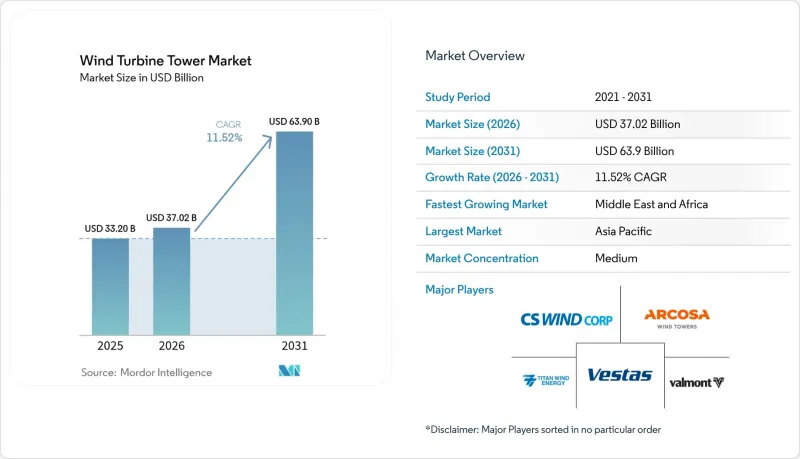
Mordor Intelligence에 따르면 풍력 터빈 타워 시장 규모는 2025년 332억 달러에서 2026년에는 370억 2,000만 달러로 확대되고, 2026년부터 2031년까지 CAGR 11.52%를 기록하며 2031년에는 639억 달러에 달할 것으로 예측됩니다.
본 보고서는 타워 유형(강관식, 콘크리트식, 강·콘크리트 복합식, 격자식, 지선식 및 모듈식/적층 복합식), 설치 형태(육상, 고정식 해상, 부유식 해상), 타워 높이(80미터 이하, 81-120미터, 121-160미터, 및 160미터 이상), 그리고 지역(북미, 유럽, 아시아태평양, 남미, 중동 및 아프리카)별로 분류되어 있습니다.
세계 풍력 터빈 타워 시장의 동향 및 인사이트
IRA(인플레이션 억제법)에 힘입어, 미국 내 100m 초과 강철 타워 생산능력의 현지화
IRA에 포함된 국내 조달률 관련 규정에 따라, 중서부 전역에서 총액 20억 달러 규모의 타워 공장 건설이 잇달아 발표되었으며, CS Wind나 Arcosa와 같은 세계 유수의 기업들이 미국의 수요와 아시아의 비용 기반 간의 균형을 맞추는 ‘듀얼 쇼어(Dual Shore)’ 생산 전략에 참여하고 있습니다. 신규 공장은 120m를 초과하는 섹션의 제조를 염두에 두고 설계되어, 기존 수입 의존도를 해소함과 동시에 초고층 설계 분야에서 지역의 기술력을 강화하고 있습니다. Broadwind사의 2024년 4분기 수주액은 85% 급증하여, 현지 조달을 통한 공급이 경쟁력 있는 규모를 달성했음을 보여주고 있습니다.
독일 및 북유럽 국가에서 160m를 초과하는 타워 건설을 가능하게 하는 허가 제도 개혁
베를린의 2024년 ‘육상 풍력발전법’에 따라 승인까지 소요되는 기간이 40% 단축되었으며, 현재 가동중인 높이 364m의 루사티아 발전소를 포함한 초고층 프로젝트가 잇따르고 있습니다. 북유럽 국가들의 통일된 높이 제한으로 인해 개발업자들은 더 안정적인 고고도 바람을 이용할 수 있게 되었으며, OEM 각사는 차세대 터빈의 하중 관리 소프트웨어 및 소음 허용 범위 최적화를 서둘러야 하는 상황에 놓여 있습니다.
미국 동부 해안에서 직경 15m를 초과하는 타워 섹션의 해상 물류 병목 현상
존스법(Jones Act) 규제로 인해 외국 선박의 취항이 제한되고 있어, XXL 직경 섹션에 필요한 중량물 운반선이 부족합니다. 항만의 임시 보관 장소 및 크레인 용량 증대는 수요를 따라가지 못하고 있어, 해상 모듈식 조립이나 부유식 기초와 같은 대체 수단을 사용할 수밖에 없으며, 이는 비용과 공수의 증가로 이어지고 있습니다.
부문 분석
하이브리드 강철·콘크리트 타워는 2025년 설치 건수의 18.20%를 차지하며, 2031년까지 연평균 12.68%의 성장이 예상됩니다. 이는 운송에 적합한 모듈을 통해 호송이 동반된 도로 운송 없이도 허브 높이 160m 이상을 실현할 수 있기 때문입니다. 콘크리트 사용량을 최대 40%까지 줄일 수 있어 경제성이 향상되며, 특히 인도와 중국에서는 현지 조달 의무로 인해 시멘트 조달에 이점이 있습니다. 노르덱스(Nordex)의 자체 제작 하이브리드 생산 라인은 이 회사 사상 최대 규모인 179m 높이의 타워 도입을 뒷받침하고 있는 반면,베스타스(Vestas)가 지원하는 모드비온(Modvion)의 적층 목재 프로토타입은 철강 및 콘크리트에 이은 제2의 재료 혁명의 도래를 시사하고 있습니다. 풍력 터빈 타워 시장에서는 양산 측면에서 여전히 강관이 주류를 이루고 있지만, 강판 가격 변동이 지속되는 가운데 하이브리드 옵션이 비용 격차를 좁혀가고 있습니다.
수직 통합을 향해 경쟁하는 각 OEM 기업들은 전략적 가치 확보를 중시하고 있습니다. GE 바노바의 미주리주 공장에서는 개조를 통해 플랜지 장착이 가능한 하이브리드 섹션을 생산할 수 있게 되어, 공급업체 수를 줄이고 품질 관리를 강화하고 있습니다. 이에 반해, 독립 제조업체들은 풍력 터빈 타워 시장에서의 점유율을 지키기 위해 원주 용접 로봇을 업그레이드하고 내식성 코팅으로 전환하고 있습니다.
지역별 분석
2025년 아시아태평양의 점유율 42.70%는 중국의 기가스케일 강판 공장과 인도에서의 하이브리드 방식의 급속한 보급에 기인합니다. 그러나 부지 제약이 심화됨에 따라, 관심은 수익성이 높은 해상 풍력 및 고층 타워 부문으로 옮겨가고 있습니다. 일본의 제3차 입찰에서는 15MW급 풍력 터빈 1.8GW가 도입되었고, 내식성 타워의 채택이 의무화됨에 따라 지역 평균 판매 가격이 상승하고 있습니다. 동시에, 한국은 울산 앞바다의 6GW 규모 부유식 시범 클러스터에 설비 투자를 배정하고 있어, 160m 모노파일 및 200m 하이브리드 타워에 대한 수요를 가속화하고 있습니다.
유럽은 규제 측면에서의 선견지명을 살려 그 규모 이상의 성과를 거두고 있습니다. 독일의 허가 절차 효율화로 프로젝트 주기가 18개월 단축되어, 조기에 진출한 PNE와 RWE가 그 혜택을 누리고 있습니다. EU의 탄소국경조정세로 인해 조달처가 친환경 강재로 전환되면서, 베스타스는 ‘Baltic Power’ 및 ‘Nordlicht’ 프로젝트에서 저탄소 강판 확보에 성공했습니다. 풍력 터빈 타워 시장이 세계화되는 가운데, 이러한 지속가능성 프리미엄이 유럽의 수출 경쟁력을 뒷받침하고 있습니다.
중동 및 아프리카는 사우디아라비아와 UAE의 국부펀드가 그린 수소 허브와 통합된 1-3GW 규모의 클러스터에 자금을 지원하고 있어, 낮은 기저에서 연평균 22.90%의 성장을 달성하고 있습니다. 북미에서는 IRA(인플레이션 억제법)에 힘입은 공장 건설로 인해 수입 의존도가 낮아지고 있습니다. CS Wind사의 텍사스주 내 생산 확대는 미국 및 라틴아메리카의 수요를 모두 충족시키고 있습니다. 남미에서는 송전망 업그레이드가 주목받고 있습니다. 브라질 북동부의 국영 송전 계획만으로도 9GW의 계통연계 용량이 확보되어, 지역 프로젝트 파이프라인에 새로운 활력을 불어넣고 있습니다.
기타 혜택:
- 엑셀 형식의 시장 예측(ME) 시트
- 3개월간의 애널리스트 지원
자주 묻는 질문
목차
제1장 소개
제2장 조사 방법
제3장 주요 요약
제4장 시장 구도
제5장 시장 규모와 성장 예측
제6장 경쟁 구도
제7장 시장 기회와 향후 전망
KSM 26.08.25According to Mordor Intelligence, the wind turbine tower market size is expected to grow from USD 33.20 billion in 2025 to USD 37.02 billion in 2026 and is forecast to reach USD 63.9 billion by 2031 at 11.52% CAGR over 2026-2031.
This report is Segmented by Tower Type (Tubular Steel, Concrete, Hybrid Steel-Concrete, Lattice, Guyed Pole, and Modular/Stacked Composite), Deployment (Onshore, Offshore-Fixed-Bottom, and Offshore-Floating), Tower Height (Up To 80 M, 81-120 M, 121-160 M, and Above 160 M), and Geography (North America, Europe, Asia-Pacific, South America, and Middle East and Africa).
Global Wind Turbine Tower Market Trends and Insights
IRA-driven localization of Over 100 m steel tower capacity in the United States
Domestic-content rules embedded in the IRA have triggered USD 2 billion of tower factory announcements across the Midwest, drawing global leaders such as CS Wind and Arcosa into dual-shore production strategies that balance U.S. demand with Asian cost bases.New plants are engineered for >120 m sections, eliminating historical import dependence and raising regional competence for ultra-tall designs. Order inflows at Broadwind surged 85% in Q4 2024, demonstrating that localized supply now achieves competitive scale.
Permitting reforms enabling >160 m towers in Germany & the Nordics
Berlin's 2024 "Onshore Wind Law" cut approval timelines by 40%, unleashing a queue of extreme-height projects, including the 364 m Lusatia installation now operational. Coordinated Nordic height caps allow developers to tap steadier high-altitude winds, compelling OEMs to refine load-management software and noise envelopes on next-generation turbines.
Seaborne logistics bottlenecks for >15 m-diameter tower sections on the U.S. East Coast
Jones Act rules limit foreign vessels, creating a scarcity of heavy-lift ships needed for XXL-diameter sections. Port staging yards and crane upgrades lag demand, forcing modular at-sea assembly or floating foundation workarounds that add cost and time.
Other drivers and restraints analyzed in the detailed report include:
- Hybrid steel-concrete towers cutting LCoE for low-wind inland sites in India & China
- EU carbon border adjustment accelerating adoption of green-steel towers
- Volatility in heavy-plate steel prices distorting cost models
For complete list of drivers and restraints, kindly check the Table Of Contents.
Segment Analysis
Hybrid steel-concrete towers captured 18.20% of 2025 installations and are forecast to grow 12.68% annually to 2031 as transportation-friendly modules allow >160 m hub heights without escorted road convoys. Concrete savings of up to 40% improve economics, especially in India and China, where local content mandates reward cement sourcing. Nordex's in-house hybrid line underpins the firm's largest-ever 179 m tower deployment, while Vestas-backed Modvion's laminated timber prototype signals a second material revolution beyond steel and concrete. The wind turbine tower market continues to lean on tubular steel for mass production, yet hybrid options are closing the cost gap as raw-plate volatility persists.
OEMs racing toward vertical integration highlight strategic value capture. GE Vernova's Missouri plant retrofit now outputs flange-ready hybrid sections, shrinking supplier lists and tightening quality control. Independent fabricators respond by upgrading circumferential welding robots and shifting toward corrosion-resistant coatings to defend their share in the wind turbine tower market.
Complete Report Scope:
- By Tower Type
- Tubular Steel Towers
- Concrete Towers
- Hybrid Steel-Concrete Towers
- Lattice Towers
- Guyed Pole Towers
- Modular/Stacked Composite Towers
- By Deployment
- Onshore
- Offshore (Fixed-Bottom)
- Offshore (Floating)
- By Tower Height (m)
- Up to 80 m
- 81 to 120 m
- 121 to 160 m
- Above 160 m
- By Geography
- North America
- United States
- Canada
- Mexico
- Europe
- Germany
- United Kingdom
- France
- Spain
- Italy
- Russia
- Denmark
- Sweden
- Norway
- Rest of Europe
- Asia Pacific
- China
- India
- Japan
- South Korea
- ASEAN Countries
- Australia
- Rest of Asia Pacific
- South America
- Brazil
- Argentina
- Rest of South America
- Middle East and Africa
- United Arab Emirates
- Saudi Arabia
- South Africa
- Egypt
- Rest of Middle East and Africa
- North America
Geography Analysis
Asia-Pacific's 42.70% share in 2025 flowed from China's giga-scale steel plate mills and India's rapid hybrid adoption. Yet the spotlight shifts to higher-margin offshore and tall-tower segments as land constraints tighten. Japan's Round 3 auction launches 1.8 GW of 15 MW class turbines, mandating corrosion-resistant towers that elevate regional average selling prices. Simultaneously, South Korea allocates CAPEX to a 6 GW floating pilot cluster off Ulsan, accelerating demand for 160 m monopiles and 200 m hybrid towers.
Europe leverages regulatory foresight to punch above its weight. Streamlined German permitting shaved 18 months from project cycles, rewarding early movers PNE and RWE. EU carbon-border charges shift procurement towards green steel, letting Vestas lock in low-carbon plate at Baltic Power and Nordlicht. Such sustainability premiums buttress European export competitiveness as the wind turbine tower market globalizes.
The Middle East & Africa grows 22.90% annually from a low base as sovereign funds in Saudi Arabia and the UAE bankroll 1-3 GW clusters integrated with green hydrogen hubs. North America's IRA-fuelled factory buildout is shrinking import dependence; CS Wind's Texas ramp-up feeds both U.S. and Latin American demand. South America eyes grid upgrades-Brazil's northeast state-run transmission plan alone frees 9 GW of interconnection-re-energizing the regional project pipeline.
- CS Wind Corporation
- Titan Wind Energy
- Valmont Industries Inc.
- Arcosa Wind Towers Inc.
- Trinity Structural Towers
- Broadwind Energy Inc.
- KGW Schweriner Maschinen- und Anlagenbau
- Dongkuk S&C
- Speco Technologies Co. Ltd
- Vestas Wind Systems A/S
- Siemens Gamesa Renewable Energy
- GE Vernova
- Goldwind
- Enercon GmbH
- Nordex SE
- Senvion SA
- Max Bogl Wind AG
- Ming Yang Smart Energy
- Envision Energy
- Sinoma Wind Towers
Additional Benefits:
- The market estimate (ME) sheet in Excel format
- 3 months of analyst support
TABLE OF CONTENTS
1 Introduction
- 1.1 Study Assumptions & Market Definition
- 1.2 Scope of the Study
2 Research Methodology
3 Executive Summary
4 Market Landscape
- 4.1 Market Overview
- 4.2 Market Drivers
- 4.2.1 IRA-Driven Localization of Above 100 m Steel Tower Manufacturing Capacity in the United States
- 4.2.2 Permitting Reforms Enabling Above 160 m Towers in Germany & the Nordics
- 4.2.3 Hybrid Steel-Concrete Towers Cutting LCoE for Low-Wind Inland Sites in India & China
- 4.2.4 EU Carbon Border Adjustment Accelerating Adoption of Green-Steel Towers
- 4.2.5 Surging South-Korean & Japanese Offshore Targets for Over 150 m Corrosion-Resistant Towers
- 4.2.6 On-site 3D-Printed Concrete Towers Slashing Logistics Costs in California & Spain Pilots
- 4.3 Market Restraints
- 4.3.1 Seaborne Logistics Bottlenecks for Above 15 m-Diameter Tower Sections on U.S. East Coast
- 4.3.2 Volatility in Heavy-Plate Steel Prices Distorting Cost Models
- 4.3.3 Delayed Type-Certification for Hybrid Towers in Emerging Markets
- 4.3.4 Local-Content Quotas Constraining Import of Low-Cost Asian Towers
- 4.4 Supply-Chain Analysis
- 4.5 Regulatory Outlook
- 4.6 Technological Outlook
- 4.7 Porter's Five Forces
- 4.7.1 Bargaining Power of Suppliers
- 4.7.2 Bargaining Power of Consumers
- 4.7.3 Threat of New Entrants
- 4.7.4 Threat of Substitutes
- 4.7.5 Intensity of Competitive Rivalry
5 Market Size & Growth Forecasts
- 5.1 By Tower Type
- 5.1.1 Tubular Steel Towers
- 5.1.2 Concrete Towers
- 5.1.3 Hybrid Steel-Concrete Towers
- 5.1.4 Lattice Towers
- 5.1.5 Guyed Pole Towers
- 5.1.6 Modular/Stacked Composite Towers
- 5.2 By Deployment
- 5.2.1 Onshore
- 5.2.2 Offshore (Fixed-Bottom)
- 5.2.3 Offshore (Floating)
- 5.3 By Tower Height (m)
- 5.3.1 Up to 80 m
- 5.3.2 81 to 120 m
- 5.3.3 121 to 160 m
- 5.3.4 Above 160 m
- 5.4 By Geography
- 5.4.1 North America
- 5.4.1.1 United States
- 5.4.1.2 Canada
- 5.4.1.3 Mexico
- 5.4.2 Europe
- 5.4.2.1 Germany
- 5.4.2.2 United Kingdom
- 5.4.2.3 France
- 5.4.2.4 Spain
- 5.4.2.5 Italy
- 5.4.2.6 Russia
- 5.4.2.7 Denmark
- 5.4.2.8 Sweden
- 5.4.2.9 Norway
- 5.4.2.10 Rest of Europe
- 5.4.3 Asia Pacific
- 5.4.3.1 China
- 5.4.3.2 India
- 5.4.3.3 Japan
- 5.4.3.4 South Korea
- 5.4.3.5 ASEAN Countries
- 5.4.3.6 Australia
- 5.4.3.7 Rest of Asia Pacific
- 5.4.4 South America
- 5.4.4.1 Brazil
- 5.4.4.2 Argentina
- 5.4.4.3 Rest of South America
- 5.4.5 Middle East and Africa
- 5.4.5.1 United Arab Emirates
- 5.4.5.2 Saudi Arabia
- 5.4.5.3 South Africa
- 5.4.5.4 Egypt
- 5.4.5.5 Rest of Middle East and Africa
- 5.4.1 North America
6 Competitive Landscape
- 6.1 Market Concentration
- 6.2 Strategic Moves (M&A, Partnerships, PPAs)
- 6.3 Market Share Analysis (Market Rank/Share for key companies)
- 6.4 Company Profiles (includes Global level Overview, Market level overview, Core Segments, Financials as available, Strategic Information, Products & Services, and Recent Developments)
- 6.4.1 CS Wind Corporation
- 6.4.2 Titan Wind Energy
- 6.4.3 Valmont Industries Inc.
- 6.4.4 Arcosa Wind Towers Inc.
- 6.4.5 Trinity Structural Towers
- 6.4.6 Broadwind Energy Inc.
- 6.4.7 KGW Schweriner Maschinen- und Anlagenbau
- 6.4.8 Dongkuk S&C
- 6.4.9 Speco Technologies Co. Ltd
- 6.4.10 Vestas Wind Systems A/S
- 6.4.11 Siemens Gamesa Renewable Energy
- 6.4.12 GE Vernova
- 6.4.13 Goldwind
- 6.4.14 Enercon GmbH
- 6.4.15 Nordex SE
- 6.4.16 Senvion SA
- 6.4.17 Max Bogl Wind AG
- 6.4.18 Ming Yang Smart Energy
- 6.4.19 Envision Energy
- 6.4.20 Sinoma Wind Towers
7 Market Opportunities & Future Outlook
- 7.1 White-Space & Unmet-Need Assessment


