

|
시장보고서
상품코드
2109210
핵연료 제조 시장 비즈니스 기회, 성장요인, 업계 동향 분석 및 예측(2026-2035년)Nuclear Fuel Fabrication Market Opportunity, Growth Drivers, Industry Trend Analysis, and Forecast 2026 - 2035 |
||||||

세계의 핵연료 제조 시장은 2025년에 47억 달러로 평가되었고, CAGR 5.7%로 성장하여 2035년까지 80억 달러에 이를 것으로 추정되고 있습니다.
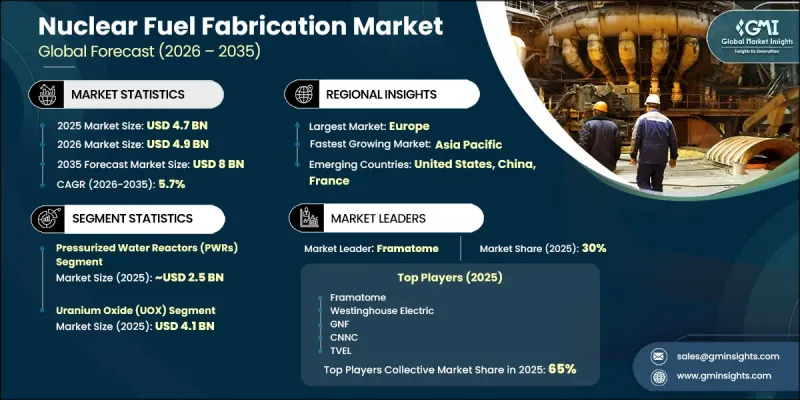
시장 확대는 주요 원자력 개발도상국에서의 원자로 건설 활동 증가, 성숙한 원자력 지역 전반에 걸친 운전 허가 갱신의 확산, 그리고 기존 산화우라늄 연료를 뛰어넘는 첨단 핵연료 기술의 단계적 상용화가 맞물려 추진되고 있습니다. 또한 업계 관계자들은 차세대 원자로 기술의 진화하는 요구 사항에 대응하기 위해 사고 내성 연료 솔루션 및 고순도 저농축 우라늄 연료 개발도 추진하고 있습니다. 규제 당국은 극한 운전 조건에서 연료 성능을 향상시키도록 설계된 첨단 연료 개념에 대해 전용 인허가 절차를 지속적으로 정비하고 있습니다. 한편, 원자력 발전소 운영 사업자들은 규제적 일관성을 유지하고, 인증된 연료 공급업체 변경에 따른 대규모 인증 요건을 피하기 위해, 통상 5년에서 10년 기간에 갱신 조항을 포함한 장기 연료 제조 계약을 여전히 선호하고 있습니다.
| 시장 범위 | |
|---|---|
| 개시 연도 | 2025년 |
| 예측 기간 | 2026-2035년 |
| 초기 시장 규모 | 47억 달러 |
| 예측액 | 80억 달러 |
| CAGR | 5.7% |
가압수형 원자로 부문은 2025년에 25억 달러 시장 규모를 기록했습니다. 이 부문의 압도적인 위상은 전 세계 상업용 원자력 발전소의 전체 구성을 반영하며, 이 원자로 기술은 전 세계 가동 중인 원자로의 3분의 2에 가까운 비중을 차지하고 있습니다. 이러한 원자로에 사용되는 연료 집합체는 개별 원자로 설계에 맞추어 특별히 설계된 표준화된 정사각형 격자 구조를 사용하여 제조되며, 초기 인증 절차가 완료된 후에는 공급업체를 변경하기가 극히 어렵습니다. 이러한 고도의 설계 특이성으로 인해 원자력 발전 사업자에게는 막대한 전환 비용이 발생하며, 원자로 운영자와 인증된 연료 제조업체 간의 장기적인 관계가 강화되고 있습니다.
우라늄 산화물(UOX) 연료 시장은 2025년에 41억 달러에 달했습니다. 제조 공정은 육불화우라늄에서 우라늄(II) 암모늄 분말을 제조하고, 약 1,700°C에서 압축 및 소결을 거쳐 고밀도 세라믹 연료 펠릿을 제조하고, 완성된 펠릿을 지르코늄 합금 피복관에 장전하여 원자로별로 특화된 연료 다발로 조립하는 과정으로 이루어집니다. UOX 연료의 광범위한 상업적 수용, 제조 공정의 성숙도, 확립된 농축 육불화우라늄 원료 공급망, 그리고 상용 경수로에서의 풍부한 규제 인증 실적이 2026년부터 2035년까지의 예측 기간 동안 이 연료의 압도적인 시장 리더십을 지속적으로 뒷받침하고 있습니다.
북미의 핵연료 제조 시장은 2025년에 14억 7,000만 달러 시장 규모를 기록했습니다. 미국은 총 설비 용량이 약 95GW에 달하는 93기의 가동 중인 상용 원자로에 힘입어, 여전히 연료 제조 수요 측면에서 최대의 단일 국가로 자리매김하고 있습니다. 지역 시장의 성장은 최대 80년간의 운전 허가를 허용하는 규제 체계 하에서 지속적으로 시행되고 있는 장기 원자로 수명 연장 프로그램과 더불어, 국내 원자력 발전 용량 확대를 목표로 한 새로운 정책 지원에 힘입어 가속화되고 있습니다. 2050년까지 원자력 설비 용량을 약 100GW에서 400GW로 확대한다는 정부의 이니셔티브는 북미 시장에 서비스를 제공하는 연료 제조 공급업체들에게 추가적인 장기적인 비즈니스 기회를 창출할 것으로 예측됩니다.
자주 묻는 질문
목차
제1장 조사 방법과 범위
제2장 주요 요약
제3장 업계 인사이트
제4장 경쟁 구도
제5장 시장 규모와 예측 : 기술별, 2022년-2035년
제6장 시장 규모와 예측 : 연료 유형별, 2022년-2035년
제7장 시장 규모와 예측 : 최종사용자별, 2022년-2035년
제8장 시장 규모와 예측 : 지역별, 2022년-2035년
제9장 기업 개요
LSH 26.08.14The Global Nuclear Fuel Fabrication Market was valued at USD 4.7 billion in 2025 and is estimated to grow at a CAGR of 5.7% to reach USD 8 billion by 2035.
Market expansion is driven by the combined impact of increasing reactor construction activity in key developing nuclear economies, widespread operating license renewals across mature nuclear regions, and the gradual commercialization of advanced nuclear fuel technologies beyond conventional uranium oxide fuel. Industry participants are also advancing accident-tolerant fuel solutions and high-assay low-enriched uranium fuel to support the evolving requirements of next-generation reactor technologies. Regulatory agencies continue to establish dedicated licensing pathways for advanced fuel concepts designed to improve fuel performance under extreme operating conditions. At the same time, nuclear power plant operators continue to favor long-term fuel fabrication agreements, typically lasting between five and ten years with renewal provisions, to maintain regulatory consistency and avoid extensive qualification requirements associated with changing qualified fuel suppliers.
| Market Scope | |
|---|---|
| Start Year | 2025 |
| Forecast Year | 2026-2035 |
| Start Value | $4.7 Billion |
| Forecast Value | $8 Billion |
| CAGR | 5.7% |
The pressurized water reactors segment generated USD 2.5 billion in 2025. Their dominant position reflects the overall composition of the global commercial nuclear fleet, where this reactor technology accounts for nearly two-thirds of operating units worldwide. Fuel assemblies used in these reactors are manufactured using standardized square-lattice configurations specifically engineered for individual reactor designs, making supplier substitution highly challenging after the initial qualification process has been completed. This high level of design specificity creates significant switching costs for nuclear utilities and reinforces long-term relationships between reactor operators and qualified fuel fabricators.
The uranium oxide (UOX) fuel segment reached USD 4.1 billion in 2025. Production invotubes andrting enriched uranium hexafluoride into ammonium diuranate powder, manufacturing high-density ceramic fuel pellets through pressing and sintering at nearly 1,700°C, loading the finished pellets into zirconium alloy cladding tubes, and assembling them into reactor-specific fuel bundles. The widespread commercial acceptance of UOX fuel, the maturity of its manufacturing process, the well-established enriched uranium feedstock supply chain, and the extensive regulatory qualification history across commercial light-water reactors continue to support its overwhelming market leadership throughout the 2026-2035 forecast period.
North America Nuclear Fuel Fabrication Market generated USD 1.47 billion in 2025. The United States remains the largest single national source of fuel fabrication demand, supported by 93 operating commercial nuclear reactors with a combined installed capacity of approximately 95 GW. Regional market growth is being reinforced by the continued implementation of long-term reactor life extension programs under regulatory frameworks permitting operating licenses of up to 80 years, alongside renewed policy support aimed at expanding domestic nuclear generating capacity. Government initiatives targeting an increase in installed nuclear capacity from approximately 100 GW to 400 GW by 2050 are expected to create additional long-term opportunities for fuel fabrication suppliers serving the North American market.
Major companies operating in the global nuclear fuel fabrication market include Global Nuclear Fuel (GNF), CNNC (China National Nuclear Corporation), TVEL (Rosatom Fuel Company), Westinghouse Electric Company, and Framatome. Companies participating in the nuclear fuel fabrication market primarily focus on securing long-term supply agreements with nuclear utilities to establish predictable revenue streams and strengthen customer retention. They continue investing in advanced fuel technologies, including accident-tolerant fuel and high-assay low-enriched uranium solutions, to align their product portfolios with evolving reactor requirements. Manufacturers also prioritize expanding production capabilities, improving fuel performance, and enhancing manufacturing efficiency to maintain competitiveness. Strategic partnerships with reactor developers, utility operators, and research organizations support technology validation and accelerate commercialization of next-generation fuel products.
Table of Contents
Chapter 1 Methodology & Scope
- 1.1 Research design
- 1.2 Quality commitment
- 1.2.1 GMI AI policy & data integrity commitment
- 1.2.1.1 Source consistency protocol
- 1.2.1 GMI AI policy & data integrity commitment
- 1.3 Research Trail & Confidence Scoring
- 1.3.1 Research trail components
- 1.3.2 Scoring components
- 1.4 Data Collection
- 1.4.1 Partial list of primary sources
- 1.5 Data mining sources
- 1.5.1 Paid sources
- 1.5.1.1 Sources, by region
- 1.5.1 Paid sources
- 1.6 Base estimates and calculations
- 1.6.1 Base year calculation for any one approach
- 1.7 Forecast model
- 1.8 Research transparency addendum
- 1.8.1 Source attribution framework
- 1.8.2 Quality assurance metrics
- 1.8.3 Our commitment to trust
- 1.9 Market definitions
Chapter 2 Executive Summary
- 2.1 Industry 360-degree synopsis, 2022 - 2035
- 2.2 Business trends
- 2.3 Technology trends
- 2.4 Fuel type trends
- 2.5 End User trends
- 2.6 Regional trends
Chapter 3 Industry Insights
- 3.1 Industry ecosystem
- 3.2 Regulatory landscape
- 3.3 Industry impact forces
- 3.3.1 Growth drivers
- 3.3.2 Industry pitfalls & challenges
- 3.4 Growth potential analysis
- 3.5 Technology & Innovation Landscape
- 3.6 Price trend analysis
- 3.6.1 Historic price trend analysis by technology
- 3.6.2 Pricing strategy by player type
- 3.7 Porter's analysis
- 3.7.1 Bargaining power of suppliers
- 3.7.2 Bargaining power of buyers
- 3.7.3 Threat of new entrants
- 3.7.4 Threat of substitutes
- 3.8 PESTEL analysis
- 3.8.1 Political factors
- 3.8.2 Economic factors
- 3.8.3 Social factors
- 3.8.4 Technological factors
- 3.8.5 Legal factors
- 3.8.6 Environmental factors
- 3.9 Emerging opportunities & trends
- 3.10 Digitalization & IoT integration
- 3.11 Investment analysis and future outlook
Chapter 4 Competitive landscape, 2026
- 4.1 Introduction
- 4.2 Company market share analysis, by region, 2025
- 4.2.1 North America
- 4.2.2 Europe
- 4.2.3 Asia Pacific
- 4.2.4 Middle East & Africa
- 4.2.5 Latin America
- 4.3 Competitive analysis of major market players
- 4.4 Competitive positioning matrix
- 4.5 Key developments
- 4.5.1 Mergers & acquisitions
- 4.5.2 Partnerships & collaborations
- 4.5.3 New product launches
- 4.5.4 Expansion plans & funding
- 4.6 Company tier benchmarking
- 4.6.1 Tier classification criteria & qualifying thresholds
- 4.6.2 Tier positioning matrix by revenue, geography & innovation
Chapter 5 Market Size and Forecast, By Technology, 2022 - 2035 (USD Million & MW)
- 5.1 Key trends
- 5.2 PWR
- 5.3 BWR
- 5.4 PHWR
- 5.5 Others
Chapter 6 Market Size and Forecast, By Fuel Type, 2022 - 2035 (USD Million & MW)
- 6.1 Key trends
- 6.2 UOX
- 6.3 MOX
- 6.4 TRISO
- 6.5 Others
Chapter 7 Market Size and Forecast, By End User, 2022 - 2035 (USD Million & MW)
- 7.1 Key trends
- 7.2 State owned utilities
- 7.3 Private/IPP utilities
- 7.4 Government/research
Chapter 8 Market Size and Forecast, By Region, 2022 - 2035 (USD Million & MW)
- 8.1 Key trends
- 8.2 North America
- 8.2.1 U.S.
- 8.2.2 Canada
- 8.3 Europe
- 8.3.1 France
- 8.3.2 Ukraine
- 8.3.3 Russia
- 8.3.4 UK
- 8.3.5 Sweden
- 8.4 Asia Pacific
- 8.4.1 China
- 8.4.2 Japan
- 8.4.3 South Korea
- 8.4.4 India
- 8.5 Middle East & Africa
- 8.5.1 Saudi Arabia
- 8.5.2 UAE
- 8.5.3 South Africa
- 8.6 Latin America
- 8.6.1 Brazil
- 8.6.2 Argentina
- 8.6.3 Chile
Chapter 9 Company Profiles
- 9.1 BWX Technologies
- 9.2 BWXT Canada
- 9.3 China National Nuclear Corporation
- 9.4 Cameco
- 9.5 ENUSA
- 9.6 Framatome
- 9.7 Global Nuclear Fuel
- 9.8 Japan Nuclear Fuel Limited
- 9.9 Korea Nuclear Fuel
- 9.10 Lightbridge Corporation
- 9.11 NAC Kazatomprom
- 9.12 Nuclear Fuel Complex
- 9.13 Nuclear Power Corporation of India Limited
- 9.14 Nuclear Fuel Factory
- 9.15 Orano
- 9.16 TVEL
- 9.17 Ultra Safe Nuclear Corporation
- 9.18 Urenco
- 9.19 Westinghouse Electric Company
- 9.20 X-energy


