

|
시장보고서
상품코드
2109284
지질 나노입자 시장 : 시장 비즈니스 기회, 성장요인, 업계 동향 분석 및 예측(2026-2035년)Lipid Nanoparticles Market Opportunity, Growth Drivers, Industry Trend Analysis, and Forecast 2026 - 2035 |
||||||

세계의 지질 나노입자 시장은 2025년에 12억 달러로 평가되었고, CAGR 13.3%로 성장할 전망이며, 2035년까지 41억 달러에 이를 것으로 예측됩니다.
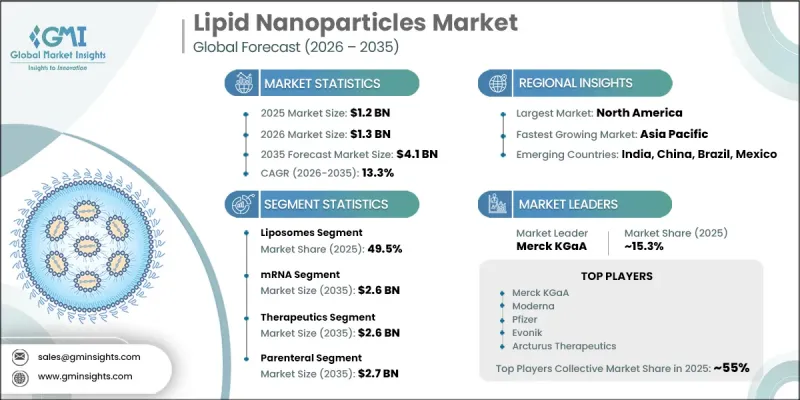
지질 나노입자 산업 전반의 성장은 감염병 및 암 유병률 증가와 더불어, 의약품 제제의 안정성, 생체이용률 및 치료 효과를 향상시키는 첨단 약물 전달 기술에 대한 수요 증가에 힘입어 견인되고 있습니다. 지질 나노입자란, 핵산 기반 치료제, 백신, 저분자 의약품 등의 치료용 화합물을 봉입하여 체내의 표적 세포로 직접 운반하도록 설계된 나노 규모의 전달 시스템입니다. 일반적으로 크기는 10-1,000나노미터 범위이며, 이러한 지질 기반 운반체는 현대 약물 전달의 효율과 정밀도를 높이는 데 있어 매우 중요한 역할을 하고 있습니다. 또한, 나노 의료 연구, RNA 기반 치료제 및 차세대 의약품 기술에 대한 투자 확대도 이 시장의 성장에 기여하고 있습니다. 제약 기업, 연구 기관, 정부 기관의 자금 지원 확대에 따라 지질 나노입자 플랫폼의 혁신이 가속화되고 있으며, 첨단 치료 솔루션 개발도 강화되고 있습니다. 정밀의료, 표적 지향형 약물 전달, 그리고 새로운 치료 제제 분야의 지속적인 발전으로 인해, 예측 기간 동안 전 세계 지질 나노입자 시장에 큰 성장 기회가 창출될 것으로 전망됩니다.
| 시장 범위 | |
|---|---|
| 개시 연도 | 2025년 |
| 예측 기간 | 2026-2035년 |
| 초기 시장 규모 | 12억 달러 |
| 예측액 | 41억 달러 |
| CAGR | 13.3% |
첨단 약물 전달 시스템을 둘러싼 연구 개발 활동이 활기를 띠는 가운데, 전 세계 지질 나노입자 산업은 계속해서 확대되고 있습니다. 치료 효율 향상, 전신성 부작용 감소, 그리고 치료 효과 향상에 대한 관심이 높아짐에 따라, 의약품 개발 전반에 걸쳐 지질 나노입자 기술의 채택이 확산되고 있습니다. 제형 기술 분야의 지속적인 혁신을 통해 전달 성능이 향상되고 용도 가능성이 확대됨에 따라, 첨단 치료 제품의 상용화가 촉진되고 있습니다. 정밀 의학 및 차세대 의약품 기술에 대한 투자 증가 또한 장기적인 시장 성장을 더욱 뒷받침하고 있습니다.
2025년에는 리포좀 부문이 시장 점유율의 49.5%를 차지했습니다. 이러한 압도적인 위상은 약물 포집 효율 향상, 약동학적 성능 최적화, 그리고 치료용 화합물의 안정성 및 생체이용률 향상과 같은 능력에 힘입은 것입니다. 리포솜의 구조적 특성 덕분에 다양한 유형의 치료제를 효율적으로 전달할 수 있게 되었으며, 장기적인 임상 적용도 지원되고 있습니다. 리포좀 제형 기술의 지속적인 발전으로, 첨단 표면 개질 기술을 통해 약물 적재 효율이 향상되고 전신 독성이 최소화되며 순환 시간이 연장됨에 따라, 시장 전체에서 이 부문의 주도적 지위가 강화되고 있습니다.
제약 및 바이오기술 기업 부문은 2025년에 7억 4,740만 달러의 매출을 기록했습니다. 이 부문의 성장은 임상 개발, 상업적 규모의 제조, 그리고 첨단 약물 전달 용도에서 지질 나노입자 플랫폼의 광범위한 활용에 의해 주도되고 있습니다. 핵산 기반 치료제 및 표적 치료 솔루션의 전달 효율 향상을 목표로 한 지속적인 연구개발 투자가 시장에서 더 광범위한 채택을 뒷받침하고 있습니다. 또한, 위탁 개발·제조 기관(CDMO)과의 협력 강화로 생산 확장성, 규제 준수, 제조 품질 및 상용화 역량이 향상되어 이 부문 시장 지배적 지위가 더욱 공고해지고 있습니다.
북미의 지질 나노입자 시장은 2025년에 41.6%의 점유율을 차지한 것으로 평가되었으며, 예측 기간 동안 상당한 성장이 전망됩니다. 이 지역의 성장은 암 및 기타 만성 질환의 유병률 증가에 힘입고 있으며, 이로 인해 첨단 표적 약물 전달 기술에 대한 수요가 지속적으로 증가하고 있습니다. 강력한 연구 역량, 막대한 제약 투자, 확대되는 임상 개발 활동, 그리고 첨단 치료 플랫폼에서의 지속적인 혁신이 전 세계 지질 나노입자 산업에서 이 지역의 선도적 지위를 더욱 공고히 하고 있습니다.
자주 묻는 질문
목차
제1장 조사 방법
제2장 주요 요약
제3장 업계 인사이트
제4장 경쟁 구도
제5장 시장 추산 및 예측 : 제품 유형별(2022-2035년)
제6장 시장 추산 및 예측 : 분자별(2022-2035년)
제7장 시장 추산 및 예측 : 용도별(2022-2035년)
제8장 시장 추산 및 예측 : 투여 경로별(2022-2035년)
제9장 시장 추산 및 예측 : 최종 용도별(2022-2035년)
제10장 시장 추산 및 예측 : 지역별(2022-2035년)
제11장 기업 개요
AJY 26.08.18The Global Lipid Nanoparticles Market was valued at USD 1.2 billion in 2025 and is estimated to grow at a CAGR of 13.3% to reach USD 4.1 billion by 2035.
Growth across the lipid nanoparticles industry is fueled by the increasing prevalence of infectious diseases and cancer, along with rising demand for advanced drug delivery technologies that improve the stability, bioavailability, and therapeutic effectiveness of pharmaceutical formulations. Lipid nanoparticles are nanoscale delivery systems engineered to encapsulate and transport therapeutic compounds, including nucleic acid-based therapies, vaccines, and small-molecule drugs, directly to targeted cells within the body. Typically ranging from 10 to 1,000 nanometers in size, these lipid-based carriers play a critical role in enhancing the efficiency and precision of modern drug delivery. The market is also benefiting from expanding investments in nanomedicine research, RNA-based therapeutics, and next-generation pharmaceutical technologies. Growing financial support from pharmaceutical companies, research institutions, and government organizations is accelerating innovation in lipid nanoparticle platforms while strengthening the development of advanced therapeutic solutions. Continued progress in precision medicine, targeted drug delivery, and novel therapeutic formulations is expected to create significant growth opportunities for the global lipid nanoparticles market throughout the forecast period.
| Market Scope | |
|---|---|
| Start Year | 2025 |
| Forecast Year | 2026-2035 |
| Start Value | $1.2 Billion |
| Forecast Value | $4.1 Billion |
| CAGR | 13.3% |
The global lipid nanoparticles industry continues to expand as research and development activities surrounding advanced drug delivery systems gain momentum. Increasing focus on improving treatment efficiency, reducing systemic side effects, and enhancing therapeutic performance is encouraging broader adoption of lipid nanoparticle technologies across pharmaceutical development. Ongoing innovation in formulation techniques is improving delivery performance, expanding application potential, and supporting the commercialization of advanced therapeutic products. Rising investment in precision medicine and next-generation pharmaceutical technologies is further reinforcing long-term market growth.
The liposomes segment accounted for a 49.5% share in 2025. Its dominant position is supported by its ability to improve drug encapsulation, optimize pharmacokinetic performance, and enhance the stability and bioavailability of therapeutic compounds. The structural characteristics of liposomes enable efficient delivery of multiple types of therapeutic agents while supporting long-term clinical applications. Continuous advancements in liposomal formulation technologies have improved drug-loading efficiency, minimized systemic toxicity, and enhanced circulation time through advanced surface modification techniques, strengthening the segment's leadership across the market.
The pharmaceutical and biotechnology companies segment generated USD 747.4 million in 2025. Growth within this segment is driven by extensive utilization of lipid nanoparticle platforms for clinical development, commercial-scale manufacturing, and advanced drug delivery applications. Continued investment in research and development aimed at improving delivery efficiency for nucleic acid-based therapeutics and targeted treatment solutions is supporting broader market adoption. In addition, increasing collaboration with contract development and manufacturing organizations is improving production scalability, regulatory compliance, manufacturing quality, and commercialization capabilities, further reinforcing the segment's dominant market position.
North America Lipid Nanoparticles Market accounted for a 41.6% share in 2025 and is expected to experience notable growth throughout the forecast period. Regional expansion is being supported by the growing prevalence of cancer and other chronic diseases, which continues to increase demand for advanced targeted drug delivery technologies. Strong research capabilities, substantial pharmaceutical investment, expanding clinical development activities, and continued innovation in advanced therapeutic platforms are further strengthening the region's leadership within the global lipid nanoparticles industry.
Major companies operating in the global lipid nanoparticles market include ABP Biosciences, Acrotech Biopharm, Alnylam Pharmaceuticals, Arcturus Therapeutics, Ascendia Pharmaceuticals, Bayer Pharmaceuticals, Boehringer Ingelheim, Cayman Chemicals, Creative Biostructure, Diant Pharma, Evonik, Merck KGaA, Moderna, Pfizer, Sigma-Tau Pharmaceuticals, Teva Pharmaceuticals, and Thermo Fisher Scientific. Companies participating in the lipid nanoparticles industry are strengthening their market position by investing heavily in research and development, advanced formulation technologies, and scalable manufacturing capabilities. Many organizations are expanding production capacity while improving lipid nanoparticle performance, stability, and delivery efficiency to address the growing demand for precision therapeutics. Strategic collaborations with pharmaceutical companies, research organizations, and contract manufacturing partners are accelerating product development and commercialization. Businesses are also focusing on regulatory compliance, quality assurance, and process optimization to support large-scale manufacturing and global market expansion.
Table of Contents
Chapter 1 Research Methodology
- 1.1 Research approach
- 1.2 Quality commitments
- 1.2.1 GMI AI policy & data integrity commitment
- 1.2.1.1 Source consistency protocol
- 1.2.1 GMI AI policy & data integrity commitment
- 1.3 Research trail & confidence scoring
- 1.3.1 Research trail components
- 1.3.2 Scoring components
- 1.4 Data collection
- 1.4.1 Partial list of primary sources
- 1.5 Data mining sources
- 1.5.1 Paid sources
- 1.5.1.1 Sources, by region
- 1.5.1 Paid sources
- 1.6 Base estimates and calculations
- 1.6.1 Base year calculation
- 1.7 Forecast model
- 1.7.1 Quantified market impact analysis
- 1.7.1.1 Mathematical impact of growth parameters on forecast
- 1.7.1 Quantified market impact analysis
- 1.8 Research transparency addendum
- 1.8.1 Source attribution framework
- 1.8.2 Quality assurance metrics
- 1.8.3 Our commitment to trust
Chapter 2 Executive Summary
- 2.1 Industry 360° synopsis
- 2.2 Key market trends
- 2.2.1 Regional trends
- 2.2.2 Product type trends
- 2.2.3 Molecule trends
- 2.2.4 Application trends
- 2.2.5 Route of administration trends
- 2.2.6 End use trends
- 2.3 CXO perspectives: Strategic imperatives
Chapter 3 Industry Insights
- 3.1 Industry ecosystem analysis
- 3.2 Industry impact forces
- 3.2.1 Growth drivers
- 3.2.1.1 Rising prevalence of infectious diseases and cancer
- 3.2.1.2 Growing demand for improved stability and bioavailability drug formulations
- 3.2.1.3 Expanding research funding and activities
- 3.2.1.4 Growing expansion in mRNA therapeutics
- 3.2.2 Industry pitfalls and challenges
- 3.2.2.1 Stringent regulatory requirements
- 3.2.2.2 High cost of raw materials
- 3.2.3 Opportunities
- 3.2.3.1 Rising adoption of personalized and precision medicine
- 3.2.1 Growth drivers
- 3.3 Growth potential analysis
- 3.4 Regulatory landscape
- 3.5 Pricing trend analysis (Driven by Primary Research)
- 3.6 Technology and innovation landscape (Driven by Primary Research)
- 3.6.1 Current technological trends
- 3.6.2 Emerging technologies
- 3.7 Future market trends (Driven by Primary Research)
- 3.8 Impact of AI & Generative AI on the Market (Driven by Primary Research)
- 3.9 Porter's analysis
- 3.10 PESTEL analysis
Chapter 4 Competitive Landscape, 2025
- 4.1 Introduction
- 4.2 Company matrix analysis
- 4.3 Company market share analysis (Driven by Primary Research)
- 4.3.1 Global
- 4.3.2 North America
- 4.3.3 Europe
- 4.3.4 Asia Pacific
- 4.3.5 LAMEA
- 4.4 Competitive analysis of major market players
- 4.5 Competitive positioning matrix
- 4.6 Key developments
- 4.6.1 Mergers & acquisitions
- 4.6.2 Partnerships & collaborations
- 4.6.3 New product launches
- 4.6.4 Expansion plans
Chapter 5 Market Estimates and Forecast, By Product Type, 2022 - 2035 ($ Mn)
- 5.1 Key trends
- 5.2 Liposomes
- 5.3 Solid lipid nanoparticles
- 5.4 Nanostructured lipid carriers
- 5.5 Other product types
Chapter 6 Market Estimates and Forecast, By Molecule, 2022 - 2035 ($ Mn)
- 6.1 Key trends
- 6.2 siRNA
- 6.3 mRNA
- 6.4 Other molecules
Chapter 7 Market Estimates and Forecast, By Application, 2022 - 2035 ($ Mn)
- 7.1 Key trends
- 7.2 Therapeutics
- 7.2.1 Cancer
- 7.2.2 Fungal disease
- 7.2.3 Analgesics
- 7.2.4 Vaccines
- 7.2.5 Immunosuppressants
- 7.2.6 Other applications
- 7.3 Research
Chapter 8 Market Estimates and Forecast, By Route of Administration, 2022 - 2035 ($ Mn)
- 8.1 Key trends
- 8.2 Oral
- 8.3 Parenteral
- 8.4 Topical
- 8.5 Other routes of administration
Chapter 9 Market Estimates and Forecast, By End Use, 2022 - 2035 ($ Mn)
- 9.1 Key trends
- 9.2 Pharmaceutical and biotechnology companies
- 9.3 Research institutes
- 9.4 Other end users
Chapter 10 Market Estimates and Forecast, By Region, 2022 - 2035 ($ Mn)
- 10.1 Key trends
- 10.2 North America
- 10.2.1 U.S.
- 10.2.2 Canada
- 10.3 Europe
- 10.3.1 Germany
- 10.3.2 UK
- 10.3.3 France
- 10.3.4 Spain
- 10.3.5 Italy
- 10.3.6 Netherlands
- 10.4 Asia Pacific
- 10.4.1 China
- 10.4.2 Japan
- 10.4.3 India
- 10.4.4 Australia
- 10.4.5 South Korea
- 10.5 Latin America
- 10.5.1 Brazil
- 10.5.2 Mexico
- 10.5.3 Argentina
- 10.6 MEA
- 10.6.1 South Africa
- 10.6.2 Saudi Arabia
- 10.6.3 UAE
Chapter 11 Company Profiles
- 11.1 ABP Biosciences
- 11.2 Acrotech Biopharm
- 11.3 Alnylam Pharmaceuticals
- 11.4 Arcturus Therapeutics
- 11.5 Ascendia Pharmaceuticals
- 11.6 Bayer Pharmaceuticals
- 11.7 Boehringer Ingelheim
- 11.8 Cayman Chemical
- 11.9 Creative Biostructure
- 11.10 Diant Pharma
- 11.11 Evonik
- 11.12 Merck KGaA
- 11.13 Moderna
- 11.14 Pfizer
- 11.15 Sigma-Tau Pharmaceuticals
- 11.16 Teva Pharmaceuticals
- 11.17 Thermo Fisher Scientific


