

|
시장보고서
상품코드
2109319
적과 로봇 시장 : 시장 기회, 성장요인, 업계 동향 분석 및 예측(2026-2035년)Fruit Thinning Robots Market Opportunity, Growth Drivers, Industry Trend Analysis, and Forecast 2026 - 2035 |
||||||

세계의 적과 로봇 시장은 2025년에 6,570만 달러로 평가되었고, CAGR 17%로 성장할 전망이며, 2035년까지 3억 2,450만 달러에 이를 것으로 추정되고 있습니다.
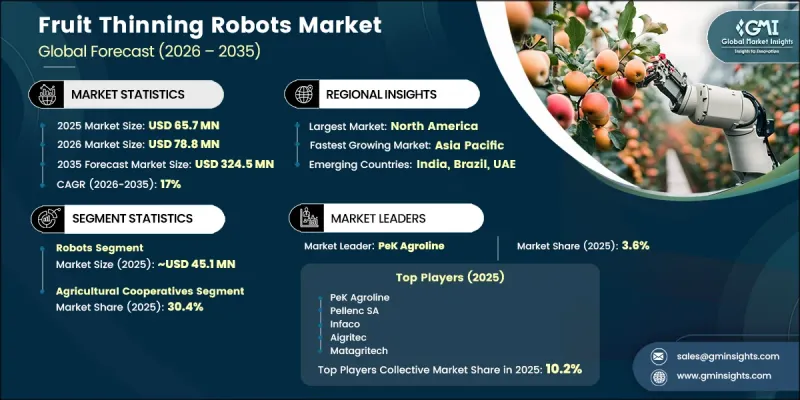
적과 로봇 업계의 성장은 만성적인 인력 부족과 운영 비용 상승에 대처하기 위한 효율적인 해결책을 모색하는 생산자들의 농업 자동화 도입 확대에 힘입고 있습니다. 계절 근로자 확보가 어려운 상황을 감안하여, 노동 집약적인 과수원 작업을 더 높은 정확도와 일관성으로 수행할 수 있는 로봇 기술에 대한 투자가 가속화되고 있습니다. 인공지능, 컴퓨터 비전, 머신러닝, 자율 주행 기술의 지속적인 발전으로 로봇 시스템은 작물의 상태를 정확하게 식별하고, 정밀한 적과를 수행하며, 복잡한 농업 환경 속에서 자율적으로 작동할 수 있게 되었습니다. 이러한 기술이 고도화됨에 따라 생산자들은 생산성 향상, 작물 품질 최적화, 그리고 수작업에 대한 의존도 감소를 도모하기 위해 자동화 솔루션 도입을 더욱 적극적으로 추진하고 있습니다. 또한, 이미지 처리 시스템, 센싱 기술, 자율 이동 기술 분야의 지속적인 혁신은 업무 효율 향상에 기여할 뿐만 아니라 정밀 농업으로의 광범위한 전환을 뒷받침하고 있습니다. 이러한 기술적 발전과 스마트 농업에 대한 투자 확대가 맞물리면서, 전 세계 적과 로봇 시장의 장기적인 성장 전망은 계속해서 견고해지고 있습니다.
| 시장 범위 | |
|---|---|
| 개시 연도 | 2025년 |
| 예측 기간 | 2026-2035년 |
| 초기 시장 규모 | 6,570만 달러 |
| 예측액 | 3억 2,450만 달러 |
| CAGR | 17% |
로봇 분야는 2025년에 4,510만 달러 시장 규모를 기록한 것으로 평가되었으며, 2035년까지 2억 480만 달러에 달할 것으로 전망됩니다. 이 분야가 주도적인 위치를 차지하고 있는 이유는 자율형 로봇 플랫폼이 통합형 비전 기반 농업 시스템에서 가장 선진적이고 가치가 높은 구성 요소이기 때문입니다. 이러한 플랫폼은 내비게이션 기술, 이미지 처리 하드웨어, 처리 장치, 전력 관리 시스템 및 지능형 제어 기능을 단일 솔루션으로 통합하여 정밀한 농장 작업을 효율적으로 수행하도록 설계되었습니다. 이러한 고도의 기술 통합과 공학적 복잡성은 시장 가치를 크게 높이는 한편, 상업적 농업 경영에서의 광범위한 도입을 촉진하고 있습니다.
농업협동조합 부문은 2025년에 30.4%의 점유율을 차지했으며, 최대의 최종 사용자 범주로 부상했습니다. 협동조합의 공동 구매 모델은 참여하는 여러 농장에 설비 투자를 분산함으로써 농업용 로봇의 보다 광범위한 도입을 지속적으로 촉진하고 있습니다. 이러한 접근 방식은 초기 설비 투자에 따른 재정적 부담을 경감시키는 동시에, 조합원들이 첨단 로봇 시스템을 보다 효율적으로 공유할 수 있게 해줍니다. 농업협동조합은 장비의 이용률을 극대화하고 비용 대비 효과를 향상시킴으로써, 업계 전반에 걸친 자동화 농업 기술의 도입을 가속화하는 데 중요한 역할을 하고 있습니다.
2025년, 미국의 과일 솎기 로봇 시장은 82.5%의 점유율을 차지했습니다. 시장 확대는 노동력 부족의 심화, 농업 운영 비용 상승, 그리고 정밀 농업 기술의 보급 확대에 힘입어 이루어지고 있습니다. 대규모 상업 농업 사업자들은 업무 효율성 향상, 생산성 증대, 그리고 수작업에 대한 의존도 감소를 도모하기 위해 지능형 로봇 시스템에 대한 투자를 지속하고 있습니다. 농업 자동화의 지속적인 발전과 스마트 농업 기술에 대한 수용 확대에 힘입어, 예측 기간 동안 전미에서 시장 성장이 더욱 가속화될 것으로 전망됩니다.
자주 묻는 질문
목차
제1장 조사 방법 및 범위
제2장 주요 요약
제3장 업계 인사이트
제4장 경쟁 구도
제5장 시장 추산 및 예측 : 컴포넌트 유형별(2022-2035년)
제6장 시장 추산 및 예측 : 센싱 기술별(2022-2035년)
제7장 시장 추산 및 예측 : 작물 유형별(2022-2035년)
제8장 시장 추산 및 예측 : 최종 용도별(2022-2035년)
제9장 시장 추산 및 예측 : 지역별(2022-2035년)
제10장 기업 개요
AJY 26.08.20The Global Fruit Thinning Robots Market was valued at USD 65.7 million in 2025 and is estimated to grow at a CAGR of 17% to reach USD 324.5 million by 2035.
Growth across the fruit thinning robots industry is driven by the increasing adoption of agricultural automation as growers seek efficient solutions to address persistent labor shortages and rising operating costs. The limited availability of seasonal agricultural workers has accelerated investment in robotic technologies capable of performing labor-intensive orchard operations with greater precision and consistency. Continuous advancements in artificial intelligence, computer vision, machine learning, and autonomous navigation technologies enable robotic systems to accurately identify crop conditions, perform precision thinning, and operate independently within complex agricultural environments. As these technologies become more sophisticated, growers are increasingly adopting automated solutions to improve productivity, optimize crop quality, and reduce dependence on manual labor. Ongoing innovation in imaging systems, sensing technologies, and autonomous mobility is also improving operational efficiency while supporting the broader transition toward precision agriculture. These technological developments, combined with increasing investments in smart farming practices, continue to strengthen the long-term growth outlook for the global fruit thinning robots market.
| Market Scope | |
|---|---|
| Start Year | 2025 |
| Forecast Year | 2026-2035 |
| Start Value | $65.7 Million |
| Forecast Value | $324.5 Million |
| CAGR | 17% |
The robots segment generated USD 45.1 million in 2025 and is anticipated to reach USD 204.8 million by 2035. This segment holds a leading position because autonomous robotic platforms represent the most advanced and valuable component of integrated vision-based agricultural systems. These platforms combine navigation technologies, imaging hardware, processing units, power management systems, and intelligent control capabilities into a single solution designed to perform precision field operations efficiently. Their high level of technological integration and engineering complexity contributes significantly to their market value while supporting widespread adoption across commercial farming operations.
The agricultural cooperatives segment accounted for a 30.4% share in 2025, making it the largest end-user category. Cooperative purchasing models continue to encourage broader adoption of agricultural robotics by distributing equipment investment across multiple participating farms. This approach reduces the financial burden associated with initial capital expenditures while allowing members to share advanced robotic systems more efficiently. By maximizing equipment utilization and improving cost effectiveness, agricultural cooperatives play an important role in accelerating the deployment of automated farming technologies throughout the industry.
U.S. Fruit Thinning Robots Market held an 82.5% share in 2025. Market expansion is supported by increasing labor constraints, higher agricultural operating costs, and growing adoption of precision farming technologies. Large-scale commercial farming operations continue to invest in intelligent robotic systems to improve operational efficiency, enhance productivity, and reduce dependence on manual labor. Ongoing advancements in agricultural automation and increased acceptance of smart farming technologies are expected to further strengthen market growth across the country throughout the forecast period.
Major companies operating in the global fruit thinning robots industry include Agrobot, Aigritec, CNH Industrial, Dogtooth Technologies, FFRobotics, Fieldwork Robotics, Finite Robotics, Harvest Automation Inc., Harvest CROO Robotics, Infaco, Kubota Corporation, Matagritech, Naio Technologies, Organifarms, PeK Agroline, Pellenc SA, Ripe Robotics, Robotic Perception, Tevel Aerobotics Technologies, Vision Robotics Corporation, and VitiBot. Companies competing in the global fruit thinning robots market are strengthening their competitive position through continuous investment in artificial intelligence, autonomous robotics, and advanced vision technologies. Manufacturers are focused on improving navigation accuracy, imaging capabilities, machine learning algorithms, and robotic precision to enhance operational efficiency and crop management performance. Many companies are expanding research and development activities, increasing manufacturing capacity, and strengthening regional distribution and service networks to improve customer support and market reach. Strategic collaborations, technology partnerships, and product portfolio expansion remain key initiatives for accelerating innovation and commercial adoption.
Table of Contents
Chapter 1 Methodology & Scope
- 1.1 Research approach
- 1.2 Quality Commitments
- 1.2.1 GMI AI policy & data integrity commitment
- 1.2.1.1 Source consistency protocol
- 1.2.1 GMI AI policy & data integrity commitment
- 1.3 Research Trail & Confidence Scoring
- 1.3.1 Research Trail Components
- 1.3.2 Scoring Components
- 1.4 Data Collection
- 1.4.1 Partial list of primary sources
- 1.5 Data mining sources
- 1.5.1 Paid sources
- 1.5.1.1 Sources, by region
- 1.5.1 Paid sources
- 1.6 Base estimates and calculations
- 1.6.1 Base year calculation for any one approach
- 1.7 Forecast model
- 1.7.1 Quantified market impact analysis
- 1.7.1.1 Mathematical impact of growth parameters on forecast
- 1.7.1 Quantified market impact analysis
- 1.8 Research transparency addendum
- 1.8.1 Source attribution framework
- 1.8.2 Quality assurance metrics
- 1.8.3 Our commitment to trust
Chapter 2 Executive Summary
- 2.1 Industry 360° synopsis
- 2.2 Key market trends
- 2.2.1 Regional
- 2.2.2 Component Type
- 2.2.3 Sensing Technology
- 2.2.4 Crop Type
- 2.2.5 End Use
Chapter 3 Industry Insights
- 3.1 Industry ecosystem analysis
- 3.1.1 Supplier landscape
- 3.1.2 Profit margin
- 3.1.3 Value addition at each stage
- 3.1.4 Factor affecting the value chain
- 3.2 Industry impact forces
- 3.2.1 Growth drivers
- 3.2.1.1 Labor shortage in agriculture
- 3.2.1.2 Increasing demand for precision agriculture
- 3.2.1.3 Government initiatives & subsidies
- 3.2.2 Industry pitfalls & challenges
- 3.2.2.1 Unpredictable thinning outcomes across canopy types
- 3.2.2.2 Interoperability & standardization gaps
- 3.2.3 Opportunities
- 3.2.3.1 Emergence of crop-specific robotic platforms
- 3.2.3.2 Integration with farm management & precision agriculture systems
- 3.2.1 Growth drivers
- 3.3 Growth potential analysis
- 3.4 Regulatory framework
- 3.5 Major market trends and disruptions
- 3.6 Technology/innovation landscape
- 3.6.1 Current trends
- 3.6.2 Emerging trends
- 3.7 Pricing Analysis (driven by primary research)
- 3.7.1 Historical price trend analysis (driven by primary research)
- 3.7.2 Pricing strategy by player type (premium / value / cost-plus) (driven by primary research)
- 3.8 Future market trends
- 3.9 Trade data analysis (driven by paid database) (HS Code- 8479.50.00)
- 3.9.1 Import/export volume & value trends (driven by primary research)
- 3.9.2 Key trade corridors & tariff impact (driven by primary research)
- 3.10 Impact of AI & Generative AI on the Market
- 3.10.1 AI-driven disruption of existing business models
- 3.10.2 Gen-AI use cases & adoption roadmap by segment
- 3.10.3 Risks, limitations & regulatory considerations
- 3.11 Porter’s analysis
- 3.12 PESTEL analysis
- 3.13 Distribution infrastructure & channel penetration landscape (driven by primary research)
- 3.13.1 Channel coverage by region & format (modern vs. traditional trade) (driven by primary research)
- 3.13.2 Last-mile infrastructure gaps & emerging channel shifts (driven by primary Research).
Chapter 4 Competitive landscape, 2025
- 4.1 Introduction
- 4.2 Company market share analysis
- 4.2.1 By region
- 4.2.1.1 North America
- 4.2.1.2 Europe
- 4.2.1.3 Asia Pacific
- 4.2.1.4 Latin America
- 4.2.1.5 Middle East and Africa
- 4.2.1 By region
- 4.3 Company matrix analysis
- 4.4 Competitive analysis of major market players
- 4.5 Competitive positioning matrix
- 4.6 Key developments
- 4.6.1 Mergers & acquisitions
- 4.6.2 Partnerships & collaborations
- 4.6.3 New product launches
- 4.6.4 Expansion plans
Chapter 5 Market Estimates & Forecast, By Component Type, 2022 - 2035 (USD Million, Thousand Units)
- 5.1 Key trends
- 5.2 Robots
- 5.2.1 Autonomous mobile robots (AMR)
- 5.2.2 Stationary robotic gantry systems
- 5.2.3 Tele-operated robots
- 5.3 End effector tools & manipulators
- 5.3.1 Pruning shear
- 5.3.2 Pruning saw
- 5.3.3 Vacuum pruning
- 5.3.4 Looper attachments
- 5.3.5 Hedge trimmer
- 5.3.6 Grasping tool
Chapter 6 Market Estimates & Forecast, By Sensing Technology, 2022 - 2035 (USD Million, Thousand Units)
- 6.1 Key trends
- 6.2 Vision-based
- 6.2.1 2D Imaging
- 6.2.2 3D Imaging
- 6.2.3 Hyperspectral Imaging
- 6.3 Non-vision Based
- 6.3.1 Mechanical Sensing
- 6.3.2 LiDAR
- 6.4 Others
Chapter 7 Market Estimates & Forecast, By Crop Type, 2022 - 2035 (USD Million, Thousand Units)
- 7.1 Key trends
- 7.2 Pome Fruits (Apples & Pears)
- 7.2.1 Blossom Thinning Stage
- 7.2.2 Fruitlet & Green Fruit Thinning Stage
- 7.3 Stone Fruits (Peaches, Plums, Cherries, Apricots)
- 7.4 Citrus Fruits
- 7.5 Berries & Grapes
- 7.6 Others
Chapter 8 Market Estimates & Forecast, By End Use, 2022 - 2035 (USD Million, Thousand Units)
- 8.1 Key trends
- 8.2 Individual farmers
- 8.3 Agricultural cooperatives
- 8.4 Corporate farming enterprises
- 8.5 Research institutes & universities
Chapter 9 Market Estimates & Forecast, By Region, 2022 – 2035 (USD Million, Thousand Units)
- 9.1 Key trends
- 9.2 North America
- 9.2.1 U.S.
- 9.2.2 Canada
- 9.3 Europe
- 9.3.1 Germany
- 9.3.2 UK
- 9.3.3 France
- 9.3.4 Spain
- 9.3.5 Italy
- 9.4 Asia Pacific
- 9.4.1 China
- 9.4.2 Japan
- 9.4.3 India
- 9.4.4 Australia
- 9.4.5 South Korea
- 9.5 Latin America
- 9.5.1 Brazil
- 9.5.2 Mexico
- 9.5.3 Argentina
- 9.6 MEA
- 9.6.1 South Africa
- 9.6.2 Saudi Arabia
- 9.6.3 UAE
Chapter 10 Company Profiles
- 10.1 Global Companies
- 10.1.1 Agrobot
- 10.1.1.1 Business Overview
- 10.1.1.2 Financial Data
- 10.1.1.3 Product Landscape
- 10.1.1.4 Strategic Outlook
- 10.1.1.5 SWOT Analysis
- 10.1.2 CNH Industrial
- 10.1.3 FFRobotics
- 10.1.4 Infaco
- 10.1.5 Kubota Corporation
- 10.1.6 Naio Technologies
- 10.1.7 PeK Agroline
- 10.1.8 Pellenc SA
- 10.1.9 Tevel Aerobotics Technologies
- 10.1.10 VitiBot
- 10.1.1 Agrobot
- 10.2 Regional Companies
- 10.2.1 Dogtooth Technologies
- 10.2.2 Fieldwork Robotics
- 10.2.3 Harvest CROO Robotics
- 10.2.4 Organifarms
- 10.2.5 Ripe Robotics
- 10.2.6 Robotics Plus
- 10.3 Emerging Companies
- 10.3.1 Aigritec
- 10.3.2 Finite Robotics
- 10.3.3 Matagritech (MATA)
- 10.3.4 Robotic Perception
- 10.3.5 Vision Robotics Corp


