

|
시장보고서
상품코드
2121107
산업용 정밀 발효 바이오리액터 시장 기회, 성장요인, 업계 동향 분석 및 예측(2026-2035년)Industrial Precision Fermentation Bioreactors Market Opportunity, Growth Drivers, Industry Trend Analysis, and Forecast 2026 - 2035 |
||||||

세계의 산업용 정밀 발효 바이오리액터 시장은 2025년에 7억 2,000만 달러 규모에 달하며, CAGR 24.1%로 확대하며, 2035년까지 62억 3,000만 달러에 달할 것으로 예측됩니다.
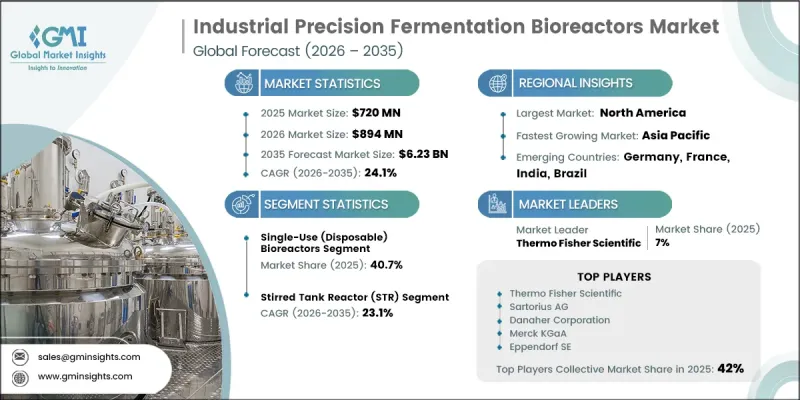
생명공학 기업과 식품 기술 기업이 바이오 제조 역량을 강화하고 추가 가공 인프라에 대한 투자를 확대함에 따라 이 시장은 상당한 성장세를 보이고 있습니다. 정밀 발효에 대한 수요가 증가함에 따라 기업은 생산 능력 확대를 모색하며 신규 및 기존 바이오리액터 시설에 대한 투자를 가속화하고 있습니다. 제조업체들이 보다 효율적이고 확장성이 뛰어난 생산 시스템을 추구하는 가운데, 바이오리액터는 산업용 발효 공정 전반에서 점점 더 중요한 역할을 수행하고 있습니다. 그 결과, 기업이 기존 시설을 업그레이드하거나 새로운 생산 거점을 설립함에 따라 조달 활동도 활발해지고 있습니다. 또한 산업용 생명공학의 광범위한 발전과 제어된 발효 환경에 대한 수요 증가도 시장을 지원하고 있습니다. 바이오리액터의 설계, 공정의 확장성, 제조 인프라의 발전은 장비 공급업체에게 더 많은 비즈니스 기회를 창출하고 있습니다. 정밀 발효의 상업적 응용이 지속적으로 발전함에 따라 제조업체들은 일관된 공정 성능을 유지하면서 증가하는 생산량을 지원할 수 있는 장비에 주목하고 있습니다.
| 시장 범위 | |
|---|---|
| 시작연도 | 2025년 |
| 예측 기간 | 2026-2035년 |
| 초기 시장 규모 | 7억 2,000만 달러 |
| 예측액 | 62억 3,000만 달러 |
| CAGR | 24.1% |
2025년에는 일회용(싱글유스) 바이오리액터 부문이 40.7%의 점유율을 차지하며, 2035년까지 연평균 성장률(CAGR) 26.2%로 성장할 것으로 예측됩니다. 이 두 구성 요소의 시장 점유율이 팽팽한 경쟁을 벌이고 있는 것은 정밀 발효 생산 환경에서 유연성이 높은 일회용 시스템과 내구성이 뛰어난 재사용 장치에 대한 수요가 모두 지속되고 있음을 반영합니다. 이러한 동향은 산업용 정밀 발효 바이오리액터에 대한 수요를 강화하여, 2035년까지 시장이 지속적으로 확대될 수 있는 유리한 조건을 조성하고 있습니다.
교반조형 리액터(STR) 부문은 2025년에 53.8%의 점유율을 차지하며, 2035년까지 연평균 성장률(CAGR) 23.1%로 성장할 것으로 전망됩니다. STR 시스템의 확고한 입지는 산업용 발효 공정에서의 중요성과 제어 가능한 확장형 처리 요건에 대한 적합성을 반영합니다. 정밀 발효 생산의 지속적인 확대로 인해 예측 기간 중 STR 기반 바이오리액터 시스템에 대한 수요가 지원될 것으로 예상됩니다.
아시아태평양의 산업용 정밀 발효 바이오리액터 시장은 2025년에 25.1%의 점유율을 차지하고, 2035년까지 연평균 성장률(CAGR) 27.5%로 성장할 것으로 예측됩니다. 이 지역의 성장은 중국의 바이오 제조 인프라에 대한 정부 주도 투자 증가, 인도의 정밀 발효 생태계 성장, 그리고 싱가포르의 규제 환경 지속적 정비에 힘입고 있습니다. 이러한 발전은 지역의 바이오 제조 환경을 강화하고 발효 생산 능력에 대한 투자를 촉진하고 있습니다. 인프라 개발의 진전과 정밀 발효에 대한 관심 증가는 아시아태평양 전역의 바이오리액터 제조업체들에게 더 많은 비즈니스 기회를 창출하고 있습니다.
자주 묻는 질문
목차
제1장 조사 방법
제2장 개요
제3장 업계 인사이트
제4장 경쟁 구도
제5장 시장 추산·예측 : 제품 유형별, 2022-2035년
제6장 시장 추산·예측 : 규모별, 2022-2035년
제7장 시장 추산·예측 : 기술별, 2022-2035년
제8장 시장 추산·예측 : 용도별, 2022-2035년
제9장 예측 : 지역별, 2022-2035년
제10장 기업 개요
KSA 26.09.02The Global Industrial Precision Fermentation Bioreactors Market was valued at USD 720 million in 2025 and is estimated to grow at a CAGR of 24.1% to reach USD 6.23 billion by 2035.
The market is gaining significant traction as biotechnology and food technology companies increase their biomanufacturing capabilities and invest in additional processing infrastructure. Rising demand for precision fermentation is encouraging companies to expand production capacity and accelerate investments in both new and existing bioreactor facilities. As manufacturers seek more efficient and scalable production systems, bioreactors are becoming increasingly important across industrial fermentation operations. Procurement activity is consequently increasing as companies upgrade existing facilities and establish new production sites. The market is also benefiting from the broader development of industrial biotechnology and the growing need for controlled fermentation environments. Advances in bioreactor design, process scalability, and manufacturing infrastructure are creating additional opportunities for equipment suppliers. As commercial applications of precision fermentation continue to develop, manufacturers are focusing on equipment that can support growing production volumes while maintaining consistent process performance.
| Market Scope | |
|---|---|
| Start Year | 2025 |
| Forecast Year | 2026-2035 |
| Start Value | $720 Million |
| Forecast Value | $6.23 Billion |
| CAGR | 24.1% |
The single-use (disposable) bioreactors segment held a 40.7% share in 2025 and is forecast to grow at a CAGR of 26.2% through 2035. The close market shares of these two configurations reflect continued demand for both flexible disposable systems and durable multi-use equipment across precision fermentation production environments. These trends are strengthening demand for industrial precision fermentation bioreactors and creating favorable conditions for continued market expansion through 2035.
The stirred tank reactor (STR) segment captured a 53.8% share in 2025 and is forecast to grow at a CAGR of 23.1% through 2035. The strong position of STR systems reflects their importance in industrial fermentation operations and their suitability for controlled and scalable processing requirements. Continued expansion of precision fermentation production is expected to support demand for STR-based bioreactor systems throughout the forecast period.
Asia Pacific Industrial Precision Fermentation Bioreactors Market accounted for a 25.1% share in 2025 and is forecast to grow at a CAGR of 27.5% through 2035. Regional expansion is being supported by increasing state-backed investment in biomanufacturing infrastructure in China, the development of a growing precision fermentation ecosystem in India, and continued progress in regulatory infrastructure in Singapore. These developments are strengthening the regional biomanufacturing landscape and encouraging investment in fermentation production capabilities. Growing infrastructure development and increasing interest in precision fermentation are creating additional opportunities for bioreactor manufacturers throughout Asia Pacific.
Prominent companies operating in the global industrial precision fermentation bioreactors market include Sartorius AG, Danaher Corporation, ABEC Inc., Eppendorf SE, Thermo Fisher Scientific, GEA Group, Bioengineering AG, Merck KGaA, Getinge AB, Tetra Pak, ZETA USA, Celltainer Biotech BV, PBS Biotech Inc., Donaldson Company, DCI Group, Bionet Engineering, FermenteQ Innovations Inc., DCI Inc. / DCI-Biolafitte LLC, Infors HT, Sarvatek, and TK Modular. Companies in the global industrial precision fermentation bioreactors market are strengthening their positions through product innovation, capacity expansion, strategic partnerships, and broader technology portfolios. Manufacturers are developing bioreactor systems designed to support greater scalability, process flexibility, and operational efficiency. Companies are also expanding their manufacturing and service capabilities to address increasing demand from precision fermentation producers. Strategic collaborations with biotechnology companies and other industry participants are helping suppliers develop solutions aligned with evolving production requirements. Market participants are also focusing on both single-use and multi-use systems to serve different manufacturing preferences and facility configurations. Expansion into high-growth regions is another key strategy, particularly as biomanufacturing infrastructure develops across emerging markets. Companies are investing in research and development to improve bioreactor performance, process control, and integration capabilities. By expanding product offerings, strengthening customer relationships, and increasing regional reach, manufacturers are working to secure long-term opportunities in the rapidly expanding global industrial precision fermentation bioreactors market.
Table of Contents
Chapter 1 Research Methodology
- 1.1 Research approach
- 1.2 Quality Commitments
- 1.2.1 GMI AI policy & data integrity commitment
- 1.2.1.1 Source consistency protocol
- 1.2.1 GMI AI policy & data integrity commitment
- 1.3 Research Trail & Confidence Scoring
- 1.3.1 Research Trail Components
- 1.3.2 Scoring Components
- 1.4 Data Collection
- 1.4.1 Partial list of primary sources
- 1.5 Data mining sources
- 1.5.1 Paid sources
- 1.5.1.1 Sources, by region
- 1.5.1 Paid sources
- 1.6 Base estimates and calculations
- 1.6.1 Base year calculation for any one approach
- 1.7 Forecast model
- 1.7.1 Quantified market impact analysis
- 1.7.1.1 Mathematical impact of growth parameters on forecast
- 1.7.1 Quantified market impact analysis
- 1.8 Research transparency addendum
- 1.8.1 Source attribution framework
- 1.8.2 Quality assurance metrics
- 1.8.3 Our commitment to trust
Chapter 2 Executive Summary
- 2.1 Industry 360° synopsis, 2022 – 2035
- 2.2 Key market trends
- 2.2.1 Regional
- 2.2.2 Product Type
- 2.2.3 Scale
- 2.2.4 Technology
- 2.2.5 Application
Chapter 3 Industry Insights
- 3.1 Industry ecosystem analysis
- 3.1.1 Factor affecting the value chain
- 3.1.2 Profit margin analysis
- 3.1.3 Disruptions
- 3.1.4 Future outlook
- 3.1.5 Manufacturers
- 3.1.6 Distributors
- 3.2 Supplier landscape
- 3.3 Key news & initiatives
- 3.4 Technology & Innovation Landscape
- 3.5 Regulatory landscape
- 3.6 Impact on forces
- 3.6.1 Growth drivers
- 3.6.2 Industry pitfalls & challenges
- 3.6.3 Opportunities
- 3.7 Porter’s analysis
- 3.8 PESTEL analysis
- 3.9 Pricing analysis (driven by primary research)
- 3.9.1 Historical Price Trend Analysis, 2019–2024 (Driven by Primary Research)
- 3.9.2 Pricing Strategy by Player Type (Driven by Primary Research)
- 3.10 Trade data analysis (driven by paid database)
- 3.10.1 Import/Export Volume & Value Trends (Driven by Primary Research)
- 3.10.2 Key Trade Corridors & Tariff Impact (Driven by Primary Research)
- 3.11 Impact of AI & Generative AI on the Market
- 3.11.1 AI-Driven Disruption of Existing Business Models
- 3.11.2 GenAI Use Cases & Adoption Roadmap by Segment
- 3.11.3 Risks, Limitations & Regulatory Considerations
- 3.12 Distribution Infrastructure & Channel Penetration Landscape (Driven by Primary Research)
- 3.12.1 Channel Coverage by Region & Format (Modern vs. Traditional Trade) (Driven by Primary Research)
- 3.12.2 Last-Mile Infrastructure Gaps & Emerging Channel Shifts (Driven by Primary Research)
Chapter 4 Competitive Landscape, 2025
- 4.1 Introduction
- 4.2 Company market share analysis
- 4.3 Competitive positioning matrix
- 4.4 Strategic outlook matrix
- 4.5 Competitive analysis of major market players
- 4.6 Key developments
- 4.6.1 Mergers & acquisitions
- 4.6.2 Partnerships & collaborations
- 4.6.3 New product launches
- 4.6.4 Expansion plans
Chapter 5 Market Estimates and Forecast, By Product Type, 2022 – 2035 ($ Million, Units)
- 5.1 Key trends
- 5.2 Single-Use (Disposable) Bioreactors
- 5.3 Stainless Steel (Multi-Use) Bioreactors
- 5.4 Glass Bioreactors
- 5.5 Hybrid Bioreactors
- 5.6 Others (Perfusion, Membrane, Hollow Fiber)
Chapter 6 Market Estimates and Forecast, By Scale, 2022 – 2035 ($ Million, Units)
- 6.1 Key trends
- 6.2 Laboratory / Research Scale
- 6.3 Pilot Scale
- 6.4 Commercial Scale
Chapter 7 Market Estimates and Forecast, By Technology, 2022 – 2035 ($ Million, Units)
- 7.1 Key trends
- 7.2 Stirred-Tank Reactor (STR)
- 7.3 Wave / Rocking Motion Bioreactors
- 7.4 Bubble Column Bioreactors
- 7.5 Airlift Bioreactors
- 7.6 Others (Hollow Fiber, Membrane, Microfluidic Systems)
Chapter 8 Market Estimates and Forecast, By Application, 2022 – 2035 ($ Million, Units)
- 8.1 Key trends
- 8.2 Food and Beverage
- 8.2.1 Alternative Proteins
- 8.2.2 Fermentation-Derived Ingredients (Non-Protein)
- 8.2.3 Functional Foods and Nutraceuticals
- 8.3 Pharmaceutical and Biotech
- 8.4 Industrial and Chemical
- 8.5 Others (Agriculture, Cosmetics, Research)
Chapter 9 Forecast, By Region, 2022 – 2035, (USD Million, Thousand Units)
- 9.1 Key trends
- 9.2 North America
- 9.2.1 U.S.
- 9.2.2 Canada
- 9.3 Europe
- 9.3.1 Germany
- 9.3.2 U.K.
- 9.3.3 France
- 9.3.4 Italy
- 9.3.5 Spain
- 9.4 Asia Pacific
- 9.4.1 China
- 9.4.2 India
- 9.4.3 Japan
- 9.4.4 South Korea
- 9.4.5 Australia
- 9.5 Latin America
- 9.5.1 Brazil
- 9.5.2 Mexico
- 9.5.3 Argentina
- 9.6 MEA
- 9.6.1 UAE
- 9.6.2 Saudi Arabia
- 9.6.3 South Africa
Chapter 10 Company Profiles
- 10.1 Global players
- 10.1.1 Thermo Fisher Scientific
- 10.1.2 Sartorius AG
- 10.1.3 Danaher Corporation
- 10.1.4 Merck KGaA
- 10.1.5 Eppendorf SE
- 10.1.6 GEA Group
- 10.1.7 Tetra Pak
- 10.2 Regional players
- 10.2.1 ABEC Inc.
- 10.2.2 DCI Inc. / DCI-Biolafitte LLC
- 10.2.3 ZETA USA
- 10.2.4 TK Modular
- 10.2.5 PBS Biotech Inc.
- 10.2.6 Getinge AB
- 10.2.7 Infors HT
- 10.2.8 Bioengineering AG
- 10.2.9 Donaldson Company
- 10.3 Emerging players
- 10.3.1 FermenteQ Innovations Inc.
- 10.3.2 Sarvatek
- 10.3.3 Bionet Engineering
- 10.3.4 DCI Group
- 10.3.5 Celltainer Biotech BV


