

|
시장보고서
상품코드
2112602
미니 바이오리액터 시장 : 바이오리액터 용량별, 세포배양 유형별, 가동 방식별, 바이오리액터 유형별, 최종사용자별, 가동 규모별, 지역별 - 동향과 예측(-2035년)Mini Bioreactors Market By Capacity of Bioreactor, Type of Cell Culture, Mode of Operation, Type of Bioreactor, End User, Scale of Operation and Geographical Regions - Trends and Forecast Till 2035 |
||||||

미니 바이오리액터 시장 - 개요
세계의 미니 바이오리액터 시장 규모는 올해 17억 달러에서 2035년까지 40억 달러로 성장하며, 예측 기간 동안 CAGR 10.4%를 기록할 것으로 추정되고 있습니다.
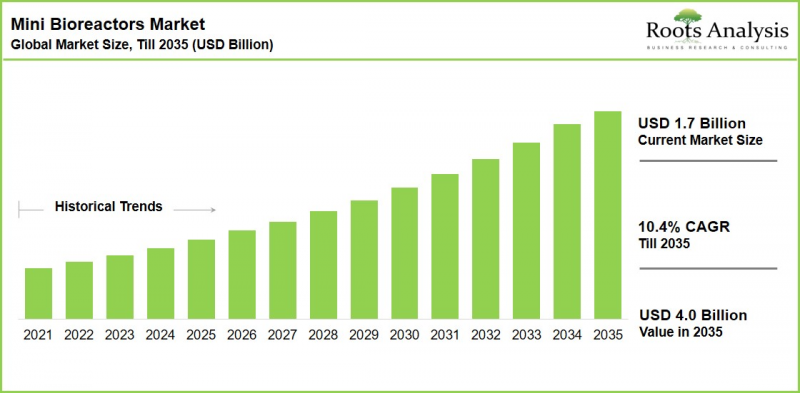
미니 바이오리액터 시장 - 성장 및 동향
미니 바이오리액터는 콤팩트한 탁상형 발효·세포배양 시스템으로, 일반적으로 250mL 미만의 작동 용량으로 가동됩니다. 이러한 바이오리액터는 pH, 온도, 용존 산소, 교반 등의 센서를 통한 매개변수 제어를 핵심으로 구축되어 있습니다. 설치 면적, 비용, 시약 소비량을 대폭 줄이면서도 생산 규모의 조건을 재현함으로써, 이러한 시스템은 스크리닝 연구, 배지 및 공정 최적화, 그리고 모노클로널 항체, 재조합 단백질, 백신, 바이러스 벡터 등의 바이오의약품 초기 단계 개발의 기반이 되고 있습니다.
이 분야는 일회용 배양 용기의 채택 확대, 자동화 및 실시간 분석의 추가적인 통합, 그리고 연구 기관 및 위탁 개발·제조 기관(CDMO)에 의한 고처리량 플랫폼의 보급이라는 세 가지 주요 동향을 통해 진화하고 있습니다. 이러한 동향들이 결합됨에 따라 개발자들은 고가의 배지, 세포, 시약의 소비를 최소화하면서 더 많은 공정 변수를 동시에 스크리닝할 수 있게 되어, 실험실에서 임상 단계로 가는 과정을 단축할 수 있게 됩니다.
바이오의약품 혁신 기업이 유연하고 지속가능하며 데이터베이스의 제조를 계속해서 우선시함에 따라 미니 및 마이크로 규모의 바이오리액터 플랫폼은 전 세계 연구개발 실험실, 학술기관, 외부 위탁 개발 기관에서 채택이 확대될 것으로 예상되며, 현대 바이오 공정 개발의 기반이 되는 툴로서의 역할을 더욱 공고히 할 것으로 전망됩니다.
성장의 원동력: 시장 확대를 지원하는 요인
- 바이오 공정 가속화에 대한 수요: 미니 바이오리액터는 배양 공정의 병렬화를 가능하게 하여, 균주 스크리닝, 배지 최적화, 공정 조건 시험 등의 작업에 소요되는 시간을 대폭 단축합니다. 이를 통해 바이오의약품 연구개발 팀 전체의 개발 기간이 단축됩니다.
- 공정 개발의 비용 효율성: 소용량 운영으로 인해 기존 벤치탑형 시스템에 비해 시약, 배지, 인건비를 절감할 수 있으므로, 연구개발 예산이 제한된 중소규모 바이오기술 기업이나 CDMO에게 이러한 플랫폼은 특히 매력적인 선택지가 되고 있습니다.
- 플랫폼 혁신의 꾸준한 진전: 콤팩트하고 분산형인 일회용 플랫폼 및 온디맨드 방식으로 배지 및 완충액을 생산할 수 있는 포드형 밀폐 시스템 등 신제품 출시가 계속되고 있으며, 이를 통해 자동화, 연결성 및 유연한 제조 방식에 대한 공급업체의 투자가 지속되고 있습니다.
시장이 해결해야 할 과제: 진전을 저해하는 중대한 장벽
- 확장성 및 스케일업의 제약: 미니 스케일 시스템과 산업용 규모 시스템 사이에는 교반 역학, 산소 전달, 전단 조건에 차이가 있으므로 소규모에서 최적화된 공정 매개변수는 스케일업시 재검증이 필요한 경우가 많아, 연구개발에서 상업 생산으로의 전환을 복잡하게 만듭니다.
- 높은 초기 투자 비용과 비용 민감도: 고도로 완전 자동화된 미니 바이오리액터 시스템은 초기 비용이 높기 때문에 소규모 연구실이나 가격에 민감한 학술기관에서의 도입이 제한될 수 있습니다. 한편, 자동화 플랫폼 운영에 필요한 전문 인력 또한 총 소유 비용(TCO)을 높이는 요인이 됩니다.
미니 바이오리액터 시장 - 주요 인사이트
이 보고서는 미니 바이오리액터 시장의 현황과 전망을 분석하여 업계내 성장 기회를 밝히고 있습니다. 주요 조사 결과는 다음과 같습니다. :
- 활발한 신제품 파이프라인: 최근 출시된 제품에는 소형 자동 일회용 플랫폼과 온디맨드 방식으로 배지 및 완충액을 생성할 수 있는 포드형 폐쇄형 시스템이 포함됩니다. 예를 들어 2월에는 Nucleus Biologics사가 ‘Krakatoa® K500’을 출시했습니다. 이는 포드형 밀폐 시스템으로, 통합된 자동화 기능, 분석 기능 및 디지털 배치 기록을 갖추고 있으며, 주문형으로 35-500리터의 배지 및 완충액을 생산할 수 있습니다. 이러한 신제품의 출시는 각 공급업체들이 소형화와 제조 등급의 자동화를 결합하기 위해 경쟁하고 있음을 보여줍니다.
- 전략적 제휴 및 파트너십: 생명과학 장비 분야의 주요 기업은 모든 역량을 사내에서 구축하기보다는 전문적인 바이오리액터 혁신 기업과의 전략적 제휴를 통해 사업 영역을 확대하고 있으며, 이는 차별화된 자동화 역량을 둘러싼 초기 단계의 통합이 진행되고 있음을 보여줍니다. 예를 들어 Cytiva는 2025년 8월 Culture Biosciences와의 제휴를 확대하여 ‘Stratyx(TM) 250’ 클라우드 연결형 바이오리액터 플랫폼의 전 세계 독점 상용화를 맡기로 했으며, 추가적인 바이오리액터 모델을 공동 개발하기로 했습니다.
- 수요는 초기 개발 단계에 집중: 신약 개발 및 임상 단계의 바이오의약품 기업이 현재 수요의 85% 가까이를 차지하고 있으며, 미니 바이오리액터가 제조 규모의 설비라기보다는 상류 공정에서 상용화 전 공정 개발 툴로 자리매김하고 있음이 부각되고 있습니다. 이는 도입된 설비 용량의 대부분이 분자의 첫 번째 GMP 배치에 앞서 진행되는 클론 및 배지 스크리닝 등의 작업에 사용되고 있음을 의미하며, 따라서 단위 수요는 진행 중인 전임상 및 제I/II상 바이오의약품 프로그램의 수와 연동되는 경향을 보입니다.
- 향후 전망: 기술이 성숙해짐에 따라 완전 자동화 시스템에서의 스케일업 충실도, 크로스 플랫폼 재현성, 그리고 총 소유 비용에 관한 장기 데이터는 투자자 및 도입 기업에게 계속해서 주목할 만한 중요한 요소가 될 것입니다. 소규모 바이오리액터와 생산 규모의 바이오리액터 사이에는 혼합 역학,산소 전달, 전단 응력 등에 차이가 있으므로 스케일업 과정에서 공정의 재최적화가 필요한 경우가 종종 있습니다. 따라서 공개된 스케일업 상관 데이터나 여러 거점에서의 재현성에 관한 연구는 플랫폼의 신뢰성을 보여주는 중요한 지표로 남아 있을 것입니다.
미니 바이오리액터 시장의 세분화
시장 규모 및 기회 분석은 다음 매개변수를 기반으로 세분화됩니다. :
바이오리액터 용량별
- 10mL 이하
- 10mL-50mL
- 50mL-250mL
세포배양 유형별
- 포유류 배양
- 미생물 배양
- 바이러스 배양
- 곤충 배양
- 기타
가동 방식별
- 배치/피드배치 모드
- 연속 모드
바이오리액터 유형별
- 일회용 바이오리액터
- 스테인리스강 바이오리액터
- 유리 바이오리액터
최종사용자별
- 바이오의약품 기업
- 학술기관/연구 기관
운영 규모별
- 신약 개발 및 임상 단계의 바이오의약품 기업
- 상업화 단계의 바이오의약품 기업
지역별
- 북미
- 미국
- 캐나다
- 멕시코
- 유럽
- 독일
- 프랑스
- 영국
- 이탈리아
- 스페인
- 기타 유럽
- 아시아태평양
- 중국
- 일본
- 인도
- 한국
- 기타 아시아태평양
- 중동 및 북아프리카
- 사우디아라비아
- 아랍에미리트
- 기타 중동 및 북아프리카
- 라틴아메리카
- 브라질
- 아르헨티나
- 기타 라틴아메리카
목차
제1장 배경
제2장 조사 방법
제3장 경제적 및 기타 프로젝트 고유의 고려 사항
제4장 거시경제 지표
제5장 개요
제6장 서론
제7장 시장 구도 : 소형 바이오리액터
제8장 제품 경쟁력 분석
제9장 기업 개요
제10장 시장 동향
제11장 사례 연구 : 일회용 바이오리액터
제12장 시장 영향 분석 : 촉진요인, 저해요인, 기회, 과제
제13장 세계의 소형 바이오리액터 시장
제14장 미니 바이오리액터 시장(바이오리액터 용량별)
제15장 미니 바이오리액터 시장(세포배양 유형별)
제16장 미니 바이오리액터 시장(가동 방식별)
제17장 미니 바이오리액터 시장(바이오리액터 유형별)
제18장 미니 바이오리액터 시장(최종사용자별)
제19장 미니 바이오리액터 시장(지역별)
제20장 미니 바이오리액터 시장(주요 기업별)
제21장 경영진 인사이트
제22장 부록 1 : 표형식 데이터
제23장 부록 2 : 기업 및 조직 리스트
KSA 26.08.24MINI BIOREACTORS MARKET: OVERVIEW
As per Roots Analysis, the global mini bioreactors market is estimated to grow from USD 1.7 billion in the current year to USD 4.0 billion by 2035, registering a CAGR of 10.4% across the forecast period.
Mini Bioreactors Market: Growth and Trends
Mini bioreactors are compact, benchtop fermentation and cell-culture systems, typically operating at working volumes below 250 mL. These bioreactors are built around sensor-driven parameters such as pH, temperature, dissolved oxygen, and agitation. By recreating production-scale conditions at a fraction of the footprint, cost, and reagent consumption, these systems have become a cornerstone for screening studies, media and process optimization, and early-phase development of biologics, including monoclonal antibodies, recombinant proteins, vaccines, and viral vectors.
The domain is evolving through three key trends, increasing adoption of single-use culture vessels, greater integration of automation and real-time analytics, and wider use of high-throughput platforms by research institutes and contract development and manufacturing organizations (CDMOs). Collectively, these trends allow developers to screen a larger number of process variables in parallel while minimizing consumption of costly media, cells, and reagents, shortening the path from bench to clinic.
As biopharmaceutical innovators continue to prioritize flexible, sustainable, and data-driven manufacturing, mini and micro-scale bioreactor platforms are expected to see broadening uptake across R&D laboratories, academic institutions, and outsourced development organizations worldwide, reinforcing their role as a foundational tool in modern bioprocess development.
Growth Drivers: Factors Fueling Market Expansion
- Need for Accelerated Bioprocessing: Mini bioreactors support parallelized cultivation runs, materially compressing the time needed for tasks such as strain screening, media optimization, and process-condition testing, which shortens overall development timelines for biopharmaceutical R&D teams.
- Cost-Efficiency in Process Development: Low-volume operation reduces reagent, media, and labor costs relative to conventional bench-top systems, making these platforms particularly attractive to small and mid-sized biotech companies and CDMOs operating under constrained R&D budgets.
- Steady Pace of Platform Innovation: Continued new product activity including compact, decentralized single-use platforms and pod-based, closed systems capable of on-demand media and buffer production signals sustained supplier investment in automation, connectivity, and flexible manufacturing formats.
Market Challenges: Critical Barriers Hindering Progress
- Scalability and Scale-Up Limitations: Differences in mixing dynamics, oxygen transfer, and shear conditions between mini-scale and industrial-scale systems mean that process parameters optimized at small scale often require re-validation during scale-up, complicating the transition from R&D to commercial manufacturing.
- High Initial Investment and Cost Sensitivity: Advanced, fully automated mini bioreactor systems carry a high upfront cost, which can restrict adoption among smaller research labs and price-sensitive academic institutions. Meanwhile, the specialized personnel needed to operate automated platforms add to total cost of ownership.
Mini Bioreactors Market: Key Insights
The report examines the current and future state of the mini bioreactors market and highlights the growth opportunities within the industry. Select findings include:
- Active New-Product Pipeline: Recent product launches include compact automated single-use platforms and pod-based closed systems for on-demand media and buffer generation. For instance, in February, Nucleus Biologics launched the Krakatoa(R) K500, a pod-based, closed system capable of producing 35-500 litres of media and buffers on demand with integrated automation, analytics, and digital batch records. Such launches illustrate how suppliers are racing to combine miniaturization with manufacturing-grade automation.
- Strategic Collaborations and Partnerships: Life science tool majors are extending their footprint through strategic collaborations with specialized bioreactor innovators rather than building every capability in-house, indicating early-stage consolidation around differentiated automation ability. For instance, Cytiva expanded its collaboration with Culture Biosciences in August 2025 to take on exclusive global commercialization of the Stratyx(TM) 250 cloud-connected bioreactor platform and to jointly develop additional bioreactor formats.
- Demand Concentrated in Early-Stage Development: Discovery and clinical-stage biopharmaceutical companies account for close to 85% of current demand, underscoring the position of mini bioreactors as an upstream, pre-commercial process-development tool rather than a manufacturing-scale asset. This means the bulk of installed capacity is used for tasks such as clone and media screening ahead of a molecule's first GMP batch, so unit demand tends to track the number of active pre-clinical and Phase I/II biologics programs.
- Future Opportunities: Long-term data on scale-up fidelity, cross-platform reproducibility, and total cost of ownership for fully automated systems will remain an important factor for investors and adopters to track as the technology matures. Differences in mixing dynamics, oxygen transfer, and shear stress between small-scale and production-scale bioreactors often require process re-optimization during scale-up. Therefore, published scale-up correlation data and multi-site reproducibility studies remain key indicators of platform reliability.
Mini Bioreactors Market Segments
The market sizing and opportunity analysis has been segmented across the following parameters:
By Capacity of Bioreactor
- Up to 10 mL
- 10 mL - 50 mL
- 50 mL - 250 mL
By Type of Cell Culture
- Mammalian Culture
- Microbial Culture
- Viral Culture
- Insect Culture
- Other Cultures
By Mode of Operation
- Batch / Fed-batch Mode
- Continuous Mode
By Type of Bioreactor
- Single-Use Bioreactors
- Stainless-Steel Bioreactors
- Glass Bioreactors
By End User
- Biopharmaceutical Companies
- Academic / Research Institutes
By Scale of Operation
- Discovery and Clinical-Stage Biopharmaceutical Companies
- Commercial-Stage Biopharmaceutical Companies
By Geographical Regions
- North America
- US
- Canada
- Mexico
- Europe
- Germany
- France
- UK
- Italy
- Spain
- Rest of Europe
- Asia-Pacific
- China
- Japan
- India
- South Korea
- Rest of Asia-Pacific
- Middle East and North Africa
- Saudi Arabia
- UAE
- Rest of Middle East and North Africa
- Latin America
- Brazil
- Argentina
- Rest of Latin America
Mini Bioreactors Market: Key Segments
Batch and Fed-Batch Operation Leads the Market
Based on Roots Analysis market report, batch, and fed-batch operation together account for the majority of current market share. This highest growth is driven by their operational simplicity and broad compatibility with both microbial and mammalian workflows. Fed-batch culture supports controlled nutrient feeding, enabling higher cell densities and product titers while reducing nutrient depletion and toxic metabolite accumulation. As the predominant manufacturing mode for commercial monoclonal antibodies and recombinant proteins, fed-batch processes are typically optimized and validated in mini bioreactors before scale-up, driving demand for these systems during process development.
Continuous mode is expected to register faster CAGR during the forecast period as biopharmaceutical companies increasingly pursue process intensification and manufacturing efficiency. Further, continuous mode supports sustained cell growth and uninterrupted product harvest, improving volumetric productivity and reducing downtime compared with batch processing. Consequently, developers are increasingly leveraging mini bioreactors to optimize and de-risk perfusion-based and other continuous manufacturing strategies before investing in commercial-scale continuous production lines.
.
Single-Use Systems Hold the Highest Share
According to our market analysis, single-use systems capture the largest share of the market. This largest share is due to their lower capital intensity, reduced cross-contamination risk, and elimination of cleaning and sterilization validation cycles associated with reusable stainless-steel systems. By eliminating the clean-in-place (CIP) and steam-in-place (SIP) qualification requirements of stainless-steel systems, single-use mini bioreactors reduce turnaround time between experiments. This is especially beneficial in process development, where multiple parallel and back-to-back studies are routinely performed.
Suppliers such as Sartorius, Eppendorf, and Cytiva have built much of their recent mini bioreactor product activity, including Cytiva's Stratyx(TM) 250 platform, around disposable culture vessels for this reason.
This segment is also expected to grow at a higher CAGR during the forecast period. This unprecedented growth is supported by the continued expansion of biologics, biosimilars, and advanced-therapy pipelines. These drugs expansion further adds incremental screening and process-development demand that developers increasingly prefer to route through disposable, ready-to-use vessels rather than reusable glass or stainless-steel hardware.
Biopharmaceutical Companies Holds the Highest Share
Based on the Roots Analysis market report, biopharmaceutical companies represent the largest end user category. This dominance is largely due to their extensive use of mini bioreactors across biologics development, process optimization, cell-line screening, and scale-up studies.
Unlike academic and research institutes, which typically use a limited number of mini bioreactors for exploratory research and training, biopharmaceutical companies integrate these systems into structured process development workflows. Biopharmaceutical companies operate mini bioreactors continuously across multiple concurrent drug development programs, resulting in a significantly larger installed base and sustained demand for consumables.
Owing to the growing demand, this segment is expected to register higher CAGR during the forecast period. This growth is further supported by expanding biologics pipelines and rising investment in bioprocess innovation. Each new clinical-stage biologic or biosimilar candidate entering development requires a dedicated phase of cell line development and process optimization, driving sustained demand for mini bioreactor systems.
Discovery and Clinical-Stage Companies Lead the Scale of Operation
Based on the Roots Analysis market report, discovery and clinical-stage biopharmaceutical companies account for nearly 85% of global market share. This highest share reflects the primary role of mini bioreactors as process development tools used before commercial-scale manufacturing.
During discovery and early clinical development, each molecule undergoes multiple rounds of clone selection, media optimization, and process screening, driving repeated use of mini bioreactor systems.
Once the manufacturing process is optimized, locked, and validated for commercial production, these systems are rarely required for the same program. Consequently, market demand is largely driven by the continuous influx of new drug development programs entering the pipeline rather than by the expansion of commercial manufacturing capacity.
North America Dominates the Mini Bioreactors Market
North America currently dominates the market and is likely to remain dominant in the future. This dominance is underpinned by an established biopharmaceutical industry, deep research infrastructure, and high levels of biotechnology investment. The region's concentration of biopharma companies, CDMOs, and academic research institutions, along with favorable government funding for biotechnology research, continues to support early and sustained adoption of high-throughput bioprocessing platforms.
Asia-Pacific is Emerging as Fastest Growing Region
Asia-Pacific is expected to register the highest CAGR through the forecast period. This lucrative growth is driven by expanding biopharmaceutical manufacturing capacity in China, India, Japan, and South Korea, rising biotechnology R&D investment, and growing outsourcing of biomanufacturing activity to the region. Further, the expanding government support for biotechnology innovation and growing cell and gene therapy research are expected to further accelerate regional adoption.
Example Players in Mini Bioreactors Market
- Biosan
- Bionet
- Cytiva
- Distek
- Eppendorf
- Merck Millipore
- Pall Corporation
- Sartorius
Expert Interview and Industry Insights
The opinions and insights presented in this study were shaped by discussions with multiple stakeholders across the value chain. The research report features detailed transcripts of interviews held with the following industry participants:
- Co-Founder, Small Company, US
- Chief Executive Officer and Co-founder, Mid-sized Company, Germany
- Chief Executive Officer, Small Company, US
- Chief Executive Officer, Mid-sized Company, UK
- Director of Cell Line Development and Bioprocess Development, Small Company, Germany
- Director, Mid-sized Company, US
- Head of Business Operations, Large Company, Germany
- Head of Bioprocess Applications, Very Large Company, Denmark
- Product Life Cycle Manager, Very Large Company, Denmark
MINI BIOREACTORS MARKET: RESEARCH COVERAGE
- Market Sizing and Opportunity Analysis: The report features an in-depth analysis of the mini bioreactors market, focusing on key segments including capacity of bioreactor, type of cell culture, mode of operation, type of bioreactor, end user, scale of operation, and geographical regions.
- Mini Bioreactors Market Landscape: A detailed assessment of the overall mini bioreactors market landscape, including analysis of product offerings by capacity, cell culture compatibility, mode of operation, and manufacturer attributes such as year of establishment, company size, and location of headquarters.
- Company Profiles: In-depth profiles of prominent players engaged in offering mini bioreactor systems, featuring information on year of establishment, headquarters, company size, product portfolio, and key strategic initiatives.
- Patent Analysis: An analysis of patents filed and granted related to mini bioreactor technologies, based on parameters such as patent type, application and publication year, jurisdiction, CPC symbols, applicant type, and patent benchmarking and valuation.
- Case Study: A detailed case study of the mini bioreactors market, featuring an analysis of commercially available products across key technical and application-based parameters, along with a comprehensive assessment of developer competitiveness based on company characteristics, geographic presence, and product portfolios, highlighting the current market landscape and emerging industry trends.
- Market Impact Analysis: An analysis of the drivers, restraints, opportunities, and challenges expected to shape the future trajectory of the mini bioreactors market.
Key Questions Answered in this Report
- Which are the leading companies in the mini bioreactors market?
- Which region dominates the mini bioreactors market, and which region is growing fastest?
- What are the key trends observed in the mini bioreactors market?
- What factors are likely to influence the evolution of this market?
- What are the primary challenges faced by mini bioreactor developers and adopters?
- What is the current and future size of the mini bioreactors market?
- What is the CAGR of the mini bioreactors market through 2035?
- How is current and future market opportunity distributed across capacity, cell culture type, mode of operation, bioreactor type, end user, and scale of operation?
Reasons to Buy this Report
This report is designed to give distributors, channel partners, and investors a decisive analytical edge in a fast-consolidating market. Its core differentiators include:
- The report provides a comprehensive market analysis with detailed revenue projections for the overall market and its sub-segments, valuable to both established leaders and emerging entrants.
- It offers stakeholders a complete view of key drivers, barriers, opportunities, and challenges, enabling data-driven decisions to capitalize on growth prospects.
- It helps businesses identify future opportunities across sub-segments and geographies and assess whether those opportunities are worth pursuing.
- It supports understanding of end user needs, preferences, and behavior, helping tailor products and services more effectively.
- It equips new entrants with the market intelligence needed to build sound go-to-market and business strategies.
- It supports more informed, evidence-backed conversations with investors, partners, and other stakeholders.
Additional Benefits
- Complementary PPT Insights Pack
- Complementary Excel Data Packs for all Analytical Modules in the Report
- 15% Free Content Customization
- Detailed Report Walkthrough Session with Research Team
- Free Updated report if the report is 6-12 months old or older
TABLE OF CONTENTS
1. BACKGROUND
- 1.1. Context
- 1.2. Project Objectives
2. RESEARCH METHODOLOGY
- 2.1. Chapter Overview
- 2.2. Research Assumptions
- 2.2.1. Market Landscape and Market Trends
- 2.2.2. Market Forecast and Opportunity Analysis
- 2.2.3. Comparative Analysis
- 2.3. Database Building
- 2.3.1. Data Collection
- 2.3.2. Data Validation
- 2.3.3. Data Analysis
- 2.4. Project Methodology
- 2.4.1. Secondary Research
- 2.4.1.1. Annual Reports
- 2.4.1.2. Academic Research Papers
- 2.4.1.3. Company Websites
- 2.4.1.4. Investor Presentations
- 2.4.1.5. Regulatory Filings
- 2.4.1.6. White Papers
- 2.4.1.7. Industry Publications
- 2.4.1.8. Conferences and Seminars
- 2.4.1.9. Government Portals
- 2.4.1.10. Media and Press Releases
- 2.4.1.11. Newsletters
- 2.4.1.12. Industry Databases
- 2.4.1.13. Roots Proprietary Databases
- 2.4.1.14. Paid Databases and Sources
- 2.4.1.15. Social Media Portals
- 2.4.1.16. Other Secondary Sources
- 2.4.2. Primary Research
- 2.4.2.1. Types of Primary Research
- 2.4.2.1.1. Qualitative Research
- 2.4.2.1.2. Quantitative Research
- 2.4.2.1.3. Hybrid Approach
- 2.4.2.2. Advantages of Primary Research
- 2.4.2.3. Techniques for Primary Research
- 2.4.2.3.1. Interviews
- 2.4.2.3.2. Surveys
- 2.4.2.3.3. Focus Groups
- 2.4.2.3.4. Observational Research
- 2.4.2.3.5. Social Media Interactions
- 2.4.2.4. Key Opinion Leaders Considered in Primary Research
- 2.4.2.4.1. Company Executives (CXOs)
- 2.4.2.4.2. Board of Directors
- 2.4.2.4.3. Company Presidents and Vice Presidents
- 2.4.2.4.4. Research and Development Heads
- 2.4.2.4.5. Technical Experts
- 2.4.2.4.6. Subject Matter Experts
- 2.4.2.4.7. Scientists
- 2.4.2.4.8. Doctors and Other Healthcare Providers
- 2.4.2.5. Ethics and Integrity
- 2.4.2.5.1. Research Ethics
- 2.4.2.5.2. Data Integrity
- 2.4.2.1. Types of Primary Research
- 2.4.3. Analytical Tools and Databases
- 2.4.1. Secondary Research
- 2.5. Robust Quality Control
3. ECONOMIC AND OTHER PROJECT-SPECIFIC CONSIDERATIONS
- 3.1. Chapter Overview
- 3.2. Forecast Methodology
- 3.2.1. Top-down Approach
- 3.2.2. Bottom-up Approach
- 3.2.3. Hybrid Approach
- 3.3. Market Assessment Framework
- 3.3.1. Total Addressable Market (TAM)
- 3.3.2. Serviceable Addressable Market (SAM)
- 3.3.3. Serviceable Obtainable Market (SOM)
- 3.3.4. Currently Acquired Market (CAM)
- 3.4. Forecasting Tools and Techniques
- 3.4.1. Qualitative Forecasting
- 3.4.2. Correlation
- 3.4.3. Regression
- 3.4.4. Extrapolation
- 3.4.5. Convergence
- 3.4.6. Sensitivity Analysis
- 3.4.7. Scenario Planning
- 3.4.8. Data Visualization
- 3.4.9. Time Series Analysis
- 3.4.10. Forecast Error Analysis
- 3.5. Key Considerations
- 3.5.1. Demographics
- 3.5.2. Government Regulations
- 3.5.3. Reimbursement Scenarios
- 3.5.4. Market Access
- 3.5.5. Supply Chain
- 3.5.6. Industry Consolidation
- 3.5.7. Pandemic / Unforeseen Disruptions Impact
- 3.6. Limitations
4. MACRO-ECONOMIC INDICATORS
- 4.1. Chapter Overview
- 4.2. Market Dynamics
- 4.2.1. Time Period
- 4.2.1.1. Historical Trends
- 4.2.1.2. Current and Forecasted Estimates
- 4.2.2. Currency Coverage
- 4.2.2.1. Major Currencies Affecting the Market
- 4.2.2.2. Factors Affecting Currency Fluctuations
- 4.2.2.3. Impact of Currency Fluctuations on the Industry
- 4.2.3. Foreign Currency Exchange Rate
- 4.2.3.1. Impact of Foreign Exchange Rate Volatility on the Market
- 4.2.3.2. Strategies for Mitigating Foreign Exchange Risk
- 4.2.4. Recession
- 4.2.4.1. Assessment of Current Economic Conditions and Potential Impact on the Market
- 4.2.4.2. Historical Analysis of Past Recessions and Lessons Learnt
- 4.2.5. Inflation
- 4.2.5.1. Measurement and Analysis of Inflationary Pressures in the Economy
- 4.2.5.2. Potential Impact of Inflation on the Market Evolution
- 4.2.6. Interest Rates
- 4.2.6.1. Interest Rates and Their Impact on the Market
- 4.2.6.2. Strategies for Managing Interest Rate Risk
- 4.2.7. Commodity Flow Analysis
- 4.2.7.1. Type of Commodity
- 4.2.7.2. Origins and Destinations
- 4.2.7.3. Values and Weights
- 4.2.7.4. Modes of Transportation
- 4.2.8. Global Trade Dynamics
- 4.2.8.1. Import Scenario
- 4.2.8.2. Export Scenario
- 4.2.8.3. Trade Policies
- 4.2.8.4. Strategies for Mitigating the Risks Associated with Trade Barriers
- 4.2.8.5. Impact of Trade Barriers on the Market
- 4.2.9. War Impact Analysis
- 4.2.9.1. Russian-Ukraine War
- 4.2.9.2. Israel-Hamas War
- 4.2.10. COVID Impact / Related Factors
- 4.2.10.1. Global Economic Impact
- 4.2.10.2. Industry-specific Impact
- 4.2.10.3. Government Response and Stimulus Measures
- 4.2.10.4. Future Outlook and Adaptation Strategies
- 4.2.11. Other Indicators
- 4.2.11.1. Fiscal Policy
- 4.2.11.2. Consumer Spending
- 4.2.11.3. Gross Domestic Product (GDP)
- 4.2.11.4. Employment
- 4.2.11.5. Taxes
- 4.2.11.6. Stock Market Performance
- 4.2.11.7. Cross-Border Dynamics
- 4.2.1. Time Period
- 4.3. Conclusion
5. EXECUTIVE SUMMARY
6. INTRODUCTION
- 6.1. Chapter Overview
- 6.2. Overview of Mini Bioreactors
- 6.2.1. Types of Mini Bioreactors
- 6.3. Advantages of Mini Bioreactors
- 6.4. Fabrication Materials for Small Scale Bioreactors
- 6.5. Future Perspectives
7. MARKET LANDSCAPE: MINI BIOREACTORS
- 7.1. Chapter Overview
- 7.2. Small Scale Bioreactors: Overall Market Landscape
- 7.2.1. Analysis by Product Characteristics
- 7.2.2. Analysis by Mode of Operation
- 7.2.3. Analysis by Type of Cell Culture
- 7.2.4. Analysis by Type of Bioreactor
- 7.2.5. Analysis by Type of Fabrication Material
- 7.2.6. Analysis by Scale of Operation
- 7.2.7. Analysis by Application Area
- 7.2.8. Analysis by Type of Process Development
- 7.2.9. Analysis by End User
- 7.2.10. Analysis by Total Volume
- 7.3. Small Scale Bioreactors Manufacturers: List of Developers
- 7.3.1. Analysis by Year of Establishment
- 7.3.2. Analysis by Company Size
- 7.3.3. Analysis by Year of Establishment and Company Size
- 7.3.4. Analysis by Location of Headquarters
- 7.3.5. Leading Manufacturers: Analysis by Number of Products
8. PRODUCT COMPETITIVENESS ANALYSIS
- 8.1. Chapter Overview
- 8.2. Assumptions and Key Parameters
- 8.3. Methodology
- 8.4. Product Competitiveness Analysis: Mini Bioreactors
- 8.4.1. Mini Bioreactors Offered by Players based in North America
- 8.4.2. Mini Bioreactors Offered by Players based in Europe
- 8.4.3. Mini Bioreactors Offered by Players based in Asia-Pacific
9. COMPANY PROFILES
- 9.1. Chapter Overview
- 9.2. Bionet
- 9.2.1. Company Overview
- 9.2.2. Product Portfolio
- 9.2.3. Recent Developments and Future Outlook
- 9.3. Biosan
- 9.4. Cytiva
- 9.5. Distek
- 9.6. Eppendorf
- 9.7. Merck Millipore
- 9.8. Pall Corporation
- 9.9. Sartorius
10. MARKET TRENDS
- 10.1. Chapter Overview
- 10.2. Scope and Methodology
- 10.3. Small Scale Bioreactors: Patent Analysis
- 10.3.1. Analysis by Patent Publication Year
- 10.3.2. Analysis by Type of Patent and Publication Year
- 10.3.3. Analysis by Patent Application Year
- 10.3.4. Analysis by Patent Jurisdiction
- 10.3.5. Analysis by CPC Symbols
- 10.3.6. Analysis by Type of Applicant
- 10.3.7. Leading Industry Players: Analysis by Number of Patents
- 10.3.8. Leading Non-Industry Players: Analysis by Number of Patents
- 10.4. Patent Benchmarking Analysis
- 10.4.1. Analysis by Patent Characteristics
- 10.5. Patent Valuation
- 10.6. Leading Patents by Number of Citations
11. CASE STUDY: SINGLE USE BIOREACTORS
- 11.1. Chapter Overview
- 11.2. Single Use Bioreactors: List of Products
- 11.2.1. Analysis by Type of Bioreactor
- 11.2.2. Analysis by Scale of Operation
- 11.2.3. Analysis by Type of Cell Culture System
- 11.2.4. Analysis by Type of Cell Culture
- 11.2.5. Analysis by Type of Molecule Processed
- 11.2.6. Analysis by Key Features
- 11.2.7. Analysis by Application Area
- 11.2.8. Analysis by End Users
- 11.2.9. Analysis by Working Volume
- 11.3. Single Use Bioreactor Developers: Overall Market Landscape
- 11.3.1. Analysis by Year of Establishment
- 11.3.2. Analysis by Company Size
- 11.3.3. Analysis by Location of Headquarters
- 11.3.4. Leading Developers: Analysis by Number of Single Use Bioreactors
12. MARKET IMPACT ANALYSIS: DRIVERS, RESTRAINTS, OPPORTUNITIES AND CHALLENGES
- 12.1. Chapter Overview
- 12.2. Market Drivers
- 12.3. Market Restraints
- 12.4. Market Opportunities
- 12.5. Market Challenges
13. GLOBAL MINI BIOREACTOR MARKET
- 13.1. Chapter Overview
- 13.2. Assumptions and Methodology
- 13.3. Global Mini Bioreactors Market, Historical Trends (Since 2021) and Forecasted Estimates (Till 2035)
- 13.3.1. Scenario Analysis
- 13.3.1.1. Conservative Scenario
- 13.3.1.2. Optimistic Scenario
- 13.3.1. Scenario Analysis
14. MINI BIOREACTORS MARKET, BY CAPACITY OF BIOREACTOR
- 14.1. Chapter Overview
- 14.2. Key Assumptions and Methodology
- 14.3. Mini Bioreactors Market: Distribution by Capacity of Bioreactor
- 14.3.1. Mini Bioreactors Market for Up to 10 mL, Historical Trends (Since 2021) and Forecasted Estimates (Till 2035)
- 14.3.2. Mini Bioreactors Market for 10 mL - 50 mL, Historical Trends (Since 2021) and Forecasted Estimates (Till 2035)
- 14.3.3. Mini Bioreactors Market for 50 mL - 250 mL, Historical Trends (Since 2021) and Forecasted Estimates (Till 2035)
- 14.4. Data Triangulation and Validation
15. MINI BIOREACTORS MARKET, BY TYPE OF CELL CULTURE
- 15.1. Chapter Overview
- 15.2. Key Assumptions and Methodology
- 15.3. Mini Bioreactors Market: Distribution by Type of Cell Culture
- 15.3.1. Mini Bioreactors Market for Mammalian Culture, Historical Trends (Since 2021) and Forecasted Estimates (Till 2035)
- 15.3.2. Mini Bioreactors Market for Microbial Culture, Historical Trends (Since 2021) and Forecasted Estimates (Till 2035)
- 15.3.3. Mini Bioreactors Market for Viral Culture, Historical Trends (Since 2021) and Forecasted Estimates (Till 2035)
- 15.3.4. Mini Bioreactors Market for Insect Culture, Historical Trends (Since 2021) and Forecasted Estimates (Till 2035)
- 15.3.5. Mini Bioreactors Market for Other Cultures, Historical Trends (Since 2021) and Forecasted Estimates (Till 2035)
- 15.4. Data Triangulation and Validation
16. MINI BIOREACTORS MARKET, BY MODE OF OPERATION
- 16.1. Chapter Overview
- 16.2. Key Assumptions and Methodology
- 16.3. Mini Bioreactors Market: Distribution by Mode of Operation
- 16.3.1. Mini Bioreactors Market for Batch / Fed-batch Mode, Historical Trends (Since 2021) and Forecasted Estimates (Till 2035)
- 16.3.2. Mini Bioreactors Market for Continuous Mode, Historical Trends (Since 2021) and Forecasted Estimates (Till 2035)
- 16.4. Data Triangulation and Validation
17. MINI BIOREACTORS MARKET, BY TYPE OF BIOREACTOR
- 17.1. Chapter Overview
- 17.2. Key Assumptions and Methodology
- 17.3. Mini Bioreactors Market: Distribution by Type of Bioreactor
- 17.3.1. Mini Bioreactors Market for Single Use Bioreactors, Historical Trends (Since 2021) and Forecasted Estimates (Till 2035)
- 17.3.2. Mini Bioreactors Market for Stainless Steel Bioreactors, Historical Trends (Since 2021) and Forecasted Estimates (Till 2035)
- 17.3.3. Mini Bioreactors Market for Glass Bioreactors, Historical Trends (Since 2021) and Forecasted Estimates (Till 2035)
- 17.4. Data Triangulation and Validation
18. MINI BIOREACTORS MARKET, BY END USER
- 18.1. Chapter Overview
- 18.2. Key Assumptions and Methodology
- 18.3. Mini Bioreactors Market: Distribution by End User
- 18.3.1. Mini Bioreactors Market for Biopharma Companies, Historical Trends (Since 2021) and Forecasted Estimates (Till 2035)
- 18.3.2. Mini Bioreactors Market for Academic / Research Institutes, Historical Trends (Since 2021) and Forecasted Estimates (Till 2035)
- 18.4. Data Triangulation and Validation
19. MINI BIOREACTORS MARKET, BY GEOGRAPHICAL REGIONS
- 19.1. Chapter Overview
- 19.2. Key Assumptions and Methodology
- 19.3. Mini Bioreactors Market: Distribution by Geographical Regions
- 19.3.1. Mini Bioreactors Market in North America, Historical Trends (Since 2021) and Forecasted Estimates (Till 2035)
- 19.3.2. Mini Bioreactors Market in Europe, Historical Trends (Since 2021) and Forecasted Estimates (Till 2035)
- 19.3.3. Mini Bioreactors Market in Asia-Pacific, Historical Trends (Since 2021) and Forecasted Estimates (Till 2035)
- 19.3.4. Mini Bioreactors Market in Middle East and North Africa, Historical Trends (Since 2021) and Forecasted Estimates (Till 2035)
- 19.3.5. Mini Bioreactors Market in Latin America, Historical Trends (Since 2021) and Forecasted Estimates (Till 2035)
- 19.4. Data Triangulation and Validation
20. MINI BIOREACTORS MARKET, BY KEY PLAYERS
- 20.1. Key Assumptions and Methodology
- 20.2. Mini Bioreactors Market: Distribution by Leading Players
- 20.2.1. Mini Bioreactors Market for Leading Player 1
- 20.2.2. Mini Bioreactors Market for Leading Player 2
- 20.2.3. Mini Bioreactors Market for Leading Player 3
- 20.2.4. Mini Bioreactors Market for Leading Player 4
- 20.2.5. Mini Bioreactors Market for Leading Player 5
- 20.2.6. Mini Bioreactors Market for Leading Player 6
- 20.3. Data Triangulation and Validation


