|
시장보고서
상품코드
2121124
일회용 바이오프로세싱 시장 기회, 성장 촉진요인, 업계 동향 분석 및 예측(2026-2035년)Single-use Bioprocessing Market Opportunity, Growth Drivers, Industry Trend Analysis, and Forecast 2026 - 2035 |
||||||

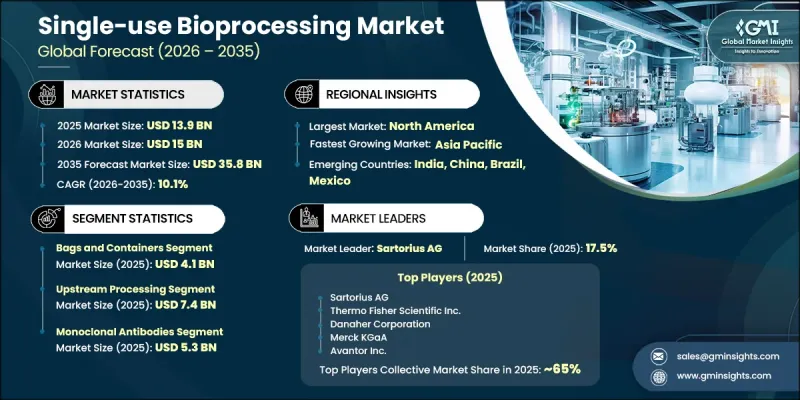
세계의 일회용 바이오프로세싱 시장은 2025년에 139억 달러로 평가되며, CAGR 10.1%로 성장하여 2035년까지 358억 달러에 달할 것으로 예측됩니다.
시장 확대는 바이오의약품 제조 수요 증가, 바이오시밀러 채택 확대, 기존 스테인리스강 인프라에 비해 필요한 설비 투자가 적게 든다는 점, 그리고 교차 오염 위험이 감소한다는 점 등에 의해 뒷받침되고 있습니다. 또한, 위탁 개발·제조 기관(CDMO) 및 위탁 제조 기관(CMO)에 대한 의존도가 높아지고 있는 점도 일회용 기술에 유리한 환경을 조성하고 있습니다. 동시에, 맞춤형 의료 및 세포·유전자 치료의 활용 확대에 따라 바이오의약품 제조사들은 보다 유연한 가공 플랫폼 도입을 촉진하고 있습니다. 일회용 시스템은 제조사가 생산을 합리화하고, 시설 도입 기간을 단축하며, 초기 투자를 절감하는 데 도움이 됩니다. 바이오의약품 기업이 더욱 복잡한 생산 요건을 관리해 나가는 가운데, 유연한 제조 전략을 지원하는 이 시스템의 능력은 그 가치를 점점 더 높여가고 있습니다. 바이오시밀러 제조사들도 운영 비용을 절감하고 시설 구축을 가속화할 수 있다는 점 때문에 일회용 공정 솔루션으로의 전환을 추진하고 있습니다. 각 제조사가 효율성, 유연성, 확장성 및 오염 관리를 지속적으로 중시함에 따라, 일회용 바이오 공정 솔루션에 대한 수요는 예측 기간 동안 강력한 성장세를 유지할 것으로 예상됩니다.
| 시장 범위 | |
|---|---|
| 시작 연도 | 2025년 |
| 예측 기간 | 2026-2035년 |
| 개시 금액 | 139억 달러 |
| 예측 금액 | 358억 달러 |
| CAGR | 10.1% |
바이오의약품 제조사들 사이에서 생산 외주화가 확대되는 추세는 시장 발전을 이끄는 또 다른 중요한 요인이 되고 있습니다. 설비 투자 억제, 상품화까지의 기간 단축, 그리고 전문적인 생산능력 확보를 추구하는 바이오의약품 기업들로 인해 CDMO 및 CMO가 점점 더 많이 선택되고 있습니다. 외부 제조 서비스 제공업체는 종종 서로 다른 제조 요건을 가진 여러 고객을 상대하기 때문에 적응성이 높고 확장 가능한 처리 인프라에 대한 필요성이 커지고 있습니다. 일회용 바이오 공정 시스템은 변화하는 제조 요구에 따라 생산 플랫폼을 구성할 수 있게함으로써 이러한 요건을 충족시킬 수 있습니다. 이러한 유연성 덕분에 서비스 제공업체는 다양한 생산 일정을 관리하면서도 시설의 효율적인 가동을 유지할 수 있게 됩니다. 아웃소싱이 바이오의약품 제조 전략에서 점점 더 중요한 요소가 됨에 따라, 일회용 공정 기술에 대한 수요도 이에 따라 증가할 것으로 예상됩니다.
백 및 컨테이너 부문은 2025년에 41억 달러의 시장 규모를 기록했습니다. 이러한 일회용 구성품은 원료의 조제, 보관, 회수, 이송, 중간 처리 등 바이오 공정 운영의 여러 단계를 지원합니다. 밀폐형 및 무균 설계 덕분에 제조업체는 오염 위험을 최소화하면서 통제된 공정 환경을 유지할 수 있습니다. 백 및 컨테이너는 다양한 용량과 구성으로 제공되므로, 제조업체는 특정 생산 요건에 맞는 솔루션을 선택할 수 있습니다. 또한 취급이 비교적 간편하고 인프라 요구 사항도 줄어들기 때문에 시설 운영 효율 향상에도 기여합니다. 일회용 어셈블리와의 호환성을 통해 일회용 제조 워크플로우로의 통합이 더욱 촉진됩니다. 바이오의약품 생산이 지속적으로 확대되고, 제조업체들이 시설 설계 및 생산 관리에서 더 높은 유연성을 추구하는 가운데, 일회용 백 및 컨테이너에 대한 수요는 계속해서 견조할 것으로 예상됩니다.
2025년에는 바이오의약품 및 제약 기업 부문이 61.5%의 점유율을 차지했습니다. 이들 조직은 일회용 바이오 공정 기술의 주요 이용자이며, 운영 비용을 절감하면서 효율적인 제조를 지원하기 위해 이러한 시스템에 대한 의존도를 높이고 있습니다. 일회용 장비를 통해 제조업체는 생산 체제를 보다 신속하게 구축하고, 변화하는 요구 사항에 따라 제조 일정을 조정할 수 있게 됩니다. 또한 이 기술은 기존 처리 방식에 비해 오염 노출을 제한하는 데에도 도움이 됩니다. 제약 및 바이오의약품 기업들이 점점 더 다양해지는 개발 파이프라인을 관리함에 따라, 제조의 유연성과 운영상의 대응 능력에 더 큰 중점을 두고 있습니다. 일회용 플랫폼은 제조업체가 생산 변경이나 상용화 요건에 더 효율적으로 대응할 수 있도록 하는 적응성이 높은 처리 기능을 제공함으로써 이러한 목표를 지원할 수 있습니다.
2025년, 북미의 일회용 바이오프로세싱 시장은 38%의 점유율을 차지했습니다. 제조업체들이 오염 관리에 더 큰 중점을 두고 바이오의약품 생산에 대한 증가하는 수요에 대응함에 따라, 이 지역의 시장은 꾸준히 확대되고 있습니다. 북미는 확립된 바이오의약품 제조 인프라, 활발한 개발 활동, 그리고 바이오기술 기업의 집중으로 인해 일회용 바이오 공정 분야에서 가장 중요한 시장 중 하나로 자리매김하고 있습니다. 이 지역의 제조사들은 더 높은 유연성을 제공하고 신속한 상용화를 지원하는 생산 시스템을 추구하며, 일회용 공정 기술의 도입을 점점 더 확대하고 있습니다. 또한, 기업들이 제조 업무의 효율화를 도모함에 따라 일회용 바이오리액터, 여과 기술 및 유체 관리 솔루션의 이용도 증가하고 있습니다. 견고한 산업 인프라와 바이오의약품 생산에 대한 지속적인 투자가 이 지역 전체에서 일회용 기술의 추가적인 보급을 뒷받침할 것으로 예상됩니다.
목차
제1장 조사 방법과 범위
제2장 주요 요약
제3장 업계 인사이트
제4장 경쟁 구도
제5장 시장 추정 및 예측 : 제품 유형별, 2022-2035년
제6장 시장 추정 및 예측 : 워크플로우 단계별, 2022-2035년
제7장 시장 추정 및 예측 : 용도별, 2022-2035년
제8장 시장 추정 및 예측 : 최종 용도별, 2022-2035년
제9장 시장 추정 및 예측 : 지역별, 2022-2035년
제10장 기업 개요
KSMThe Global Single-Use Bioprocessing Market was valued at USD 13.9 billion in 2025 and is estimated to grow at a CAGR of 10.1% to reach USD 35.8 billion by 2035.
Market expansion is supported by the increasing need for biologic manufacturing, growing adoption of biosimilars, lower capital requirements than conventional stainless-steel infrastructure, and a reduced likelihood of cross-contamination. Greater reliance on contract development and manufacturing organizations (CDMOs) and contract manufacturing organizations (CMOs) is also creating favorable conditions for single-use technologies. At the same time, the expanding use of personalized medicine and cell and gene therapies is encouraging biopharmaceutical manufacturers to adopt more flexible processing platforms. Single-use systems can help manufacturers streamline production, shorten facility deployment timelines, and reduce upfront investment. Their ability to support flexible manufacturing strategies is becoming increasingly valuable as biopharmaceutical companies manage more complex production requirements. Biosimilar manufacturers are also turning to disposable processing solutions because these systems can reduce operating expenses and enable faster facility implementation. As manufacturers continue to prioritize efficiency, flexibility, scalability, and contamination control, demand for single-use bioprocessing solutions is expected to maintain strong momentum throughout the forecast period.
| Market Scope | |
|---|---|
| Start Year | 2025 |
| Forecast Year | 2026-2035 |
| Start Value | $13.9 Billion |
| Forecast Value | $35.8 Billion |
| CAGR | 10.1% |
The growing tendency among biopharmaceutical manufacturers to outsource production is becoming another important factor driving market development. CDMOs and CMOs are increasingly being selected by biopharma companies seeking to control capital spending, shorten commercialization timelines, and obtain access to specialized production capabilities. External manufacturing providers often serve multiple customers with different production requirements, which increases the need for adaptable and scalable processing infrastructure. Single-use bioprocessing systems can address these requirements by allowing production platforms to be configured according to changing manufacturing needs. Their flexibility also enables service providers to manage diverse production schedules while maintaining efficient facility utilization. As outsourcing continues to become a more important component of biopharmaceutical manufacturing strategies, demand for disposable processing technologies is expected to increase accordingly.
The bags and containers segment generated USD 4.1 billion in 2025. These disposable components support several stages of bioprocessing operations, including material preparation, storage, collection, transfer, and intermediate handling. Their closed and sterile design helps manufacturers maintain controlled processing environments while limiting contamination exposure. Bags and containers are available across different capacities and configurations, allowing manufacturers to select solutions that align with specific production requirements. Their relatively simple handling characteristics and reduced infrastructure needs can also contribute to more efficient facility operations. Compatibility with disposable assemblies further supports their integration into single-use manufacturing workflows. As biopharmaceutical production continues to expand and manufacturers seek greater flexibility in facility design and production management, the demand for single-use bags and containers is expected to remain strong.
The biopharmaceutical and pharmaceutical companies segment accounted for a 61.5% share in 2025. These organizations constitute the primary users of disposable bioprocessing technologies and increasingly rely on these systems to support efficient manufacturing while controlling operational expenses. Single-use equipment enables manufacturers to establish production operations more rapidly and adjust manufacturing schedules according to changing requirements. Technology can also help limit contamination exposure compared with conventional processing approaches. As pharmaceutical and biopharmaceutical companies manage increasingly diverse development pipelines, they are placing greater emphasis on manufacturing flexibility and operational responsiveness. Single-use platforms can support these objectives by providing adaptable processing capabilities that allow manufacturers to respond more efficiently to production changes and commercialization requirements.
North America Single-Use Bioprocessing Market held a 38% share in 2025. The regional market is expanding steadily as manufacturers place greater emphasis on contamination control and respond to increasing demand for biologic production. North America remains one of the most important markets for single-use bioprocessing because of its established biopharmaceutical manufacturing infrastructure, substantial development activity, and concentration of biotechnology companies. Manufacturers throughout the region are increasingly adopting disposable processing technologies as they seek production systems that provide greater flexibility and support quicker commercialization. The use of single-use bioreactors, filtration technologies, and fluid management solutions is also increasing as companies seek to streamline manufacturing operations. Strong industry infrastructure and continued investment in biopharmaceutical production are expected to support further adoption of single-use technologies across the region.
Key companies operating in the global single-use bioprocessing market include Sartorius AG, Danaher Corporation, Avantor Inc., Thermo Fisher Scientific Inc., Merck KGaA, Getinge AB, Eppendorf SE, Repligen Corporation, Saint-Gobain Life Sciences, Entegris Inc., Parker Hannifin Corporation, Meissner Filtration Products Inc., Celltainer Biotech BV, PBS Biotech Inc., and Cellexus International Ltd. Companies operating in the single-use bioprocessing market are strengthening their positions by expanding their technology portfolios, improving disposable processing solutions, and investing in product development. Market participants are also focusing on strategic collaborations, regional expansion, and stronger distribution networks to reach a broader customer base. Companies are enhancing manufacturing capabilities to address rising demand for flexible and scalable bioprocessing platforms. Investments in research and development are helping suppliers improve system performance, process efficiency, and contamination control. Leading participants are also developing integrated solutions that can simplify manufacturing workflows and improve operational flexibility. In addition, companies are strengthening customer support and technical service capabilities to build long-term relationships with biopharmaceutical manufacturers.
Table of Contents
Chapter 1 Methodology and Scope
- 1.1 Market scope and definition
- 1.2 Research design
- 1.2.1 Research approach
- 1.2.2 Data collection methods
- 1.3 Data mining sources
- 1.3.1 Global
- 1.3.2 Regional/Country
- 1.4 Base estimates and calculations
- 1.4.1 Base year calculation
- 1.4.2 Key trends for market estimation
- 1.5 Primary research and validation
- 1.5.1 Primary sources
- 1.6 Forecast model
- 1.7 Research assumptions and limitations
Chapter 2 Executive Summary
- 2.1 Industry 360° synopsis
- 2.2 Key market trends
- 2.2.1 Regional trends
- 2.2.2 Product type trends
- 2.2.3 Workflow stage trends
- 2.2.4 Application trends
- 2.2.5 End use trends
- 2.3 CXO perspectives: Strategic imperatives
Chapter 3 Industry Insights
- 3.1 Industry ecosystem analysis
- 3.2 Industry impact forces
- 3.2.1 Growth drivers
- 3.2.1.1 Rising demand for biologics and biosimilars
- 3.2.1.2 Increasing adoption of personalized medicines and cell & gene therapies
- 3.2.1.3 Rising outsourcing to CDMOs and CMOs
- 3.2.1.4 Reduced risk of cross-contamination
- 3.2.1.5 Lower capital investment compared to stainless-steel systems
- 3.2.2 Industry pitfalls and challenges
- 3.2.2.1 Concerns regarding extractables and leachables
- 3.2.2.2 Environmental concerns related to plastic waste generation
- 3.2.2.3 High recurring consumables cost
- 3.2.3 Market opportunities
- 3.2.3.1 Continuous bioprocessing integration with single-use platforms
- 3.2.3.2 Development of advanced high-capacity single-use bioreactors
- 3.2.1 Growth drivers
- 3.3 Growth potential analysis
- 3.4 Regulatory landscape
- 3.4.1 North America
- 3.4.2 Europe
- 3.4.3 Asia Pacific
- 3.4.4 Latin America
- 3.4.5 Middle East and Africa
- 3.5 Technological advancements
- 3.5.1 Current technological trends
- 3.5.2 Emerging technologies
- 3.6 Pricing trend analysis (Driven by primary research)
- 3.7 Future market trends (Driven by primary research)
- 3.8 Porter's analysis
- 3.9 PESTEL analysis
- 3.10 Gap analysis
- 3.11 Impact of AI and Generative AI on the market (Driven by primary research)
Chapter 4 Competitive Landscape, 2025
- 4.1 Introduction
- 4.2 Company matrix analysis
- 4.3 Company market share analysis (Driven by primary research)
- 4.3.1 Global
- 4.3.2 North America
- 4.3.3 Europe
- 4.3.4 Asia Pacific
- 4.4 Competitive positioning matrix
- 4.5 Competitive analysis of major market players
- 4.6 Key developments
- 4.6.1 Mergers & acquisitions
- 4.6.2 Partnerships & collaborations
- 4.6.3 New product launches
- 4.6.4 Expansion plans
Chapter 5 Market Estimates and Forecast, By Product Type, 2022 - 2035 ($ Mn)
- 5.1 Key trends
- 5.2 Single-use bioreactors
- 5.2.1 Stirred tank single-use bioreactors
- 5.2.2 Wave-mixed single-use bioreactors
- 5.2.3 Bubble column single-use bioreactors
- 5.2.4 Other products
- 5.3 Bags and containers
- 5.4 Tubing assemblies
- 5.5 Connectors and fittings
- 5.6 Filtration devices
- 5.7 Mixing systems
- 5.8 Sensors and probes
- 5.8.1 pH sensors
- 5.8.2 Dissolved oxygen sensors
- 5.8.3 Pressure and flow sensors
- 5.8.4 Other sensor types
- 5.9 Sampling systems
Chapter 6 Market Estimates and Forecast, By Workflow Stage, 2022 - 2035 ($ Mn)
- 6.1 Key trends
- 6.2 Upstream processing
- 6.3 Downstream processing
- 6.4 Final processing
Chapter 7 Market Estimates and Forecast, By Application, 2022 - 2035 ($ Mn)
- 7.1 Key trends
- 7.2 Monoclonal antibodies (mAbs)
- 7.3 Vaccine production
- 7.4 Cell and gene therapy
- 7.5 Plasma-derived products
- 7.6 Other biologics
Chapter 8 Market Estimates and Forecast, By End Use, 2022 - 2035 ($ Mn)
- 8.1 Key trends
- 8.2 Biopharmaceutical and pharmaceutical companies
- 8.3 CMOs and CROs
- 8.4 Academic and research institutes
Chapter 9 Market Estimates and Forecast, By Region, 2022 - 2035 ($ Mn)
- 9.1 Key trends
- 9.2 North America
- 9.2.1 U.S.
- 9.2.2 Canada
- 9.3 Europe
- 9.3.1 Germany
- 9.3.2 UK
- 9.3.3 France
- 9.3.4 Spain
- 9.3.5 Italy
- 9.3.6 Netherlands
- 9.4 Asia Pacific
- 9.4.1 China
- 9.4.2 India
- 9.4.3 Japan
- 9.4.4 Australia
- 9.4.5 South Korea
- 9.5 Latin America
- 9.5.1 Brazil
- 9.5.2 Mexico
- 9.5.3 Argentina
- 9.6 Middle East and Africa
- 9.6.1 Saudi Arabia
- 9.6.2 South Africa
- 9.6.3 UAE
Chapter 10 Company Profiles
- 10.1 Avantor Inc.
- 10.2 Cellexus International Ltd.
- 10.3 Celltainer Biotech BV
- 10.4 Danaher Corporation
- 10.5 Entegris Inc.
- 10.6 Eppendorf SE
- 10.7 Getinge AB
- 10.8 Meissner Filtration Products Inc.
- 10.9 Merck KGaA
- 10.10 Parker Hannifin Corporation
- 10.11 PBS Biotech Inc.
- 10.12 Repligen Corporation
- 10.13 Saint-Gobain Life Sciences
- 10.14 Sartorius AG
- 10.15 Thermo Fisher Scientific Inc.