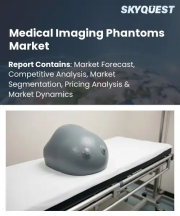
|
시장보고서
상품코드
2086014
의료 영상 팬텀 시장 : 제품 유형별, 소재별, 용도별, 최종 사용자별, 유통 채널별 시장 예측(2026-2032년)Medical Imaging Phantoms Market by Product Type, Material, Application, End User, Distribution Channel - Global Forecast 2026-2032 |
||||||
 360iResearch
의료 영상 팬텀 시장은 2032년까지 연평균 복합 성장률(CAGR) 5.29%로 성장이 전망되며, 2억 9,347만 달러 규모로 확대될 것으로 예측됩니다.
| 주요 시장 통계 | |
|---|---|
| 기준 연도 : 2025년 | 2억 455만 달러 |
| 추정 연도 : 2026년 | 2억 1,501만 달러 |
| 예측 연도 : 2032년 | 2억 9,347만 달러 |
| CAGR(%) | 5.29% |
의료 영상 팬텀이란, 컴퓨터 단층촬영(CT), 자기공명영상(MRI), 초음파 검사, X선 검사, 유방촬영술, 투시 검사, 핵의학 및 방사선 치료의 워크플로우에서 인체 조직의 감쇠, 밀도, 음향적·자기적 특성, 혹은 방사성 추적자의 거동을 재현하는 정밀한 시험용 물체입니다.
이러한 수요는 입증 가능한 임상적 필요성에 근거하고 있습니다. 병원, 영상진단센터, 의료기기 제조업체, 연구기관은 기기 인수 검사, 일상적인 품질 보증, 선량 최적화, 스캐너 교정, 영상 유도 치료 검증, 인증, 연수 및 정량적 영상진단의 표준화를 위해 팬텀을 활용하고 있습니다. 영상 진단이 더욱 정량적이고 프로토콜 중심적으로 변화함에 따라, 의료 영상 팬텀은 백오피스에서의 품질 관리 도구에서 환자 안전, 규제 준수, AI를 활용한 영상 진단 성능을 위한 전략적 자산으로 그 역할이 전환되고 있습니다.
이미지 팬텀 분야의 혁신적인 변화
이 분야는 단순한 기하학적 품질 관리 도구에서 임상 현장의 복잡성을 더 잘 반영한 인체를 모방한 모달리티 전용 및 다중 모달리티 팬텀으로 점차 전환되고 있습니다. 3D 프린팅, 조직을 모방한 고분자, 겔 제제, MR 대응 소재 및 이식형 센서 기술의 발전으로 인해, 종양학, 순환기학, 신경학, 유방 영상 진단 및 중재 시술에 사용되는 장기 특이적 및 환자 특이적 팬텀의 구현이 가능해졌습니다.
인공지능(AI)이 가져오는 누적 영향
인공지능(AI)은 알고리즘 테스트를 위한 통제된 환경을 구축함으로써 의료 영상 팬텀의 전략적 가치를 높이고 있습니다. 병변 감지, 영상 재구성, 분할, 라디오믹스, 선량 저감, 워크플로우 자동화 등에 사용되는 AI 모델에는 재현성이 있는 벤치마크가 필요합니다. 팬텀은 환자 데이터셋에서는 일관되게 제공되지 않는 경우가 많은 ‘그라운드 트루(진실값)’을 제공합니다.
세계 시장의 주요 지역별 동향
북미는 선진적인 병원 인프라, 인증 제도에 기반한 품질 보증, 의료기기의 활발한 혁신, 그리고 CT, MRI, 유방촬영술, 핵의학, 방사선종양학 시스템의 보급 덕분에 여전히 도입률이 높은 지역으로 남아 있습니다. 유럽에서는 성숙한 공중보건 시스템, EU의 의료기기 규제, 국경을 초월한 연구 네트워크, 그리고 선량 관리, 방사선 방호, 임상시험의 표준화에 대한 중점이 꾸준한 수요를 뒷받침하고 있습니다.
전략적 우선순위 설정을 위한 주요 그룹별 인사이트
유럽연합(EU)은 표준화되고 규정을 준수하는 영상 진단용 팬텀의 주요 수요 시장입니다. 이는 영상 진단 서비스 제공업체나 제조업체가 엄격한 품질, 안전성 및 적합성 평가 체계 하에서 사업을 영위해야 하기 때문입니다. G7 국가 시장은 스캐너 보급률이 높고, 탄탄한 보험 환급 제도, 학술 연구, 그리고 첨단 방사선 의학 네트워크를 모두 갖추고 있어, 정량적 영상 진단, AI 검증 및 멀티모달리티 팬텀 솔루션의 조기 도입국으로 자리매김하고 있습니다.
의료 영상 팬텀에 관한 주요 국가의 동향 분석
미국은 FDA의 의료기기 개발 규제, ACR의 인증 기준, 강력한 대학병원, 그리고 AI 영상 진단의 혁신을 바탕으로 첨단 팬텀 도입에 있어 선도적인 입지를 차지하고 있습니다. 캐나다는 통합된 품질 관리 프로그램과 연구 병원의 혜택을 누리고 있는 반면, 멕시코와 브라질에서는 병원 현대화와 암 치료에 대한 투자를 통해 수요가 확대되고 있습니다. 영국, 독일, 프랑스, 이탈리아, 스페인에서는 방사선과 품질 관리(QA), 방사선 치료, 임상 연구 분야에서 팬텀의 활용이 활발하며, 특히 독일과 프랑스는 공학 주도형 의료 기술 및 영상 물리학 분야에서 활발한 움직임을 보이고 있습니다.
업계 리더를 위한 실천적인 제안
업계 리더는 스캐너 보정, 선량 최적화, 프로토콜 표준화, 인증 준비, AI 모델 검증 등 측정 가능한 임상적 및 운영적 과제를 해결하는 팬텀을 우선적으로 고려해야 합니다. 제품 포트폴리오에는 모달리티별 QA 팬텀, 인체 모사 팬텀, 소아용 및 장기별 모델, 방사선 치료용 팬텀, 그리고 표준화된 성능 보고서를 생성하는 디지털 보조 도구가 포함되어야 합니다.
조사 방법 및 데이터 검증 접근법
본 조사 기법은 2차 조사, 전문가의 해석, 그리고 신뢰성이 높은 의료·규제·기술 정보 출처를 활용한 삼각 검증을 결합한 것입니다. 입력 정보에는 FDA, IEC, IAEA, WHO, AAPM, ACR, RSNA, QIBA 등 공인 기관이 공개한 지침 외에도, 화질, 선량 측정, 라디오믹스의 재현성, AI 검증 및 모달리티별 팬텀 설계에 관한 동료 심사를 거친 문헌이 포함됩니다.
결론 : 의료 영상 팬텀의 전략적 전망
의료 영상 팬텀은 현대의 영상 품질, 안전성 및 혁신을 위해 필수적인 인프라로 자리 잡고 있습니다. 현재 그 역할은 일상적인 품질 보증(QA), 방사선 방호, 정량적 영상, 영상 유도 치료, AI 검증, 그리고 임상시험의 표준화에 이르기까지 다양합니다.
자주 묻는 질문
목차
제1장 서문
제2장 조사 방법
제3장 주요 요약
제4장 시장 개요
제5장 시장 인사이트
제6장 AI의 누적 영향(2026년)
제7장 의료 영상 팬텀 시장 : 제품 유형별
제8장 의료 영상 팬텀 시장 : 소재별
제9장 의료 영상 팬텀 시장 : 용도별
제10장 의료 영상 팬텀 시장 : 최종 사용자별
제11장 의료 영상 팬텀 시장 : 유통 채널별
제12장 의료 영상 팬텀 시장 : 지역별
제13장 의료 영상 팬텀 시장 : 그룹별
제14장 의료 영상 팬텀 시장 : 국가별
제15장 경쟁 구도
제16장 기업 개요
AJY 26.07.20The Medical Imaging Phantoms Market is projected to grow by USD 293.47 million at a CAGR of 5.29% by 2032.
| KEY MARKET STATISTICS | |
|---|---|
| Base Year [2025] | USD 204.55 million |
| Estimated Year [2026] | USD 215.01 million |
| Forecast Year [2032] | USD 293.47 million |
| CAGR (%) | 5.29% |
Medical imaging phantoms are precision test objects that replicate the attenuation, density, acoustic, magnetic, or radiotracer behavior of human tissues for computed tomography, magnetic resonance imaging, ultrasound, X-ray, mammography, fluoroscopy, nuclear medicine, and radiation therapy workflows.
Demand is anchored in verifiable clinical needs: hospitals, imaging centers, device manufacturers, and research organizations rely on phantoms for equipment acceptance testing, routine quality assurance, dose optimization, scanner calibration, image-guided therapy validation, accreditation, training, and quantitative imaging standardization. As imaging becomes more quantitative and protocol-driven, medical imaging phantoms are shifting from back-office quality control tools to strategic assets for patient safety, regulatory readiness, and AI-enabled imaging performance.
Transformative Shifts in the Imaging Phantom Landscape
The landscape is moving from simple geometric QA tools toward anthropomorphic, modality-specific, and multi-modality phantoms that better reflect clinical complexity. Advances in 3D printing, tissue-mimicking polymers, gel formulations, MR-compatible materials, and embedded sensor technologies are enabling organ-specific and patient-specific phantoms for oncology, cardiology, neurology, breast imaging, and interventional procedures.
A second shift is the convergence of physical and digital phantoms. Organizations are using computational phantoms, virtual imaging trials, and standardized test objects to evaluate quantitative biomarkers, low-dose CT protocols, MRI sequences, ultrasound elastography, PET/SPECT quantification, and radiotherapy planning. This trend aligns with guidance and practices promoted by bodies such as the AAPM, IAEA, FDA, IEC, ACR, and QIBA.
Cumulative Impact of Artificial Intelligence
Artificial intelligence is increasing the strategic value of medical imaging phantoms by creating a controlled environment for algorithm testing. AI models used in lesion detection, image reconstruction, segmentation, radiomics, dose reduction, and workflow automation require repeatable benchmarks; phantoms provide ground truth that patient datasets often cannot deliver consistently.
The cumulative impact extends beyond model development. AI-enabled phantom analysis can automate image quality scoring, detect scanner drift, compare multi-site performance, and support harmonization for clinical trials. However, AI adoption also increases the need for phantoms that represent demographic, anatomical, and pathology variability, helping reduce bias and improving the reproducibility of machine learning-based imaging tools.
Key Regional Insights Across Global Markets
North America remains a high-adoption region because of advanced hospital infrastructure, accreditation-driven quality assurance, strong medical device innovation, and widespread use of CT, MRI, mammography, nuclear medicine, and radiation oncology systems. Europe shows steady demand supported by mature public health systems, EU medical device regulation, cross-border research networks, and emphasis on dose management, radiation protection, and clinical trial standardization.
Asia-Pacific is expanding quickly as China, India, Japan, South Korea, Australia, and ASEAN countries invest in diagnostic capacity, cancer care, and domestic medical technology capabilities. Latin America is driven by modernization of imaging departments in Brazil, Mexico, and other urban centers, while the Middle East is investing in tertiary hospitals, oncology centers, and medical tourism. Africa remains uneven but strategically important, with demand tied to radiology capacity building, equipment maintenance, workforce training, and IAEA-supported quality assurance practices.
Key Group Insights for Strategic Prioritization
The European Union is a major demand center for standardized, regulation-aligned imaging phantoms because imaging providers and manufacturers must operate within strict quality, safety, and conformity assessment frameworks. G7 markets combine high scanner density, strong reimbursement systems, academic research, and sophisticated radiology networks, making them early adopters of quantitative imaging, AI validation, and multi-modality phantom solutions.
BRICS countries represent scale-driven opportunity, particularly where governments are expanding cancer screening, radiotherapy access, diagnostic imaging capacity, and domestic device manufacturing. ASEAN demand is growing through private hospital expansion and public health modernization, while GCC countries are investing in advanced diagnostic centers, oncology infrastructure, and high-acuity specialty care. NATO member countries add demand through military medicine, trauma care, deployable imaging, radiological preparedness, and standardization of medical readiness capabilities.
Key Country Insights for Medical Imaging Phantoms
The United States leads in advanced phantom adoption due to FDA-regulated device development, ACR accreditation practices, strong academic medical centers, and AI imaging innovation. Canada benefits from centralized quality programs and research hospitals, while Mexico and Brazil are expanding demand through hospital modernization and cancer care investment. The United Kingdom, Germany, France, Italy, and Spain show strong use in radiology QA, radiotherapy, and clinical research, with Germany and France particularly active in engineering-led medical technology and imaging physics.
China and India provide large-volume growth potential as imaging access expands, cancer care networks develop, and domestic manufacturers scale. Japan and South Korea remain technology-intensive markets with strong demand for precision QA and advanced MRI, CT, ultrasound, and nuclear medicine validation. Australia supports adoption through high clinical standards and regional research leadership, while Russia maintains demand across diagnostic imaging and radiotherapy despite procurement complexity.
Actionable Recommendations for Industry Leaders
Industry leaders should prioritize phantoms that solve measurable clinical and operational problems: scanner calibration, dose optimization, protocol harmonization, accreditation readiness, and AI model validation. Product portfolios should include modality-specific QA phantoms, anthropomorphic phantoms, pediatric and organ-specific models, radiotherapy phantoms, and digital companion tools that generate standardized performance reports.
Manufacturers should align designs with AAPM, IEC, ACR, IAEA, and QIBA-relevant practices, while offering documentation that supports regulatory submissions and procurement evaluations. Partnerships with hospitals, imaging OEMs, contract research organizations, academic research groups, and AI developers can accelerate adoption. Regional strategies should address affordability, service support, local training, and compatibility with installed scanner bases.
Research Methodology and Data Validation Approach
The research methodology combines secondary research, expert interpretation, and triangulation of credible healthcare, regulatory, and technical sources. Inputs include public guidance from recognized organizations such as the FDA, IEC, IAEA, WHO, AAPM, ACR, RSNA, and QIBA, along with peer-reviewed literature on image quality, dosimetry, radiomics reproducibility, AI validation, and modality-specific phantom design.
Market interpretation considers demand drivers across hospitals, imaging centers, diagnostic laboratories, academic institutes, OEMs, and research organizations. Regional and country-level insights are assessed through healthcare infrastructure maturity, imaging equipment adoption, accreditation requirements, cancer and chronic disease burden, reimbursement conditions, public investment, radiation protection priorities, and medical device manufacturing ecosystems.
Conclusion: Strategic Outlook for Medical Imaging Phantoms
Medical imaging phantoms are becoming essential infrastructure for modern imaging quality, safety, and innovation. Their role now spans routine QA, radiation protection, quantitative imaging, image-guided therapy, AI validation, and clinical trial standardization.
As healthcare systems pursue earlier diagnosis, lower radiation exposure, reproducible imaging biomarkers, and trustworthy AI, demand will favor advanced, standardized, and application-specific phantoms. Organizations that combine material science, clinical workflow knowledge, regulatory alignment, and digital analytics will be best positioned to capture adoption across mature and emerging markets.
Table of Contents
1. Preface
- 1.1. Objectives of the Study
- 1.2. Market Definition
- 1.3. Market Segmentation & Coverage
- 1.4. Years Considered for the Study
- 1.5. Currency Considered for the Study
- 1.6. Language Considered for the Study
- 1.7. Key Stakeholders
2. Research Methodology
- 2.1. Introduction
- 2.2. Research Design
- 2.2.1. Primary Research
- 2.2.2. Secondary Research
- 2.3. Research Framework
- 2.3.1. Qualitative Analysis
- 2.3.2. Quantitative Analysis
- 2.4. Market Size Estimation
- 2.4.1. Top-Down Approach
- 2.4.2. Bottom-Up Approach
- 2.5. Data Triangulation
- 2.6. Research Outcomes
- 2.7. Research Assumptions
- 2.8. Research Limitations
3. Executive Summary
- 3.1. Introduction
- 3.2. CXO Perspective
- 3.3. Market Size & Growth Trends
- 3.4. Market Share Analysis, 2025
- 3.5. FPNV Positioning Matrix, 2025
- 3.6. New Revenue Opportunities
- 3.7. Next-Generation Business Models
- 3.8. Industry Roadmap
4. Market Overview
- 4.1. Introduction
- 4.2. Industry Ecosystem & Value Chain Analysis
- 4.2.1. Supply-Side Analysis
- 4.2.2. Demand-Side Analysis
- 4.2.3. Stakeholder Analysis
- 4.3. Market Dynamics
- 4.3.1. Key Drivers
- 4.3.2. Key Restraints
- 4.3.3. Key Opportunities
- 4.3.4. Key Challenges
- 4.4. Porter's Five Forces Analysis
- 4.5. PESTLE Analysis
- 4.6. Market Outlook
- 4.6.1. Near-Term Market Outlook (0-2 Years)
- 4.6.2. Medium-Term Market Outlook (3-5 Years)
- 4.6.3. Long-Term Market Outlook (5-10 Years)
- 4.7. Go-to-Market Strategy
5. Market Insights
- 5.1. Consumer Insights & End-User Perspective
- 5.2. Consumer Experience Benchmarking
- 5.3. Opportunity Mapping
- 5.4. Distribution Channel Analysis
- 5.5. Pricing Trend Analysis
- 5.6. Regulatory Compliance & Standards Framework
- 5.7. ESG & Sustainability Analysis
- 5.8. Disruption & Risk Scenarios
- 5.9. Return on Investment & Cost-Benefit Analysis
6. Cumulative Impact of Artificial Intelligence 2026
7. Medical Imaging Phantoms Market, by Product Type
- 7.1. X-ray/CT Phantoms
- 7.1.1. CT head phantoms
- 7.1.2. CT body phantoms
- 7.1.3. CT cardiac phantoms
- 7.2. MRI Phantoms
- 7.2.1. Head MRI phantoms
- 7.2.2. Body MRI phantoms
- 7.2.3. Cardiac MRI phantoms
- 7.3. Ultrasound Phantoms
- 7.4. Nuclear Imaging Phantoms
8. Medical Imaging Phantoms Market, by Material
- 8.1. Acrylic
- 8.2. Epoxy
- 8.3. Hydrogel
- 8.4. Plastic
- 8.5. Rubber
9. Medical Imaging Phantoms Market, by Application
- 9.1. Equipment Testing
- 9.2. Quality Assurance
- 9.3. Research
- 9.4. Training & Education
10. Medical Imaging Phantoms Market, by End User
- 10.1. Academic & Research Institutes
- 10.2. Diagnostic Centers
- 10.3. Hospitals
- 10.4. Pharmaceutical Companies
11. Medical Imaging Phantoms Market, by Distribution Channel
- 11.1. Online
- 11.2. Offline
12. Medical Imaging Phantoms Market, by Region
- 12.1. Asia-Pacific
- 12.2. North America
- 12.3. Latin America
- 12.4. Europe
- 12.5. Middle East
- 12.6. Africa
13. Medical Imaging Phantoms Market, by Group
- 13.1. ASEAN
- 13.2. GCC
- 13.3. European Union
- 13.4. BRICS
- 13.5. G7
- 13.6. NATO
14. Medical Imaging Phantoms Market, by Country
- 14.1. United States
- 14.2. Canada
- 14.3. Mexico
- 14.4. Brazil
- 14.5. United Kingdom
- 14.6. Germany
- 14.7. France
- 14.8. Russia
- 14.9. Italy
- 14.10. Spain
- 14.11. China
- 14.12. India
- 14.13. Japan
- 14.14. Australia
- 14.15. South Korea
15. Competitive Landscape
- 15.1. Market Concentration Analysis, 2025
- 15.1.1. Concentration Ratio (CR)
- 15.1.2. Herfindahl Hirschman Index (HHI)
- 15.2. Recent Developments & Impact Analysis, 2025
- 15.3. Product Portfolio Analysis, 2025
- 15.4. Benchmarking Analysis, 2025
16. Company Profiles
- 16.1. Agfa-Gevaert N.V.
- 16.2. BARTEC Top Holding GmbH
- 16.3. Biodex Medical Systems, Inc.
- 16.4. Canon Medical Systems Corporation
- 16.5. Capintec, Inc.
- 16.6. Carestream Health, Inc.
- 16.7. Carville Limited
- 16.8. Dielectric Corporation
- 16.9. Fluke Corporation
- 16.10. FUJIFILM Holdings Corporation
- 16.11. Gammex, Inc.
- 16.12. Gold Standard Phantoms Ltd.
- 16.13. IBA Dosimetry GmbH
- 16.14. Koninklijke Philips N.V.
- 16.15. Kyoto Kagaku Co., Ltd.
- 16.16. Leeds Test Objects Ltd.
- 16.17. Mirion Technologies
- 16.18. Modus Medical Devices Inc.
- 16.19. PhantomX GmbH
- 16.20. PTW Freiburg GmbH
- 16.21. Pure Imaging Phantoms
- 16.22. QRM GmbH
- 16.23. QUART GmbH
- 16.24. Radcal Corporation
- 16.25. Radiology Support Devices, Inc.
- 16.26. Siemens Healthineers AG
- 16.27. Standard Imaging, Inc.
- 16.28. Sun Nuclear Corporation
- 16.29. The Phantom Laboratory, Inc.
- 16.30. True Phantom Solutions