|
시장보고서
상품코드
2114738
의료 영상 팬텀 : 시장 점유율 분석, 업계 동향 및 통계, 성장 예측(2026-2031년)Medical Imaging Phantoms - Market Share Analysis, Industry Trends & Statistics, Growth Forecasts (2026 - 2031) |
||||||
 Mordor Intelligence
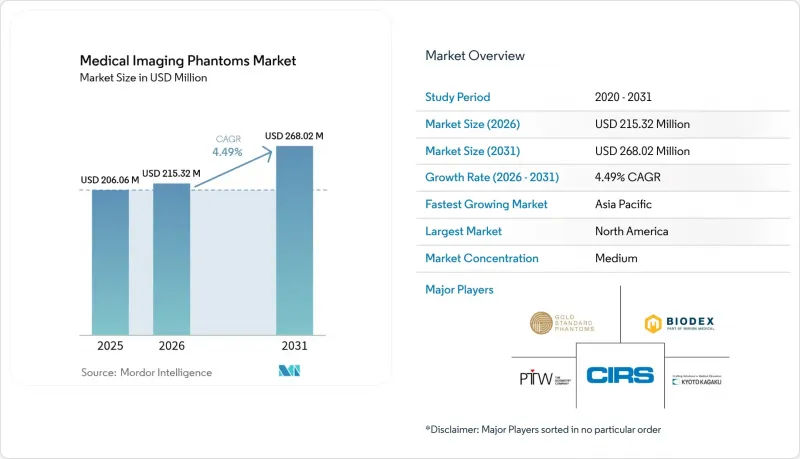
Mordor Intelligence에 의하면, 의료 영상 팬텀 시장 규모는 2025년 2억 606만 달러로 평가되었습니다. 2026년에는 2억 1,532만 달러로 확대되어 2026-2031년에 걸쳐 CAGR 4.49%로 성장을 지속하여, 2031년까지 2억 6,802만 달러에 이를 것으로 예측됩니다.
본 보고서는 제품 유형(X선 팬텀, CT 팬텀, 초음파 팬텀, MRI 팬텀, 핵의학 영상 팬텀, 기타), 소재(자극 장치, 인공 장기(인체형), 기타), 최종 사용자(병원, 영상 센터, 기타),지역(북미, 유럽, 기타)별로 분류되어 있습니다. 시장 예측은 금액(달러) 기준으로 제시되어 있습니다.
세계의 의료 영상 팬텀 시장 동향 및 인사이트
가치 기반 보상 프로그램에서 품질 보증(QA) 기준의 강화
메디케어·메디케이드 서비스 센터(CMS)가 2027년부터 시행하는 CT 팬텀 평가 의무화에 따라, 검사 대상물은 ‘모범 사례의 보조 도구’에서 ‘규정 준수의 핵심 도구’로 전환됩니다. 미국 방사선학회(ACR)의 ARCH-AI 프레임워크는 표준화된 팬텀 실행을 AI 검증 워크플로우에 더욱 통합하여, 알고리즘의 신뢰성을 팬텀을 통해 검증된 지표와 연계하고 있습니다. 현재 의료 기관들은 팬텀 구매를 재량적 지출이 아닌 수익 보호를 위한 투자로 간주하고 있으며, 이것이 의료 영상 팬텀 시장의 기반이 되고 있습니다. 메디케어 어드밴티지 플랜의 품질 기반 보너스 제도는 기록된 영상의 일관성을 평가하여 보상을 제공함으로써 팬텀 도입을 더욱 촉진하고 있습니다.
3D 프린팅을 통한 모달리티 독립형 팬텀 채택의 급증
적층 가공 기술을 통해 기하학적 공차 0.1mm 이내의 환자별 복제본을 제조할 수 있게 되었으며, 새로운 PLA-PCL 혼합 소재는 한 번의 제조 공정으로 CT, MRI, 초음파의 콘트라스트를 동시에 유지합니다. 광학 영상 팬텀에 초점을 맞춘 산학 공동 연구센터에 대한 미국 국립보건원(NIH)의 지원은 연방 정부의 지속적인 후원을 보여줍니다. 복잡한 인체 모사 장치의 제조 비용은 현재 250달러 이하로 떨어졌으며, 제조 기간도 수개월에서 수일로 단축되었습니다. 다중 에너지 보정이 필요한 하이브리드 PET/MR 및 광음향 시스템을 통해 개발자들은 모달리티 독립형 팬텀 설계를 추진하고 있으며, 이로 인해 전 세계 의료 영상 팬텀 시장 규모가 확대되고 있습니다. 또한 데스크톱형 스테레오 리소그래피 프린터의 진입 가격 하락으로 인해 중규모 방사선과 그룹도 병원 내에서 제조가 가능해져 조달 주기가 단축되고 있습니다.
자본 집약적인 맞춤형 팬텀 프로토타이핑
환자별 맞춤형 인체 모사 팬텀의 개발에는 영상화, 분할, 다중 재료 인쇄, 검증 비용이 소요되므로 5만 달러를 초과하는 경우도 있습니다. 소규모 공급업체는 틈새 모달리티에서 비용을 회수하기 어렵고, 그 결과 산업 재편이나 혁신 둔화로 이어지고 있습니다. 학술 연구팀은 성능이 제각각인 자체 제작 키트를 즉흥적으로 만드는 경우가 많아, 기관 간 비교 가능성을 저해하고 있습니다. 이러한 자본적 장벽이 전문 분야 내 의료 영상 팬텀 시장의 확장을 가로막고 있습니다.
부문별 분석
2025년, X선 팬텀은 의료 영상 팬텀 시장의 38.72%를 차지했으며, 이는 유방촬영술 관련 규정에 따라 검사 대상의 정기적인 스캔이 의무화되어 있음을 뒷받침합니다. 전 세계 디지털 X선 촬영실 도입 대수가 다른 모달리티를 크게 상회하고 있어 수요는 안정적인 상태입니다. CT 부문은 새로운 선량 모니터링 규정이 시행됨에 따라 연평균 성장률(CAGR) 6.14%로 확대되고 있으며, 이는 규제 체계의 진화가 슬라이스 기반 영상 분야에서 의료 영상 팬텀 시장 규모를 지속적으로 재편하고 있음을 반영합니다.
각 제조업체는 하나의 쉘에 X선용 및 CT용 인서트를 내장한 복합 팬텀을 개발함으로써 혁신을 꾀하고 있으며, 이를 통해 소규모 클리닉의 재고 요구 사항을 줄이고 있습니다. 초음파 팬텀 제조업체는 간, 갑상선, 근골격계 평가로의 임상적 확장에 대응하기 위해 엘라스토그래피 기능에 주력하고 있습니다. MRI 팬텀에 대한 수요는 헬륨 공급 문제로 인해 스캐너 설치가 정체되어 여전히 불안정하지만, 정량적 영상 바이오마커가 확산과 T1/T2 보정 세트에 대한 관심을 높이고 있습니다. 핵의학 팬텀은 정확한 선량 측정이 표준 치료법이 된 테라노스틱스의 성장에 따라 안정적인 수주를 유지하고 있습니다.
지역별 분석
2025년, 북미는 의료 영상 팬텀 시장의 36.74%를 차지하며 시장을 선도했습니다. 이는 FDA의 엄격한 기기 성능 규제와 빈번한 품질 보증(QA) 주기를 완수하는 촘촘한 영상 센터 네트워크를 반영한 것입니다. 병원들은 ARCH-AI 프로그램을 준수하기 위해 AI 연동형 팬텀에 투자하고 있으며, 이것이 교체 수요의 기반이 되고 있습니다. 정부의 품질 향상 인센티브가 인건비 상승을 상쇄하여 공급업체의 건전한 이익률을 유지하고 있습니다.
아시아태평양은 대규모 병원 건설과 지방 의료 센터의 디지털 영상 전환에 힘입어 연평균 성장률(CAGR) 6.05%로 가장 빠르게 성장하고 있는 지역입니다. 중국에서는 복잡한 다중 모달리티 팬텀이 필요한 하이브리드 PET/MR 도입에 자금이 투입되고 있는 반면, 인도의 국가검사인증위원회(NABT)는 승인 전에 문서화된 품질 보증(QA)을 의무화하고 있습니다. 선전이나 오사카와 같은 현지 제조 클러스터 덕분에 수입 관세는 낮아졌지만, 고급 인서트의 경우 여전히 미국이나 유럽공급원에 의존하고 있어 의료 영상 팬텀 시장의 국제 무역 흐름이 유지되고 있습니다.
유럽에서는 의료기기 규정(MDR)에 따라 품질 보증용 액세서리의 추적성이 의무화됨에 따라 꾸준한 성장이 나타나고 있습니다. 독일과 영국은 생체 흡수성 팬텀 소재를 개발하는 연구개발(R&D) 파트너십을 주도하고 있는 반면, 스칸디나비아의 의료 기관들은 중앙 집중형 물리학 허브와 연계된 팬텀 원격 모니터링을 선구적으로 도입하고 있습니다. 중동 및 아프리카에서는 걸프 지역 국가들의 병원이 지역 의료 관광의 중심지로서의 입지를 확고히 하고 영상 진단 품질 기준을 높이고 있어 새로운 수요가 창출되고 있습니다. 남미에서는 재정적 제약으로 인해 성장 속도가 완만하지만, 브라질의 민간 종양학 부문에서는 틈새 시장 수주가 증가하고 있습니다.
기타 혜택
- 엑셀 형식 시장 예측(ME) 시트
- 3개월간의 애널리스트 지원
자주 묻는 질문
목차
제1장 서론
제2장 조사 방법
제3장 주요 요약
제4장 시장 구도
제5장 시장 규모 및 성장 예측
제6장 경쟁 구도
제7장 시장 기회 및 향후 전망
KTHAccording to Mordor Intelligence, the medical imaging phantoms market size is expected to grow from USD 206.06 million in 2025 to USD 215.32 million in 2026 and is forecast to reach USD 268.02 million by 2031 at 4.49% CAGR over 2026-2031.
This report is Segmented by Product Type (X-Ray Phantoms, CT Phantoms, Ultrasound Phantoms, MRI Phantoms, Nuclear Imaging Phantoms, and Others), Material (Stimulating Devices, False Organs (Anthropomorphic) and Other Materials), End User (Hospitals, Diagnostic Imaging Centers, and More), and Geography (North America, Europe, and More). The Market Forecasts are Provided in Terms of Value (USD).
Global Medical Imaging Phantoms Market Trends and Insights
Escalating QA-Stringency of Value-Based Reimbursement Programs
Mandatory CT phantom assessments that the Centers for Medicare & Medicaid Services will enforce from 2027 convert test objects from best-practice accessories into core compliance tools. The American College of Radiology ARCH-AI framework further embeds standardized phantom runs into AI validation workflows, tying algorithm reliability to phantom-verified metrics. Health systems now regard phantom purchases as revenue-protection spend, not discretionary outlays, anchoring the medical imaging phantoms market. Quality-based bonus pools in Medicare Advantage plans intensify uptake by rewarding documented imaging consistency.
Surging Adoption of 3-D Printed, Modality-Agnostic Phantoms
Additive manufacturing delivers patient-specific replicas within 0.1 mm geometric tolerance, while new PLA-PCL blends maintain CT, MRI, and ultrasound contrast in a single build. NIH support for an Industry-University Cooperative Research Center focused on optical imaging phantoms signals sustained federal backing. Production of complex anthropomorphic units now costs under USD 250 and finishes in days instead of months. Hybrid PET/MR and photoacoustic systems that need multi-energy calibration spur developers to design modality-agnostic phantoms, broadening the global medical imaging phantoms market footprint. The lower entry price of desktop stereolithography printers also empowers mid-tier radiology groups to fabricate on-site, shortening procurement cycles.
Capital-Intensive Custom Phantom Prototyping
Developing a patient-specific anthropomorphic phantom can exceed USD 50,000 due to imaging, segmentation, multi-material printing, and validation costs. Small suppliers find it difficult to recoup expenses in niche modalities, leading to consolidation and slower innovation. Academic teams often improvise do-it-yourself kits that vary in performance, undermining cross-site comparability. This capital barrier curbs the medical imaging phantoms market expansion in subspecialty domains.
Other drivers and restraints analyzed in the detailed report include:
- Rising Installation of Hybrid PET/CT & PET/MR Scanners
- AI-Enabled Auto-QA Workflows Cutting Test-Cycle Time
- Scarcity of Elastography-Grade Tissue-Mimicking Polymers
For complete list of drivers and restraints, kindly check the Table Of Contents.
Segment Analysis
X-ray phantoms held 38.72% of the medical imaging phantoms market in 2025, a testament to mammography regulations that mandate routine test object scanning. Demand remains stable because the global installed base of digital radiography rooms vastly exceeds that of other modalities. The CT segment is picking up at a 6.14% CAGR as new dose-monitoring rules take effect, reflecting how evolving regulatory frameworks continuously reshape the medical imaging phantoms market size for slice-based imaging.
Manufacturers innovate with combination phantoms that house X-ray and CT inserts in one shell, lowering inventory requirements for smaller clinics. Ultrasound phantom makers focus on elastography features to match clinical expansion into liver, thyroid, and musculoskeletal assessments. MRI phantom demand remains uneven as helium supply challenges stall scanner installations, although quantitative imaging biomarkers spur interest in diffusion and T1/T2 calibration sets. Nuclear medicine phantoms chart steady orders tied to theranostic growth, where precise dosimetry becomes standard of care.
Complete Report Scope:
- By Product Type
- X-ray Phantoms
- CT Phantoms
- Ultrasound Phantoms
- MRI Phantoms
- Nuclear Imaging Phantoms
- Others
- By Material
- Stimulating Devices
- False Organs (Anthropomorphic)
- Other Materials
- By End User
- Hospitals
- Diagnostic Imaging Centers
- Other End Users
- By Geography
- North America
- United States
- Canada
- Mexico
- Europe
- Germany
- United Kingdom
- France
- Italy
- Spain
- Rest of Europe
- Asia Pacific
- China
- Japan
- India
- Australia
- South Korea
- Rest of Asia Pacific
- Middle East and Africa
- GCC
- South Africa
- Rest of Middle East and Africa
- South America
- Brazil
- Argentina
- Rest of South America
- North America
Geography Analysis
North America dominated with 36.74% of the medical imaging phantoms market in 2025, reflecting stringent FDA equipment performance rules and a dense imaging center network that completes frequent QA cycles. Hospitals invest in AI-linked phantoms to align with the ARCH-AI program, anchoring replacement demand. Government quality incentives compensate for higher labor costs, preserving healthy margins for suppliers.
Asia Pacific is the fastest-growing region at a 6.05% CAGR, supported by large-scale hospital build-outs and the transition of provincial centers to digital imaging. China funds hybrid PET/MR rollouts that need complex multimodality phantoms, while India's National Accreditation Board for Testing mandates documented QA before licensure. Local manufacturing clusters in Shenzhen and Osaka lower import duties, yet premium inserts still rely on U.S. and European sources, sustaining international trade flows in the medical imaging phantoms market.
Europe posts steady gains as the Medical Device Regulation enforces traceability for QA accessories. Germany and the United Kingdom lead R&D partnerships that develop bio-resorbable phantom materials, while Scandinavian clinics pioneer remote phantom monitoring linked to centralized physics hubs. Middle East and Africa register emerging demand as Gulf hospitals position themselves as regional medical tourism centers, raising imaging quality benchmarks. South America grows more slowly due to fiscal constraints, although niche orders rise in Brazil's private oncology sector.
- Bartec Technologies
- Biodex Medical Systems
- Carville
- Computerized Imaging Reference Systems (CIRS)
- Gold Standard Phantoms
- Kyoto Kagaku
- Leeds Test Objects
- Modus Medical Devices
- PTW Freiburg
- Pure Imaging Phantoms
- QUART
- True Phantom Solutions
- Dielectric Corporation
- The Phantom Laboratory
- QRM GmbH
- Capintec
- Radcal
- PhantomX
Additional Benefits:
- The market estimate (ME) sheet in Excel format
- 3 months of analyst support
TABLE OF CONTENTS
1 Introduction
- 1.1 Study Assumptions & Market Definition
- 1.2 Scope of the Study
2 Research Methodology
3 Executive Summary
4 Market Landscape
- 4.1 Market Overview
- 4.2 Market Drivers
- 4.2.1 Escalating QA-stringency of value-based reimbursement programs
- 4.2.2 Surging adoption of 3-D printed, modality-agnostic phantoms
- 4.2.3 Rising installation of hybrid PET/CT & PET/MR scanners
- 4.2.4 Expanding radiology capacity in ambulatory imaging centers
- 4.2.5 AI-enabled auto-QA workflows cutting test-cycle time
- 4.2.6 Growing grant funding for photo-acoustic tomography validation
- 4.3 Market Restraints
- 4.3.1 Capital-intensive custom phantom prototyping
- 4.3.2 Scarcity of elastography-grade tissue-mimicking polymers
- 4.3.3 Limited physicist bandwidth for advanced QA protocols
- 4.3.4 Supply-chain volatility for high-purity radioactive gels
- 4.4 Regulatory Landscape
- 4.5 Technological Outlook
- 4.6 Porter's Five Forces Analysis
- 4.6.1 Threat of New Entrants
- 4.6.2 Bargaining Power of Buyers
- 4.6.3 Bargaining Power of Suppliers
- 4.6.4 Threat of Substitutes
- 4.6.5 Competitive Rivalry
5 Market Size & Growth Forecasts (Value)
- 5.1 By Product Type
- 5.1.1 X-ray Phantoms
- 5.1.2 CT Phantoms
- 5.1.3 Ultrasound Phantoms
- 5.1.4 MRI Phantoms
- 5.1.5 Nuclear Imaging Phantoms
- 5.1.6 Others
- 5.2 By Material
- 5.2.1 Stimulating Devices
- 5.2.2 False Organs (Anthropomorphic)
- 5.2.3 Other Materials
- 5.3 By End User
- 5.3.1 Hospitals
- 5.3.2 Diagnostic Imaging Centers
- 5.3.3 Other End Users
- 5.4 By Geography
- 5.4.1 North America
- 5.4.1.1 United States
- 5.4.1.2 Canada
- 5.4.1.3 Mexico
- 5.4.2 Europe
- 5.4.2.1 Germany
- 5.4.2.2 United Kingdom
- 5.4.2.3 France
- 5.4.2.4 Italy
- 5.4.2.5 Spain
- 5.4.2.6 Rest of Europe
- 5.4.3 Asia Pacific
- 5.4.3.1 China
- 5.4.3.2 Japan
- 5.4.3.3 India
- 5.4.3.4 Australia
- 5.4.3.5 South Korea
- 5.4.3.6 Rest of Asia Pacific
- 5.4.4 Middle East and Africa
- 5.4.4.1 GCC
- 5.4.4.2 South Africa
- 5.4.4.3 Rest of Middle East and Africa
- 5.4.5 South America
- 5.4.5.1 Brazil
- 5.4.5.2 Argentina
- 5.4.5.3 Rest of South America
- 5.4.1 North America
6 Competitive Landscape
- 6.1 Market Concentration
- 6.2 Market Share Analysis
- 6.3 Company Profiles (includes Global level Overview, Market level overview, Core Segments, Financials as available, Strategic Information, Market Rank/Share for key companies, Products & Services, and Recent Developments)
- 6.3.1 Bartec Technologies
- 6.3.2 Biodex Medical Systems
- 6.3.3 Carville
- 6.3.4 Computerized Imaging Reference Systems (CIRS)
- 6.3.5 Gold Standard Phantoms
- 6.3.6 Kyoto Kagaku
- 6.3.7 Leeds Test Objects
- 6.3.8 Modus Medical Devices
- 6.3.9 PTW Freiburg
- 6.3.10 Pure Imaging Phantoms
- 6.3.11 QUART GmbH
- 6.3.12 True Phantom Solutions
- 6.3.13 Dielectric Corporation
- 6.3.14 The Phantom Laboratory
- 6.3.15 QRM GmbH
- 6.3.16 Capintec
- 6.3.17 Radcal
- 6.3.18 PhantomX
7 Market Opportunities & Future Outlook
- 7.1 White-space & Unmet-need Assessment