|
시장보고서
상품코드
2087736
박막 배터리 및 프린티드 배터리 시장 : 배터리 유형, 재료, 출력, 셀 타입, 용도별 - 시장 예측(2026-2032년)Thin Film & Printed Battery Market by Battery Type, Material, Power Output, Cell Type, Application - Global Forecast 2026-2032 |
||||||
 360iResearch
박막 배터리 및 프린티드 배터리 시장은 2032년까지 연평균 복합 성장률(CAGR) 19.26%로 9억 7,692만 달러에 달할 것으로 예측됩니다.
| 주요 시장 통계 | |
|---|---|
| 기준 연도 : 2025년 | 2억 8,468만 달러 |
| 추정 연도 : 2026년 | 3억 3,900만 달러 |
| 예측 연도 : 2032년 | 9억 7,692만 달러 |
| CAGR(%) | 19.26% |
박막·인쇄형 전지 시장 개요
박막 및 프린티드 배터리 시장은 틈새 부품 카테고리에서 벗어나, 플렉서블 전자기기, 의료용 웨어러블 기기, 스마트 라벨, 무선 센서, 그리고 초저전력 IoT 기기의 구현을 가능하게 하는 핵심 요소로 자리매김하고 있습니다. 기존의 원통형이나 파우치형 배터리와는 달리, 박막 배터리 및 프린티드 배터리는 폼 팩터, 유연성, 안전성, 얇은 두께에서의 통합, 그리고 롤-투-롤 방식 및 적층 가공 공정과의 호환성을 중시하여 설계되었습니다.
박막·인쇄형 배터리 시장의 획기적인 변화
프린트 전자공학, 고체 배터리 화학, 그리고 저파워 반도체 설계의 융합으로 인해 시장 구도가 재편되고 있습니다. OEM 업체들은 더 이상 배터리를 독립된 부품으로 평가하지 않고, 제품 개발 초기 단계부터 기판, 센서 패치, RFID 라벨, 스마트 카드, 의료기기, 플렉서블 디스플레이에 전원을 통합하는 설계를 진행하고 있습니다.
박막 및 인쇄형 전지에 대한 인공지능의 누적 영향
인공지능(AI)은 소재 발굴, 코팅 최적화, 품질 검사 및 수명 주기 예측 과정에서 시행착오를 줄임으로써 박막 및 프린트형 전지의 밸류체인을 가속화하고 있습니다. AI를 활용한 재료 정보학을 통해, 기존의 실험실에서 수행하던 반복 작업보다 더 신속하게 전극, 전해질, 분리막, 집전체의 조합을 선별할 수 있게 됩니다. 또한, 머신러닝 모델은 도막 두께의 일관성, 밀착성, 이온 전도도 및 사이클 안정성을 향상시키는 가공 조건을 파악하는 데 도움이 됩니다.
박막 및 인쇄형 전지 수요에 관한 주요 지역별 분석
아시아태평양은 대량 생산되는 전자 제품, 첨단 디스플레이 공급망, 프린티드 전자 기술력, 그리고 웨어러블 기기, 센서, 스마트 카드, 커넥티드 헬스케어 기기에 대한 활발한 수요가 맞물려 박막 및 프린티드 배터리의 주요 성장 동력이 되고 있습니다. 중국, 일본, 한국, 인도, 호주는 소재 가공 및 소비자용 전자제품부터 의료 기술, 원격 모니터링, 산업용 IoT 도입에 이르기까지 각자의 강점을 살려 시장에 기여하고 있습니다.
전략적 시장 우선순위 설정에 관한 주요 그룹별 인사이트
아세안(ASEAN)은 전자기기 조립, 패키징 생산 및 커넥티드 소비자용 기기에 대한 수요 증가의 혜택을 누리고 있으며, 이 지역은 스마트 라벨, 웨어러블 기기, 물류용 센서에 인쇄형 배터리를 탑재하는 데 있어 매력적인 거점으로 부상하고 있습니다. 이러한 제조 생태계는 유연한 형상과 확장 가능한 인쇄 공정이 중요한, 비용 효율성을 중시하는 응용 분야를 뒷받침하고 있습니다.
박막·인쇄형 배터리 도입에 관한 주요 국가들의 동향
미국은 강력한 대학, 국립 연구소, 벤처 생태계의 지원을 바탕으로 의료용 웨어러블, 방위용 전자기기, 반도체를 활용한 IoT, 그리고 첨단 소재 연구와 같은 고부가가치 분야에서 주도적인 역할을 수행하고 있습니다. 캐나다는 청정 기술, 의료 혁신, 산업용 모니터링을 통해 기여하고 있는 반면, 멕시코의 전자기기 제조 거점은 스마트 라벨, 카드, 센서 탑재 제품의 지역 공급망 통합을 뒷받침하고 있습니다.
박막·인쇄형 전지 분야의 선도 기업을 위한 실천적 제안
업계 선도 기업들은 단순히 에너지 밀도만으로 경쟁하기보다는 용도에 특화된 설계를 우선시해야 합니다. 가장 큰 기회는 얇은 두께, 유연성, 안전성, 낮은 누출률, 긴 보관 기간 및 직접 통합을 통해 측정 가능한 제품적 우위를 창출하는 이용 사례에 있습니다.
박막·인쇄형 전지 분석을 위한 조사 기법
본 요약 보고서는 박막 및 프린트 전지 생태계 전반에 걸친 기술 도입 현황, 밸류체인 동향, 규제상의 촉진요인 및 최종 용도 수요를 평가하기 위해 활용된 체계적인 1차 및 2차 조사 프레임워크를 기반으로 합니다. 2차 조사의 정보 출처에는 정부 에너지 기관, 배터리 안전 기준 제정 기관, 특허 데이터베이스, 동료 심사를 거친 학술지, 업계 단체 및 규제 관련 간행물에서 얻을 수 있는 공개 정보가 포함됩니다.
결론: 박막·인쇄 전지의 전략적 전망
박막 및 프린트 전지는 차세대 유연하고, 네트워크에 연결되며, 소형화된 기기에 있어 필수적인 요소로 자리 잡고 있습니다. 이러한 가치 제안은 기존 배터리가 설계의 자유도, 안전성, 무게, 폐기 용이성, 혹은 얇은 기판에의 통합 측면에서 제약이 되는 분야에서 가장 두드러지게 발휘됩니다.
자주 묻는 질문
목차
제1장 서문
제2장 조사 방법
제3장 주요 요약
제4장 시장 개요
제5장 시장 인사이트
제6장 AI의 누적 영향, 2026년
제7장 박막 배터리 및 프린티드 배터리 시장 : 배터리 유형별
제8장 박막 배터리 및 프린티드 배터리 시장 : 재료별
제9장 박막 배터리 및 프린티드 배터리 시장 : 출력별
제10장 박막 배터리 및 프린티드 배터리 시장 : 셀 타입별
제11장 박막 배터리 및 프린티드 배터리 시장 : 용도별
제12장 박막 배터리 및 프린티드 배터리 시장 : 지역별
제13장 박막 배터리 및 프린티드 배터리 시장 : 그룹별
제14장 박막 배터리 및 프린티드 배터리 시장 : 국가별
제15장 경쟁 구도
제16장 기업 개요
LSH 26.07.22The Thin Film & Printed Battery Market is projected to grow by USD 976.92 million at a CAGR of 19.26% by 2032.
| KEY MARKET STATISTICS | |
|---|---|
| Base Year [2025] | USD 284.68 million |
| Estimated Year [2026] | USD 339.00 million |
| Forecast Year [2032] | USD 976.92 million |
| CAGR (%) | 19.26% |
Thin Film & Printed Battery Market Introduction
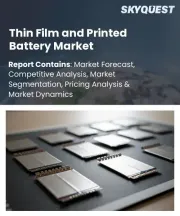
The thin film and printed battery market is moving from a niche component category into a critical enabler of flexible electronics, medical wearables, smart labels, wireless sensors, and ultra-low-power Internet of Things devices. Unlike conventional cylindrical or pouch cells, thin film batteries and printed batteries are designed around form factor, bendability, safety, low-profile integration, and compatibility with roll-to-roll or additive manufacturing processes.
Demand is being reinforced by verified technology trends, including expanding connected-device deployments, miniaturized healthcare monitoring, edge sensing, and the need for safer solid-state energy storage in compact devices. Solid-state thin film batteries, zinc-based printed batteries, lithium microbatteries, and flexible rechargeable formats are gaining attention where energy density, footprint, shelf life, and device integration matter as much as cost per watt-hour.
Transformative Shifts in the Thin Film & Printed Battery Landscape
The market landscape is being reshaped by the convergence of printed electronics, solid-state battery chemistry, and low-power semiconductor design. OEMs are no longer evaluating batteries as standalone components; they are designing power sources into substrates, sensor patches, RFID labels, smart cards, medical devices, and flexible displays at the earliest product-development stage.
Manufacturing strategy is also shifting. Roll-to-roll printing, screen printing, sputtering, and physical vapor deposition are being optimized to improve electrode uniformity, production throughput, and device reliability. At the same time, regulatory scrutiny around battery safety, recyclability, and critical minerals is pushing suppliers toward safer chemistries, thinner solid electrolytes, and battery designs that reduce leakage and flammability risk.
Commercial adoption is strongest where conventional batteries restrict product design, including disposable and semi-disposable medical sensors, logistics condition-monitoring tags, consumer wearables, hearing devices, cosmetic patches, smart packaging, and industrial wireless sensing networks. The result is a more application-specific market in which customization, substrate compatibility, and integration support are decisive competitive factors.
Cumulative Impact of Artificial Intelligence on Thin Film & Printed Batteries
Artificial intelligence is accelerating the thin film and printed battery value chain by reducing trial-and-error in materials discovery, coating optimization, quality inspection, and lifecycle prediction. AI-enabled materials informatics can screen electrode, electrolyte, separator, and current-collector combinations faster than conventional laboratory iteration, while machine-learning models help identify processing windows that improve film thickness consistency, adhesion, ionic conductivity, and cycle stability.
In manufacturing, computer vision and predictive analytics are improving yield by detecting microcracks, pinholes, delamination, registration errors, and coating defects during high-speed production. These capabilities are especially relevant for printed batteries because small deviations in layer geometry can affect internal resistance, capacity, and safety.
AI is also strengthening downstream adoption. Digital twins, embedded battery diagnostics, and predictive maintenance models allow device makers to estimate performance under temperature, humidity, bending, and duty-cycle stress. For industry leaders, the cumulative impact is clear: AI is becoming a practical tool to shorten R&D cycles, lower scrap rates, improve certification readiness, and support scalable production of reliable flexible power sources.
Key Regional Insights Across Thin Film & Printed Battery Demand
Asia-Pacific is a central growth engine for thin film and printed batteries because it combines high-volume electronics manufacturing, advanced display supply chains, printed electronics capability, and strong demand for wearables, sensors, smart cards, and connected healthcare devices. China, Japan, South Korea, India, and Australia contribute through different strengths, from materials processing and consumer electronics to medical technology, remote monitoring, and industrial IoT deployment.
North America is defined by strong R&D activity, medical device innovation, defense electronics, semiconductor design, and early adoption of industrial sensing. The United States and Canada benefit from university research, national laboratory programs, venture-backed hardware development, and demand from healthcare, aerospace, logistics, and smart infrastructure applications.
Latin America is emerging through smart packaging, agricultural monitoring, asset tracking, and healthcare access applications, with Brazil and Mexico standing out as demand centers due to manufacturing scale and expanding digital supply chains. Europe is shaped by sustainability regulation, advanced manufacturing, medical technology, automotive electronics, and strong printed electronics research, with the European Union's battery policy framework reinforcing circularity, safety, and traceability across the value chain.
The Middle East is gaining relevance through smart city programs, logistics modernization, healthcare digitization, and energy-infrastructure monitoring, especially across GCC economies. Africa is earlier in adoption but offers long-term opportunities in medical diagnostics, cold-chain monitoring, agriculture sensors, and distributed infrastructure, where low-cost, thin, and safe power sources can support connected services.
Key Group Insights for Strategic Market Prioritization
ASEAN benefits from electronics assembly, packaging production, and growing demand for connected consumer devices, making the region an attractive base for printed battery integration in smart labels, wearables, and logistics sensors. Its manufacturing ecosystem supports cost-sensitive applications where flexible form factors and scalable printing processes are important.
The GCC is increasingly relevant as smart city, healthcare, logistics, and infrastructure monitoring programs expand across Saudi Arabia, the United Arab Emirates, Qatar, and neighboring economies. Thin film and printed batteries align with sensor networks used in asset tracking, environmental monitoring, connected buildings, and critical infrastructure applications.
The European Union is one of the most influential policy and technology blocs for this market because its battery regulations emphasize sustainability, safety, recycling, carbon footprint reporting, and supply-chain transparency. These priorities favor suppliers that can demonstrate safer materials, low-waste manufacturing, and compliance-ready designs.
BRICS economies represent both manufacturing scale and large end-market potential. China and India are especially important for electronics, healthcare access, and IoT growth, while Brazil and South Africa support opportunities in agriculture, logistics, and distributed monitoring. The G7 remains central to advanced R&D, medical devices, defense electronics, and premium consumer technology, while NATO-related demand supports ruggedized sensors, secure communications devices, and lightweight power sources for defense and field operations.
Key Country Insights in Thin Film & Printed Battery Adoption
The United States leads in high-value applications across medical wearables, defense electronics, semiconductor-enabled IoT, and advanced materials research, supported by strong university, national laboratory, and venture ecosystems. Canada contributes through clean technology, medical innovation, and industrial monitoring, while Mexico's electronics manufacturing base supports regional supply-chain integration for smart labels, cards, and sensor-enabled products.
Brazil is the leading Latin American opportunity due to its scale in agriculture, logistics, healthcare, and consumer markets. In Europe, the United Kingdom supports innovation through medtech, flexible electronics research, and specialty manufacturing; Germany anchors demand through industrial automation, automotive electronics, and precision engineering; France contributes through aerospace, defense, healthcare, and smart card ecosystems; Italy and Spain support adoption in packaging, wearables, and industrial applications. Russia maintains technical capabilities in materials science and defense-related electronics, though market access and supply-chain participation are shaped by geopolitical constraints.
China is a major force due to its electronics manufacturing depth, battery supply chain, printed electronics capability, and large domestic demand for connected devices. India is expanding through digital health, IoT, smart logistics, and electronics manufacturing incentives. Japan remains important for miniaturization, materials precision, medical electronics, and solid-state battery expertise. Australia contributes through mining, remote monitoring, healthcare technology, and research partnerships, while South Korea is highly relevant in displays, semiconductors, wearables, and advanced battery materials.
Actionable Recommendations for Thin Film & Printed Battery Leaders
Industry leaders should prioritize application-specific design rather than competing only on energy density. The strongest opportunities are in use cases where thinness, flexibility, safety, low leakage, long shelf life, and direct integration create measurable product advantages.
Battery developers should deepen partnerships with medical device manufacturers, printed electronics firms, semiconductor companies, packaging converters, and IoT platform providers. Early co-design improves form factor compatibility, regulatory readiness, and total system performance.
Manufacturers should invest in AI-enabled process control, inline inspection, and roll-to-roll quality systems to improve yield and scalability. Companies should also build compliance roadmaps around battery safety, transport rules, chemical restrictions, recyclability, and customer documentation requirements.
Commercial teams should segment the market by duty cycle, rechargeability, substrate, temperature exposure, and disposal requirements. This helps align chemistries and production methods with profitable applications such as medical patches, logistics indicators, smart cards, asset tags, and industrial sensors.
Research Methodology for Thin Film & Printed Battery Analysis
This executive summary is based on a structured secondary and primary research framework used to evaluate technology adoption, value-chain dynamics, regulatory drivers, and end-use demand across the thin film and printed battery ecosystem. Secondary inputs include publicly available information from government energy agencies, battery safety standards bodies, patent databases, peer-reviewed journals, trade associations, and regulatory publications.
Primary validation typically includes interviews and discussions with battery material suppliers, printed electronics specialists, device OEMs, contract manufacturers, research institutions, distributors, and end-user organizations. Insights are triangulated across application demand, manufacturing feasibility, supply-chain readiness, and policy developments to reduce bias and support data-backed conclusions.
Market interpretation emphasizes verified indicators such as connected-device adoption, medical wearable growth, printed electronics commercialization, semiconductor miniaturization, sustainability regulation, and manufacturing investment rather than unsupported market-size claims. This approach supports an authoritative view of where thin film batteries and printed batteries are commercially viable today and where adoption is likely to accelerate.
Conclusion: Strategic Outlook for Thin Film & Printed Batteries
Thin film and printed batteries are becoming essential for the next generation of flexible, connected, and miniaturized devices. Their value proposition is strongest where conventional batteries limit design freedom, safety, weight, disposability, or integration into thin substrates.
The market is being shaped by advances in solid-state materials, printed electronics manufacturing, AI-enabled process control, and rising demand for connected healthcare, smart packaging, logistics visibility, and industrial IoT. Regional momentum is strongest in Asia-Pacific, North America, and Europe, while Latin America, the Middle East, and Africa present targeted opportunities in sensing, healthcare, and infrastructure monitoring.
Organizations that combine reliable chemistry, scalable manufacturing, compliance readiness, and co-design partnerships will be best positioned to capture opportunities in the evolving thin film and printed battery market.
Table of Contents
1. Preface
- 1.1. Objectives of the Study
- 1.2. Market Definition
- 1.3. Market Segmentation & Coverage
- 1.4. Years Considered for the Study
- 1.5. Currency Considered for the Study
- 1.6. Language Considered for the Study
- 1.7. Key Stakeholders
2. Research Methodology
- 2.1. Introduction
- 2.2. Research Design
- 2.2.1. Primary Research
- 2.2.2. Secondary Research
- 2.3. Research Framework
- 2.3.1. Qualitative Analysis
- 2.3.2. Quantitative Analysis
- 2.4. Market Size Estimation
- 2.4.1. Top-Down Approach
- 2.4.2. Bottom-Up Approach
- 2.5. Data Triangulation
- 2.6. Research Outcomes
- 2.7. Research Assumptions
- 2.8. Research Limitations
3. Executive Summary
- 3.1. Introduction
- 3.2. CXO Perspective
- 3.3. Market Size & Growth Trends
- 3.4. Market Share Analysis, 2025
- 3.5. FPNV Positioning Matrix, 2025
- 3.6. New Revenue Opportunities
- 3.7. Next-Generation Business Models
- 3.8. Industry Roadmap
4. Market Overview
- 4.1. Introduction
- 4.2. Industry Ecosystem & Value Chain Analysis
- 4.2.1. Supply-Side Analysis
- 4.2.2. Demand-Side Analysis
- 4.2.3. Stakeholder Analysis
- 4.3. Market Dynamics
- 4.3.1. Key Drivers
- 4.3.2. Key Restraints
- 4.3.3. Key Opportunities
- 4.3.4. Key Challenges
- 4.4. Porter's Five Forces Analysis
- 4.5. PESTLE Analysis
- 4.6. Market Outlook
- 4.6.1. Near-Term Market Outlook (0-2 Years)
- 4.6.2. Medium-Term Market Outlook (3-5 Years)
- 4.6.3. Long-Term Market Outlook (5-10 Years)
- 4.7. Go-to-Market Strategy
5. Market Insights
- 5.1. Consumer Insights & End-User Perspective
- 5.2. Consumer Experience Benchmarking
- 5.3. Opportunity Mapping
- 5.4. Distribution Channel Analysis
- 5.5. Pricing Trend Analysis
- 5.6. Regulatory Compliance & Standards Framework
- 5.7. ESG & Sustainability Analysis
- 5.8. Disruption & Risk Scenarios
- 5.9. Return on Investment & Cost-Benefit Analysis
6. Cumulative Impact of Artificial Intelligence 2026
7. Thin Film & Printed Battery Market, by Battery Type
- 7.1. Printed
- 7.2. Thin Film
8. Thin Film & Printed Battery Market, by Material
- 8.1. Lithium Ion Polymer
- 8.1.1. Lithium Cobalt Oxide
- 8.1.2. Lithium Iron Phosphate
- 8.1.3. Lithium Manganese Oxide
- 8.2. Nickel Metal Hydride
- 8.3. Solid State
- 8.3.1. Oxide Electrolytes
- 8.3.2. Polymer Electrolytes
- 8.3.3. Sulfide Electrolytes
- 8.4. Zinc Air
9. Thin Film & Printed Battery Market, by Power Output
- 9.1. 10-100 Mw
- 9.2. <10 Mw
- 9.3. >100 Mw
10. Thin Film & Printed Battery Market, by Cell Type
- 10.1. Primary
- 10.2. Secondary
- 10.2.1. Rechargeable Printed
- 10.2.2. Rechargeable Thin Film
11. Thin Film & Printed Battery Market, by Application
- 11.1. Aerospace & Defense
- 11.2. Automotive Electronics
- 11.3. Consumer Electronics
- 11.3.1. Cameras
- 11.3.2. Laptops
- 11.3.3. Smartphones
- 11.3.4. Tablets
- 11.4. Iot Devices
- 11.5. Medical Devices
- 11.5.1. Biosensors
- 11.5.2. Implantable Sensors
- 11.5.3. Pacemakers
- 11.6. Smart Cards
- 11.7. Wearable Devices
- 11.7.1. Fitness Bands
- 11.7.2. Smart Clothing
- 11.7.3. Smart Watches
12. Thin Film & Printed Battery Market, by Region
- 12.1. Asia-Pacific
- 12.2. North America
- 12.3. Latin America
- 12.4. Europe
- 12.5. Middle East
- 12.6. Africa
13. Thin Film & Printed Battery Market, by Group
- 13.1. ASEAN
- 13.2. GCC
- 13.3. European Union
- 13.4. BRICS
- 13.5. G7
- 13.6. NATO
14. Thin Film & Printed Battery Market, by Country
- 14.1. United States
- 14.2. Canada
- 14.3. Mexico
- 14.4. Brazil
- 14.5. United Kingdom
- 14.6. Germany
- 14.7. France
- 14.8. Russia
- 14.9. Italy
- 14.10. Spain
- 14.11. China
- 14.12. India
- 14.13. Japan
- 14.14. Australia
- 14.15. South Korea
15. Competitive Landscape
- 15.1. Market Concentration Analysis, 2025
- 15.1.1. Concentration Ratio (CR)
- 15.1.2. Herfindahl Hirschman Index (HHI)
- 15.2. Recent Developments & Impact Analysis, 2025
- 15.3. Product Portfolio Analysis, 2025
- 15.4. Benchmarking Analysis, 2025
16. Company Profiles
- 16.1. Blue Spark Technologies, Inc.
- 16.2. BrightVolt, Inc.
- 16.3. Cymbet Corporation
- 16.4. Enfucell Oy
- 16.5. Excellatron Solid State, LLC
- 16.6. FlexEl, LLC
- 16.7. Ilika plc
- 16.8. Imprint Energy, Inc.
- 16.9. ITN Energy Systems, Inc.
- 16.10. Jenax Inc.
- 16.11. LG Energy Solution, Ltd.
- 16.12. LionVolt B.V.
- 16.13. Molex, LLC
- 16.14. Murata Manufacturing Co., Ltd.
- 16.15. NEC Energy Solutions, Inc.
- 16.16. NGK Insulators, Ltd.
- 16.17. Panasonic Holdings Corporation
- 16.18. Printed Energy Pty Ltd
- 16.19. ProLogium Technology Co., Ltd.
- 16.20. Renata SA
- 16.21. Saft Groupe S.A.
- 16.22. Samsung SDI Co., Ltd.
- 16.23. STMicroelectronics N.V.
- 16.24. Ultralife Corporation
- 16.25. VARTA AG