|
시장보고서
상품코드
2048729
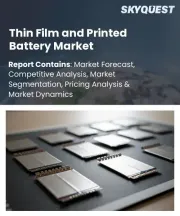
박막 및 인쇄 배터리 시장 규모, 점유율, 성장 분석 : 기술별, 전압 범위별, 재료 유형별, 용도별, 최종사용자별, 지역별 - 업계 예측(2026-2033년)Thin Film and Printed Battery Market Size, Share, and Growth Analysis, By Technology (Thin Film Battery, Printed Battery), By Voltage Range, By Material Type, By Application, By End User, By Region - Industry Forecast 2026-2033 |
||||||

세계의 박막 및 인쇄 배터리 시장 규모는 2024년에 2억 960만 달러로 평가되었으며, 2025년 2억 5,928만 달러에서 2033년까지 14억 2,141만 달러로 확대되어 예측 기간(2026-2033년) 동안 CAGR 23.7%로 성장할 것으로 전망됩니다.
박막 및 인쇄 배터리 세계 시장은 IoT 기기 및 웨어러블 기술 보급 확대에 따른 소형 및 유연한 전원공급장치에 대한 수요 증가에 힘입어 괄목할 만한 성장세를 보이고 있습니다. 이 배터리는 부피가 큰 기존 배터리에 의존하지 않고 센서, 의료용 패치, 스마트 포장 등 다양한 용도에 적합한 초박형 에너지 저장 솔루션을 제공합니다. 롤투롤 인쇄 및 첨단 소재와 같은 제조 기술 혁신으로 확장성이 향상되는 동시에 비용이 크게 절감되었습니다. 디바이스의 소형화, 라이프사이클 비용에 대한 고려가 높아짐에 따라 각 제조사들은 생산능력을 확대하고 새로운 화학적 조성의 변형을 모색하고 있습니다. 또한, 재활용 가능성과 안전한 재료에 대한 관심이 높아짐에 따라 인쇄 배터리의 다양한 분야로의 도입이 촉진되어 혁신적인 수익 모델과 광범위한 시장 보급의 길을 열어주고 있습니다.
세계 박막 및 인쇄 배터리 시장의 성장요인
작고 가볍고 유연한 전자기기에 대한 수요가 증가함에 따라 박막 및 인쇄 배터리 기술의 채택이 크게 증가하고 있습니다. 이러한 첨단 배터리는 두께를 늘리지 않고도 기존의 틀에 얽매이지 않는 다양한 제품 형태에 매끄럽게 통합할 수 있어 웨어러블 기술, 스마트 포장, 의료용 센서, 플렉서블 전자제품과 같은 신흥 시장에 특히 적합합니다. 표면과 경량 구조에 밀착되는 특성으로 인해 제조업체는 보다 혁신적인 제품과 우수한 사용자 경험을 개발할 수 있어 시장의 매력을 높일 수 있습니다. 또한, 롤투롤 제조 및 플렉서블 기판 기술과의 호환성을 통해 제조업체들이 다양한 응용 분야에서 비용 효율적인 생산과 독창적인 제품 디자인을 추구함에 따라 시장 침투를 촉진하고 있습니다.
세계 박막 및 인쇄 배터리 시장의 억제요인
세계 박막 및 인쇄 배터리 시장은 기존 배터리 화학에 비해 상대적으로 낮은 에너지 밀도로 인해 큰 도전에 직면해 있습니다. 많은 장치에서 안정적인 전력 공급과 충분한 에너지 저장이 필요하기 때문에 이러한 제한은 박막 및 인쇄 배터리에 적합한 용도의 범위를 좁히고 있습니다. 그 결과, 사용자는 인쇄된 배터리 솔루션을 통합하기 위해 장치의 수명, 추가 전원공급장치 또는 기능 저하와 같은 타협을 해야 합니다. 이는 긴 작동 수명을 중시하는 분야에서의 시장 보급을 저해하고 있습니다. 또한, 이러한 성능상의 단점은 제조업체와 최종사용자 모두의 신뢰를 떨어뜨려 기존 배터리로부터의 전환을 방해하는 요인으로 작용할 수 있습니다.
세계 박막 및 인쇄 배터리 시장 동향
전 세계 박막 및 인쇄 배터리 시장에서는 초박형, 형태추적형 전원에 대한 수요가 증가함에 따라 유연한 웨어러블 기기에 통합되는 경향이 두드러지게 나타나고 있습니다. 이러한 움직임은 웨어러블 기기 및 스마트 섬유에 이러한 첨단 배터리를 통합하는 것을 촉진하고 있으며, 폼팩터의 적응성, 피부 안전 소재, 얇은 전력 관리 솔루션의 혁신을 요구하고 있습니다. 섬유 제조업체, 장치 설계자, 배터리 개발자 간의 협력으로 새로운 모듈식 조립 기술과 혁신적인 적층 기술이 개발되어 편안함과 내구성을 향상시키고 있습니다. 이러한 시너지 효과로 인해 박막 및 인쇄 배터리의 적용 범위가 전자, 의료 모니터링, 산업 안전 분야로 확대되는 동시에 제조 공정의 효율적인 설계가 촉진되고 있습니다.
자주 묻는 질문
목차
소개
조사 방법
주요 요약
시장 역학과 전망
주요 시장 인사이트
세계의 박막 및 인쇄 배터리 시장 규모 : 기술별
세계의 박막 및 인쇄 배터리 시장 규모 : 전압 범위별
세계의 박막 및 인쇄 배터리 시장 규모 : 재료 유형별
세계의 박막 및 인쇄 배터리 시장 규모 : 용도별
세계의 박막 및 인쇄 배터리 시장 규모 : 최종사용자별
세계의 박막 및 인쇄 배터리 시장 규모 : 유통 채널별
세계의 박막 및 인쇄 배터리 시장 규모 : 지역별
경쟁 정보
주요 기업 개요
결론과 제안
KSM 26.06.08Global Thin Film And Printed Battery Market size was valued at USD 209.6 Million in 2024 and is poised to grow from USD 259.28 Million in 2025 to USD 1421.41 Million by 2033, growing at a CAGR of 23.7% during the forecast period (2026-2033).
The global market for thin film and printed batteries is witnessing substantial growth driven by the rising need for compact and flexible power sources that cater to the increasing prevalence of IoT devices and wearable technologies. These batteries offer ultra-thin energy storage solutions suitable for diverse applications, including sensors, medical patches, and smart packaging, without relying on bulky traditional cells. Innovations in manufacturing, such as roll-to-roll printing and advanced materials, have significantly reduced costs while enhancing scalability. As device miniaturization continues and lifecycle cost considerations mount, manufacturers are expanding production capabilities and exploring new chemistry varieties. Additionally, the focus on recyclability and safe materials is facilitating the integration of printed batteries into various sectors, paving the way for innovative revenue models and widespread market adoption.
Top-down and bottom-up approaches were used to estimate and validate the size of the Global Thin Film And Printed Battery market and to estimate the size of various other dependent submarkets. The research methodology used to estimate the market size includes the following details: The key players in the market were identified through secondary research, and their market shares in the respective regions were determined through primary and secondary research. This entire procedure includes the study of the annual and financial reports of the top market players and extensive interviews for key insights from industry leaders such as CEOs, VPs, directors, and marketing executives. All percentage shares split, and breakdowns were determined using secondary sources and verified through Primary sources. All possible parameters that affect the markets covered in this research study have been accounted for, viewed in extensive detail, verified through primary research, and analyzed to get the final quantitative and qualitative data.
Global Thin Film And Printed Battery Market Segments Analysis
Global thin film and printed battery market is segmented by technology, voltage range, material type, application, end user, distribution channel and region. Based on technology, the market is segmented into Thin Film Battery and Printed Battery. Based on voltage range, the market is segmented into Below 1.5 V, 1.5 V to 3 V and Above 3 V. Based on material type, the market is segmented into Lithium-Based, Zinc-Based, Manganese Dioxide-Based, Silver Oxide-Based and Others. Based on application, the market is segmented into Wearable Devices, Medical Devices, Smart Cards & RFID Tags, Consumer Electronics, IoT Devices & Sensors, Smart Packaging, Wireless Monitoring Systems and Others. Based on end user, the market is segmented into Healthcare, Consumer Electronics, Industrial, Retail & Packaging, Automotive, Telecommunications, Aerospace & Defense and Others. Based on distribution channel, the market is segmented into Direct Sales, Distributors & Value-Added Resellers and Online Sales. Based on region, the market is segmented into North America, Europe, Asia Pacific, Latin America and Middle East & Africa.
Driver of the Global Thin Film And Printed Battery Market
The increasing demand for compact, lightweight, and flexible electronic devices is significantly driving the adoption of thin film and printed battery technologies. These advanced batteries can seamlessly integrate into various non-traditional product formats without adding extra bulk, making them particularly suitable for emerging markets such as wearable technology, smart packaging, medical sensors, and flexible electronics. Their ability to conform to surfaces and lightweight structures empowers manufacturers to develop more innovative products and enhanced user experiences, thereby boosting their overall market attractiveness. Moreover, the compatibility with roll-to-roll manufacturing and flexible substrate techniques facilitates broader market penetration as manufacturers seek cost-effective production and unique product designs across diverse applications.
Restraints in the Global Thin Film And Printed Battery Market
The Global Thin Film and Printed Battery market faces significant challenges due to the comparatively lower energy density of these battery technologies when compared to traditional battery chemistries. This limitation curtails the range of applications suitable for thin film and printed batteries, as many devices necessitate consistent power supply and substantial energy storage. Consequently, users must make compromises regarding device longevity, additional power sources, or reduced functionality in order to integrate printed battery solutions, which diminishes market adoption in sectors that prioritize long operational lifespans. Additionally, these performance shortcomings can undermine confidence among both manufacturers and end users, hindering the transition from conventional batteries.
Market Trends of the Global Thin Film And Printed Battery Market
The Global Thin Film and Printed Battery market is experiencing a notable trend toward flexible wearable integration, as the demand for ultra-thin, conformable power sources rises. This drive is propelling the incorporation of these advanced batteries into wearables and smart textiles, necessitating innovations in form factor adaptability, skin-safe materials, and low-profile power management solutions. Collaborative efforts among textile manufacturers, device designers, and battery developers are fostering new modular assembly techniques and innovative laminates, ensuring enhanced comfort and durability. This synergy broadens the applicability of thin film and printed batteries across electronics, medical monitoring, and industrial safety sectors, while promoting efficient design for manufacturing processes.
Table of Contents
Introduction
- Objectives of the Study
- Market Definition & Scope
Research Methodology
- Research Process
- Secondary & Primary Data Methods
- Market Size Estimation Methods
Executive Summary
- Global Market Outlook
- Key Market Highlights
- Segmental Overview
- Competition Overview
Market Dynamics & Outlook
- Macro-Economic Indicators
- Drivers & Opportunities
- Restraints & Challenges
- Supply Side Trends
- Demand Side Trends
- Porters Analysis & Impact
- Competitive Rivalry
- Threat of Substitute
- Bargaining Power of Buyers
- Threat of New Entrants
- Bargaining Power of Suppliers
Key Market Insights
- Key Success Factors
- Market Impacting Factors
- Top Investment Pockets
- Ecosystem Mapping
- Market Attractiveness Index 2025
- PESTEL Analysis
- Regulatory Landscape
Global Thin Film and Printed Battery Market Size by Technology & CAGR (2026-2033)
- Market Overview
- Thin Film Battery
- Rechargeable Thin Film Battery
- Non-Rechargeable Thin Film Battery
- Printed Battery
- Rechargeable Printed Battery
- Non-Rechargeable Printed Battery
Global Thin Film and Printed Battery Market Size by Voltage Range & CAGR (2026-2033)
- Market Overview
- Below 1.5 V
- 1.5 V to 3 V
- Above 3 V
Global Thin Film and Printed Battery Market Size by Material Type & CAGR (2026-2033)
- Market Overview
- Lithium-Based
- Zinc-Based
- Manganese Dioxide-Based
- Silver Oxide-Based
- Others
Global Thin Film and Printed Battery Market Size by Application & CAGR (2026-2033)
- Market Overview
- Wearable Devices
- Medical Devices
- Smart Cards & RFID Tags
- Consumer Electronics
- IoT Devices & Sensors
- Smart Packaging
- Wireless Monitoring Systems
- Others
Global Thin Film and Printed Battery Market Size by End User & CAGR (2026-2033)
- Market Overview
- Healthcare
- Consumer Electronics
- Industrial
- Retail & Packaging
- Automotive
- Telecommunications
- Aerospace & Defense
- Others
Global Thin Film and Printed Battery Market Size by Distribution Channel & CAGR (2026-2033)
- Market Overview
- Direct Sales
- Distributors & Value-Added Resellers
- Online Sales
Global Thin Film and Printed Battery Market Size & CAGR (2026-2033)
- North America (Technology, Voltage Range, Material Type, Application, End User, Distribution Channel)
- US
- Canada
- Europe (Technology, Voltage Range, Material Type, Application, End User, Distribution Channel)
- Germany
- Spain
- France
- UK
- Italy
- Rest of Europe
- Asia Pacific (Technology, Voltage Range, Material Type, Application, End User, Distribution Channel)
- China
- India
- Japan
- South Korea
- Rest of Asia-Pacific
- Latin America (Technology, Voltage Range, Material Type, Application, End User, Distribution Channel)
- Mexico
- Brazil
- Rest of Latin America
- Middle East & Africa (Technology, Voltage Range, Material Type, Application, End User, Distribution Channel)
- GCC Countries
- South Africa
- Rest of Middle East & Africa
Competitive Intelligence
- Top 5 Player Comparison
- Market Positioning of Key Players, 2025
- Strategies Adopted by Key Market Players
- Recent Developments in the Market
- Company Market Share Analysis, 2025
- Company Profiles of All Key Players
- Company Details
- Product Portfolio Analysis
- Company's Segmental Share Analysis
- Revenue Y-O-Y Comparison (2023-2025)
Key Company Profiles
- Blue Spark Technologies
- Company Overview
- Business Segment Overview
- Financial Updates
- Key Developments
- BrightVolt Technologies
- Company Overview
- Business Segment Overview
- Financial Updates
- Key Developments
- Enfucell Oy
- Company Overview
- Business Segment Overview
- Financial Updates
- Key Developments
- Imprint Energy
- Company Overview
- Business Segment Overview
- Financial Updates
- Key Developments
- Ilika plc
- Company Overview
- Business Segment Overview
- Financial Updates
- Key Developments
- Jenax Inc.
- Company Overview
- Business Segment Overview
- Financial Updates
- Key Developments
- Molex LLC
- Company Overview
- Business Segment Overview
- Financial Updates
- Key Developments
- NEC Energy Solutions
- Company Overview
- Business Segment Overview
- Financial Updates
- Key Developments
- Panasonic Energy Co., Ltd.
- Company Overview
- Business Segment Overview
- Financial Updates
- Key Developments
- Samsung SDI Co., Ltd.
- Company Overview
- Business Segment Overview
- Financial Updates
- Key Developments
- STMicroelectronics N.V.
- Company Overview
- Business Segment Overview
- Financial Updates
- Key Developments
- TDK Corporation
- Company Overview
- Business Segment Overview
- Financial Updates
- Key Developments
- Ultralife Corporation
- Company Overview
- Business Segment Overview
- Financial Updates
- Key Developments
- Varta AG
- Company Overview
- Business Segment Overview
- Financial Updates
- Key Developments
- Voltaiq
- Company Overview
- Business Segment Overview
- Financial Updates
- Key Developments
- Cymbet Corporation
- Company Overview
- Business Segment Overview
- Financial Updates
- Key Developments
- Prieto Battery Inc.
- Company Overview
- Business Segment Overview
- Financial Updates
- Key Developments
- Excellatron Solid State LLC
- Company Overview
- Business Segment Overview
- Financial Updates
- Key Developments
- ProLogium Technology Co., Ltd.
- Company Overview
- Business Segment Overview
- Financial Updates
- Key Developments
- LG Energy Solution Ltd.
- Company Overview
- Business Segment Overview
- Financial Updates
- Key Developments