|
시장보고서
상품코드
1661749
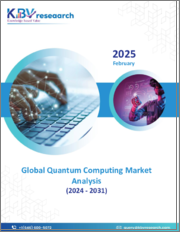
양자 컴퓨팅 시장 : 시장 규모, 점유율, 동향 분석(제공 내용별, 전개 방법별, 용도별, 최종사용자별), 지역별 전망 및 예측(2024-2031년)Global Quantum Computing Market Size, Share & Trends Analysis Report By Offering (System, and Services), By Deployment, By Application, By End-user, By Regional Outlook and Forecast, 2024 - 2031 |
||||||

양자 컴퓨팅 시장 규모는 예측 기간 동안 19.6%의 연평균 복합 성장률(CAGR)로 성장하여 2031년까지 45억 8,000만 달러에 달할 것으로 예상됩니다.
KBV Cardinal matrix에 제시된 분석에 따르면,Google LLC와 Microsoft Corporation은 양자 컴퓨팅 시장의 선구자이며,Amazon Web Services,Inc. 2024년 11월, Google LLC는 미국에 본사를 둔 반도체 회사인 NVIDIA Corporation과 협력하여 CUDA-Q 플랫폼과 NVIDIA Eos 슈퍼컴퓨터를 사용하여 양자컴퓨팅 시장을 선도하고 있습니다. Eos 슈퍼컴퓨터를 사용하여 양자 컴퓨터 개발을 강화했습니다. 이번 협력은 양자 프로세서의 물리학을 시뮬레이션하고 양자 하드웨어의 노이즈 문제를 완화하기 위한 것으로, GPU 가속 컴퓨팅을 활용함으로써 구글은 양자 장치 시뮬레이션을 몇 주가 아닌 몇 분 만에 실행할 수 있게 됐습니다. 몇 주가 아닌 몇 분 만에 양자 장치 시뮬레이션을 실행할 수 있게 되었습니다.
시장 성장 요인
의료 및 제약 업계는 양자 컴퓨팅을 통해 분자 상호작용을 원자 수준에서 시뮬레이션하여 신약 발견을 가속화하고 있습니다. 전통적인 의약품 개발은 시간과 비용이 많이 들고 수년간의 계산 시뮬레이션과 물리적 테스트가 필요합니다. 양자컴퓨팅은 분자 구조의 빠른 시뮬레이션을 통해 훨씬 더 짧은 시간에 새로운 약물과 치료법을 발견할 수 있습니다. 따라서 전 세계 조직들은 미래 지향적인 보안을 보장하기 위해 양자 내성 암호화 프로토콜에 투자하고 있으며, 양자 기술에 대한 수요가 더욱 증가하고 있습니다.
또한, 클라우드 기반 양자 컴퓨팅은 기존 시스템과 양자 시스템이 협력하여 복잡한 문제를 해결하는 하이브리드 모델도 실현할 수 있습니다. 양자 컴퓨팅은 아직 초기 단계에 있어 기존 컴퓨팅을 완전히 대체할 수는 없지만, 하이브리드 모델을 통해 기업은 두 기술의 장점을 모두 활용할 수 있습니다. 예를 들어, 금융 기관은 리스크 모델링에 양자 클라우드 서비스를 사용하고, 제약 회사는 양자 시뮬레이션을 신약 개발 파이프라인에 통합하고 있습니다. 따라서 클라우드 기반 플랫폼이 진화하고 시장 성장을 가속함에 따라 양자 컴퓨팅은 다양한 산업에서 주류 도구가 될 것으로 예상됩니다.
시장 성장 억제요인
양자컴퓨터는 고도로 특수하고 고가의 하드웨어를 필요로 하기 때문에 대규모 도입이 어렵습니다. 반도체 기반 트랜지스터에 의존하는 기존 컴퓨터와 달리 양자컴퓨터는 극저온(밀리켈빈 수준)과 고도의 극저온 냉각 시스템을 필요로 하는 양자 비트를 사용하여 작동합니다. 따라서 양자컴퓨팅 하드웨어 및 인프라 개발의 높은 비용이 시장 성장을 저해하는 요인으로 작용하고 있습니다.
제공 내용별 전망
제공 내용에 따라 시장은 시스템 및 서비스로 분류됩니다. 서비스 부문은 2023년 시장에서 36%의 매출 점유율을 차지할 것으로 예상됩니다. 클라우드 기반 양자 컴퓨팅, 컨설팅 및 통합 서비스에 대한 수요가 증가함에 따라 이 부문의 성장을 견인하고 있습니다. 기업들은 QCaaS(Quantum Computing as a Service)를 활용하여 막대한 초기 투자 없이도 양자 기능을 이용할 수 있으며, 물류, 사이버 보안, 인공지능 등 다양한 산업에서 양자 컴퓨팅의 채택을 가속화하고 있습니다.
전개 방식별 전망
배포를 기반으로 시장은 온프레미스와 클라우드로 분류됩니다. 온프레미스 부문은 2023년 시장에서 56%의 매출 점유율을 차지할 것으로 예상됩니다. 특히 국방, 의료, 금융 분야에서 많은 기업들이 기밀 데이터와 중요한 작업을 보다 엄격하게 제어하기 위해 양자 시스템을 온프레미스에 배치하는 것을 선호합니다. 온프레미스 양자컴퓨터는 높은 보안과 빠른 처리 속도를 제공하기 때문에 특정 컴퓨팅 요구사항과 대규모 인프라 투자를 필요로 하는 조직에 적합합니다.
용도별 전망
용도별로 시장은 최적화, 시뮬레이션, 머신러닝, 기타로 나뉘어져 있습니다. 머신러닝 부문은 2023년 시장에서 31%의 매출 점유율을 차지할 것으로 예상됩니다. 양자 머신러닝은 데이터 분석과 모델 학습을 가속화하고 더 빠르고 정확한 예측을 가능하게 하기 때문에 중요한 관심 분야가 되고 있습니다. 방대한 양의 데이터를 처리하고 패턴을 보다 효과적으로 식별할 수 있는 능력을 갖춘 양자 컴퓨팅은 자연어 처리, 이미지 인식, 예측 분석에서 머신러닝 기술을 강화하여 금융, 의료, 마케팅 등의 산업을 변화시킬 수 있는 강력한 도구로 자리매김하고 있습니다.
최종 사용자별 전망
최종 사용자에 따라 시장은 항공우주 및 방위, 은행/금융서비스/보험(BFSI), 의료, 자동차, 에너지 및 전력, 화학, 정부, 기타로 분류됩니다. 에너지 및 전력 부문은 2023년 시장에서 11%의 매출 점유율을 차지할 것으로 예상됩니다. 양자 컴퓨팅은 전력망 효율성 향상, 에너지 저장 최적화, 재생 에너지 통합 강화 등 에너지 시스템의 복잡한 최적화 문제를 해결하는 데 필수적입니다.
지역별 전망
지역별로는 북미, 유럽, 아시아태평양, 라틴아메리카, 중동 및 아프리카로 시장을 분석했습니다. 북미 부문은 2023년 시장에서 32%의 매출 점유율을 기록할 것으로 예상됩니다. 북미, 특히 미국에는 강력한 양자 연구 기반이 있으며, 정부의 이니셔티브와 민간 부문의 투자가 혁신을 주도하고 있습니다.
목차
제1장 시장 범위및 분석 방법
- 시장의 정의
- 목적
- 시장 범위
- 세분화
- 분석 방법
제2장 시장 요람
- 주요 하이라이트
제3장 시장 개요
- 서론
- 개요
- 시장 구성과 시나리오
- 개요
- 시장에 영향을 미치는 주요 요인
- 시장 성장 촉진요인
- 시장 성장 억제요인
- 시장 기회
- 시장이 해결해야 할 과제
제4장 경쟁 분석 : 세계 시장
- KBV Cardinal Matrix
- 최근 업계 전체의 전략적 전개
- 사업 제휴 및 협력, 계약
- 제품 발매, 확대
- 기업인수합병(M&A)
- 시장 점유율 분석(2023년)
- 주요 성공 전략
- 주요 전략
- 주요 전략적 움직임
- Porter의 Five Forces 분석
제5장 세계의 양자 컴퓨팅 시장 : 제공 내용별
- 세계의 시스템 시장 : 지역별
- 세계의 서비스 시장 : 지역별
제6장 세계의 양자 컴퓨팅 시장 : 전개 방식별
- 세계의 온프레미스 시장 : 지역별
- 세계의 클라우드 시장 : 지역별
제7장 세계의 양자 컴퓨팅 시장 : 용도별
- 세계의 최적화 시장 : 지역별
- 세계의 머신러닝 시장 : 지역별
- 세계의 시뮬레이션 시장 : 지역별
- 세계의 기타 용도 시장 : 지역별
제8장 세계의 양자 컴퓨팅 시장 : 최종사용자별
- 세계의 은행/금융서비스/보험(BFSI) 시장 : 지역별
- 세계의 의료 시장 : 지역별
- 세계의 자동차 시장 : 지역별
- 세계의 에너지 및 전력 시장 : 지역별
- 세계의 정부 시장 : 지역별
- 세계의 항공우주 및 방위 시장 : 지역별
- 세계의 화학 시장 : 지역별
- 세계의 기타 최종사용자 시장 : 지역별
제9장 세계의 양자 컴퓨팅 시장 : 지역별
- 북미
- 북미의 양자 컴퓨팅 시장 : 국가별
- 미국
- 캐나다
- 멕시코
- 기타 북미
- 북미의 양자 컴퓨팅 시장 : 국가별
- 유럽
- 유럽의 양자 컴퓨팅 시장 : 국가별
- 독일
- 영국
- 프랑스
- 러시아
- 스페인
- 이탈리아
- 기타 유럽
- 유럽의 양자 컴퓨팅 시장 : 국가별
- 아시아태평양
- 아시아태평양의 양자 컴퓨팅 시장 : 국가별
- 중국
- 일본
- 인도
- 한국
- 싱가포르
- 말레이시아
- 기타 아시아태평양
- 아시아태평양의 양자 컴퓨팅 시장 : 국가별
- 라틴아메리카/중동 및 아프리카
- 라틴아메리카/중동 및 아프리카의 양자 컴퓨팅 시장 : 국가별
- 브라질
- 아르헨티나
- 아랍에미리트(UAE)
- 사우디아라비아
- 남아프리카공화국
- 나이지리아
- 기타 라틴아메리카/중동 및 아프리카
- 라틴아메리카/중동 및 아프리카의 양자 컴퓨팅 시장 : 국가별
제10장 기업 개요
- Google LLC(Alphabet Inc)
- Microsoft Corporation
- IBM Corporation
- Amazon Web Services, Inc(Amazon.com, Inc.)
- QC Ware Corp
- Huawei Technologies Co, Ltd.(Huawei Investment & Holding Co., Ltd.)
- Rigetti Computing, Inc
- SpinQ Technology Co, Ltd.
- D-Wave Systems Inc
- Intel Corporation
제11장 양자 컴퓨팅 시장을 위한 성공 필수 조건
LSH 25.03.13The Global Quantum Computing Market size is expected to reach $4.58 billion by 2031, rising at a market growth of 19.6% CAGR during the forecast period.
In the chemical industry, quantum computing is used for molecular modelling and material discovery, enabling researchers to simulate chemical reactions at an atomic level. This accelerates the development of new materials and chemicals with specific properties, which is crucial for industries such as pharmaceuticals, petrochemicals, and advanced materials manufacturing. Thus, the chemical segment held 7% revenue share in the market in 2023.
The major strategies followed by the market participants are partnerships as the key developmental strategy to keep pace with the changing demands of end users. For instance, In February, 2025, Intel Corporation and the National Institute of Advanced Industrial Science and Technology (AIST) signed an MOU to strengthen their collaboration in industrializing silicon quantum computers. By combining AIST's G-QuAT research center capabilities with Intel's semiconductor processes, the partnership aims to develop systems with tens of thousands of qubits by the early 2030s. Additionally, In December, 2024, SpinQ Technology Co., Ltd. partnered with the Technology Innovation Institute (TII), a leading research center under Abu Dhabi's Advanced Technology Research Council, to integrate SpinQ's superconducting quantum processing units (QPUs) into TII's quantum research framework. The partnership addresses key quantum hardware challenges like scarcity and high costs, offering modular, customizable QPUs with high fidelity and coherence times.
Based on the Analysis presented in the KBV Cardinal matrix; Google LLC and Microsoft Corporation are the forerunners in the Quantum Computing Market. Companies such as Amazon Web Services, Inc., Huawei Technologies Co., Ltd. and IBM Corporation are some of the key innovators in Quantum Computing Market. In November, 2024, Google LLC joined hands with NVIDIA Corporation, a U.S.-based semiconductor company, to enhance quantum computer development using the CUDA-Q platform and the NVIDIA Eos supercomputer. This collaboration aims to simulate quantum processor physics, mitigating noise challenges in quantum hardware. By leveraging GPU-accelerated computing, Google can now conduct quantum device simulations in minutes instead of weeks.
Market Growth Factors
In the healthcare and pharmaceutical sectors, quantum computing accelerates drug discovery by simulating molecular interactions at an atomic level. Traditional drug development is time-consuming and costly, requiring years of computational simulations and physical testing. Quantum computing allows for rapid simulations of molecular structures, leading to the discovery of new drugs and treatments in significantly less time. Therefore, organizations worldwide invest in quantum-resistant encryption protocols to ensure future-proof security, further driving demand for quantum technologies.
Additionally, Cloud-based quantum computing also facilitates hybrid models, where classical and quantum systems work together to solve complex problems. Since quantum computing is still in its early stages and cannot fully replace classical computing, hybrid models allow businesses to leverage both technologies' strengths. For example, financial institutions use quantum cloud services for risk modelling, while pharmaceutical companies integrate quantum simulations into their drug discovery pipelines. Therefore, quantum computing is expected to become a mainstream tool in various industries as cloud-based platforms evolve, driving market growth.
Market Restraining Factors
Quantum computers require highly specialized and costly hardware, making large-scale adoption challenging. Unlike classical computers, which rely on semiconductor-based transistors, quantum computers operate using qubits, which require extremely low temperatures (millikelvin levels) and sophisticated cryogenic cooling systems. Therefore, the high cost of quantum computing hardware and infrastructure development is hindering market growth.
Offering Outlook
Based on offering, the market is characterized into system and services. The services segment procured 36% revenue share in the market in 2023. The growing need for cloud-based quantum computing, consulting, and integration services has fueled this segment's expansion. Businesses are leveraging quantum computing as a service (QCaaS) to access quantum capabilities without significant upfront investments, accelerating adoption across various industries, including logistics, cybersecurity, and artificial intelligence.
Deployment Outlook
On the basis of deployment, the market is classified into on-premises and cloud. The on-premises segment acquired 56% revenue share in the market in 2023. Many enterprises, particularly in defense, healthcare, and finance, prefer on-premises deployment for quantum systems to maintain greater control over their sensitive data and critical operations. On-premises quantum computers allow for high security and faster processing, making them ideal for organizations with specific computational needs and substantial infrastructure investments.
Application Outlook
By application, the market is divided into optimization, simulation, machine learning, and others. The machine learning segment garnered 31% revenue share in the market in 2023. Quantum machine learning is becoming a key area of interest as it promises to accelerate data analysis and model training, enabling faster and more accurate predictions. With its ability to process vast amounts of data and identify patterns more effectively, quantum computing is enhancing machine learning techniques in natural language processing, image recognition, and predictive analytics, positioning it as a powerful tool for transforming industries like finance, healthcare, and marketing.
End User Outlook
Based on end-user, the market is segmented into aerospace & defense, BFSI, healthcare, automotive, energy & power, chemical, government, and others. The energy & power segment attained 11% revenue share in the market in 2023. Quantum computing is vital in solving complex optimization problems in energy systems, such as improving power grid efficiency, optimizing energy storage, and enhancing renewable energy integration.
Regional Outlook
Region-wise, the market is analyzed across North America, Europe, Asia Pacific, and LAMEA. The North America segment witnessed 32% revenue share in the market in 2023. North America, particularly the United States, has a strong quantum research foundation, with government initiatives and private-sector investments driving innovation.
Recent Strategies Deployed in the Market
- Dec-2024: Google LLC unveiled its new quantum computing chip, Willow, which can reportedly solve problems in five minutes that would take the world's fastest supercomputers 10 septillion years. The chip integrates key breakthroughs aimed at advancing toward a large-scale, practical quantum computer.
- Nov-2024: Google LLC joined hands with NVIDIA Corporation, a U.S.-based semiconductor company, to enhance quantum computer development using the CUDA-Q platform and the NVIDIA Eos supercomputer. This collaboration aims to simulate quantum processor physics, mitigating noise challenges in quantum hardware. By leveraging GPU-accelerated computing, Google can now conduct quantum device simulations in minutes instead of weeks.
- Sep-2024: D-Wave Systems Inc. teamed up with Staque, a leading consulting firm specializing in AI, blockchain, and quantum computing, to accelerate the adoption of annealing quantum computing across the Middle East. The collaboration will leverage D-Wave's quantum computers and hybrid solvers via its Leap(TM) cloud service to address enterprise challenges in areas such as supply chain management and portfolio optimization. This collaboration aims to help organizations embrace quantum and AI technologies to drive business optimization and innovation in the region.
- Apr-2024: Huawei Technologies Co., Ltd. launched the HECS X cloud computing instance designed for small to medium-sized businesses (SMBs). This new instance, an upgrade from the HECS L, offers two times the performance at the same specifications and includes over 100 customizable options. With the support of AI optimization and live migration capabilities, the HECS X ensures efficient performance for applications.
- Apr-2024: SpinQ Technology Co., Ltd. launched the Novera(TM) QPU Partner Program, an ecosystem designed to support the development of high-performance, on-premises quantum computing. The program integrates quantum computing hardware, software, and service providers to ensure compatibility and quality.
- Jan-2024: IBM Corporation collaborated with Korea Quantum Computing (KQC), providing advanced AI, infrastructure, and quantum computing services. Through this collaboration, users access IBM's AI stack, including watsonx. KQC extends its quantum collaboration, offering access to IBM's global quantum systems. Additionally, plans entail deploying IBM Quantum System Two at KQC in Busan by 2028.
List of Key Companies Profiled
- Google LLC (Alphabet Inc.)
- Microsoft Corporation
- IBM Corporation
- Amazon Web Services, Inc. (Amazon.com, Inc.)
- QC Ware Corp.
- SpinQ Technology Co., Ltd.
- Rigetti Computing, Inc.
- D-Wave Systems Inc.
- Intel Corporation
- Huawei Technologies Co., Ltd. (Huawei Investment & Holding Co., Ltd.)
Global Quantum Computing Market Report Segmentation
By Offering
- System
- Services
By Deployment
- On-premise
- Cloud
By Application
- Optimization
- Machine Learning
- Simulation
- Other Application
By End-user
- BFSI
- Healthcare
- Automotive
- Energy & Power
- Government
- Aerospace & Defense
- Chemical
- Other End-user
By Geography
- North America
- US
- Canada
- Mexico
- Rest of North America
- Europe
- Germany
- UK
- France
- Russia
- Spain
- Italy
- Rest of Europe
- Asia Pacific
- China
- Japan
- India
- South Korea
- Singapore
- Malaysia
- Rest of Asia Pacific
- LAMEA
- Brazil
- Argentina
- UAE
- Saudi Arabia
- South Africa
- Nigeria
- Rest of LAMEA
Table of Contents
Chapter 1. Market Scope & Methodology
- 1.1 Market Definition
- 1.2 Objectives
- 1.3 Market Scope
- 1.4 Segmentation
- 1.4.1 Global Quantum Computing Market, by Offering
- 1.4.2 Global Quantum Computing Market, by Deployment
- 1.4.3 Global Quantum Computing Market, by Application
- 1.4.4 Global Quantum Computing Market, by End-user
- 1.4.5 Global Quantum Computing Market, by Geography
- 1.5 Methodology for the research
Chapter 2. Market at a Glance
- 2.1 Key Highlights
Chapter 3. Market Overview
- 3.1 Introduction
- 3.1.1 Overview
- 3.1.1.1 Market Composition and Scenario
- 3.1.1 Overview
- 3.2 Key Factors Impacting the Market
- 3.2.1 Market Drivers
- 3.2.2 Market Restraints
- 3.2.3 Market Opportunities
- 3.2.4 Market Challenges
Chapter 4. Competition Analysis - Global
- 4.1 KBV Cardinal Matrix
- 4.2 Recent Industry Wide Strategic Developments
- 4.2.1 Partnerships, Collaborations and Agreements
- 4.2.2 Product Launches and Product Expansions
- 4.2.3 Acquisition and Mergers
- 4.3 Market Share Analysis, 2023
- 4.4 Top Winning Strategies
- 4.4.1 Key Leading Strategies: Percentage Distribution (2020-2024)
- 4.4.2 Key Strategic Move: (Partnerships, Collaborations and Agreements: 2021, Jan - 2025, Feb) Leading Players
- 4.5 Porter's Five Forces Analysis
Chapter 5. Global Quantum Computing Market by Offering
- 5.1 Global System Market by Region
- 5.2 Global Services Market by Region
Chapter 6. Global Quantum Computing Market by Deployment
- 6.1 Global On-premise Market by Region
- 6.2 Global Cloud Market by Region
Chapter 7. Global Quantum Computing Market by Application
- 7.1 Global Optimization Market by Region
- 7.2 Global Machine Learning Market by Region
- 7.3 Global Simulation Market by Region
- 7.4 Global Other Application Market by Region
Chapter 8. Global Quantum Computing Market by End-user
- 8.1 Global BFSI Market by Region
- 8.2 Global Healthcare Market by Region
- 8.3 Global Automotive Market by Region
- 8.4 Global Energy & Power Market by Region
- 8.5 Global Government Market by Region
- 8.6 Global Aerospace & Defense Market by Region
- 8.7 Global Chemical Market by Region
- 8.8 Global Other End-user Market by Region
Chapter 9. Global Quantum Computing Market by Region
- 9.1 North America Quantum Computing Market
- 9.1.1 North America Quantum Computing Market by Offering
- 9.1.1.1 North America System Market by Region
- 9.1.1.2 North America Services Market by Region
- 9.1.2 North America Quantum Computing Market by Deployment
- 9.1.2.1 North America On-premise Market by Country
- 9.1.2.2 North America Cloud Market by Country
- 9.1.3 North America Quantum Computing Market by Application
- 9.1.3.1 North America Optimization Market by Country
- 9.1.3.2 North America Machine Learning Market by Country
- 9.1.3.3 North America Simulation Market by Country
- 9.1.3.4 North America Other Application Market by Country
- 9.1.4 North America Quantum Computing Market by End-user
- 9.1.4.1 North America BFSI Market by Country
- 9.1.4.2 North America Healthcare Market by Country
- 9.1.4.3 North America Automotive Market by Country
- 9.1.4.4 North America Energy & Power Market by Country
- 9.1.4.5 North America Government Market by Country
- 9.1.4.6 North America Aerospace & Defense Market by Country
- 9.1.4.7 North America Chemical Market by Country
- 9.1.4.8 North America Other End-user Market by Country
- 9.1.5 North America Quantum Computing Market by Country
- 9.1.5.1 US Quantum Computing Market
- 9.1.5.1.1 US Quantum Computing Market by Offering
- 9.1.5.1.2 US Quantum Computing Market by Deployment
- 9.1.5.1.3 US Quantum Computing Market by Application
- 9.1.5.1.4 US Quantum Computing Market by End-user
- 9.1.5.2 Canada Quantum Computing Market
- 9.1.5.2.1 Canada Quantum Computing Market by Offering
- 9.1.5.2.2 Canada Quantum Computing Market by Deployment
- 9.1.5.2.3 Canada Quantum Computing Market by Application
- 9.1.5.2.4 Canada Quantum Computing Market by End-user
- 9.1.5.3 Mexico Quantum Computing Market
- 9.1.5.3.1 Mexico Quantum Computing Market by Offering
- 9.1.5.3.2 Mexico Quantum Computing Market by Deployment
- 9.1.5.3.3 Mexico Quantum Computing Market by Application
- 9.1.5.3.4 Mexico Quantum Computing Market by End-user
- 9.1.5.4 Rest of North America Quantum Computing Market
- 9.1.5.4.1 Rest of North America Quantum Computing Market by Offering
- 9.1.5.4.2 Rest of North America Quantum Computing Market by Deployment
- 9.1.5.4.3 Rest of North America Quantum Computing Market by Application
- 9.1.5.4.4 Rest of North America Quantum Computing Market by End-user
- 9.1.5.1 US Quantum Computing Market
- 9.1.1 North America Quantum Computing Market by Offering
- 9.2 Europe Quantum Computing Market
- 9.2.1 Europe Quantum Computing Market by Offering
- 9.2.1.1 Europe System Market by Country
- 9.2.1.2 Europe Services Market by Country
- 9.2.2 Europe Quantum Computing Market by Deployment
- 9.2.2.1 Europe On-premise Market by Country
- 9.2.2.2 Europe Cloud Market by Country
- 9.2.3 Europe Quantum Computing Market by Application
- 9.2.3.1 Europe Optimization Market by Country
- 9.2.3.2 Europe Machine Learning Market by Country
- 9.2.3.3 Europe Simulation Market by Country
- 9.2.3.4 Europe Other Application Market by Country
- 9.2.4 Europe Quantum Computing Market by End-user
- 9.2.4.1 Europe BFSI Market by Country
- 9.2.4.2 Europe Healthcare Market by Country
- 9.2.4.3 Europe Automotive Market by Country
- 9.2.4.4 Europe Energy & Power Market by Country
- 9.2.4.5 Europe Government Market by Country
- 9.2.4.6 Europe Aerospace & Defense Market by Country
- 9.2.4.7 Europe Chemical Market by Country
- 9.2.4.8 Europe Other End-user Market by Country
- 9.2.5 Europe Quantum Computing Market by Country
- 9.2.5.1 Germany Quantum Computing Market
- 9.2.5.1.1 Germany Quantum Computing Market by Offering
- 9.2.5.1.2 Germany Quantum Computing Market by Deployment
- 9.2.5.1.3 Germany Quantum Computing Market by Application
- 9.2.5.1.4 Germany Quantum Computing Market by End-user
- 9.2.5.2 UK Quantum Computing Market
- 9.2.5.2.1 UK Quantum Computing Market by Offering
- 9.2.5.2.2 UK Quantum Computing Market by Deployment
- 9.2.5.2.3 UK Quantum Computing Market by Application
- 9.2.5.2.4 UK Quantum Computing Market by End-user
- 9.2.5.3 France Quantum Computing Market
- 9.2.5.3.1 France Quantum Computing Market by Offering
- 9.2.5.3.2 France Quantum Computing Market by Deployment
- 9.2.5.3.3 France Quantum Computing Market by Application
- 9.2.5.3.4 France Quantum Computing Market by End-user
- 9.2.5.4 Russia Quantum Computing Market
- 9.2.5.4.1 Russia Quantum Computing Market by Offering
- 9.2.5.4.2 Russia Quantum Computing Market by Deployment
- 9.2.5.4.3 Russia Quantum Computing Market by Application
- 9.2.5.4.4 Russia Quantum Computing Market by End-user
- 9.2.5.5 Spain Quantum Computing Market
- 9.2.5.5.1 Spain Quantum Computing Market by Offering
- 9.2.5.5.2 Spain Quantum Computing Market by Deployment
- 9.2.5.5.3 Spain Quantum Computing Market by Application
- 9.2.5.5.4 Spain Quantum Computing Market by End-user
- 9.2.5.6 Italy Quantum Computing Market
- 9.2.5.6.1 Italy Quantum Computing Market by Offering
- 9.2.5.6.2 Italy Quantum Computing Market by Deployment
- 9.2.5.6.3 Italy Quantum Computing Market by Application
- 9.2.5.6.4 Italy Quantum Computing Market by End-user
- 9.2.5.7 Rest of Europe Quantum Computing Market
- 9.2.5.7.1 Rest of Europe Quantum Computing Market by Offering
- 9.2.5.7.2 Rest of Europe Quantum Computing Market by Deployment
- 9.2.5.7.3 Rest of Europe Quantum Computing Market by Application
- 9.2.5.7.4 Rest of Europe Quantum Computing Market by End-user
- 9.2.5.1 Germany Quantum Computing Market
- 9.2.1 Europe Quantum Computing Market by Offering
- 9.3 Asia Pacific Quantum Computing Market
- 9.3.1 Asia Pacific Quantum Computing Market by Offering
- 9.3.1.1 Asia Pacific System Market by Country
- 9.3.1.2 Asia Pacific Services Market by Country
- 9.3.2 Asia Pacific Quantum Computing Market by Deployment
- 9.3.2.1 Asia Pacific On-premise Market by Country
- 9.3.2.2 Asia Pacific Cloud Market by Country
- 9.3.3 Asia Pacific Quantum Computing Market by Application
- 9.3.3.1 Asia Pacific Optimization Market by Country
- 9.3.3.2 Asia Pacific Machine Learning Market by Country
- 9.3.3.3 Asia Pacific Simulation Market by Country
- 9.3.3.4 Asia Pacific Other Application Market by Country
- 9.3.4 Asia Pacific Quantum Computing Market by End-user
- 9.3.4.1 Asia Pacific BFSI Market by Country
- 9.3.4.2 Asia Pacific Healthcare Market by Country
- 9.3.4.3 Asia Pacific Automotive Market by Country
- 9.3.4.4 Asia Pacific Energy & Power Market by Country
- 9.3.4.5 Asia Pacific Government Market by Country
- 9.3.4.6 Asia Pacific Aerospace & Defense Market by Country
- 9.3.4.7 Asia Pacific Chemical Market by Country
- 9.3.4.8 Asia Pacific Other End-user Market by Country
- 9.3.5 Asia Pacific Quantum Computing Market by Country
- 9.3.5.1 China Quantum Computing Market
- 9.3.5.1.1 China Quantum Computing Market by Offering
- 9.3.5.1.2 China Quantum Computing Market by Deployment
- 9.3.5.1.3 China Quantum Computing Market by Application
- 9.3.5.1.4 China Quantum Computing Market by End-user
- 9.3.5.2 Japan Quantum Computing Market
- 9.3.5.2.1 Japan Quantum Computing Market by Offering
- 9.3.5.2.2 Japan Quantum Computing Market by Deployment
- 9.3.5.2.3 Japan Quantum Computing Market by Application
- 9.3.5.2.4 Japan Quantum Computing Market by End-user
- 9.3.5.3 India Quantum Computing Market
- 9.3.5.3.1 India Quantum Computing Market by Offering
- 9.3.5.3.2 India Quantum Computing Market by Deployment
- 9.3.5.3.3 India Quantum Computing Market by Application
- 9.3.5.3.4 India Quantum Computing Market by End-user
- 9.3.5.4 South Korea Quantum Computing Market
- 9.3.5.4.1 South Korea Quantum Computing Market by Offering
- 9.3.5.4.2 South Korea Quantum Computing Market by Deployment
- 9.3.5.4.3 South Korea Quantum Computing Market by Application
- 9.3.5.4.4 South Korea Quantum Computing Market by End-user
- 9.3.5.5 Singapore Quantum Computing Market
- 9.3.5.5.1 Singapore Quantum Computing Market by Offering
- 9.3.5.5.2 Singapore Quantum Computing Market by Deployment
- 9.3.5.5.3 Singapore Quantum Computing Market by Application
- 9.3.5.5.4 Singapore Quantum Computing Market by End-user
- 9.3.5.6 Malaysia Quantum Computing Market
- 9.3.5.6.1 Malaysia Quantum Computing Market by Offering
- 9.3.5.6.2 Malaysia Quantum Computing Market by Deployment
- 9.3.5.6.3 Malaysia Quantum Computing Market by Application
- 9.3.5.6.4 Malaysia Quantum Computing Market by End-user
- 9.3.5.7 Rest of Asia Pacific Quantum Computing Market
- 9.3.5.7.1 Rest of Asia Pacific Quantum Computing Market by Offering
- 9.3.5.7.2 Rest of Asia Pacific Quantum Computing Market by Deployment
- 9.3.5.7.3 Rest of Asia Pacific Quantum Computing Market by Application
- 9.3.5.7.4 Rest of Asia Pacific Quantum Computing Market by End-user
- 9.3.5.1 China Quantum Computing Market
- 9.3.1 Asia Pacific Quantum Computing Market by Offering
- 9.4 LAMEA Quantum Computing Market
- 9.4.1 LAMEA Quantum Computing Market by Offering
- 9.4.1.1 LAMEA System Market by Country
- 9.4.1.2 LAMEA Services Market by Country
- 9.4.2 LAMEA Quantum Computing Market by Deployment
- 9.4.2.1 LAMEA On-premise Market by Country
- 9.4.2.2 LAMEA Cloud Market by Country
- 9.4.3 LAMEA Quantum Computing Market by Application
- 9.4.3.1 LAMEA Optimization Market by Country
- 9.4.3.2 LAMEA Machine Learning Market by Country
- 9.4.3.3 LAMEA Simulation Market by Country
- 9.4.3.4 LAMEA Other Application Market by Country
- 9.4.4 LAMEA Quantum Computing Market by End-user
- 9.4.4.1 LAMEA BFSI Market by Country
- 9.4.4.2 LAMEA Healthcare Market by Country
- 9.4.4.3 LAMEA Automotive Market by Country
- 9.4.4.4 LAMEA Energy & Power Market by Country
- 9.4.4.5 LAMEA Government Market by Country
- 9.4.4.6 LAMEA Aerospace & Defense Market by Country
- 9.4.4.7 LAMEA Chemical Market by Country
- 9.4.4.8 LAMEA Other End-user Market by Country
- 9.4.5 LAMEA Quantum Computing Market by Country
- 9.4.5.1 Brazil Quantum Computing Market
- 9.4.5.1.1 Brazil Quantum Computing Market by Offering
- 9.4.5.1.2 Brazil Quantum Computing Market by Deployment
- 9.4.5.1.3 Brazil Quantum Computing Market by Application
- 9.4.5.1.4 Brazil Quantum Computing Market by End-user
- 9.4.5.2 Argentina Quantum Computing Market
- 9.4.5.2.1 Argentina Quantum Computing Market by Offering
- 9.4.5.2.2 Argentina Quantum Computing Market by Deployment
- 9.4.5.2.3 Argentina Quantum Computing Market by Application
- 9.4.5.2.4 Argentina Quantum Computing Market by End-user
- 9.4.5.3 UAE Quantum Computing Market
- 9.4.5.3.1 UAE Quantum Computing Market by Offering
- 9.4.5.3.2 UAE Quantum Computing Market by Deployment
- 9.4.5.3.3 UAE Quantum Computing Market by Application
- 9.4.5.3.4 UAE Quantum Computing Market by End-user
- 9.4.5.4 Saudi Arabia Quantum Computing Market
- 9.4.5.4.1 Saudi Arabia Quantum Computing Market by Offering
- 9.4.5.4.2 Saudi Arabia Quantum Computing Market by Deployment
- 9.4.5.4.3 Saudi Arabia Quantum Computing Market by Application
- 9.4.5.4.4 Saudi Arabia Quantum Computing Market by End-user
- 9.4.5.5 South Africa Quantum Computing Market
- 9.4.5.5.1 South Africa Quantum Computing Market by Offering
- 9.4.5.5.2 South Africa Quantum Computing Market by Deployment
- 9.4.5.5.3 South Africa Quantum Computing Market by Application
- 9.4.5.5.4 South Africa Quantum Computing Market by End-user
- 9.4.5.6 Nigeria Quantum Computing Market
- 9.4.5.6.1 Nigeria Quantum Computing Market by Offering
- 9.4.5.6.2 Nigeria Quantum Computing Market by Deployment
- 9.4.5.6.3 Nigeria Quantum Computing Market by Application
- 9.4.5.6.4 Nigeria Quantum Computing Market by End-user
- 9.4.5.7 Rest of LAMEA Quantum Computing Market
- 9.4.5.7.1 Rest of LAMEA Quantum Computing Market by Offering
- 9.4.5.7.2 Rest of LAMEA Quantum Computing Market by Deployment
- 9.4.5.7.3 Rest of LAMEA Quantum Computing Market by Application
- 9.4.5.7.4 Rest of LAMEA Quantum Computing Market by End-user
- 9.4.5.1 Brazil Quantum Computing Market
- 9.4.1 LAMEA Quantum Computing Market by Offering
Chapter 10. Company Profiles
- 10.1 Google LLC (Alphabet Inc.)
- 10.1.1 Company Overview
- 10.1.2 Financial Analysis
- 10.1.3 Segmental and Regional Analysis
- 10.1.4 Research & Development Expenses
- 10.1.5 Recent strategies and developments:
- 10.1.5.1 Partnerships, Collaborations, and Agreements:
- 10.1.5.2 Product Launches and Product Expansions:
- 10.1.6 SWOT Analysis
- 10.2 Microsoft Corporation
- 10.2.1 Company Overview
- 10.2.2 Financial Analysis
- 10.2.3 Segmental and Regional Analysis
- 10.2.4 Research & Development Expenses
- 10.2.5 Recent strategies and developments:
- 10.2.5.1 Partnerships, Collaborations, and Agreements:
- 10.2.6 SWOT Analysis
- 10.3 IBM Corporation
- 10.3.1 Company Overview
- 10.3.2 Financial Analysis
- 10.3.3 Regional & Segmental Analysis
- 10.3.4 Research & Development Expenses
- 10.3.5 Recent strategies and developments:
- 10.3.5.1 Partnerships, Collaborations, and Agreements:
- 10.3.5.2 Geographical Expansions:
- 10.3.6 SWOT Analysis
- 10.4 Amazon Web Services, Inc. (Amazon.com, Inc.)
- 10.4.1 Company Overview
- 10.4.2 Financial Analysis
- 10.4.3 Segmental Analysis
- 10.4.4 Recent strategies and developments:
- 10.4.4.1 Geographical Expansions:
- 10.4.5 SWOT Analysis
- 10.5 QC Ware Corp.
- 10.5.1 Company Overview
- 10.5.2 Recent strategies and developments:
- 10.5.2.1 Partnerships, Collaborations, and Agreements:
- 10.5.2.2 Product Launches and Product Expansions:
- 10.6 Huawei Technologies Co., Ltd. (Huawei Investment & Holding Co., Ltd.)
- 10.6.1 Company Overview
- 10.6.2 Financial Analysis
- 10.6.3 Segmental and Regional Analysis
- 10.6.4 Research & Development Expenses
- 10.6.5 Recent strategies and developments:
- 10.6.5.1 Product Launches and Product Expansions:
- 10.6.6 SWOT Analysis
- 10.7 Rigetti Computing, Inc.
- 10.7.1 Company Overview
- 10.7.2 Financial Analysis
- 10.7.3 Regional Analysis
- 10.7.4 Research & Development Expenses
- 10.8 SpinQ Technology Co., Ltd.
- 10.8.1 Company Overview
- 10.8.2 Recent strategies and developments:
- 10.8.2.1 Partnerships, Collaborations, and Agreements:
- 10.8.2.2 Product Launches and Product Expansions:
- 10.9 D-Wave Systems Inc.
- 10.9.1 Company Overview
- 10.9.2 Financial Analysis
- 10.9.3 Regional Analysis
- 10.9.4 Research & Development Expenses
- 10.9.5 Recent strategies and developments:
- 10.9.5.1 Partnerships, Collaborations, and Agreements:
- 10.10. Intel Corporation
- 10.10.1 Company Overview
- 10.10.2 Financial Analysis
- 10.10.3 Segmental and Regional Analysis
- 10.10.4 Research & Development Expenses
- 10.10.5 Recent strategies and developments:
- 10.10.5.1 Partnerships, Collaborations, and Agreements:
- 10.10.5.2 Product Launches and Product Expansions:
- 10.10.6 SWOT Analysis