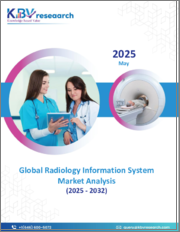
|
시장보고서
상품코드
1743552
방사선 정보 시스템 시장 : 규모, 점유율 및 동향 분석(제품별, 배포별, 최종 용도별, 지역별), 전망, 예측(2025-2032년)Global Radiology Information System Market Size, Share & Industry Analysis Report By Product (Integrated RIS and Standalone RIS), By Deployment (Web-based, On-premise, and Cloud-based), By End Use, By Regional Outlook and Forecast, 2025 - 2032 |
||||||

세계의 방사선 정보 시스템 시장 규모는 예측기간 동안 9.3%의 연평균 복합 성장률(CAGR)을 나타내 2032년까지 24억 9,000만 달러에 달할 것으로 예상되고 있습니다.
KBV Cardinal matrix : 방사선 정보 시스템 시장 경쟁 분석
KBV Cardinal matrix에 제시된 분석을 바탕으로 Oracle Corporation은 방사선 정보 시스템 시장의 선구자입니다. NV는 환자 관리, 조사, 교육 및 지역사회에 봉사하기 위해 노력하는 비영리 단체인 Mass General Brigham과 협력하여 환자 케어를 강화하기 위한 고급 데이터 인프라와 AI를 개발했습니다.
시장 성장 요인
첨단 의료용 IT 시스템의 도입 확대는 시장의 성장을 크게 견인하고 있습니다. 워크플로우 관리, 이미지 추적 및 결과 전달을 위한 강력한 도구를 제공합니다. 따라서 고급 의료 IT 시스템의 광범위한 도입은 방사선과 워크플로우의 효율성과 케어 제공을 향상시켜 시장 성장을 크게 촉진합니다.
게다가 영상진단센터의 세계 확대는 시장의 성장을 가속하는 가장 영향력 있는 요인 중 하나입니다.
시장 성장 억제요인
방사선 정보 시스템의 도입과 유지에 드는 고액의 비용은 시장의 성장을 막는 큰 장벽이 되고 있습니다.
제품별 전망
제품별로 볼 때 시장은 통합형 RIS와 독립형 RIS로 분류됩니다. 복잡한 시스템 통합 없이 의료용 IT 인프라가 제한된 지역과 예산의 제약으로 인해 통합 시스템의 도입이 어려운 지역에서는 독립형 RIS 수요가 여전히 견조합니다.
배포별 전망
배포 방법을 기반으로 시장은 웹 기반, 온프레미스 및 클라우드으로 분류됩니다. 이는 유연성, 확장성 및 액세스 용이성으로 인해 사용자가 인터넷 지원 장치를 통해 원격지에서 방사선 데이터를 검색하고 관리할 수 있도록 합니다. 하드웨어 인프라의 필요성을 줄이고 유지 보수 비용을 절감하고 여러 기지에 걸친 의료 종사자 간의 실시간 협업을 가능하게 합니다.
최종 용도별 전망
최종 용도별로 보면, 시장은 병원 및 진료소, 외래 진료소, 기타로 분류됩니다.
지역별 전망
지역별로 보면 북미, 유럽, 아시아태평양, LAMEA(라틴아메리카·중동·아프리카) 시장이 분석되고 있습니다. 의료 IT 인프라에 대한 투자 증가로 지원되고 있습니다. 많은 유럽 국가에서는 진단 워크 플로우의 효율성을 높이고 의료 제산업체 간의 데이터 공유를 향상시키고 환자의 결과 개선을 위해 RIS(Information Technology)를 도입했습니다.
시장 경쟁과 특성
방사선 정보 시스템 시장은 급속한 기술진보, 효율적인 의료관리에 대한 수요 증가, 디지털 이미지 솔루션 도입 확대를 배경으로 치열한 경쟁을 펼치고 있습니다. 규제 기준에 대한 컴플라이언스 등이 있습니다. 시장 기업은 혁신을 경쟁하고, 클라우드 솔루션, AI를 활용한 분석, 확장 가능한 아키텍처를 제공합니다.
목차
제1장 시장 범위와 조사 방법
- 시장 정의
- 목적
- 시장 범위
- 세분화
- 조사 방법
제2장 시장 개관
- 주요 하이라이트
제3장 시장 개요
- 서론
- 개요
- 시장구성과 시나리오
- 개요
- 시장에 영향을 미치는 주요 요인
- 시장 성장 촉진요인
- 시장 성장 억제요인
- 시장 기회
- 시장의 과제
제4장 경쟁 분석 : 세계 시장
- KBV Cardinal Matrix
- 최근 업계 전체의 전략적 전개
- 사업 제휴 및 협력, 계약
- 제품 발매·확대
- 기업 합병·인수(M&A)
- 시장 점유율 분석(2024년)
- 주요 성공 전략
- 주요 전략
- 주요 전략적 움직임
- Porter's Five Forces 분석
제5장 세계의 방사선 정보 시스템 시장 : 제품별
- 세계의 통합형 RIS 시장 : 지역별
- 세계의 독립형 RIS 시장 : 지역별
제6장 세계의 방사선 정보 시스템 시장 : 배포별
- 세계의 웹 시장 : 지역별
- 세계의 온프레미스 시장 : 지역별
- 세계의 클라우드 시장 : 지역별
제7장 세계의 방사선 정보 시스템 시장 : 최종 용도별
- 세계의 병원 및 진료소 시장 : 지역별
- 세계의 외래 진료과(OPD) 클리닉 시장 : 지역별
- 세계의 기타 최종 용도 시장 : 지역별
제8장 세계의 방사선 정보 시스템 시장 : 지역별
- 북미
- 북미의 방사선 정보 시스템 시장 : 국가별
- 미국
- 캐나다
- 멕시코
- 기타 북미
- 북미의 방사선 정보 시스템 시장 : 국가별
- 유럽
- 유럽의 방사선 정보 시스템 시장 : 국가별
- 독일
- 영국
- 프랑스
- 러시아
- 스페인
- 이탈리아
- 기타 유럽
- 유럽의 방사선 정보 시스템 시장 : 국가별
- 아시아태평양
- 아시아태평양의 방사선 정보 시스템 시장 : 국가별
- 중국
- 일본
- 인도
- 한국
- 호주
- 말레이시아
- 기타 아시아태평양
- 아시아태평양의 방사선 정보 시스템 시장 : 국가별
- 라틴아메리카·중동·아프리카
- LAMEA의 방사선 정보 시스템 시장 : 국가별
- 브라질
- 아르헨티나
- 아랍에미리트(UAE)
- 사우디아라비아
- 남아프리카
- 나이지리아
- 기타 라틴아메리카·중동·아프리카
- LAMEA의 방사선 정보 시스템 시장 : 국가별
제9장 기업 프로파일
- GE HealthCare Technologies, Inc
- Koninklijke Philips NV
- Siemens Healthineers AG(Siemens AG)
- Carestream Health, Inc(Onex Corporation)
- Nextgen healthcare, inc
- Oracle Corporation
- IBM Corporation
- Epic Systems Corporation
- eClinicalWorks LLC
- McKesson Corporation
제10장 방사선 정보 시스템 시장의 성공 필수 조건
KTH 25.06.18The Global Radiology Information System Market size is expected to reach $2.49 billion by 2032, rising at a market growth of 9.3% CAGR during the forecast period.
The rising interest in digital transformation and the need for scalable, cost-effective solutions have driven the adoption of cloud-based RIS. These systems offer advantages such as remote accessibility, automatic software updates, and reduced capital expenditure. Furthermore, the growing emphasis on interoperability and data sharing across healthcare networks has made cloud-based deployment an attractive option for many providers, particularly in regions with advanced IT infrastructure.
The major strategies followed by the market participants are Partnerships as the key developmental strategy to keep pace with the changing demands of end users. For instance, In April, 2025, Siemens Healthineers AG teamed up with Tower Health, a regional integrated healthcare system to enhance diagnostic imaging and digital tools across radiology, oncology, and cardiology. The collaboration includes upgrading equipment, implementing digital automation, and standardizing clinical operations, aiming to improve patient care, efficiency, and long-term viability for Tower Health's healthcare network. Additionally, In March, 2025, GE HealthCare Technologies, Inc. announced the partnership with NVIDIA, a computer manufacturer corporation to develop AI-driven autonomous imaging solutions, starting with X-ray and ultrasound. Leveraging NVIDIA's Isaac and Cosmos platforms, the goal is to ease radiology staff shortages and improve workflow efficiency through smart, automated systems that enhance diagnostic imaging and patient care.
KBV Cardinal Matrix - Radiology Information System Market Competition Analysis
Based on the Analysis presented in the KBV Cardinal matrix; Oracle Corporation is the forerunner in the Radiology Information System Market. Companies such as General Electric Company, IBM Corporation, McKesson Corporation are some of the key innovators in Radiology Information System Market. In February, 2025, Koninklijke Philips N.V. teamed up with Mass General Brigham, a nonprofit organization that is committed to patient care, research, teaching, and service to the community to develop advanced data infrastructure and AI to enhance patient care. This collaboration integrates live healthcare data from various sources, enabling real-time analysis and actionable insights. It focuses on improving patient safety, operational efficiency, and early detection of critical health issues.
Market Growth Factors
The rising adoption of advanced healthcare IT systems is significantly driving the growth of the market. As healthcare institutions continue to modernize their infrastructure, RIS solutions have become indispensable in streamlining radiological operations. These systems offer robust tools for patient scheduling, workflow management, image tracking, and result distribution. Hence, the widespread integration of advanced healthcare IT systems significantly fuels the market's growth by streamlining radiology workflows and enhancing care delivery.
Additionally, the global expansion of imaging centers is one of the most influential factors fuelling the growth of the market. As the world's population ages, healthcare systems are seeing a marked increase in age-related health conditions, which require diagnostic imaging for effective treatment. To meet this growing demand, public and private healthcare entities invest in new diagnostic and imaging centers equipped with state-of-the-art technology, of which RIS is a foundational component.
Market Restraining Factors
The high cost associated with implementing and maintaining Radiology Information Systems presents a significant barrier to market growth. Setting up a RIS infrastructure requires substantial capital investment in hardware, software licensing, networking, and integration with other hospital information systems like PACS and EHR. Thus, RIS implementation's substantial initial and ongoing costs can hinder adoption, especially among small and mid-sized healthcare providers.
Product Outlook
Based on product, the market is characterized into integrated RIS and standalone RIS. This growth can be attributed to its cost-effectiveness and ease of implementation, especially among smaller healthcare facilities and imaging centres. These systems provide essential radiology-specific functionalities such as patient scheduling, reporting, and results tracking without the complexity of full-scale integration. The demand for standalone RIS remains robust in regions with limited healthcare IT infrastructure or where budget constraints make integrated systems less feasible.
Deployment Outlook
Based on deployment, the market is classified into web-based, on-premise, and cloud-based. This is primarily due to its flexibility, scalability, and ease of access, which allows users to retrieve and manage radiology data remotely through internet-enabled devices. Web-based RIS solutions reduce the need for extensive hardware infrastructure, lower maintenance costs, and enable real-time collaboration among healthcare professionals across multiple locations. These advantages have driven widespread adoption of web-based systems, especially in large hospital networks and diagnostic centres aiming to streamline operations and enhance service delivery.
End Use Outlook
By end use, the market is divided into hospitals & clinics, outpatient department (OPD) clinics, and others. The outpatient department (OPD) clinics segment garnered 13% revenue share in the market in 2024. This growth is attributed to the increasing demand for specialized imaging services in outpatient settings, where quick turnaround and efficient patient scheduling are crucial.
Regional Outlook
Region-wise, the market is analyzed across North America, Europe, Asia Pacific, and LAMEA. This growth is supported by the increasing digitization of healthcare services, a strong focus on improving clinical efficiency, and rising investments in health IT infrastructure. Many European countries are adopting RIS to streamline diagnostic workflows, enhance data sharing between healthcare providers, and improve patient outcomes.
Market Competition and Attributes
The Radiology Information System (RIS) market is highly competitive, driven by rapid technological advancements, growing demand for efficient healthcare management, and increasing adoption of digital imaging solutions. Key attributes defining competition include system integration capabilities, user-friendly interfaces, data security, interoperability with other healthcare systems, and compliance with regulatory standards. Market players compete on innovation, offering cloud-based solutions, AI-driven analytics, and scalable architectures. Customer support, pricing flexibility, and seamless integration with Picture Archiving and Communication Systems (PACS) are also crucial for market success.
Recent Strategies Deployed in the Market
- Apr-2025: Siemens Healthineers AG teamed up with Tower Health, a regional integrated healthcare system to enhance diagnostic imaging and digital tools across radiology, oncology, and cardiology. The collaboration includes upgrading equipment, implementing digital automation, and standardizing clinical operations, aiming to improve patient care, efficiency, and long-term viability for Tower Health's healthcare network.
- Mar-2025: GE HealthCare Technologies, Inc. announced the partnership with NVIDIA, a computer manufacturer corporation to develop AI-driven autonomous imaging solutions, starting with X-ray and ultrasound. Leveraging NVIDIA's Isaac and Cosmos platforms, the goal is to ease radiology staff shortages and improve workflow efficiency through smart, automated systems that enhance diagnostic imaging and patient care.
- Mar-2025: GE HealthCare Technologies, Inc. unveiled Genesis, a cloud-based enterprise imaging SaaS suite featuring edge, storage, vendor neutral archive, and AI-powered data migration. Designed for efficiency, interoperability, and security, Genesis aims to enhance healthcare workflows and support scalable digital transformation via AWS infrastructure.
- Mar-2025: GE HealthCare Technologies, Inc. acquired Nihon Medi-Physics (NMP), a Pharmaceutical company, gaining full ownership from Sumitomo Chemical. This acquisition enhances GE HealthCare's portfolio in radiopharmaceuticals, supporting disease detection and diagnosis. NMP, based in Japan, will contribute expertise to global molecular imaging markets, focusing on neurology, cardiology, and oncology.
- Mar-2025: Koninklijke Philips N.V. unveiled SmartSpeed Precise, an MRI solution powered by dual-AI engines that enhances scan speed and image quality. It boosts efficiency, reduces patient wait times, and improves diagnostic accuracy. Additionally, Philips presented its helium-free BlueSeal MRI scanner, promoting sustainability.
- Feb-2025: GE HealthCare Technologies, Inc. unveiled Freelium, a helium-free sealed magnet platform in development, aiming to deliver high-quality MR imaging with under 1% helium usage. Designed for efficiency, sustainability, and AI compatibility, Freelium enhances diagnostic access while supporting GE HealthCare's environmental and operational goals worldwide.
- Feb-2025: Koninklijke Philips N.V. teamed up with Mass General Brigham, a nonprofit organization that is committed to patient care, research, teaching, and service to the community to develop advanced data infrastructure and AI to enhance patient care. This collaboration integrates live healthcare data from various sources, enabling real-time analysis and actionable insights. It focuses on improving patient safety, operational efficiency, and early detection of critical health issues.
- Feb-2025: Siemens Healthineers AG announced the partnership with Sectra, a Secure communication company to enhance radiology workflows by integrating Siemens' NAEOTOM Alpha photon-counting CT images within Sectra's PACS. This seamless integration allows radiologists to access advanced spectral post-processing tools, improving diagnostic precision, reducing radiation doses, and enabling faster, more accurate diagnoses for better patient care.
List of Key Companies Profiled
- GE HealthCare Technologies, Inc.
- Koninklijke Philips N.V.
- Siemens Healthineers AG (Siemens AG)
- Carestream Health, Inc. (Onex Corporation)
- NEXTGEN HEALTHCARE, INC.
- Oracle Corporation
- IBM Corporation
- Epic Systems Corporation
- General Electric Company
- McKesson Corporation
Global Radiology Information System Market Report Segmentation
By Product
- Integrated RIS
- Standalone RIS
By Deployment
- Web-based
- On-premise
- Cloud-based
By End Use
- Hospitals & Clinics
- Outpatient Department (OPD) Clinics
- Other End Use
By Geography
- North America
- US
- Canada
- Mexico
- Rest of North America
- Europe
- Germany
- UK
- France
- Russia
- Spain
- Italy
- Rest of Europe
- Asia Pacific
- China
- Japan
- India
- South Korea
- Australia
- Malaysia
- Rest of Asia Pacific
- LAMEA
- Brazil
- Argentina
- UAE
- Saudi Arabia
- South Africa
- Nigeria
- Rest of LAMEA
Table of Contents
Chapter 1. Market Scope & Methodology
- 1.1 Market Definition
- 1.2 Objectives
- 1.3 Market Scope
- 1.4 Segmentation
- 1.4.1 Global Radiology Information System Market, by Product
- 1.4.2 Global Radiology Information System Market, by Deployment
- 1.4.3 Global Radiology Information System Market, by End Use
- 1.4.4 Global Radiology Information System Market, by Geography
- 1.5 Methodology for the research
Chapter 2. Market at a Glance
- 2.1 Key Highlights
Chapter 3. Market Overview
- 3.1 Introduction
- 3.1.1 Overview
- 3.1.1.1 Market Composition and Scenario
- 3.1.1 Overview
- 3.2 Key Factors Impacting the Market
- 3.2.1 Market Drivers
- 3.2.2 Market Restraints
- 3.2.3 Market Opportunities
- 3.2.4 Market Challenges
Chapter 4. Competition Analysis - Global
- 4.1 KBV Cardinal Matrix
- 4.2 Recent Industry Wide Strategic Developments
- 4.2.1 Partnerships, Collaborations and Agreements
- 4.2.2 Product Launches and Product Expansions
- 4.2.3 Acquisition and Mergers
- 4.3 Market Share Analysis, 2024
- 4.4 Top Winning Strategies
- 4.4.1 Key Leading Strategies: Percentage Distribution (2021-2025)
- 4.4.2 Key Strategic Move: (Partnerships, Collaborations & Agreements: 2023, Sep - 2025, Apr) Leading Players
- 4.5 Porter Five Forces Analysis
Chapter 5. Global Radiology Information Systems Market by Product
- 5.1 Global Integrated RIS Market by Region
- 5.2 Global Standalone RIS Market by Region
Chapter 6. Global Radiology Information Systems Market by Deployment
- 6.1 Global Web-based Market by Region
- 6.2 Global On-premise Market by Region
- 6.3 Global Cloud-based Market by Region
Chapter 7. Global Radiology Information Systems Market by End Use
- 7.1 Global Hospitals & Clinics Market by Region
- 7.2 Global Outpatient Department (OPD) Clinics Market by Region
- 7.3 Global Other End Use Market by Region
Chapter 8. Global Radiology Information Systems Market by Region
- 8.1 North America Radiology Information Systems Market
- 8.1.1 North America Radiology Information Systems Market by Product
- 8.1.1.1 North America Integrated RIS Market by Country
- 8.1.1.2 North America Standalone RIS Market by Country
- 8.1.2 North America Radiology Information Systems Market by Deployment
- 8.1.2.1 North America Web-based Market by Country
- 8.1.2.2 North America On-premise Market by Country
- 8.1.2.3 North America Cloud-based Market by Country
- 8.1.3 North America Radiology Information Systems Market by End Use
- 8.1.3.1 North America Hospitals & Clinics Market by Country
- 8.1.3.2 North America Outpatient Department (OPD) Clinics Market by Country
- 8.1.3.3 North America Other End Use Market by Country
- 8.1.4 North America Radiology Information Systems Market by Country
- 8.1.4.1 US Radiology Information Systems Market
- 8.1.4.1.1 US Radiology Information Systems Market by Product
- 8.1.4.1.2 US Radiology Information Systems Market by Deployment
- 8.1.4.1.3 US Radiology Information Systems Market by End Use
- 8.1.4.2 Canada Radiology Information Systems Market
- 8.1.4.2.1 Canada Radiology Information Systems Market by Product
- 8.1.4.2.2 Canada Radiology Information Systems Market by Deployment
- 8.1.4.2.3 Canada Radiology Information Systems Market by End Use
- 8.1.4.3 Mexico Radiology Information Systems Market
- 8.1.4.3.1 Mexico Radiology Information Systems Market by Product
- 8.1.4.3.2 Mexico Radiology Information Systems Market by Deployment
- 8.1.4.3.3 Mexico Radiology Information Systems Market by End Use
- 8.1.4.4 Rest of North America Radiology Information Systems Market
- 8.1.4.4.1 Rest of North America Radiology Information Systems Market by Product
- 8.1.4.4.2 Rest of North America Radiology Information Systems Market by Deployment
- 8.1.4.4.3 Rest of North America Radiology Information Systems Market by End Use
- 8.1.4.1 US Radiology Information Systems Market
- 8.1.1 North America Radiology Information Systems Market by Product
- 8.2 Europe Radiology Information Systems Market
- 8.2.1 Europe Radiology Information Systems Market by Product
- 8.2.1.1 Europe Integrated RIS Market by Country
- 8.2.1.2 Europe Standalone RIS Market by Country
- 8.2.2 Europe Radiology Information Systems Market by Deployment
- 8.2.2.1 Europe Web-based Market by Country
- 8.2.2.2 Europe On-premise Market by Country
- 8.2.2.3 Europe Cloud-based Market by Country
- 8.2.3 Europe Radiology Information Systems Market by End Use
- 8.2.3.1 Europe Hospitals & Clinics Market by Country
- 8.2.3.2 Europe Outpatient Department (OPD) Clinics Market by Country
- 8.2.3.3 Europe Other End Use Market by Country
- 8.2.4 Europe Radiology Information Systems Market by Country
- 8.2.4.1 Germany Radiology Information Systems Market
- 8.2.4.1.1 Germany Radiology Information Systems Market by Product
- 8.2.4.1.2 Germany Radiology Information Systems Market by Deployment
- 8.2.4.1.3 Germany Radiology Information Systems Market by End Use
- 8.2.4.2 UK Radiology Information Systems Market
- 8.2.4.2.1 UK Radiology Information Systems Market by Product
- 8.2.4.2.2 UK Radiology Information Systems Market by Deployment
- 8.2.4.2.3 UK Radiology Information Systems Market by End Use
- 8.2.4.3 France Radiology Information Systems Market
- 8.2.4.3.1 France Radiology Information Systems Market by Product
- 8.2.4.3.2 France Radiology Information Systems Market by Deployment
- 8.2.4.3.3 France Radiology Information Systems Market by End Use
- 8.2.4.4 Russia Radiology Information Systems Market
- 8.2.4.4.1 Russia Radiology Information Systems Market by Product
- 8.2.4.4.2 Russia Radiology Information Systems Market by Deployment
- 8.2.4.4.3 Russia Radiology Information Systems Market by End Use
- 8.2.4.5 Spain Radiology Information Systems Market
- 8.2.4.5.1 Spain Radiology Information Systems Market by Product
- 8.2.4.5.2 Spain Radiology Information Systems Market by Deployment
- 8.2.4.5.3 Spain Radiology Information Systems Market by End Use
- 8.2.4.6 Italy Radiology Information Systems Market
- 8.2.4.6.1 Italy Radiology Information Systems Market by Product
- 8.2.4.6.2 Italy Radiology Information Systems Market by Deployment
- 8.2.4.6.3 Italy Radiology Information Systems Market by End Use
- 8.2.4.7 Rest of Europe Radiology Information Systems Market
- 8.2.4.7.1 Rest of Europe Radiology Information Systems Market by Product
- 8.2.4.7.2 Rest of Europe Radiology Information Systems Market by Deployment
- 8.2.4.7.3 Rest of Europe Radiology Information Systems Market by End Use
- 8.2.4.1 Germany Radiology Information Systems Market
- 8.2.1 Europe Radiology Information Systems Market by Product
- 8.3 Asia Pacific Radiology Information Systems Market
- 8.3.1 Asia Pacific Radiology Information Systems Market by Product
- 8.3.1.1 Asia Pacific Integrated RIS Market by Country
- 8.3.1.2 Asia Pacific Standalone RIS Market by Country
- 8.3.2 Asia Pacific Radiology Information Systems Market by Deployment
- 8.3.2.1 Asia Pacific Web-based Market by Country
- 8.3.2.2 Asia Pacific On-premise Market by Country
- 8.3.2.3 Asia Pacific Cloud-based Market by Country
- 8.3.3 Asia Pacific Radiology Information Systems Market by End Use
- 8.3.3.1 Asia Pacific Hospitals & Clinics Market by Country
- 8.3.3.2 Asia Pacific Outpatient Department (OPD) Clinics Market by Country
- 8.3.3.3 Asia Pacific Other End Use Market by Country
- 8.3.4 Asia Pacific Radiology Information Systems Market by Country
- 8.3.4.1 China Radiology Information Systems Market
- 8.3.4.1.1 China Radiology Information Systems Market by Product
- 8.3.4.1.2 China Radiology Information Systems Market by Deployment
- 8.3.4.1.3 China Radiology Information Systems Market by End Use
- 8.3.4.2 Japan Radiology Information Systems Market
- 8.3.4.2.1 Japan Radiology Information Systems Market by Product
- 8.3.4.2.2 Japan Radiology Information Systems Market by Deployment
- 8.3.4.2.3 Japan Radiology Information Systems Market by End Use
- 8.3.4.3 India Radiology Information Systems Market
- 8.3.4.3.1 India Radiology Information Systems Market by Product
- 8.3.4.3.2 India Radiology Information Systems Market by Deployment
- 8.3.4.3.3 India Radiology Information Systems Market by End Use
- 8.3.4.4 South Korea Radiology Information Systems Market
- 8.3.4.4.1 South Korea Radiology Information Systems Market by Product
- 8.3.4.4.2 South Korea Radiology Information Systems Market by Deployment
- 8.3.4.4.3 South Korea Radiology Information Systems Market by End Use
- 8.3.4.5 Australia Radiology Information Systems Market
- 8.3.4.5.1 Australia Radiology Information Systems Market by Product
- 8.3.4.5.2 Australia Radiology Information Systems Market by Deployment
- 8.3.4.5.3 Australia Radiology Information Systems Market by End Use
- 8.3.4.6 Malaysia Radiology Information Systems Market
- 8.3.4.6.1 Malaysia Radiology Information Systems Market by Product
- 8.3.4.6.2 Malaysia Radiology Information Systems Market by Deployment
- 8.3.4.6.3 Malaysia Radiology Information Systems Market by End Use
- 8.3.4.7 Rest of Asia Pacific Radiology Information Systems Market
- 8.3.4.7.1 Rest of Asia Pacific Radiology Information Systems Market by Product
- 8.3.4.7.2 Rest of Asia Pacific Radiology Information Systems Market by Deployment
- 8.3.4.7.3 Rest of Asia Pacific Radiology Information Systems Market by End Use
- 8.3.4.1 China Radiology Information Systems Market
- 8.3.1 Asia Pacific Radiology Information Systems Market by Product
- 8.4 LAMEA Radiology Information Systems Market
- 8.4.1 LAMEA Radiology Information Systems Market by Product
- 8.4.1.1 LAMEA Integrated RIS Market by Country
- 8.4.1.2 LAMEA Standalone RIS Market by Country
- 8.4.2 LAMEA Radiology Information Systems Market by Deployment
- 8.4.2.1 LAMEA Web-based Market by Country
- 8.4.2.2 LAMEA On-premise Market by Country
- 8.4.2.3 LAMEA Cloud-based Market by Country
- 8.4.3 LAMEA Radiology Information Systems Market by End Use
- 8.4.3.1 LAMEA Hospitals & Clinics Market by Country
- 8.4.3.2 LAMEA Outpatient Department (OPD) Clinics Market by Country
- 8.4.3.3 LAMEA Other End Use Market by Country
- 8.4.4 LAMEA Radiology Information Systems Market by Country
- 8.4.4.1 Brazil Radiology Information Systems Market
- 8.4.4.1.1 Brazil Radiology Information Systems Market by Product
- 8.4.4.1.2 Brazil Radiology Information Systems Market by Deployment
- 8.4.4.1.3 Brazil Radiology Information Systems Market by End Use
- 8.4.4.2 Argentina Radiology Information Systems Market
- 8.4.4.2.1 Argentina Radiology Information Systems Market by Product
- 8.4.4.2.2 Argentina Radiology Information Systems Market by Deployment
- 8.4.4.2.3 Argentina Radiology Information Systems Market by End Use
- 8.4.4.3 UAE Radiology Information Systems Market
- 8.4.4.3.1 UAE Radiology Information Systems Market by Product
- 8.4.4.3.2 UAE Radiology Information Systems Market by Deployment
- 8.4.4.3.3 UAE Radiology Information Systems Market by End Use
- 8.4.4.4 Saudi Arabia Radiology Information Systems Market
- 8.4.4.4.1 Saudi Arabia Radiology Information Systems Market by Product
- 8.4.4.4.2 Saudi Arabia Radiology Information Systems Market by Deployment
- 8.4.4.4.3 Saudi Arabia Radiology Information Systems Market by End Use
- 8.4.4.5 South Africa Radiology Information Systems Market
- 8.4.4.5.1 South Africa Radiology Information Systems Market by Product
- 8.4.4.5.2 South Africa Radiology Information Systems Market by Deployment
- 8.4.4.5.3 South Africa Radiology Information Systems Market by End Use
- 8.4.4.6 Nigeria Radiology Information Systems Market
- 8.4.4.6.1 Nigeria Radiology Information Systems Market by Product
- 8.4.4.6.2 Nigeria Radiology Information Systems Market by Deployment
- 8.4.4.6.3 Nigeria Radiology Information Systems Market by End Use
- 8.4.4.7 Rest of LAMEA Radiology Information Systems Market
- 8.4.4.7.1 Rest of LAMEA Radiology Information Systems Market by Product
- 8.4.4.7.2 Rest of LAMEA Radiology Information Systems Market by Deployment
- 8.4.4.7.3 Rest of LAMEA Radiology Information Systems Market by End Use
- 8.4.4.1 Brazil Radiology Information Systems Market
- 8.4.1 LAMEA Radiology Information Systems Market by Product
Chapter 9. Company Profiles
- 9.1 GE HealthCare Technologies, Inc.
- 9.1.1 Company Overview
- 9.1.2 Financial Analysis
- 9.1.3 Segmental and Regional Analysis
- 9.1.4 Research & Development Expenses
- 9.1.5 Recent strategies and developments:
- 9.1.5.1 Partnerships, Collaborations, and Agreements:
- 9.1.5.2 Product Launches and Product Expansions:
- 9.1.5.3 Acquisition and Mergers:
- 9.1.6 SWOT Analysis
- 9.2 Koninklijke Philips N.V.
- 9.2.1 Company Overview
- 9.2.2 Financial Analysis
- 9.2.3 Segmental and Regional Analysis
- 9.2.4 Research & Development Expense
- 9.2.5 Recent strategies and developments:
- 9.2.5.1 Partnerships, Collaborations, and Agreements:
- 9.2.5.2 Product Launches and Product Expansions:
- 9.2.6 SWOT Analysis
- 9.3 Siemens Healthineers AG (Siemens AG)
- 9.3.1 Company Overview
- 9.3.2 Financial Analysis
- 9.3.3 Segmental and Regional Analysis
- 9.3.4 Research & Development Expense
- 9.3.5 Recent strategies and developments:
- 9.3.5.1 Partnerships, Collaborations, and Agreements:
- 9.3.5.2 Product Launches and Product Expansions:
- 9.3.6 SWOT Analysis
- 9.4 Carestream Health, Inc. (Onex Corporation)
- 9.4.1 Company Overview
- 9.4.2 SWOT Analysis
- 9.5 Nextgen healthcare, inc.
- 9.5.1 Company Overview
- 9.5.2 SWOT Analysis
- 9.6 Oracle Corporation
- 9.6.1 Company Overview
- 9.6.2 Financial Analysis
- 9.6.3 Segmental and Regional Analysis
- 9.6.4 Research & Development Expense
- 9.6.5 SWOT Analysis
- 9.7 IBM Corporation
- 9.7.1 Company Overview
- 9.7.2 Financial Analysis
- 9.7.3 Regional & Segmental Analysis
- 9.7.4 Research & Development Expenses
- 9.7.5 Recent strategies and developments:
- 9.7.5.1 Product Launches and Product Expansions:
- 9.7.6 SWOT Analysis
- 9.8 Epic Systems Corporation
- 9.8.1 Company Overview
- 9.8.2 SWOT Analysis
- 9.9 eClinicalWorks LLC
- 9.9.1 Company Overview
- 9.10. McKesson Corporation
- 9.10.1 Company Overview
- 9.10.2 Financial Analysis
- 9.10.3 Segmental Analysis
- 9.10.4 Research & Development Expense
- 9.10.5 SWOT Analysis