
|
시장보고서
상품코드
1881291
바이오 계면활성제 시장 : 유형별, 적용분야별, 지역별(-2030년)Biosurfactants Market by Type (Glycolipids (Sophorolipids, Rhamnolipids) and Lipopeptides), Application (Detergent, Personal Care, Food Processing, Agricultural Chemicals), and Region - Global Forecast to 2030 |
||||||

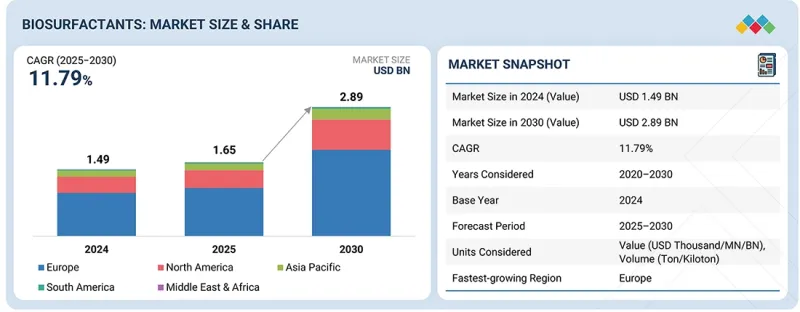
바이오 계면활성제 시장 규모는 예측기간 동안 CAGR 11.79%로 성장하고, 2025년 16억 5,000만 달러, 2030년에는 28억 9,000만 달러에 이를 것으로 전망됩니다.
연구개발은 기존보다 높은 계면활성 성능, 안정성, 저비용을 갖춘 차세대 바이오 계면활성제의 지속적 개발을 뒷받침하고 있습니다.
| 조사 범위 | |
|---|---|
| 조사 기간 | 2020-2030년 |
| 기준 연도 | 2024년 |
| 예측 기간 | 2025-2030년 |
| 단위 | 금각(달러) 및 톤/킬로톤 |
| 부문 | 유형, 용도, 지역 |
| 대상 지역 | 아시아태평양, 유럽, 북미, 중동, 아프리카, 남미 |
소홀로리피드와 람노리피드 등의 글리콜리피드계 바이오 계면활성제는 세제, 퍼스널케어, 식품 가공 등의 용도에 있어서 발포성, 유화성, 항균 성능을 향상시키기 위해 재설계되어 있습니다. 또한 바이오마크 엔지니어링, 바이오프로세스 최적화, 발효 수율 향상, 효소공학의 진전으로 생산자는 적은 사용량으로 보다 강력한 성능을 실현할 수 있게 되어 생산 비용과 환경에 미치는 영향을 저감하고 있습니다. 바이오 테크놀로지에 의한 균주 개량이나 재생 가능 원료의 활용도, 순환형 경제의 목표 달성을 향해 업계가 주력하는 분야입니다. 제조업체 각사는 천연 유래·비독·생분해성이라는 특성을 갖춘 그린으로 다기능인 바이오 계면활성제에 대한 투자를 확대하고 있어 이것이 세계 시장의 대폭적인 성장을 견인하고 있습니다.
"글리콜리피드 부문이 2024년 최대 점유율을 차지한다"
2024년, 글리콜리피드(소홀로리피드 및 람노리피드 포함)는 높은 생분해성, 유화 능력, 온화함으로 인해 가장 큰 점유율을 차지했습니다. 글리콜리피드는 성능의 일관성과 환경적 적합성 때문에 세제, 화장품, 가정용 세정 제품에서 사용률이 높습니다. 또, 자극성이 없고 강력한 세정력과 발포성을 갖추고 있기 때문에 소비자용 제품과 공업용 제품의 양쪽에서 급속하게 채택이 진행되고 있습니다. 또한 발효 기술과 다운스트림 공정의 회수 기술의 진보에 의해 생산 규모의 확대가 가능해져 합성 계면활성제보다 비용 효율이 높고 경쟁력 있는 제품이 되고 있습니다. 지속가능성이 여전히 소비자 동향과 규제 정책에 영향을 미치는 가운데 글리콜리피드는 세계 바이오 계면활성제 시장의 성장을 견인하는 주요 요인이 될 전망입니다.
"용도별로는 퍼스널케어 부문이 2위"
바이오 계면활성제를 채택한 퍼스널케어 제품은 저자극성, 뛰어난 발포성, 높은 유화성을 갖추어, 피부에의 친화성과 환경 안전성을 실현하고 있습니다. 이러한 천연 유래 계면활성제는 샴푸, 세안료, 화장품에서 생분해성 및 비독성 성분에 대한 수요에 충분한 대응력을 나타내고 있습니다. 소홀로리피드 및 람노리피드와 같은 바이오 계면활성제는 자극 없이 효과적인 세정력과 컨디셔닝 기능을 제공함으로써 이러한 요구 사항을 충족합니다. 또한 제품의 질감, 안정성 및 기능 특성을 유지하면서 깨끗한 라벨과 지속가능성에 대한 주장에도 대응할 수 있으므로 제형 개발자에게 유익합니다. 소비자에 의한 천연 유래로 온화하고 친환경적인 처방에 대한 수요가 확대되고 있는 가운데, 퍼스널케어 산업에 있어서의 바이오 계면활성제의 역할은 현저하게 확대하고 있습니다. 유화능력과 항균활성 등, 그 다기능성에 의해 바이오 계면활성제는 21세기 이후의 퍼스널케어 제품 개발에 있어서 중요한 성분이 되고 있습니다.
"지역별로는 유럽이 2024년 최대 시장 규모를 보여준다"
유럽은 생분해성 및 재생 가능 계면활성제의 사용을 촉진하는 견고한 규제 메커니즘을 통해 바이오 계면활성제 시장을 계속 독점하고 있습니다. 이 지역의 높은 수요는 환경 규제 준수와 녹색 인증이 매우 중요한 세제, 개인 관리 및 식품 가공 분야에서 광범위한 사용으로 인해 발생합니다. 유럽 소비자의 지속가능한 식물 유래 제품에 대한 수요는 높고, 이러한 동향에 대한 인식은 석유화학계에서 바이오계 계면활성제로의 전환을 더욱 가속화할 것입니다. 게다가 독일, 프랑스, 네덜란드 등 국가에서는 국내외 제조업체들이 생명공학과 발효 효율을 활용하여 제조 능력을 확대하고 있습니다. 이러한 지역 주도 노력 외에도 연구 개발에 대한 강력한 투자와 유리한 규제 환경이 결합되어 유럽은 세계 바이오 계면활성제 시장의 주요 개발 기지로 계속되고 있습니다.
본 보고서에서는 세계의 바이오 계면활성제 시장을 조사했으며, 시장 개요, 시장 성장에 대한 각종 영향요인 분석, 기술·특허 동향, 법규제 환경, 사례 연구, 시장 규모 추이와 예측, 각종 구분·지역/주요 국가별 상세 분석, 경쟁 구도, 주요 기업 프로파일 등을 정리했습니다.
자주 묻는 질문
목차
제1장 서론
제2장 주요 요약
제3장 중요 인사이트
제4장 시장 개요
- 시장 역학
- 성장 촉진요인
- 억제요인
- 기회
- 과제
- 상호접속된 시장과 분야 횡단적인 기회
- Tier 1/2/3 기업의 전략적 움직임
제5장 업계 동향
- Porter's Five Forces 분석
- 거시경제 전망
- 공급망 분석
- 생태계 분석
- 가격 분석
- 무역 분석
- 2025-2026년 주요 회의 및 이벤트
- 고객의 사업에 영향을 주는 동향/혁신
- 투자 및 자금조달 시나리오
- 사례 연구 분석
- 2025년 미국 관세의 영향-개요
제6장 기술의 진보, AI에 의한 영향, 특허, 혁신, 장래의 용도
- 주요 신기술
- 보완적 기술
- 기술/제품 로드맵
- 특허 분석
- AI/생성형 AI가 바이오 계면활성제 시장에 미치는 영향
제7장 지속가능성과 규제상황
- 지역 규제 및 규정 준수
- 지속가능성에 대한 노력
- 지속가능성에 미치는 영향과 규제 정책의 노력
- 인증, 라벨, 환경 기준
제8장 고객정세와 구매행동
- 의사결정 프로세스
- 이해관계자와 구매평가기준
- 채택 장벽과 내부 과제
- 다양한 응용 분야에서 언멧 요구
제9장 바이오 계면활성제 시장 : 유형별
- 글리코리피드
- 리포펩타이드
제10장 바이오 계면활성제 시장 : 용도별
- 세제
- 퍼스널케어
- 식품가공
- 농약
- 기타
제11장 바이오 계면활성제 시장 : 지역별
- 유럽
- 독일
- 영국
- 프랑스
- 북미
- 미국
- 아시아태평양
- 일본
- 중국
- 한국
- 남미
- 브라질
- 중동 및 아프리카
제12장 경쟁 구도
- 개요
- 주요 기업의 전략/유력 기업
- 시장 점유율 분석
- 수익 분석
- 기업 평가 매트릭스 : 주요 기업
- 기업평가 매트릭스: 스타트업/중소기업
- 브랜드 비교
- 기업평가와 재무지표
- 경쟁 시나리오
제13장 기업 프로파일
- 주요 기업
- EVONIK INDUSTRIES AG
- SHAANXI DEGUAN BIOTECHNOLOGY CO., LTD.
- BIOTENSIDON GMBH
- SARAYA CO., LTD.
- ALLIED CARBON SOLUTIONS CO., LTD.
- STEPAN COMPANY
- DAQING VICTEX CHEMICAL INDUSTRIES CO., LTD.
- HOLIFERM LIMITED
- SOLVAY SA
- DOW INC.
- GIVAUDAN SA
- AGAE TECHNOLOGIES, LLC
- BIOSURFACTANTS LLC
- KANEKA CORPORATION
- KEMIN INDUSTRIES, INC.
- 스타트업/SME기업
- WHEATOLEO
- JENEIL BIOTECH, INC.
- GLYCOSURF, LLC
- TENSIOGREEN TECHNOLOGY CORP.
- DISPERSA INC.
- ZFA TECHNOLOGIES INC.
- HUB.TECH. SA
- MG INTOBIO CO., LTD.
- SYNTHEZYME LLC
- SASOL LIMITED
- TEEGENE BIOTECH LTD.
- BIOFUTURE LTD.
- TOYOBO CO., LTD.
- VETLINE
- KANEBO COSMETICS INC.
- FRAUNHOFER IGB
- LOCUS FERMENTATION SOLUTIONS
제14장 조사 방법
제15장 인접 시장과 관련 시장
제16장 부록
SHW 25.12.11The biosurfactants market is expected to grow from USD 1.65 billion in 2025 to USD 2.89 billion by 2030, at a compound annual growth rate (CAGR) of 11.79% during the forecast period. R&D is being used in the continuous development of next-generation biosurfactants that have a superior surfacing property, stability, and lower cost than previous bio-based formulations.
| Scope of the Report | |
|---|---|
| Years Considered for the Study | 2020-2030 |
| Base Year | 2024 |
| Forecast Period | 2025-2030 |
| Units Considered | Value (USD Thousand/MN/BN) and Volume (Ton/Kiloton) |
| Segments | Type, Application, and Region |
| Regions covered | Asia Pacific, Europe, North America, the Middle East & Africa, and South America |
Glycolipid biosurfactants are being reformulated to enhance foaming, emulsification, and antimicrobial performance in challenging applications in detergents, personal care, and food processing, such as sophorolipids and rhamnolipids. Biomark engineering, optimization of bioprocesses, and the increase in fermentation yields, as well as enzyme engineering, are also enabling producers to achieve more powerful performance with fewer dosage needs, thereby reducing production costs and environmental impact. Enhancing strains via biotechnology and utilizing renewable feedstocks are also areas that the industry is targeting to achieve the aims of the circular economy. The manufacturers are also investing more money in green and multifunctional biosurfactants, which are natural, non-toxic, and biodegradable substances, thereby driving significant growth in the global market.
Glycolipids segment accounted for the largest share in the biosurfactants market, in terms of value, in 2024.
In 2024, the glycolipids segment, including sophorolipids and rhamnolipids, had the highest percentage of the biosurfactants market share due to its high rate of biodegradation, emulsification capability, and mildness. The use of glycolipids in detergents, cosmetics, and household cleaning products is high due to their performance consistency and environmental compliance. They possess strong cleaning and foaming properties that are non-irritating, which has led to their rapid adoption in both consumer and industrial formulations. Moreover, advancements in fermentation technologies and downstream recovery technologies have enabled an increase in production scale, making them cost-effective and more competitive than synthetic surfactants. With sustainability still influencing consumer trends and regulatory policies, glycolipids are poised to be the primary driver of growth in the biosurfactants market globally.
The personal care segment was the second-largest application, in terms of value, in the global biosurfactants market.
Personal care products that utilize biosurfactants offer mildness, enhanced foaming capacity, and superior emulsification, making them skin-compatible and environmentally safe. These naturally obtained surfactants are gaining sufficient response to the demand for biodegradable and non-toxic ingredients in shampoos, facial cleansers, and cosmetics. Biosurfactants, such as sophorolipids and rhamnolipids, meet this requirement, offering effective levels of cleansing and conditioning functionality without irritation. Moreover, they enable formulators to preserve product texture, stability, and sensory qualities, while also addressing clean-labeling and sustainability statements. With the ever-growing demand from consumers for naturally produced, mild, and eco-friendly formulations, the role of biosurfactants in the personal care industry has expanded significantly. Their versatility, including the ability to emulsify, antimicrobial activity, and so on, is making biosurfactants an important ingredient in the development of personal care in the twenty-first century and beyond.
Europe is estimated to be the largest regional market for biosurfactants, in terms of value, in 2024
Europe continues to dominate the biosurfactants market due to its robust regulatory mechanisms, which promote the use of biodegradable and renewable surfactants. The high demand in the region is due to the widespread use in the detergents, personal care, and food processing sectors, where environmental compliance and green certification will be of high importance. The demand for sustainable, plant-based products among European consumers is high, and awareness of this trend will further accelerate the shift from petrochemical to bio-based surfactants. Additionally, local and foreign manufacturers are expanding their manufacturing capacities in countries such as Germany, France, and the Netherlands, leveraging biotechnology and fermentation efficiency. This local leadership, combined with strong investment in research and development and a favorable regulatory environment, continues to make Europe a key development center in the global biosurfactants market.
- By Company Type: Tier 1 - 55%, Tier 2 - 25%, and Tier 3 - 20%
- By Designation: Directors - 50%, Managers - 30%, and Others - 20%
- By Region: North America - 40%, Europe - 35%, Asia Pacific - 20%, Rest of World - 5%
The key players profiled in the report include Evonik Industries AG (Germany), Shaanxi Deguan Biotechnology Co., Ltd (China), Biotensidon GmbH (Germany), Saraya Co., Ltd. (Japan), Allied Carbon Solutions Co., Ltd. (Japan), Daqing VICTEX Chemical Industries Co., Ltd. (China), Stepan Company (US), Holiferm Limited (UK), Dow Inc. (US), Solvay SA (Belgium), Givaudan SA (Switzerland), AGAE Technologies, LLC (US), Biosurfactants LLC (US), Kaneka Corporation (Japan), and Kemin Industries, Inc. (US).
Research Coverage
This report segments the biosurfactants market by type, application, and region, and provides estimations of value (in USD thousand) for the overall market size across various regions. A detailed analysis of key industry players has been conducted to provide insights into their business overviews, services, and key strategies associated with the biosurfactants market.
Reasons to Buy this Report
This research report is focused on various levels of analysis - industry analysis (industry trends), market share analysis of top players, and company profiles, which together provide an overall view of the competitive landscape, emerging and high-growth segments of the biosurfactants market, high-growth regions, and market drivers, restraints, and opportunities.
The report provides insights into the following points:
- Market Penetration: Comprehensive information on biosurfactants offered by top players in the global market
- Analysis of key drivers: (Increasing demand for green solutions, regulations on use of synthetic surfactants, personal care product manufacturers going green) restraints (Less commercialization due to high production cost, conventional bio-based products gaining popularity) opportunities (Development of cost-effective production techniques, rhamnolipids as antitumor agents and immunomodulators, rising demand from petroleum industry), and challenges (Lack of production technology and cost-competitiveness of rhamnolipids) influencing the growth of the biosurfactants market
- Product Development/Innovation: Detailed insights on upcoming technologies, research & development activities, and new product & service launches in the biosurfactants market
- Market Development: Comprehensive information about lucrative emerging markets - the report analyzes the markets for biosurfactants across regions
- Market Diversification: Exhaustive information about new products, untapped regions, and recent developments in the global biosurfactants market
- Competitive Assessment: In-depth assessment of market shares, strategies, products, and manufacturing capabilities of leading players in the biosurfactants market
TABLE OF CONTENTS
1 INTRODUCTION
- 1.1 STUDY OBJECTIVES
- 1.2 MARKET DEFINITION
- 1.3 STUDY SCOPE
- 1.3.1 MARKETS COVERED AND REGIONAL SCOPE
- 1.3.2 INCLUSIONS AND EXCLUSIONS
- 1.3.3 MARKET DEFINITION AND INCLUSIONS, BY TYPE
- 1.3.4 MARKET DEFINITION AND INCLUSIONS, BY APPLICATION
- 1.3.5 YEARS CONSIDERED
- 1.3.6 CURRENCY CONSIDERED
- 1.3.7 UNIT CONSIDERED
- 1.4 STAKEHOLDERS
- 1.5 SUMMARY OF CHANGES
2 EXECUTIVE SUMMARY
- 2.1 MARKET HIGHLIGHTS AND KEY INSIGHTS
- 2.2 KEY MARKET PARTICIPANTS: MAPPING OF STRATEGIC DEVELOPMENTS
- 2.3 DISRUPTIVE TRENDS IN BIOSURFACTANTS MARKET
- 2.4 HIGH-GROWTH SEGMENTS & EMERGING FRONTIERS
- 2.5 EUROPE: MARKET SIZE, GROWTH RATE, AND FORECAST
3 PREMIUM INSIGHTS
- 3.1 ATTRACTIVE OPPORTUNITIES FOR PLAYERS IN BIOSURFACTANTS MARKET
- 3.2 BIOSURFACTANTS MARKET, BY REGION
- 3.3 EUROPE: BIOSURFACTANTS MARKET, BY APPLICATION AND COUNTRY, 2024
- 3.4 BIOSURFACTANTS MARKET, BY APPLICATION
- 3.5 BIOSURFACTANTS MARKET, APPLICATION VS. REGION
- 3.6 BIOSURFACTANTS MARKET: MAJOR COUNTRIES
4 MARKET OVERVIEW
- 4.1 INTRODUCTION
- 4.2 MARKET DYNAMICS
- 4.2.1 DRIVERS
- 4.2.1.1 Increasing demand for green solutions
- 4.2.1.2 Regulations on use of synthetic surfactants
- 4.2.1.3 Personal care brands shifting toward sustainable solutions
- 4.2.2 RESTRAINTS
- 4.2.2.1 Less commercialization due to high production cost
- 4.2.2.2 Conventional bio-based products gaining popularity
- 4.2.3 OPPORTUNITIES
- 4.2.3.1 Development of cost-effective production techniques
- 4.2.3.2 Use of rhamnolipids as antitumor agents and immunomodulators
- 4.2.3.3 Rising demand from petroleum industry
- 4.2.4 CHALLENGES
- 4.2.4.1 Lack of production technology and cost-competitiveness of rhamnolipids
- 4.2.1 DRIVERS
- 4.3 INTERCONNECTED MARKETS AND CROSS-SECTOR OPPORTUNITIES
- 4.3.1 INTERCONNECTED MARKETS
- 4.3.2 CROSS-SECTOR OPPORTUNITIES
- 4.4 STRATEGIC MOVES BY TIER-1/2/3 PLAYERS
- 4.4.1 KEY MOVES AND STRATEGIC FOCUS
5 INDUSTRY TRENDS
- 5.1 PORTER'S FIVE FORCES ANALYSIS
- 5.1.1 THREAT OF SUBSTITUTES
- 5.1.2 BARGAINING POWER OF SUPPLIERS
- 5.1.3 BARGAINING POWER OF BUYERS
- 5.1.4 THREAT OF NEW ENTRANTS
- 5.1.5 INTENSITY OF COMPETITIVE RIVALRY
- 5.2 MACROECONOMIC OUTLOOK
- 5.2.1 INTRODUCTION
- 5.2.2 GDP TRENDS AND FORECAST FOR MAJOR ECONOMIES
- 5.2.3 TRENDS IN GLOBAL BIOSURFACTANT APPLICATIONS
- 5.3 SUPPLY CHAIN ANALYSIS
- 5.4 ECOSYSTEM ANALYSIS
- 5.5 PRICING ANALYSIS
- 5.5.1 AVERAGE SELLING PRICE OF KEY PLAYERS, BY APPLICATION
- 5.5.2 AVERAGE SELLING PRICE TREND, BY REGION
- 5.6 TRADE ANALYSIS
- 5.6.1 IMPORT SCENARIO
- 5.6.2 EXPORT SCENARIO
- 5.7 KEY CONFERENCES & EVENTS, 2025-2026
- 5.8 TRENDS/DISRUPTIONS IMPACTING CUSTOMER BUSINESS
- 5.8.1 REVENUE SHIFTS & NEW REVENUE POCKETS FOR BIOSURFACTANTS MARKET
- 5.9 INVESTMENT AND FUNDING SCENARIO
- 5.10 CASE STUDY ANALYSIS
- 5.10.1 CASE STUDY ON EVONIK-BRAND PARTNERSHIPS ON RHAMNOLIPIDS
- 5.10.2 CASE STUDY ON BIOSURFACTANT FLUSHING WITH MULTI-PHASE EXTRACTION
- 5.11 IMPACT OF 2025 US TARIFF - OVERVIEW
- 5.11.1 INTRODUCTION
- 5.11.2 KEY TARIFF RATES
- 5.11.3 PRICE IMPACT ANALYSIS
- 5.11.4 IMPACT ON COUNTRIES/REGIONS
- 5.11.4.1 US
- 5.11.4.2 Europe
- 5.11.4.3 Asia Pacific
- 5.11.5 IMPACT ON END-USE INDUSTRIES
6 TECHNOLOGICAL ADVANCEMENTS, AI-DRIVEN IMPACT, PATENTS, INNOVATIONS, AND FUTURE APPLICATIONS
- 6.1 KEY EMERGING TECHNOLOGIES
- 6.1.1 STRAIN ENGINEERING AND SYNTHETIC BIOLOGY
- 6.1.2 FERMENTATION PROCESS OPTIMIZATION
- 6.1.3 DOWNSTREAM PROCESSING AND PURIFICATION, ALONG WITH APPLICATION ENGINEERING
- 6.2 COMPLEMENTARY TECHNOLOGIES
- 6.2.1 FEEDSTOCK VALORIZATION AND CIRCULAR ECONOMY INTEGRATION
- 6.2.2 GREEN CHEMISTRY AND ENZYMATIC PROCESSING
- 6.3 TECHNOLOGY/PRODUCT ROADMAP
- 6.3.1 SHORT-TERM (2025-2027) | FOUNDATION & EARLY COMMERCIALIZATION
- 6.3.2 MID-TERM (2027-2030) | EXPANSION & STANDARDIZATION
- 6.3.3 LONG-TERM (2030-2035+) | MASS COMMERCIALIZATION & CIRCULAR INTEGRATION
- 6.4 PATENT ANALYSIS
- 6.4.1 APPROACH
- 6.4.2 DOCUMENT TYPES
- 6.4.3 TOP APPLICANTS
- 6.4.4 JURISDICTION ANALYSIS
- 6.5 IMPACT OF AI/GEN AI ON BIOSURFACTANTS MARKET
7 SUSTAINABILITY AND REGULATORY LANDSCAPE
- 7.1 REGIONAL REGULATIONS AND COMPLIANCE
- 7.1.1 REGULATORY BODIES, GOVERNMENT AGENCIES, AND OTHER ORGANIZATIONS
- 7.1.2 INDUSTRY STANDARDS
- 7.1.2.1 ISO 14001: Environmental management systems
- 7.1.2.2 ISO 9001: Quality management systems
- 7.2 SUSTAINABILITY INITIATIVES
- 7.2.1 CARBON IMPACT REDUCTION
- 7.2.2 ECO-APPLICATIONS
- 7.3 SUSTAINABILITY IMPACT AND REGULATORY POLICY INITIATIVES
- 7.4 CERTIFICATIONS, LABELING, AND ECO-STANDARDS
8 CUSTOMER LANDSCAPE & BUYER BEHAVIOR
- 8.1 DECISION-MAKING PROCESS
- 8.2 BUYER STAKEHOLDERS AND BUYING EVALUATION CRITERIA
- 8.2.1 KEY STAKEHOLDERS IN BUYING PROCESS
- 8.2.2 BUYING CRITERIA
- 8.3 ADOPTION BARRIERS & INTERNAL CHALLENGES
- 8.4 UNMET NEEDS IN VARIOUS APPLICATIONS
9 BIOSURFACTANTS MARKET, BY TYPE
- 9.1 INTRODUCTION
- 9.2 GLYCOLIPIDS
- 9.2.1 HIGH BIODEGRADABILITY AND ENVIRONMENTAL COMPATIBILITY TO DRIVE MARKET
- 9.3 LIPOPEPTIDES
- 9.3.1 ECO-FRIENDLINESS, LESS TOXICITY, BIODEGRADABILITY, AND BIOCOMPATIBILITY CHARACTERISTICS TO DRIVE DEMAND
10 BIOSURFACTANTS MARKET, BY APPLICATION
- 10.1 INTRODUCTION
- 10.2 DETERGENTS
- 10.2.1 INCREASING USE OF ENVIRONMENTALLY FRIENDLY DETERGENTS IN HOME CARE INDUSTRY TO DRIVE DEMAND
- 10.3 PERSONAL CARE
- 10.3.1 CONSUMER AWARENESS REGARDING USE OF ENVIRONMENTALLY FRIENDLY PRODUCTS TO DRIVE MARKET
- 10.4 FOOD PROCESSING
- 10.4.1 RISING ADOPTION IN FOOD INDUSTRY TO BOOST MARKET GROWTH
- 10.5 AGRICULTURAL CHEMICALS
- 10.5.1 DEMAND FOR CROP PROTECTION AND IMPROVED SHELF LIFE TO DRIVE MARKET
- 10.6 OTHERS
11 BIOSURFACTANTS MARKET, BY REGION
- 11.1 INTRODUCTION
- 11.2 EUROPE
- 11.2.1 GERMANY
- 11.2.1.1 Investments by major biosurfactant manufacturing companies to support market growth
- 11.2.2 UK
- 11.2.2.1 Strong industrial base and easy availability of raw materials to drive market
- 11.2.3 FRANCE
- 11.2.3.1 Economic stability, progressive industrial hubs, and high labor productivity to fuel market
- 11.2.1 GERMANY
- 11.3 NORTH AMERICA
- 11.3.1 US
- 11.3.1.1 Shift in focus toward use of sustainable plastics across industries to support demand
- 11.3.1 US
- 11.4 ASIA PACIFIC
- 11.4.1 JAPAN
- 11.4.1.1 Increasing shift toward sustainable and biodegradable products to support market growth
- 11.4.2 CHINA
- 11.4.2.1 Changing consumer demand and increase in industrial output to drive market growth
- 11.4.3 SOUTH KOREA
- 11.4.3.1 Presence of technologically advanced manufacturers supporting market growth
- 11.4.1 JAPAN
- 11.5 SOUTH AMERICA
- 11.5.1 BRAZIL
- 11.5.1.1 Rising exploration activities and discovery of new oilfields to fuel demand
- 11.5.1 BRAZIL
- 11.6 MIDDLE EAST & AFRICA
12 COMPETITIVE LANDSCAPE
- 12.1 OVERVIEW
- 12.2 KEY PLAYERS' STRATEGIES/RIGHT TO WIN
- 12.3 MARKET SHARE ANALYSIS
- 12.4 REVENUE ANALYSIS
- 12.5 COMPANY EVALUATION MATRIX: KEY PLAYERS, 2024
- 12.5.1 STARS
- 12.5.2 EMERGING LEADERS
- 12.5.3 PERVASIVE PLAYERS
- 12.5.4 PARTICIPANTS
- 12.5.5 COMPANY FOOTPRINT: KEY PLAYERS, 2024
- 12.5.5.1 Company footprint
- 12.5.5.2 Region footprint
- 12.5.5.3 Type footprint
- 12.5.5.4 Application footprint
- 12.6 COMPANY EVALUATION MATRIX: STARTUPS/SMES, 2024
- 12.6.1 PROGRESSIVE COMPANIES
- 12.6.2 RESPONSIVE COMPANIES
- 12.6.3 DYNAMIC COMPANIES
- 12.6.4 STARTING BLOCKS
- 12.6.5 COMPETITIVE BENCHMARKING: STARTUPS/SMES, 2024
- 12.6.5.1 Detailed list of key startups/SMES
- 12.6.5.2 Competitive benchmarking of key startups/SMEs
- 12.7 BRAND COMPARISON
- 12.8 COMPANY VALUATION AND FINANCIAL METRICS
- 12.9 COMPETITIVE SCENARIO
- 12.9.1 PRODUCT LAUNCHES
- 12.9.2 DEALS
- 12.9.3 EXPANSIONS
- 12.9.4 OTHER DEVELOPMENTS
13 COMPANY PROFILES
- 13.1 KEY PLAYERS
- 13.1.1 EVONIK INDUSTRIES AG
- 13.1.1.1 Business overview
- 13.1.1.2 Products/Solutions/Services offered
- 13.1.1.3 Recent developments
- 13.1.1.3.1 Expansions
- 13.1.1.3.2 Other developments
- 13.1.1.4 MnM view
- 13.1.1.4.1 Right to win
- 13.1.1.4.2 Strategic choices
- 13.1.1.4.3 Weaknesses and competitive threats
- 13.1.2 SHAANXI DEGUAN BIOTECHNOLOGY CO., LTD.
- 13.1.2.1 Business overview
- 13.1.2.2 Products/Solutions/Services offered
- 13.1.2.3 MnM view
- 13.1.2.3.1 Right to win
- 13.1.2.3.2 Strategic choices
- 13.1.2.3.3 Weaknesses and competitive threats
- 13.1.3 BIOTENSIDON GMBH
- 13.1.3.1 Business overview
- 13.1.3.2 Products/Solutions/Services offered
- 13.1.3.3 MnM view
- 13.1.3.3.1 Right to win
- 13.1.3.3.2 Strategic choices
- 13.1.3.3.3 Weaknesses and competitive threats
- 13.1.4 SARAYA CO., LTD.
- 13.1.4.1 Business overview
- 13.1.4.2 Products/Solutions/Services offered
- 13.1.4.3 MnM view
- 13.1.4.3.1 Right to win
- 13.1.4.3.2 Strategic choices
- 13.1.4.3.3 Weaknesses and competitive threats
- 13.1.5 ALLIED CARBON SOLUTIONS CO., LTD.
- 13.1.5.1 Business overview
- 13.1.5.2 Products/Solutions/Services offered
- 13.1.5.3 Recent developments
- 13.1.5.3.1 Deals
- 13.1.5.4 MnM view
- 13.1.5.4.1 Right to win
- 13.1.5.4.2 Strategic choices
- 13.1.5.4.3 Weaknesses and competitive threats
- 13.1.6 STEPAN COMPANY
- 13.1.6.1 Business overview
- 13.1.6.2 Products/Solutions/Services offered
- 13.1.6.3 Recent developments
- 13.1.6.3.1 Deals
- 13.1.6.3.2 Expansions
- 13.1.6.4 MnM view
- 13.1.6.4.1 Right to win
- 13.1.6.4.2 Strategic choices
- 13.1.6.4.3 Weaknesses and competitive threats
- 13.1.7 DAQING VICTEX CHEMICAL INDUSTRIES CO., LTD.
- 13.1.7.1 Business overview
- 13.1.7.2 Products/Solutions/Services offered
- 13.1.8 HOLIFERM LIMITED
- 13.1.8.1 Business overview
- 13.1.8.2 Products/Solutions/Services offered
- 13.1.8.3 Recent developments
- 13.1.8.3.1 Deals
- 13.1.8.3.2 Expansions
- 13.1.9 SOLVAY SA
- 13.1.9.1 Business overview
- 13.1.9.2 Products/Solutions/Services offered
- 13.1.9.3 Recent developments
- 13.1.9.3.1 Product launches
- 13.1.10 DOW INC.
- 13.1.10.1 Business overview
- 13.1.10.2 Products/Solutions/Services offered
- 13.1.10.3 Recent developments
- 13.1.10.3.1 Deals
- 13.1.11 GIVAUDAN SA
- 13.1.11.1 Business overview
- 13.1.11.2 Products/Solutions/Services offered
- 13.1.12 AGAE TECHNOLOGIES, LLC
- 13.1.12.1 Business overview
- 13.1.12.2 Products/Solutions/Services offered
- 13.1.12.3 Recent developments
- 13.1.12.3.1 Expansions
- 13.1.12.3.2 Other developments
- 13.1.13 BIOSURFACTANTS LLC
- 13.1.13.1 Business overview
- 13.1.13.2 Products/Solutions/Services offered
- 13.1.14 KANEKA CORPORATION
- 13.1.14.1 Business overview
- 13.1.14.2 Products/Solutions/Services offered
- 13.1.15 KEMIN INDUSTRIES, INC.
- 13.1.15.1 Business overview
- 13.1.15.2 Products/Solutions/Services offered
- 13.1.1 EVONIK INDUSTRIES AG
- 13.2 START-UP/SMES PLAYERS
- 13.2.1 WHEATOLEO
- 13.2.2 JENEIL BIOTECH, INC.
- 13.2.3 GLYCOSURF, LLC
- 13.2.4 TENSIOGREEN TECHNOLOGY CORP.
- 13.2.5 DISPERSA INC.
- 13.2.6 ZFA TECHNOLOGIES INC.
- 13.2.7 HUB.TECH. S.A.
- 13.2.8 MG INTOBIO CO., LTD.
- 13.2.9 SYNTHEZYME LLC
- 13.2.10 SASOL LIMITED
- 13.2.11 TEEGENE BIOTECH LTD.
- 13.2.12 BIOFUTURE LTD.
- 13.2.13 TOYOBO CO., LTD.
- 13.2.14 VETLINE
- 13.2.15 KANEBO COSMETICS INC.
- 13.2.16 FRAUNHOFER IGB
- 13.2.17 LOCUS FERMENTATION SOLUTIONS
14 RESEARCH METHODOLOGY
- 14.1 RESEARCH DATA
- 14.1.1 SECONDARY DATA
- 14.1.1.1 Key data from secondary sources
- 14.1.2 PRIMARY DATA
- 14.1.2.1 Key data from primary sources
- 14.1.2.2 Key primary participants
- 14.1.2.3 Breakdown of primary interviews
- 14.1.2.4 Key industry insights
- 14.1.1 SECONDARY DATA
- 14.2 MARKET SIZE ESTIMATION
- 14.2.1 BOTTOM-UP APPROACH
- 14.2.2 TOP-DOWN APPROACH
- 14.3 GROWTH FORECAST
- 14.3.1 SUPPLY-SIDE ANALYSIS
- 14.3.2 DEMAND-SIDE ANALYSIS
- 14.4 DATA TRIANGULATION
- 14.5 RESEARCH ASSUMPTIONS
- 14.6 RESEARCH LIMITATIONS
- 14.7 RISK ASSESSMENT
15 ADJACENT & RELATED MARKETS
- 15.1 INTRODUCTION
- 15.2 LIMITATIONS
- 15.3 SURFACTANTS MARKET
- 15.3.1 MARKET DEFINITION
- 15.3.2 MARKET OVERVIEW
- 15.4 SURFACTANTS MARKET, BY REGION
- 15.4.1 ASIA PACIFIC
- 15.4.2 EUROPE
- 15.4.3 NORTH AMERICA
- 15.4.4 MIDDLE EAST & AFRICA
- 15.4.5 SOUTH AMERICA
16 APPENDIX
- 16.1 DISCUSSION GUIDE
- 16.2 KNOWLEDGESTORE: MARKETSANDMARKETS' SUBSCRIPTION PORTAL
- 16.3 CUSTOMIZATION OPTIONS
- 16.4 RELATED REPORTS
- 16.5 AUTHOR DETAILS


