|
시장보고서
상품코드
1964919
직원 성과 관리 시장 예측(-2030년) : 플랫폼별Employee Performance Management Market by Platform (Performance Appraisal Systems, 360-Degree Feedback, Goal Setting & Tracking, Continuous Feedback and Learning, Other Types ) - Global Forecast to 2030 |
||||||

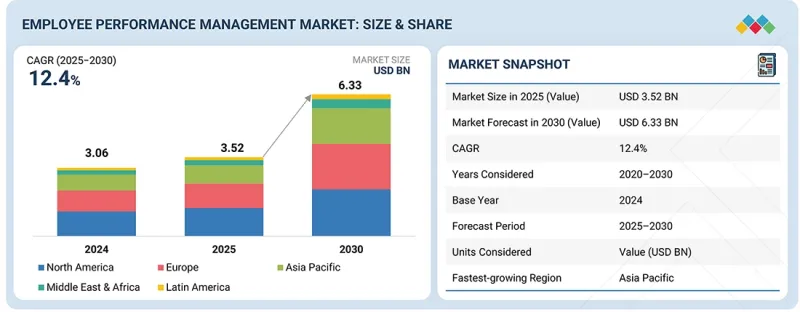
세계의 직원 성과 관리 시장 규모는 2025년에 추정 35억 2,000만 달러로, 2030년까지 63억 3,000만 달러에 달할 것으로 예측되며, CAGR로 12.4%의 성장이 전망되고 있습니다.
| 조사 범위 | |
|---|---|
| 조사 대상 기간 | 2020-2030년 |
| 기준연도 | 2024년 |
| 예측 기간 | 2025-2030년 |
| 단위 | 100만 달러 |
| 부문 | 제공, 조직 규모, 업계, 지역 |
| 대상 지역 | 북미, 유럽, 아시아태평양, 중동 및 아프리카, 라틴아메리카 |
디지털 기술과 클라우드 기반 솔루션의 급속한 발전은 전 세계 직원 성과 관리 시장을 변화시키고 있으며, 조직이 인력의 생산성을 향상시키고, 목표의 일관성을 간소화하며, 데이터베이스 인재 전략을 실행할 수 있도록 돕고 있습니다. 북미는 첨단 IT 인프라, AI 지원 성과관리 플랫폼의 강력한 채택, SAP SuccessFactors, Oracle Cloud HCM, Workday, ADP, Microsoft Viva 등 주요 벤더의 존재로 인해 가장 큰 시장 점유율을 차지할 것으로 예측됩니다. 가장 큰 시장 점유율을 차지할 것으로 예측됩니다. 성과 평가 시스템은 360도 피드백을 통합한 구조화된 평가 프레임워크를 제공하고, 은행, 금융서비스 및 보험(BFSI), IT 및 ITeS, 의료, 통신 등 다양한 산업에서 실행 가능한 인사이트을 제공하는 가장 널리 채택된 툴로 자리매김하고 있습니다. 기업은 이러한 시스템을 활용하여 성과에 대한 지속적인 모니터링, 직원 목표와 조직 목표의 일치, 대규모 인재 개발 계획을 지원하고 있습니다.
"성과평가 시스템이 가장 큰 시장 규모를 차지할 것으로 예측됩니다. "
성과 평가 시스템은 직원들의 성과 측정, 개인 목표와 조직 목표의 일치, 그리고 구조화된 검토 주기의 촉진에 있으며, 기본 툴로서의 지위를 유지하고 있으므로 EPM 환경에서 가장 큰 시장 규모를 차지할 것으로 예측됩니다. BFSI, IT 및 ITeS, 의료, 통신 등 다양한 산업 분야의 대기업은 매년 또는 반기별 성과 평가 관리, 360도 피드백 통합, 목표 설정 프레임워크의 지원을 위해 이러한 시스템을 계속 사용하고 있습니다. SAP SuccessFactors, Oracle Cloud HCM, Workday, ADP 등 주요 벤더들은 AI 분석, 자동 평가 시스템, 학습 및 인재 관리 모듈과의 연계 기능을 갖춘 확장 가능한 클라우드 기반 평가 솔루션을 제공합니다. 예를 들어 Microsoft Viva Insights와 Workday Performance Management는 지속적인 평가, 예측적 성과 분석, 실용적인 직원 개발 인사이트을 제공하기 위해 기업에서 널리 활용되고 있습니다. 목표 지향적 평가, 컴플라이언스, 직원 참여에 대한 지속적인 관심으로 인해 성과 평가 시스템은 예측 기간 중 가장 큰 시장 규모를 유지할 것으로 예측됩니다.
"북미가 가장 큰 시장 점유율을 유지할 것으로 예상됩니다"
북미는 첨단 디지털 인프라, 클라우드 기반 HR 솔루션의 높은 채택률, 주요 EPM 벤더의 존재로 인해 전 세계 직원 성과 관리 시장에서 가장 큰 점유율을 차지할 것으로 예측됩니다. Workday, Microsoft, Oracle, SAP SuccessFactors, ADP를 포함한 이 지역의 기업은 대기업 고객 기반을 보유하고 있으며, 플랫폼의 광범위한 배포를 촉진하고 있습니다. BFSI, IT 및 ITeS, 의료, 정부 등의 산업에서는 생산성, 컴플라이언스, 노동력 연계를 강화하기 위해 AI 분석, 실시간 피드백, 직원 참여 솔루션을 적극적으로 도입하고 있습니다. 예를 들어 Bank of America, Cisco, Accenture 등의 조직은 클라우드 기반 EPM 솔루션을 활용하여 여러 지역에 걸친 사업 관리, 지속적인 성과 모니터링 촉진, 학습 및 인재 개발 활동의 통합을 실현하고 있습니다. 이러한 요인으로 인해 북미는 예측 기간 중 EPM 솔루션의 가장 규모가 큰 지역 시장이 될 것으로 예측됩니다.
세계의 직원 성과 관리(Employee Performance Management) 시장에 대해 조사 분석했으며, 주요 촉진요인 및 저해요인, 제품 개발 및 혁신, 경쟁 구도 등의 정보를 전해드립니다.
자주 묻는 질문
목차
제1장 서론
제2장 개요
제3장 중요 인사이트
제4장 시장 개요
제5장 업계 동향
제6장 기술, 특허, 디지털, AI의 채택에 의한 전략적 파괴
제7장 규제 상황
제8장 고객 상황과 구매 행동
제9장 직원 성과 관리 시장 : 제공별
제10장 직원 성과 관리 시장 : 조직 규모별
제11장 직원 성과 관리 시장 : 업계별
제12장 직원 성과 관리 시장 : 지역별
제13장 경쟁 구도
제14장 기업 개요
제15장 조사 방법
제16장 부록
KSA 26.03.24MarketsandMarkets: The employee performance management market is estimated to be worth USD 3.52 billion in 2025 and is projected to reach USD 6.33 billion by 2030, growing at a CAGR of 12.4%.
| Scope of the Report | |
|---|---|
| Years Considered for the Study | 2020-2030 |
| Base Year | 2024 |
| Forecast Period | 2025-2030 |
| Units Considered | Value (USD Million) |
| Segments | By Offering, Organization Size, Vertical, and Region |
| Regions covered | North America, Europe, Asia Pacific, the Middle East & Africa, and Latin America |
Rapid advancements in digital technologies and cloud-based solutions are transforming the global employee performance management market, enabling organizations to enhance workforce productivity, streamline goal alignment, and implement data-driven talent strategies. North America is expected to hold the largest market share, driven by its advanced IT infrastructure, strong adoption of AI-enabled performance management platforms, and presence of leading vendors such as SAP SuccessFactors, Oracle Cloud HCM, Workday, ADP, and Microsoft Viva. Performance Appraisal Systems continue to be the most widely adopted tools, providing structured evaluation frameworks that integrate 360-degree feedback and deliver actionable insights across various industries, including BFSI, IT & ITeS, healthcare, and telecom. Enterprises are increasingly leveraging these systems to continuously monitor performance, align employee objectives with organizational goals, and support large-scale talent development initiatives.
"Performance appraisal systems are expected to have the largest market size."
Performance appraisal systems are projected to account for the largest market size in the EPM landscape, as they remain the foundational tool for measuring employee performance, aligning individual objectives with organizational goals, and facilitating structured review cycles. Large organizations across various verticals, including BFSI, IT & ITeS, healthcare, and telecom, continue to rely on these systems to manage annual or semi-annual performance evaluations, integrate 360-degree feedback, and support goal-setting frameworks. Leading vendors, such as SAP SuccessFactors, Oracle Cloud HCM, Workday, and ADP, provide scalable, cloud-based appraisal solutions equipped with AI analytics, automated rating systems, and integration with learning and talent management modules. For example, Microsoft Viva Insights and Workday Performance Management are widely used in enterprises to enable continuous appraisal, predictive performance analytics, and actionable employee development insights. The continued focus on objective-driven assessments, compliance, and employee engagement ensures that Performance Appraisal Systems will maintain the largest market size during the forecast period.
"North America is expected to hold the largest market share."
North America is expected to hold the largest share in the global employee performance management market due to its advanced digital infrastructure, high adoption of cloud-based HR solutions, and presence of leading EPM vendors. Companies in the region, including Workday, Microsoft, Oracle, SAP SuccessFactors, and ADP, have a strong customer base among large enterprises, driving widespread deployment of platforms. Industries such as BFSI, IT & ITeS, healthcare, and government are actively implementing AI-powered analytics, real-time feedback, and employee engagement solutions to enhance productivity, compliance, and workforce alignment. For instance, organizations such as Bank of America, Cisco, and Accenture leverage cloud-based EPM solutions to manage multi-regional operations, facilitate continuous performance monitoring, and integrate learning and talent development initiatives. These factors make North America the largest regional market for EPM solutions during the forecast period.
Breakdown of primaries
The study offers insights from a range of industry experts, including solution vendors and Tier 1 companies. The break-up of the primaries is as follows:
- By Company Type: Tier 1 - 62%, Tier 2 - 23%, and Tier 3 - 15%
- By Designation: C-level - 38%, D-level - 30%, and Others - 32%
- By Region: North America - 40%, Europe - 15%, Asia Pacific - 35%, Middle East & Africa - 5%, Latin America - 5%
The major players in the employee performance management market include SAP SE (Germany), Oracle (US), Microsoft (US), Workday (US), ADP (US), Qualtrics (US), Cornerstone OnDemand (US), Zoho Corporation (India), TriNet (US), BambooHR (US), Lattice (US), 15Five (US), Namely (US), Culture AMP (Australia), BetterWorks (US), Quantum Workplace (US), Workleap (Canada), ClearCompany (US), Performly (US), Trakstar (US), BreatheHR (UK), Actus (US), FactorHR (India), Awardco (US), Vantage Circle (India), SurveySparrow (India), and Insperity (US). These players have adopted various growth strategies, including partnerships, agreements, collaborations, product launches, enhancements, and acquisitions, to expand their footprint in the employee performance management market.
Research Coverage
The market study encompasses the employee performance management market size and growth potential across various segments, including offering, organization size, vertical, and region. The offerings are further segmented into platforms, which include performance appraisal systems, 360-degree feedback tools, goal setting & tracking platforms, continuous feedback & learning platforms, and other types such as employee recognition platforms, engagement & pulse survey tools, hr & people analytics tools, performance insights tools, and services, covering integration & implementation, support & maintenance, and training & development. By organization size, the market is categorized into large enterprises and SMEs, while by vertical, it spans BFSI, healthcare, IT & ITeS, telecom, and government. The regional analysis of the Employee Performance Management market covers North America, Europe, the Asia Pacific, the Middle East & Africa, and Latin America.
Key Benefits of Buying the Report
The report will help market leaders and new entrants with information on the closest approximations of the global employee performance management market's revenue numbers and subsegments. It will also help stakeholders understand the competitive landscape, gain valuable insights, and develop effective go-to-market strategies. Moreover, the report will provide stakeholders with insights into the market's pulse, offering them information on key market drivers, restraints, challenges, and opportunities.
The report provides the following insights.
Analysis of key drivers (adoption of cloud-based performance management platforms, growing need for continuous feedback and talent optimization, increasing focus on employee engagement and retention, demand for data-driven workforce insights), restraints (high implementation and subscription costs for advanced EPM solutions, integration complexity with legacy HR systems, lack of skilled personnel to manage EPM platforms, concerns over data privacy and security), opportunities (expansion in SMEs and emerging markets, AI and analytics-enabled performance management, integration of learning and development with performance tools, adoption of mobile and remote performance management solutions), and challenges (resistance to change among employees and managers, standardization of performance metrics across global operations, rapid technological advancements requiring frequent updates, varying regional compliance and regulatory requirements) influencing the growth of the employee performance management market.
Product Development/Innovation: Detailed insights on upcoming technologies, research & development activities, and product & service launches in the employee performance management market
Market Development: The report provides comprehensive information about lucrative markets, analyzing the employee performance management market across various regions.
Market Diversification: Comprehensive information about new products and services, untapped geographies, recent developments, and investments in the employee performance management market.
Competitive Assessment: In-depth assessment of market shares, growth strategies and service offerings of leading players SAP SE (Germany), Oracle (US), Microsoft (US), Workday (US), ADP (US), Qualtrics (US), Cornerstone OnDemand (US), Zoho Corporation (India), TriNet (US), BambooHR (US), Lattice (US), 15Five (US), Namely (US), Culture AMP (Australia), BetterWorks (US), Quantum Workplace (US), Workleap (Canada), ClearCompany (US), Performly (US), Trakstar (US), BreatheHR (UK), Actus (US), FactorHR (India), Awardco (US), Vantage Circle (India), SurveySparrow (India), and Insperity (US).
TABLE OF CONTENTS
1 INTRODUCTION
- 1.1 STUDY OBJECTIVES
- 1.2 MARKET DEFINITION
- 1.3 MARKET SCOPE
- 1.3.1 MARKET SEGMENTATION & REGIONAL SCOPE
- 1.3.2 INCLUSIONS AND EXCLUSIONS
- 1.4 YEARS CONSIDERED
- 1.5 CURRENCY CONSIDERED
- 1.6 STAKEHOLDERS
2 EXECUTIVE SUMMARY
- 2.1 MARKET HIGHLIGHTS AND KEY INSIGHTS
- 2.2 KEY MARKET PARTICIPANTS: MAPPING OF STRATEGIC DEVELOPMENTS
- 2.3 DISRUPTIVE TRENDS IN EMPLOYEE PERFORMANCE MANAGEMENT MARKET
- 2.4 HIGH-GROWTH SEGMENTS
- 2.5 REGIONAL SNAPSHOT: MARKET SIZE, GROWTH RATE, AND FORECAST
3 PREMIUM INSIGHTS
- 3.1 ATTRACTIVE OPPORTUNITIES FOR PLAYERS IN EMPLOYEE PERFORMANCE MANAGEMENT MARKET
- 3.2 EMPLOYEE PERFORMANCE MANAGEMENT MARKET, BY OFFERING AND REGION
- 3.3 EMPLOYEE PERFORMANCE MANAGEMENT MARKET, BY OFFERING
- 3.4 EMPLOYEE PERFORMANCE MANAGEMENT MARKET, BY PLATFORM
- 3.5 EMPLOYEE PERFORMANCE MANAGEMENT MARKET, BY SERVICE
4 MARKET OVERVIEW
- 4.1 INTRODUCTION
- 4.2 MARKET DYNAMICS
- 4.2.1 DRIVERS
- 4.2.1.1 Acceleration of data-driven talent decision-making across enterprises
- 4.2.1.2 Adoption of integrated EPM modules within unified HCM suites
- 4.2.1.3 Rapid migration toward high-velocity cloud-native ecosystems
- 4.2.1.4 AI-enabled productivity and quality gains
- 4.2.2 RESTRAINTS
- 4.2.2.1 Cultural resistance to continuous feedback and real-time evaluation models
- 4.2.2.2 Integration complexity with core HCM
- 4.2.3 OPPORTUNITIES
- 4.2.3.1 Rising demand for employee-owned performance and self-direction
- 4.2.3.2 Adoption of industry- and role-specific performance frameworks
- 4.2.4 CHALLENGES
- 4.2.4.1 Security, privacy, and sensitive data handling
- 4.2.4.2 Preventing bias in AI-driven performance evaluation systems
- 4.2.1 DRIVERS
- 4.3 INTERCONNECTED MARKETS AND CROSS-SECTOR OPPORTUNITIES
- 4.3.1 INTERCONNECTED MARKETS
- 4.3.2 CROSS-SECTOR OPPORTUNITIES
- 4.4 STRATEGIC MOVES BY TIER-1/2/3 PLAYERS
5 INDUSTRY TRENDS
- 5.1 PORTER'S FIVE FORCES ANALYSIS
- 5.1.1 THREAT OF NEW ENTRANTS
- 5.1.2 THREAT OF SUBSTITUTES
- 5.1.3 BARGAINING POWER OF SUPPLIERS
- 5.1.4 BARGAINING POWER OF BUYERS
- 5.1.5 INTENSITY OF COMPETITIVE RIVALRY
- 5.2 MACROECONOMIC OUTLOOK
- 5.2.1 INTRODUCTION
- 5.2.2 GDP TRENDS AND FORECAST
- 5.2.3 TRENDS IN GLOBAL EMPLOYEE PERFORMANCE MANAGEMENT MARKET
- 5.3 SUPPLY CHAIN ANALYSIS
- 5.3.1 SOLUTION PROVIDERS
- 5.3.2 CLOUD/TECHNOLOGY INFRASTRUCTURE PROVIDERS
- 5.3.3 SYSTEM INTEGRATORS& IMPLEMENTATION PARTNERS
- 5.3.4 SERVICE PROVIDERS
- 5.3.5 END USERS
- 5.4 ECOSYSTEM ANALYSIS
- 5.5 PRICING ANALYSIS
- 5.5.1 AVERAGE SELLING PRICE OF EMPLOYEE PERFORMANCE MANAGEMENT INTEGRATED SOLUTIONS, BY KEY PLAYER, 2025
- 5.5.2 INDICATIVE PRICING ANALYSIS OF EMPLOYEE PERFORMANCE MANAGEMENT, BY KEY PLAYER, 2025
- 5.6 KEY CONFERENCES AND EVENTS, 2026-2027
- 5.7 TRENDS/DISRUPTIONS IMPACTING CUSTOMER BUSINESS
- 5.8 INVESTMENT AND FUNDING SCENARIO
- 5.9 CASE STUDY ANALYSIS
- 5.9.1 DIGITAL PERFORMANCE AND COMPENSATION WORKFLOW TRANSFORMATION TO IMPROVE WORKFORCE EVALUATION EFFICIENCY
- 5.9.2 AUTOMATION OF PERFORMANCE REVIEW AND GOAL ALIGNMENT PROCESSES TO STRENGTHEN WORKFORCE ACCOUNTABILITY
- 5.9.3 GLOBAL PERFORMANCE MANAGEMENT STANDARDIZATION TO STRENGTHEN WORKFORCE ALIGNMENT AND PRODUCTIVITY VISIBILITY
- 5.9.4 AI-DRIVEN PERFORMANCE AND TALENT DEVELOPMENT PLATFORM IMPLEMENTATION TO STRENGTHEN GLOBAL WORKFORCE AGILITY
- 5.9.5 GLOBAL PERFORMANCE AND TALENT ALIGNMENT TRANSFORMATION THROUGH CLOUD-BASED WORKFORCE EVALUATION STANDARDIZATION
- 5.10 IMPACT OF 2025 US TARIFF- EMPLOYEE PERFORMANCE MANAGEMENT MARKET
- 5.10.1 INTRODUCTION
- 5.10.2 KEY TARIFF RATES
- 5.10.3 PRICE IMPACT ANALYSIS
- 5.10.3.1 Strategic Shifts and Emerging Trends
- 5.10.4 IMPACT ON COUNTRY/REGION
- 5.10.4.1 US
- 5.10.4.2 China
- 5.10.4.3 Europe
- 5.10.4.4 Asia Pacific (excluding China)
- 5.10.5 IMPACT ON END-USER INDUSTRY
- 5.10.5.1 Enterprises and Organizations Using Employee Performance Management (EPM) Platforms
6 STRATEGIC DISRUPTION THROUGH TECHNOLOGY, PATENTS, DIGITAL, AND AI ADOPTION
- 6.1 KEY TECHNOLOGIES
- 6.1.1 ARTIFICIAL INTELLIGENCE
- 6.1.2 MACHINE LEARNING
- 6.1.3 NATURAL LANGUAGE PROCESSING (NLP)
- 6.1.4 CLOUD COMPUTING
- 6.1.5 DATA ANALYTICS
- 6.2 COMPLEMENTARY TECHNOLOGIES
- 6.2.1 SENTIMENT ANALYSIS
- 6.2.2 VIRTUAL REALITY
- 6.2.3 AUGMENTED REALITY
- 6.3 TECHNOLOGY ROADMAP
- 6.3.1 SHORT-TERM (2026-2027) | FOUNDATION & EARLY COMMERCIALIZATION
- 6.3.2 MID-TERM (2027-2028) | SCALED DEPLOYMENT & AI-DRIVEN INTELLIGENCE
- 6.3.3 LONG-TERM (2029-2030+) | AUTONOMOUS PERFORMANCE INTELLIGENCE & WORKFORCE OPTIMIZATION
- 6.4 PATENT ANALYSIS
- 6.5 IMPACT OF AI/GEN AI ON EMPLOYEE PERFORMANCE MANAGEMENT MARKET
- 6.5.1 TOP USE CASES AND MARKET POTENTIAL
- 6.5.2 CASE STUDIES OF AI IMPLEMENTATION IN CLOUD EMPLOYEE PERFORMANCE MANAGEMENT MARKET
- 6.5.3 INTERCONNECTED ADJACENT ECOSYSTEMS AND IMPACT ON MARKET PLAYERS
- 6.5.4 CLIENTS' READINESS TO ADOPT GENERATIVE AI IN EMPLOYEE PERFORMANCE MANAGEMENT MARKET
- 6.6 SUCCESS STORIES AND REAL-WORLD APPLICATIONS
- 6.6.1 MICROSOFT IMPLEMENTED EMPLOYEE EXPERIENCE AND PERFORMANCE INSIGHTS PLATFORMS TO ENHANCE WORKFORCE ENGAGEMENT AND PRODUCTIVITY
- 6.6.2 SAP ENABLED CONTINUOUS PERFORMANCE MANAGEMENT TO BUILD DIGITAL PERFORMANCE CULTURE
- 6.6.3 WORKDAY ENABLED DATA-DRIVEN PERFORMANCE AND TALENT MANAGEMENT TO IMPROVE WORKFORCE PRODUCTIVITY
- 6.6.4 ORACLE ENABLED INTEGRATED TALENT AND PERFORMANCE MANAGEMENT TO IMPROVE WORKFORCE PLANNING
7 REGULATORY LANDSCAPE
- 7.1 REGIONAL REGULATIONS AND COMPLIANCE
- 7.1.1 INDUSTRY STANDARDS
8 CUSTOMER LANDSCAPE & BUYER BEHAVIOR
- 8.1 DECISION-MAKING PROCESS
- 8.2 BUYER STAKEHOLDERS AND BUYING EVALUATION CRITERIA
- 8.2.1 KEY STAKEHOLDERS IN BUYING PROCESS
- 8.2.2 BUYING CRITERIA
- 8.3 UNMET NEEDS FROM VARIOUS END-USE INDUSTRIES
9 EMPLOYEE PERFORMANCE MANAGEMENT MARKET, BY OFFERING
- 9.1 INTRODUCTION
- 9.1.1 OFFERING: EMPLOYEE PERFORMANCE MANAGEMENT MARKET DRIVERS
- 9.2 PLATFORMS
- 9.2.1 HIGH DEMAND FOR AI-LED AUTOMATION TO HANDLE REPETITIVE MANAGEMENT TASKS EXPECTED TO DRIVE MARKET
- 9.2.2 PERFORMANCE APPRAISAL SYSTEMS
- 9.2.3 360-DEGREE FEEDBACK TOOLS
- 9.2.4 GOAL SETTING & TRACKING PLATFORMS
- 9.2.5 CONTINUOUS FEEDBACK & LEARNING PLATFORMS
- 9.2.6 OTHER PLATFORMS
- 9.3 SERVICES
- 9.3.1 GROWING NEED FOR EXPERT HELP TO MANAGE COMPLEX SOFTWARE SETUPS IS EXPECTED TO INCREASE THE NEED FOR SERVICES
- 9.3.2 INTEGRATION & IMPLEMENTATION
- 9.3.3 SUPPORT & MAINTENANCE
- 9.3.4 TRAINING & DEVELOPMENT
10 EMPLOYEE PERFORMANCE MANAGEMENT MARKET, BY ORGANIZATION SIZE
- 10.1 INTRODUCTION
- 10.1.1 ORGANIZATION SIZE: EMPLOYEE PERFORMANCE MANAGEMENT MARKET DRIVERS
- 10.2 LARGE ENTERPRISES
- 10.2.1 INCREASED NEED TO MANAGE LARGER WORKFORCE GLOBALLY TO DRIVE MARKET
- 10.3 SMES
- 10.3.1 AVAILABILITY OF TIERED, LOW-COST SAAS PRICING MODEL TO DRIVE MARKET
11 EMPLOYEE PERFORMANCE MANAGEMENT MARKET, BY VERTICAL
- 11.1 INTRODUCTION
- 11.1.1 VERTICAL: EMPLOYEE PERFORMANCE MANAGEMENT MARKET DRIVERS
- 11.2 BFSI
- 11.2.1 STRICT LAWS THAT REQUIRE EVERY EMPLOYEE ACTION TO BE TRACKABLE AND AUDITABLE EXPECTED TO DRIVE MARKET
- 11.3 HEALTHCARE
- 11.3.1 SHIFT FROM SIMPLE EFFICIENCY TOWARDS PATIENT SATISFACTION AND MEDICAL SAFETY OUTCOMES TO DRIVE MARKET
- 11.4 IT & ITES
- 11.4.1 NEED FOR EPM TOOLS THAT CAN TRACK DEVELOPER'S CODING CERTIFICATIONS AND TECHNICAL SKILLS IN REAL-TIME TO DRIVE MARKET
- 11.5 TELECOM
- 11.5.1 MOBILE TOOLS THAT TRACK SAFETY COMPLIANCE AND SERVICE QUALITY TO DRIVE MARKET
- 11.6 GOVERNMENT
- 11.6.1 NEED TO ACHIEVE POLICY GOALS TO DRIVE MARKET
- 11.7 MANUFACTURING
- 11.7.1 HIGHER INDIVIDUAL WORKER PERFORMANCE LEADING TO MACHINE UPTIME AND PRODUCTION QUALITY EXPECTED TO DRIVE MARKET
- 11.8 OTHER VERTICALS
12 EMPLOYEE PERFORMANCE MANAGEMENT MARKET, BY REGION
- 12.1 INTRODUCTION
- 12.2 NORTH AMERICA
- 12.2.1 US
- 12.2.1.1 Government policies and enterprise digital transformation driving advanced employee performance management adoption
- 12.2.2 CANADA
- 12.2.2.1 Government workforce modernization programs and enterprise HR digitalization supporting employee performance management adoption
- 12.2.1 US
- 12.3 EUROPE
- 12.3.1 UK
- 12.3.1.1 Regulatory reforms and workforce modernization initiatives strengthening employee performance management adoption
- 12.3.2 GERMANY
- 12.3.2.1 Industrial governance and enterprise digitalization driving adoption of employee performance management solutions
- 12.3.3 FRANCE
- 12.3.3.1 Workforce modernization initiatives accelerating employee performance management adoption
- 12.3.4 REST OF EUROPE
- 12.3.1 UK
- 12.4 ASIA PACIFIC
- 12.4.1 CHINA
- 12.4.1.1 Large-scale enterprise digitalization and workforce optimization initiatives accelerating employee performance management adoption
- 12.4.2 JAPAN
- 12.4.2.1 Structured workforce governance and digital HR modernization supporting employee performance management adoption
- 12.4.3 INDIA
- 12.4.3.1 Rapid enterprise expansion and government-led digital initiatives accelerating employee performance management adoption
- 12.4.4 REST OF ASIA PACIFIC
- 12.4.1 CHINA
- 12.5 MIDDLE EAST & AFRICA
- 12.5.1 UAE
- 12.5.1.1 Focus on employee performance management integration and sustainable urban development to drive demand
- 12.5.2 KSA
- 12.5.2.1 Vision 2030's strategic plan of sustainable initiatives to drive market
- 12.5.3 SOUTH AFRICA
- 12.5.3.1 Growing enterprise digital adoption and workforce modernization supporting employee performance management growth
- 12.5.4 REST OF MIDDLE EAST & AFRICA
- 12.5.1 UAE
- 12.6 LATIN AMERICA
- 12.6.1 BRAZIL
- 12.6.1.1 Digital transformation and workforce optimization initiatives driving employee performance management adoption
- 12.6.2 MEXICO
- 12.6.2.1 Expanding digital economy and enterprise workforce modernization supporting employee performance management adoption
- 12.6.3 REST OF LATIN AMERICA
- 12.6.1 BRAZIL
13 COMPETITIVE LANDSCAPE
- 13.1 INTRODUCTION
- 13.2 KEY PLAYER STRATEGIES/RIGHT TO WIN, 2023-2025
- 13.3 REVENUE ANALYSIS, 2023-2025
- 13.4 MARKET SHARE ANALYSIS, 2024
- 13.5 BRAND/PRODUCT COMPARISON
- 13.6 COMPANY VALUATION AND FINANCIAL METRICS
- 13.7 COMPANY EVALUATION MATRIX: KEY PLAYERS, 2025
- 13.7.1 STARS
- 13.7.2 EMERGING LEADERS
- 13.7.3 PERVASIVE PLAYERS
- 13.7.4 PARTICIPANTS
- 13.7.5 COMPANY FOOTPRINT: KEY PLAYERS, 2025
- 13.7.5.1 Company footprint
- 13.7.5.2 Region footprint
- 13.7.5.3 Offering footprint
- 13.7.5.4 Vertical footprint
- 13.7.5.5 Organization size footprint
- 13.8 COMPANY EVALUATION MATRIX: STARTUPS/SMES, 2025
- 13.8.1 PROGRESSIVE COMPANIES
- 13.8.2 RESPONSIVE COMPANIES
- 13.8.3 DYNAMIC COMPANIES
- 13.8.4 STARTING BLOCKS
- 13.8.5 COMPETITIVE BENCHMARKING: STARTUPS/SMES, 2025
- 13.8.5.1 Detailed list of key startups/SMEs
- 13.8.5.2 Competitive benchmarking of key startups/SMEs
- 13.9 COMPETITIVE SCENARIO
- 13.9.1 PRODUCT LAUNCHES AND ENHANCEMENTS
- 13.9.2 DEALS
14 COMPANY PROFILES
- 14.1 KEY PLAYERS
- 14.1.1 WORKDAY
- 14.1.1.1 Business overview
- 14.1.1.2 Products/Solutions/Services offered
- 14.1.1.3 Recent developments
- 14.1.1.3.1 Product launches
- 14.1.1.3.2 Deals
- 14.1.1.4 MnM view
- 14.1.1.4.1 Key strengths
- 14.1.1.4.2 Strategic choices
- 14.1.1.4.3 Weaknesses and competitive threats
- 14.1.2 SAP SE
- 14.1.2.1 Business overview
- 14.1.2.2 Products/Solutions/Services offered
- 14.1.2.3 Recent developments
- 14.1.2.3.1 Product launches
- 14.1.2.3.2 Deals
- 14.1.2.4 MnM view
- 14.1.2.4.1 Key strengths
- 14.1.2.4.2 Strategic choices
- 14.1.2.4.3 Weaknesses and competitive threats
- 14.1.3 MICROSOFT
- 14.1.3.1 Business overview
- 14.1.3.2 Products/Solutions/Services offered
- 14.1.3.3 Recent developments
- 14.1.3.3.1 Product launches
- 14.1.3.4 MnM view
- 14.1.3.4.1 Key strengths
- 14.1.3.4.2 Strategic choices
- 14.1.3.4.3 Weaknesses and competitive threats
- 14.1.4 ORACLE
- 14.1.4.1 Business overview
- 14.1.4.2 Platforms/Solutions/Services offered
- 14.1.4.3 Recent developments
- 14.1.4.3.1 Product launches
- 14.1.4.4 MnM view
- 14.1.4.4.1 Key strengths
- 14.1.4.4.2 Strategic choices
- 14.1.4.4.3 Weaknesses and competitive threats
- 14.1.5 CORNERSTONE ONDEMAND
- 14.1.5.1 Business overview
- 14.1.5.2 Products/Solutions/Services offered
- 14.1.5.2.1 Deals
- 14.1.5.3 MnM view
- 14.1.5.3.1 Right to win
- 14.1.5.3.2 Strategic choices
- 14.1.5.3.3 Weaknesses and competitive threats
- 14.1.6 ZOHO
- 14.1.6.1 Business overview
- 14.1.6.2 Platforms/Solutions/Services offered
- 14.1.6.3 Recent developments
- 14.1.6.3.1 Product launches
- 14.1.7 QUALTRICS
- 14.1.7.1 Business overview
- 14.1.7.2 Platforms/Solutions/Services offered
- 14.1.7.2.1 Product launches
- 14.1.7.2.2 Deals
- 14.1.8 TRINET
- 14.1.8.1 Business overview
- 14.1.8.2 Products/Solutions/Services offered
- 14.1.8.2.1 Deals
- 14.1.9 BAMBOOHR
- 14.1.9.1 Business overview
- 14.1.9.2 Platforms/Solutions/Services offered
- 14.1.10 ADP
- 14.1.10.1 Business overview
- 14.1.10.2 Platforms/Solutions/Services offered
- 14.1.10.2.1 Deals
- 14.1.11 LATTICE
- 14.1.12 15FIVE
- 14.1.13 NAMELY
- 14.1.1 WORKDAY
- 14.2 STARTUPS/SMES
- 14.2.1 CULTURE AMP
- 14.2.2 BETTERWORKS
- 14.2.3 QUANTUM WORKPLACE
- 14.2.4 WORKLEAP
- 14.2.5 CLEARCOMPANY
- 14.2.6 PERFORMLY
- 14.2.7 ACTUS
- 14.2.8 FACTOHR
- 14.2.9 AWARD CO
- 14.2.10 VANTAGE CIRCLE
- 14.2.11 SURVEY SPARROW
15 RESEARCH METHODOLOGY
- 15.1 RESEARCH DATA
- 15.1.1 SECONDARY DATA
- 15.1.1.1 Key data from secondary sources
- 15.1.2 PRIMARY DATA
- 15.1.2.1 Primary interviews with experts
- 15.1.2.2 Breakdown of primary profiles
- 15.1.2.3 Key data from primary sources
- 15.1.2.4 Key industry insights
- 15.1.1 SECONDARY DATA
- 15.2 MARKET BREAKUP AND DATA TRIANGULATION
- 15.3 MARKET SIZE ESTIMATION
- 15.3.1 TOP-DOWN APPROACH
- 15.3.2 BOTTOM-UP APPROACH
- 15.4 MARKET FORECAST
- 15.4.1 FACTOR ANALYSIS
- 15.5 RESEARCH ASSUMPTIONS
- 15.6 LIMITATIONS
16 APPENDIX
- 16.1 DISCUSSION GUIDE
- 16.2 KNOWLEDGESTORE: MARKETSANDMARKETS' SUBSCRIPTION PORTAL
- 16.3 CUSTOMIZATION OPTIONS
- 16.4 RELATED REPORTS
- 16.5 AUTHOR DETAILS