

|
시장보고서
상품코드
2033999
관리형 탐지 및 대응(MDR) 시장 : 제공별, 도입 형태별, 조직 규모별, 업계별, 지역별 - 세계 예측(-2031년)Managed Detection and Response (MDR) Market by Security Type (Network, Endpoint, Cloud), Deployment Mode (On-Premises and Cloud), Organization Size (SMEs and Large Enterprises), Vertical, and Region - Global Forecast to 2031 |
||||||

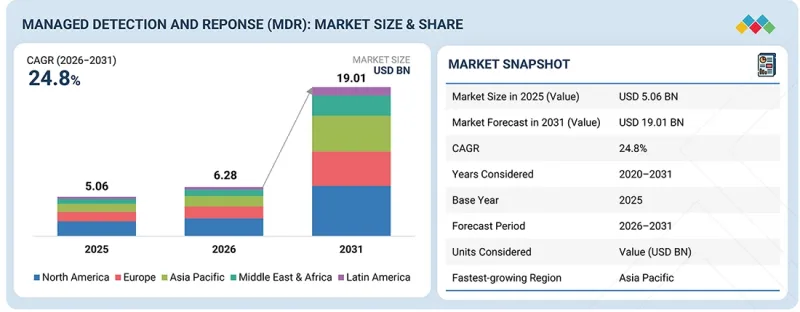
관리형 탐지 및 대응(MDR) 시장 규모는 예측 기간 동안 CAGR 24.8%로 확대되어 2026년 62억 8,000만 달러에서 2031년에는 190억 1,000만 달러에 달할 것으로 전망됩니다.
진화하는 사이버 보안 규제와 데이터 보호법 준수에 대한 요구가 높아짐에 따라, 조직은 지속적인 모니터링, 사고 대응 및 감사 대응 체계를 마련하기 위해 MDR 서비스를 도입하고 있습니다.
| 조사 범위 | |
|---|---|
| 조사 대상 기간 | 2020-2031년 |
| 기준 연도 | 2025년 |
| 예측 기간 | 2026-2031년 |
| 대상 단위 | 금액(10억 달러) |
| 부문 | 제공별, 도입 형태별, 조직 규모별, 업계별, 지역별 |
| 대상 지역 | 북미, 유럽, 아시아태평양, 중동 및 아프리카, 라틴아메리카 |
동시에 기술의 급속한 보급과 IoT의 침투가 진행됨에 따라 공격 대상 영역이 확대되고, 연결된 기기 전체에 새로운 취약점이 발생하고 있습니다. MDR 솔루션은 중앙 집중식 가시성, 실시간 위협 탐지, 전문가 중심의 대응을 제공함으로써 이러한 문제를 해결하고, 조직이 복잡하고 분산된 IT 및 IoT 환경을 보호하면서 컴플라이언스 요건을 관리할 수 있도록 지원합니다.
"보안 유형별로는 엔드포인트 보안 부문이 예측 기간 동안 두 번째로 높은 CAGR을 기록할 것으로 예상됩니다."
분산형 IT 환경에서 엔드포인트가 사이버 공격의 주요 표적이 되고 있는 만큼, MDR 시장에서 엔드포인트 보안 부문은 강력한 성장세를 보일 것으로 예상됩니다. 원격 근무, 모바일 기기 및 BYOD 정책의 확대로 인해 보호가 필요한 엔드포인트의 수가 증가하면서 지속적인 모니터링과 대응에 대한 요구가 증가하고 있습니다. CrowdStrike의 'Global Threat Report'에 따르면, 2025년 2월 기준 공격자들은 초기 접근을 위해 인증정보 탈취 및 측면 이동과 같은 엔드포인트 기반 기법을 점점 더 많이 사용하고 있다고 합니다. 또한, 마이크로소프트의 'Digital Defense Report'에 따르면, 2024년 10월 기준 패치 누락 및 설정 오류로 인해 엔드포인트 취약점은 여전히 랜섬웨어 및 악성코드 공격의 주요 침입 경로로 남아있다고 합니다. MDR 제공업체는 엔드포인트 텔레메트리, 행동 분석 및 EDR 기능을 활용하여 이상 징후를 탐지하고 위협에 실시간으로 대응하고 있습니다. XDR 플랫폼과의 통합을 통해 엔드포인트, 클라우드, ID 레이어 전반에 걸쳐 가시성을 높이고 탐지 정확도를 향상시킬 수 있습니다. 조직이 디지털 풋프린트를 계속 확장하고 하이브리드 업무 모델을 채택함에 따라 엔드포인트에 초점을 맞춘 MDR 서비스가 주목받고 있으며, 이는 시장 내 강력한 성장 궤도에 기여하고 있습니다.
"산업별로는 2026년 정부 부문이 시장 점유율 2위를 차지할 것으로 예측됩니다."
정부 부문은 중요 인프라와 시민의 기밀 데이터를 보호하기 위한 사이버 보안에 대한 투자가 증가함에 따라 MDR 시장에서 두 번째로 큰 비중을 차지할 것으로 예상됩니다. 정부 기관은 국가 주도의 공격자, 랜섬웨어 그룹, 사이버 첩보 활동으로 인한 위협이 증가함에 따라 지속적인 모니터링과 신속한 사고 대응이 필수적입니다. IBM X-Force 위협 인텔리전스 지수에 따르면, 2025년 3월 기준 공공 부문 조직은 전 세계적으로 고도화된 사이버 공격의 주요 표적 중 하나였습니다. 팔로알토 네트웍스의 Unit 42 위협 보고서에 따르면, 2024년 7월 기준 정부 시스템은 클라우드 환경과 레거시 인프라의 취약점을 노린 공격의 표적이 되는 경우가 증가하고 있습니다. MDR 서비스는 24시간 365일 모니터링, 위협 인텔리전스, 사고 대응 기능을 제공함으로써 정부 기관이 사이버 복원력을 강화할 수 있도록 지원합니다. 또한, 이러한 서비스는 국가의 사이버 보안 프레임워크 및 데이터 보호 규정 준수를 지원합니다. 정부가 e-거버넌스, 스마트 인프라 등 디지털 전환(DX) 이니셔티브를 가속화함에 따라 확장 가능하고 중앙집중화된 MDR 솔루션에 대한 수요가 지속적으로 증가하고 있으며, 이는 이 부문의 견고한 시장 지위를 뒷받침하고 있습니다.
조직 규모별로는 중소기업(SME) 부문이 예측 기간 동안 가장 높은 CAGR로 성장할 것으로 예상됩니다.
사이버 위험의 증가와 사내 사이버 보안 전문 지식의 부족으로 인해 MDR 시장에서 중소기업 부문은 가장 높은 CAGR로 성장할 것으로 예상됩니다. 중소기업은 보안 대책이 취약하고 리소스에 제약이 있어 랜섬웨어, 피싱 등 사이버 공격의 주요 타겟이 되고 있습니다. Verizon의 '데이터 침해 조사 보고서'에 따르면, 2024년 5월 기준, 사이버 사고의 상당 부분이 중소기업에 영향을 미쳤다고 합니다. 소포스의 위협 보고서에 따르면, 2025년 1월, 중소기업은 불충분한 보안 인프라와 숙련된 인력 부족으로 인해 랜섬웨어 공격의 증가에 직면했습니다. MDR 서비스는 사내에 SOC(보안운영센터) 기능을 구축할 필요 없이 첨단 보안 기술에 대한 접근과 전문가 주도의 모니터링을 제공함으로써 비용 효율적인 솔루션을 제공합니다. 이러한 서비스를 통해 중소기업은 지속적인 위협 탐지, 신속한 대응 및 컴플라이언스 준수를 지원할 수 있습니다. 클라우드 및 원격 근무 환경을 포함한 디지털화의 진전에 따라 중소기업의 MDR 서비스 수요는 크게 증가할 것으로 예상되며, 이 부문의 급속한 성장을 견인할 것으로 예상됩니다.
MDR 시장의 주요 업체로는 CrowdStrike(미국), Rapid7(미국), Palo Alto Networks(미국), ESET(슬로바키아), Bitdefender(미국), Red Canary(미국), Arctic Wolf(미국), Kudelski Security(스위스), SentinelOne(미국), Proficio(미국), Expel(미국), Deepwatch(미국), Binary Defense(미국), Sophos(영국), eSentire(캐나다), Netsurion(미국), GoSecure(캐나다), Arctic Wolf(미국), Kudelski(스위스), Kudelski GoSecure(캐나다), LMNTRIX(호주), UnderDefense(우크라이나), Ackcent(스페인), Critical Start(미국), Critical Insight(미국) 등이 있습니다.
MDR 시장의 주요 기업에 대한 상세한 경쟁 분석, 각 기업 프로파일, 최근 동향, 주요 시장 전략 등을 조사하여 전해드립니다.
조사 범위
본 보고서에서는 MDR 시장을 세분화하여 보안 유형(엔드포인트 보안, 네트워크 보안, 클라우드 보안, 기타 보안), 도입 형태(클라우드 및 온프레미스), 조직 규모(대기업 및 중소기업), 산업 분야(BFSI, IT·ITeS, 정부 기관, 의료, 에너지·공공사업, 제조, 소매, 기타 업종), 및 지역(북미, 유럽, 아시아태평양, 중동·아프리카, 라틴아메리카)에 따라 MDR 시장을 세분화하고 그 규모를 예측하고 있습니다.
또한, 주요 시장 플레이어에 대한 상세한 경쟁 분석, 기업 개요, 제품 및 비즈니스 오퍼링에 대한 주요 관찰 사항, 최근 동향, 주요 시장 전략에 대해서도 다루고 있습니다.
본 보고서 구매의 주요 이점
이 보고서는 전체 MDR 시장과 그 하위 부문의 매출에 대한 가장 정확한 추정치를 제공함으로써 시장 리더와 신규 진입자에게 도움을 줄 수 있습니다. 이 보고서는 이해관계자들이 시장 상황을 이해하고, 자신의 비즈니스를 더 나은 위치에 놓고, 적절한 시장 진입 전략을 수립하는 데 도움이 되는 귀중한 인사이트를 얻을 수 있도록 돕습니다. 또한, 이 보고서는 이해관계자들이 시장 동향을 파악하고 주요 시장 촉진요인, 억제요인, 과제 및 기회에 대한 정보를 제공함으로써 시장 동향을 파악할 수 있도록 돕습니다.
본 보고서에서는 다음과 같은 사항에 대한 인사이트를 제공합니다:
- 주요 촉진요인 분석(비즈니스 이메일 사기, 랜섬웨어, 크립토재킹 위협 증가, MDR 서비스 도입을 촉진하는 규제 준수 필요성 증가, 기술 보급 및 IoT 확산), 제약요인(타사 애플리케이션에 대한 신뢰 부족, 조직에 대한 MDR 서비스 비용의 장벽, 오탐지가 MDR 서비스의 효과를 저해), 기회(AI/ML을 활용한 MDR 서비스 증가, 중요 인프라 및 중견기업 부문의 MDR 도입), 도전과제(현대적 IT 인프라의 부족)
- 제품 개발/혁신 : MDR 시장의 미래 기술, R&D 활동, 신제품 및 서비스 출시에 대한 심층적인 인사이트를 제공합니다.
- 시장 개발 : 수익성 높은 시장에 대한 종합적인 정보 - 이 보고서는 다양한 지역의 MDR 시장을 분석합니다.
- 시장 다각화 : MDR 시장의 신제품 및 서비스, 미개척 지역, 최근 동향 및 투자에 대한 종합적인 정보 제공
- 경쟁사 분석 : CrowdStrike(미국), Rapid7(미국), Palo Alto Networks(미국), ESET(슬로바키아), Bitdefender(미국), Red Canary(미국), Arctic Wolf(미국), Kudelski Security(스위스), SentinelOne(미국), Proficio(미국), Expel(미국) 등 주요 업체의 시장 점유율, 성장 전략, 서비스 제공 내용에 대한 상세한 평가
자주 묻는 질문
목차
제1장 소개
제2장 주요 요약
제3장 주요 인사이트
제4장 시장 개요
제5장 업계 동향
제6장 기술 진보, AI에 의한 영향, 특허, 혁신, 그리고 향후 응용
제7장 규제 상황
제8장 소비자 상황과 구매 행동
제9장 관리형 탐지 및 대응 서비스 시장(제공별)
제10장 관리형 탐지 및 대응 시장(도입 모드별)
제11장 관리형 탐지 및 대응 시장(조직 규모별)
제12장 관리형 탐지 및 대응 시장(업계별)
제13장 관리형 탐지 및 대응 시장(지역별)
제14장 경쟁 구도
제15장 기업 개요
제16장 조사 방법
제17장 부록
KSM 26.05.27The managed detection and response (MDR) market is projected to grow from USD 6.28 billion in 2026 to USD 19.01 billion by 2031 at a CAGR of 24.8% during the forecast period. The rising need to comply with evolving cybersecurity regulations and data protection laws is driving organizations to adopt MDR services for continuous monitoring, incident response, and audit readiness.
| Scope of the Report | |
|---|---|
| Years Considered for the Study | 2020-2031 |
| Base Year | 2025 |
| Forecast Period | 2026-2031 |
| Units Considered | Value (USD Billion) |
| Segments | By Security Type, Deployment Mode, Vertical, and Region |
| Regions covered | North America, Europe, Asia Pacific, Middle East & Africa, Latin America |
At the same time, rapid technological proliferation and increasing IoT penetration are expanding the attack surface, introducing new vulnerabilities across connected devices. MDR solutions help address these challenges by providing centralized visibility, real-time threat detection, and expert-led response, enabling organizations to manage compliance requirements while securing complex, distributed IT and IoT environments.
"By security type, the endpoint security segment is expected to witness the second-highest CAGR during the forecast period."
The endpoint security segment is expected to witness strong growth in the MDR market as endpoints continue to be a primary target for cyberattacks in distributed IT environments. The expansion of remote work, mobile devices, and BYOD policies has increased the number of endpoints requiring protection, driving demand for continuous monitoring and response. According to CrowdStrike Global Threat Report, in February 2025, adversaries increasingly used endpoint-based techniques such as credential theft and lateral movement to gain initial access. According to Microsoft Digital Defense Report, in October 2024, endpoint vulnerabilities remained a major entry point for ransomware and malware attacks due to patching gaps and misconfigurations. MDR providers leverage endpoint telemetry, behavioral analytics, and EDR capabilities to detect anomalies and respond to threats in real time. Integration with XDR platforms enhances visibility across endpoint, cloud, and identity layers, improving detection accuracy. As organizations continue to expand their digital footprint and adopt hybrid work models, endpoint-focused MDR services are gaining traction, contributing to their strong growth trajectory within the market.
"By vertical, the government segment is projected to hold the second-largest market share in 2026."
The government segment is projected to hold the second-largest share in the MDR market due to increasing investments in cybersecurity to protect critical infrastructure and sensitive citizen data. Government agencies face growing threats from nation-state actors, ransomware groups, and cyber espionage campaigns, making continuous monitoring and rapid incident response essential. According to the IBM X-Force Threat Intelligence Index, in March 2025, public sector organizations were among the top targets for sophisticated cyberattacks globally. According to Palo Alto Networks Unit 42 Threat Report, in July 2024, government systems were increasingly targeted through vulnerabilities in cloud environments and legacy infrastructure. MDR services enable government entities to strengthen cyber resilience by providing 24/7 monitoring, threat intelligence, and incident response capabilities. These services also support compliance with national cybersecurity frameworks and data protection regulations. As governments accelerate digital transformation initiatives such as e-governance and smart infrastructure, the demand for scalable and centralized MDR solutions continues to grow, supporting the segment's strong market position.
By organization size, the SMEs segment is expected to grow at the highest CAGR during the forecast period.
The SMEs segment is expected to grow at the highest CAGR in the MDR market due to increasing cyber risks and limited in-house cybersecurity expertise. SMEs are becoming prime targets for cyberattacks such as ransomware and phishing due to weaker security controls and resource constraints. According to Verizon Data Breach Investigations Report, in May 2024, a significant share of cyber incidents impacted small and mid-sized organizations. According to Sophos Threat Report, in January 2025, SMEs faced rising ransomware attacks due to inadequate security infrastructure and a lack of skilled personnel. MDR services offer a cost-effective solution by providing access to advanced security technologies and expert-led monitoring without the need to build in-house SOC capabilities. These services enable SMEs to achieve continuous threat detection, rapid response, and compliance support. As digital adoption increases among SMEs, including cloud and remote work environments, the demand for outsourced MDR services is expected to grow significantly, driving the segment's rapid expansion.
Breakdown of Primaries
The study draws insights from a range of industry experts, including component suppliers, Tier 1 companies, and OEMs. The break-up of the primaries is as follows:
- By Company Type: Tier 1 - 4%, Tier 2 - 35%, and Tier 3 - 25%
- By Designation: C-level - 55%, Directors - 25%, Managers - 20%
- By Region: North America - 35%, Europe - 30%, Asia Pacific - 15%, Middle East & Africa - 12%, Latin America - 8%
Major vendors in the MDR market include CrowdStrike (US), Rapid7 (US), Palo Alto Networks (US), ESET (Slovakia), Bitdefender (US), Red Canary (US), Arctic Wolf (US), Kudelski Security (Switzerland), SentinelOne (US), Proficio (US), Expel (US), Deepwatch (US), Binary Defense (US), Sophos (UK), eSentire (Canada), Netsurion (US), GoSecure (Canada), LMNTRIX (Australia), UnderDefense (Ukraine), Ackcent (Spain), Critical Start (US), and Critical Insight (US).
The study includes an in-depth competitive analysis of the key players in the MDR market, their company profiles, recent developments, and key market strategies.
Research Coverage
The report segments the MDR market and forecasts its size based on security type (endpoint security, network security, cloud security, and other security types), deployment mode (cloud and on-premises), organization size (large enterprises and SMEs), vertical (BFSI, IT & ITeS, government, healthcare, energy & utilities, manufacturing, retail, other verticals), and region (North America, Europe, Asia Pacific, Middle East & Africa, and Latin America).
The study also includes an in-depth competitive analysis of the market's key players, their company profiles, key observations related to product and business offerings, recent developments, and key market strategies.
Key Benefits of Buying the Report
The report will help market leaders/new entrants with information on the closest approximations of revenue numbers for the overall MDR market and its subsegments. This report will help stakeholders understand the competitive landscape and gain valuable insights to better position their businesses and plan suitable go-to-market strategies. The report also helps stakeholders understand the market pulse and provides information on key market drivers, restraints, challenges, and opportunities.
The report provides insights on the following pointers:
- Analysis of critical drivers (Rise in incidents of business email compromise, ransomware, and crypto-jacking threats, Rising need for compliance with regulations to drive adoption of MDR services, Technological proliferation and increasing penetration of loT), restraints (Lack of trust in third-party applications, Cost of MDR services to be inhibitor for organizations, False positives hinder effectiveness of MDR services), opportunities (Rise in AI/ML-driven MDR services, MDR adoption across critical infrastructure and mid-market segments), and challenges (Lack of modern IT infrastructure)
- Product Development/Innovation: Detailed insights on upcoming technologies, research development activities, new products, and service launches in the MDR market
- Market Development: Comprehensive information about lucrative markets - the report analyses the MDR market across varied regions.
- Market Diversification: Exhaustive information about new products and services, untapped geographies, recent developments, and investments in the MDR market
- Competitive Assessment: In-depth assessment of market shares, growth strategies, and service offerings of leading players, such as CrowdStrike (US), Rapid7 (US), Palo Alto Networks (US), ESET (Slovakia), Bitdefender (US), Red Canary (US), Arctic Wolf (US), Kudelski Security (Switzerland), SentinelOne (US), Proficio (US), and Expel (US), among others, in the MDR market strategies
TABLE OF CONTENTS
1 INTRODUCTION
- 1.1 STUDY OBJECTIVES
- 1.2 MARKET DEFINITION
- 1.3 STUDY SCOPE AND SEGMENTATION
- 1.3.1 MARKET SEGMENTATION
- 1.3.2 INCLUSIONS & EXCLUSIONS
- 1.3.3 YEARS CONSIDERED
- 1.4 CURRENCY CONSIDERED
- 1.5 STAKEHOLDERS
- 1.6 SUMMARY OF CHANGES
2 EXECUTIVE SUMMARY
- 2.1 MARKET HIGHLIGHTS AND KEY INSIGHTS
- 2.2 KEY MARKET PARTICIPANTS: MAPPING OF STRATEGIC DEVELOPMENTS
- 2.3 DISRUPTIVE TRENDS SHAPING MARKET
- 2.4 HIGH-GROWTH SEGMENTS & EMERGING FRONTIERS
- 2.5 SNAPSHOT: GLOBAL MARKET SIZE, GROWTH RATE, AND FORECAST
3 PREMIUM INSIGHTS
- 3.1 ATTRACTIVE OPPORTUNITIES FOR PLAYERS IN MANAGED DETECTION AND RESPONSE MARKET
- 3.2 MANAGED DETECTION AND RESPONSE MARKET, BY OFFERING
- 3.3 MDR-INTEGRATED PLATFORMS MARKET, BY TYPE
- 3.4 MDR SERVICES MARKET, BY TYPE
- 3.5 MANAGED DETECTION AND RESPONSE MARKET, BY DEPLOYMENT MODE
- 3.6 MANAGED DETECTION AND RESPONSE MARKET, BY ORGANIZATION SIZE
- 3.7 MANAGED DETECTION AND RESPONSE MARKET, BY VERTICAL
- 3.8 MANAGED DETECTION AND RESPONSE MARKET, BY REGION
4 MARKET OVERVIEW
- 4.1 INTRODUCTION
- 4.2 MARKET DYNAMICS
- 4.2.1 DRIVERS
- 4.2.1.1 Need for 24/7 security monitoring and rapid incident response
- 4.2.1.2 Cost efficiency compared to building in-house SOCs
- 4.2.1.3 Growing complexity of IT and hybrid cloud environments
- 4.2.1.4 Strict regulatory compliance requirements
- 4.2.2 RESTRAINTS
- 4.2.2.1 Complexity of managing multi-vendor security environments
- 4.2.2.2 False positives hindering MDR service effectiveness
- 4.2.3 OPPORTUNITIES
- 4.2.3.1 Rising adoption of cloud and multi-cloud environments
- 4.2.3.2 Increasing demand for integrated XDR
- 4.2.3.3 Integration of AI and automation in threat detection
- 4.2.3.4 Growing demand for security services among SMEs
- 4.2.4 CHALLENGES
- 4.2.4.1 Managing large volumes of security alerts and data
- 4.2.4.2 Difficulty in detecting sophisticated and evolving cyber threats
- 4.2.1 DRIVERS
- 4.3 UNMET NEEDS AND WHITE SPACES
- 4.4 INTERCONNECTED MARKETS AND CROSS-SECTOR OPPORTUNITIES
- 4.4.1 INTERCONNECTED MARKETS
- 4.4.2 CROSS-SECTOR OPPORTUNITIES
- 4.5 STRATEGIC MOVES BY TIER -1/2/3 PLAYERS
- 4.5.1 CROSS-TIER STRATEGIC PATTERNS
- 4.5.2 STRATEGIC TRENDS
- 4.5.2.1 Convergence of MDR with extended detection and response (XDR)
- 4.5.2.2 Expansion of cloud-native and scalable MDR platforms
- 4.5.2.3 Integration of MDR with identity and access security
5 INDUSTRY TRENDS
- 5.1 PORTER'S FIVE FORCES ANALYSIS
- 5.1.1 THREAT OF NEW ENTRANTS
- 5.1.2 BARGAINING POWER OF SUPPLIERS
- 5.1.3 BARGAINING POWER OF BUYERS
- 5.1.4 THREAT OF SUBSTITUTES
- 5.1.5 INTENSITY OF COMPETITIVE RIVALRY
- 5.2 MACROECONOMIC INDICATORS
- 5.2.1 INTRODUCTION
- 5.2.2 GDP TRENDS AND FORECAST
- 5.2.3 TRENDS IN GLOBAL ICT INDUSTRY
- 5.2.4 TRENDS IN GLOBAL CYBERSECURITY INDUSTRY
- 5.3 VALUE CHAIN ANALYSIS
- 5.3.1 RESEARCH & DEVELOPMENT
- 5.3.2 SECURITY PLATFORM DEVELOPMENT
- 5.3.3 MDR OFFERINGS
- 5.3.4 PLANNING & DESIGNING
- 5.3.5 INFRASTRUCTURE DEPLOYMENT & SYSTEM INTEGRATION
- 5.3.6 END-USER INDUSTRIES
- 5.4 ECOSYSTEM ANALYSIS
- 5.5 PRICING ANALYSIS
- 5.5.1 AVERAGE SELLING PRICE OF KEY PLAYERS, BY OFFERING, 2026
- 5.5.2 INDICATIVE PRICING ANALYSIS, BY VENDOR
- 5.6 KEY CONFERENCES AND EVENTS, 2026-2027
- 5.7 TRENDS/DISRUPTIONS IMPACTING CUSTOMER BUSINESS
- 5.8 INVESTMENT AND FUNDING SCENARIO
- 5.9 CASE STUDY ANALYSIS
- 5.9.1 WINTHROP & WEINSTINE STRENGTHENS LAW FIRM CYBERSECURITY WITH RAPID7 MDR MONITORING
- 5.9.2 SKYTEL SECURES MULTI-COUNTRY EXPANSION WITH SOPHOS MDR
- 5.9.3 HOWARD LLP STRENGTHENS CYBERSECURITY AND GAINS 24/7 THREAT VISIBILITY WITH ARCTIC WOLF MDR
- 5.9.4 ANSYS EXTENDS 24/7 CYBERSECURITY COVERAGE WITH RED CANARY MDR AND MICROSOFT DEFENDER
- 5.9.5 VISA INCREASES SECURITY VISIBILITY ACROSS M&A AND STREAMLINES OPERATIONS WITH EXPEL MDR
- 5.10 IMPACT OF 2025 US TARIFF - MANAGED DETECTION AND RESPONSE MARKET
- 5.10.1 INTRODUCTION
- 5.10.2 KEY TARIFF RATES
- 5.10.3 PRICE IMPACT ANALYSIS
- 5.10.4 IMPACT ON COUNTRIES/REGIONS
- 5.10.4.1 North America
- 5.10.4.2 Europe
- 5.10.4.3 Asia Pacific
- 5.10.5 IMPACT ON END-USE INDUSTRIES
6 TECHNOLOGICAL ADVANCEMENTS, AI-DRIVEN IMPACT, PATENTS, INNOVATIONS, AND FUTURE APPLICATIONS
- 6.1 TECHNOLOGY ANALYSIS
- 6.1.1 KEY EMERGING TECHNOLOGIES
- 6.1.1.1 Artificial intelligence (AI) and machine learning (ML)
- 6.1.1.2 Identity threat detection and response (ITDR)
- 6.1.1.3 Security orchestration, automation, and response (SOAR)
- 6.1.2 COMPLEMENTARY TECHNOLOGIES
- 6.1.2.1 Security information and event management (SIEM)
- 6.1.2.2 Threat intelligence platforms (TIPs)
- 6.1.2.3 Big data analytics
- 6.1.3 ADJACENT TECHNOLOGIES
- 6.1.3.1 Extended detection and response (XDR)
- 6.1.3.2 Network detection and response (NDR)
- 6.1.3.3 Endpoint security
- 6.1.1 KEY EMERGING TECHNOLOGIES
- 6.2 TECHNOLOGY/PRODUCT ROADMAP
- 6.2.1 SHORT-TERM (2026-2027) | FOUNDATION & EARLY COMMERCIALIZATION
- 6.2.2 MID-TERM (2027-2030) | SCALING, INTELLIGENCE & ECOSYSTEM EXPANSION
- 6.2.3 LONG-TERM (2030-2035+) | AUTONOMOUS, REAL-TIME & PREDICTIVE CYBER DEFENSE
- 6.3 PATENT ANALYSIS
- 6.4 FUTURE APPLICATIONS
- 6.4.1 AUTONOMOUS SECURITY OPERATIONS CENTERS (SOCS)
- 6.4.2 CLOUD & MULTI-CLOUD SECURITY MONITORING
- 6.4.3 MANAGED DETECTION FOR EXTENDED DETECTION PLATFORMS
- 6.4.4 AI-DRIVEN THREAT HUNTING & PREDICTIVE SECURITY
- 6.4.5 IDENTITY-CENTRIC THREAT DETECTION
- 6.5 IMPACT OF AI/GEN AI ON MANAGED DETECTION AND RESPONSE MARKET
- 6.5.1 BEST PRACTICES IN MANAGED DETECTION AND RESPONSE MARKET
- 6.5.2 CASE STUDIES OF AI IMPLEMENTATION IN MANAGED DETECTION AND RESPONSE MARKET
- 6.5.3 INTERCONNECTED ADJACENT ECOSYSTEM AND IMPACT ON MARKET PLAYERS
- 6.5.4 CLIENTS' READINESS TO ADOPT GENERATIVE AI IN MANAGED DETECTION AND RESPONSE MARKET
- 6.6 SUCCESS STORIES AND REAL-WORLD APPLICATIONS
- 6.6.1 CROWDSTRIKE: SONY PICTURES ENTERTAINMENT CYBERSECURITY TRANSFORMATION
- 6.6.2 SENTINELONE: VISMA IMPROVES CYBER DEFENSE WITH AI-DRIVEN MDR
7 REGULATORY LANDSCAPE
- 7.1 REGIONAL REGULATIONS AND COMPLIANCE
- 7.1.1 REGULATORY BODIES, GOVERNMENT AGENCIES, AND OTHER ORGANIZATIONS
- 7.1.2 INDUSTRY STANDARDS
8 CONSUMER LANDSCAPE AND BUYER BEHAVIOR
- 8.1 DECISION-MAKING PROCESS
- 8.2 KEY STAKEHOLDERS INVOLVED IN BUYING PROCESS AND THEIR EVALUATION CRITERIA
- 8.2.1 KEY STAKEHOLDERS IN BUYING PROCESS
- 8.2.2 BUYING CRITERIA
- 8.3 ADOPTION BARRIERS AND INTERNAL CHALLENGES
- 8.4 UNMET NEEDS IN VARIOUS END-USE INDUSTRIES
- 8.5 MARKET PROFITABILITY
- 8.5.1 REVENUE POTENTIAL
- 8.5.2 COST DYNAMICS
- 8.5.3 MARGIN OPPORTUNITIES IN KEY APPLICATIONS
9 MANAGED DETECTION AND RESPONSE MARKET, BY OFFERING
- 9.1 INTRODUCTION
- 9.1.1 OFFERING: MANAGED DETECTION AND RESPONSE MARKET DRIVERS
- 9.2 MDR-INTEGRATED PLATFORM OFFERINGS
- 9.2.1 GROWING CONVERGENCE OF MDR WITH SECURITY PLATFORMS TO ENABLE UNIFIED AND AUTOMATED SECURITY OPERATIONS
- 9.2.1.1 Integration with XDR platforms
- 9.2.1.2 Integration with EDR platforms
- 9.2.1.3 Integration with SIEM platforms
- 9.2.1 GROWING CONVERGENCE OF MDR WITH SECURITY PLATFORMS TO ENABLE UNIFIED AND AUTOMATED SECURITY OPERATIONS
- 9.3 MDR SERVICES
- 9.3.1 INCREASE IN ADOPTION OF CLOUD-BASED MDR TO ENABLE SCALABLE, AGILE, AND REMOTE SECURITY OPERATIONS
- 9.3.1.1 Fully managed MDR
- 9.3.1.2 Co-managed MDR
- 9.3.1 INCREASE IN ADOPTION OF CLOUD-BASED MDR TO ENABLE SCALABLE, AGILE, AND REMOTE SECURITY OPERATIONS
10 MANAGED DETECTION AND RESPONSE MARKET, BY DEPLOYMENT MODE
- 10.1 INTRODUCTION
- 10.1.1 DEPLOYMENT MODE: MANAGED DETECTION AND RESPONSE MARKET DRIVERS
- 10.2 CLOUD-BASED MDR
- 10.2.1 INCREASE IN ADOPTION OF CLOUD-BASED MDR TO ENABLE SCALABLE, AGILE, AND REMOTE SECURITY OPERATIONS
- 10.3 ON-PREMISE MDR
- 10.3.1 CONTINUED DEMAND FOR ON-PREMISE MDR IN REGULATED AND SECURITY-SENSITIVE ENVIRONMENTS
- 10.4 HYBRID MDR
- 10.4.1 GROWING ADOPTION OF HYBRID MDR TO ENABLE UNIFIED SECURITY ACROSS CLOUD AND ON-PREMISE ENVIRONMENTS
11 MANAGED DETECTION AND RESPONSE MARKET, BY ORGANIZATION SIZE
- 11.1 INTRODUCTION
- 11.1.1 ORGANIZATION SIZE: MANAGED DETECTION AND RESPONSE MARKET DRIVERS
- 11.2 LARGE ENTERPRISES
- 11.2.1 HIGH ADOPTION OF MDR AMONG LARGE ENTERPRISES TO MANAGE COMPLEX AND DISTRIBUTED SECURITY ENVIRONMENTS
- 11.3 SMALL & MEDIUM-SIZED ENTERPRISES
- 11.3.1 RAPID GROWTH IN MDR ADOPTION AMONG SMES TO ADDRESS RESOURCE AND SKILL CONSTRAINTS
12 MANAGED DETECTION AND RESPONSE MARKET, BY VERTICAL
- 12.1 INTRODUCTION
- 12.1.1 VERTICAL: MANAGED DETECTION AND RESPONSE MARKET DRIVERS
- 12.2 BFSI
- 12.2.1 HIGH ADOPTION OF MDR IN BFSI TO MITIGATE FINANCIAL CYBER RISKS AND ENSURE REGULATORY COMPLIANCE
- 12.3 HEALTHCARE & LIFE SCIENCES
- 12.3.1 RAPID GROWTH IN MDR ADOPTION IN HEALTHCARE TO ADDRESS RANSOMWARE AND PROTECT PATIENT DATA
- 12.4 IT & TELECOMMUNICATIONS
- 12.4.1 STRONG DEMAND FOR MDR TO SECURE LARGE-SCALE DIGITAL INFRASTRUCTURE AND NETWORK ECOSYSTEMS
- 12.5 GOVERNMENT & DEFENSE
- 12.5.1 CRITICAL DEPENDENCE ON MDR TO COUNTER NATION-STATE THREATS AND PROTECT NATIONAL INFRASTRUCTURE
- 12.6 RETAIL & E-COMMERCE
- 12.6.1 INCREASE IN ADOPTION OF MDR TO SECURE DIGITAL COMMERCE AND PAYMENT ECOSYSTEMS
- 12.7 MANUFACTURING
- 12.7.1 STRONG GROWTH IN MDR ADOPTION TO SECURE OT ENVIRONMENTS AND ENSURE PRODUCTION CONTINUITY
- 12.8 ENERGY & UTILITIES
- 12.8.1 CRITICAL NEED FOR MDR TO PROTECT CYBER-PHYSICAL INFRASTRUCTURE AND ENSURE GRID RESILIENCE
- 12.9 MEDIA & ENTERTAINMENT
- 12.9.1 INCREASING NEED FOR MDR TO PROTECT DIGITAL CONTENT, STREAMING PLATFORMS, AND INTELLECTUAL PROPERTY
- 12.10 TRANSPORTATION & LOGISTICS
- 12.10.1 RISING ADOPTION OF MDR TO SECURE CONNECTED TRANSPORT SYSTEMS AND GLOBAL SUPPLY CHAINS
- 12.11 TRAVEL & HOSPITALITY
- 12.11.1 GROWTH IN ADOPTION OF MDR TO PROTECT CUSTOMER DATA AND ENSURE SECURE DIGITAL EXPERIENCES
- 12.12 OTHER VERTICALS
13 MANAGED DETECTION AND RESPONSE MARKET, BY REGION
- 13.1 INTRODUCTION
- 13.2 NORTH AMERICA
- 13.2.1 NORTH AMERICA: MANAGED DETECTION AND RESPONSE MARKET DRIVERS
- 13.2.2 US
- 13.2.2.1 High federal cybersecurity spending and critical infrastructure protection initiatives to drive market growth
- 13.2.3 CANADA
- 13.2.3.1 Government-led cybersecurity programs and data protection regulations to propel market growth
- 13.3 EUROPE
- 13.3.1 EUROPE: MANAGED DETECTION AND RESPONSE MARKET DRIVERS
- 13.3.2 UK
- 13.3.2.1 Rapid expansion of digital financial services and national cyber resilience programs to drive market growth
- 13.3.3 GERMANY
- 13.3.3.1 Regulatory-driven security architecture and industrial cyber-physical risk supporting MDR growth
- 13.3.4 FRANCE
- 13.3.4.1 Strong national cybersecurity strategy accelerating MDR adoption
- 13.3.5 ITALY
- 13.3.5.1 Rising ransomware exposure and public sector digitalization fueling MDR market growth
- 13.3.6 REST OF EUROPE
- 13.4 ASIA PACIFIC
- 13.4.1 ASIA PACIFIC: MANAGED DETECTION AND RESPONSE MARKET DRIVERS
- 13.4.2 CHINA
- 13.4.2.1 Strong government control and expansion of national digital infrastructure accelerating MDR adoption
- 13.4.3 JAPAN
- 13.4.3.1 Precision-driven industrial cybersecurity and legacy-to-cloud modernization to fuel MDR demand
- 13.4.4 INDIA
- 13.4.4.1 Mass digitalization, cost-sensitive security adoption, and expanding managed services ecosystem driving MDR market growth
- 13.4.5 AUSTRALIA & NEW ZEALAND
- 13.4.5.1 Mature risk-driven security posture and regulation-led cyber resilience driving MDR adoption
- 13.4.6 REST OF ASIA PACIFIC
- 13.5 MIDDLE EAST & AFRICA
- 13.5.1 MIDDLE EAST & AFRICA: MANAGED DETECTION AND RESPONSE MARKET DRIVERS
- 13.5.2 GCC
- 13.5.2.1 Government-led cybersecurity initiatives driving MDR growth
- 13.5.2.2 KSA
- 13.5.2.3 UAE
- 13.5.2.4 Rest of GCC countries
- 13.5.3 SOUTH AFRICA
- 13.5.3.1 Rising cyber threats and expanding digital ecosystem driving MDR adoption
- 13.5.4 REST OF THE MIDDLE EAST & AFRICA
- 13.6 LATIN AMERICA
- 13.6.1 LATIN AMERICA: MANAGED DETECTION AND RESPONSE MARKET DRIVERS
- 13.6.2 BRAZIL
- 13.6.2.1 Real-time payments growth and regulatory compliance pressures driving MDR adoption
- 13.6.3 MEXICO
- 13.6.3.1 Digital payments expansion and cloud modernization reshaping enterprise security priorities
- 13.6.4 REST OF LATIN AMERICA
14 COMPETITIVE LANDSCAPE
- 14.1 INTRODUCTION
- 14.2 KEY PLAYER STRATEGIES/RIGHT TO WIN
- 14.3 REVENUE ANALYSIS
- 14.4 MARKET SHARE ANALYSIS
- 14.5 PRODUCT/BRAND COMPARISON
- 14.6 COMPANY VALUATION AND FINANCIAL METRICS
- 14.6.1 COMPANY VALUATION
- 14.6.2 FINANCIAL METRICS USING EV/EBIDTA
- 14.7 COMPANY EVALUATION MATRIX: KEY PLAYERS, 2025
- 14.7.1 STARS
- 14.7.2 EMERGING LEADERS
- 14.7.3 PERVASIVE PLAYERS
- 14.7.4 PARTICIPANTS
- 14.7.5 COMPANY FOOTPRINT: KEY PLAYERS
- 14.7.5.1 Company footprint
- 14.7.5.2 Regional footprint
- 14.7.5.3 Offering footprint
- 14.7.5.4 Deployment mode footprint
- 14.7.5.5 Vertical footprint
- 14.8 COMPANY EVALUATION MATRIX: STARTUPS/SMES, 2025
- 14.8.1 PROGRESSIVE COMPANIES
- 14.8.2 RESPONSIVE COMPANIES
- 14.8.3 DYNAMIC COMPANIES
- 14.8.4 STARTING BLOCKS
- 14.8.5 COMPETITIVE BENCHMARKING: STARTUPS/SMES, 2026
- 14.8.5.1 Detailed list of key startups/SMEs
- 14.8.5.2 Competitive Benchmarking of Key Startups/SMEs
- 14.8.5.2.1 Regional footprint
- 14.8.5.2.2 Offering footprint
- 14.8.5.2.3 Deployment Mode footprint
- 14.8.5.3 Vertical footprint
- 14.9 COMPETITIVE SCENARIO AND TRENDS
- 14.9.1 PRODUCT LAUNCHES/ENHANCEMENTS
- 14.9.2 DEALS
15 COMPANY PROFILES
- 15.1 KEY PLAYERS
- 15.1.1 CROWDSTRIKE
- 15.1.1.1 Business overview
- 15.1.1.2 Products/Solutions/Services offered
- 15.1.1.3 Recent developments
- 15.1.1.3.1 Product launches/enhancements
- 15.1.1.3.2 Deals
- 15.1.1.4 MnM view
- 15.1.1.4.1 Key strengths
- 15.1.1.4.2 Strategic choices
- 15.1.1.4.3 Weaknesses and competitive threats
- 15.1.2 RAPID7
- 15.1.2.1 Business overview
- 15.1.2.2 Products/Solutions/Services offered
- 15.1.2.3 Recent developments
- 15.1.2.3.1 Product launches/enhancements
- 15.1.2.3.2 Deals
- 15.1.2.3.3 Expansions
- 15.1.2.4 MnM view
- 15.1.2.4.1 Key strengths
- 15.1.2.4.2 Strategic choices
- 15.1.2.4.3 Weaknesses and competitive threats
- 15.1.3 SOPHOS
- 15.1.3.1 Business overview
- 15.1.3.2 Products/Solutions/Services offered
- 15.1.3.3 Recent developments
- 15.1.3.3.1 Product launches/enhancements
- 15.1.3.3.2 Deals
- 15.1.3.4 MnM view
- 15.1.3.4.1 Key strengths
- 15.1.3.4.2 Strategic choices
- 15.1.3.4.3 Weaknesses and competitive threats
- 15.1.4 ARCTIC WOLF NETWORKS
- 15.1.4.1 Business overview
- 15.1.4.2 Products/Solutions/Services offered
- 15.1.4.3 Recent developments
- 15.1.4.3.1 Product launches/enhancements
- 15.1.4.3.2 Deals
- 15.1.4.3.3 Expansions
- 15.1.4.4 MnM view
- 15.1.4.4.1 Key strengths
- 15.1.4.4.2 Strategic choices
- 15.1.4.4.3 Weaknesses and competitive threats
- 15.1.5 RED CANARY
- 15.1.5.1 Business overview
- 15.1.5.2 Products/Solutions/Services offered
- 15.1.5.3 Recent developments
- 15.1.5.3.1 Product launches/enhancements
- 15.1.5.3.2 Deals
- 15.1.5.4 MnM view
- 15.1.5.4.1 Key strengths
- 15.1.5.4.2 Strategic choices
- 15.1.5.4.3 Weaknesses and competitive threats
- 15.1.6 PALO ALTO NETWORKS
- 15.1.6.1 Business overview
- 15.1.6.2 Products/Solutions/Services offered
- 15.1.6.3 Recent developments
- 15.1.6.3.1 Product launches/enhancements
- 15.1.6.3.2 Deals
- 15.1.6.3.3 Expansions
- 15.1.7 KUDELSKI SECURITY
- 15.1.7.1 Business overview
- 15.1.7.2 Products/Solutions/Services offered
- 15.1.7.3 Recent developments
- 15.1.7.3.1 Product launches/enhancements
- 15.1.7.3.2 Expansions
- 15.1.8 ESENTIRE
- 15.1.8.1 Business overview
- 15.1.8.2 Products/Solutions/Services offered
- 15.1.8.3 Recent developments
- 15.1.8.3.1 Product launches/enhancements
- 15.1.8.3.2 Deals
- 15.1.8.3.3 Expansions
- 15.1.9 PROFICIO
- 15.1.9.1 Business overview
- 15.1.9.2 Products/Solutions/Services offered
- 15.1.9.3 Recent developments
- 15.1.9.3.1 Product launches/enhancements
- 15.1.9.3.2 Deals
- 15.1.10 SECEON
- 15.1.10.1 Business overview
- 15.1.10.2 Products/Solutions/Services offered
- 15.1.10.3 Recent developments
- 15.1.10.3.1 Product launches/enhancements
- 15.1.10.3.2 Deals
- 15.1.11 SENTINELONE
- 15.1.11.1 Business overview
- 15.1.11.2 Products/Solutions/Services offered
- 15.1.11.3 Recent developments
- 15.1.11.3.1 Product launches/enhancements
- 15.1.11.3.2 Deals
- 15.1.11.3.3 Expansions
- 15.1.12 EXPEL
- 15.1.12.1 Business overview
- 15.1.12.2 Products/Solutions/Services offered
- 15.1.12.3 Recent developments
- 15.1.12.3.1 Product launches/enhancements
- 15.1.12.3.2 Deals
- 15.1.13 LEVELBLUE
- 15.1.13.1 Business overview
- 15.1.13.2 Products/Solutions/Services offered
- 15.1.13.3 Recent developments
- 15.1.13.3.1 Product launches/enhancements
- 15.1.13.3.2 Deals
- 15.1.14 BITDEFENDER
- 15.1.14.1 Business overview
- 15.1.14.2 Products/Solutions/Services offered
- 15.1.14.3 Recent developments
- 15.1.14.3.1 Product launches/enhancements
- 15.1.14.3.2 Deals
- 15.1.14.3.3 Expansions
- 15.1.1 CROWDSTRIKE
- 15.2 OTHER KEY PLAYERS
- 15.2.1 CYNET
- 15.2.2 BINARY DEFENSE
- 15.2.3 GOOGLE (MANDIANT)
- 15.2.4 ESET
- 15.2.5 ONTINUE
- 15.2.6 WITHSECURE
- 15.2.7 DEEPWATCH
- 15.2.8 CRITICAL START
- 15.2.9 SISA
- 15.2.10 AHEAD
- 15.2.11 THREAT DOWN
- 15.2.12 LMNTRIX
- 15.2.13 LUMIFI CYBER
- 15.2.14 RELIAQUEST
- 15.2.15 KROLL
- 15.2.16 EVIDEN (ATOS)
16 RESEARCH METHODOLOGY
- 16.1 RESEARCH DATA
- 16.1.1 SECONDARY DATA
- 16.1.2 PRIMARY DATA
- 16.1.2.1 Breakup of primary profiles
- 16.1.2.2 Key industry insights
- 16.2 DATA TRIANGULATION
- 16.3 MARKET SIZE ESTIMATION
- 16.3.1 TOP-DOWN APPROACH
- 16.3.2 BOTTOM-UP APPROACH
- 16.4 FACTOR ANALYSIS
- 16.5 RESEARCH ASSUMPTIONS
- 16.6 RESEARCH LIMITATIONS
17 APPENDIX
- 17.1 DISCUSSION GUIDE
- 17.2 KNOWLEDGESTORE: MARKETSANDMARKETS' SUBSCRIPTION PORTAL
- 17.3 CUSTOMIZATION OPTIONS
- 17.4 RELATED REPORTS
- 17.5 AUTHOR DETAILS


