

|
시장보고서
상품코드
2037801
디지털 조선소 시장 예측(-2030년) : 기술, 조선소, 생산능력, 최종사용자, 프로세스, 디지털화 레벨, 지역별Digital Shipyard Market by Technology, Shipyard, Capacity, End Use, Process, Digitalization Level, Region - Global Forecast to 2030 |
||||||

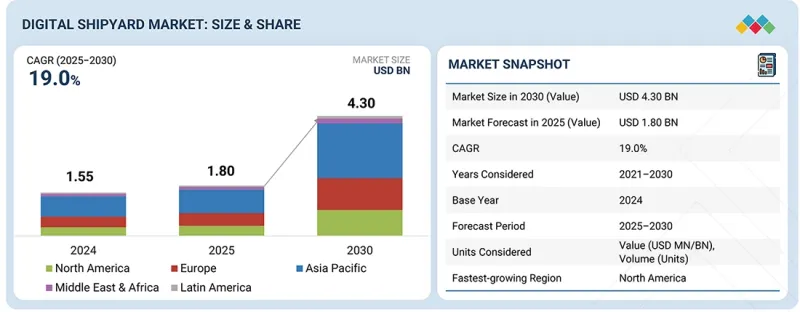
디지털 조선소 시장 규모는 2025년에 18억 달러 규모에 달할 것으로 전망되고 있으며, 2025-2030년에 CAGR 19.0%로 추이하며, 2030년에는 43억 달러에 달할 것으로 예측됩니다.
| 조사 범위 | |
|---|---|
| 조사 대상 기간 | 2021-2030년 |
| 기준연도 | 2024년 |
| 예측 기간 | 2025-2030년 |
| 단위 | 금액(달러) |
| 부문 | 기술, 프로세스, 최종사용자, 지역별 |
| 대상 지역 | 북미, 유럽, 아시아태평양, 기타 지역 |
디지털 조선소 시장의 성장은 효율성 향상과 비용 관리의 필요성에서 비롯되었습니다. 조선소에서는 디지털 트윈, 자동화, 데이터 분석과 같은 디지털 툴로 점차 전환하고 있으며, 이러한 툴은 설계, 생산, 유지보수 작업을 지원하고 있습니다. 동시에 더 복잡한 선박에 대한 수요도 증가하고 있습니다. 또한 많은 조선소들이 업그레이드가 필요한 구식 시스템을 사용하고 있으며, 새로운 솔루션 도입에 박차를 가하고 있습니다. 또한 지연시간 단축과 품질 향상에 대한 요구도 높아지고 있습니다. 이러한 모든 요인들이 시장 성장을 촉진하고 있습니다.
"프로세스별로는 R&D 부문이 예측 기간 중 가장 높은 CAGR로 성장할 것으로 예상됩니다. "
연구개발 부문의 성장은 조선업의 혁신에 대한 집중력 강화에 기인합니다. 조선소는 선박 설계 및 개발 프로세스를 개선하기 위해 신기술에 대한 투자를 확대하고 있습니다. 디지털 트윈, 시뮬레이션, 자동화 등의 툴을 활용하여 정확도 향상과 개발 기간 단축을 도모하고 있습니다. 동시에 더 효율적이고 복잡한 선박에 대한 수요도 증가하고 있습니다. 이것이 각 사의 연구개발 역량 향상을 촉진하고 있습니다. 또한 개발의 생산성 향상과 오류 감소가 요구되고 있습니다. 이러한 요인들이 이 부문의 꾸준한 성장을 지원하고 있습니다.
"디지털화 수준별로 보면 풀 디지털 조선소 부문이 예측 기간 중 가장 높은 CAGR로 성장할 것으로 예상됩니다. "
풀 디지털 조선소 부문의 성장은 조선의 전 공정을 단일 시스템 내에서 연계할 필요성에 기인합니다. 조선소는 디지털 트윈, 자동화, 실시간 데이터 시스템 등의 툴로 전환하고 있습니다. 이를 통해 업무 효율성 향상과 일상 업무의 오류를 줄일 수 있습니다. 완전 디지털화된 환경은 의사결정을 가속화하고 프로젝트 관리를 강화합니다. 또한 팀이 진행 상황을 보다 명확하게 파악할 수 있도록 도와줍니다. 또한 비용 절감과 프로젝트 기한내 완료에 대한 압박도 커지고 있습니다. 이러한 이유로 더 많은 조선소들이 완전한 디지털 환경으로 전환하고 있습니다.
"지역별로는 유럽이 예측 기간 중 두 번째로 높은 성장률을 보일 것으로 예상"
유럽의 디지털 조선소 시장의 성장은 현대화 및 인더스트리 4.0에 대한 적극적인 투자에 힘입어 성장하고 있습니다. 정부 및 조선사들은 효율성 향상을 위해 노력하고 있으며, 디지털 툴을 활용한 지속가능성 노력에도 집중하고 있습니다. 고급 해군 함정과 상선에 대한 수요도 증가하고 있습니다. 이것이 디지털 솔루션 도입을 촉진하고 있습니다. 또한 기술 제공업체와 조선소 간의 협력도 강화되고 있습니다. 이를 통해 디지털 역량 향상에 기여하고 있습니다. 동시에 엄격한 환경 규제도 시행되고 있습니다. 조선소는 이러한 규제를 충족하고 업무를 보다 효과적으로 모니터링하기 위해 디지털 툴을 활용하고 있습니다.
세계의 디지털 조선소(Digital Shipyard) 시장을 조사했으며, 시장 개요, 시장 성장에 영향을 미치는 각종 영향요인 분석, 기술-특허 동향, 법-규제 환경, 사례 분석, 시장 규모 추이 및 예측, 각종 부문별-지역별-주요 국가별 상세 분석, 경쟁 구도, 주요 기업 개요 등의 정보를 정리하여 전해드립니다.
자주 묻는 질문
목차
제1장 서론
제2장 개요
제3장 주요 인사이트
제4장 시장 개요
제5장 업계 동향
제6장 기술의 진보, AI의 영향, 특허, 혁신, 향후 응용
제7장 지속가능성과 규제 상황
제8장 고객 상황과 구매 행동
제9장 디지털 조선소 시장 : 기술별
제10장 디지털 조선소 시장 : 조선소 유형별
제11장 디지털 조선소 시장 : 생산능력별
제12장 디지털 조선소 시장 : 용도별
제13장 디지털 조선소 시장 : 프로세스별
제14장 디지털 조선소 시장 : 디지털화 레벨별
제15장 디지털 조선소 시장 : 지역별
제16장 경쟁 구도
제17장 기업 개요
제18장 조사 방법
제19장 부록
KSA 26.06.01The Digital Shipyard market is expected to register USD 1.80 billion in 2025 and is projected to reach USD 4.30 billion by 2030, at a CAGR of 19.0% from 2025 to 2030.
| Scope of the Report | |
|---|---|
| Years Considered for the Study | 2021-2030 |
| Base Year | 2024 |
| Forecast Period | 2025-2030 |
| Units Considered | Value (USD Billion) |
| Segments | By Technology, Process, End User and Region |
| Regions covered | North America, Europe, APAC, RoW |
Growth in the digital shipyard market is coming from the need to improve efficiency and keep costs under control. Shipyards are slowly moving towards digital tools like digital twins, automation, and data analytics. These tools help in design, production, and maintenance work. At the same time, demand for more complex vessels is increasing. Many shipyards also have older systems that need upgrades. This is pushing them to adopt new solutions. There is also pressure to reduce delays and improve quality. All these factors are helping the market grow.
"By Process, the Research & Development segment is projected to grow at the highest CAGR during the forecast period."
Growth in the research and development segment is coming from a stronger focus on innovation in shipbuilding. Shipyards are investing more in new technologies to improve how ships are designed and developed. They are using tools like digital twins, simulation, and automation to get better accuracy and reduce development time. At the same time, demand for more efficient and complex vessels is increasing. This is pushing companies to improve their R&D capabilities. There is also a need to improve productivity and reduce errors during development. These factors are helping the segment grow steadily.
"By Digitalization Level, the Fully Digital Shipyard segment is projected to grow at the highest CAGR during the forecast period."
Growth in the fully digital shipyard segment comes from the need to connect all parts of shipbuilding within a single system. Shipyards are moving towards tools like digital twins, automation, and real-time data systems. This helps improve efficiency and reduce errors in daily work. A fully digital setup speeds up decision-making and provides better control over projects. It also helps teams track progress more clearly. There is also pressure to reduce costs and finish projects on time. Because of this, more shipyards are shifting towards fully digital environments.
"Europe is projected to become the second-fastest-growing region during the forecast per iod."
Growth in the European digital shipyard market is coming from strong investment in modernization and Industry 4.0. Governments and shipbuilders are trying to improve efficiency. They are also giving more attention to sustainability through digital tools. Demand for advanced naval and commercial vessels is also increasing. This is supporting adoption of digital solutions. There is also more collaboration between technology providers and shipyards. This is helping improve digital capabilities. At the same time, strict environmental rules are in place. Shipyards are using digital tools to meet these rules and to monitor operations more effectively.
The breakdown of profiles for primary participants in the Digital Shipyard market is provided below:
- By Company Type: Tier 1 - 35%, Tier 2 - 45%, and Tier 3 - 20%
- By Designation: C Level - 35%, Director Level - 25%, and Others - 40%
- By Region: North America - 25%, Europe - 15%, Asia Pacific - 45%, Middle East - 10%, Rest of the World (RoW) - 5%
Research Coverage:
This market study covers the Digital Shipyard market across various segments and subsegments. It aims to estimate the size and growth potential of this market across different parts and regions. This study also includes an in-depth competitive analysis of the key players in the market, their company profiles, key observations on their products and business offerings, recent developments, and the key market strategies they have adopted.
Reasons to buy this report:
The report will help the market leader/new entrants with information on the closest approximations of the revenue numbers for the overall Digital Shipyard market. It will also help stakeholders understand the competitive landscape and gain more insights to position their businesses better and plan suitable go-to-market strategies. The report will also help stakeholders understand the market pulse and will provide information on key market drivers, restraints, challenges, and opportunities.
The report provides insights into the following pointers:
- Market drivers (naval modernization and defense fleet expansion), restraints (high capital investment requirements), opportunities (emergence of autonomous and smart vessel programs), and challenges (managing complex multi-vendor technology integration)
- Market Penetration: Comprehensive information on the Digital Shipyard market offered by the top players in the market
- Product Development/Innovation: Detailed insights on upcoming technologies, research & development activities, and product launches in the Digital Shipyard market
- Market Development: Comprehensive information about lucrative markets across varied regions
- Market Diversification: Exhaustive information about new products, untapped geographies, recent developments, and investments in the Digital Shipyard market
- Competitive Assessment: In-depth assessment of market share, growth strategies, products, and manufacturing capabilities of leading players in the Digital Shipyard market
TABLE OF CONTENTS
1 INTRODUCTION
- 1.1 STUDY OBJECTIVES
- 1.2 MARKET DEFINITION
- 1.3 STUDY SCOPE
- 1.3.1 MARKETS COVERED
- 1.3.2 YEARS CONSIDERED
- 1.4 INCLUSIONS AND EXCLUSIONS
- 1.5 CURRENCY CONSIDERED
- 1.6 LIMITATIONS
- 1.7 STAKEHOLDERS
- 1.8 SUMMARY OF CHANGES
2 EXECUTIVE SUMMARY
- 2.1 KEY INSIGHTS AND MARKET HIGHLIGHTSS
- 2.2 KEY MARKET PARTICIPANTS: MAPPING OF STRATEGIC DEVELOPMENTS
- 2.3 DISRUPTIVE TRENDS IN DIGITAL SHIPYARD MARKET
- 2.4 HIGH-GROWTH SEGMENTS
- 2.5 REGIONAL SNAPSHOT: MARKET SIZE, GROWTH RATE, AND FORECAST
3 PREMIUM INSIGHTS
- 3.1 ATTRACTIVE OPPORTUNITIES FOR PLAYERS IN DIGITAL SHIPYARD MARKET
- 3.2 DIGITAL SHIPYARD MARKET, BY SHIPYARD TYPE
- 3.3 DIGITAL SHIPYARD MARKET, BY DIGITALIZATION LEVEL
- 3.4 DIGITAL SHIPYARD MARKET, BY END USE
- 3.5 DIGITAL SHIPYARD MARKET, BY TECHNOLOGY
4 MARKET OVERVIEW
- 4.1 INTRODUCTION
- 4.2 MARKET DYNAMICS
- 4.2.1 DRIVERS
- 4.2.1.1 Naval modernization and defense fleet expansion
- 4.2.1.2 Demand for higher production efficiency and cost optimization
- 4.2.1.3 Rising adoption of advanced and smart vessel architectures
- 4.2.1.4 Expansion of green shipbuilding and sustainable manufacturing practices
- 4.2.2 RESTRAINTS
- 4.2.2.1 High capital investment requirements
- 4.2.2.2 Integration complexity with legacy infrastructure
- 4.2.2.3 Shortage of digitally skilled workforce
- 4.2.2.4 Cybersecurity and data protection concerns
- 4.2.3 OPPORTUNITIES
- 4.2.3.1 Emergence of autonomous and smart vessel programs
- 4.2.3.2 Expansion of government-funded shipyard modernization programs
- 4.2.3.3 Integration of artificial intelligence and predictive analytics in production
- 4.2.3.4 Development of green and net-zero shipyard infrastructure
- 4.2.4 CHALLENGES
- 4.2.4.1 Managing complex multi-vendor technology integration
- 4.2.4.2 Ensuring continuous production during digital transformation
- 4.2.4.3 Building digitally ready organizational culture
- 4.2.4.4 Balancing standardization with customization requirements
- 4.2.1 DRIVERS
- 4.3 UNMET NEEDS AND WHITE SPACES
- 4.4 INTERCONNECTED MARKETS AND CROSS-SECTOR OPPORTUNITIES
- 4.5 STRATEGIC MOVES BY TIER-1/2/3 PLAYERS
5 INDUSTRY TRENDS
- 5.1 INTRODUCTION
- 5.2 MACROECONOMIC OUTLOOK
- 5.2.1 INTRODUCTION
- 5.2.2 GDP TRENDS AND FORECAST
- 5.2.3 TRENDS IN GLOBAL SHIPYARD INDUSTRY
- 5.2.4 TRENDS IN GLOBAL DIGITAL SHIPYARD INDUSTRY
- 5.2.5 PLANNING AND REVISING FUNDING (~15%)
- 5.2.6 RESEARCH AND DEVELOPMENT (~20%)
- 5.2.7 RAW MATERIAL PROCUREMENT AND MANUFACTURING (~15%)
- 5.2.8 ASSEMBLY, TESTING, AND APPROVAL (~30%)
- 5.2.9 DISTRIBUTION (~10%)
- 5.2.10 AFTER-SALES SERVICE (~10%)
- 5.3 ECOSYSTEM ANALYSIS
- 5.3.1 MANUFACTURERS
- 5.3.2 SOLUTION AND SERVICE PROVIDERS
- 5.3.3 END USERS
- 5.4 INVESTMENT AND FUNDING SCENARIO
- 5.5 PRICING ANALYSIS
- 5.6 TRADE ANALYSIS
- 5.6.1 IMPORT SCENARIO
- 5.6.2 EXPORT SCENARIO
- 5.7 CASE STUDY ANALYSIS
- 5.7.1 CADMATIC EGO IMPLEMENTATION AT TSUNEISHI SHIPBUILDING
- 5.7.2 DIGITAL SHIPYARD PROGRAM BY BAE SYSTEMS
- 5.7.3 3DEXPERIENCE PLATFORM DEPLOYMENT BY FINCANTIERI WITH DASSAULT SYSTEMES
- 5.8 KEY CONFERENCES & EVENTS, 2025-2026
- 5.9 TRENDS & DISRUPTIONS IMPACTING CUSTOMER BUSINESS
- 5.10 IMPACT OF 2025 US TARIFFS
- 5.10.1 INTRODUCTION
- 5.11 KEY TARIFF RATES
- 5.12 PRICE IMPACT ANALYSIS
- 5.12.1 IMPACT ON COUNTRY/REGION
- 5.12.1.1 US
- 5.12.1.2 Europe
- 5.12.1.3 Asia Pacific
- 5.12.2 IMPACT ON DIFFERENT APPLICATIONS
- 5.12.2.1 Design & engineering
- 5.12.2.2 Manufacturing & planning
- 5.12.2.3 Maintenance & support
- 5.12.2.4 Training & simulation
- 5.12.2.5 Research & development
- 5.12.1 IMPACT ON COUNTRY/REGION
6 TECHNOLOGICAL ADVANCEMENTS, AI-DRIVEN IMPACT, PATENTS, INNOVATIONS, AND FUTURE APPLICATIONS
- 6.1 KEY EMERGING TECHNOLOGIES
- 6.1.1 AI-ENABLED DIGITAL TWIN & SIMULATION
- 6.1.2 IIOT-ENABLED SMART MANUFACTURING AND ROBOTICS
- 6.1.3 CLOUD, MASTER DATA MANAGEMENT, AND CYBERSECURITY PLATFORMS
- 6.2 COMPLEMENTARY TECHNOLOGIES
- 6.2.1 AR/VR-BASED VISUALIZATION AND WORKFORCE ENABLEMENT
- 6.3 ADJACENT TECHNOLOGIES
- 6.3.1 SMART SHIP AND AUTONOMOUS VESSEL SYSTEMS
- 6.4 TECHNOLOGY ROADMAP
- 6.5 PATENT ANALYSIS
- 6.6 FUTURE APPLICATIONS
- 6.7 IMPACT OF AI/ GENERATIVE AI ON DIGITAL SHIPYARD MARKET
- 6.7.1 TOP USE CASES AND MARKET POTENTIAL
- 6.7.2 BEST PRACTICES IN DIGITAL SHIPYARD MARKET
- 6.7.3 INTERCONNECTED ADJACENT ECOSYSTEM AND IMPACT ON MARKET PLAYERS
- 6.7.4 CLIENTS' READINESS TO ADOPT GENERATIVE AI IN DIGITAL SHIPYARD MARKET
7 SUSTAINABILITY AND REGULATORY LANDSCAPE
- 7.1 REGIONAL REGULATIONS AND COMPLIANCE
- 7.1.1 REGULATORY BODIES, GOVERNMENT AGENCIES, AND OTHER ORGANIZATIONS
- 7.1.2 INDUSTRY STANDARDS
- 7.2 SUSTAINABILITY INITIATIVES
- 7.2.1 CARBON IMPACT REDUCTION
- 7.2.2 ECO-APPLICATIONS
- 7.3 SUSTAINABILITY IMPACT AND REGULATORY POLICY INITIATIVES
- 7.3.1 SUSTAINABILITY IMPACT ON DIGITAL SHIPYARD MARKET
- 7.3.2 REGULATORY POLICY INITIATIVES DRIVING DIGITAL SHIPYARD DEPLOYMENT
- 7.4 CERTIFICATIONS, LABELING, AND ECO-STANDARDS
8 CUSTOMER LANDSCAPE AND BUYER BEHAVIOR
- 8.1 DECISION-MAKING PROCESS
- 8.2 BUYER STAKEHOLDERS AND BUYING EVALUATION CRITERIA
- 8.2.1 KEY STAKEHOLDERS IN BUYING PROCESS
- 8.2.2 BUYING CRITERIA
- 8.3 ADOPTION BARRIERS AND INTERNAL CHALLENGES
- 8.4 UNMET NEEDS FROM VARIOUS END USERS
- 8.4.1 NEED FOR HIGHER PRODUCTION FLEXIBILITY AND MULTI-PROGRAM CAPABILITIES
- 8.4.2 NEED FOR ENHANCED OPERATIONAL RESILIENCE AND CYBERSECURITY
- 8.4.3 NEED FOR WORKFORCE DIGITAL SKILL DEVELOPMENT AND CHANGE ENABLEMENT
9 DIGITAL SHIPYARD MARKET, BY TECHNOLOGY
- 9.1 INTRODUCTION
- 9.2 AUGMENTED & VIRTUAL REALITY (AR & VR)
- 9.2.1 AR & VR DEVICES FOR SHIPBUILDING TO AID MARKET GROWTH
- 9.3 DIGITAL TWIN & SIMULATION
- 9.3.1 DIGITAL TWIN & SIMULATION TO BE EMERGING TECHNOLOGIES
- 9.4 ADDITIVE MANUFACTURING
- 9.4.1 ADDITIVE MANUFACTURING ASSISTS NAVIES IN DESIGNING AND ENGINEERING SOLUTIONS
- 9.5 ARTIFICIAL INTELLIGENCE & BIG DATA ANALYTICS
- 9.5.1 INCREASING GLOBAL MARITIME TRADE DRIVES DEMAND FOR AI-POWERED ANALYTICS
- 9.6 ROBOTIC PROCESS AUTOMATION
- 9.6.1 SOPHISTICATED AND TIME-SAVING SOLUTIONS TO DRIVE DEMAND
- 9.7 INDUSTRIAL INTERNET OF THINGS (IIOT)
- 9.7.1 DEMAND FOR TECHNOLOGICAL ADVANCEMENTS TO BOOST SEGMENT
- 9.8 CYBERSECURITY
- 9.8.1 NEED TO COMBAT INCREASING CYBERTHREATS TO FUEL SEGMENT
- 9.9 BLOCKCHAIN
- 9.9.1 RISING DEMAND FOR BLOCKCHAIN TECHNOLOGY IN MEDIUM AND LARGE SHIPYARDS
- 9.10 CLOUD COMPUTING & MASTER DATA MANAGEMENT
- 9.10.1 INCREASED ADOPTION OF PLM AND CLOUD-BASED MAINTENANCE SYSTEMS ACROSS SHIPBUILDING
10 DIGITAL SHIPYARD MARKET, BY SHIPYARD TYPE
- 10.1 INTRODUCTION
- 10.2 COMMERCIAL SHIPYARDS
- 10.2.1 INCREASING MARITIME TRADE BOOSTS DEMAND FOR COMMERCIAL SHIPYARDS
- 10.3 MILITARY SHIPYARDS
- 10.3.1 PROCUREMENT OF ADVANCED VESSELS BY NAVIES WORLDWIDE
11 DIGITAL SHIPYARD MARKET, BY CAPACITY
- 11.1 INTRODUCTION
- 11.2 SMALL SHIPYARD
- 11.2.1 INCREASE IN MODERNIZATION PLANS OF SMALL SHIPYARDS
- 11.3 MEDIUM SHIPYARD
- 11.3.1 SMART SOLUTIONS TO INCREASE MARKET SHARE FOR MEDIUM SHIPYARDS
- 11.4 LARGE SHIPYARD
- 11.4.1 UPGRADING AND PROCUREMENT PLANS BY NAVIES GLOBALLY
12 DIGITAL SHIPYARD MARKET, BY END USE
- 12.1 INTRODUCTION
- 12.2 IMPLEMENTATION
- 12.2.1 RISING ORDER BACKLOGS AND DELIVERY PRESSURES TO DRIVE IMPLEMENTATION OF DIGITAL TECHNOLOGIES IN SHIPYARDS
- 12.3 UPGRADES & SERVICES
- 12.3.1 EVOLVING DIGITAL ECOSYSTEMS AND CYBER RISKS DRIVE DEMAND FOR UPGRADES & SERVICES IN SHIPYARDS
13 DIGITAL SHIPYARD MARKET, BY PROCESS
- 13.1 INTRODUCTION
- 13.2 RESEARCH & DEVELOPMENT
- 13.2.1 DEMAND FOR MODERNIZATION DRIVES R&D ACTIVITIES IN DIGITAL SHIPYARDS
- 13.3 DESIGN & ENGINEERING
- 13.3.1 INCREASE IN DEMAND FOR SOPHISTICATED DESIGN & ENGINEERING SOLUTIONS
- 13.4 MANUFACTURING & PLANNING
- 13.4.1 USE OF ADVANCED MANUFACTURING TECHNOLOGIES AND PLM SOLUTIONS ON RISE
- 13.5 MAINTENANCE & SUPPORT
- 13.5.1 HIGH-END TECHNOLOGIES FOR MAINTENANCE & SUPPORT OF PRODUCTS & SERVICES
- 13.6 TRAINING & SIMULATION
- 13.6.1 TRAINING & SIMULATION PROGRAMS FOR SKILLED WORKFORCE EXPECTED TO BE HIGH
14 DIGITAL SHIPYARD MARKET, BY DIGITALIZATION LEVEL
- 14.1 INTRODUCTION
- 14.2 FULLY DIGITAL SHIPYARD
- 14.2.1 PROCUREMENT PLANS FOR ADVANCED VESSELS BY NAVIES GLOBALLY
- 14.3 SEMI DIGITAL SHIPYARD
- 14.3.1 MODERNIZATION PLANS TO LEAD GROWTH IN SMALL AND MEDIUM-SIZED SEMI DIGITAL SHIPYARDS
- 14.4 PARTIALLY DIGITAL SHIPYARD
- 14.4.1 INCREASE IN ADOPTION OF PLM SOLUTIONS DRIVES MARKET
15 DIGITAL SHIPYARD MARKET, BY REGION
- 15.1 INTRODUCTION
- 15.2 NORTH AMERICA
- 15.2.1 US
- 15.2.1.1 Modern technologies led to digitalization of shipyards in US
- 15.2.2 CANADA
- 15.2.2.1 Shipyards in Canada to move toward Industry 4.0
- 15.2.1 US
- 15.3 EUROPE
- 15.3.1 UK
- 15.3.1.1 Expansion of naval modernization programs accelerating digital transformation in UK shipyards
- 15.3.2 GERMANY
- 15.3.2.1 Growing demand for complex vessel construction accelerating digitalization in German shipyards
- 15.3.3 FRANCE
- 15.3.3.1 Strategic collaborations and naval programs driving digital shipyard growth in France
- 15.3.4 ITALY
- 15.3.4.1 Naval procurement and shipyard modernization accelerating digital shipyard adoption in Italy
- 15.3.5 NETHERLANDS
- 15.3.5.1 Strong shipbuilding ecosystem and technology integration driving digital shipyard growth in the Netherlands
- 15.3.6 SPAIN
- 15.3.6.1 Shipyard construction projects and fleet renewal programs driving digital shipyard growth in Spain
- 15.3.7 REST OF EUROPE
- 15.3.7.1 Cross-border maritime collaboration and emerging shipyard digitalization driving growth in the rest of Europe
- 15.3.1 UK
- 15.4 ASIA PACIFIC
- 15.4.1 CHINA
- 15.4.1.1 Advancements in marine industry and rising efficiency demands driving digital shipyard growth in China
- 15.4.2 SOUTH KOREA
- 15.4.2.1 Major shipyard mergers intensifying competition and accelerating digital transformation in South Korea
- 15.4.3 JAPAN
- 15.4.3.1 Shipbuilders to leverage technical capability and R&D resources
- 15.4.4 INDIA
- 15.4.4.1 Government-led shipbuilding initiatives and rapid technology adoption driving digital shipyard growth in India
- 15.4.5 AUSTRALIA
- 15.4.5.1 National shipbuilding modernization programs accelerating digital shipyard adoption in Australia
- 15.4.6 REST OF ASIA PACIFIC
- 15.4.1 CHINA
- 15.5 MIDDLE EAST
- 15.5.1 UAE
- 15.5.1.1 Smart shipyard investments and naval modernization, accelerating digital transformation in the UAE
- 15.5.2 TURKEY
- 15.5.2.1 Expanding naval shipbuilding programs and defense industrial growth driving digital shipyard adoption in Turkey
- 15.5.3 REST OF MIDDLE EAST
- 15.5.1 UAE
- 15.6 REST OF THE WORLD
- 15.6.1 LATIN AMERICA
- 15.6.1.1 Port expansion and offshore energy activities driving digital shipyard growth in Latin America
- 15.6.2 AFRICA
- 15.6.2.1 Maritime infrastructure development and coastal trade growth driving digital shipyard adoption in Africa
- 15.6.1 LATIN AMERICA
16 COMPETITIVE LANDSCAPE
- 16.1 INTRODUCTION
- 16.2 KEY PLAYER STRATEGIES/RIGHT TO WIN, 2022-2025
- 16.3 MARKET SHARE ANALYSIS, 2024
- 16.4 REVENUE ANALYSIS OF TOP 5 MARKET PLAYERS, 2024
- 16.5 BRAND/PRODUCT COMPARISON
- 16.6 COMPANY VALUATION AND FINANCIAL METRICS
- 16.7 COMPANY EVALUATION MATRIX: KEY PLAYERS, 2024
- 16.7.1 STARS
- 16.7.2 EMERGING LEADERS
- 16.7.3 PERVASIVE PLAYERS
- 16.7.4 PARTICIPANTS
- 16.7.5 COMPANY FOOTPRINT
- 16.7.5.1 Company footprint
- 16.7.5.2 By technology
- 16.7.5.3 By end use
- 16.7.5.4 By region
- 16.8 COMPANY EVALUATION MATRIX: STARTUPS/SMES, 2024
- 16.8.1 PROGRESSIVE COMPANIES
- 16.8.2 RESPONSIVE COMPANIES
- 16.8.3 DYNAMIC COMPANIES
- 16.8.4 STARTING BLOCKS
- 16.9 COMPETITIVE BENCHMARKING
- 16.10 COMPETITIVE SCENARIO
- 16.10.1 PRODUCT LAUNCHES
- 16.10.2 DEALS
- 16.10.3 OTHERS
17 COMPANY PROFILES
- 17.1 KEY COMPANIES
- 17.1.1 SIEMENS
- 17.1.1.1 Business overview
- 17.1.1.2 Products/Solutions/Services offered
- 17.1.1.3 Recent developments
- 17.1.1.3.1 Deals
- 17.1.1.4 Recent developments
- 17.1.1.4.1 Product launches
- 17.1.1.4.2 Others
- 17.1.1.5 MnM view
- 17.1.1.5.1 Key strengths
- 17.1.1.5.2 Strategic choices
- 17.1.1.5.3 Weaknesses and competitive threats
- 17.1.2 DASSAULT SYSTEMES
- 17.1.2.1 Business overview
- 17.1.2.2 Products/Solutions/Services offered
- 17.1.2.3 Recent developments
- 17.1.2.3.1 Deals
- 17.1.2.3.2 Others
- 17.1.2.4 MnM view
- 17.1.2.4.1 Key strengths
- 17.1.2.4.2 Strategic choices
- 17.1.2.4.3 Weaknesses and competitive threats
- 17.1.3 ACCENTURE
- 17.1.3.1 Business overview
- 17.1.3.2 Products/Solutions/Services offered
- 17.1.3.3 Recent developments
- 17.1.3.3.1 Deals
- 17.1.3.4 MnM view
- 17.1.3.4.1 Key strengths
- 17.1.3.4.2 Strategic choices made
- 17.1.3.4.3 Weaknesses and competitive threats
- 17.1.4 SAP
- 17.1.4.1 Business overview
- 17.1.4.2 Products/Solutions/Services offered
- 17.1.4.3 Recent developments
- 17.1.4.3.1 Deals
- 17.1.4.3.2 Others
- 17.1.4.4 MnM view
- 17.1.4.4.1 Key strengths
- 17.1.4.4.2 Strategic choices
- 17.1.4.4.3 Weaknesses and competitive threats
- 17.1.5 BAE SYSTEMS
- 17.1.5.1 Business overview
- 17.1.5.2 Products/Solutions/Services offered
- 17.1.5.3 Recent developments
- 17.1.5.3.1 Deals
- 17.1.5.3.2 Others
- 17.1.5.4 MnM view
- 17.1.5.4.1 Key strengths
- 17.1.5.4.2 Strategic choices
- 17.1.5.4.3 Weaknesses and competitive threats
- 17.1.6 HEXAGON AB
- 17.1.6.1 Business overview
- 17.1.6.2 Products/Solutions/Services offered
- 17.1.6.3 Recent developments
- 17.1.6.3.1 Product launches
- 17.1.6.3.2 Deals
- 17.1.7 WARTSILA
- 17.1.7.1 Business overview
- 17.1.7.2 Products/Solutions/Services offered
- 17.1.7.3 Recent developments
- 17.1.7.3.1 Product launches
- 17.1.7.3.2 Deals
- 17.1.8 KUKA SE & CO. KGAA
- 17.1.8.1 Business overview
- 17.1.8.2 Products/Solutions/Services offered
- 17.1.8.3 Recent developments
- 17.1.8.3.1 Deals
- 17.1.9 IFS
- 17.1.9.1 Business overview
- 17.1.9.2 Products/Solutions/Services offered
- 17.1.9.3 Recent developments
- 17.1.9.3.1 Product launches
- 17.1.9.3.2 Deals
- 17.1.9.3.3 Others
- 17.1.10 PEMAMEK
- 17.1.10.1 Business overview
- 17.1.10.2 Products/Solutions/Services offered
- 17.1.10.3 Recent developments
- 17.1.10.3.1 Product launches
- 17.1.10.3.2 Deals
- 17.1.10.3.3 Others
- 17.1.11 ARAS
- 17.1.11.1 Business overview
- 17.1.11.2 Products/Solutions/Services offered
- 17.1.11.3 Recent developments
- 17.1.11.4 Recent developments
- 17.1.11.4.1 Deals
- 17.1.12 KREYON
- 17.1.12.1 Business overview
- 17.1.12.2 Products/Solutions/Services offered
- 17.1.12.3 Recent developments
- 17.1.12.3.1 Deals
- 17.1.13 SSI
- 17.1.13.1 Business overview
- 17.1.13.2 Products/Solutions/Services offered
- 17.1.13.3 Recent developments
- 17.1.13.3.1 Deals
- 17.1.13.3.2 Others
- 17.1.14 IBASE-T
- 17.1.14.1 Business overview
- 17.1.14.2 Products/Solutions/Services offered
- 17.1.14.3 Recent developments
- 17.1.14.3.1 Product launches
- 17.1.14.3.2 Deals
- 17.1.15 PROSTEP AG
- 17.1.15.1 Business overview
- 17.1.15.2 Products/Solutions/Services offered
- 17.1.15.3 Recent developments
- 17.1.15.3.1 Product launches
- 17.1.15.3.2 Deals
- 17.1.16 KRANEDONK
- 17.1.16.1 Business overview
- 17.1.16.2 Products/Solutions/Services offered
- 17.1.16.3 Recent developments
- 17.1.16.3.1 Product launches
- 17.1.16.3.2 Deals
- 17.1.17 DAMEN SHIPYARDS GROUP
- 17.1.17.1 Business overview
- 17.1.17.2 Products/Solutions/Services offered
- 17.1.17.3 Recent developments
- 17.1.17.3.1 Product launches
- 17.1.17.3.2 Deals
- 17.1.17.3.3 Others
- 17.1.18 THYSSENKRUPP MARINE SYSTEMS
- 17.1.18.1 Business overview
- 17.1.18.2 Products/Solutions/Services offered
- 17.1.18.3 Recent developments
- 17.1.18.3.1 Deals
- 17.1.19 NAVANTIA, S.A.
- 17.1.19.1 Business overview
- 17.1.19.2 Products/Solutions/Services offered
- 17.1.19.3 Recent developments
- 17.1.19.3.1 Product launches
- 17.1.19.3.2 Deals
- 17.1.20 BUREAU VERITAS
- 17.1.20.1 Business overview
- 17.1.20.2 Products/Solutions/Services offered
- 17.1.20.3 Recent developments
- 17.1.20.3.1 Product launches
- 17.1.20.3.2 Deals
- 17.1.21 CADMATIC
- 17.1.21.1 Business overview
- 17.1.21.2 Products/Solutions/Services offered
- 17.1.21.3 Recent developments
- 17.1.21.3.1 DEALS
- 17.1.1 SIEMENS
- 17.2 OTHER PLAYERS
- 17.2.1 BLUEWATER AUTONOMY
- 17.2.2 SARONIC TECHNOLOGIES
- 17.2.3 SEA.AI
- 17.2.4 VOYAGEX.AI
- 17.2.5 SEA-FLUX LTD
- 17.2.6 ECHANDIA AB
- 17.2.7 FLOORGANISE SHIPBUILDING MES-SOFTWARE
- 17.2.8 B&A SOFTWARE
- 17.2.9 D5 SOFTWARE GMBH
- 17.2.10 SHIPREALITY INC
18 RESEARCH METHODOLOGY
- 18.1 RESEARCH DATA
- 18.1.1 SECONDARY DATA
- 18.1.1.1 Key data from secondary sources
- 18.1.2 PRIMARY DATA
- 18.1.2.1 Key data from primary sources
- 18.1.1 SECONDARY DATA
- 18.2 DEMAND- AND SUPPLY-SIDE ANALYSIS
- 18.2.1 INTRODUCTION
- 18.2.2 DEMAND-SIDE INDICATORS
- 18.2.2.1 Procurement of advanced vessels by navies worldwide
- 18.2.2.2 Rise in global seaborne trade
- 18.2.3 SUPPLY-SIDE INDICATORS
- 18.2.3.1 High regulations and need for reduced overheads
- 18.3 MARKET SIZE ESTIMATION
- 18.3.1 SEGMENTS AND SUBSEGMENTS
- 18.4 RESEARCH APPROACH AND METHODOLOGY
- 18.4.1 BOTTOM-UP APPROACH
- 18.4.1.1 Digital shipyard market: Bottom-up approach
- 18.4.1.2 Digital shipyard market, by shipyard type
- 18.4.1.3 Digital shipyard market, by capacity
- 18.4.1.4 Digital shipyard market, by end use
- 18.4.1.5 Digital shipyard market, by process
- 18.4.1.6 Digital shipyard market, by country
- 18.4.2 TOP-DOWN APPROACH
- 18.4.1 BOTTOM-UP APPROACH
- 18.5 TRIANGULATION THROUGH SECONDARY RESEARCH
- 18.6 RESEARCH ASSUMPTIONS
- 18.6.1 GROWTH RATE ASSUMPTIONS
- 18.6.2 ASSUMPTIONS FOR RESEARCH STUDY
- 18.6.3 RISK ANALYSIS
19 APPENDIX
- 19.1 DISCUSSION GUIDE
- 19.2 KNOWLEDGESTORE: MARKETSANDMARKETS' SUBSCRIPTION PORTAL
- 19.3 CUSTOMIZATION OPTIONS
- 19.4 RELATED REPORTS
- 19.5 AUTHOR DETAILS


