|
시장보고서
상품코드
2058128
데이터센터 스토리지 시장 예측(-2032년) : 스토리지 미디어(SSD, HDD), 인터페이스(SATA, SAS, NVMe), 최종사용자(하이퍼스케일/클라우드 서비스 프로바이더, 기업, 정부 및 공공 부문), 폼팩터(3.5인치, 2.5인치, M.2), 용량별Data Center Storage Market By Storage Medium (SSDs, HDDs), Interface (SATA, SAS, NVMe), End User (Hyperscale/Cloud Service Providers, Enterprises, Government & Public Sector), Form Factor (3.5-inch, 2.5-inch, M.2), and Capacity - Global Forecast to 2032 |
||||||

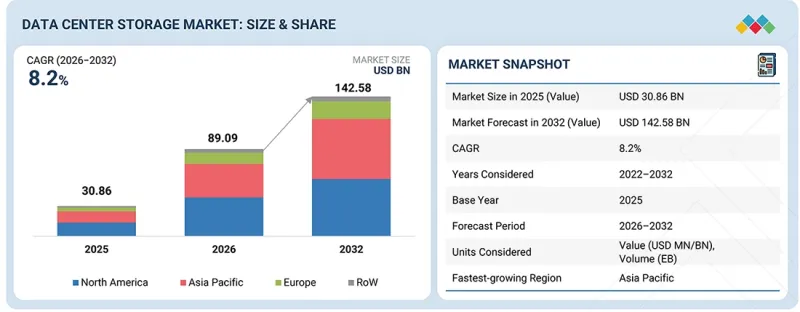
데이터센터 스토리지 시장 규모는 2026년 추정 890억 9,000만 달러에서 2032년에는 1,425억 8,000만 달러에 달할 것으로 예측되고 있으며, 예측 기간 중 CAGR 8.2%로 성장할 것으로 전망되고 있습니다.
| 조사 범위 | |
|---|---|
| 조사 대상 기간 | 2021-2032년 |
| 기준연도 | 2025년 |
| 예측 기간 | 2026-2032년 |
| 단위 | 금액(달러) |
| 부문 | 스토리지 미디어, 최종사용자, 지역별 |
| 대상 지역 | 북미, 유럽, 아시아태평양, 기타 지역 |
“최종사용자별로는 하이퍼스케일/클라우드 서비스 제공업체 부문이 예측 기간 중 가장 높은 연평균 성장률(CAGR)을 기록할 것으로 예상됩니다. '
하이퍼스케일/클라우드 서비스 제공업체 부문은 하이퍼스케일 시설, AI 인프라, 대규모 클라우드 컴퓨팅 환경에 대한 투자 확대에 힘입어 가장 높은 연평균 성장률(CAGR)을 기록할 것으로 예상됩니다. 이러한 기업은 방대한 데이터 생성, AI 훈련 워크로드, 가상화, 실시간 분석 애플리케이션을 지원하기 위해 대용량 HDD와 고성능 SSD가 필요합니다. 확장성이 뛰어나고 지연 시간이 짧으며 에너지 효율이 우수한 스토리지 아키텍처에 대한 관심이 높아짐에 따라 고성능 NVMe SSD와 초대용량 니어라인 HDD의 도입이 가속화되고 있습니다. 또한 클라우드의 보급 확대와 기업의 디지털 플랫폼 전환 증가가 하이퍼스케일 환경 전반에 걸친 스토리지 인프라 확장을 더욱 가속화하고 있습니다.
“도입 형태별로는 예측 기간 중 클라우드 기반 부문이 가장 큰 시장 점유율을 차지할 것으로 예상됩니다. '
클라우드 기반 부문은 클라우드 컴퓨팅 플랫폼의 도입 확대, 하이퍼스케일 인프라의 확장, 그리고 기업의 디지털 워크로드로의 전환 증가에 힘입어 가장 큰 점유율을 차지하고 있습니다. 클라우드 기반 스토리지 환경에서는 AI 애플리케이션, 가상화, 분석, 실시간 데이터 처리 워크로드를 지원하기 위해 확장성이 뛰어나고 대용량이며 지연 시간이 짧은 HDD 및 SSD 솔루션이 요구되고 있습니다. 하이퍼스케일 클라우드 제공업체의 영향력이 커지고, 유연하며 원격 접속이 가능한 스토리지 인프라에 대한 수요가 증가함에 따라 첨단 데이터센터 스토리지 기술의 도입이 가속화되고 있습니다. 또한 비용 효율성이 높고 확장성이 뛰어난 스토리지 아키텍처에 대한 기업의 수요가 증가함에 따라 전 세계에서 클라우드 기반 스토리지 도입이 더욱 가속화되고 있습니다.
“예측 기간 중 아시아태평양이 가장 큰 시장 점유율을 차지할 것으로 예상됩니다. ” '
아시아태평양은 하이퍼스케일 데이터센터의 급속한 확대, 클라우드 컴퓨팅의 보급 확대, 그리고 해당 지역 주요 경제권에서의 AI 인프라 투자 증가에 힘입어 가장 큰 점유율을 차지하고 있습니다. 기업의 디지털화 진전과 인터넷 보급률 증가에 따라 클라우드 환경이나 기업 환경을 불문하고 대용량 HDD 및 고성능 SSD에 대한 수요가 급증하고 있습니다. 반도체 제조 생태계의 강력한 입지와 전 세계 클라우드 서비스 제공업체들의 투자 증가가 아시아태평양 전체에서 첨단 데이터센터 스토리지 솔루션의 대규모 도입을 더욱 촉진하고 있습니다.
이 보고서에서는 전 세계 데이터센터 스토리지 시장을 조사하여, 시장 개요, 시장 성장에 영향을 미치는 다양한 요인에 대한 분석, 기술 및 특허 동향, 법규 환경, 사례 연구, 시장 규모 추이 및 전망, 각종 분류 및 지역/주요 국가별 상세 분석, 경쟁 구도, 주요 기업 개요 등을 종합적으로 다루고 있습니다.
자주 묻는 질문
목차
제1장 서론
제2장 개요
제3장 주요 인사이트
제4장 시장 개요
제5장 업계 동향
제6장 기술의 진보, AI의 영향, 특허, 혁신, 향후 응용
제7장 규제 상황과 지속가능성 구상
제8장 고객 상황과 구매 행동
제9장 데이터센터 스토리지 상황 개요 : 워크로드 유형별
제10장 데이터센터에서 스토리지 아키텍처
제11장 데이터센터에서 스토리지 시스템의 구성
제12장 데이터센터에서 데이터 스토리지 유형
제13장 데이터센터 스토리지 시장 : 스토리지 미디어별
제14장 데이터센터 스토리지 시장 : 인터페이스별
제15장 데이터센터 스토리지 시장 : 용량별
제16장 데이터센터 스토리지 시장 : 폼팩터별
제17장 데이터센터 스토리지 시장 : 도입 형태별
제18장 데이터센터 스토리지 시장 : 최종사용자별
제19장 데이터센터 스토리지 시장 : 지역별
제20장 경쟁 구도
제21장 기업 개요
제22장 조사 방법
제23장 부록
KSA 26.06.23The data center storage market is projected to reach USD 142.58 billion by 2032 from an estimated USD 89.09 billion in 2026, growing at a CAGR of 8.2% during the forecast period.
| Scope of the Report | |
|---|---|
| Years Considered for the Study | 2021-2032 |
| Base Year | 2025 |
| Forecast Period | 2026-2032 |
| Units Considered | Value (USD Billion) |
| Segments | By Storage Medium, End User and Region |
| Regions covered | North America, Europe, APAC, RoW |
"Based on end user, the hyperscale/cloud service providers segment is expected to witness the highest CAGR during the forecast period."
The hyperscale/cloud service providers segment is expected to witness the highest CAGR in the data center storage market, driven by increasing investments in hyperscale facilities, AI infrastructure, and large-scale cloud computing environments. These operators require high-capacity HDDs and high-performance SSDs to support massive data generation, AI training workloads, virtualization, and real-time analytics applications. Their growing focus on scalable, low-latency, and energy-efficient storage architectures is accelerating the deployment of advanced NVMe SSDs and ultra-high-capacity nearline HDDs. Additionally, expanding cloud adoption and increasing enterprise migration toward digital platforms are further driving storage infrastructure expansion across hyperscale environments.
"Based on deployment type, the cloud-based segment is expected to account for the largest market share during the forecast period."
The cloud-based segment accounts for the largest share of the data center storage market due to the increasing adoption of cloud computing platforms, hyperscale infrastructure expansion, and rising enterprise migration toward digital workloads. Cloud-based storage environments require scalable, high-capacity, and low-latency HDD and SSD solutions to support AI applications, virtualization, analytics, and real-time data processing workloads. The growing presence of hyperscale cloud providers and the increasing demand for flexible, remotely accessible storage infrastructure are accelerating the deployment of advanced data center storage technologies. Additionally, rising enterprise demand for cost-efficient and scalable storage architectures is further strengthening the adoption of cloud-based storage deployments globally.
"Asia Pacific is expected to account for the largest market share during the forecast period."
The Asia Pacific region accounts for the largest share of the data center storage market due to rapid hyperscale data center expansion, increasing cloud computing adoption, and rising AI infrastructure investments across major economies in the region. Growing enterprise digitalization and increasing internet penetration are accelerating demand for high-capacity HDDs and high-performance SSDs across cloud and enterprise environments. The strong presence of semiconductor manufacturing ecosystems and increasing investments by global cloud service providers are further supporting the large-scale deployment of advanced data center storage solutions across the Asia Pacific.
Extensive primary interviews were conducted with key industry experts in the data center storage market to determine and verify the market size for various segments and subsegments gathered through secondary research. The breakdown of primary participants for the report is shown below.
The study contains insights from various industry experts, including component suppliers, Tier 1 companies, and OEMs. The break-up of the primaries is as follows:
- By Company Type - Tier 1 - 40%, Tier 2 - 35%, and Tier 3 - 25%
- By Designation - C-level Executives - 35%, Directors - 40%, and Others - 25%
- By Region - North America - 30%, Europe - 20%, Asia Pacific - 40%, and RoW - 10%
The data center storage market is characterized by the presence of several established SSD and HDD manufacturers, such as Samsung (South Korea), SK HYNIX INC. (South Korea), Micron Technology, Inc. (US), KIOXIA Corporation (Japan), Sandisk Corporation (US), Seagate Technology LLC (Ireland), Western Digital Corporation (US), and Toshiba Electronic Devices & Storage Corporation (Japan), among others.
The study includes an in-depth competitive analysis of these key players in the data center storage market, covering their company profiles, recent developments, product innovations, storage technology advancements, and key market strategies.
Study Coverage:
The report segments the data center storage market and forecasts its size by storage medium (hard disk drives (HDDs), solid-state drives (SSDs)), interface (SATA, SAS, NVMe), capacity (low capacity (<2 TB), mid capacity (2-10 TB), high capacity (10-20 TB), ultra-high capacity (>20 TB)), form factor (3.5-inch, 2.5-inch, M.2, U.2/ U.3, EDSFF, Add-in-Cards (AICs)), deployment type (on-premises, cloud-based, hybrid), and end user (hyperscale/cloud service providers, enterprises, government & public sector). The report also analyses key market drivers, restraints, opportunities, and challenges influencing industry growth. It provides a detailed regional assessment across Asia Pacific, North America, Europe, and the RoW, along with country-level insights for major markets. In addition, the study includes a value chain analysis and a competitive landscape assessment of leading players in the global data center storage ecosystem.
Key Benefits of Buying the Report:
- Analysis of key drivers (increasing hyperscale data center deployments, rising adoption of AI and high-performance computing workloads, expanding cloud computing infrastructure, growing enterprise data generation, increasing demand for low-latency and high-capacity storage solutions), restraints (high capital investment requirements for advanced storage infrastructure, supply chain fluctuations in NAND flash and storage components, increasing power consumption and cooling requirements in large-scale data centers, pricing volatility in memory and storage devices), opportunities (growing AI server deployments, increasing adoption of edge computing infrastructure, rising demand for NVMe SSDs and ultra-high-capacity nearline HDDs, expansion of hyperscale and colocation data centers, increasing enterprise migration toward cloud-based storage architectures), challenges (thermal management and power efficiency concerns in high-density storage deployments, maintaining data reliability and endurance in AI-intensive workloads, complexities associated with scaling storage infrastructure for hyperscale environments, managing latency and performance requirements across data-intensive applications).
- Product Development/Innovation: Detailed insights on emerging storage technologies, advancements in NAND flash architectures, PCIe Gen5 and NVMe interface developments, ongoing research and development activities, and new product launches in the data center storage market.
- Market Development: Comprehensive information about high-growth markets-the report analyzes the data center storage market across North America, Europe, Asia Pacific, and the RoW.
- Market Diversification: Exhaustive information about new storage technologies, untapped application areas, strategic investments, and expansion opportunities in the data center storage market.
- Competitive Assessment: In-depth assessment of market shares and growth strategies of leading players, such as Samsung (South Korea), SK HYNIX INC. (South Korea), Micron Technology, Inc. (US), KIOXIA Corporation (Japan), Sandisk Corporation (US), Seagate Technology LLC(Ireland), Western Digital Corporation (US), and Toshiba Electronic Devices & Storage Corporation (Japan).
TABLE OF CONTENTS
1 INTRODUCTION
- 1.1 STUDY OBJECTIVES
- 1.2 MARKET DEFINITION
- 1.3 MARKET SCOPE
- 1.3.1 MARKET SEGMENTATION AND REGIONAL SCOPE
- 1.3.2 YEARS CONSIDERED
- 1.3.3 INCLUSIONS AND EXCLUSIONS
- 1.4 CURRENCY CONSIDERED
- 1.5 UNIT CONSIDERED
- 1.6 STAKEHOLDERS
2 EXECUTIVE SUMMARY
- 2.1 MARKET HIGHLIGHTS AND KEY INSIGHTS
- 2.2 KEY MARKET PARTICIPANTS: MAPPING OF STRATEGIC DEVELOPMENTS
- 2.3 DISRUPTIVE TRENDS IN DATA CENTER STORAGE MARKET
- 2.4 HIGH-GROWTH SEGMENTS
- 2.5 REGIONAL SNAPSHOT: MARKET SIZE, GROWTH RATE, AND FORECAST
3 PREMIUM INSIGHTS
- 3.1 ATTRACTIVE OPPORTUNITIES FOR PLAYERS IN DATA CENTER STORAGE MARKET
- 3.2 DATA CENTER STORAGE MARKET, BY STORAGE MEDIUM
- 3.3 DATA CENTER STORAGE MARKET, BY INTERFACE
- 3.4 DATA CENTER STORAGE MARKET, BY CAPACITY
- 3.5 DATA CENTER STORAGE MARKET, BY FORM FACTOR
- 3.6 DATA CENTER STORAGE MARKET, BY DEPLOYMENT TYPE
- 3.7 DATA CENTER STORAGE MARKET, BY END USER
- 3.8 DATA CENTER STORAGE MARKET, BY REGION
- 3.9 DATA CENTER STORAGE MARKET, BY COUNTRY
4 MARKET OVERVIEW
- 4.1 INTRODUCTION
- 4.2 MARKET DYNAMICS
- 4.2.1 DRIVERS
- 4.2.1.1 Increasing use of AI-, ML-, generative AI-driven workloads
- 4.2.1.2 Rapid expansion of hyperscale and cloud data centers
- 4.2.1.3 Pressing need to increase data storage capacity in data centers
- 4.2.1.4 Elevating demand for data storage systems with high throughput and low latency
- 4.2.2 RESTRAINTS
- 4.2.2.1 Requirement for high investment to modernize storage infrastructure
- 4.2.2.2 Substantial operating cost of storage infrastructure due to high power consumption
- 4.2.2.3 Volatile pricing of memory modules impacting large-scale procurement planning
- 4.2.3 OPPORTUNITIES
- 4.2.3.1 Growing adoption of AI-optimized storage infrastructure
- 4.2.3.2 Surging demand for distributed data center storage due to rising adoption of edge AI and real-time applications
- 4.2.3.3 Increasing adoption of software-defined storage architectures
- 4.2.3.4 Next-generation HDD innovations sustaining large-scale capacity expansion
- 4.2.4 CHALLENGES
- 4.2.4.1 Managing exponential growth of unstructured data
- 4.2.4.2 Scaling storage infrastructure without performance degradation
- 4.2.4.3 Increasing regulatory and cybersecurity pressures complicating storage operations
- 4.2.4.4 Component supply instability affecting storage manufacturing and deployment timelines
- 4.2.1 DRIVERS
- 4.3 INTERCONNECTED MARKETS AND CROSS-SECTOR OPPORTUNITIES
- 4.3.1 INTERCONNECTED MARKETS
- 4.3.2 CROSS-SECTOR OPPORTUNITIES
- 4.4 STRATEGIC MOVES BY TIER 1/2/3 PLAYERS
5 INDUSTRY TRENDS
- 5.1 INTRODUCTION
- 5.2 PORTER'S FIVE FORCES ANALYSIS
- 5.2.1 THREAT OF NEW ENTRANTS
- 5.2.2 THREAT OF SUBSTITUTES
- 5.2.3 BARGAINING POWER OF SUPPLIERS
- 5.2.4 BARGAINING POWER OF BUYERS
- 5.2.5 INTENSITY OF COMPETITIVE RIVALRY
- 5.3 MACROECONOMIC OUTLOOK
- 5.3.1 INTRODUCTION
- 5.3.2 GDP TRENDS AND FORECAST
- 5.3.3 TRENDS IN NAND FLASH MEMORY AND SEMICONDUCTOR INDUSTRIES
- 5.3.4 TRENDS IN DATA CENTER INFRASTRUCTURE AND STORAGE TECHNOLOGY MARKET
- 5.4 VALUE CHAIN ANALYSIS
- 5.5 ECOSYSTEM ANALYSIS
- 5.6 PRICING ANALYSIS
- 5.6.1 AVERAGE SELLING PRICE TREND OF DATA CENTER STORAGE SOLTUIONS, BY STORAGE MEDIUM, 2022-2025
- 5.6.2 AVERAGE SELLING PRICE TREND OF DATA CENTER STORAGE MEDIUMS, BY REGION, 2022-2025
- 5.6.2.1 Average selling price trend of HDDs, by region, 2022-2025
- 5.6.2.2 Average selling price trend of SSDs, by region, 2022-2025
- 5.7 TRADE ANALYSIS
- 5.7.1 IMPORT SCENARIO (HS CODE 847170)
- 5.7.2 EXPORT SCENARIO (HS CODE 847170)
- 5.8 KEY CONFERENCES AND EVENTS, 2026-2027
- 5.9 TRENDS/DISRUPTIONS IMPACTING CUSTOMER BUSINESS
- 5.10 INVESTMENT AND FUNDING SCENARIO, 2022-2026
- 5.11 CASE STUDY ANALYSIS
- 5.11.1 HYPERSCALE STORAGE DEPLOYMENTS FOR AI AND CLOUD WORKLOADS
- 5.11.2 CLOUD STORAGE MODERNIZATION FOR ENTERPRISE APPLICATIONS
- 5.11.3 HIGH-DENSITY STORAGE ARCHITECTURES FOR CONTENT DELIVERY AND AI APPLICATIONS
- 5.12 IMPACT OF US TARIFFS - DATA CENTER STORAGE MARKET
- 5.12.1 KEY TARIFF RATES
- 5.12.2 PRICE IMPACT ANALYSIS
- 5.12.3 IMPACT ON COUNTRIES/REGIONS
- 5.12.3.1 US
- 5.12.3.2 Europe
- 5.12.3.3 Asia Pacific
- 5.12.4 IMPACT ON END USERS
6 TECHNOLOGICAL ADVANCEMENTS, AI-DRIVEN IMPACT, PATENTS, INNOVATIONS, AND FUTURE APPLICATIONS
- 6.1 KEY EMERGING TECHNOLOGIES
- 6.1.1 3D NAND SCALING AND LAYER INNOVATIONS
- 6.1.2 AI-OPTIMIZED DATA CENTER SSD ARCHITECTURES
- 6.1.3 ZONED STORAGE TECHNOLOGIES
- 6.1.4 COMPUTATIONAL STORAGE AND IN-STORAGE PROCESSING
- 6.1.5 NEXT-GENERATION HDD TECHNOLOGIES
- 6.1.6 NVME AND PCIE GEN5/GEN6 STORAGE INTERFACES
- 6.2 COMPLEMENTARY TECHNOLOGIES
- 6.2.1 DATA PROCESSING UNITS AND SMARTNICS
- 6.2.2 NVME-OVER-FABRICS AND RDMA NETWORKING
- 6.2.3 ADVANCED COOLING AND THERMAL MANAGEMENT TECHNOLOGIES
- 6.2.4 DATA SECURITY, ENCRYPTION, AND RANSOMWARE PROTECTION TECHNOLOGIES
- 6.2.5 STORAGE VIRTUALIZATION AND COMPOSABLE INFRASTRUCTURE
- 6.2.6 STORAGE POWER OPTIMIZATION AND ENERGY-EFFICIENT ARCHITECTURES
- 6.3 TECHNOLOGY ROADMAP
- 6.3.1 SHORT-TERM (2025-2027): PERFORMANCE OPTIMIZATION AND AI INFRASTRUCTURE SCALING
- 6.3.2 MID-TERM (2027-2030): COMPOSABLE STORAGE AND DISAGGREGATED INFRASTRUCTURE
- 6.3.3 LONG-TERM (2030-2035+): INTELLIGENT STORAGE INFRASTRUCTURE AND AUTONOMOUS DATA MANAGEMENT
- 6.4 PATENT ANALYSIS
- 6.5 IMPACT OF AI ON DATA CENTER STORAGE MARKET
- 6.5.1 TOP USE CASES AND MARKET POTENTIAL
- 6.5.2 BEST PRACTICES FOLLOWED BY MANUFACTURERS/OEMS IN DATA CENTER STORAGE MARKET
- 6.5.3 CASE STUDIES RELATED TO AI IMPLEMENTATION IN DATA CENTER STORAGE MARKET
- 6.5.4 INTERCONNECTED ECOSYSTEM AND IMPACT ON MARKET PLAYERS
- 6.5.5 CLIENTS' READINESS TO ADOPT AI-INTEGRATED DATA CENTER STORAGE
7 REGULATORY LANDSCAPE AND SUSTAINABILITY INITIATIVES
- 7.1 INTRODUCTION
- 7.2 REGIONAL REGULATIONS AND COMPLIANCE
- 7.2.1 REGULATORY BODIES, GOVERNMENT AGENCIES, AND OTHER ORGANIZATIONS
- 7.2.2 INDUSTRY STANDARDS
- 7.2.2.1 Storage interface and performance standards (NVMe, PCIe, SATA, SAS)
- 7.2.2.2 Data security and cybersecurity standards (ISO/IEC 27001, NIST)
- 7.2.2.3 Energy efficiency and sustainability standards (ENERGY STAR, ISO 50001)
- 7.2.2.4 Storage interoperability and form factor standards (SNIA, OCP, EDSFF)
- 7.3 SUSTAINABILITY INITIATIVES
- 7.3.1 USE OF DATA CENTER STORAGE SOLUTIONS TO REDUCE ENVIRONMENTAL IMPACT
- 7.3.2 ENERGY-EFFICIENT STORAGE ARCHITECTURES AND POWER OPTIMIZATION
- 7.3.3 ELECTRONIC WASTE MANAGEMENT AND RECYCLING INITIATIVES
- 7.3.4 SUSTAINABLE DATA CENTER INFRASTRUCTURE AND CARBON REDUCTION INITIATIVES
- 7.4 SUSTAINABILITY IMPACT AND REGULATORY POLICY INITIATIVES
- 7.4.1 IMPACT OF ENVIRONMENTAL REGULATIONS ON DATA CENTER STORAGE DESIGN
- 7.4.2 IMPACT OF ENERGY EFFICIENCY POLICIES ON DATA CENTER OPERATIONS
- 7.4.3 IMPACT OF ELECTRONIC WASTE AND RECYCLING REGULATIONS
- 7.4.4 IMPACT OF DATA SECURITY AND DATA LOCALIZATION POLICIES
- 7.5 CERTIFICATIONS, LABELING, AND ECO-STANDARDS
- 7.5.1 PRODUCT SAFETY AND REGULATORY CERTIFICATION
- 7.5.2 ENVIRONMENTAL COMPLIANCE AND HAZARDOUS SUBSTANCE REGULATIONS
- 7.5.3 ENERGY EFFICIENCY AND ENVIRONMENTAL LABELING PROGRAMS
- 7.5.4 ELECTRONIC WASTE MANAGEMENT AND RECYCLING COMPLIANCE
8 CUSTOMER LANDSCAPE AND BUYER BEHAVIOR
- 8.1 INTRODUCTION
- 8.2 DECISION-MAKING PROCESS
- 8.3 KEY STAKEHOLDERS INVOLVED IN BUYING PROCESS AND THEIR EVALUATION CRITERIA
- 8.3.1 KEY STAKEHOLDERS IN BUYING PROCESS
- 8.3.2 BUYING CRITERIA
- 8.4 ADOPTION BARRIERS AND INTERNAL CHALLENGES
- 8.5 UNMET NEEDS OF VARIOUS END USERS
9 DATA CENTER STORAGE LANDSCAPE, BY WORKLOAD TYPE
- 9.1 INTRODUCTION
- 9.2 AI/ML WORKLOADS
- 9.2.1 TRAINING
- 9.2.2 INFERENCE
- 9.3 GENERAL-PURPOSE WORKLOADS
10 STORAGE ARCHITECTURES IN DATA CENTERS
- 10.1 INTRODUCTION
- 10.2 DIRECT-ATTACHED STORAGE (DAS)
- 10.3 NETWORK-ATTACHED STORAGE (NAS)
- 10.4 STORAGE AREA NETWORK (SAN)
11 STORAGE SYSTEM CONFIGURATIONS IN DATA CENTERS
- 11.1 INTRODUCTION
- 11.2 ALL-FLASH ARRAYS
- 11.3 ALL-HDD ARRAYS
- 11.4 HYBRID ARRAYS (HDD + SSD)
12 DATA STORAGE TYPES IN DATA CENTERS
- 12.1 INTRODUCTION
- 12.2 BLOCK STORAGE
- 12.3 FILE STORAGE
- 12.4 OBJECT STORAGE
13 DATA CENTER STORAGE MARKET, BY STORAGE MEDIUM
- 13.1 INTRODUCTION
- 13.2 HARD DISK DRIVES
- 13.2.1 CONVENTIONAL MAGNETIC RECORDING
- 13.2.1.1 Increasing demand for reliable large-scale storage to accelerate adoption
- 13.2.2 SHINGLED MAGNETIC RECORDING
- 13.2.2.1 Higher storage density and archival data expansion to support segmental growth
- 13.2.1 CONVENTIONAL MAGNETIC RECORDING
- 13.3 SOLID-STATE DRIVES
- 13.3.1 SINGLE-LEVEL CELL
- 13.3.1.1 High endurance and ultra-low latency features to drive adoption
- 13.3.2 MULTI-LEVEL CELL
- 13.3.2.1 Suitability for performance-sensitive enterprise applications to stimulate demand
- 13.3.3 TRIPLE-LEVEL CELL
- 13.3.3.1 Potential to improve application responsiveness and reduce storage latency to spike demand
- 13.3.4 QUAD-LEVEL CELL
- 13.3.4.1 Increasing demand for high-capacity flash storage with improved energy efficiency to contribute to segmental growth
- 13.3.1 SINGLE-LEVEL CELL
14 DATA CENTER STORAGE MARKET, BY INTERFACE
- 14.1 INTRODUCTION
- 14.2 SATA
- 14.2.1 MATURE ECOSYSTEM AND LOWER IMPLEMENTATION COST TO BOOST DEMAND
- 14.3 SAS
- 14.3.1 RISING USE IN MISSION-CRITICAL STORAGE ARRAYS AND TRANSACTIONAL DATABASES TO SUPPORT SEGMENTAL GROWTH
- 14.4 NVME
- 14.4.1 ABILITY TO HANDLE MASSIVE PARALLEL INPUT/OUTPUT OPERATIONS WITH MINIMAL PROTOCOL OVERHEAD TO PROPEL MARKET
15 DATA CENTER STORAGE MARKET, BY CAPACITY
- 15.1 INTRODUCTION
- 15.2 LOW CAPACITY (<2 TB)
- 15.2.1 BOOT INFRASTRUCTURE AND EDGE DEPLOYMENTS TO SUSTAIN DEMAND FOR LOW-CAPACITY DATA CENTER STORAGE SOLUTIONS
- 15.3 MID CAPACITY (2-10 TB)
- 15.3.1 ENTERPRISE VIRTUALIZATION AND MIXED-WORKLOAD INFRASTRUCTURE TO DRIVE DEPLOYMENT
- 15.4 HIGH CAPACITY (10-20 TB)
- 15.4.1 CONTINUED EXPANSION OF CLOUD-NATIVE APPLICATIONS TO ACCELERATE DEMAND
- 15.5 ULTRA-HIGH CAPACITY (>20 TB)
- 15.5.1 HYPERSCALE DATA EXPANSION AND AI STORAGE CONSOLIDATION TO DRIVE ADOPTION
16 DATA CENTER STORAGE MARKET, BY FORM FACTOR
- 16.1 INTRODUCTION
- 16.2 3.5 INCH
- 16.2.1 BULK DATA RETENTION AND HYPERSCALE CLOUD EXPANSION TO SUSTAIN SEGMENTAL GROWTH
- 16.3 2.5 INCH
- 16.3.1 ENTERPRISE SSD EXPANSION AND SPACE-EFFICIENT SERVER DESIGN TO ACCELERATE DEMAND
- 16.4 M.2
- 16.4.1 COMPACT SERVER ARCHITECTURES AND CONTINUED GROWTH OF EDGE INFRASTRUCTURE TO BOOST DEMAND
- 16.5 U.2/U.3
- 16.5.1 NEED FOR CONTINUOUS UPTIME AND SIMPLIFIED MAINTENANCE IN ENTERPRISES TO SPUR DEMAND
- 16.6 EDSFF
- 16.6.1 AI SERVER DENSITY REQUIREMENTS TO CONTRIBUTE TO SEGMENTAL GROWTH
- 16.7 ADD-IN CARDS (AICS)
- 16.7.1 ULTRA-LOW LATENCY COMPUTING AND GPU-CENTRIC INFRASTRUCTURE TO SUPPORT SEGMENTAL GROWTH
17 DATA CENTER STORAGE MARKET, BY DEPLOYMENT TYPE
- 17.1 INTRODUCTION
- 17.2 ON-PREMISES
- 17.2.1 REGULATORY COMPLIANCE AND OPERATIONAL SECURITY REQUIREMENTS TO SPIKE DEMAND
- 17.3 CLOUD-BASED
- 17.3.1 ENTERPRISE CLOUD MIGRATION AND HYPERSCALE DATA CENTER INVESTMENTS TO EXPEDITE SEGMENTAL GROWTH
- 17.4 HYBRID
- 17.4.1 ENTERPRISE WORKLOAD FLEXIBILITY AND MULTI-CLOUD STRATEGIES TO ELEVATE HYBRID DEPLOYMENTS
18 DATA CENTER STORAGE MARKET, BY END USER
- 18.1 INTRODUCTION
- 18.2 HYPERSCALE/CLOUD SERVICE PROVIDERS
- 18.2.1 RAPID EXPANSION OF AI SERVICES, CLOUD-NATIVE APPLICATIONS, AND HYPERSCALE INFRASTRUCTURE TO PROPEL MARKET
- 18.3 ENTERPRISES
- 18.3.1 BFSI
- 18.3.1.1 Rising use of AI models in fraud monitoring, risk analysis, and credit scoring applications to drive market
- 18.3.2 IT & TELECOM
- 18.3.2.1 Elevating adoption of AI for network optimization, predictive maintenance, and customer analytics to support market growth
- 18.3.3 HEALTHCARE
- 18.3.3.1 Increasing digitalization of patient care, clinical workflows, diagnostics, and healthcare analytics to fuel market growth
- 18.3.4 RETAIL & E-COMMERCE
- 18.3.4.1 Rising focus of retailers on analyzing customer behavior and purchasing patterns to create growth opportunities
- 18.3.5 MANUFACTURING
- 18.3.5.1 Escalating use of AI models in equipment monitoring, production optimization, and defect detection applications to fuel market growth
- 18.3.6 ENERGY & UTILITIES
- 18.3.6.1 Growing adoption of smart grid infrastructure and connected utility networks to facilitate market growth
- 18.3.7 AUTOMOTIVE
- 18.3.7.1 Increasing deployment of AI and ML models across automotive operations to foster market growth
- 18.3.8 OTHER ENTERPRISES
- 18.3.1 BFSI
- 18.4 GOVERNMENT & PUBLIC SECTOR
- 18.4.1 SOVEREIGN DATA INFRASTRUCTURE AND NATIONAL DIGITALIZATION PROGRAMS TO SPUR DEMAND
19 DATA CENTER STORAGE MARKET, BY REGION
- 19.1 INTRODUCTION
- 19.2 NORTH AMERICA
- 19.2.1 US
- 19.2.1.1 Rising investments in hyperscale data center expansion initiatives to drive market
- 19.2.2 CANADA
- 19.2.2.1 Expansion of sustainable data centers and cloud infrastructure to spike demand
- 19.2.3 MEXICO
- 19.2.3.1 Increasing colocation investments and nearshore digital expansion to accelerate adoption
- 19.2.1 US
- 19.3 EUROPE
- 19.3.1 GERMANY
- 19.3.1.1 Elevating adoption of Industry 4.0, IIOT, and AI-driven manufacturing systems to contribute to market growth
- 19.3.2 UK
- 19.3.2.1 Increasing deployment of edge computing infrastructure for 5G networks and low-latency applications to fuel market growth
- 19.3.3 FRANCE
- 19.3.3.1 Government-led digital infrastructure initiatives to foster market growth
- 19.3.4 NETHERLANDS
- 19.3.4.1 Escalating adoption of AI-enabled analytics platforms to create growth opportunities
- 19.3.5 RUSSIA
- 19.3.5.1 Focus on enhancing domestic semiconductor and IT ecosystem development to strengthen demand
- 19.3.6 ITALY
- 19.3.6.1 Shift from legacy IT to integrated digital operations to contribute to market expansion
- 19.3.7 POLAND
- 19.3.7.1 Expanding role in fintech operations and e-commerce fulfillment to create lucrative growth opportunities
- 19.3.8 SPAIN
- 19.3.8.1 Increasing data generation from digital banking, OTT, and mobile applications to facilitate market growth
- 19.3.9 SWITZERLAND
- 19.3.9.1 Large volumes of transactional records, encrypted datasets, and real-time financial processing workloads to propel market
- 19.3.10 SWEDEN
- 19.3.10.1 High-volume data generation due to rising use of gaming and engineering simulation platforms to stimulate demand
- 19.3.11 BELGIUM
- 19.3.11.1 Cross-border enterprise activity to support storage infrastructure expansion
- 19.3.12 REST OF EUROPE
- 19.3.1 GERMANY
- 19.4 ASIA PACIFIC
- 19.4.1 CHINA
- 19.4.1.1 Continuous growth in e-commerce, online entertainment, and smart manufacturing platforms to accelerate market growth
- 19.4.2 AUSTRALIA
- 19.4.2.1 Renewable energy expansion and enterprise cloud migration to support market expansion
- 19.4.3 JAPAN
- 19.4.3.1 Pressing need for highly stable and predictable data processing architectures in automated factories to create growth momentum
- 19.4.4 INDIA
- 19.4.4.1 Rapidly expanding digital economy and large-scale internet consumption patterns to boost demand
- 19.4.5 SINGAPORE
- 19.4.5.1 Limited land availability and regional data exchange density to drive demand for high-value storage deployments
- 19.4.6 INDONESIA
- 19.4.6.1 Surging demand for e-commerce applications, digital wallets, online gaming, and video streaming services to fuel market growth
- 19.4.7 NEW ZEALAND
- 19.4.7.1 Transition from fragmented systems to cohesive cloud solutions to foster market growth
- 19.4.8 SOUTH KOREA
- 19.4.8.1 Strong semiconductor manufacturing base to create market expansion opportunities
- 19.4.9 REST OF ASIA PACIFIC
- 19.4.1 CHINA
- 19.5 ROW
- 19.5.1 SOUTH AMERICA
- 19.5.1.1 Brazil
- 19.5.1.1.1 Growing importance of digital transactions in financial services, retail, and telecommunications sectors to propel market
- 19.5.1.2 Rest of South America
- 19.5.1.1 Brazil
- 19.5.2 MIDDLE EAST & AFRICA
- 19.5.2.1 GCC
- 19.5.2.1.1 National digital diversification programs and sovereign cloud investments to accelerate demand
- 19.5.2.2 South Africa
- 19.5.2.2.1 Financial services expansion and regional connectivity infrastructure to fuel market growth
- 19.5.2.3 Rest of Middle East & Africa
- 19.5.2.1 GCC
- 19.5.1 SOUTH AMERICA
20 COMPETITIVE LANDSCAPE
- 20.1 OVERVIEW
- 20.2 KEY PLAYER COMPETITIVE STRATEGIES/RIGHT TO WIN, 2022-2026
- 20.3 REVENUE ANALYSIS, 2021-2025
- 20.4 MARKET SHARE ANALYSIS, 2025
- 20.5 COMPANY VALUATION AND FINANCIAL METRICS, 2025
- 20.6 COMPANY EVALUATION MATRIX, 2025
- 20.6.1 COMPANY EVALUATION MATRIX: PUREPLAY SSD VENDORS, 2025
- 20.6.1.1 Stars
- 20.6.1.2 Emerging leaders
- 20.6.1.3 Pervasive players
- 20.6.1.4 Participants
- 20.6.2 COMPANY EVALUATION MATRIX: NAND-INDEPENDENT SSD VENDORS, 2025
- 20.6.2.1 Stars
- 20.6.2.2 Emerging leaders
- 20.6.2.3 Pervasive players
- 20.6.2.4 Participants
- 20.6.3 COMPANY FOOTPRINT: KEY PLAYERS, 2025
- 20.6.3.1 Company footprint
- 20.6.3.2 Region footprint
- 20.6.3.3 Interface footprint
- 20.6.3.4 Capacity footprint
- 20.6.3.5 Deployment type footprint
- 20.6.3.6 End user footprint
- 20.6.1 COMPANY EVALUATION MATRIX: PUREPLAY SSD VENDORS, 2025
- 20.7 BRAND COMPARISON
- 20.7.1 SAMSUNG (SOUTH KOREA)
- 20.7.2 MICRON TECHNOLOGY, INC. (US)
- 20.7.3 SK HYNIX INC. (SOUTH KOREA)
- 20.7.4 KIOXIA HOLDINGS CORPORATION (JAPAN)
- 20.7.5 SANDISK CORPORATION (US)
- 20.8 COMPETITIVE SCENARIO
- 20.8.1 PRODUCT LAUNCHES
- 20.8.2 DEALS
21 COMPANY PROFILES
- 21.1 INTRODUCTION
- 21.2 KEY PLAYERS
- 21.2.1 SAMSUNG
- 21.2.1.1 Business overview
- 21.2.1.2 Products offered
- 21.2.1.3 Recent developments
- 21.2.1.3.1 Product launches
- 21.2.1.4 MnM view
- 21.2.1.4.1 Key strengths/Right to win
- 21.2.1.4.2 Strategic choices
- 21.2.1.4.3 Weaknesses/Competitive threats
- 21.2.2 MICRON TECHNOLOGY, INC.
- 21.2.2.1 Business overview
- 21.2.2.2 Products offered
- 21.2.2.3 Recent developments
- 21.2.2.3.1 Product launches
- 21.2.2.4 MnM view
- 21.2.2.4.1 Key strengths/Right to win
- 21.2.2.4.2 Strategic choices
- 21.2.2.4.3 Weaknesses/Competitive threats
- 21.2.3 KIOXIA HOLDINGS CORPORATION
- 21.2.3.1 Business overview
- 21.2.3.2 Products offered
- 21.2.3.3 Recent developments
- 21.2.3.3.1 Product launches
- 21.2.3.4 MnM view
- 21.2.3.4.1 Key strengths/Right to win
- 21.2.3.4.2 Strategic choices
- 21.2.3.4.3 Weaknesses/Competitive threats
- 21.2.4 SK HYNIX INC.
- 21.2.4.1 Business overview
- 21.2.4.2 Products offered
- 21.2.4.3 Recent developments
- 21.2.4.3.1 Product launches
- 21.2.4.4 MnM view
- 21.2.4.4.1 Key strengths/Right to win
- 21.2.4.4.2 Strategic choices
- 21.2.4.4.3 Weaknesses/Competitive threats
- 21.2.5 SANDISK CORPORATION
- 21.2.5.1 Business overview
- 21.2.5.2 Products offered
- 21.2.5.3 Recent developments
- 21.2.5.3.1 Deals
- 21.2.5.4 MnM view
- 21.2.5.4.1 Key strengths/Right to win
- 21.2.5.4.2 Strategic choices
- 21.2.5.4.3 Weaknesses/Competitive threats
- 21.2.6 SEAGATE TECHNOLOGY LLC
- 21.2.6.1 Business overview
- 21.2.6.2 Products offered
- 21.2.6.3 Recent developments
- 21.2.6.3.1 Product launches
- 21.2.6.4 MnM view
- 21.2.6.4.1 Key strengths/Right to win
- 21.2.6.4.2 Strategic choices
- 21.2.6.4.3 Weaknesses/Competitive threats
- 21.2.7 WESTERN DIGITAL CORPORATION
- 21.2.7.1 Business overview
- 21.2.7.2 Products offered
- 21.2.7.3 Recent developments
- 21.2.7.3.1 Product launches
- 21.2.7.3.2 Other developments
- 21.2.7.4 MnM view
- 21.2.7.4.1 Key strengths/Right to win
- 21.2.7.4.2 Strategic choices
- 21.2.7.4.3 Weaknesses/Competitive threats
- 21.2.8 TOSHIBA ELECTRONIC DEVICES & STORAGE CORPORATION
- 21.2.8.1 Business overview
- 21.2.8.2 Products offered
- 21.2.8.3 Recent developments
- 21.2.8.3.1 Product launches
- 21.2.8.4 MnM view
- 21.2.8.4.1 Key strengths/Right to win
- 21.2.8.4.2 Strategic choices
- 21.2.8.4.3 Weaknesses/Competitive threats
- 21.2.1 SAMSUNG
- 21.3 OTHER PLAYERS
- 21.3.1 BEIJING MEMBLAZE TECHNOLOGY CO., LTD.
- 21.3.2 DAPUSTOR CORPORATION
- 21.3.3 SCALEFLUX, INC.
- 21.3.4 SHENZHEN UNIONMEMORY INFORMATION SYSTEM LIMITED
- 21.3.5 NIMBUS DATA
- 21.3.6 KINGSTON TECHNOLOGY
- 21.3.7 PENGUIN SOLUTIONS
- 21.3.8 ATP ELECTRONICS, INC.
- 21.3.9 INNODISK CORPORATION
- 21.3.10 APACER TECHNOLOGY INC.
- 21.3.11 VIRTIUM
- 21.3.12 SWISSBIT AG
- 21.3.13 BIWIN STORAGE TECHNOLOGY CO., LTD.
- 21.3.14 FADU INC.
- 21.3.15 YMTC
- 21.3.16 VIKING ENTERPRISE SOLUTIONS
- 21.3.17 PHISON ELECTRONICS
22 RESEARCH METHODOLOGY
- 22.1 RESEARCH DATA
- 22.1.1 SECONDARY AND PRIMARY RESEARCH
- 22.1.2 SECONDARY DATA
- 22.1.2.1 List of key secondary sources
- 22.1.2.2 Key data from secondary sources
- 22.1.3 PRIMARY DATA
- 22.1.3.1 List of primary interview participants
- 22.1.3.2 Breakdown of primaries
- 22.1.3.3 Key data from primary sources
- 22.1.3.4 Key industry insights
- 22.2 MARKET SIZE ESTIMATION
- 22.2.1 BOTTOM-UP APPROACH
- 22.2.1.1 Approach to estimate market size using bottom-up analysis (demand side)
- 22.2.2 TOP-DOWN APPROACH
- 22.2.2.1 Approach to estimate market size using top-down analysis (supply side)
- 22.2.1 BOTTOM-UP APPROACH
- 22.3 DATA TRIANGULATION
- 22.4 RESEARCH ASSUMPTIONS
- 22.5 RESEARCH LIMITATIONS
- 22.6 RISK ASSESSMENT
23 APPENDIX
- 23.1 INSIGHTS FROM INDUSTRY EXPERTS
- 23.2 DISCUSSION GUIDE
- 23.3 KNOWLEDGESTORE: MARKETSANDMARKETS' SUBSCRIPTION PORTAL
- 23.4 CUSTOMIZATION OPTIONS
- 23.5 RELATED REPORTS
- 23.6 AUTHOR DETAILS