|
시장보고서
상품코드
2061161
군용 클라우드 컴퓨팅 시장 예측(-2031년) : 오퍼링별, 배포별, 최종사용자별, 용도별, 지역별Military Cloud Computing Market by Offering (Service Models, Migration & Modernization, Integration & Engineering, Managed Operations, Security, Compliance & Authorization, FinOps), Deployment, End User, Application, and Region - Global Forecast to 2031 |
||||||

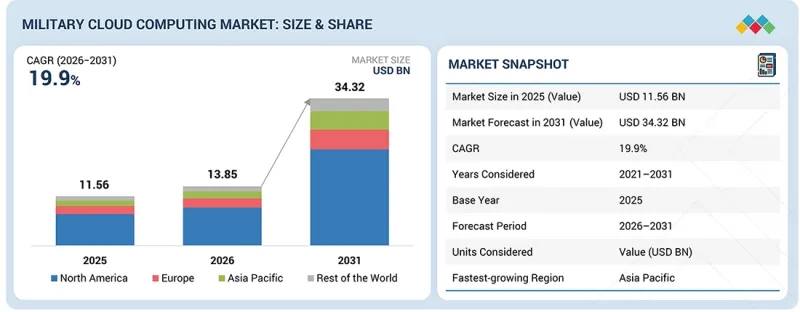
군용 클라우드 컴퓨팅 시장 규모는 2026년 138억 5,000만 달러에서 2031년까지 343억 2,000만 달러로, CAGR 19.9%로 확대할 것으로 예측됩니다.
| 조사 범위 | |
|---|---|
| 조사 대상 기간 | 2020-2031년 |
| 기준연도 | 2025년 |
| 예측 기간 | 2026-2032년 |
| 대상 단위 | 금액(10억 달러) |
| 부문 | 오퍼링별, 배포별, 최종사용자별, 용도별, 지역별 |
| 대상 지역 | 북미, 유럽, 아시아태평양, 기타 지역 |
군사용 클라우드 컴퓨팅 시장은 연결된 군사 네트워크, C2/C4ISR 시스템, 클라우드 플랫폼, 센서, 데이터센터 및 소프트웨어 기반 방위 시스템의 활용 확대에 힘입어 성장하고 있습니다. 이러한 시스템은 사이버 공격의 침입 경로를 늘리므로, 더욱 견고한 네트워크 보안, 엔드포인트 보호, IAM(신원 및 접근 관리), 암호화, 모니터링 및 사이버 테스트가 필요합니다. 또한 국가와 관련된 사이버 위협의 증가, 방위 산업 공급업체에 대한 보안 규정의 강화, 그리고 방위 기관, 군대, 국토안보 부문, 방위 산업 기반 기업 전반에 걸친 기밀 군사 데이터 보호에 대한 수요 역시 시장 성장을 지원하고 있습니다.
“제품 유형별로는 클라우드 서비스 모델 부문이 예측 기간 중 가장 지배적인 부문이 될 것으로 예상됩니다. ” '
방위 기관들이 개별 하드웨어 및 소프트웨어 환경에서 즉시 이용 가능한 클라우드 서비스로 전환함에 따라 클라우드 서비스 모델 부문은 가장 높은 연평균 성장률(CAGR)을 달성할 것으로 예상됩니다. IaaS, PaaS, SaaS는 기지, 기관, 배포처 전반에 걸쳐 미션 크리티컬 애플리케이션의 실행, 데이터 처리, 새로운 툴의 테스트, 워크로드의 신속한 확장을 지원하는 동시에 인프라 재구축의 필요성을 줄여줍니다.
“용도별로는 ISR 데이터 처리·분석 부문이 예측 기간 중 가장 높은 연평균 성장률(CAGR)을 기록할 것으로 예상됩니다. '
ISR 데이터 처리·분석 부문은 예측 기간 중 가장 높은 연평균 성장률(CAGR)을 달성할 것으로 예상됩니다. 이는 군이 항공기, 위성, 드론, 함정, 지상 시스템 등을 통해 더 많은 영상, 이미지, 신호, 센서 데이터를 수집하고 있기 때문입니다. 클라우드 플랫폼은 이러한 데이터의 저장, 처리, 분석을 신속하게 수행하며, 복잡한 작전 상황에서 각 사령부 및 전개 부대 간의 정보 공유, 목표 추적, 임무 계획 수립, 그리고 거의 실시간으로 이루어지는 의사결정을 지원합니다.
“예측 기간 중 북미가 가장 큰 시장 점유율을 차지할 것으로 예상됩니다. ” '
북미는 국방 분야에서의 클라우드 배포이 활발히 진행되고 있으며, 군사 IT 예산도 막대한 데다 정부의 기밀 워크로드나 기밀 정보를 다루는 대규모 프로그램이 존재하므로 예측 기간 중 가장 큰 점유율을 차지할 것으로 예상됩니다. 또한 미국과 캐나다에서는 지휘통제, ISR(정보·감시·정찰), 병참 및 전비 시스템의 현대화가 진행되고 있으며, 국방 분야 사용자 및 정부 기관의 임무 수행에 있으며, 퍼블릭, 프라이빗, 하이브리드 및 전술 엣지 클라우드에 대한 안정적인 수요가 발생하고 있습니다.
마이크로소프트(미국), 제너럴 다이내믹스 코퍼레이션(미국), 레이더스(미국), 액센츄어(아일랜드), 그리고 아마존닷컴(미국)은 군사용 클라우드 컴퓨팅 시장의 주요 기업 중 일부입니다.
조사 범위:
본 조사는 다양한 부문 및 하위 부문에 걸친 군사용 클라우드 컴퓨팅 시장을 대상으로 합니다. 본 조사의 목적은 서로 다른 분야 및 지역에서 해당 시장의 규모와 성장 가능성을 추정하는 것입니다. 또한 본 조사에는 시장의 주요 업체에 대한 상세한 경쟁 분석, 각 기업의 프로필, 제품 및 사업 제공과 관련된 주요 분석 결과, 최근 동향, 그리고 각 기업이 채택하고 있는 주요 시장 전략이 포함되어 있습니다.
이 보고서를 구매해야 하는 이유:
이 보고서는 시장 선도 기업 및 신규 진입 기업을 대상으로, 군사용 클라우드 컴퓨팅 시장 전체의 매출에 관한 가장 정확한 추정치를 제공합니다. 또한 이해관계자들이 경쟁 구도를 파악하고, 자사의 비즈니스를 더 유리한 위치에 놓으며, 적절한 시장 진입 전략을 수립하는 데 필요한 추가적인 인사이트를 얻는 데 도움이 됩니다. 또한 이 보고서는 이해관계자들이 시장 동향을 파악하는 데 도움을 주며, 주요 시장 촉진요인, 제약 요인, 과제 및 기회에 대한 정보를 제공합니다.
마지막으로 이 보고서에서는 다음 사항에 대한 인사이트를 제공합니다. :
- 시장 촉진요인(전장 데이터의 증가로 인해 군이 클라우드 기반 처리로 전환하고 있다는 점, 합동 작전의 증가로 인해 공유형 클라우드 기반 임무 시스템에 대한 수요가 높아지고 있다는 점), 제약 요인(기존 국방 IT 시스템이 클라우드 전환을 지연·복잡하게 만들고 있다는 점, 기밀 취급이 필요한 안전한 클라우드 환경을 구축하기 위해서는 초기 단계에서 막대한 투자가 필요하다는 점), 기회(현장 수준의 클라우드 활용이 전술적인 엣지 솔루션에 대한 새로운 수요를 창출하고 있는 점, 승인된 국방용 소프트웨어 플랫폼이 새로운 클라우드 매출 경로를 창출하고 있는 점), 과제(군사용 클라우드 시스템이 첨단 사이버 공격에 노출될 위험에 직면해 있다는 점, 기밀 취급이 필요한 클라우드 인력이 부족하여 안전한 도입 및 운영이 지연되고 있다는 점)
- 시장 침투도: 시장을 선도하는 주요 기업이 제공하는 군사용 클라우드 컴퓨팅 솔루션에 대한 포괄적인 정보
- 제품 개발 및 혁신: 군사용 클라우드 컴퓨팅 시장의 향후 기술, 연구개발 활동 및 제품 출시에 대한 심층적인 인사이트
- 시장 개발: 다양한 지역의 수익성이 높은 시장에 대한 포괄적인 정보
- 시장의 다양화: 군사용 클라우드 컴퓨팅 시장의 신제품, 미개발 지역, 최근 동향 및 투자에 관한 포괄적인 정보
- 경쟁사 분석: 군사용 클라우드 컴퓨팅 시장 주요 기업의 시장 점유율, 성장 전략, 제품 및 생산 능력에 대한 상세한 평가
목차
제1장 서론
제2장 개요
제3장 주요 인사이트
제4장 시장 개요
제5장 업계 동향
제6장 기술 진보, AI에 의한 영향, 특허, 혁신, 향후 응용
제7장 지속가능성과 규제 상황
제8장 고객 상황과 구매 행동
제9장 군용 클라우드 컴퓨팅 시장(오퍼링별)
제10장 군용 클라우드 컴퓨팅 시장(배포별)
제11장 군용 클라우드 컴퓨팅 시장(최종사용자별)
제12장 군용 클라우드 컴퓨팅 시장(용도별)
제13장 군용 클라우드 컴퓨팅 시장(지역별)
제14장 경쟁 구도
제15장 기업 개요
제16장 조사 방법
제17장 부록
KSAThe military cloud computing market is projected to grow from USD 13.85 billion in 2026 to USD 34.32 billion by 2031 at a CAGR of 19.9%.
| Scope of the Report | |
|---|---|
| Years Considered for the Study | 2020-2031 |
| Base Year | 2025 |
| Forecast Period | 2026-2032 |
| Units Considered | Value (USD Billion) |
| Segments | By Offering, Deployment, Application and Region |
| Regions covered | North America, Europe, APAC, RoW |
The military cloud computing market is driven by the growing use of connected military networks, C2/C4ISR systems, cloud platforms, sensors, data centers and software-based defense systems. These systems create more entry points for cyberattacks and require stronger network security, endpoint protection, IAM, encryption, monitoring and cyber testing. Growth is also supported by rising state-linked cyber threats, stricter defense supplier security rules and the need to protect sensitive military data across defense agencies, armed forces, homeland security units and defense industrial base companies.
"By offering, the cloud service model segment is expected to be the most dominant segment during the forecast period."
The cloud service model segment is expected to achieve the highest CAGR because defense agencies are shifting from separate hardware and software setups to ready cloud services. IaaS, PaaS and SaaS help them run mission apps, process data, test new tools and scale workloads faster across bases, agencies and deployed locations, while reducing the need for repeated infrastructure builds.
"By application, the ISR data processing and analytics segment is expected to register the highest CAGR during the forecast period."
The ISR data processing and analytics segment is expected to achieve the highest CAGR during the forecast period because militaries are collecting more video, imagery, signals and sensor data from aircraft, satellites, drones, ships and ground systems. Cloud platforms help store, process, and analyze this data faster, supporting intelligence sharing, target tracking, mission planning, and near-real-time decisions across commands and deployed forces in complex operations.
"North America is expected to account for the largest market share during the forecast period."
North America is expected to account for the largest share during the forecast period because the region has strong defense cloud adoption, high military IT budgets, and large programs for secure government and classified workloads. The US and Canada are also modernizing command, ISR, logistics and readiness systems, creating steady demand for public, private, hybrid and tactical edge cloud across defense users and agencies' missions.
Microsoft (US), General Dynamics Corporation (US), Leidos (US), Accenture (Ireland), and Amazon.com, Inc (US) are some of the key players in the military cloud computing market.
The breakdown of profiles for primary participants in the military cloud computing market is provided below:
- By Company Type: Tier 1 - 40%, Tier 2 - 30%, and Tier 3 - 30%
- By Designation: Directors - 20%, C-level Executives - 10%, and Others (Managers and Other Non-C-level Executives) - 70%
- By Region: Asia Pacific - 40%, Europe - 20%, North America - 20%, RoW - 20%
Research Coverage:
This study covers the military cloud computing market across various segments and subsegments. It aims to estimate the size and growth potential of this market across different parts and regions. Additionally, this study includes an in-depth competitive analysis of key players in the market, their company profiles, key observations on their products and business offerings, recent developments, and the key market strategies they have adopted.
Reasons to Buy This Report:
The report will help market leaders/new entrants with information on the closest approximations of revenue for the overall military cloud computing market. It will also help stakeholders understand the competitive landscape and gain more insights to position their businesses better and plan suitable go-to-market strategies. Moreover, the report will help stakeholders understand the market pulse and will provide information on key market drivers, restraints, challenges, and opportunities.
Lastly, the report provides insights into the following pointers:
- Market Drivers (Growing battlefield data volumes pushing militaries toward cloud-based processing, joint operations increasing the need for shared cloud-based mission systems), Restraints (Old defense IT systems making cloud transition slow and complex, secure classified cloud setups requiring heavy early investment), Opportunities (Field-level cloud use opening new demand for tactical edge solutions, approved defense software platforms creating new cloud revenue paths), Challenges (Military cloud systems facing higher exposure to advanced cyberattacks, limited cleared cloud talent delaying secure deployment and operations)
- Market Penetration: Comprehensive information on military cloud computing solutions offered by the top players in the market
- Product Development/Innovation: Detailed insights on upcoming technologies, research & development activities, and product launches in the military cloud computing market
- Market Development: Comprehensive information about lucrative markets across varied regions
- Market Diversification: Exhaustive information about new products, untapped geographies, recent developments, and investments in the military cloud computing market
- Competitive Assessment: In-depth assessment of market share, growth strategies, products, and manufacturing capabilities of leading players in the military cloud computing market
TABLE OF CONTENTS
1 INTRODUCTION
- 1.1 STUDY OBJECTIVES
- 1.2 MARKET DEFINITION
- 1.3 STUDY SCOPE
- 1.3.1 MARKET SEGMENTATION & REGIONAL SNAPSHOT
- 1.3.2 INCLUSIONS & EXCLUSIONS
- 1.4 YEARS CONSIDERED
- 1.5 CURRENCY CONSIDERED
- 1.6 STAKEHOLDERS
- 1.7 SUMMARY OF CHANGES
2 EXECUTIVE SUMMARY
- 2.1 KEY INSIGHTS & MARKET HIGHLIGHTS
- 2.2 KEY MARKET PARTICIPANTS: MAPPING OF STRATEGIC DEVELOPMENTS
- 2.3 DISRUPTIVE TRENDS IN MILITARY CLOUD COMPUTING MARKET
- 2.4 HIGH GROWTH SEGMENTS
- 2.5 REGIONAL SNAPSHOT: MARKET SIZE, GROWTH RATE, AND FORECAST
3 PREMIUM INSIGHTS
- 3.1 ATTRACTIVE OPPORTUNITIES FOR PLAYERS IN MILITARY CLOUD COMPUTING MARKET
- 3.2 MILITARY CLOUD COMPUTING MARKET, BY DEPLOYMENT
- 3.3 MILITARY CLOUD COMPUTING MARKET, BY CLOUD SERVICE MODEL
- 3.4 MILITARY CLOUD COMPUTING MARKET, BY END USER
- 3.5 MILITARY CLOUD COMPUTING MARKET, BY APPLICATION
4 MARKET OVERVIEW
- 4.1 INTRODUCTION
- 4.2 MARKET DYNAMICS
- 4.2.1 DRIVERS
- 4.2.1.1 Exponential surge in tactical sensor data
- 4.2.1.2 Cross-domain military interoperability requirements
- 4.2.1.3 Maturation of specialized defense cloud vendors
- 4.2.2 RESTRAINTS
- 4.2.2.1 Legacy infrastructure and cultural inertia
- 4.2.2.2 High initial capital expenditure for classified implementations
- 4.2.3 OPPORTUNITIES
- 4.2.3.1 Tactical cloud at tactical edge
- 4.2.3.2 Proliferation of defense-specific SaaS marketplaces
- 4.2.4 CHALLENGES
- 4.2.4.1 Vulnerability to sophisticated state-sponsored cyber threats
- 4.2.4.2 Severe shortage of cleared cloud-native engineering talent
- 4.2.1 DRIVERS
- 4.3 UNMET NEEDS AND WHITE SPACES IN MILITARY CLOUD COMPUTING MARKET
- 4.4 INTER-CONNECTED MARKETS AND CROSS-SECTOR OPPORTUNITIES
- 4.5 STRATEGIC MOVES BY TIER 1/2/3 PLAYERS
- 4.5.1 STRATEGIC MOVES BY TIER 1, 2, AND 3 PLAYERS
5 INDUSTRY TRENDS
- 5.1 INTRODUCTION
- 5.2 MACROECONOMIC OUTLOOK
- 5.2.1 INTRODUCTION
- 5.2.2 GDP TRENDS AND FORECAST
- 5.2.3 TRENDS IN MILITARY CLOUD COMPUTING MARKET
- 5.3 VALUE CHAIN ANALYSIS
- 5.4 ECOSYSTEM ANALYSIS
- 5.5 KEY CONFERENCES & EVENTS, 2026-2027
- 5.6 TRENDS & DISRUPTIONS IMPACTING CUSTOMER BUSINESS
- 5.7 INVESTMENT & FUNDING SCENARIO
- 5.8 PRICING ANALYSIS
- 5.9 AVERAGE SELLING PRICE OF MILITARY CLOUD COMPUTING, BY OFFERING, 2021-2025 (USD MILLION)
- 5.10 AVERAGE SELLING PRICE OF MILITARY CLOUD COMPUTING, BY REGION, 2025 (USD MILLION)
- 5.11 OPERATIONAL DATA
- 5.12 CASE STUDIES
- 5.12.1 CASE STUDY 1: CENTER FOR NAVAL ANALYSES PARTNERED WITH MICROSOFT TO DEPLOY SECURE GENERATIVE AI IN HIGH-COMPLIANCE FOOTPRINTS
- 5.12.2 CASE STUDY 2: US AIR FORCE PARTNERED WITH AWS TO EXECUTE AUTOMATED REFACTORING OF A MISSION-CRITICAL MAINFRAME
- 5.12.3 CASE STUDY 3: JOINT COMMANDS IMPLEMENTED ORACLE ROVING EDGE INFRASTRUCTURE TO UNIFY DISCONNECTED OPERATIONS
- 5.12.4 BUSINESS MODELS
- 5.12.5 CONSUMPTION-BASED SUBSCRIPTION (IAAS / PAAS) MODEL
- 5.12.6 RUGGEDIZED COMPUTE-AS-A-SERVICE (HARDWARE-AS-A-SERVICE) MODEL
- 5.12.7 SOVEREIGN CLOUD / AIR-GAPPED PRIVATE HOSTING MODALITY MODEL
6 TECHNOLOGICAL ADVANCEMENTS, AI-DRIVEN IMPACT, PATENTS, INNOVATIONS, AND FUTURE APPLICATIONS
- 6.1 KEY TECHNOLOGIES
- 6.1.1 NEUROMORPHIC EDGE COMPUTE SUBSTRATES
- 6.1.2 MULTI-AGENT LOGICAL ORCHESTRATION
- 6.1.3 POST-QUANTUM CRYPTOGRAPHIC PROTOCOLS
- 6.2 COMPLEMENTARY TECHNOLOGIES
- 6.2.1 CLOUD-NATIVE C4ISR PLATFORMS
- 6.2.2 ZERO TRUST FEDERATED IDENTITY AND ACCESS MANAGEMENT
- 6.2.3 TACTICAL MISSION FABRICS AND SOFTWARE-DEFINED ROUTING
- 6.3 ADJACENT TECHNOLOGIES
- 6.3.1 LIVE, VIRTUAL, AND CONSTRUCTIVE (LVC) SYNTHETIC SIMULATION
- 6.3.2 NON-TERRESTRIAL NETWORK LEO SATELLITE CONSTELLATIONS
- 6.3.3 DATA CENTER BIOMETRIC AND PHYSICAL ACCESS CONTROL
- 6.4 TECHNOLOGY ROADMAP
- 6.5 IMPACT OF AI/ GENERATIVE AI
- 6.5.1 TOP USE CASES AND MARKET POTENTIAL
- 6.5.2 BEST PRACTICES
- 6.5.3 CASE STUDIES OF AI IMPLEMENTATION
- 6.5.4 INTERCONNECTED ECOSYSTEM AND IMPACT ON MARKET PLAYERS
- 6.5.5 CLIENTS' READINESS TO ADOPT GENERATIVE AI
- 6.6 PATENT ANALYSIS
- 6.7 FUTURE APPLICATIONS
- 6.8 SUCCESS STORIES AND REAL-WORLD APPLICATIONS
- 6.8.1 AMAZON: SECURE MILITARY DATA MANAGEMENT THROUGH AWS GOVCLOUD
- 6.8.2 MICROSOFT CORPORATION: AZURE GOVERNMENT FOR DEFENSE OPERATIONS AND DECISION SUPPORT
- 6.8.3 GOOGLE: AI-ENABLED MILITARY CLOUD ANALYTICS AND DEFENSE DATA PROCESSING
7 SUSTAINABILITY AND REGULATORY LANDSCAPE
- 7.1 REGIONAL REGULATIONS AND COMPLIANCE
- 7.1.1 REGULATORY BODIES, GOVERNMENT AGENCIES, AND OTHER ORGANIZATIONS
- 7.2 REGULATORY FRAMEWORK
- 7.3 INDUSTRY STANDARDS
- 7.4 SUSTAINABILITY INITIATIVES
- 7.4.1 CARBON IMPACT AND ECO-APPLICATIONS OF GRAPHENE
8 CUSTOMER LANDSCAPE & BUYER BEHAVIOR
- 8.1 DECISION-MAKING PROCESS
- 8.2 BUYERS, STAKEHOLDERS, AND BUYING EVALUATION CRITERIA
- 8.2.1 KEY STAKEHOLDERS IN BUYING PROCESS
- 8.2.2 BUYING CRITERIA
- 8.3 ADOPTION BARRIERS & INTERNAL CHALLENGES
- 8.4 UNMET NEEDS FROM VARIOUS END-USE INDUSTRIES
9 MILITARY CLOUD COMPUTING MARKET, BY OFFERING
- 9.1 INTRODUCTION
- 9.2 CLOUD SERVICE MODELS
- 9.2.1 FOUNDATIONAL FRAMEWORK THAT CATEGORIZES COMPUTING RESOURCES INTO THREE DISTINCT, LAYERED DELIVERY METHODS
- 9.2.2 INFRASTRUCTURE AS A SERVICE
- 9.2.2.1 Compute service
- 9.2.2.2 Storage, backup, and disaster recovery
- 9.2.2.3 Network and connectivity services
- 9.2.3 PLATFORM AS A SERVICE
- 9.2.3.1 Database and data management platform
- 9.2.3.2 Container and Kubernetes platforms
- 9.2.3.3 Middleware and API management platforms
- 9.2.3.4 DevSecOps and application development platforms
- 9.2.3.5 Artificial intelligence and machine learning development platforms
- 9.2.4 SOFTWARE AS A SERVICE
- 9.2.4.1 Productivity and collaboration software
- 9.2.4.2 Enterprise resource planning and business applications
- 9.2.4.3 Logistics and maintenance applications
- 9.2.4.4 Mission and command applications
- 9.2.4.5 Analytics and data visualization applications
- 9.3 CLOUD MIGRATION AND MODERNIZATION SERVICE
- 9.3.1 OPERATIONAL MANDATE TO TRANSFER LEGACY COMMAND ARCHITECTURES INTO SECURE, MULTI-TENANT DIGITAL ENVIRONMENTS TO DRIVE SEGMENTAL GROWTH
- 9.3.2 CLOUD READINESS ASSESSMENT
- 9.3.3 APPLICATION RATIONALIZATION
- 9.3.4 REHOSTING AND REPLATFORMING
- 9.3.5 APPLICATION REFACTORING AND MODERNIZATION
- 9.3.6 DATA MIGRATION SERVICE
- 9.4 CLOUD INTEGRATION AND ENGINEERING SERVICES
- 9.4.1 STRUCTURAL REQUIREMENT TO ESTABLISH UNIFORM OPERATIONAL CONTINUITY ACROSS HIGHLY FRAGMENTED IT ENVIRONMENTS TO DRIVE SEGMENTAL GROWTH
- 9.4.2 CLOUD ARCHITECTURE AND DESIGN
- 9.4.3 LEGACY SYSTEM INTEGRATION
- 9.4.4 API AND DATA INTEGRATION
- 9.4.5 MULTI CLOUD AND HYBRID CLOUD INTEGRATION
- 9.4.6 MISSION SYSTEM INTEGRATION
- 9.5 MANAGED CLOUD OPERATIONS
- 9.5.1 OPERATIONAL NECESSITY TO MAINTAIN STRICT, NON-NEGOTIABLE COMPLIANCE BOUNDARIES AND UNIFIED GOVERNANCE ACROSS SPRAWLING SOFTWARE LANDSCAPES TO DRIVE SEGMENTAL GROWTH
- 9.5.2 CLOUD MONITORING AND ADMINISTRATION
- 9.5.3 WORKLOAD PERFORMANCE MANAGEMENT
- 9.5.4 CLOUD SERVICE DESK AND SUPPORT
- 9.5.5 AVAILABILITY AND RELIABILITY MANAGEMENT
- 9.5.6 MANAGED MULTI-CLOUD OPERATION
- 9.6 CLOUD SECURITY, COMPLIANCE, AND AUTHORIZATION SERVICES
- 9.6.1 OPERATIONAL MANDATE TO SAFEGUARD HIGHLY CLASSIFIED DATA WHILE TRANSITIONING LEGACY SYSTEMS INTO DISTRIBUTED ENVIRONMENTS TO DRIVE SEGMENTAL GROWTH
- 9.6.2 CLOUD SECURITY ARCHITECTURE
- 9.6.3 IDENTITY, ACCESS, AND PRIVILEGE MANAGEMENT FOR CLOUD
- 9.6.4 ENCRYPTION AND KEY MANAGEMENT
- 9.6.5 LOGGING, MONITORING, AND AUDIT READINESS
- 9.6.6 AUTHORIZATION TO OPERATE AND COMPLIANCE SUPPORT
- 9.6.7 ZERO TRUST ALIGNMENT FOR CLOUD ENVIRONMENT
- 9.7 CLOUD COST MANAGEMENT AND GOVERNANCE, FINOPS
- 9.7.1 STRUCTURAL REQUIREMENT TO TRANSITION FROM FIXED, PREDICTABLE CAPEX BUDGETING MODELS TO HIGHLY VARIABLE OPEX FRAMEWORKS TO DRIVE SEGMENTAL GROWTH
- 9.7.2 CLOUD SPEND MONITORING
- 9.7.3 USAGE AND COST OPTIMIZATION
- 9.7.4 CHARGEBACK AND SHOWBACK MODELS
- 9.7.5 CLOUD PROCUREMENT GOVERNANCE
- 9.7.6 LICENSE AND SUBSCRIPTION OPTIMIZATION
10 MILITARY CLOUD COMPUTING MARKET, BY DEPLOYMENT
- 10.1 INTRODUCTION
- 10.2 PUBLIC CLOUD
- 10.2.1 OPERATIONAL DEMAND FOR ADVANCED ARTIFICIAL INTELLIGENCE, MACHINE LEARNING, AND RAPID DEVSECOPS DEPLOYMENT PIPELINES TO DRIVE SEGMENTAL GROWTH
- 10.3 PRIVATE CLOUD
- 10.3.1 HEAVY FUNDING FOR TACTICAL EDGE COMPUTING AND DECENTRALIZED BATTLEFIELD RESILIENCE TO DRIVE SEGMENTAL GROWTH
- 10.4 HYBRID CLOUD
- 10.4.1 CRITICAL DEMAND FOR TACTICAL EDGE CONTINUITY IN CONTESTED ELECTRONIC ENVIRONMENTS TO DRIVE SEGMENTAL GROWTH
- 10.5 TACTICAL EDGE CLOUD
- 10.5.1 CRITICAL REQUIREMENT TO OVERCOME SEVERE BANDWIDTH CONSTRAINTS TO DRIVE SEGMENTAL GROWTH
11 MILITARY CLOUD COMPUTING MARKET BY END USER
- 11.1 INTRODUCTION
- 11.2 LAND
- 11.2.1 STRUCTURAL REQUIREMENT TO PROCESS EXPLOSIVE VOLUMES OF DATA DIRECTLY AT THE FRONTLINE TO DRIVE SEGMENTAL GROWTH
- 11.3 NAVAL
- 11.3.1 MAJOR FLEET MODERNIZATION INITIATIVES TO DRIVE SEGMENTAL GROWTH
- 11.4 AIR
- 11.4.1 CRITICAL DEMAND TO FIELD AUTONOMOUS AND COLLABORATIVE COMBAT AIRCRAFT ALONGSIDE TRADITIONAL HUMAN-PILOTED FORMATIONS TO DRIVE SEGMENTAL GROWTH
- 11.5 SPACE
- 11.5.1 CRITICAL DEMAND TO RUN COMPLEX ARTIFICIAL INTELLIGENCE MODELS AND DYNAMIC SOFTWARE MODIFICATIONS DIRECTLY ON-ORBIT TO DRIVE SEGMENTAL GROWTH
- 11.6 OTHER DEFENSE AGENCIES
12 MILITARY CLOUD COMPUTING MARKET, BY APPLICATION
- 12.1 INTRODUCTION
- 12.2 COMMAND CONTROL AND MISSION APPLICATIONS
- 12.2.1 OPERATIONAL MANDATE TO EXECUTE REAL-TIME SENSOR FUSION AND ACCELERATE THE TARGET-ENGAGEMENT LOOP ACROSS CONTESTED, MULTI-DOMAIN ENVIRONMENTS TO DRIVE SEGMENTAL GROWTH
- 12.3 ISR DATA PROCESSING AND ANALYTICS
- 12.3.1 URGENT OPERATIONAL MANDATE TO MANAGE EXPONENTIAL INFLUX OF UNSTRUCTURED SENSOR DATA TO DRIVE SEGMENTAL GROWTH
- 12.4 LOGISTICS, MAINTENANCE, AND READINESS MANAGEMENT
- 12.4.1 OPERATIONAL MANDATE TO TRANSITION FROM LEGACY, SCHEDULED MAINTENANCE CYCLES TO DATA-DRIVEN, PREDICTIVE SUSTAINMENT MODELS TO DRIVE SEGMENTAL GROWTH
- 12.5 TRAINING, SIMULATION, AND DIGITAL ENGINEERING
- 12.5.1 OPERATIONAL REQUIREMENT TO RUN COMPLEX, HYPER-REALISTIC VIRTUAL ENVIRONMENTS AND BUILD COLLABORATIVE DEVELOPMENT PIPELINES TO DRIVE SEGMENTAL GROWTH
- 12.6 OTHERS
13 MILITARY CLOUD COMPUTING MARKET, BY REGION
- 13.1 INTRODUCTION
- 13.2 NORTH AMERICA
- 13.2.1 US
- 13.2.1.1 Scalable procurement frameworks and algorithmic modernization to drive market
- 13.2.2 CANADA
- 13.2.2.1 Sovereign data governance and strict cross-border allied alignment to drive market
- 13.2.1 US
- 13.3 EUROPE
- 13.3.1 UK
- 13.3.1.1 Substantial financial capital to pioneer advanced digital capabilities, secure networks, and data analytics to drive market
- 13.3.2 FRANCE
- 13.3.2.1 SecNumCloud standardization and high-sovereignty joint ventures to drive market
- 13.3.3 GERMANY
- 13.3.3.1 Air-gapped hyperscale implementations and localized PaaS alliances to drive market
- 13.3.4 ITALY
- 13.3.4.1 Multi-tier sovereignty categorization and orbital edge experiments to drive market
- 13.3.5 SPAIN
- 13.3.5.1 Industrial digitization protocols and consolidated data spaces to drive military cloud adoption
- 13.3.6 REST OF EUROPE
- 13.3.1 UK
- 13.4 ASIA PACIFIC
- 13.4.1 INDIA
- 13.4.1.1 Multi-domain tri-service conversion and sovereign data center investments to drive market
- 13.4.2 JAPAN
- 13.4.2.1 Bilateral allied interoperability and active cyber defense mandates to drive market
- 13.4.3 SOUTH KOREA
- 13.4.3.1 Sovereign foundation alliances to drive market
- 13.4.4 AUSTRALIA
- 13.4.4.1 Interoperability standardization and top-secret sovereignty mandates to drive market
- 13.4.5 REST OF ASIA PACIFIC
- 13.4.1 INDIA
- 13.5 REST OF THE WORLD
- 13.5.1 MIDDLE EAST & AFRICA
- 13.5.1.1 Cross-border interoperability frameworks and autonomous cyber factories to drive market
- 13.5.2 LATIN AMERICA
- 13.5.2.1 Border surveillance frameworks and transnational cyber defense drills to drive market
- 13.5.1 MIDDLE EAST & AFRICA
14 COMPETITIVE LANDSCAPE
- 14.1 INTRODUCTION
- 14.2 KEY PLAYER STRATEGIES/RIGHT TO WIN, 2022-2025
- 14.3 REVENUE ANALYSIS, 2021-2025
- 14.4 MARKET SHARE ANALYSIS, 2025
- 14.5 BRAND/PRODUCT COMPARISON
- 14.6 COMPANY VALUATION AND FINANCIAL METRICS
- 14.7 COMPANY EVALUATION MATRIX: KEY PLAYERS, 2025
- 14.7.1 STARS
- 14.7.2 EMERGING LEADERS
- 14.7.3 PERVASIVE PLAYERS
- 14.7.4 PARTICIPANTS
- 14.7.5 COMPANY FOOTPRINT
- 14.7.5.1 Company footprint
- 14.7.5.2 Region footprint
- 14.7.5.3 End user footprint
- 14.7.5.4 Application footprint
- 14.7.5.5 Deployment footprint
- 14.8 COMPANY EVALUATION MATRIX: STARTUPS/SMES, 2025
- 14.8.1 PROGRESSIVE COMPANIES
- 14.8.2 RESPONSIVE COMPANIES
- 14.8.3 DYNAMIC COMPANIES
- 14.8.4 STARTING BLOCKS
- 14.8.5 COMPETITIVE BENCHMARKING
- 14.8.5.1 List of startups/SMEs
- 14.8.5.2 Competitive benchmarking of startups/SMEs
- 14.9 COMPETITIVE SCENARIO
- 14.9.1 PRODUCT LAUNCHES/ENHANCEMENTS
- 14.9.2 DEALS
- 14.9.3 EXPANSIONS
- 14.9.4 OTHER DEVELOPMENTS
15 COMPANY PROFILES
- 15.1 KEY PLAYERS
- 15.1.1 AMAZON.COM, INC.
- 15.1.1.1 Business overview
- 15.1.1.2 Products/Solutions/Services offered
- 15.1.1.3 Recent developments
- 15.1.1.3.1 Product launches
- 15.1.1.3.2 Other developments
- 15.1.1.4 MnM view
- 15.1.1.4.1 Right to win
- 15.1.1.4.2 Strategic choices
- 15.1.1.4.3 Weaknesses and competitive threats
- 15.1.2 MICROSOFT
- 15.1.2.1 Business overview
- 15.1.2.2 Products/Solutions/Services offered
- 15.1.2.3 Recent developments
- 15.1.2.3.1 Product launches
- 15.1.2.3.2 Deals
- 15.1.2.3.3 Other developments
- 15.1.2.4 MnM view
- 15.1.2.4.1 Right to win
- 15.1.2.4.2 Strategic choices
- 15.1.2.4.3 Weaknesses and competitive threats
- 15.1.3 LEIDOS
- 15.1.3.1 Business overview
- 15.1.3.2 Products/Solutions/Services offered
- 15.1.3.3 Recent developments
- 15.1.3.3.1 Other developments
- 15.1.3.4 MnM view
- 15.1.3.4.1 Right to win
- 15.1.3.4.2 Strategic choices
- 15.1.3.4.3 Weaknesses and competitive threats
- 15.1.4 GENERAL DYNAMICS CORPORATION
- 15.1.4.1 Business overview
- 15.1.4.2 Products/Solutions/Services offered
- 15.1.4.3 Recent developments
- 15.1.4.3.1 Deals
- 15.1.4.3.2 Other developments
- 15.1.4.4 MnM view
- 15.1.4.4.1 Right to win
- 15.1.4.4.2 Strategic choices
- 15.1.4.4.3 Weaknesses and competitive threats
- 15.1.5 ACCENTURE
- 15.1.5.1 Business overview
- 15.1.5.2 Products/Solutions/Services offered
- 15.1.5.3 Recent developments
- 15.1.5.3.1 Deals
- 15.1.5.3.2 Other developments
- 15.1.5.4 MnM view
- 15.1.5.4.1 Right to win
- 15.1.5.4.2 Strategic choices
- 15.1.5.4.3 Weaknesses and competitive threats
- 15.1.6 GOOGLE LLC
- 15.1.6.1 Business overview
- 15.1.6.2 Products offered
- 15.1.6.3 Recent developments
- 15.1.6.3.1 Product launches
- 15.1.6.3.2 Deals
- 15.1.6.3.3 Other developments
- 15.1.7 ORACLE
- 15.1.7.1 Business overview
- 15.1.7.2 Products/Solutions/Services offered
- 15.1.7.3 Recent developments
- 15.1.7.3.1 Product launches
- 15.1.7.3.2 Deals
- 15.1.7.3.3 Other developments
- 15.1.8 DELL INC.
- 15.1.8.1 Business overview
- 15.1.8.2 Products/Solutions/Services offered
- 15.1.8.3 Recent developments
- 15.1.8.3.1 Other developments
- 15.1.9 THALES
- 15.1.9.1 Business overview
- 15.1.9.2 Products/Solutions/Services offered
- 15.1.9.3 Recent developments
- 15.1.9.3.1 Product launches
- 15.1.9.3.2 Deals
- 15.1.9.3.3 Other developments
- 15.1.10 CISCO SYSTEMS, INC.
- 15.1.10.1 Business overview
- 15.1.10.2 Products/Solutions/Services offered
- 15.1.10.3 Recent developments
- 15.1.10.3.1 Product launches
- 15.1.10.3.2 Other developments
- 15.1.11 IBM
- 15.1.11.1 Business overview
- 15.1.11.2 Products/Solutions/Services offered
- 15.1.11.2.1 Deals
- 15.1.11.2.2 Other developments
- 15.1.12 ATOS SE
- 15.1.12.1 Business overview
- 15.1.12.2 Products/Solutions/Services offered
- 15.1.13 BAE SYSTEMS
- 15.1.13.1 Business overview
- 15.1.13.2 Products/Solutions/Services offered
- 15.1.13.3 Recent developments
- 15.1.13.3.1 Deals
- 15.1.13.3.2 Other developments
- 15.1.14 RTX
- 15.1.14.1 Business overview
- 15.1.14.2 Products/Solutions/Services offered
- 15.1.14.3 Recent developments
- 15.1.14.3.1 Deals
- 15.1.15 SALESFORCE, INC.
- 15.1.15.1 Business overview
- 15.1.15.2 Products/Solutions/Services offered
- 15.1.15.3 Recent developments
- 15.1.15.3.1 Product launches
- 15.1.15.3.2 Other developments
- 15.1.16 CAPGEMINI
- 15.1.16.1 Business overview
- 15.1.16.2 Products/Solutions/Services offered
- 15.1.16.2.1 Other developments
- 15.1.17 SAIC
- 15.1.17.1 Business overview
- 15.1.17.2 Products/Solutions/Services offered
- 15.1.17.2.1 Other developments
- 15.1.18 BOOZ ALLEN HAMILTON INC.
- 15.1.18.1 Business overview
- 15.1.18.2 Products/Solutions/Services offered
- 15.1.18.3 Recent developments
- 15.1.18.3.1 Deals
- 15.1.18.3.2 Other developments
- 15.1.19 PALANTIR TECHNOLOGIES INC.
- 15.1.19.1 Business overview
- 15.1.19.2 Products/Solutions/Services offered
- 15.1.19.3 Recent developments
- 15.1.19.3.1 Product launches
- 15.1.19.3.2 Deals
- 15.1.19.3.3 Other developments
- 15.1.1 AMAZON.COM, INC.
- 15.2 OTHER PLAYERS
- 15.2.1 CGI INC.
- 15.2.2 DXC TECHNOLOGY COMPANY
- 15.2.3 HADEAN
- 15.2.4 PERATON
- 15.2.5 SMX
- 15.2.6 WIND RIVER
16 RESEARCH METHODOLOGY
- 16.1 RESEARCH DATA
- 16.1.1 SECONDARY DATA
- 16.1.1.1 Key data from secondary sources
- 16.1.2 PRIMARY DATA
- 16.1.2.1 Primary interview participants
- 16.1.2.2 Key data from primary sources
- 16.1.2.3 Breakdown of primary interviews
- 16.1.2.4 Insights from industry experts
- 16.1.1 SECONDARY DATA
- 16.2 FACTOR ANALYSIS
- 16.2.1 MACRO AND MICRO-INDICATORS ANALYZED
- 16.2.2 COUNTRY SELECTION HEATMAP
- 16.2.3 COMPANY SELECTION HEATMAP
- 16.3 MARKET SIZE ESTIMATION
- 16.3.1 BOTTOM-UP APPROACH
- 16.3.1.1 Market size estimation methodology
- 16.3.2 TOP-DOWN APPROACH
- 16.3.3 MARKET FORECAST APPROACH
- 16.3.3.1 Supply side
- 16.3.3.2 Demand side
- 16.3.1 BOTTOM-UP APPROACH
- 16.4 DATA TRIANGULATION
- 16.5 RESEARCH ASSUMPTIONS
- 16.6 RESEARCH LIMITATIONS
- 16.7 RISK ASSESSMENT
17 APPENDIX
- 17.1 DISCUSSION GUIDE
- 17.2 KNOWLEDGESTORE: MARKETSANDMARKETS' SUBSCRIPTION PORTAL
- 17.3 CUSTOMIZATION OPTIONS
- 17.4 RELATED REPORTS
- 17.5 AUTHOR DETAILS