|
시장보고서
상품코드
2074464
스마트 교통 시장(-2032년) : 교통 모드별(도로, 철도, 항공, 해운), 최종사용자별(정부, 민간기업)Smart Transportation Market by Transportation Mode (Roadways, Railways, Airways, Maritime), By End User (Government, Commercial Organizations) - Global Forecast to 2032 |
||||||

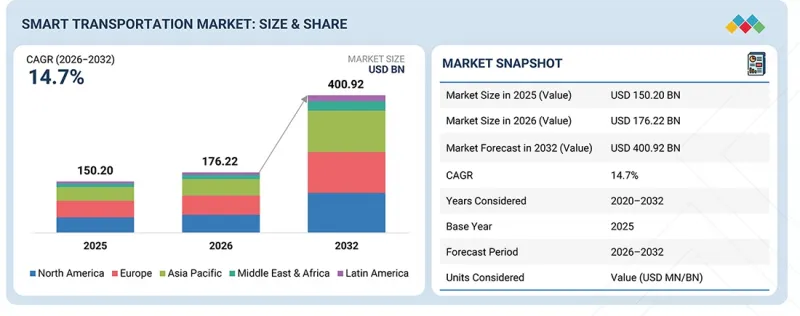
스마트 교통 시장 규모는 2026년 1,762억 2,000만 달러에서 2032년에는 4,009억 2,000만 달러에 이르며 CAGR 14.7%로 확대될 것으로 예측됩니다.
디지털 전환의 시대를 맞이하여, 다양한 업계의 기업들이 AI, IoT, 빅데이터와 같은 최첨단 기술을 통합하여 업무 효율을 높이고 고객 경험을 개선하고 있습니다.
| 조사 범위 | |
|---|---|
| 조사 대상 기간 | `2020-2032년 |
| 기준연도 | 2025년 |
| 예측 기간 | 2026-2032년 |
| 단위 | 금액(달러) |
| 부문 | 교통 모드, 최종사용자, 지역별 |
| 대상 지역 | 북미, 유럽, 아시아태평양, 중동 및 아프리카, 라틴아메리카 |
또한, 정부와 기관들이 교통 관리 최적화, 교통 체증 완화, 안전성 향상에 주력함에 따라 더욱 스마트한 교통 솔루션에 대한 수요가 급증하고 있습니다. 이러한 진전에 따라 도로, 철도, 항공 분야의 스마트 교통 기술 도입이 촉진되어, 전 세계적으로 더욱 지속 가능하고 효율적인 교통 시스템이 구축될 것으로 예측됩니다.
“도로 분야에서는 예측 기간 동안 교통 관리 솔루션이 가장 큰 시장 규모를 차지할 것으로 예측됩니다.”
교통 관리 솔루션은 특히 도시 환경에서 도로망의 효율성과 안전성을 높이기 위해 필수적인 요소입니다. 이러한 기술들은 AI, 머신러닝, IoT 센서, 빅데이터 분석 등의 첨단 기술을 활용하여 교통 흐름을 최적화합니다. 이러한 시스템은 실시간 교통 상황을 모니터링하고, 신호등 타이밍을 관리하며, 교통 체증을 예측하고, 병목 현상을 완화하기 위한 해결책을 제공합니다. 교통 모니터링 및 제어를 자동화함으로써, 이러한 시스템은 지연과 오염을 줄이고 이동 시간을 단축하며, 보다 지속 가능한 도시 이동성 실현에 기여합니다. 예를 들어, Siemens Mobility의 교통 관리 솔루션은 이러한 첨단 기술을 통합하여 신호를 동적으로 조정하고, 대중교통 차량을 관리하며, 전반적인 교통 효율을 향상시킴으로써 전 세계 도시에서 보다 원활한 출퇴근 및 이동을 실현하고 있습니다.
“철도 분야에서는 예측 기간 동안 여객 정보 솔루션이 가장 높은 성장률을 보일 것으로 전망됩니다.”
승객 정보 솔루션은 승객에게 실시간으로 유용한 데이터를 제공하여, 승객이 충분한 정보를 바탕으로 이동 결정을 내릴 수 있도록 지원합니다. 이러한 솔루션은 일반적으로 디지털 디스플레이, 모바일 앱, 자동 안내 방송으로 구성되어 있으며, 열차 운행 일정, 지연, 운행 중단, 승강장 변경에 관한 최신 정보를 제공합니다. 원활하고 쾌적한 여행 경험에 대한 수요가 높아지는 가운데, 철도 사업자들은 고객 만족도와 업무 효율성을 높이기 위해 이러한 기술에 투자하고 있습니다. 예를 들어, 알스톰(Alstom)의 승객 정보 시스템은 실시간 데이터를 활용하여 승객에게 여행 정보의 최신 변경 사항을 알리고, 여정 조정이 원활하게 이루어지도록 하고 있습니다. 철도 업계가 고객 경험 향상과 업무 효율화에 주력하는 가운데, 승객 정보 시스템은 여행 경험 전반을 개선하고, 승객의 대기 시간을 단축하며, 여정의 예측 가능성을 높이는 데 있어 매우 중요한 역할을 하고 있습니다.
“항공 분야에서는 예측 기간 동안 항공 교통 관리 솔루션이 가장 큰 시장 점유율을 차지할 것으로 예측됩니다.”
항공교통관리(ATM) 시스템은 항공 여행의 안전성, 효율성 및 원활한 운항을 보장하는 데 있어 매우 중요합니다. 항공 교통을 관리하기 위해 이러한 시스템은 AI, 레이더, 위성 항법, 실시간 데이터 분석 등 다양한 첨단 기술을 활용하고 있습니다. 비행 경로 최적화, 지연 감소, 공역 수용 능력 확대를 통해 ATM 시스템은 항공기가 안전하고 효율적으로, 환경에 미치는 영향을 최소화하며 비행할 수 있도록 합니다. 전 세계 항공 교통량 증가에 따라, 이러한 시스템은 혼잡 관리와 비행 안전성 향상 측면에서 점점 더 중요한 역할을 하고 있습니다. 예를 들어, Thales의 항공 교통 관리 솔루션은 예측 분석과 실시간 데이터 공유를 도입하여 항공 교통 흐름과 의사 결정을 강화함으로써, 항공 교통 관제사의 업무 효율을 높이고 공역 이용을 최적화하고 있습니다. 이를 통해 혼잡이 심화되는 공역에서 지연 감소, 보다 원활한 운항, 그리고 안전성 향상을 도모할 수 있습니다.
본 보고서에서는 전 세계 스마트 교통 시장을 조사했으며, 시장 개요, 시장 성장에 영향을 미치는 다양한 요인에 대한 분석, 기술 및 특허 동향, 법규제 환경, 사례 연구, 시장 규모 추이 및 전망, 각종 분류·지역/주요 국가별 상세 분석, 경쟁 현황, 주요 기업 프로파일 등을 정리했습니다.
자주 묻는 질문
목차
제1장 서론
제2장 주요 요약
제3장 프리미엄 인사이트
제4장 시장 개요와 업계 동향
제5장 업계 동향
제6장 전략적 파괴 : 디지털과 AI 도입
제7장 규제 상황
제8장 고객 현황과 구매 행동
제9장 스마트 교통 시장 : 교통 모드별
제10장 스마트 교통 시장 : 최종사용자별
제11장 스마트 교통 시장 : 지역별
제12장 경쟁 구도
제13장 기업 개요
제14장 조사 방법
제15장 부록
LSH 26.07.07The smart transportation market is projected to grow from USD 176.22 billion in 2026 to USD 400.92 billion by 2032 at a CAGR of 14.7%. As it is an era of digital transformation, businesses across various industries are integrating cutting-edge technologies such as AI, IoT, and big data to enhance operational efficiency and improve customer experiences.
| Scope of the Report | |
|---|---|
| Years Considered for the Study | 2020-2032 |
| Base Year | 2025 |
| Forecast Period | 2026-2032 |
| Units Considered | Value (USD Million/Billion) |
| Segments | By Transportation Mode, End User, and Region |
| Regions covered | North America, Europe, Asia Pacific, Middle East & Africa, and Latin America |
Moreover, the demand for smarter transportation solutions is skyrocketing as governments and organizations focus on optimizing traffic management, reducing congestion, and enhancing safety. These advancements are expected to drive the adoption of smart transportation technologies in roadways, railways, and airways, fostering more sustainable and efficient transportation systems globally.
"In the roadways segment, the traffic management solution is expected to have the largest market size during the forecast period."
In the roadways segment, the traffic management solution is expected to have the largest market size during the forecast period. Traffic management solutions are integral to improving the efficiency and safety of road networks, especially in urban environments. They leverage advanced technologies such as AI, machine learning, IoT sensors, and big data analytics to optimize traffic flow. These systems monitor real-time traffic conditions, manage traffic signal timings, predict congestion, and offer solutions to alleviate bottlenecks. By automating the monitoring and control of traffic, these systems reduce delays and pollution, improve travel times, and contribute to more sustainable urban mobility. For example, Siemens Mobility's Traffic Management Solutions integrates these advanced technologies to adjust traffic signals dynamically, manage public transportation fleets, and enhance overall traffic efficiency, ensuring smoother commutes in cities worldwide.
"In the railways segment, the passenger information solution will witness the highest growth during the forecast period."
The passenger information solution will witness the highest growth in the railways segment during the forecast period. Passenger information solutions provide real-time, actionable data to passengers, helping them make informed travel decisions. These solutions are typically powered by digital displays, mobile applications, and automated announcements, providing up-to-the-minute updates on train schedules, delays, cancellations, and platform changes. With the growing demand for seamless and comfortable travel experiences, rail operators are investing in these technologies to improve customer satisfaction and operational efficiency. For example, Alstom's Passenger Information System uses real-time data to inform passengers of travel updates, enabling better coordination of their journey. As the rail industry focuses on enhancing customer experience and streamlining operations, passenger information systems are crucial in improving the overall travel experience, reducing the time passengers wait, and making their journeys more predictable.
"In the airways segment, the air traffic management solution is expected to have the largest market share during the forecast period."
In the airways segment, the air traffic management solution is expected to account for the largest market share during the forecast period. Air traffic management (ATM) systems are pivotal for ensuring air travel's safety, efficiency, and smooth operation. To manage air traffic, these systems use various advanced technologies, including AI, radar, satellite navigation, and real-time data analytics. By optimizing flight routes, reducing delays, and enhancing airspace capacity, ATM systems ensure aircraft can travel safely, efficiently, and with minimal environmental impact. With the growth in global air traffic, these systems are increasingly critical to managing congestion and improving flight safety. For example, Thales' air traffic management solution incorporates predictive analytics and real-time data sharing to enhance air traffic flow and decision-making, improving the efficiency of air traffic controllers and optimizing airspace usage. This ensures reduced delays, smoother flight operations, and enhanced safety across increasingly crowded skies.
Breakdown of Primaries
The study contains insights from various industry experts, from solution vendors to Tier 1 companies. The break-up of the primaries is as follows:
- By Company Type: Tier 1 - 62%, Tier 2 - 23%, and Tier 3 - 15%
- By Designation: C-level -50%, D-level - 30%, and Others - 20%
- By Region: North America - 38%, Europe - 15%, Asia Pacific - 35%, Middle East & Africa - 7%, and Latin America- 5%.
The major players in the smart transportation market include Thales Group (France), Huawei (China), Siemens (Germany), Cisco (US), DNV (Norway), Cubic (US), Alstom (France), Toshiba (Japan), Veson Nautical (US), NEC Corporation (Japan), Bentley Systems (US), Indra (Spain), Trimble (US), TomTom (Netherlands), Conduent (US), Kapsch (Austria), Hitachi (Japan), and Descartes (Canada). These players have adopted various growth strategies, such as partnerships, agreements, collaborations, product launches, enhancements, and acquisitions, to expand their market footprint.
Research Coverage
The market study covers the smart transportation market size across different segments. It aims to estimate the market size and the growth potential across various segments, including transportation mode, end user, and region. The transportation mode includes Roadways (Smart Ticketing, Parking Management, Traffic Management, Passenger Information, Intelligent Mobility Solutions, Freight and Fleet Management, Other Roadway Solutions such as GIS Tracking, Safety Management, and Depot Management System), Railways (Railway Smart Ticketing, Passenger Information, Freight Management, Rail Traffic Management, Rail Asset Management, Other Railway Solutions such as GIS Tracking, Security and Safety Solutions, and Advanced Analytics), Airways (Smart Ticketing, Airway Passenger Information, Airport Security Solutions, Freight Management, Air Traffic Management, Other Airway Solutions such as Integrated Operating Center, Queue Management System, and Airport Parking Management), and Maritime (Port and Terminal Management, Maritime Traffic Management, Passenger Information, Other Maritime Solutions such as Smart Ticketing, Real-time Weather Intelligence, and Maritime Safety and Security Solutions). All share the same services (Consulting, Deployment and Integration, and Support and Maintenance). The regional analysis of the smart transportation market covers North America, Europe, Asia Pacific, the Middle East & Africa, and Latin America. The study includes an in-depth competitive analysis of the leading market players, their company profiles, key observations related to product and business offerings, recent developments, and market strategies.
Key Benefits of Buying the Report
The report will help market leaders and new entrants with information on the closest approximations of the global smart transportation market's revenue numbers and subsegments. It will also help stakeholders understand the competitive landscape and gain more insights to position their businesses better and plan suitable go-to-market strategies. Moreover, the report will provide insights for stakeholders to understand the market's pulse and provide them with information on key market drivers, restraints, challenges, and opportunities.
The report provides insights on the following pointers:
1. Analysis of key drivers (Increasing demand for smarter and safer transportation, government investments in smart cities, advancements in AI, IoT, and connected infrastructure), restraints (High initial implementation costs, lack of standardized frameworks, privacy and security concerns with data), opportunities (Growing adoption of electric vehicles, rising demand for autonomous transport systems, increased integration of digital technologies in transportation), and challenges (Cybersecurity risks, complexity in integrating new technologies with existing systems, resistance to change in traditional transportation sectors) influencing the growth of the smart transportation market.
2. Product Development/Innovation: Detailed insights on upcoming technologies, research & development activities, and new product & service launches in the smart transportation market.
3. Market Development: Comprehensive information about lucrative markets - the report analyses the smart transportation market across various regions.
4. Market Diversification: Exhaustive information about new products & services, untapped geographies, recent developments, and investments in the smart transportation market.
5. Competitive Assessment: In-depth assessment of market shares, growth strategies, and service offerings of leading players, such as Thales Group (France), Huawei (China), Siemens (Germany), Cisco (US), and DNV (Norway), Cubic (US), Alstom (France), Toshiba (Japan), Veson Nautical (US), NEC Corporation (Japan), Bentley Systems (US), Indra (Spain), Trimble (US), TomTom (Netherlands), Conduent (US), Kapsch (Austria), Hitachi (Japan), and Descartes (Canada), Wartsila (Finland), Bosch (Germany), IEI Integration Corp. (Taiwan), Schneider Electric (France), and Transcore (US).
TABLE OF CONTENTS
1 INTRODUCTION
- 1.1 STUDY OBJECTIVES
- 1.2 MARKET DEFINITION
- 1.3 MARKET SCOPE
- 1.3.1 MARKET SEGMENTATION & REGIONAL SCOPE
- 1.3.2 INCLUSIONS AND EXCLUSIONS
- 1.4 YEARS CONSIDERED
- 1.5 CURRENCY CONSIDERED
- 1.6 STAKEHOLDERS
- 1.7 SUMMARY OF CHANGES
2 EXECUTIVE SUMMARY
- 2.1 MARKET HIGHLIGHTS AND KEY INSIGHTS
- 2.2 KEY MARKET PARTICIPANTS: MAPPING OF STRATEGIC DEVELOPMENTS
- 2.3 DISRUPTIVE TRENDS IN SMART TRANSPORTATION MARKET
- 2.4 HIGH-GROWTH SEGMENTS
- 2.5 REGIONAL SNAPSHOT: MARKET SIZE, GROWTH RATE, AND FORECAST
3 PREMIUM INSIGHTS
- 3.1 ATTRACTIVE OPPORTUNITIES FOR PLAYERS IN SMART TRANSPORTATION MARKET
- 3.2 SMART TRANSPORTATION MARKET, BY END USER AND REGION
- 3.3 SMART TRANSPORTATION MARKET, BY TRANSPORTATION MODE
- 3.4 SMART TRANSPORTATION MARKET, BY END USER
4 MARKET OVERVIEW AND INDUSTRY TRENDS
- 4.1 INTRODUCTION
- 4.2 MARKET DYNAMICS
- 4.2.1 DRIVERS
- 4.2.1.1 Increasing Demand for Autonomous and Connected Vehicles
- 4.2.1.2 Technological Advancements to Enhance Customer Experience
- 4.2.1.3 Rising Government Funding for Sustainable Transportation Infrastructure
- 4.2.1.4 Accelerating Smart City Investments Driving Intelligent Transportation Adoption
- 4.2.2 RESTRAINTS
- 4.2.2.1 Data Privacy and Cybersecurity Concerns in Connected Transport Networks
- 4.2.2.2 Lack of Uniform Standards and Interoperability
- 4.2.3 OPPORTUNITIES
- 4.2.3.1 AI-enabled Traffic and Fleet Optimization
- 4.2.3.2 Expansion of Multimodal Mobility Platforms
- 4.2.4 CHALLENGES
- 4.2.4.1 High Initial Cost of Deployment
- 4.2.4.2 Regulatory Complexity Across Modes and Geographies
- 4.2.1 DRIVERS
- 4.3 INTERCONNECTED MARKETS AND CROSS-SECTOR OPPORTUNITIES
- 4.3.1 SMART CITY MARKET
- 4.3.2 CONNECTED VEHICLE MARKET
- 4.3.3 ELECTRIC VEHICLE INFRASTRUCTURE MARKET
- 4.3.4 MOBILITY-AS-A-SERVICE (MAAS) MARKET
- 4.3.5 DIGITAL RAILWAY MARKET
- 4.3.6 AIRPORTS AND AVIATION SECTOR
- 4.3.7 PORTS AND MARITIME SECTOR
- 4.3.8 LOGISTICS AND FREIGHT SECTOR
- 4.3.9 PUBLIC SAFETY AND EMERGENCY RESPONSE SECTOR
- 4.4 TRATEGIC MOVES BY TIER-1/2/3 PLAYERS
5 INDUSTRY TRENDS
- 5.1 PORTER'S FIVE FORCES ANALYSIS
- 5.1.1 THREAT OF NEW ENTRANTS
- 5.1.2 THREAT OF SUBSTITUTES
- 5.1.3 BARGAINING POWER OF SUPPLIERS
- 5.1.4 BARGAINING POWER OF BUYERS
- 5.1.5 INTENSITY OF COMPETITIVE RIVALRY
- 5.2 MACROECONOMICS INDICATORS
- 5.2.1 INTRODUCTION
- 5.2.2 GDP TRENDS AND FORECAST
- 5.2.3 TRENDS IN INTELLIGENT URBAN MOBILITY AND TRAFFIC MANAGEMENT INDUSTRY
- 5.2.4 TRENDS IN SMART LOGISTICS AND FREIGHT TRANSPORTATION INDUSTRY
- 5.3 SUPPLY CHAIN ANALYSIS
- 5.4 ECOSYSTEM ANALYSIS
- 5.5 PRICING MODEL ANALYSIS
- 5.5.1 INDICATIVE PRICING ANALYSIS OF KEY PLAYERS, BY SERVICE, 2025
- 5.6 KEY CONFERENCES AND EVENTS, 2026-2027
- 5.7 TRENDS/DISRUPTIONS IMPACTING CUSTOMERS' BUSINESSES
- 5.8 INVESTMENT AND FUNDING SCENARIO
- 5.9 CASE STUDY ANALYSIS
- 5.9.1 DEPLOYING APPYWAY TRAFFIC SUITE & D-TROS FOR SUSTAINABLE KERBSIDE MANAGEMENT AT LAMBETH COUNCIL
- 5.9.2 DEPLOYING NEURAL LABS AI-BASED INTELLIGENT TRANSPORTATION SYSTEMS WITH THALES SENTINEL EMS
- 5.9.3 DIGITALIZING RAIL TRAFFIC MANAGEMENT WITH SIEMENS MOBILITY
- 5.9.4 DEPLOYING TRANSCORE OPEN ROADS TOLLING SYSTEM FOR UNIVERSITY OF AKRON
- 5.9.5 LEVERAGING INRIX DATA-DRIVEN TRANSPORTATION SOLUTIONS FOR NASHVILLE
- 5.9.6 DEPLOYING AZITEK WAREHOUSE DIGITAL TWIN FOR REAL-TIME ASSET VISIBILITY AND PROCESS AUTOMATION
- 5.10 IMPACT OF 2025 US TARIFF - SMART TRANSPORTATION MARKET
- 5.10.1 INTRODUCTION
- 5.10.2 KEY TARIFF RATES
- 5.10.3 PRICE IMPACT ANALYSIS
- 5.10.3.1 Strategic shifts and emerging trends
- 5.10.4 IMPACT ON COUNTRIES/REGIONS
- 5.10.4.1 US
- 5.10.4.2 Europe
- 5.10.4.3 Asia Pacific
- 5.10.5 IMPACT ON END-USER INDUSTRIES
- 5.10.5.1 Public Transportation Authorities
- 5.10.5.2 Automotive & Connected Vehicle Manufacturers
- 5.10.5.3 Rail Transportation Operators
- 5.10.5.4 Transportation Infrastructure Developers
6 STRATEGIC DISRUPTIONS: DIGITAL AND AI ADOPTION
- 6.1 KEY EMERGING TECHNOLOGIES
- 6.1.1 VEHICLE-TO-EVERYTHING (V2X)
- 6.1.2 AI & ML
- 6.1.3 AUTONOMOUS VEHICLES
- 6.1.4 GIS
- 6.1.5 ADJACENT TECHNOLOGIES
- 6.1.5.1 Augmented Reality (AR)
- 6.1.5.2 Smart sensors & cameras
- 6.1.5.3 Robotics
- 6.1.6 COMPLEMENTARY TECHNOLOGIES
- 6.1.6.1 5G/6G Connectivity
- 6.1.6.2 Digital twin
- 6.1.6.3 ADAS
- 6.1.6.4 Blockchain
- 6.2 TECHNOLOGY/PRODUCT ROADMAP FOR SMART TRANSPORTATION MARKET
- 6.2.1 SHORT-TERM ROADMAP (2023-2025)
- 6.2.2 MID-TERM ROADMAP (2026-2028)
- 6.2.3 LONG-TERM ROADMAP (2029-2032)
- 6.3 PATENT ANALYSIS
- 6.4 IMPACT OF AI/GEN AI ON SMART TRANSPORTATION MARKET
- 6.4.1 TOP USE CASES AND MARKET POTENTIAL
- 6.4.2 BEST PRACTICES IN SMART TRANSPORTATION PROCESS
- 6.4.3 CASE STUDIES OF AI IMPLEMENTATION IN SMART TRANSPORTATION MARKET
- 6.4.4 INTERCONNECTED ADJACENT ECOSYSTEM AND IMPACT ON MARKET PLAYERS
- 6.4.5 CLIENTS' READINESS TO ADOPT GENERATIVE AI IN SMART TRANSPORTATION
7 REGULATORY LANDSCAPE
- 7.1 REGULATORY BODIES, GOVERNMENT AGENCIES, AND OTHER ORGANIZATIONS
- 7.2 INDUSTRY STANDARDS
8 CUSTOMER LANDSCAPE & BUYING BEHAVIOR
- 8.1 DECISION-MAKING PROCESS
- 8.2 KEY STAKEHOLDERS & BUYING CRITERIA
- 8.2.1 KEY STAKEHOLDERS IN BUYING PROCESS
- 8.2.2 BUYING CRITERIA
- 8.3 ADOPTION BARRIERS & INTERNAL CHALLENGES
- 8.4 UNMET NEEDS FROM VARIOUS END-USE INDUSTRIES
9 SMART TRANSPORTATION MARKET, BY TRANSPORTATION MODE
- 9.1 INTRODUCTION
- 9.1.1 TRANSPORTATION MODES: SMART TRANSPORTATION MARKET DRIVERS
- 9.2 ROADWAYS
- 9.2.1 SOLUTIONS
- 9.2.1.1 Smart ticketing
- 9.2.1.2 Parking management
- 9.2.1.3 Traffic management
- 9.2.1.4 Passenger information
- 9.2.1.5 Intelligent Mobility Solutions (IMS)
- 9.2.1.6 Freight & fleet management
- 9.2.1.7 Other roadway solutions
- 9.2.2 SERVICES
- 9.2.2.1 Consulting
- 9.2.2.2 Deployment & integration
- 9.2.2.3 Support & maintenance
- 9.2.1 SOLUTIONS
- 9.3 RAILWAYS
- 9.3.1 SOLUTIONS
- 9.3.1.1 Railway smart ticketing
- 9.3.1.2 Passenger Information Systems (PIS)
- 9.3.1.3 Freight management
- 9.3.1.4 Rail traffic management
- 9.3.1.5 Rail asset management
- 9.3.1.6 Other railway solutions
- 9.3.2 SERVICES
- 9.3.2.1 Consulting
- 9.3.2.2 Deployment & integration
- 9.3.2.3 Support & maintenance
- 9.3.1 SOLUTIONS
- 9.4 AIRWAYS
- 9.4.1 SOLUTIONS
- 9.4.1.1 Smart ticketing
- 9.4.1.2 Airway passenger information
- 9.4.1.3 Airport security solutions
- 9.4.1.4 Freight management
- 9.4.1.5 Air Traffic Management (ATM)
- 9.4.1.6 Other airway solutions
- 9.4.2 SERVICES
- 9.4.2.1 Consulting
- 9.4.2.2 Deployment & integration
- 9.4.2.3 Support & Maintenance
- 9.4.1 SOLUTIONS
- 9.5 MARITIME
- 9.5.1 SOLUTIONS
- 9.5.1.1 Port & terminal operations
- 9.5.1.2 Maritime traffic management
- 9.5.1.3 Passenger Information Systems (PIS)
- 9.5.1.4 Other maritime solutions
- 9.5.2 SERVICES
- 9.5.2.1 Consulting
- 9.5.2.2 Deployment & integration
- 9.5.2.3 Support & maintenance
- 9.5.1 SOLUTIONS
10 SMART TRANSPORTATION MARKET, BY END USER
- 10.1 INTRODUCTION
- 10.1.1 END USERS: SMART TRANSPORTATION MARKET DRIVERS
- 10.2 GOVERNMENT
- 10.3 COMMERCIAL ORGANIZATIONS
11 SMART TRANSPORTATION MARKET, BY REGION
- 11.1 INTRODUCTION
- 11.2 NORTH AMERICA
- 11.2.1 US
- 11.2.1.1 Expansion of smart transportation initiatives, such as intelligent traffic systems and connected vehicle technologies, to address congestion and improve mobility to drive market
- 11.2.2 CANADA
- 11.2.2.1 Rising vehicle numbers and urban congestion, along with advancements in smart transportation infrastructure, to propel market
- 11.2.1 US
- 11.3 EUROPE
- 11.3.1 UK
- 11.3.1.1 Need to improve efficiency of existing transportation infrastructure to fuel demand for smart transportation solutions
- 11.3.2 GERMANY
- 11.3.2.1 Robust economy and technological advancements and need to optimize use of roads, transportation, travel data, traffic management, and system integration to boost market growth
- 11.3.3 FRANCE
- 11.3.3.1 Strong hold on infrastructure development and presence of major players to accelerate market growth
- 11.3.4 ITALY
- 11.3.4.1 Growing adoption of IoT and analytics and 'Smarter Italy' program by Italian Ministry of Economic Development to bolster market growth
- 11.3.5 REST OF EUROPE
- 11.3.1 UK
- 11.4 ASIA PACIFIC
- 11.4.1 CHINA
- 11.4.1.1 Strong transportation network, increasing investments, and faster economic development to accelerate market growth
- 11.4.2 JAPAN
- 11.4.2.1 Higher adoption of transportation technologies and need to improve safety, operational efficiency, and passenger comfort to boost market
- 11.4.3 INDIA
- 11.4.3.1 Need for smart mobility solutions to manage transit to propel market
- 11.4.4 REST OF ASIA PACIFIC
- 11.4.1 CHINA
- 11.5 MIDDLE EAST & AFRICA
- 11.5.1 KSA
- 11.5.1.1 Increasing government initiatives to drive market
- 11.5.2 UAE
- 11.5.2.1 Technological advancements and government initiatives to improve transportation infrastructure to boost market growth
- 11.5.3 REST OF MIDDLE EAST & AFRICA
- 11.5.1 KSA
- 11.6 LATIN AMERICA
- 11.6.1 BRAZIL
- 11.6.1.1 Significant scope for development of advanced railway infrastructure to boost market growth
- 11.6.2 MEXICO
- 11.6.2.1 Increased demand for improved transportation infrastructure to fuel market growth
- 11.6.3 REST OF LATIN AMERICA
- 11.6.1 BRAZIL
12 COMPETITIVE LANDSCAPE
- 12.1 INTRODUCTION
- 12.2 KEY PLAYER STRATEGIES/RIGHT TO WIN, 2023-2026
- 12.3 MARKET SHARE ANALYSIS, 2025
- 12.4 REVENUE ANALYSIS OF LEADING PLAYERS, 2021-2025
- 12.5 BRAND/PRODUCT COMPARISON
- 12.6 COMPANY VALUATION AND FINANCIAL METRICS
- 12.7 COMPANY EVALUATION MATRIX, BY ROADWAY, 2025
- 12.7.1 STARS
- 12.7.2 EMERGING LEADERS
- 12.7.3 PERVASIVE PLAYERS
- 12.7.4 PARTICIPANTS
- 12.8 COMPANY EVALUATION MATRIX, BY RAILWAY, 2025
- 12.8.1 STARS
- 12.8.2 EMERGING LEADERS
- 12.8.3 PERVASIVE PLAYERS
- 12.8.4 PARTICIPANTS
- 12.9 COMPANY EVALUATION MATRIX, BY AIRWAY, 2025
- 12.9.1 STARS
- 12.9.2 EMERGING LEADERS
- 12.9.3 PERVASIVE PLAYERS
- 12.9.4 PARTICIPANTS
- 12.10 COMPANY EVALUATION MATRIX, BY MARITIME, 2025
- 12.10.1 STARS
- 12.10.2 EMERGING LEADERS
- 12.10.3 PERVASIVE PLAYERS
- 12.10.4 PARTICIPANTS
- 12.10.5 COMPANY FOOTPRINT: KEY PLAYERS, 2025
- 12.10.5.1 Company footprint
- 12.10.5.2 Region footprint
- 12.10.5.3 Transportation mode footprint
- 12.10.5.4 End user footprint
- 12.11 COMPETITIVE SCENARIO
- 12.11.1 PRODUCT LAUNCHES
- 12.11.2 DEALS
13 COMPANY PROFILES
- 13.1 KEY PLAYERS
- 13.1.1 THALES GROUP
- 13.1.1.1 Business overview
- 13.1.1.2 Products/Solutions/Services offered
- 13.1.1.3 Recent developments
- 13.1.1.3.1 Deals
- 13.1.1.4 MnM view
- 13.1.1.4.1 Right to win
- 13.1.1.4.2 Strategic choices
- 13.1.1.4.3 Weaknesses and competitive threats
- 13.1.2 HUAWEI
- 13.1.2.1 Business overview
- 13.1.2.2 Products/Solutions/Services offered
- 13.1.2.3 Recent developments
- 13.1.2.3.1 Product launches
- 13.1.2.3.2 Deals
- 13.1.2.4 MnM view
- 13.1.2.4.1 Right to win
- 13.1.2.4.2 Strategic choices
- 13.1.2.4.3 Weaknesses and competitive threats
- 13.1.3 SIEMENS
- 13.1.3.1 Business overview
- 13.1.3.2 Products/Solutions/Services offered
- 13.1.3.3 Recent developments
- 13.1.3.3.1 Deals
- 13.1.3.4 MnM view
- 13.1.3.4.1 Right to win
- 13.1.3.4.2 Strategic choices
- 13.1.3.4.3 Weaknesses and competitive threats
- 13.1.4 ALSTOM
- 13.1.4.1 Business overview
- 13.1.4.2 Products/Solutions/Services offered
- 13.1.4.3 Recent developments
- 13.1.4.3.1 Deals
- 13.1.4.4 MnM view
- 13.1.4.4.1 Right to win
- 13.1.4.4.2 Strategic choices
- 13.1.4.4.3 Weaknesses and competitive threats
- 13.1.5 HITACHI
- 13.1.5.1 Business overview
- 13.1.5.2 Products/Solutions/Services offered
- 13.1.5.3 Recent developments
- 13.1.5.3.1 Deals
- 13.1.5.4 MnM view
- 13.1.5.4.1 Right to win
- 13.1.5.4.2 Strategic choices
- 13.1.5.4.3 Weaknesses and competitive threats
- 13.1.6 CISCO
- 13.1.6.1 Business overview
- 13.1.6.2 Products/Solutions/Services offered
- 13.1.6.3 Recent developments
- 13.1.6.3.1 Deals
- 13.1.7 DNV
- 13.1.7.1 Business overview
- 13.1.7.2 Products/Solutions/Services offered
- 13.1.7.3 Recent developments
- 13.1.7.3.1 Deals
- 13.1.7.3.2 Expansions
- 13.1.8 CUBIC
- 13.1.8.1 Business overview
- 13.1.8.2 Products/Solutions/Services offered
- 13.1.8.3 Recent developments
- 13.1.8.3.1 Product launches
- 13.1.8.3.2 Deals
- 13.1.8.3.3 Expansions
- 13.1.9 TOSHIBA
- 13.1.9.1 Business overview
- 13.1.9.2 Products/Solutions/Services offered
- 13.1.9.3 Recent developments
- 13.1.9.3.1 Deals
- 13.1.10 VESON NAUTICAL
- 13.1.10.1 Business overview
- 13.1.10.2 Products/Solutions/Services offered
- 13.1.10.3 Recent developments
- 13.1.10.3.1 Product launches
- 13.1.10.3.2 Deals
- 13.1.10.3.3 Expansions
- 13.1.11 ALMAVIVA
- 13.1.12 NEC CORPORATION
- 13.1.13 BENTLEY SYSTEMS
- 13.1.14 INDRA
- 13.1.15 TRIMBLE
- 13.1.16 TOMTOM
- 13.1.17 CONDUENT
- 13.1.18 KAPSCH
- 13.1.19 DESCARTES
- 13.1.20 WARTSILA
- 13.1.21 BOSCH
- 13.1.22 IEI INTEGRATION CORP.
- 13.1.23 SCHNEIDER ELECTRIC
- 13.1.24 TRANSCORE
- 13.1.1 THALES GROUP
- 13.2 OTHER PLAYERS
- 13.2.1 BASSNET
- 13.2.2 EKE-ELECTRONICS
- 13.2.3 AITEK
- 13.2.4 INRIX
- 13.2.5 TAGMASTER
- 13.2.6 ATSUKE
- 13.2.7 PARK+
- 13.2.8 APPYWAY
- 13.2.9 EFFTRONICS SYSTEMS
14 RESEARCH METHODOLOGY
- 14.1 RESEARCH DATA
- 14.1.1 SECONDARY DATA
- 14.1.1.1 Key data from secondary sources
- 14.1.2 PRIMARY DATA
- 14.1.2.1 Breakdown of primary profiles
- 14.1.2.2 Key data from primary sources
- 14.1.2.3 Key industry insights
- 14.1.1 SECONDARY DATA
- 14.2 MARKET BREAKUP AND DATA TRIANGULATION
- 14.3 MARKET SIZE ESTIMATION
- 14.3.1 TOP-DOWN APPROACH
- 14.3.2 BOTTOM-UP APPROACH
- 14.3.3 SMART TRANSPORTATION MARKET ESTIMATION: DEMAND-SIDE ANALYSIS
- 14.4 MARKET FORECAST
- 14.5 RESEARCH ASSUMPTIONS
- 14.6 LIMITATIONS
15 APPENDIX
- 15.1 DISCUSSION GUIDE
- 15.2 KNOWLEDGESTORE: MARKETSANDMARKETS' SUBSCRIPTION PORTAL
- 15.3 CUSTOMIZATION OPTIONS
- 15.4 RELATED REPORTS
- 15.5 AUTHOR DETAILS