|
시장보고서
상품코드
2120741
스마트 교통 : 시장 점유율 분석, 업계 동향과 통계, 성장 예측(2026-2031년)Smart Transportation - Market Share Analysis, Industry Trends & Statistics, Growth Forecasts (2026 - 2031) |
||||||
 Mordor Intelligence
Mordor Intelligence에 따르면 스마트 교통 시장 규모는 2025년 1,256억 5,000만 달러에서 2026년에는 1,434억 7,000만 달러로 확대되어, 2026년부터 2031년까지 CAGR 14.18%를 기록하며 2031년에는 2,783억 6,000만 달러에 달할 것으로 예측됩니다.
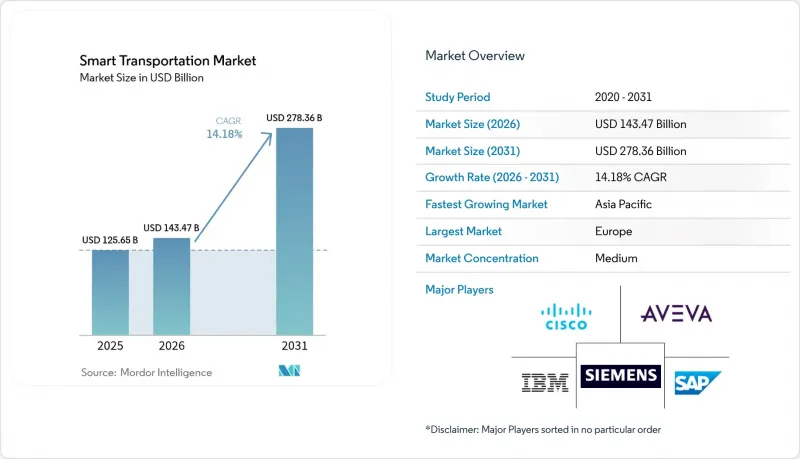
본 보고서는 용도(교통 관리, 도로 안전·보안 등), 제품 유형(첨단 여객 정보 시스템(ATIS) 등), 서비스(도입·통합 등), 교통 수단(도로, 철도 등), 연결 기술(DSRC/C-V2X, 5G 및 LTE-M 등), 그리고 지역별로 분류되어 있습니다. 시장 예측은 금액(달러) 기준으로 제시되어 있습니다.
세계 스마트 교통 시장의 동향 및 인사이트
급속한 도시 인구 증가가 기존 도로망에 부담을 주고 있습니다
도시로의 인구 유입으로 인해 전례 없는 교통 밀도가 발생하고 있으며, 2030년까지 전 세계 인구의 60%가 도시 지역에 거주할 것으로 예측됩니다. 많은 경제권에서 교통 정체는 이미 GDP의 2-4%를 잠식하고 있으며, 교통 당국은 비용이 많이 드는 도로 확장 대신 AI를 활용한 교통 최적화 도입을 추진하고 있습니다. 베이징의 스마트 신호등 네트워크는 2024년에 평균 지연 시간을 23% 단축했으며, 뭄바이와 자카르타에서도 유사한 도입이 진행되고 있습니다. 디지털 트윈을 활용함으로써 기획 담당자는 차선 배치를 가상으로 스트레스 테스트할 수 있게 되었습니다. 또한, 차량 프로브 데이터와 결합된 적응형 신호 제어를 통해 아시아의 메가시티 내 통행 소요 시간이 25% 단축되었습니다. 따라서 도시들이 콘크리트 기반 확장보다 기술적 해결책을 우선시함에 따라, 스마트 교통 시장은 도시의 밀도로부터 직접적인 혜택을 받고 있습니다.
정부의 스마트 시티 자금 지원 및 ITS 의무화
입법적 지원에 힘입어, 지능형 모빌리티 분야에서는 수십억 달러 규모의 프로젝트가 진행 중입니다. 미국의 ‘인프라 투자 및 고용법’에서는 대중교통 현대화에 912억 달러가 배정되었으며, ATTAIN 프로그램에서는 첨단 기술 실증 실험에 연간 6,000만 달러가 확보되어 있습니다. 유럽연합(EU)의 병행 노력에서는 상호 운용 가능한 데이터 공유와 탄소 중립 교통 회랑이 의무화되어 있어, 스마트 교통 시장의 공급업체들에게 수요의 확실성을 뒷받침하는 기반이 되고 있습니다. 자금 지원 규정에는 지역적 포용성이 요구되는 경우가 많아, 이로 인해 대상 수요가 주요 도시를 넘어 확대되고 있으며, 저비용 센서 패키지 및 클라우드 오케스트레이션 분야의 혁신이 촉진되고 있습니다.
도시 전역에 걸친 ATMS 도입에 따른 막대한 초기 설비 투자
첨단 교통 관리 인프라 도입에는 교차로 1곳당 6,000-7,000달러의 비용이 소요되며, 대도시의 경우 자본 지출이 7,000만 달러를 훌쩍 넘기도 합니다. 예산 주기 및 조달 규정이 도입을 지연시키고 있으며, 특히 세수 기반이 작은 지역에서 이러한 경향이 두드러집니다. 자본 지출을 연기하기 위한 민관 파트너십 및 사용량 기반 요금 모델이 등장하고 있지만, 자금 측면의 과제는 여전히 스마트 교통 시장이 직면한 가장 시급한 역풍으로 남아 있습니다.
부문 분석
2025년, 교통 관리는 스마트 교통 시장에서 32.05%의 시장 점유율을 차지했으며, 도시들이 AI를 통한 조정을 통해 두 자릿수 수준의 교통 체증 감소를 목표로 하고 있는 만큼 시장 전체 성장률을 상회하는 속도로 확대될 것으로 전망됩니다. 플로리다주 전역의 시험 구간에서 실시간 적응형 신호 제어를 통해 이동 시간이 35% 단축된 것이 입증되었으며, 이는 교차로 분석, 사고 감지 및 교통 흐름 최적화를 위한 조달의 기반이 되고 있습니다. 지자체 구매 담당자들은 대규모 시스템 업데이트가 필요 없이 기존 제어 장치에 연결할 수 있는 모듈식 클라우드 대시보드를 중시하고 있으며, 이러한 설계 원칙 덕분에 공급업체의 대응 범위가 확대되고 있습니다.
주차 관리 기술은 연평균 성장률(CAGR) 12.95%로 발전하고 있으며, 갓길 주차 공간을 디지털 자산으로 전환하는 동시에 도심 교통량의 최대 30%에 달하기도 하는 순환 교통을 대폭 줄이고 있습니다. 대중교통은 승객들이 소유에서 이용 기반의 구독 모델로 전환함에 따라 성장하고 있습니다. 화물 운송 분야에서는 협업형 어댑티브 크루즈 컨트롤을 통해 5-6%의 연료 절감과 평균 속도 향상이 입증되어, 물류용 ITS 도입에 대한 비즈니스 사례를 창출하고 스마트 교통 시장을 더욱 견인하고 있습니다.
2025년에는 첨단 교통 관리 시스템이 스마트 교통 시장의 31.45%를 차지하며, 다중 모드 네트워크의 디지털 운영체제 역할을 수행했습니다. 각 기관은 사일로화된 온프레미스형 서버를 예측 분석, 공사 구역 자동화, 온실가스 대시보드를 지원하는 클라우드 네이티브 오케스트레이션으로 대체하고 있습니다. 캘리포니아주가 20개의 레거시 시스템을 단일 COTS 플랫폼으로 통합하기 위해 조달을 진행한 것은 이러한 통합 추세를 상징합니다.
연평균 성장률(CAGR) 16.75%를 기록하고 있는 협업형 차량 시스템은 5G와 엣지 AI를 융합하여 플래토닝, 고급 위험 경보, 긴급 차량의 우선 경로 설정을 가능하게 하고 있습니다. 5G Automotive Association(5GAA)가 2025년 파리에서 실시한 비지상파 네트워크 실증 실험에서는 위성과 휴대전화 네트워크를 결합한 하이브리드형 V2X의 유효성이 입증되었으며, 지방 고속도로에서의 통신 범위가 확대되었습니다(5gaa.org). 정체 과금 제도가 수익원을 재구성하고 교통 수단의 전환을 촉진하는 가운데, 첨단 교통 요금 징수 시스템이 탄력을 받고 있으며, 실시간 마이크로 과금에는 블록체인이 자주 활용되고 있습니다.
지역별 분석
유럽은 엄격한 배기가스 목표와 일관된 자금 조달 모델에 힘입어 2025년 스마트 교통 시장 수익의 39.10%를 차지했습니다. ‘지속가능하고 스마트한 모빌리티 전략’에서는 2030년까지 3,000만 대의 무공해 차량 도입과 고속철도 수송량 배가가 요구되고 있습니다. 공공 데이터 공간 및 오픈 소스 시뮬레이션 플랫폼에 대한 투자는 공급업체의 혁신을 가속화하는 동시에, 각 도시가 지역 전체의 성과를 비교·평가하는 데 도움이 되고 있습니다. 북유럽의 성숙한 통신 인프라와 혼잡통행료 제도의 조기 도입은 유럽 전역에서 재현 가능한 모델이 되고 있습니다.
북미는 2위를 차지했습니다. ‘SMART Grants’(연간 1억 달러)나 메가그랜트 코리도(Mega Grant Corridor)와 같은 연방 프로그램을 통해 시범 사업의 확대와 지방으로의 확산이 재정적으로 지원되고 있습니다. 실리콘밸리의 클라우드 및 반도체 클러스터는 풍부한 공급업체 생태계를 뒷받침하며, 스마트 교통 시장에 필수적인 LiDAR 모듈, 매핑 API, 미들웨어의 신속한 상용화를 가능하게 하고 있습니다. FCC가 상용 모바일 주파수 대역을 이용한 보충 위성 통신을 승인함에 따라 V2X의 커버리지가 인구 밀도가 낮은 지역까지 확대되어 긴급 서비스의 복원력이 강화되고 있습니다.
아시아태평양은 연평균 성장률(CAGR) 13.28%로 가장 높은 성장률을 기록하고 있습니다. 중국의 각 성에서는 국가 지침을 충족하기 위해 도로변 C-V2X 도입을 추진하고 있는 반면, 인도에서는 전용 고속도로 및 항만 프로그램에서 소요 시간 보장을 목적으로 IoT 센서가 통합되고 있습니다. 아세안(ASEAN)의 메가시티에서는 국민 신분증 제도와 연계된 비접촉식 티켓 시스템이 도입되어, MaaS(Mobility as a Service)의 보급 주기가 단축되고 있습니다. 이와 병행하여 중동 국가들은 ‘비전 2030’ 자금을 자율주행 지하철 노선에 투입하고 있으며, 2030년까지 지역 전체의 ITS 지출을 70억 달러로 늘리는 것을 목표로 하고 있습니다. 이러한 노력들이 맞물려 APAC은 스마트 교통 시장의 주요 수요원으로서의 입지를 공고히 하고 있습니다.
기타 혜택:
- 엑셀 형식의 시장 예측(ME) 시트
- 3개월간의 애널리스트 지원
자주 묻는 질문
목차
제1장 소개
제2장 조사 방법
제3장 주요 요약
제4장 시장 구도
제5장 시장 규모와 성장 예측
제6장 경쟁 구도
제7장 시장 기회와 향후 전망
KSM 26.09.02According to Mordor Intelligence, the smart transportation market size is expected to grow from USD 125.65 billion in 2025 to USD 143.47 billion in 2026 and is forecast to reach USD 278.36 billion by 2031 at 14.18% CAGR over 2026-2031.
This report is Segmented by Application (Traffic Management, Road Safety and Security, and More), Product Type (Advanced Traveler Information Systems (ATIS), and More), Service (Deployment and Integration, and More), Transportation Mode (Roadways, Railways, and More), Connectivity Technology (DSRC/C-V2X, 5G and LTE-M, and More), and by Geography. The Market Forecasts are Provided in Terms of Value (USD).
Global Smart Transportation Market Trends and Insights
Rapid Urban-Population Growth Stressing Legacy Road Networks
The migration of people toward cities is creating unprecedented traffic density, with urban areas forecast to host 60% of the global population by 2030. Congestion already erodes 2-4% of GDP in many economies, spurring transport agencies to deploy AI-driven traffic optimisation instead of costly road widening. Beijing's smart signal network cut average delays by 23% in 2024, and similar deployments are underway in Mumbai and Jakarta. Digital twins allow planners to stress-test lane configurations virtually, while adaptive signal control paired with vehicle probe data has trimmed corridor travel times by 25% inside Asian megacities. The smart transportation market, therefore, benefits directly from urban density as cities prioritise technological fixes over concrete expansions.
Government Smart-City Funding & ITS Mandates
Legislative support is translating into multibillion-dollar pipelines for intelligent mobility. The U.S. Infrastructure Investment and Jobs Act allocates USD 91.2 billion for modernising public transit, and the ATTAIN program reserves USD 60 million annually for advanced technology pilots. Parallel initiatives in the European Union mandate interoperable data sharing and carbon-neutral corridors, anchoring demand certainty for vendors in the smart transportation market. Funding provisions often require rural inclusion, widening addressable demand beyond tier-one cities, and stimulating innovation in low-cost sensor packages and cloud orchestration.
High Upfront Capex for City-Wide ATMS Roll-Outs
Deploying an advanced traffic management backbone can cost USD 6,000-7,000 per intersection, and large cities easily exceed USD 70 million capital outlay. Budget cycles and procurement rules slow adoption, particularly where tax bases are small. Public-private partnerships and usage-based pricing models are emerging to defer capex, yet financial friction remains the most immediate headwind facing the smart transportation market.
Other drivers and restraints analyzed in the detailed report include:
- Drop-in Cost of AI-Enabled Edge Sensors
- Growth of MaaS Subscription Platforms
- Lack of Cross-Vendor Data Standards for V2X
For complete list of drivers and restraints, kindly check the Table Of Contents.
Segment Analysis
Traffic Management contributed 32.05% market share to the smart transportation market in 2025 and is projected to outpace overall growth as cities target double-digit congestion cuts with AI coordination. Real-time adaptive signal control shows 35% travel-time savings in pilot corridors across Florida, underpinning procurement for intersection analytics, incident detection, and corridor optimisation. Municipal buyers value modular cloud dashboards that plug into legacy controllers without forklift upgrades, a design principle widening vendor addressability.
Parking Management technologies are advancing at a 12.95% CAGR, converting curbside inventory into digital assets and slashing cruising traffic that can reach 30% of downtown volumes. Public Transport is growing as passengers shift from ownership toward usage-based subscriptions. In freight, cooperative adaptive cruise control demonstrates 5-6% fuel savings and higher average speeds, generating business cases for logistics ITS deployments and further boosting the smart transportation market.
Advanced Transportation Management Systems represented 31.45% of smart transportation market share in 2025, acting as the digital operating system for multi-modal networks. Agencies are replacing siloed, on-premise servers with cloud-native orchestration that supports predictive analytics, work-zone automation, and greenhouse-gas dashboards. California's procurement to unify 20 legacy systems under a single COTS platform exemplifies the consolidation trend.
Cooperative Vehicle Systems, posting a 16.75% CAGR, marries 5G and edge AI to enable platooning, advanced hazard alerts, and prioritised emergency routing. The 5G Automotive Association's 2025 non-terrestrial network trial in Paris validated hybrid satellite-cellular V2X, widening coverage for rural highways 5gaa.org. Advanced Transportation Pricing Systems are gaining momentum as congestion pricing reshapes revenue streams and nudges modal shift, often using blockchain for real-time micro-tolling.
Complete Report Scope:
- By Application
- Traffic Management
- Road Safety and Security
- Parking Management
- Public Transport ITS
- Automotive Telematics
- Freight and Logistics ITS
- By Product Type
- Advanced Traveler Information Systems (ATIS)
- Advanced Transportation Management Systems (ATMS)
- Advanced Transportation Pricing Systems (ATPS)
- Advanced Public Transportation Systems (APTS)
- Cooperative Vehicle Systems (C-ITS)
- By Service
- Deployment and Integration
- Cloud and Managed Services
- Professional and Consulting
- By Transportation Mode
- Roadways
- Railways
- Airways
- Maritime
- By Connectivity Technology
- DSRC / C-V2X
- 5G and LTE-M
- Satellite (GNSS, L-band)
- By Geography
- North America
- United States
- Canada
- Mexico
- South America
- Brazil
- Argentina
- Europe
- Germany
- United Kingdom
- France
- Russia
- Rest of Europe
- APAC
- China
- Japan
- India
- Rest of APAC
- Middle East and Africa
- Saudi Arabia
- United Arab Emirates
- South Africa
- Rest of Middle East and Africa
- North America
Geography Analysis
Europe captured 39.10% of 2025 revenue in the smart transportation market, underpinned by stringent emissions targets and cohesive funding models. The Sustainable and Smart Mobility Strategy calls for 30 million zero-emission vehicles and a doubling of high-speed rail traffic by 2030. Investment in public data spaces and open-source simulation platforms accelerates vendor innovation while helping cities benchmark performance region-wide. Northern Europe's mature telecom infrastructure and early adoption of congestion pricing provide templates replicable across the continent.
North America ranks second. Federal programmes, including SMART Grants (USD 100 million annually) and mega-grant corridors, finance pilot scaling and rural outreach. Silicon Valley's cloud and semiconductor clusters feed a rich supplier ecosystem, allowing rapid commercialization of LIDAR modules, mapping APIs, and middleware critical to the smart transportation market. The FCC's approval for supplemental satellite coverage using commercial mobile spectrum extends V2X reach into sparsely populated regions, reinforcing the resilience of emergency services.
Asia-Pacific posts the highest growth at 13.28% CAGR. Chinese provinces are activating roadside C-V2X to meet national mandates, while India's dedicated highway and port programmes integrate IoT sensors for journey-time guarantees. ASEAN megacities deploy contactless ticketing tied to national identity schemes, shortening adoption cycles for Mobility-as-a-Service. In parallel, Middle Eastern states channel Vision 2030 funds into autonomous metro lines, targeting USD 7 billion regional ITS spend by 2030. Collectively, these initiatives cement APAC as a principal volume engine for the smart transportation market.
- Siemens Corporation
- Cisco Systems Inc.
- IBM Corporation
- SAP SE
- AVEVA Group PLC
- Thales Group
- Huawei Technologies Co. Ltd.
- Alstom SA
- Kapsch TrafficCom AG
- Hitachi Ltd.
- Oracle Corporation
- Advantech Co. Ltd.
- Orange SA
- TransCore LP
- Cubic Transportation Systems
- TomTom NV
- Panasonic Holdings Corp.
- Ericsson AB
- Qualcomm Inc.
- Continental AG
- Iteris Inc.
- PTV Group
Additional Benefits:
- The market estimate (ME) sheet in Excel format
- 3 months of analyst support
TABLE OF CONTENTS
1 INTRODUCTION
- 1.1 Study Assumptions and Market Definition
- 1.2 Scope of the Study
2 RESEARCH METHODOLOGY
3 EXECUTIVE SUMMARY
4 MARKET LANDSCAPE
- 4.1 Market Overview
- 4.2 Market Drivers
- 4.2.1 Rapid urban?population growth stressing legacy road networks
- 4.2.2 Government smart-city funding and ITS mandates
- 4.2.3 Drop-in cost of AI-enabled edge sensors
- 4.2.4 Growth of MaaS subscription platforms
- 4.2.5 Transition of toll roads to blockchain-based micro-payment rails
- 4.2.6 Aviation-grade GNSS redundancy adopted for dense urban canyons
- 4.3 Market Restraints
- 4.3.1 High upfront capex for city-wide ATMS roll-outs
- 4.3.2 Lack of cross-vendor data standards for V2X
- 4.3.3 Cyber-security-compliance liabilities for public agencies
- 4.3.4 Scarcity of dedicated 5.9 GHz spectrum in megacities
- 4.4 Value / Supply-Chain Analysis
- 4.5 Regulatory Landscape
- 4.6 Technological Outlook
- 4.7 Porter's Five Forces Analysis
- 4.7.1 Bargaining Power of Suppliers
- 4.7.2 Bargaining Power of Buyers
- 4.7.3 Threat of New Entrants
- 4.7.4 Intensity of Competitive Rivalry
- 4.7.5 Threat of Substitute Products
- 4.8 Impact of Macroeconomic Trends
- 4.9 Industry Value-Chain Analysis
5 MARKET SIZE AND GROWTH FORECASTS (VALUE)
- 5.1 By Application
- 5.1.1 Traffic Management
- 5.1.2 Road Safety and Security
- 5.1.3 Parking Management
- 5.1.4 Public Transport ITS
- 5.1.5 Automotive Telematics
- 5.1.6 Freight and Logistics ITS
- 5.2 By Product Type
- 5.2.1 Advanced Traveler Information Systems (ATIS)
- 5.2.2 Advanced Transportation Management Systems (ATMS)
- 5.2.3 Advanced Transportation Pricing Systems (ATPS)
- 5.2.4 Advanced Public Transportation Systems (APTS)
- 5.2.5 Cooperative Vehicle Systems (C-ITS)
- 5.3 By Service
- 5.3.1 Deployment and Integration
- 5.3.2 Cloud and Managed Services
- 5.3.3 Professional and Consulting
- 5.4 By Transportation Mode
- 5.4.1 Roadways
- 5.4.2 Railways
- 5.4.3 Airways
- 5.4.4 Maritime
- 5.5 By Connectivity Technology
- 5.5.1 DSRC / C-V2X
- 5.5.2 5G and LTE-M
- 5.5.3 Satellite (GNSS, L-band)
- 5.6 By Geography
- 5.6.1 North America
- 5.6.1.1 United States
- 5.6.1.2 Canada
- 5.6.1.3 Mexico
- 5.6.2 South America
- 5.6.2.1 Brazil
- 5.6.2.2 Argentina
- 5.6.3 Europe
- 5.6.3.1 Germany
- 5.6.3.2 United Kingdom
- 5.6.3.3 France
- 5.6.3.4 Russia
- 5.6.3.5 Rest of Europe
- 5.6.4 APAC
- 5.6.4.1 China
- 5.6.4.2 Japan
- 5.6.4.3 India
- 5.6.4.4 Rest of APAC
- 5.6.5 Middle East and Africa
- 5.6.5.1 Saudi Arabia
- 5.6.5.2 United Arab Emirates
- 5.6.5.3 South Africa
- 5.6.5.4 Rest of Middle East and Africa
- 5.6.1 North America
6 COMPETITIVE LANDSCAPE
- 6.1 Market Concentration
- 6.2 Strategic Initiatives and Mergers and Acquisitions
- 6.3 Market Share Analysis
- 6.4 Company Profiles (includes global overview, market overview, core segments, financials, strategy, market rank/share, products and services, recent developments)
- 6.4.1 Siemens Corporation
- 6.4.2 Cisco Systems Inc.
- 6.4.3 IBM Corporation
- 6.4.4 SAP SE
- 6.4.5 AVEVA Group PLC
- 6.4.6 Thales Group
- 6.4.7 Huawei Technologies Co. Ltd.
- 6.4.8 Alstom SA
- 6.4.9 Kapsch TrafficCom AG
- 6.4.10 Hitachi Ltd.
- 6.4.11 Oracle Corporation
- 6.4.12 Advantech Co. Ltd.
- 6.4.13 Orange SA
- 6.4.14 TransCore LP
- 6.4.15 Cubic Transportation Systems
- 6.4.16 TomTom NV
- 6.4.17 Panasonic Holdings Corp.
- 6.4.18 Ericsson AB
- 6.4.19 Qualcomm Inc.
- 6.4.20 Continental AG
- 6.4.21 Iteris Inc.
- 6.4.22 PTV Group
7 MARKET OPPORTUNITIES AND FUTURE OUTLOOK
- 7.1 White-space and Unmet-Need Assessment