
|
시장보고서
상품코드
2076884
산업용 윤활유 시장 : 기유별, 제품 유형별, 최종 이용 산업별, 지역별 - 세계 예측(-2031년)Industrial Lubricants Market by Base Oil (Mineral Oil, Synthetic Oil, Bio-based Oil), Product Type (Hydraulic Fluid, Metalworking Fluid, Grease), End-use Industry (Construction, Power Generation, Food Processing), and Region - Global Forecast to 2031 |
||||||

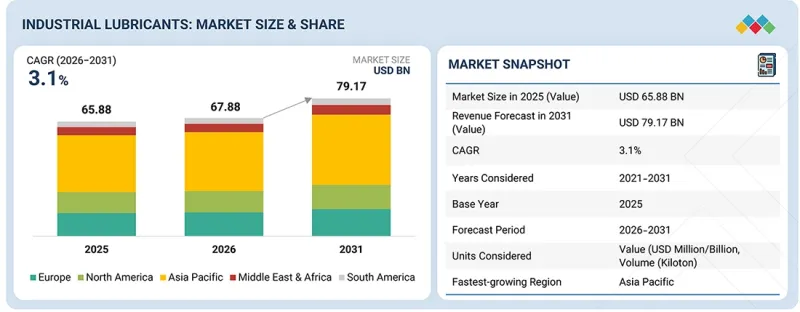
산업용 윤활유 시장 규모는 2026년 678억 8,000만 달러에서 2031년까지 791억 7,000만 달러에 달할 것으로 예상되며, 예측 기간 동안 CAGR은 3.1%를 기록할 전망입니다.
| 조사 범위 | |
|---|---|
| 조사 대상 기간 | 2021-2031년 |
| 기준 연도 | 2025년 |
| 예측 기간 | 2026-2031년 |
| 산정 단위 | 금액(100만/10억 달러) 및 킬로톤 |
| 부문 | 기유별, 제품 유형별, 최종 이용 산업별, 지역별 |
| 대상 지역 | 아시아태평양, 유럽, 북미, 중동 및 아프리카, 남미 |
인프라 개발 활동으로 인해 건설기계, 자재 운반 시스템, 산업용 기계의 사용이 증가함에 따라 산업용 윤활유에 대한 수요가 크게 높아지고 있습니다. 대규모 개발 프로젝트에서는 프로젝트 실행의 여러 단계에 걸쳐 광범위한 설비의 가동이 필요합니다. 윤활유는 가혹한 작업 환경에서 설비의 성능을 유지하고, 부품을 보호하며, 원활한 가동을 보장하는 데 있어 매우 중요한 역할을 합니다. 교통망, 공공사업, 산업 시설, 공공 인프라에 대한 투자가 확대됨에 따라 기계의 가동률과 유지보수 요구 사항이 높아지고 있습니다. 인프라 프로젝트에 사용되는 장비는 장기간 가동되므로, 생산성과 효율성을 유지하기 위해서는 정기적인 윤활이 필요합니다. 정부와 민간 기관이 인프라 확충에 대한 투자를 지속하는 가운데, 장비 도입 및 유지보수 활동의 증가로 인해 산업용 윤활유 수요가 증가하고 있습니다. 인프라의 성장과 기계 가동 사이의 이러한 연관성으로 인해, 인프라 투자는 전 세계 산업용 윤활유 소비에 있어 중요한 요인이 되고 있습니다.
"2025년, 바이오 기반 오일 부문은 산업용 윤활유 시장에서 3위의 점유율을 차지했습니다."
2025년, 바이오 기반 오일 부문은 산업용 윤활유 시장에서 3위의 점유율을 차지했습니다. 각 업계가 사업 전략에 지속가능성 목표를 점점 더 많이 반영함에 따라, 바이오 기반 오일은 산업용 윤활유 시장에서 강력한 성장세를 보이고 있습니다. 제조, 광업, 임업, 가공 등 각 분야의 기업들은 가동 효율을 유지하면서 환경 보전을 지원하는 윤활유를 찾고 있습니다. 재생 가능한 원료에서 얻어지는 바이오 기반 오일은, 유한한 석유 자원에 대한 의존도를 낮춤으로써 이러한 목표와 밀접하게 부합합니다. 바이오 기반 오일의 도입은 기업이 지속가능성 프로그램을 강화하고, 책임 있는 조달 이니셔티브를 지원하며, 환경 성과 지표를 개선하는 데 도움이 됩니다. 환경에 대한 책임이 산업 경쟁의 중요한 요소로 부상하는 가운데, 바이오 기반 오일은 장기적인 지속가능성 목표를 뒷받침하는 실용적인 해결책으로서 계속해서 받아들여지고 있습니다.
"예측 기간 동안 기어 오일 부문이 가장 빠르게 성장할 것으로 전망됩니다."
2026년부터 2031년까지 산업용 윤활유 제품 유형 중 기어 오일 분야가 가장 빠르게 성장할 것으로 전망됩니다. 풍력발전 인프라의 급속한 확대로 인해 산업용 기어 오일에 대한 수요가 급증하고 있습니다. 풍력 터빈은 변동하는 부하와 환경 조건 하에서 연속 운전을 수행하는 대형 기어박스에 의존하고 있습니다. 이러한 시스템에서는 효율적인 동력 전달을 뒷받침하고, 장기간에 걸친 가동 기간 동안 운전의 안정성을 유지하기 위해 전용 기어 오일이 필요합니다. 육상 및 해상 풍력발전 프로젝트가 확대됨에 따라, 에너지 시장 전반에서 기어 구동식 설비의 도입 대수가 증가하고 있습니다. 풍력발전소 운영사는 운영 효율과 수명 주기 성능을 매우 중요하게 여기고 있으며, 고품질 기어 오일은 유지보수 전략에 있어 필수적인 요소로 자리 잡고 있습니다. 전 세계적으로 재생에너지에 대한 투자가 지속적으로 확대되는 가운데, 풍력 터빈의 도입 확대는 기어 오일 부문의 수요 증가를 이끄는 중요한 요인으로 부상하고 있습니다.
"식품 가공 분야는 예측 기간 동안 가장 높은 연평균 성장률(CAGR)을 기록할 것으로 전망됩니다."
식품 가공 부문은 2026년부터 2031년까지 산업용 윤활유 시장에서 가장 높은 연평균 성장률(CAGR)을 기록할 것으로 전망됩니다. 포장 식품, 냉동 식품, 즉석 식품 및 편의점 식품의 소비가 꾸준히 증가하고 있는 것이 식품 가공 업계 전체의 눈부신 성장을 이끌고 있습니다. 소비자들은 편의성, 안정적인 품질, 그리고 더 긴 유통기한을 갖춘 제품을 점점 더 많이 요구하고 있으며, 이로 인해 제조업체들은 생산능력 확충을 서둘러야 하는 상황에 놓여 있습니다. 이러한 성장을 위해서는 제조 시설 전체에 걸친 가공, 혼합, 충전, 포장 및 이송 시스템의 지속적인 가동이 필수적입니다. 산업용 윤활유는 여러 가공 단계에 걸쳐 원활한 가동을 유지함으로써, 이러한 생산 환경의 효율적인 운영을 뒷받침하고 있습니다. 식품 제조업체들이 변화하는 소비자의 기호에 부응하기 위해 생산량을 늘리면서, 생산 시설 전체의 윤활유 수요도 증가하고 있습니다. 따라서 가공식품 소비가 지속적으로 확대되고 있는 것은 식품 가공 업계에서 산업용 윤활유 수요를 뒷받침하는 주요 요인으로 계속 작용하고 있습니다.
"2025년, 북미는 금액 기준으로 전 세계 산업용 윤활유 시장에서 3위의 점유율을 차지했습니다."
2025년, 북미는 금액 기준으로 산업용 윤활유 시장 전체에서 3위의 점유율을 차지했습니다. 북미는 광범위한 시추, 채굴, 가공 및 운송 인프라에 힘입어 셰일 오일 및 천연가스 생산 분야에서 여전히 세계적 선도국으로서의 지위를 유지하고 있습니다. 산업용 윤활유는 에너지 밸류체인 전반에 걸쳐 사용되는 시추 장비, 펌프, 압축기, 터빈 및 가공 설비의 가동에 필수적입니다. 이러한 자산들은 가혹한 조건에서 연속 가동되고 있어, 설비의 성능과 수명을 뒷받침하는 신뢰성 높은 윤활 솔루션에 대한 강력한 수요를 창출하고 있습니다. 윤활유는 중요한 기계 시스템이 원활하게 작동하도록 하는 동시에, 운영 효율을 유지하는 데에도 기여합니다. 에너지 개발 프로젝트에 대한 지속적인 투자를 통해 탐사 및 생산 활동 전반에 걸친 설비 가동률이 향상되고 있습니다. 셰일 자원이 지역 에너지 정세에서 중요한 위치를 차지하고 있기 때문에 업스트림·미드스티림·다운스트림 각 사업 분야에서 산업용 윤활유 소비량은 계속해서 증가하고 있습니다.
본 보고서에서 다루고 있는 주요 기업 개요에는 Shell plc(영국), Exxon Mobil Corporation(미국), BP p.l.c.(영국), Chevron Corporation(미국), TotalEnergies SE(프랑스), PetroChina Company Limited(중국), China Petroleum & Chemical Corporation(중국), ENEOS Holdings Inc.(일본), Idemitsu Kosan(일본), FUCHS SE(독일), Petroliam Nasional Berhad(PETRONAS)(말레이시아)가 포함됩니다.
조사 범위
본 보고서에서는 산업용 윤활유 시장을 기유, 제품 유형, 최종 이용 산업 및 지역별로 세분화하여, 각 지역의 시장 규모 총액(100만 달러) 및 킬로톤에 대한 추정치를 제시하고 있습니다. 또한, 주요 업계 업체들에 대해 상세한 분석을 수행하여, 해당 업체들의 사업 개요, 서비스 및 산업용 윤활유 시장과 관련된 주요 전략에 대한 인사이트를 제공합니다.
이 보고서를 구매해야 하는 이유
본 조사 보고서는 업계 분석(업계 동향), 주요 기업의 시장 점유율 분석, 기업 개요 등 다양한 수준의 분석에 초점을 맞추고 있으며, 이를 종합함으로써 산업용 윤활유 시장의 경쟁 구도, 신흥 및 고성장 부문, 고성장 지역, 그리고 시장 촉진요인, 억제요인, 성장 기회에 대한 전반적인 그림을 제공합니다.
본 보고서에서는 다음 사항에 대한 인사이트를 제공합니다:
- 시장 침투도 : 세계 시장에서 주요 기업들이 제공하는 산업용 윤활유에 관한 종합적인 정보
- 산업용 윤활유 시장의 성장에 영향을 미치는 주요 촉진요인(산업용 생산능력 확대, 설비 신뢰성 및 가동 중단 시간 단축에 대한 관심 증가, 자동화 및 고성능 기계 도입 확대) , 제약요인(시장 안정성을 저해하는 기유 및 첨가제 비용 변동, 환경 규제 준수 비용 증가), 기회(수익성 높은 성장 기회를 창출하는 합성 윤활유로의 전환 확대, 신흥 경제국의 급속한 산업화), 그리고 과제(치열한 가격 경쟁과 제품 차별화)에 대한 분석
- 제품 개발 및 혁신 : 산업용 윤활유 시장의 향후 기술 동향, 연구개발 활동, 그리고 제품 및 서비스의 신규 출시와 관련된 상세한 분석
- 시장 개발 : 수익성이 높은 신흥 시장에 대한 종합적인 정보 - 본 보고서에서는 지역별 산업용 윤활유 시장을 분석하고 있습니다.
- 시장의 다양화 : 신제품, 미개척 지역 및 전 세계 산업용 윤활유 시장의 최근 동향에 관한 종합적인 정보
- 경쟁 분석 : 산업용 윤활유 시장에서 주요 기업의 시장 점유율, 전략, 제품 및 생산능력에 대한 상세한 평가
자주 묻는 질문
목차
제1장 소개
제2장 주요 요약
제3장 주요 인사이트
제4장 시장 개요
제5장 업계 동향
제6장 기술 진보, AI에 의한 영향, 특허, 혁신, 그리고 향후 응용
제7장 규제 상황과 지속가능성에 대한 대처
제8장 고객 상황과 구매 행동
제9장 산업용 윤활유 시장(기유별)
제10장 산업용 윤활유 시장(제품 유형별)
제11장 산업용 윤활유 시장(최종 이용 산업별)
제12장 산업용 윤활유 시장(지역별)
제13장 경쟁 구도
제14장 기업 개요
제15장 조사 방법
제16장 부록
KSM 26.07.07The industrial lubricants market is expected to reach USD 79.17 billion by 2031 from USD 67.88 billion in 2026, at a CAGR of 3.1% during the forecast period.
| Scope of the Report | |
|---|---|
| Years Considered for the Study | 2021-2031 |
| Base Year | 2025 |
| Forecast Period | 2026-2031 |
| Units Considered | Value (USD Million/Billion) and Volume (Kiloton) |
| Segments | Base Oil, Product Type, End-use Industry, and Region |
| Regions covered | Asia Pacific, Europe, North America, Middle East & Africa, and South America |
Infrastructure development activities are generating substantial demand for industrial lubricants through the increased use of construction equipment, material handling systems, and industrial machinery. Large-scale development projects require extensive equipment operation across multiple stages of project execution. Lubricants play a critical role in maintaining equipment performance, protecting components, and ensuring smooth operation under demanding working conditions. Growing investments in transportation networks, utilities, industrial facilities, and public infrastructure are increasing machinery utilization rates and maintenance requirements. Equipment used in infrastructure projects operates for extended periods and requires regular lubrication to maintain productivity and efficiency. As governments and private organizations continue investing in infrastructure expansion, demand for industrial lubricants rises through increased equipment deployment and servicing activities. This connection between infrastructure growth and machinery operation makes infrastructure investment an important contributor to industrial lubricant consumption worldwide.
"The bio-based oil segment accounted for the third-largest share in the industrial lubricants market in 2025."
The bio-based oil segment accounted for the third-largest share in the industrial lubricants market in 2025. Bio-based oils are gaining strong traction in the industrial lubricants market as industries increasingly integrate sustainability objectives into their operational strategies. Organizations across manufacturing, mining, forestry, and processing sectors are seeking lubricants that support environmental stewardship while maintaining operational efficiency. Bio-based oils, derived from renewable feedstocks, align closely with these goals by reducing dependence on finite petroleum resources. Their adoption helps companies strengthen sustainability programs, support responsible sourcing initiatives, and improve environmental performance metrics. As environmental responsibility becomes an important component of industrial competitiveness, bio-based oils continue to gain acceptance as a practical solution that supports long-term sustainability objectives.
"The gear oil segment is projected to be the fastest-growing during the forecast period."
The gear oil segment is projected to be the fastest-growing product type of industrial lubricants between 2026 and 2031. The rapid expansion of wind energy infrastructure is creating strong demand for industrial gear oils. Wind turbines rely on large gearboxes that operate continuously under varying loads and environmental conditions. These systems require specialized gear oils to support efficient power transmission and maintain operational stability over extended service periods. Growth in onshore and offshore wind projects is increasing the installed base of gear-driven equipment across energy markets. Wind farm operators place significant emphasis on operational efficiency and lifecycle performance, making high-quality gear oils an essential part of maintenance strategies. As renewable energy investments continue to expand globally, the growing deployment of wind turbines is becoming an important contributor to demand growth within the gear oil segment.
"The food processing segment is projected to witness the highest CAGR during the forecast period."
The food processing segment is projected to witness the highest CAGR in industrial lubricants between 2026 and 2031. The steady rise in consumption of packaged, frozen, ready-to-eat, and convenience food products is driving significant growth across the food processing industry. Consumers increasingly seek products that offer convenience, consistent quality, and longer shelf life, encouraging manufacturers to expand production capacity. This growth requires continuous operation of processing, mixing, filling, packaging, and conveying systems throughout manufacturing facilities. Industrial lubricants support the efficient functioning of these production environments by helping maintain smooth operations across multiple processing stages. As food manufacturers increase output volumes to meet evolving consumer preferences, lubrication requirements rise across production facilities. The continued expansion of processed food consumption therefore remains a major factor supporting industrial lubricant demand within the food processing industry.
"North America accounted for the third-largest share of the global industrial lubricants market, in terms of value, in 2025."
North America held the third-largest share of the overall industrial lubricants market, in terms of value, in 2025. North America remains a global leader in shale oil and natural gas production, supported by extensive drilling, extraction, processing, and transportation infrastructure. Industrial lubricants are essential for the operation of drilling rigs, pumps, compressors, turbines, and processing equipment used throughout the energy value chain. These assets operate continuously under demanding conditions, creating a strong requirement for reliable lubrication solutions that support equipment performance and service life. Lubricants help maintain operational efficiency while enabling smooth functioning of critical mechanical systems. Continued investment in energy development projects increases equipment utilization across exploration and production activities. As shale resources remain an important part of the regional energy landscape, industrial lubricant consumption continues to grow across upstream, midstream, and downstream operations.
- By Company Type: Tier 1 - 55%, Tier 2 - 25%, and Tier 3 - 20%
- By Designation: Directors - 50%, Managers - 30%, and Others - 20%
- By Region: North America - 40%, Europe - 35%, Asia Pacific - 20%, RoW- 5%
The key players profiled in the report include Shell plc (UK), Exxon Mobil Corporation (US), BP p.l.c. (UK), Chevron Corporation (US), TotalEnergies SE (France), PetroChina Company Limited (China), China Petroleum & Chemical Corporation (China), ENEOS Holdings Inc. (Japan), Idemitsu Kosan Co., Ltd. (Japan), FUCHS SE (Germany), and Petroliam Nasional Berhad (PETRONAS) (Malaysia).
Study Coverage
This report segments the market for industrial lubricants based on base oil, product type, end-use industry, and region, and provides estimations of value (in USD million) and volume (in kilotons) for the overall market size across various regions. A detailed analysis of key industry players has been conducted to provide insights into their business overviews, services, and key strategies associated with the industrial lubricants market.
Reasons to Buy this Report
This research report is focused on various levels of analysis-industry analysis (industry trends), market share analysis of top players, and company profiles, which together provide an overall view of the competitive landscape, emerging and high-growth segments of the industrial lubricants market, high-growth regions, and market drivers, restraints, and opportunities.
The report provides insights into the following points:
- Market Penetration: Comprehensive information on industrial lubricants offered by top players in the global market
- Analysis of key drivers (expansion of industrial manufacturing capacity, growing focus on equipment reliability and downtime reduction, rising adoption of automated and high-performance machinery), restraints (volatility in base oil and additive costs limiting market stability, increasing environmental compliance costs), opportunities (growing shift towards synthetic lubricants creating lucrative growth opportunities, rapid industrialization across emerging economies), and challenges (intense price competition and product differentiation) influencing the growth of the industrial lubricants market
- Product Development/Innovation: Detailed insights on upcoming technologies, research & development activities, and product & service launches in the industrial lubricants market
- Market Development: Comprehensive information about lucrative emerging markets-the report analyzes the market for industrial lubricants across regions.
- Market Diversification: Exhaustive information about new products, untapped regions, and recent developments in the global industrial lubricants market
- Competitive Assessment: In-depth assessment of market shares, strategies, products, and manufacturing capabilities of leading players in the industrial lubricants market
TABLE OF CONTENTS
1 INTRODUCTION
- 1.1 STUDY OBJECTIVES
- 1.2 MARKET DEFINITION
- 1.3 STUDY SCOPE
- 1.3.1 MARKETS COVERED AND REGIONAL SCOPE
- 1.3.2 INCLUSIONS AND EXCLUSIONS OF STUDY
- 1.3.3 MARKET DEFINITION AND INCLUSIONS, BY BASE OIL
- 1.3.4 MARKET DEFINITION AND INCLUSIONS, BY PRODUCT TYPE
- 1.3.5 MARKET DEFINITION AND INCLUSIONS, BY END-USE INDUSTRY
- 1.3.6 YEARS CONSIDERED
- 1.3.7 CURRENCY CONSIDERED
- 1.3.8 UNIT CONSIDERED
- 1.4 STAKEHOLDERS
- 1.5 SUMMARY OF CHANGES
2 EXECUTIVE SUMMARY
- 2.1 MARKET HIGHLIGHTS AND KEY INSIGHTS
- 2.2 KEY MARKET PARTICIPANTS: MAPPING OF STRATEGIC DEVELOPMENTS
- 2.3 DISRUPTIVE TRENDS IN INDUSTRIAL LUBRICANTS MARKET
- 2.4 HIGH-GROWTH SEGMENTS
- 2.5 REGIONAL SNAPSHOT: MARKET SIZE, GROWTH RATE, AND FORECAST
3 PREMIUM INSIGHTS
- 3.1 ATTRACTIVE OPPORTUNITIES FOR PLAYERS IN INDUSTRIAL LUBRICANTS MARKET
- 3.2 INDUSTRIAL LUBRICANTS MARKET, BY PRODUCT TYPE AND REGION
- 3.3 INDUSTRIAL LUBRICANTS MARKET, BY BASE OIL
- 3.4 INDUSTRIAL LUBRICANTS MARKET, BY COUNTRY
4 MARKET OVERVIEW
- 4.1 INTRODUCTION
- 4.2 MARKET DYNAMICS
- 4.2.1 DRIVERS
- 4.2.1.1 Expansion of industrial manufacturing capacity
- 4.2.1.2 Growing focus on equipment reliability and downtime reduction
- 4.2.1.3 Rising adoption of automated and high-performance machinery
- 4.2.2 RESTRAINTS
- 4.2.2.1 Volatility in base oil and additive costs limiting market stability
- 4.2.2.2 Increasing environmental compliance costs
- 4.2.3 OPPORTUNITIES
- 4.2.3.1 Growing shift toward synthetic lubricants creating lucrative growth opportunities
- 4.2.3.2 Rapid industrialization across emerging economies
- 4.2.4 CHALLENGES
- 4.2.4.1 Intense price competition and product differentiation
- 4.2.1 DRIVERS
- 4.3 INTERCONNECTED MARKETS AND CROSS-SECTOR OPPORTUNITIES
- 4.3.1 INTERCONNECTED MARKETS
- 4.3.2 CROSS-SECTOR OPPORTUNITIES
- 4.4 STRATEGIC MOVES BY TIER-1/2/3 PLAYERS
- 4.4.1 KEY MOVES AND STRATEGIC FOCUS
5 INDUSTRY TRENDS
- 5.1 PORTER'S FIVE FORCES ANALYSIS
- 5.1.1 THREAT OF SUBSTITUTES
- 5.1.2 THREAT OF NEW ENTRANTS
- 5.1.3 BARGAINING POWER OF SUPPLIERS
- 5.1.4 BARGAINING POWER OF BUYERS
- 5.1.5 INTENSITY OF COMPETITIVE RIVALRY
- 5.2 MACROECONOMIC OUTLOOK
- 5.2.1 INTRODUCTION
- 5.2.2 GDP TRENDS AND FORECAST
- 5.2.3 TRENDS IN CONSTRUCTION INDUSTRY
- 5.3 SUPPLY CHAIN ANALYSIS
- 5.4 ECOSYSTEM ANALYSIS
- 5.5 PRICING ANALYSIS
- 5.5.1 AVERAGE SELLING PRICE OF KEY PLAYERS, BY END-USE INDUSTRY, 2025
- 5.5.2 AVERAGE SELLING PRICE TREND OF INDUSTRIAL LUBRICANTS, BY REGION, 2021-2025
- 5.6 TRADE ANALYSIS
- 5.6.1 IMPORT SCENARIO (HS CODE 2710)
- 5.6.2 EXPORT SCENARIO (HS CODE 2710)
- 5.7 KEY CONFERENCES & EVENTS, 2026-2027
- 5.8 TRENDS/DISRUPTIONS IMPACTING CUSTOMER BUSINESS
- 5.8.1 REVENUE SHIFTS & REVENUE POCKETS FOR INDUSTRIAL LUBRICANTS MARKET
- 5.9 INVESTMENT AND FUNDING SCENARIO
- 5.10 CASE STUDY ANALYSIS
- 5.10.1 REDUCING EQUIPMENT DOWNTIME IN CEMENT PRODUCTION
- 5.10.2 IMPROVING HYDRAULIC SYSTEM RELIABILITY IN CONSTRUCTION EQUIPMENT
- 5.11 IMPACT OF 2025 US TARIFF - OVERVIEW
- 5.11.1 INTRODUCTION
- 5.11.2 KEY TARIFF RATES
- 5.11.3 PRICE IMPACT ANALYSIS
- 5.11.4 IMPACT ON COUNTRIES/REGIONS
- 5.11.4.1 US
- 5.11.4.2 Europe
- 5.11.4.3 Asia Pacific
- 5.11.5 IMPACT ON END-USE INDUSTRIES
6 TECHNOLOGICAL ADVANCEMENTS, AI-DRIVEN IMPACT, PATENTS, INNOVATIONS, AND FUTURE APPLICATIONS
- 6.1 KEY EMERGING TECHNOLOGIES
- 6.1.1 ADVANCED BASE OIL PROCESSING TECHNOLOGY
- 6.1.2 ADDITIVE FORMULATION TECHNOLOGY
- 6.2 COMPLEMENTARY TECHNOLOGIES
- 6.2.1 OIL CONDITION MONITORING AND PREDICTIVE MAINTENANCE TECHNOLOGY
- 6.2.2 FILTRATION AND CONTAMINATION CONTROL TECHNOLOGY
- 6.3 TECHNOLOGY/PRODUCT ROADMAP
- 6.3.1 SHORT-TERM (2026-2027) | FORMULATION OPTIMIZATION & EARLY ADOPTION
- 6.3.2 MID-TERM (2027-2030) | PERFORMANCE ENHANCEMENT & INDUSTRY STANDARDIZATION
- 6.3.3 LONG-TERM (2030-2035+) | SMART LUBRICATION & SUSTAINABLE INTEGRATION
- 6.4 PATENT ANALYSIS
- 6.4.1 APPROACH
- 6.4.2 DOCUMENT TYPES
- 6.4.3 TOP APPLICANTS
- 6.4.4 JURISDICTION ANALYSIS
- 6.5 IMPACT OF AI/GEN AI ON INDUSTRIAL LUBRICANTS MARKET
- 6.5.1 TOP USE CASES AND MARKET POTENTIAL
- 6.5.2 BEST PRACTICES IN INDUSTRIAL LUBRICANT PROCESSING
- 6.5.3 CASE STUDIES OF AI IMPLEMENTATION IN INDUSTRIAL LUBRICANTS MARKET
- 6.5.4 INTERCONNECTED ADJACENT ECOSYSTEM AND IMPACT ON MARKET PLAYERS
- 6.5.5 CLIENTS' READINESS TO ADOPT GENERATIVE AI IN INDUSTRIAL LUBRICANTS MARKET
7 REGULATORY LANDSCAPE AND SUSTAINABILITY INITIATIVES
- 7.1 REGIONAL REGULATIONS AND COMPLIANCE
- 7.1.1 REGULATORY BODIES, GOVERNMENT AGENCIES, AND OTHER ORGANIZATIONS
- 7.1.2 INDUSTRY STANDARDS
- 7.2 SUSTAINABILITY INITIATIVES
- 7.2.1 OPERATIONAL EFFICIENCY ENHANCEMENT
- 7.2.2 SUSTAINABLE INDUSTRIAL APPLICATION
- 7.3 SUSTAINABILITY IMPACT AND REGULATORY POLICY INITIATIVES
- 7.4 CERTIFICATIONS, LABELING, AND ECO-STANDARDS
8 CUSTOMER LANDSCAPE & BUYER BEHAVIOR
- 8.1 DECISION-MAKING PROCESS
- 8.2 BUYER STAKEHOLDERS AND BUYING EVALUATION CRITERIA
- 8.2.1 KEY STAKEHOLDERS IN BUYING PROCESS
- 8.2.2 BUYING CRITERIA
- 8.3 ADOPTION BARRIERS & INTERNAL CHALLENGES
- 8.4 UNMET NEEDS IN VARIOUS END-USE INDUSTRIES
9 INDUSTRIAL LUBRICANTS MARKET, BY BASE OIL
- 9.1 INTRODUCTION
- 9.2 MINERAL OIL
- 9.2.1 COST-EFFECTIVE LUBRICATION SOLUTIONS SUPPORT MARKET EXPANSION
- 9.3 SYNTHETIC OIL
- 9.3.1 SUPERIOR PERFORMANCE IN EXTREME OPERATING CONDITIONS EXPANDS ADOPTION
- 9.3.2 PAO
- 9.3.3 PAG
- 9.3.4 ESTERS
- 9.3.5 GROUP III (HYDROCRACKING)
- 9.4 BIO-BASED OIL
- 9.4.1 RISING AWARENESS REGARDING BIO-BASED LUBRICANTS DRIVES MARKET EXPANSION
10 INDUSTRIAL LUBRICANTS MARKET, BY PRODUCT TYPE
- 10.1 INTRODUCTION
- 10.2 HYDRAULIC FLUID
- 10.2.1 GROWING CONSTRUCTION INDUSTRY TO DRIVE DEMAND
- 10.2.2 HL HYDRAULIC FLUID
- 10.2.3 HLP HYDRAULIC FLUID
- 10.2.4 HLP-D HYDRAULIC FLUID
- 10.2.5 FIRE-RESISTANT HYDRAULIC FLUID
- 10.3 METALWORKING FLUIDS
- 10.3.1 GROWING STEEL INDUSTRY TO FUEL DEMAND
- 10.3.2 REMOVAL METALWORKING FLUID
- 10.3.3 PROTECTING METALWORKING FLUID
- 10.3.4 FORMING METALWORKING FLUID
- 10.3.5 TREATING METALWORKING FLUID
- 10.4 GEAR OIL
- 10.4.1 GROWING WIND POWER INDUSTRY TO FUEL HIGH DEMAND FOR GEAR OILS
- 10.4.2 RUST & CORROSION-INHIBITED GEAR OIL
- 10.4.3 COMPOUNDED GEAR OIL
- 10.4.4 EXTREME PRESSURE GEAR OIL
- 10.5 COMPRESSOR OIL
- 10.5.1 INCREASING DEMAND FOR REFRIGERATION & AIR-CONDITIONING SYSTEMS TO DRIVE MARKET
- 10.6 GREASE
- 10.6.1 GROWING MINING, CONSTRUCTION & TRANSPORT INDUSTRIES TO DRIVE DEMAND
- 10.6.2 METALLIC SOAP THICKENER
- 10.6.2.1 Lithium
- 10.6.2.2 Calcium
- 10.6.2.3 Aluminum
- 10.6.2.4 Sodium
- 10.6.2.5 Other metallic soaps
- 10.6.3 NON-SOAP THICKENER
- 10.6.4 INORGANIC THICKENER
- 10.6.4.1 Clay
- 10.6.4.2 Silica
- 10.6.5 OTHER THICKENERS
- 10.7 TURBINE OIL
- 10.7.1 GROWING POWER GENERATION CAPACITY TO DRIVE MARKET GROWTH
- 10.8 OTHER PRODUCT TYPES
- 10.8.1 TRANSFORMER OIL
- 10.8.2 REFRIGERATION OIL
- 10.8.3 TEXTILE MACHINERY LUBRICANTS
11 INDUSTRIAL LUBRICANTS MARKET, BY END-USE INDUSTRY
- 11.1 INTRODUCTION
- 11.2 CONSTRUCTION
- 11.2.1 INCREASED GOVERNMENT INVESTMENTS IN INFRASTRUCTURE PROJECTS TO DRIVE DEMAND
- 11.3 METAL & MINING PRODUCTION
- 11.3.1 RISING EXTRACTION ACTIVITIES AND ORE PROCESSING OPERATIONS TO FUEL MARKET GROWTH
- 11.4 CEMENT PRODUCTION
- 11.4.1 GROWING CAPACITY ADDITIONS IN CEMENT MANUFACTURING TO ACCELERATE CONSUMPTION
- 11.5 POWER GENERATION
- 11.5.1 EXPANSION OF POWER GENERATION CAPACITY TO STRENGTHEN DEMAND
- 11.6 AUTOMOTIVE (VEHICLE MANUFACTURING)
- 11.6.1 INCREASING PRODUCTION OF PRECISION-ENGINEERED COMPONENTS TO BOOST MARKET DEMAND
- 11.7 CHEMICAL
- 11.7.1 RISING INSTALLATION OF PROCESS EQUIPMENT IN CHEMICAL FACILITIES TO SUPPORT MARKET EXPANSION
- 11.8 OIL & GAS
- 11.8.1 INCREASING DRILLING AND HYDROCARBON PROCESSING ACTIVITIES TO ENHANCE LUBRICANT CONSUMPTION
- 11.9 TEXTILE
- 11.9.1 GROWING ADOPTION OF HIGH-SPEED TEXTILE MACHINERY TO SUPPORT MARKET GROWTH
- 11.10 FOOD PROCESSING
- 11.10.1 EXPANSION OF AUTOMATED FOOD MANUFACTURING LINES TO FUEL DEMAND
- 11.11 OTHER END-USE INDUSTRIES
12 INDUSTRIAL LUBRICANTS MARKET, BY REGION
- 12.1 INTRODUCTION
- 12.2 ASIA PACIFIC
- 12.2.1 CHINA
- 12.2.1.1 Growing industrial activities to drive market
- 12.2.2 INDIA
- 12.2.2.1 Rapid industrialization to drive demand
- 12.2.3 JAPAN
- 12.2.3.1 Increasing focus on equipment lifecycle optimization to drive market
- 12.2.4 SOUTH KOREA
- 12.2.4.1 Expansion of smart factory infrastructure to fuel growth
- 12.2.5 AUSTRALIA & NEW ZEALAND
- 12.2.5.1 Expansion of large-scale mining operations to drive market
- 12.2.6 THAILAND
- 12.2.6.1 Expansion of power generation maintenance activities to propel market
- 12.2.7 INDONESIA
- 12.2.7.1 Growth of food processing capacity to fuel demand
- 12.2.1 CHINA
- 12.3 NORTH AMERICA
- 12.3.1 US
- 12.3.1.1 Strong industrial infrastructure to fuel growth
- 12.3.2 CANADA
- 12.3.2.1 Focus on advanced research and development to drive demand
- 12.3.3 MEXICO
- 12.3.3.1 Automotive component manufacturing expansion to drive market
- 12.3.1 US
- 12.4 EUROPE
- 12.4.1 GERMANY
- 12.4.1.1 Increasing production complexity in vehicle manufacturing to drive market
- 12.4.2 FRANCE
- 12.4.2.1 Focus on long-term performance of power generation assets to fuel growth
- 12.4.3 UK
- 12.4.3.1 Increasing renovation and infrastructure upgrade activities to drive demand
- 12.4.4 ITALY
- 12.4.4.1 Expansion of value-added food manufacturing to drive growth
- 12.4.5 SPAIN
- 12.4.5.1 Rising demand for construction material production to drive market
- 12.4.6 RUSSIA
- 12.4.6.1 Expansion of domestic chemical production activities to drive market
- 12.4.7 TURKEY
- 12.4.7.1 Expansion of export-oriented textile production to propel market
- 12.4.1 GERMANY
- 12.5 MIDDLE EAST & AFRICA
- 12.5.1 SAUDI ARABIA
- 12.5.1.1 Downstream industrial operations expansion to drive market
- 12.5.2 SOUTH AFRICA
- 12.5.2.1 Mining production activities to fuel growth
- 12.5.3 IRAN
- 12.5.3.1 Expansion of domestic industrial manufacturing to fuel demand
- 12.5.1 SAUDI ARABIA
- 12.6 SOUTH AMERICA
- 12.6.1 BRAZIL
- 12.6.1.1 Economic momentum drives adoption across sectors
- 12.6.2 ARGENTINA
- 12.6.2.1 Agricultural processing facility expansion to fuel demand
- 12.6.1 BRAZIL
13 COMPETITIVE LANDSCAPE
- 13.1 INTRODUCTION
- 13.2 KEY PLAYER STRATEGIES/RIGHT TO WIN, JANUARY 2021-MAY 2026
- 13.3 MARKET SHARE ANALYSIS, 2025
- 13.4 REVENUE ANALYSIS, 2021-2025
- 13.5 COMPANY EVALUATION MATRIX: KEY PLAYERS, 2025
- 13.5.1 STARS
- 13.5.2 EMERGING LEADERS
- 13.5.3 PERVASIVE PLAYERS
- 13.5.4 PARTICIPANTS
- 13.5.5 COMPANY FOOTPRINT: KEY PLAYERS, 2025
- 13.5.5.1 Company footprint
- 13.5.5.2 Region footprint
- 13.5.5.3 Base oil footprint
- 13.5.5.4 Product type footprint
- 13.5.5.5 End-use industry footprint
- 13.6 COMPANY EVALUATION MATRIX: STARTUPS/SMES, 2025
- 13.6.1 PROGRESSIVE COMPANIES
- 13.6.2 RESPONSIVE COMPANIES
- 13.6.3 DYNAMIC COMPANIES
- 13.6.4 STARTING BLOCKS
- 13.6.5 COMPETITIVE BENCHMARKING: STARTUPS/SMES
- 13.6.5.1 Detailed list of key startups/SMES
- 13.6.5.2 Competitive benchmarking of key startups/SMEs
- 13.7 PRODUCT COMPARISON ANALYSIS
- 13.8 COMPANY VALUATION AND FINANCIAL METRICS
- 13.9 COMPETITIVE SCENARIO
- 13.9.1 PRODUCT LAUNCHES
- 13.9.2 DEALS
- 13.9.3 EXPANSIONS
- 13.9.4 OTHER DEVELOPMENTS
14 COMPANY PROFILES
- 14.1 KEY PLAYERS
- 14.1.1 EXXON MOBIL CORPORATION
- 14.1.1.1 Business overview
- 14.1.1.2 Products/Solutions/Services offered
- 14.1.1.3 Recent developments
- 14.1.1.3.1 Product launches
- 14.1.1.3.2 Expansions
- 14.1.1.4 Strategic intelligence
- 14.1.1.4.1 Position in market
- 14.1.1.4.2 Financial strategy
- 14.1.1.4.3 Operational strategy
- 14.1.1.4.4 Market expansion strategy
- 14.1.1.4.5 Strategic DNA
- 14.1.1.4.6 Product USP
- 14.1.1.4.7 Win-loss analysis
- 14.1.1.5 MnM view
- 14.1.1.5.1 Right to Win
- 14.1.1.5.2 Strategic choices
- 14.1.1.5.3 Weaknesses and competitive threats
- 14.1.2 TOTALENERGIES SE
- 14.1.2.1 Business overview
- 14.1.2.2 Products/Solutions/Services offered
- 14.1.2.3 Recent developments
- 14.1.2.3.1 Product launches
- 14.1.2.3.2 Deals
- 14.1.2.4 Strategic intelligence
- 14.1.2.4.1 Position in market
- 14.1.2.4.2 Financial strategy
- 14.1.2.4.3 Operational strategy
- 14.1.2.4.4 Market expansion strategy
- 14.1.2.4.5 Strategic DNA
- 14.1.2.4.6 Product USP
- 14.1.2.4.7 Win-loss analysis
- 14.1.2.5 MnM view
- 14.1.2.5.1 Right to win
- 14.1.2.5.2 Strategic choices
- 14.1.2.5.3 Weaknesses and competitive threats
- 14.1.3 SHELL PLC
- 14.1.3.1 Business overview
- 14.1.3.2 Products/Solutions/Services offered
- 14.1.3.3 Recent developments
- 14.1.3.3.1 Deals
- 14.1.3.3.2 Other developments
- 14.1.3.4 Strategic intelligence
- 14.1.3.4.1 Position in market
- 14.1.3.4.2 Financial strategy
- 14.1.3.4.3 Operational strategy
- 14.1.3.4.4 Market expansion strategy
- 14.1.3.4.5 Strategic DNA
- 14.1.3.4.6 Product USP
- 14.1.3.4.7 Win-loss analysis
- 14.1.3.5 MnM view
- 14.1.3.5.1 Right to win
- 14.1.3.5.2 Strategic choices
- 14.1.3.5.3 Weaknesses and competitive threats
- 14.1.4 CHEVRON CORPORATION
- 14.1.4.1 Business overview
- 14.1.4.2 Products/Solutions/Services offered
- 14.1.4.3 Recent developments
- 14.1.4.3.1 Deals
- 14.1.4.4 Strategic intelligence
- 14.1.4.4.1 Position in market
- 14.1.4.4.2 Financial strategy
- 14.1.4.4.3 Operational strategy
- 14.1.4.4.4 Market expansion strategy
- 14.1.4.4.5 Strategic DNA
- 14.1.4.4.6 Product USP
- 14.1.4.4.7 Win-loss analysis
- 14.1.4.5 MnM view
- 14.1.4.5.1 Right to win
- 14.1.4.5.2 Strategic choices
- 14.1.4.5.3 Weaknesses and competitive threats
- 14.1.5 BP P.L.C.
- 14.1.5.1 Business overview
- 14.1.5.2 Products/Solutions/Services offered
- 14.1.5.3 Recent developments
- 14.1.5.3.1 Expansions
- 14.1.5.4 Strategic intelligence
- 14.1.5.4.1 Position in market
- 14.1.5.4.2 Financial strategy
- 14.1.5.4.3 Operational strategy
- 14.1.5.4.4 Market expansion strategy
- 14.1.5.4.5 Strategic DNA
- 14.1.5.4.6 Product USP
- 14.1.5.4.7 Win-loss analysis
- 14.1.5.5 MnM view
- 14.1.5.5.1 Right to win
- 14.1.5.5.2 Strategic choices
- 14.1.5.5.3 Weaknesses and competitive threats
- 14.1.6 PETROCHINA COMPANY LIMITED
- 14.1.6.1 Business overview
- 14.1.6.2 Products/Solutions/Services offered
- 14.1.6.3 Strategic intelligence
- 14.1.6.3.1 Position in market
- 14.1.6.3.2 Financial strategy
- 14.1.6.3.3 Operational strategy
- 14.1.6.3.4 Market expansion strategy
- 14.1.6.3.5 Strategic DNA
- 14.1.6.3.6 Product USP
- 14.1.6.3.7 Win-loss analysis
- 14.1.7 CHINA PETROLEUM & CHEMICAL CORPORATION
- 14.1.7.1 Business overview
- 14.1.7.2 Products/Solutions/Services offered
- 14.1.7.3 Recent developments
- 14.1.7.3.1 Deals
- 14.1.7.4 Strategic intelligence
- 14.1.7.4.1 Position in market
- 14.1.7.4.2 Financial strategy
- 14.1.7.4.3 Operational strategy
- 14.1.7.4.4 Market expansion strategy
- 14.1.7.4.5 Strategic DNA
- 14.1.7.4.6 Product USP
- 14.1.7.4.7 Win-loss analysis
- 14.1.8 ENEOS HOLDINGS, INC.
- 14.1.8.1 Business overview
- 14.1.8.2 Products/Solutions/Services offered
- 14.1.8.3 Recent developments
- 14.1.8.3.1 Deals
- 14.1.8.4 Strategic intelligence
- 14.1.8.4.1 Position in market
- 14.1.8.4.2 Financial strategy
- 14.1.8.4.3 Operational strategy
- 14.1.8.4.4 Market expansion strategy
- 14.1.8.4.5 Strategic DNA
- 14.1.8.4.6 Product USP
- 14.1.8.4.7 Win-Loss Analysis
- 14.1.9 IDEMITSU KOSAN CO., LTD.
- 14.1.9.1 Business overview
- 14.1.9.2 Products/Solutions/Services offered
- 14.1.9.3 Recent developments
- 14.1.9.3.1 Deals
- 14.1.9.4 Strategic intelligence
- 14.1.9.4.1 Position in market
- 14.1.9.4.2 Financial strategy
- 14.1.9.4.3 Operational strategy
- 14.1.9.4.4 Market expansion strategy
- 14.1.9.4.5 Strategic DNA
- 14.1.9.4.6 Product USP
- 14.1.9.4.7 Win-Loss analysis
- 14.1.10 FUCHS SE
- 14.1.10.1 Business overview
- 14.1.10.2 Products/Solutions/Services offered
- 14.1.10.3 Recent developments
- 14.1.10.3.1 Deals
- 14.1.10.4 Strategic intelligence
- 14.1.10.4.1 Position in market
- 14.1.10.4.2 Financial strategy
- 14.1.10.4.3 Operational strategy
- 14.1.10.4.4 Market expansion strategy
- 14.1.10.4.5 Strategic DNA
- 14.1.10.4.6 Product USP
- 14.1.10.4.7 Win-Loss analysis
- 14.1.11 PETROLIAM NASIONAL BERHAD (PETRONAS)
- 14.1.11.1 Business overview
- 14.1.11.2 Products/Solutions/Services offered
- 14.1.11.3 Recent developments
- 14.1.11.3.1 Deals
- 14.1.11.3.2 Expansions
- 14.1.11.4 Strategic intelligence
- 14.1.11.4.1 Position in market
- 14.1.11.4.2 Financial strategy
- 14.1.11.4.3 Operational strategy
- 14.1.11.4.4 Market expansion strategy
- 14.1.11.4.5 Strategic DNA
- 14.1.11.4.6 Product USP
- 14.1.11.4.7 Win-Loss analysis
- 14.1.1 EXXON MOBIL CORPORATION
- 14.2 STARTUP/SMES
- 14.2.1 ENOC COMPANY
- 14.2.2 PETROLEO BRASILEIRO S.A. (PETROBRAS)
- 14.2.3 PJSC LUKOIL
- 14.2.4 PT PERTAMINA (PERSERO)
- 14.2.5 ENI S.P.A.
- 14.2.6 PJSC ROSNEFT OIL COMPANY
- 14.2.7 GAZPROMNEFT-SM LLC
- 14.2.8 GULF OIL INTERNATIONAL LTD.
- 14.2.9 PHILLIPS 66
- 14.2.10 INDIAN OIL CORPORATION LIMITED
- 14.2.11 COSMO OIL LUBRICANTS CO., LTD.
- 14.2.12 KLUBER LUBRICATION
- 14.2.13 HINDUSTAN PETROLEUM CORPORATION LIMITED (HPCL)
- 14.2.14 MOTUL S.A.
15 RESEARCH METHODOLOGY
- 15.1 RESEARCH DATA
- 15.1.1 SECONDARY DATA
- 15.1.1.1 Key data from secondary sources
- 15.1.2 PRIMARY DATA
- 15.1.2.1 Key data from primary sources
- 15.1.2.2 Primary interview - demand side and supply side
- 15.1.2.3 Breakdown of primary interviews
- 15.1.2.4 Key industry insights
- 15.1.1 SECONDARY DATA
- 15.2 MARKET SIZE ESTIMATION
- 15.2.1 BOTTOM-UP APPROACH
- 15.2.2 TOP-DOWN APPROACH
- 15.3 GROWTH FORECAST
- 15.3.1 SUPPLY SIDE
- 15.3.2 DEMAND SIDE
- 15.4 DATA TRIANGULATION
- 15.5 FACTOR ANALYSIS
- 15.6 RESEARCH ASSUMPTIONS
- 15.7 RESEARCH LIMITATIONS
- 15.8 RISK ASSESSMENT
16 APPENDIX
- 16.1 DISCUSSION GUIDE
- 16.2 KNOWLEDGESTORE: MARKETSANDMARKETS' SUBSCRIPTION PORTAL
- 16.3 CUSTOMIZATION OPTIONS
- 16.4 RELATED REPORTS
- 16.5 AUTHOR DETAILS


