|
시장보고서
상품코드
2081115
헬스케어 EDI 시장 예측(-2031년) : 오퍼링별, 접속 방식별, 배포 모델별, 최종사용자별, 지역별Healthcare EDI Market by offering (Clearinghouse, Claims, Eligibility & Verification, Referral Management), Connectivity (VAN, Point-to-point, Web Portal, API-enabled), Deployment, End user (Hospitals, ASC, Payers, Pharmacies) - Global Forecast to 2031 |
||||||

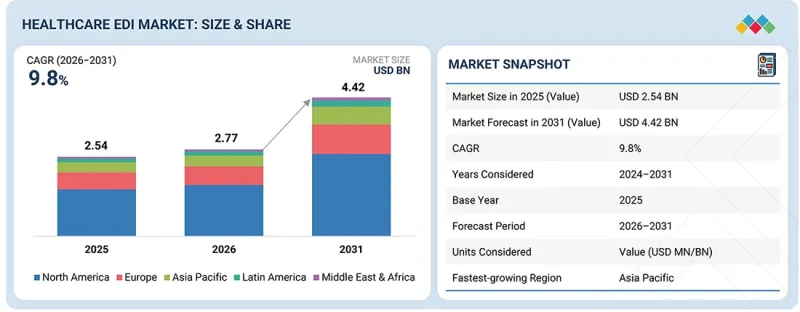
세계의 헬스케어 EDI 시장 규모는 2026년 27억 7,000만 달러에서 2031년까지 44억 2,000만 달러에 달할 것으로 예측되고 있으며, CAGR은 9.8%에 달할 전망입니다.
이 시장의 성장은 주로 청구서 제출, 피보험자 자격 및 급여 내용 확인, 청구 현황 확인, 사전 승인, 전자 송금, 지급 계상 등 의료 거래의 자동화에 대한 수요 증가에 힘입어 이루어지고 있습니다. 의료 제공자와 보험사는 종이 서류, 전화, 팩스를 통한 승인, 수작업 청구 업무 등에서 점차 벗어나고 있습니다. 이는 처리하는 데 시간이 오래 걸리고, 비용이 많이 들며, 실수가 발생하기 쉽기 때문입니다. EDI는 조직이 표준화된 형식으로 데이터를 교환하여 청구 거절을 줄이고, 환급 절차를 신속하게 처리하며, 매출 주기의 효율성을 높이는 데 도움이 됩니다.
| 조사 범위 | |
|---|---|
| 조사 대상 기간 | 2026-2031년 |
| 기준연도 | 2025년 |
| 예측 기간 | 2026-2031년 |
| 산정 단위 | 금액(10억 달러) |
| 부문 | 오퍼링별, 접속 방식별, 배포 모델별, 최종사용자별, 지역별 |
| 대상 지역 | 제공 서비스, 접속 방식, 배포 모델, 최종사용자 |
이 시장은 청산소 네트워크, 클라우드 기반 EDI 플랫폼, 관리형 EDI 서비스 및 API 지원 워크플로우의 활용 확대에 힘입어 더욱 성장하고 있습니다. 이러한 솔루션은 병원, 진료소, 보험사, 약국 및 정보교환센터가 대량의 거래를 더 높은 정확도와 가시성을 바탕으로 처리하는 데 도움을 주고 있습니다. 청구 및 환급 절차가 복잡한 의료 업계에서는 안전하고 전자적이며 상호 운용 가능한 데이터 교환에 대한 필요성이 높아지고 있습니다. 이에 따라 보험사 및 의료 제공자 간의 의사소통, 청구 관리, 지급 업무, 그리고 관리 워크플로우의 자동화 분야에서 헬스케어 EDI 솔루션 도입이 확대되고 있습니다.
'2025년, 헬스케어 EDI 시장에서 VAN/클리어링하우스 기반 EDI가 가장 큰 점유율을 차지했습니다.'
연결 방식에 따라 헬스케어 EDI 시장은 VAN/클리어링하우스형 EDI, 포인트-투-포인트형 EDI, 웹 포털형 EDI, API 지원형 EDI 및 기타 방식으로 분류됩니다. 2025년에는 의료 제공자와 지급 기관이 대량의 거래 교환에 있으며, 여전히 청산소에 의존하고 있었기 때문에 VAN/청산소형 EDI 부문이 가장 큰 점유율을 차지했습니다. 이러한 플랫폼은 병원, 진료소, 지급 기관, 약국 및 청구 담당 팀이 청구, 수급 자격 확인, 청구 현황 조회, 사전 승인, 전자 송금 및 지급 관련 데이터를 표준 형식으로 송수신하는 데 도움이 됩니다. VAN/청산소 기반의 EDI가 여전히 널리 이용되고 있는 이유는 의료 서비스 제공자가 모든 지급 기관과 직접 연결을 구축해야 하는 부담을 줄일 수 있기 때문입니다. 또한 거래 검증, 청구 데이터 편집, 결제 기관별 형식 지원, 오류 확인 및 안전한 라우팅도 지원합니다. 이로 인해 여러 지급 기관과의 관계를 관리하고 매일 대량의 청구 처리를 수행하는 의료 제공자에게 실용적인 선택지가 되고 있습니다.
'예측 기간 중 클라우드 기반 도입 부문이 가장 빠른 성장세를 보일 것으로 예상됩니다.'
구현 모델별로는 헬스케어 EDI 시장이 클라우드형, 온프레미스형, 하이브리드형으로 분류됩니다. 이 중 클라우드 기반 부문은 예측 기간 중 가장 빠른 성장세를 보일 것으로 예상됩니다. 이러한 성장은 주로 확장성이 뛰어나고 접근성이 좋으며 유지보수 부담이 적은 EDI 플랫폼에 대한 수요에 힘입어 이루어지고 있습니다. 클라우드 기반 EDI를 통해 의료 기관은 대규모 온프레미스 IT 인프라를 유지 관리할 필요 없이 청구, 피보험자 자격 확인, 사전 승인, 송금 내역 및 지급 계상을 관리할 수 있습니다. 또한 지급 기관의 규정, 규정 준수 요건 또는 거래 기준이 변경되었을 때, 공급업체가 업데이트를 보다 신속하게 적용하는 데에도 도움이 됩니다. 중소규모 의료 제공자들은 초기 비용을 절감하고, 지불 기관 및 청산 기관과의 연계를 신속하게 진행할 수 있다는 점에서 클라우드 기반 플랫폼을 점점 더 많이 선택하고 있습니다. 의료 기관들이 실시간 거래, 관리형 서비스, API 지원 워크플로로 전환함에 따라 클라우드 배포는 기존의 온프레미스형 시스템보다 훨씬 빠르게 확대될 전망입니다.
'예측 기간 중 아시아태평양이 가장 높은 성장률을 기록할 것으로 전망됩니다.'
아시아태평양은 예측 기간 중 헬스케어 EDI 시장에서 가장 높은 성장률을 보일 것으로 예상됩니다. 이러한 성장은 주로 의료 분야의 디지털화 진전, 민간 보험 가입률 상승, 병원 네트워크 확대, 그리고 청구 및 지급 업무 프로세스 자동화에 대한 수요 증가에 힘입어 이루어지고 있습니다. 인도, 중국, 일본, 한국, 호주 등 여러 국가에서는 청구, 보험 확인, 보험금 청구 및 환급을 위한 전자 시스템의 활용이 점차 확대되고 있습니다. 환자 수가 증가하고 의료 제공자가 더 많은 공적·민간 보험사와 거래를 맺게 됨에 따라 이 지역 전체에서 보험사와 의료 제공자 간의 데이터 교환이 보다 신속하고 정확하게 이루어져야 할 필요성이 커지고 있습니다. 인도와 중국은 방대한 환자 기반, 확대되는 건강보험 제도, 그리고 병원 정보 시스템 및 클라우드 기반 의료 플랫폼의 도입 확대에 힘입어 중요한 성장 시장으로 부상하고 있습니다. 일본, 한국, 호주 역시 견고한 의료 IT 인프라, 성숙한 보험 제도, 그리고 행정 업무 부담 경감에 주력함으로써 시장 성장에 기여하고 있습니다. 또한 지역 의료기관에서는 수작업에 의한 사무 처리 감소, 청구 정확도 향상, 수급 자격 확인의 신속화, 그리고 전자 송금 워크플로우 지원을 목적으로 EDI 도입이 진행되고 있습니다. 클라우드 기반 EDI, 관리형 EDI 서비스, 청산소와의 연결, 그리고 API를 활용한 데이터 교환의 이용 확대가 아시아태평양의 시장 성장을 더욱 촉진할 것으로 예상됩니다.
Optum, Inc.(미국), Availity, LLC(미국), Waystar Holding Corp.(미국), Cognizant Technology Solutions Corporation(미국) 및 Experian Information Solutions, Inc.(미국)는 헬스케어 EDI 시장의 주요 기업입니다.
- 본 조사에서는 헬스케어 EDI 시장의 주요 기업에 대해 기업 개요, 최근 동향 및 주요 시장 전략을 포함한 상세한 경쟁 분석을 수행하고 있습니다.
조사 범위
본 조사 보고서에서는 헬스케어 EDI 시장을 제공 항목(솔루션, 서비스), 연결 방식(VAN/클리어링하우스형 EDI, 포인트-투-포인트형 EDI, 웹 포털형 EDI, API 지원 EDI, 기타), 전개 모델(클라우드형, 온프레미스형, 하이브리드형), 최종사용자(의료 제공자, 의료 보험자, 기타 최종사용자) 및 지역(북미, 유럽, 아시아태평양, 라틴아메리카, 중동 및 아프리카)별로 분류하고 있습니다. 이 보고서의 조사 범위에는 헬스케어 EDI 시장의 성장에 영향을 미치는 주요 요인(촉진요인, 제약 요인, 과제, 기회 등)에 대한 상세한 정보가 포함되어 있습니다. 주요 업계 업체에 대한 상세한 분석을 통해 각 기업의 사업 개요, 솔루션 및 서비스, 주요 전략, 계약·제휴·합의, 신제품·서비스 출시, 합병·인수, 그리고 헬스케어 EDI 시장의 최근 동향에 대한 인사이트를 제공합니다. 이 보고서에서는 헬스케어 EDI 시장 생태계내 신생 기업 및 기존 기업의 경쟁 분석을 포괄적으로 다루고 있습니다.
이 보고서를 구매해야 하는 이유
이 보고서는 헬스케어 EDI 시장 및 그 하위 부문의 매출에 관한 가장 정확한 추정치를 제공함으로써, 이 시장의 선도 기업과 신규 진입 기업을 지원합니다. 이 보고서는 이해관계자들이 경쟁 구도를 이해하고, 자사의 비즈니스를 더 나은 위치로 이끌며, 적절한 시장 진입 전략을 수립하는 데 필요한 인사이트를 얻는 데 도움이 됩니다. 또한 이 보고서는 이해관계자들이 시장 동향을 파악할 수 있도록 지원하며, 주요 시장 촉진요인, 억제요인, 과제 및 기회에 대한 정보를 제공합니다.
이 보고서에서는 다음 사항에 대한 인사이트를 제공합니다. :
- 이 보고서에서는 주요 촉진요인(거래 프로세스를 지원하는 규제, 의료비 억제에 대한 요구 증가, 헬스케어 EDI 소프트웨어가 초래하는 비용 절감 및 업무 효율 향상, 합리화된 청구 관리에 대한 수요 증가, API 통합을 통한 청구 관리 신속화) , 제약 요인(데이터 보안에 대한 우려 및 높은 소프트웨어 도입 비용), 기회(EDI 서비스 아웃소싱 증가 추세, ICD-11 가이드라인 채택, 실시간 데이터 교환의 이점, 원격의료 및 원격 모니터링 기능의 확대), 그리고 과제(의료 IT 솔루션의 통합, 최종사용자의 제약 및 요구 사항, 레거시 시스템의 상호 운용성 문제, 거래에 수반되는 복잡성)에 대해 헬스케어 EDI 시장의 성장에 영향을 미치는 요인에 대한 인사이트를 제공합니다.
- 제품 개발/혁신: 헬스케어 EDI 시장의 향후 기술, 연구개발 활동 및 신제품·서비스 출시에 관한 상세 인사이트
- 시장 개발: 수익성이 높은 시장에 대한 포괄적인 정보. 이 보고서에서는 다양한 지역에 걸친 헬스케어 EDI 시장을 분석하고 있습니다.
- 시장의 다양화: 헬스케어 EDI 시장의 신제품·서비스, 미개발 지역, 최근 동향 및 투자에 관한 포괄적인 정보
- 경쟁사 분석: Optum, Inc.(미국), Availity, LLC(미국), Waystar Holding Corp.(미국), Cognizant Technology Solutions Corporation(미국), Experian Information Solutions, Inc.(미국) 등, 헬스케어 EDI 시장 주요 기업의 시장 점유율, 성장 전략 및 서비스 제공에 대한 상세한 평가
자주 묻는 질문
목차
제1장 서론
제2장 개요
제3장 주요 인사이트
제4장 시장 개요
제5장 업계 동향
제6장 기술, 특허, 디지털 기술, AI의 도입에 의한 전략적 파괴
제7장 규제 상황
제8장 고객 상황과 구매 행동
제9장 헬스케어 EDI 시장(오퍼링별)
제10장 헬스케어 EDI 시장(접속 방식별)
제11장 헬스케어 EDI 시장(배포 모델별)
제12장 헬스케어 EDI 시장(최종사용자별)
제13장 헬스케어 EDI 시장(지역별)
제14장 경쟁 구도
제15장 기업 개요
제16장 조사 방법
제17장 부록
KSA 26.07.14The global healthcare EDI market is projected to reach USD 4.42 billion by 2031 from USD 2.77 billion in 2026, at a CAGR of 9.8%. Growth in the market is mainly driven by the rising need to automate healthcare transactions such as claims submission, eligibility and benefits verification, claim status checks, prior authorization, electronic remittance, and payment posting. Healthcare providers and payers are increasingly moving away from paper forms, phone calls, fax-based approvals, and manual billing work because these methods are slow, costly, and error-prone. EDI helps organizations exchange data in a standard format, reduce claim denials, speed up reimbursements, and improve revenue cycle efficiency.
| Scope of the Report | |
|---|---|
| Years Considered for the Study | 2026-2031 |
| Base Year | 2025 |
| Forecast Period | 2026-2031 |
| Units Considered | Value (USD billion) |
| Segments | Offering, Connectivity Mode, Deployment Model, End User |
| Regions covered | Offering, Connectivity Mode, Deployment Model, End User |
The market is further supported by the growing use of clearinghouse networks, cloud-based EDI platforms, managed EDI services, and API-enabled workflows. These solutions help hospitals, clinics, payers, pharmacies, and clearinghouses handle large transaction volumes with better accuracy and visibility. In the healthcare industry, which has complex billing and reimbursement processes, there is a rising need for secure, electronic, and interoperable data exchange. This is driving the adoption of healthcare EDI solutions across payer-provider communication, claims management, payment operations, and administrative workflow automation.
"VAN/clearinghouse-based EDI accounted for the largest share of the healthcare EDI market in 2025."
Based on connectivity mode, the healthcare EDI market is divided into VAN/clearinghouse-based EDI, point-to-point EDI, web portal-based EDI, API-enabled EDI, and other modes. The VAN/clearinghouse-based EDI segment accounted for the largest share in 2025, as healthcare providers and payers continue to depend on clearinghouses for high-volume transaction exchange. These platforms help hospitals, clinics, payers, pharmacies, and billing teams send and receive claims, eligibility checks, claim status requests, prior authorizations, electronic remittance, and payment-related data in a standard format. VAN/clearinghouse-based EDI remains widely used because it reduces the need for providers to build direct links with every payer. It also supports transaction validation, claim edits, payer-specific formatting, error checks, and secure routing. This makes it a practical option for providers managing multiple payer relationships and large daily billing volumes.
"Cloud-based deployment segment is expected to register the fastest growth during the forecast period."
Based on deployment model, the healthcare EDI market is segmented into cloud-based, on-premises, and hybrid models. Of these, the cloud-based segment is expected to record the fastest growth during the forecast period. The growth is mainly driven by the need for scalable, easy-to-access, and lower-maintenance EDI platforms. Cloud-based EDI allows healthcare organizations to manage claims, eligibility verification, prior authorization, remittance, and payment posting without maintaining heavy local IT infrastructure. It also helps vendors roll out updates more quickly when payer rules, compliance requirements, or transaction standards change. Small and mid-sized providers are increasingly choosing cloud-based platforms because they reduce upfront costs and support faster onboarding with payers and clearinghouses. As healthcare organizations move toward real-time transactions, managed services, and API-enabled workflows, cloud deployment is likely to grow faster than traditional on-premises systems.
"APAC to witness the highest growth rate during the forecast period."
The Asia Pacific is expected to witness the highest growth in the healthcare EDI market during the forecast period. The growth is mainly supported by increasing healthcare digitization, rising private insurance coverage, expanding hospital networks, and the growing need to automate claims and payment workflows. Countries such as India, China, Japan, South Korea, and Australia are gradually increasing the use of electronic systems for billing, insurance verification, claims submission, and reimbursement. As patient volumes rise and healthcare providers work with more public and private payers, the need for faster, more accurate payer-provider data exchange is growing across the region. India and China are emerging as important growth markets due to their large patient base, expanding health insurance programs, and growing adoption of hospital information systems and cloud-based healthcare platforms. Japan, South Korea, and Australia are also contributing to growth because of their stronger healthcare IT infrastructure, mature insurance systems, and focus on reducing administrative burden. In addition, regional healthcare organizations are adopting EDI to reduce manual paperwork, improve claim accuracy, speed up eligibility checks, and support electronic remittance workflows. The increasing use of cloud-based EDI, managed EDI services, clearinghouse connectivity, and API-enabled data exchange is expected to further support market growth in the Asia Pacific.
The breakdown of primary participants is as follows:
- By Company Type - Tier 1: 60%, Tier 2: 30%, and Tier 3: 10%
- By Designation - C-level: 30%, Director-level: 50%, and Others: 20%
- By Region - North America: 45%, Europe: 20%, Asia Pacific: 25%, Rest of the world: 10%.
Optum, Inc. (US), Availity, LLC (US), Waystar Holding Corp. (US), Cognizant Technology Solutions Corporation (US), and Experian Information Solutions, Inc. (US) are among the key players in the healthcare EDI market.
- The study includes an in-depth competitive analysis of these key players in the healthcare EDI market, with their company profiles, recent developments, and key market strategies.
Research Coverage
This research report categorizes the healthcare EDI market by offering (solutions, services), connectivity mode (VAN/clearinghouse-based EDI, point-to-point EDI, web portal-based EDI, API-enabled EDI, others), deployment model (cloud-based, on-premises, hybrid), and end user (healthcare providers, healthcare payers, other end users), and region (North America, Europe, Asia Pacific, Latin America, and Middle East & Africa). The scope of the report covers detailed information regarding the major factors, such as drivers, restraints, challenges, and opportunities, influencing the growth of the healthcare EDI market. A detailed analysis of the key industry players has been conducted to provide insights into their business overviews, solutions and services; key strategies; contracts, partnerships, agreements; new product & service launches; mergers & acquisitions; and recent developments in the healthcare EDI market. This report covers the competitive analysis of emerging and established players in the healthcare EDI market ecosystem.
Reasons to buy this report
The report will help the market leaders/new entrants in this market with information on the closest approximations of the revenue numbers for the healthcare EDI market and the subsegments. This report will help stakeholders understand the competitive landscape and gain insights to better position their businesses and plan suitable go-to-market strategies. The report also helps stakeholders understand the pulse of the market and provides them with information on key market drivers, restraints, challenges, and opportunities.
The report provides insights into the following pointers:
- The report provides insights on the key drivers (supportive regulations for transaction processes, growing requirement to curb healthcare costs, low-cost and improved operational efficiency offered by healthcare EDI software, increasing demand for streamlined claims management, and acceleration of claims management with API integration), restraints (concerns associated with data security and high software implementation costs), opportunities (rising trend of outsourcing EDI services, adoption of ICD-11 guidelines, benefits of real-time data exchange, and expansion of telehealth and remote monitoring capabilities), and challenges (integration of healthcare IT solutions, end-user limitations and requirements, interoperability issues in legacy systems, and complexities associated with transactions) influencing the growth of the healthcare EDI market.
- Product Development/Innovation: Detailed insights on upcoming technologies, research & development activities, and new product & service launches in the healthcare EDI market
- Market Development: Comprehensive information about lucrative markets; the report analyzes the healthcare EDI market across varied regions.
- Market Diversification: Exhaustive information about new products & services, untapped geographies, recent developments, and investments in the healthcare EDI market
- Competitive Assessment: In-depth assessment of market shares, growth strategies, and service offerings of leading players like Optum, Inc. (US), Availity, LLC (US), Waystar Holding Corp. (US), Cognizant Technology Solutions Corporation (US), Experian Information Solutions, Inc. (US), among others, in the healthcare EDI market
TABLE OF CONTENTS
1 INTRODUCTION
- 1.1 STUDY OBJECTIVES
- 1.2 MARKET DEFINITION
- 1.3 MARKET SCOPE
- 1.3.1 MARKET SEGMENTATION & REGIONAL SCOPE
- 1.3.2 INCLUSIONS & EXCLUSIONS
- 1.3.3 YEARS CONSIDERED
- 1.4 CURRENCY CONSIDERED
- 1.5 LIMITATIONS
- 1.6 STAKEHOLDERS
- 1.7 SUMMARY OF CHANGES
2 EXECUTIVE SUMMARY
- 2.1 KEY INSIGHTS AND MARKET HIGHLIGHTS
- 2.2 KEY MARKET PARTICIPANTS: SHARE INSIGHTS AND STRATEGIC DEVELOPMENTS
- 2.3 DISRUPTIVE TRENDS SHAPING MARKET
- 2.4 HIGH-GROWTH SEGMENTS & EMERGING FRONTIERS
- 2.5 SNAPSHOT: GLOBAL MARKET SIZE, GROWTH RATE, AND FORECAST
3 PREMIUM INSIGHTS
- 3.1 HEALTHCARE EDI MARKET OVERVIEW
- 3.2 HEALTHCARE EDI MARKET, BY OFFERING & REGION
- 3.3 HEALTHCARE EDI MARKET: GEOGRAPHIC SNAPSHOT
4 MARKET OVERVIEW
- 4.1 INTRODUCTION
- 4.2 MARKET DYNAMICS
- 4.2.1 DRIVERS
- 4.2.1.1 Supportive regulations for transaction processes
- 4.2.1.2 Growing requirement to curb healthcare costs
- 4.2.1.3 Low cost and improved operational efficiency associated with healthcare EDI software
- 4.2.1.4 Increasing demand for streamlined claims management
- 4.2.1.5 API integration accelerating claims management
- 4.2.2 RESTRAINTS
- 4.2.2.1 Concerns associated with data security
- 4.2.2.2 High software implementation costs
- 4.2.3 OPPORTUNITIES
- 4.2.3.1 Rising trend of outsourcing EDI services
- 4.2.3.2 Adoption of ICD-11 guidelines
- 4.2.3.3 Utilizing real-time data exchange
- 4.2.3.4 Expansion of telehealth and remote monitoring capabilities
- 4.2.4 CHALLENGES
- 4.2.4.1 Integration of healthcare IT solutions
- 4.2.4.2 End-user limitations & requirements
- 4.2.4.3 Interoperability issues in legacy systems
- 4.2.4.4 Complexities associated with transactions
- 4.2.1 DRIVERS
- 4.3 UNMET NEEDS AND WHITE SPACES
- 4.4 INTERCONNECTED MARKETS AND CROSS-SECTOR OPPORTUNITIES
- 4.5 STRATEGIC MOVES BY TIER-1/2/3 PLAYERS
5 INDUSTRY TRENDS
- 5.1 PORTER'S FIVE FORCES ANALYSIS
- 5.1.1 BARGAINING POWER OF SUPPLIERS
- 5.1.2 BARGAINING POWER OF BUYERS
- 5.1.3 THREAT OF SUBSTITUTES
- 5.1.4 THREAT OF NEW ENTRANTS
- 5.1.5 INTENSITY OF COMPETITIVE RIVALRY
- 5.2 MACROECONOMIC INDICATORS
- 5.2.1 INTRODUCTION
- 5.2.2 GDP TRENDS AND FORECAST
- 5.2.3 TRENDS IN GLOBAL HEALTHCARE IT INDUSTRY
- 5.3 VALUE CHAIN ANALYSIS
- 5.3.1 RESEARCH & PRODUCT DEVELOPMENT
- 5.3.2 TECHNOLOGY INPUTS AND INFRASTRUCTURE
- 5.3.3 PLATFORM DEVELOPMENT AND INTEGRATION
- 5.3.4 DISTRIBUTION
- 5.3.5 MARKETING AND SALES
- 5.3.6 POST-SALES SERVICES
- 5.4 ECOSYSTEM ANALYSIS
- 5.5 PRICING ANALYSIS
- 5.5.1 INDICATIVE PRICE FOR HEALTHCARE EDI SOLUTIONS, BY OFFERING (2025)
- 5.5.2 INDICATIVE PRICE OF HEALTHCARE EDI SOLUTIONS, BY REGION (2025)
- 5.6 KEY CONFERENCES AND EVENTS, 2026-2027
- 5.7 TRENDS/DISRUPTIONS IMPACTING CUSTOMER BUSINESS
- 5.8 INVESTMENT AND FUNDING SCENARIO
- 5.9 CASE STUDY ANALYSIS
- 5.10 IMPACT OF 2025 US TARIFF - HEALTHCARE EDI MARKET
- 5.10.1 INTRODUCTION
- 5.10.2 KEY TARIFF RATES
- 5.10.3 PRICE IMPACT ANALYSIS
- 5.10.4 IMPACT ON COUNTRY/REGION
- 5.10.4.1 US
- 5.10.4.2 Europe
- 5.10.4.3 Asia Pacific
- 5.10.5 IMPACT ON END-USE INDUSTRIES
- 5.10.5.1 Healthcare providers
- 5.10.5.2 Healthcare payers
- 5.10.5.3 Healthcare clearinghouses
- 5.10.5.4 Pharmacies and PBMs
- 5.10.5.5 Other end users
6 STRATEGIC DISRUPTION THROUGH TECHNOLOGY, PATENTS, DIGITAL, AND AI ADOPTION
- 6.1 KEY EMERGING TECHNOLOGIES
- 6.1.1 FHIR-BASED APIS/API-ENABLED EDI
- 6.1.2 AI/MACHINE LEARNING FOR EDI AUTOMATION
- 6.1.3 ELECTRONIC CLAIMS ATTACHMENTS/DIGITAL DOCUMENTATION EXCHANGE
- 6.2 COMPLEMENTARY TECHNOLOGIES
- 6.2.1 EHR/PRACTICE MANAGEMENT SYSTEM INTEGRATION
- 6.2.2 REVENUE CYCLE MANAGEMENT PLATFORMS
- 6.3 ADJACENT TECHNOLOGIES
- 6.3.1 HEALTHCARE INTEROPERABILITY PLATFORMS/HEALTH INFORMATION EXCHANGES
- 6.3.2 HEALTHCARE PAYMENT & EFT PLATFORMS
- 6.4 TECHNOLOGY/PRODUCT ROADMAP
- 6.5 PATENT ANALYSIS
- 6.5.1 PATENT PUBLICATION TRENDS FOR HEALTHCARE EDI MARKET
- 6.5.2 INSIGHTS: JURISDICTION AND TOP APPLICANT ANALYSIS
- 6.6 FUTURE APPLICATIONS
- 6.6.1 AI-DRIVEN CLAIMS PROCESSING AND DECISION AUTOMATION
- 6.6.2 REAL-TIME INTEROPERABILITY AND API-ENABLED DATA EXCHANGE
- 6.6.3 INTELLIGENT REVENUE CYCLE AND PAYMENT MANAGEMENT
- 6.7 IMPACT OF AI/GEN AI ON HEALTHCARE EDI MARKET
- 6.7.1 INTRODUCTION
- 6.7.2 MARKET POTENTIAL OF AI/GEN AI IN HEALTHCARE EDI MARKET
- 6.7.3 CASE STUDIES RELATED TO AI/GEN AI IMPLEMENTATION
- 6.7.3.1 AI-powered claims management and revenue cycle optimization at Sentara Health
- 6.7.4 IMPACT OF AI/GEN AI ON INTERCONNECTED AND ADJACENT ECOSYSTEMS
- 6.7.4.1 Revenue cycle management market
- 6.7.4.2 Healthcare interoperability market
- 6.7.4.3 Healthcare claims management market
- 6.7.5 USER READINESS AND IMPACT ASSESSMENT
- 6.7.5.1 User readiness
- 6.7.5.1.1 Healthcare providers
- 6.7.5.1.2 Healthcare payers
- 6.7.5.2 Impact assessment
- 6.7.5.2.1 User A: Healthcare providers
- 6.7.5.2.1.1 Implementation
- 6.7.5.2.1.2 Impact
- 6.7.5.2.2 User B: Healthcare payers
- 6.7.5.2.2.1 Implementation
- 6.7.5.2.2.2 Impact
- 6.7.5.2.1 User A: Healthcare providers
- 6.7.5.1 User readiness
7 REGULATORY LANDSCAPE
- 7.1 REGIONAL REGULATIONS AND COMPLIANCE
- 7.1.1 REGULATORY BODIES, GOVERNMENT AGENCIES, AND OTHER ORGANIZATIONS
- 7.1.2 REGULATORY FRAMEWORK
- 7.1.2.1 North America
- 7.1.2.2 Europe
- 7.1.2.3 Asia Pacific
- 7.1.2.4 Latin America
- 7.1.2.5 Middle East & Africa
- 7.1.3 INDUSTRY STANDARDS
8 CUSTOMER LANDSCAPE & BUYER BEHAVIOR
- 8.1 INTRODUCTION
- 8.2 DECISION-MAKING PROCESS
- 8.3 BUYER STAKEHOLDERS AND BUYING EVALUATION CRITERIA
- 8.3.1 KEY STAKEHOLDERS IN BUYING PROCESS
- 8.3.2 BUYING CRITERIA
- 8.4 ADOPTION BARRIERS & INTERNAL CHALLENGES
- 8.5 UNMET NEEDS FROM VARIOUS END-USE INDUSTRIES
- 8.5.1 UNMET NEEDS
- 8.5.2 END-USER EXPECTATIONS
- 8.6 MARKET PROFITABILITY
9 HEALTHCARE EDI MARKET, BY OFFERING
- 9.1 INTRODUCTION
- 9.2 SOLUTIONS
- 9.2.1 EDI CLEARINGHOUSE SOLUTIONS
- 9.2.1.1 Payer-network scale, post-disruption resilience, and FHIR evolution sustain network-mediated platform demand
- 9.2.2 CLAIMS MANAGEMENT SOLUTIONS
- 9.2.2.1 AI-powered denial prevention converts first-pass accuracy into measurable financial performance metric
- 9.2.3 ELIGIBILITY & BENEFITS VERIFICATION SOLUTIONS
- 9.2.3.1 Front-end coverage precision prevents upstream error that generates majority of downstream denials
- 9.2.4 PRIOR AUTHORIZATION & REFERRAL MANAGEMENT SOLUTIONS
- 9.2.4.1 Federal API mandates convert most manual healthcare workflow into electronically mandated process
- 9.2.5 ELECTRONIC REMITTANCE & PAYMENT POSTING SOLUTIONS
- 9.2.5.1 Multi-trillion dollar electronic payment volumes and fraud risk validate strategic migration to automated posting
- 9.2.6 OTHER SOLUTIONS
- 9.2.6.1 Electronic claim attachments and workflow analytics extend EDI value chain beyond core transactions
- 9.2.1 EDI CLEARINGHOUSE SOLUTIONS
- 9.3 SERVICES
- 9.3.1 REGULATORY DEADLINES, DIGITAL TRANSFORMATION BACKLOGS, AND WORKFORCE GAPS GENERATE SERVICES DEMAND
- 9.3.2 IMPLEMENTATION & INTEGRATION SERVICES
- 9.3.2.1 EHR replatforming and FHIR API builds create concurrent multi-year integration project backlogs
- 9.3.3 MANAGED EDI SERVICES
- 9.3.3.1 Operational risk and revenue-cycle staffing shortages accelerate outsourcing of transaction management
- 9.3.4 SUPPORT & MAINTENANCE SERVICES
- 9.3.4.1 Perpetual payer-rule evolution and annual code-set updates make EDI maintenance non-discretionary
- 9.3.5 CONSULTING & COMPLIANCE SERVICES
- 9.3.5.1 Cascading federal interoperability deadlines generate an immediate and multi-year compliance advisory pipeline
- 9.3.6 OTHER SERVICES
- 9.3.6.1 Network onboarding, platform migration, and custom mapping accelerate as organizations diversify and modernize
10 HEALTHCARE EDI MARKET, BY CONNECTIVITY MODE
- 10.1 INTRODUCTION
- 10.2 VAN/CLEARINGHOUSE-BASED EDI
- 10.2.1 SINGLE-CONNECTION PAYERS AND POST-DISRUPTION RESILIENCE INVESTMENT SUSTAIN DOMINANT NETWORK-MEDIATED VOLUMES
- 10.3 POINT-TO-POINT EDI
- 10.3.1 ENTERPRISE VOLUME ECONOMICS AND INTEGRATION-PLATFORM DEPLOYMENTS SUSTAIN DIRECT BILATERAL CONNECTIVITY
- 10.4 WEB PORTAL-BASED EDI
- 10.4.1 BROWSER-BASED ACCESS SERVES LOW-VOLUME PROVIDERS AND ACTS AS AUTOMATION TRANSITION PATHWAY
- 10.5 API-ENABLED EDI
- 10.5.1 FHIR API MANDATES MAKE REAL-TIME PROGRAMMATIC EXCHANGE FASTEST-GROWING AND MOST STRATEGICALLY URGENT MODE
- 10.6 OTHER CONNECTIVITY MODES
- 10.6.1 SECURE BULK FILE EXCHANGE AND HYBRID ARCHITECTURES SERVE LARGE-BATCH WORKLOADS DURING MULTI-YEAR MODERNIZATION
11 HEALTHCARE EDI MARKET, BY DEPLOYMENT MODEL
- 11.1 INTRODUCTION
- 11.2 CLOUD-BASED
- 11.2.1 SCALABILITY, AI DELIVERY, AND POST-OUTAGE RESILIENCE INVESTMENT ESTABLISH CLOUD AS MARKET'S DOMINANT DEPLOYMENT MODEL
- 11.3 ON-PREMISES
- 11.3.1 DATA SOVEREIGNTY, SECURITY MANDATES, AND LEGACY INTEGRATION DEPTH SUSTAIN ON-SITE DEPLOYMENT AT ENTERPRISE PAYERS
- 11.4 HYBRID
- 11.4.1 PHASED MODERNIZATION DELIVERS FHIR API COMPLIANCE WITHOUT DISRUPTING MISSION-CRITICAL LEGACY BATCH INFRASTRUCTURE
12 HEALTHCARE EDI MARKET, BY END USER
- 12.1 INTRODUCTION
- 12.2 HEALTHCARE PROVIDERS
- 12.2.1 HOSPITALS & CLINICS
- 12.2.1.1 Institutional billing complexity and enterprise revenue scale justify deep EDI investment across claims lifecycle
- 12.2.2 AMBULATORY SURGICAL CENTERS
- 12.2.2.1 High-value procedures and mandatory pre-authorization make automation central to ASC financial performance
- 12.2.3 DIAGNOSTIC CENTERS & LABORATORIES
- 12.2.3.1 Ultra-high claim volumes at thin margins make per-transaction automation economics decisive for laboratory profitability
- 12.2.4 OTHER HEALTHCARE PROVIDERS
- 12.2.4.1 Parity enforcement, dental practice expansion, and post-acute growth extend EDI into historically underdigitized care settings
- 12.2.1 HOSPITALS & CLINICS
- 12.3 HEALTHCARE PAYERS
- 12.3.1 FEDERAL API COMPLIANCE OBLIGATIONS AND PAYMENT-ACCURACY IMPERATIVES COMPEL COMPREHENSIVE PAYER-SIDE EDI MODERNIZATION
- 12.3.2 PRIVATE PAYERS
- 12.3.2.1 Competitive efficiency and provider experience quality drive commercial-plan investment in EDI modernization
- 12.3.3 PUBLIC PAYERS
- 12.3.3.1 Federal mandates and modernization funding catalyze electronic exchange across government health programs
- 12.4 HEALTHCARE CLEARINGHOUSES
- 12.4.1 SECURITY INVESTMENT AND FHIR EVOLUTION SIMULTANEOUSLY DEFEND AND TRANSFORM CLEARINGHOUSE BUSINESS MODEL
- 12.5 PHARMACIES & PBMS
- 12.5.1 REAL-TIME PRESCRIPTION TRANSACTIONS AND ELECTRONIC PRIOR AUTHORIZATION SUSTAIN ULTRA-HIGH-VELOCITY PHARMACY-SECTOR EDI
- 12.6 OTHER END USERS
- 12.6.1 RCM OUTSOURCERS, DIGITAL-HEALTH COMPANIES, AND SUPPLY-CHAIN ORGANIZATIONS BROADEN EDI TRANSACTION BASE
13 HEALTHCARE EDI MARKET, BY REGION
- 13.1 INTRODUCTION
- 13.2 NORTH AMERICA
- 13.2.1 MACROECONOMIC OUTLOOK FOR NORTH AMERICA
- 13.2.2 US
- 13.2.2.1 Regulatory compliance and administrative automation driving healthcare EDI adoption
- 13.2.3 CANADA
- 13.2.3.1 Interoperability initiatives and digital health transformation support healthcare EDI growth
- 13.3 EUROPE
- 13.3.1 MACROECONOMIC OUTLOOK FOR EUROPE
- 13.3.2 GERMANY
- 13.3.2.1 Health Data Act and digital health infrastructure driving healthcare EDI adoption
- 13.3.3 FRANCE
- 13.3.3.1 National Digital Health Strategy and health data exchange initiatives driving healthcare EDI adoption
- 13.3.4 UK
- 13.3.4.1 NHS digital transformation and interoperability initiatives accelerating healthcare EDI adoption
- 13.3.5 ITALY
- 13.3.5.1 Digital health infrastructure investments and FSE expansion transforming healthcare data exchange
- 13.3.6 SPAIN
- 13.3.6.1 National digital health strategy and interoperability infrastructure modernization to boost market
- 13.3.7 REST OF EUROPE
- 13.4 ASIA PACIFIC
- 13.4.1 MACROECONOMIC OUTLOOK FOR ASIA PACIFIC
- 13.4.2 CHINA
- 13.4.2.1 Healthcare insurance expansion and digital health infrastructure modernization
- 13.4.3 JAPAN
- 13.4.3.1 Healthcare DX initiatives and national health insurance digitalization driving healthcare interoperability
- 13.4.4 INDIA
- 13.4.4.1 Ayushman Bharat Digital Mission (ABDM) and National Health Claims Exchange (NHCX) advancing healthcare interoperability
- 13.4.5 AUSTRALIA
- 13.4.5.1 National Digital Health Strategy and interoperability initiatives strengthening healthcare data exchange
- 13.4.6 SOUTH KOREA
- 13.4.6.1 Digital health policy and national interoperability initiatives accelerating healthcare data exchange
- 13.4.7 REST OF ASIA PACIFIC
- 13.5 LATIN AMERICA
- 13.5.1 MACROECONOMIC OUTLOOK FOR LATIN AMERICA
- 13.5.2 BRAZIL
- 13.5.2.1 National Health Data Network (RNDS) and digital health transformation strengthening healthcare interoperability
- 13.5.3 MEXICO
- 13.5.3.1 Healthcare interoperability initiatives and electronic health record modernization to facilitate market growth
- 13.5.4 REST OF LATIN AMERICA
- 13.6 MIDDLE EAST & AFRICA
- 13.6.1 MACROECONOMIC OUTLOOK FOR MIDDLE EAST & AFRICA
- 13.6.2 GCC COUNTRIES
- 13.6.2.1 SAUDI ARABIA
- 13.6.2.1.1 National Health Information Exchange (NPHIES) and Vision 2030 accelerating healthcare interoperability
- 13.6.2.2 UAE
- 13.6.2.2.1 National health information exchange initiatives and digital health strategy advancing healthcare interoperability
- 13.6.2.3 Other GCC Countries
- 13.6.2.3.1 National digital health strategies and interoperability initiatives strengthening healthcare data exchange
- 13.6.2.1 SAUDI ARABIA
- 13.6.3 SOUTH AFRICA
- 13.6.3.1 National health insurance reforms and healthcare digitalization driving market
- 13.6.4 REST OF MIDDLE EAST & AFRICA
14 COMPETITIVE LANDSCAPE
- 14.1 INTRODUCTION
- 14.2 KEY PLAYER STRATEGIES/RIGHT TO WIN
- 14.2.1 OVERVIEW OF STRATEGIES ADOPTED BY PLAYERS IN HEALTHCARE EDI MARKET
- 14.3 REVENUE SHARE ANALYSIS, 2021-2025
- 14.4 MARKET SHARE ANALYSIS, 2025
- 14.5 COMPANY EVALUATION MATRIX: KEY PLAYERS, 2025
- 14.5.1 STARS
- 14.5.2 PERVASIVE PLAYERS
- 14.5.3 EMERGING LEADERS
- 14.5.4 PARTICIPANTS
- 14.5.5 COMPANY FOOTPRINT: KEY PLAYERS, 2025
- 14.5.5.1 Company footprint
- 14.5.5.2 Region footprint
- 14.5.5.3 Offering footprint
- 14.5.5.4 Connectivity mode footprint
- 14.5.5.5 End user footprint
- 14.6 COMPANY EVALUATION MATRIX: STARTUPS /SMES, 2025
- 14.6.1 PROGRESSIVE COMPANIES
- 14.6.2 DYNAMIC COMPANIES
- 14.6.3 STARTING BLOCKS
- 14.6.4 RESPONSIVE COMPANIES
- 14.6.5 COMPETITIVE BENCHMARKING: STARTUPS/SMES, 2025
- 14.7 COMPANY VALUATION & FINANCIAL METRICS
- 14.7.1 FINANCIAL METRICS
- 14.7.2 COMPANY VALUATION
- 14.8 BRAND/SOFTWARE COMPARISON ANALYSIS
- 14.9 COMPETITIVE SCENARIO
- 14.9.1 PRODUCT LAUNCHES & DEVELOPMENTS
- 14.9.2 DEALS
15 COMPANY PROFILES
- 15.1 KEY PLAYERS
- 15.1.1 OPTUM INC.
- 15.1.1.1 Business overview
- 15.1.1.2 Products offered
- 15.1.1.3 Recent developments
- 15.1.1.3.1 Deals
- 15.1.1.3.2 Other developments
- 15.1.2 AVAILITY, LLC
- 15.1.2.1 Business overview
- 15.1.2.2 Products offered
- 15.1.2.3 Recent developments
- 15.1.2.3.1 Deals
- 15.1.3 WAYSTAR HOLDING CORP.
- 15.1.3.1 Business overview
- 15.1.3.2 Products offered
- 15.1.3.3 Recent developments
- 15.1.3.3.1 Product launches & approvals
- 15.1.3.3.2 Deals
- 15.1.4 COGNIZANT
- 15.1.4.1 Business overview
- 15.1.4.2 Products offered
- 15.1.4.3 Recent developments
- 15.1.4.3.1 Product launches & approvals
- 15.1.4.3.2 Deals
- 15.1.4.3.3 Other developments
- 15.1.5 MCKESSON CORPORATION
- 15.1.5.1 Business overview
- 15.1.5.2 Products offered
- 15.1.5.3 Recent developments
- 15.1.5.3.1 Other developments
- 15.1.6 EXPERIAN INFORMATION SOLUTIONS, INC.
- 15.1.6.1 Business overview
- 15.1.6.2 Products offered
- 15.1.6.3 Recent developments
- 15.1.6.3.1 Product launches & approvals
- 15.1.6.3.2 Other developments
- 15.1.7 INOVALON HOLDINGS, INC.
- 15.1.7.1 Business overview
- 15.1.7.2 Products offered
- 15.1.7.3 Recent developments
- 15.1.7.3.1 Product launches & approvals
- 15.1.7.3.2 Deals
- 15.1.8 ATHENAHEALTH GROUP, INC.
- 15.1.8.1 Business overview
- 15.1.8.2 Products offered
- 15.1.8.3 Recent developments
- 15.1.8.3.1 Product launches & approvals
- 15.1.9 VERADIGM INC.
- 15.1.9.1 Business overview
- 15.1.9.2 Products offered
- 15.1.9.3 Recent developments
- 15.1.9.3.1 Product launches & approvals
- 15.1.10 THE SSI GROUP, LLC
- 15.1.10.1 Business overview
- 15.1.10.2 Products offered
- 15.1.11 IBM
- 15.1.11.1 Business overview
- 15.1.11.2 Products offered
- 15.1.11.3 Recent developments
- 15.1.11.3.1 Product launches & approvals
- 15.1.11.3.2 Deals
- 15.1.12 ORACLE
- 15.1.12.1 Business overview
- 15.1.12.2 Products offered
- 15.1.12.3 Recent developments
- 15.1.12.3.1 Product launches & approvals
- 15.1.13 NTT DATA GROUP CORPORATION
- 15.1.13.1 Business overview
- 15.1.13.2 Products offered
- 15.1.14 COMARCH S.A.
- 15.1.14.1 Business overview
- 15.1.14.2 Products offered
- 15.1.15 AXWAY
- 15.1.15.1 Business overview
- 15.1.15.2 Products offered
- 15.1.15.3 Recent developments
- 15.1.15.3.1 Deals
- 15.1.16 BOOMI, LP
- 15.1.16.1 Business overview
- 15.1.16.2 Products offered
- 15.1.16.3 Recent developments
- 15.1.16.3.1 Product launches & approvals
- 15.1.17 TRUECOMMERCE, INC.
- 15.1.17.1 Business overview
- 15.1.17.2 Products offered
- 15.1.17.3 Recent developments
- 15.1.17.3.1 Product launches & approvals
- 15.1.18 PLEXIS HEALTHCARE SYSTEMS, INC.
- 15.1.18.1 Business overview
- 15.1.18.2 Products offered
- 15.1.19 EPICOR SOFTWARE CORPORATION
- 15.1.19.1 Business overview
- 15.1.19.2 Products offered
- 15.1.20 CLEO COMMUNICATIONS LLC
- 15.1.20.1 Business overview
- 15.1.20.2 Products offered
- 15.1.1 OPTUM INC.
- 15.2 OTHER PLAYERS
- 15.2.1 STEDI, INC.
- 15.2.2 CANDID HEALTH, INC.
- 15.2.3 AKASA, INC.
- 15.2.4 RIALTIC, INC.
- 15.2.5 PLEDGE HEALTH, INC.
16 RESEARCH METHODOLOGY
- 16.1 RESEARCH APPROACH
- 16.1.1 SECONDARY RESEARCH
- 16.1.1.1 Key data from secondary sources
- 16.1.2 PRIMARY RESEARCH
- 16.1.2.1 Primary sources
- 16.1.2.2 Key data from primary sources
- 16.1.2.3 Breakdown of primaries
- 16.1.2.4 Insights from primary experts
- 16.1.1 SECONDARY RESEARCH
- 16.2 RESEARCH METHODOLOGY DESIGN
- 16.3 MARKET SIZE ESTIMATION
- 16.4 MARKET BREAKDOWN DATA TRIANGULATION
- 16.5 MARKET SHARE ESTIMATION
- 16.6 STUDY ASSUMPTIONS
- 16.7 RESEARCH LIMITATIONS
- 16.7.1 METHODOLOGY-RELATED LIMITATIONS
- 16.8 RISK ASSESSMENT
17 APPENDIX
- 17.1 DISCUSSION GUIDE
- 17.2 KNOWLEDGESTORE: MARKETSANDMARKETS' SUBSCRIPTION PORTAL
- 17.3 CUSTOMIZATION OPTIONS
- 17.4 RELATED REPORTS
- 17.5 AUTHOR DETAILS